


 |
市场调查报告书
商品编码
1959609
军事及国防半导体市场机会、成长要素、产业趋势分析及2026年至2035年预测Military and Defense Semiconductor Market Opportunity, Growth Drivers, Industry Trend Analysis, and Forecast 2026 - 2035 |
||||||

2025 年全球军用和国防半导体市场价值 129 亿美元,预计到 2035 年将达到 366 亿美元,年复合成长率为 11.2%。
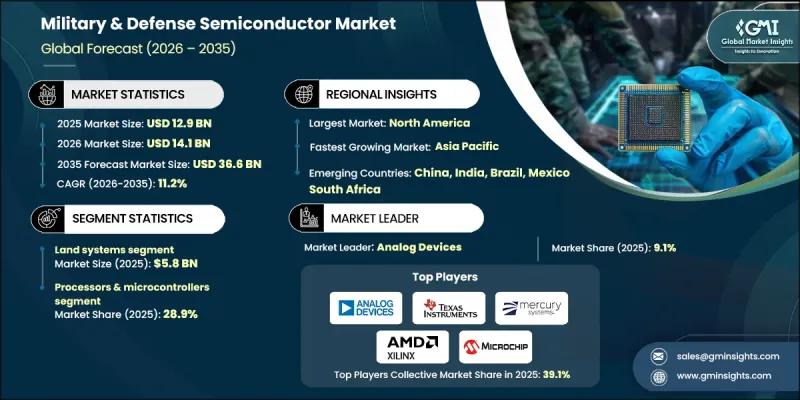
随着世界各国政府将增加国防费用和确保技术优势列为优先事项,该市场展现出强劲的成长动能。预算拨款的增加正在加速先进半导体解决方案的研发和部署,这些解决方案应用于通讯网路、资讯系统、雷达平台、电子战和精确导引系统等领域。现代国防基础设施越来越依赖高效能半导体组件,以实现高速资料处理、安全连接、即时分析和系统互通性。用于军事和国防应用的半导体是具有可控导电性的关键电子材料,是微处理器、积体电路、感测器和电源管理装置的基础。这些组件对于先进国防电子设备的性能、效率和可靠性至关重要。随着各国军队不断提升其空中、陆地、海洋和太空能力,对稳健、安全且节能的半导体技术的需求持续增长,从而支撑着全球国防生态系统中半导体市场的长期持续扩张。
| 市场范围 | |
|---|---|
| 开始年份 | 2025 |
| 预测年份 | 2026-2035 |
| 起始值 | 129亿美元 |
| 预测金额 | 366亿美元 |
| 复合年增长率 | 11.2% |
另一方面,出口限制和地缘政治紧张局势为军工半导体市场带来了结构性挑战。严格的贸易法规和国家安全政策限制了敏感技术的跨境转移,阻碍了全球供应链的柔软性。各国政府正在实施保障措施以保护其战略半导体能力,这可能导致采购週期延长和采购受限。地缘政治的不确定性进一步加剧了供应链的波动性,使得本地生产和安全的供应来源对国防应用日益重要。
预计到2025年,陆地系统市场规模将达到58亿美元,并在2026年至2035年间以11.8%的复合年增长率成长。随着国防机构将自主导航、先进感测和安全通讯技术整合到战术系统中,地面平台的半导体整合度也不断提高。即时数据处理、任务协调和容错通讯网路是推动该领域半导体应用的关键需求。在恶劣环境下,对耐用、低功耗和高可靠性组件的需求,确保了作战的连续性,这也再次凸显了专为陆基军事应用设计的专用半导体装置的重要性。
预计到2025年,处理器和微控制器市占率将达到28.9%。国防平台对高效能运算日益增长的需求正在加速先进处理技术的应用。现代国防系统需要嵌入式智慧、加密、安全通讯和人工智慧驱动的分析功能,而这些功能都由先进的处理器提供支援。此外,稳健且节能的微控制器正越来越多地应用于紧凑型国防电子设备、无人系统和携带式军事装备。这些技术能够提升多个关键任务应用的指挥控制、自动化和作战效率。
预计到2025年,北美军工半导体市场将占据45.1%的全球份额。空中、陆地、海上和太空平台的持续现代化计画支撑了该地区的成长。对人工智慧、自主系统、网路安全和先进通讯基础设施日益增长的关注,也持续推动对高效能半导体技术的需求。定期的升级、系统维修和维护计划也为长期采购活动提供了支援。此外,政府为加强国内半导体製造能力所做的努力,正在增强区域自主性,并降低对外国供应商关键国防零件的依赖。
目录
第一章:调查方法和范围
第二章执行摘要
第三章业界考察
- 生态系分析
- 供应商情况
- 利润率分析
- 成本结构
- 每个阶段增加的价值
- 影响价值链的因素
- 中断
- 影响产业的因素
- 促进因素
- 政府增加对军事领域的投资
- 利用耐辐射半导体元件
- 飞机升级和现代化计划的增加
- 对先进半导体技术的需求不断增长
- 扩大人工智慧(AI)和机器学习(ML)在军事行动中的应用
- 产业潜在风险与挑战
- 高成本,开发週期长
- 出口限制和地缘政治紧张局势
- 市场机会
- 电子战和通讯系统的进步
- 用于国防模拟和指挥系统的高效能运算
- 促进因素
- 成长潜力分析
- 监管环境
- 北美洲
- 欧洲
- 亚太地区
- 拉丁美洲
- 中东和非洲
- 波特的分析
- PESTEL 分析
- 科技与创新趋势
- 当前技术趋势
- 新兴技术
- 新兴经营模式
- 合规要求
- 国防预算分析
- 全球国防费用趋势
- 区域国防预算分配
- 北美洲
- 欧洲
- 亚太地区
- 中东和非洲
- 拉丁美洲
- 主要国防现代化项目
- 预算预测(2025-2034 年)
- 对产业成长的影响
- 国防预算
- 按部门分類的国防预算分配
- 人员
- 运作/维护
- 采购
- 研究与发展/测试与评估
- 基础设施和建筑
- 技术与创新
- 供应链韧性
- 地缘政治分析
- 劳动力分析
- 数位转型
- 併购和策略联盟的趋势
- 风险评估与管理
- 重大合约授予情况(2022-2025 年)
第四章 竞争情势
- 介绍
- 企业市占率分析
- 按地区
- 北美洲
- 欧洲
- 亚太地区
- 拉丁美洲
- 中东和非洲
- 按地区
- 主要企业的竞争标竿分析
- 财务绩效比较
- 收入
- 利润率
- 研究与开发
- 产品系列比较
- 产品线的广度
- 科技
- 创新
- 区域扩张比较
- 全球扩张分析
- 服务网路覆盖
- 按地区分類的市场渗透率
- 竞争定位矩阵
- 领导企业
- 受让人
- 追踪者
- 小众玩家
- 战略展望矩阵
- 财务绩效比较
- 2021-2024 年重大发展
- 併购
- 合作伙伴关係和合资企业
- 技术进步
- 扩张和投资策略
- 数位转型计划
- 新兴/Start-Ups竞争对手的发展趋势
第五章 市场估算与预测:依产品类型划分,2022-2035年
- 处理器和微控制器
- 通用处理器
- 人工智慧/机器学习处理器
- 加密处理器
- 数位讯号处理器
- 微控制器
- 储存装置
- 静态随机存取记忆体(SRAM)
- DRAM(动态随机存取记忆体)
- 快闪记忆体(NAND、NOR)
- 磁阻记忆体(MRAM)
- EEPROM/NVRAM
- 逻辑装置
- ASIC(专用积体电路)
- FPGA(现场可程式化闸阵列)
- PLD(可程式逻辑装置)
- CPLD(复杂可程式逻辑装置)
- 射频和微波组件
- MMIC(单晶微波积体电路)
- 收发模组(T/R模组)
- 射频功率放大器
- 其他的
- 电源管理积体电路
- DC-DC转换器(降压型、升压型、降压/升压型、隔离型)
- LDO(低压差稳压器)
- 功率 MOSFET 和闸极驱动器
- 其他的
- 类比和混合讯号积体电路
- 运算放大器
- 比较器
- 类比开关和多工器
- 其他的
- 资料转换器(ADC/DAC)
- 光电子学
- 离散半导体
- 其他的
第六章 市场估计与预测:依应用领域划分,2022-2035年
- 陆基系统
- 作战车辆(战车、步兵战车、装甲运兵车)
- 战术车辆(悍马、防地雷反伏击车、卡车)
- 火炮系统
- 地面防空系统
- 其他的
- 海军系统
- 水面作战舰艇
- 航空母舰
- 潜水艇
- 两栖船
- 其他的
- 航空系统
- 战斗机
- 运输机及加油机
- 直升机
- 无人驾驶飞行器(UAV)
- 其他的
- 空间系统
- 军事通讯卫星
- 侦察/监视卫星
- 导航卫星
- 飞弹预警卫星
- 空间情境察觉
- 其他的
第七章 市场估计与预测:依地区划分,2022-2035年
- 北美洲
- 我们
- 加拿大
- 欧洲
- 德国
- 英国
- 法国
- 西班牙
- 义大利
- 荷兰
- 亚太地区
- 中国
- 印度
- 日本
- 澳洲
- 韩国
- 拉丁美洲
- 巴西
- 墨西哥
- 阿根廷
- 中东和非洲
- 南非
- 沙乌地阿拉伯
- 阿拉伯聯合大公国
第八章:公司简介
- 主要企业
- Lockheed Martin
- Raytheon Technologies
- Northrop Grumman
- Boeing
- 按地区分類的主要企业
- 北美洲
- General Dynamics
- L3Harris Technologies
- Analog Devices
- 欧洲
- BAE Systems
- Thales Group
- Infineon Technologies
- 北美洲
- 特殊玩家/干扰者
- Microchip Technology
- Texas Instruments
- STMicroelectronics
The Global Military & Defense Semiconductor Market was valued at USD 12.9 billion in 2025 and is estimated to grow at a CAGR of 11.2% to reach USD 36.6 billion by 2035.
The market is witnessing strong momentum as governments worldwide continue to increase defense spending and prioritize technological superiority. Higher budget allocations are accelerating research, development, and deployment of advanced semiconductor solutions across communication networks, intelligence systems, radar platforms, electronic warfare, and precision-guided equipment. Modern defense infrastructure increasingly depends on high-performance semiconductor components that enable faster data processing, secure connectivity, real-time analytics, and system interoperability. Semiconductors used in military and defense applications function as critical electronic materials with controlled conductivity, forming the foundation of microprocessors, integrated circuits, sensors, and power management devices. These components are central to the performance, efficiency, and reliability of advanced defense electronics. As armed forces modernize air, land, naval, and space capabilities, demand for rugged, secure, and energy-efficient semiconductor technologies continues to rise, supporting sustained long-term market expansion across global defense ecosystems.
| Market Scope | |
|---|---|
| Start Year | 2025 |
| Forecast Year | 2026-2035 |
| Start Value | $12.9 Billion |
| Forecast Value | $36.6 Billion |
| CAGR | 11.2% |
At the same time, export controls and geopolitical tensions present structural challenges for the military & defense semiconductor market. Strict trade regulations and national security policies limit the cross-border transfer of sensitive technologies, restricting global supply chain flexibility. Governments are implementing protective measures to safeguard strategic semiconductor capabilities, which can slow procurement cycles and create sourcing constraints. Geopolitical uncertainties further intensify supply chain volatility, making localized production and secure sourcing increasingly important for defense applications.
The land systems segment generated USD 5.8 billion in 2025 and is expected to grow at a CAGR of 11.8% between 2026 and 2035. Semiconductor integration within ground-based platforms is expanding as defense organizations incorporate autonomous navigation, advanced sensing, and secure communication technologies into tactical systems. Real-time data processing, mission coordination, and resilient communication networks are essential requirements driving semiconductor adoption in this segment. Durable, low-power, and high-reliability components are being deployed to ensure operational continuity in demanding environments, reinforcing the importance of specialized semiconductor design for land-based military applications.
The processors & microcontrollers segment accounted for 28.9% share in 2025. Rising demand for high-performance computing in defense platforms is accelerating the adoption of advanced processing technologies. Modern defense systems require embedded intelligence, encryption capability, secure communications, and AI-enabled analytics, all supported by sophisticated processors. In addition, ruggedized and power-efficient microcontrollers are gaining traction for deployment in compact defense electronics, unmanned systems, and portable military equipment. These technologies enhance command control, automation, and operational efficiency across multiple mission-critical applications.
North America Military & Defense Semiconductor Market held a 45.1% share in 2025. Regional growth is supported by ongoing modernization programs across air, ground, naval, and space platforms. Increased emphasis on artificial intelligence, autonomous systems, cybersecurity, and advanced communications infrastructure continues to fuel demand for high-performance semiconductor technologies. Recurring upgrade cycles, system retrofitting, and maintenance programs also sustain long-term procurement activity. Furthermore, government initiatives aimed at strengthening domestic semiconductor manufacturing capacity are enhancing regional self-reliance and reducing dependence on foreign suppliers for critical defense components.
Key companies operating in the Global Military & Defense Semiconductor Market include Texas Instruments, Lockheed Martin, Analog Devices, Northrop Grumman, Microchip Technology, Raytheon Technologies, Infineon Technologies, General Dynamics, STMicroelectronics, L3Harris Technologies, Boeing, and BAE Systems. Companies in the military & defense semiconductor market strengthen their competitive position by investing heavily in research and development focused on secure, rugged, and high-performance chip architectures. Strategic partnerships with defense contractors and government agencies help align product development with mission-specific requirements. Many firms are expanding domestic manufacturing capabilities to address supply chain security and comply with national security regulations. Portfolio diversification across processors, sensors, power devices, and communication chips enhances cross-platform integration opportunities.
Table of Contents
Chapter 1 Methodology and Scope
- 1.1 Market scope and definition
- 1.2 Research design
- 1.2.1 Research approach
- 1.2.2 Data collection methods
- 1.3 Data mining sources
- 1.3.1 Global
- 1.3.2 Regional/Country
- 1.4 Base estimates and calculations
- 1.4.1 Base year calculation
- 1.4.2 Key trends for market estimation
- 1.5 Primary research and validation
- 1.5.1 Primary sources
- 1.6 Forecast model
- 1.7 Research assumptions and limitations
Chapter 2 Executive Summary
- 2.1 Industry 360° synopsis, 2021 - 2034
- 2.2 Key market trends
- 2.2.1 Product type trends
- 2.2.2 Application trends
- 2.2.3 Regional trends
- 2.3 TAM analysis, 2025-2034
- 2.4 CXO perspectives: Strategic imperatives
- 2.4.1 Executive decision points
- 2.4.2 Critical success factors
- 2.5 Future outlook and strategic recommendations
Chapter 3 Industry Insights
- 3.1 Industry ecosystem analysis
- 3.1.1 Supplier landscape
- 3.1.2 Profit margin analysis
- 3.1.3 Cost structure
- 3.1.4 Value addition at each stage
- 3.1.5 Factor affecting the value chain
- 3.1.6 Disruptions
- 3.2 Industry impact forces
- 3.2.1 Growth drivers
- 3.2.1.1 Increasing government investments in military
- 3.2.1.2 Utilization of radiation-tolerant semiconductor components
- 3.2.1.3 Increasing aircraft upgrades and modernization programs
- 3.2.1.4 Growing demand for advanced semiconductor technologies
- 3.2.1.5 Increasing use of Artificial Intelligence (AI) and Machine Learning (ML) in military operations
- 3.2.2 Industry pitfalls and challenges
- 3.2.2.1 High cost and long development cycles
- 3.2.2.2 Export restrictions and geopolitical tensions
- 3.2.3 Market opportunities
- 3.2.3.1 Advancements in electronic warfare and communication systems
- 3.2.3.2 High-performance computing for defense simulation and command systems
- 3.2.1 Growth drivers
- 3.3 Growth potential analysis
- 3.4 Regulatory landscape
- 3.4.1 North America
- 3.4.2 Europe
- 3.4.3 Asia Pacific
- 3.4.4 Latin America
- 3.4.5 Middle East & Africa
- 3.5 Porter’s analysis
- 3.6 PESTEL analysis
- 3.7 Technology and Innovation landscape
- 3.7.1 Current technological trends
- 3.7.2 Emerging technologies
- 3.8 Emerging business models
- 3.9 Compliance requirements
- 3.10 Defense budget analysis
- 3.11 Global defense spending trends
- 3.12 Regional defense budget allocation
- 3.12.1 North America
- 3.12.2 Europe
- 3.12.3 Asia Pacific
- 3.12.4 Middle East and Africa
- 3.12.5 Latin America
- 3.13 Key defense modernization programs
- 3.14 Budget forecast (2025-2034)
- 3.14.1 Impact on industry growth
- 3.14.2 Defense budgets by country
- 3.14.3 Defense budget allocation by segment
- 3.14.3.1 Personnel
- 3.14.3.2 Operations and maintenance
- 3.14.3.3 Procurement
- 3.14.3.4 Research, development, test and evaluation
- 3.14.3.5 Infrastructure and construction
- 3.14.3.6 Technology and innovation
- 3.15 Supply chain resilience
- 3.16 Geopolitical analysis
- 3.17 Workforce analysis
- 3.18 Digital transformation
- 3.19 Mergers, acquisitions, and strategic partnerships landscape
- 3.20 Risk assessment and management
- 3.21 Major contract awards (2022-2025)
Chapter 4 Competitive Landscape, 2024
- 4.1 Introduction
- 4.2 Company market share analysis
- 4.2.1 By region
- 4.2.1.1 North America
- 4.2.1.2 Europe
- 4.2.1.3 Asia Pacific
- 4.2.1.4 Latin America
- 4.2.1.5 Middle East & Africa
- 4.2.1 By region
- 4.3 Competitive benchmarking of key players
- 4.3.1 Financial performance comparison
- 4.3.1.1 Revenue
- 4.3.1.2 Profit margin
- 4.3.1.3 R&D
- 4.3.2 Product portfolio comparison
- 4.3.2.1 Product range breadth
- 4.3.2.2 Technology
- 4.3.2.3 Innovation
- 4.3.3 Geographic presence comparison
- 4.3.3.1 Global footprint analysis
- 4.3.3.2 Service network coverage
- 4.3.3.3 Market penetration by region
- 4.3.4 Competitive positioning matrix
- 4.3.4.1 Leaders
- 4.3.4.2 Challengers
- 4.3.4.3 Followers
- 4.3.4.4 Niche players
- 4.3.5 Strategic outlook matrix
- 4.3.1 Financial performance comparison
- 4.4 Key developments, 2021-2024
- 4.4.1 Mergers and acquisitions
- 4.4.2 Partnerships and collaborations
- 4.4.3 Technological advancements
- 4.4.4 Expansion and investment strategies
- 4.4.5 Digital transformation initiatives
- 4.5 Emerging/ startup competitors landscape
Chapter 5 Market Estimates and Forecast, By Product Type, 2022 - 2035 ($ Bn)
- 5.1 Key trends
- 5.1.1 Processors & microcontrollers
- 5.1.2 General-purpose processors
- 5.1.3 AI/ML processors
- 5.1.4 Cryptographic processors
- 5.1.5 Digital signal processors
- 5.1.6 Microcontrollers
- 5.2 Memory devices
- 5.2.1 SRAM (static RAM)
- 5.2.2 DRAM (dynamic RAM)
- 5.2.3 Flash memory (NAND, NOR)
- 5.2.4 MRAM (magnetoresistive RAM)
- 5.2.5 EEPROM/NVRAM
- 5.3 Logic devices
- 5.3.1 ASICs (application-specific integrated circuits)
- 5.3.2 FPGAs (field-programmable gate arrays)
- 5.3.3 PLDs (programmable logic devices)
- 5.3.4 CPLDs (complex programmable logic devices)
- 5.4 RF & microwave components
- 5.4.1 MMICs (monolithic microwave ICs)
- 5.4.2 T/R modules (transmit/receive modules)
- 5.4.3 RF power amplifiers
- 5.4.4 Others
- 5.5 Power management ICs
- 5.5.1 DC-DC converters (buck, boost, buck-boost, isolated)
- 5.5.2 LDOs (low-dropout regulators)
- 5.5.3 Power MOSFETs & gate drivers
- 5.5.4 Others
- 5.6 Analog & mixed-signal ICs
- 5.6.1 Operational amplifiers
- 5.6.2 Comparators
- 5.6.3 Analog switches & multiplexers
- 5.6.4 Others
- 5.7 Data converters (ADC/DAC)
- 5.8 Optoelectronics
- 5.9 Discrete semiconductors
- 5.10 Others
Chapter 6 Market Estimates and Forecast, By Application, 2022 - 2035 ($ Bn)
- 6.1 Key trends
- 6.2 Land systems
- 6.2.1 Combat vehicles (tanks, IFVs, APCs)
- 6.2.2 Tactical vehicles (HMMWVs, MRAPs, trucks)
- 6.2.3 Artillery systems
- 6.2.4 Ground-based air defense
- 6.2.5 Others
- 6.3 Naval systems
- 6.3.1 Surface combatants
- 6.3.2 Aircraft carriers
- 6.3.3 Submarines
- 6.3.4 Amphibious warfare ships
- 6.3.5 Others
- 6.4 Airborne systems
- 6.4.1 Fighter aircraft
- 6.4.2 Transport & tanker aircraft
- 6.4.3 Helicopters
- 6.4.4 UAVs
- 6.4.5 Others
- 6.5 Space systems
- 6.5.1 Military communications satellites
- 6.5.2 Reconnaissance & surveillance satellites
- 6.5.3 Navigation satellites
- 6.5.4 Missile warning satellites
- 6.5.5 Space situational awareness
- 6.5.6 Others
Chapter 7 Market Estimates and Forecast, By Region, 2022 - 2035 ($ Bn)
- 7.1 Key trends
- 7.2 North America
- 7.2.1 U.S.
- 7.2.2 Canada
- 7.3 Europe
- 7.3.1 Germany
- 7.3.2 UK
- 7.3.3 France
- 7.3.4 Spain
- 7.3.5 Italy
- 7.3.6 Netherlands
- 7.4 Asia Pacific
- 7.4.1 China
- 7.4.2 India
- 7.4.3 Japan
- 7.4.4 Australia
- 7.4.5 South Korea
- 7.5 Latin America
- 7.5.1 Brazil
- 7.5.2 Mexico
- 7.5.3 Argentina
- 7.6 Middle East and Africa
- 7.6.1 South Africa
- 7.6.2 Saudi Arabia
- 7.6.3 UAE
Chapter 8 Company Profiles
- 8.1 Global Key Players
- 8.1.1 Lockheed Martin
- 8.1.2 Raytheon Technologies
- 8.1.3 Northrop Grumman
- 8.1.4 Boeing
- 8.2 Regional Key Players
- 8.2.1 North America
- 8.2.1.1 General Dynamics
- 8.2.1.2 L3Harris Technologies
- 8.2.1.3 Analog Devices
- 8.2.2 Europe
- 8.2.2.1 BAE Systems
- 8.2.2.2 Thales Group
- 8.2.2.3 Infineon Technologies
- 8.2.1 North America
- 8.3 Niche Players / Disruptors
- 8.3.1 Microchip Technology
- 8.3.2 Texas Instruments
- 8.3.3 STMicroelectronics


