


 |
市场调查报告书
商品编码
1959633
保温袋市场机会、成长要素、产业趋势分析及2026年至2035年预测。Cooler Bags Market Opportunity, Growth Drivers, Industry Trend Analysis, and Forecast 2026 - 2035 |
||||||

2025 年全球保温袋市场价值 42 亿美元,预计到 2035 年将达到 62 亿美元,年复合成长率为 4%。
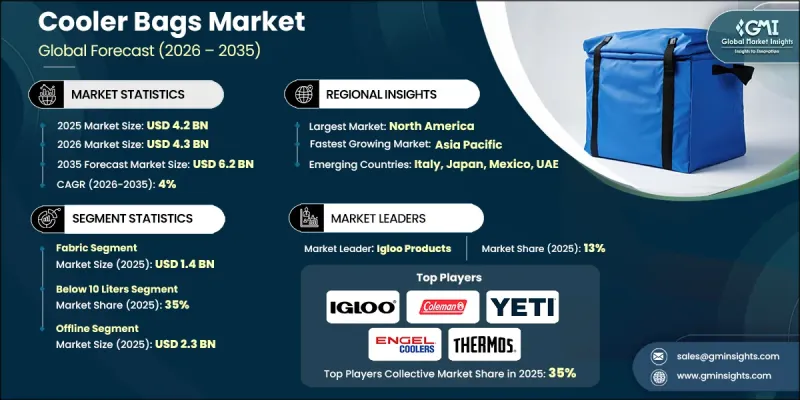
市场成长与人们参与户外休閒活动已深深融入消费者的行为模式。随着人们越来越重视灵活且便利的短期体验,对便携式食品和饮料储存解决方案的需求也随之上升。因此,对轻便易携的冷藏产品的需求持续成长。保温袋为固定式冷藏库提供了实用替代方案,能够有效率地运输新鲜食品和冷饮。都市区消费者,尤其是年轻一代,正在推动这一趋势,他们追求更注重体验而非拥有的自发性和社交性活动。除了功能性之外,保温袋正在演变为与健康、出行和积极的生活方式相关的时尚产品。设计创新、色彩丰富和现代风格正在改变保温袋的定位,使其不再只是实用物品,而是与注重健康和户外生活方式相契合的时尚配饰,进一步巩固了全球保温袋市场的未来前景。
| 市场范围 | |
|---|---|
| 开始年份 | 2025 |
| 预测年份 | 2026-2035 |
| 起始值 | 42亿美元 |
| 预测金额 | 62亿美元 |
| 复合年增长率 | 4% |
预计到2025年,织物保温袋市场规模将达到14亿美元。织物保温袋因其价格实惠、用途广泛且适应性强而广受欢迎。聚酯纤维、尼龙、帆布和再生纤维等材料使製造商能够开发出轻巧灵活的设计,适用于日常使用、休閒和商业用途。柔软的材质增强了便携性和易收纳性,使织物保温袋成为各个消费群体都青睐的产品。
预计到2025年,容量小于10公升的冷藏包将占据35%的市场。小型冷藏包因其兼具便携性和便利性而广受欢迎,满足了日常出行的需求。其易于搬运的尺寸和轻巧的结构深受注重运输便利性和空间利用率的都市区消费者的青睐。随着越来越多的消费者寻求适合其积极、行动生活方式的实用冷藏解决方案,这个尺寸类别的冷藏包持续受到关注。
预计到2025年,美国保温袋市占率将达到64.5%,销售额将达9亿美元。美国拥有浓厚的户外休閒文化和较高的休閒活动参与率,造就了一个成熟且稳定的市场。携带式食品消费的广泛普及也进一步支撑了市场的稳定需求。保温袋已深度融入日常生活和休閒活动中,推动了美国市场的持续成长。
目录
第一章:调查方法和范围
第二章执行摘要
第三章业界考察
- 生态系分析
- 供应商情况
- 利润率
- 每个阶段增加的价值
- 影响价值链的因素
- 影响产业的因素
- 促进因素
- 增加户外休閒活动
- 对永续性的意识以及对可重复使用产品的偏好
- 产品设计与功能创新
- 产业潜在风险与挑战
- 在永续性压力下进行成本管理
- 技术防御有限
- 机会
- 高端和高性能细分市场
- 客製化和企业品牌推广
- 促进因素
- 成长潜力分析
- 未来市场趋势
- 科技与创新趋势
- 当前技术趋势
- 新兴技术
- 价格趋势
- 按地区
- 依材料类型
- 监管环境
- 标准和合规要求
- 区域法规结构
- 认证标准
- 波特的分析
- PESTEL 分析
第四章 竞争情势
- 介绍
- 企业市占率分析
- 按地区
- 公司矩阵分析
- 主要市场公司的竞争分析
- 竞争定位矩阵
- 主要进展
- 併购
- 伙伴关係与合作
- 新产品发布
- 扩张计划
第五章 市场估算与预测:依材料类型划分,2022-2035年
- 塑胶
- 金属
- 织物
- 形式
- 其他(凝胶等)
第六章 市场估计与预测:依产能划分,2022-2035年
- 少于10公升
- 10-20升
- 20公升或以上
第七章 市场估计与预测:依价格区间划分,2022-2035年
- 低价位
- 中价位
- 高价位范围
第八章 市场估计与预测:依应用领域划分,2022-2035年
- 对于个人
- 零售
- 旅行
- 其他的
第九章 市场估价与预测:依通路划分,2022-2035年
- 在线的
- 电子商务
- 公司网站
- 离线
- 超级市场
- 专卖店
- 其他(百货公司等)
第十章 市场估价与预测:依地区划分,2022-2035年
- 北美洲
- 我们
- 加拿大
- 欧洲
- 德国
- 英国
- 法国
- 义大利
- 西班牙
- 亚太地区
- 中国
- 日本
- 印度
- 澳洲
- 韩国
- 拉丁美洲
- 巴西
- 墨西哥
- 阿根廷
- 中东和非洲
- 南非
- 沙乌地阿拉伯
- 阿拉伯聯合大公国
第十一章:公司简介
- AO Coolers
- Arctic Zone
- Carhartt
- Coleman Company
- Dometic Group
- Engel Coolers
- Grizzly Coolers
- Hydro Flask
- Igloo Products
- Klein Tools
- Stanley
- Pelican Products
- RTIC Outdoors
- Thermos
- YETI Holdings
The Global Cooler Bags Market was valued at USD 4.2 billion in 2025 and is estimated to grow at a CAGR of 4% to reach USD 6.2 billion by 2035.
Market growth is tied to the rising participation in outdoor and recreational lifestyles, which have become deeply embedded in consumer behavior. Individuals increasingly prioritize flexible, short-duration experiences that require portable food and beverage storage solutions. As a result, demand for lightweight and convenient cooling products continues to rise. Cooler bags provide a practical alternative to fixed refrigeration, enabling users to transport fresh meals and chilled drinks efficiently. Urban consumers, particularly younger demographics, are fueling this trend as they seek spontaneous, socially driven activities that emphasize experience over ownership. Beyond functionality, cooler bags are evolving into lifestyle-oriented products associated with wellness, mobility, and active living. Design innovation, color variation, and modern styling have repositioned cooler bags from simple utility items to fashionable accessories that align with health-conscious and outdoor-focused lifestyles, further strengthening the global cooler bags market outlook.
| Market Scope | |
|---|---|
| Start Year | 2025 |
| Forecast Year | 2026-2035 |
| Start Value | $4.2 Billion |
| Forecast Value | $6.2 Billion |
| CAGR | 4% |
In 2025, the fabric segment generated USD 1.4 billion. Fabric-based cooler bags remain widely preferred due to their affordability, versatility, and adaptability across multiple use cases. Materials such as polyester, nylon, canvas, and recycled textiles enable manufacturers to develop lightweight and flexible designs suited for daily use, recreation, and commercial applications. Soft-sided construction enhances portability and storage convenience, making fabric cooler bags highly popular across various consumer segments.
The segment with a capacity of below 10 liters accounted for 35% share in 2025. Compact cooler bags are favored for their balance of portability and convenience, addressing everyday mobility needs. Their manageable size and lightweight structure appeal strongly to urban consumers who prioritize ease of transport and space efficiency. This size category continues to gain traction as consumers seek practical cooling solutions that align with active and on-the-go lifestyles.
U.S. Cooler Bags Market held 64.5% share, generating USD 900 million in 2025. The United States represents a mature and well-established market supported by a strong culture of outdoor recreation and high participation in leisure activities. Widespread acceptance of portable food consumption further supports consistent demand. Cooler bags are deeply integrated into everyday routines as well as recreational activities, contributing to sustained market growth across the country.
Major companies operating in the Global Cooler Bags Market include AO Coolers, Arctic Zone, Carhartt, Coleman Company, Dometic Group, Engel Coolers, Grizzly Coolers, Hydro Flask, Igloo Products, Klein Tools, Stanley, Pelican Products, RTIC Outdoors, Thermos, and YETI Holdings. Companies in the cooler bags market are reinforcing their competitive position through product innovation, material advancements, and brand-driven marketing strategies. Leading players are investing in improved insulation technologies and durable, eco-friendly materials to meet evolving consumer expectations. Many brands emphasize design differentiation to align with lifestyle trends and premium positioning. Strategic retail partnerships and expanded e-commerce channels are enhancing market reach and customer accessibility. Companies are also leveraging collaborations and limited-edition releases to strengthen brand loyalty. Sustainability initiatives, including the use of recycled fabrics and responsible sourcing practices, are becoming central to corporate strategies.
Table of Contents
Chapter 1 Methodology and Scope
- 1.1 Market scope and definition
- 1.2 Research design
- 1.2.1 Research approach
- 1.2.2 Data collection methods
- 1.3 Data mining sources
- 1.3.1 Global
- 1.3.2 Regional/Country
- 1.4 Base estimates and calculations
- 1.4.1 Base year calculation
- 1.4.2 Key trends for market estimation
- 1.5 Primary research and validation
- 1.5.1 Primary sources
- 1.6 Forecast model
- 1.7 Research assumptions and limitations
Chapter 2 Executive Summary
- 2.1 Industry 360° synopsis
- 2.2 Key market trends
- 2.2.1 Regional
- 2.2.2 Material type
- 2.2.3 Capacity
- 2.2.4 Price
- 2.2.5 Application
- 2.2.6 Distribution channel
- 2.3 CXO perspectives: Strategic imperatives
- 2.3.1 Key decision points for industry executives
- 2.3.2 Critical success factors for market players
- 2.4 Future outlook and strategic recommendations
Chapter 3 Industry Insights
- 3.1 Industry ecosystem analysis
- 3.1.1 Supplier landscape
- 3.1.2 Profit margin
- 3.1.3 Value addition at each stage
- 3.1.4 Factor affecting the value chain
- 3.2 Industry impact forces
- 3.2.1 Growth drivers
- 3.2.1.1 Rising outdoor & leisure activities
- 3.2.1.2 Sustainability awareness & reusable product preference
- 3.2.1.3 Product design & functional innovation
- 3.2.2 Industry pitfalls & challenges
- 3.2.2.1 Cost management under sustainability pressure
- 3.2.2.2 Limited technological defensibility
- 3.2.3 Opportunities
- 3.2.3.1 Premium & performance-focused segments
- 3.2.3.2 Customization & corporate branding
- 3.2.1 Growth drivers
- 3.3 Growth potential analysis
- 3.4 Future market trends
- 3.5 Technology and innovation landscape
- 3.5.1 Current technological trends
- 3.5.2 Emerging technologies
- 3.6 Price trends
- 3.6.1 By region
- 3.6.2 By material type
- 3.7 Regulatory landscape
- 3.7.1 Standards and compliance requirements
- 3.7.2 Regional regulatory frameworks
- 3.7.3 Certification standards
- 3.8 Porter’s analysis
- 3.9 PESTEL analysis
Chapter 4 Competitive Landscape, 2025
- 4.1 Introduction
- 4.2 Company market share analysis
- 4.2.1 By region
- 4.2.1.1 North America
- 4.2.1.2 Europe
- 4.2.1.3 Asia Pacific
- 4.2.1.4 Latin America
- 4.2.1.5 Middle East and Africa
- 4.2.1 By region
- 4.3 Company matrix analysis
- 4.4 Competitive analysis of major market players
- 4.5 Competitive positioning matrix
- 4.6 Key developments
- 4.6.1 Mergers & acquisitions
- 4.6.2 Partnerships & collaborations
- 4.6.3 New product launches
- 4.6.4 Expansion plans
Chapter 5 Market Estimates and Forecast, By Material Type, 2022 - 2035 (USD Billion) (Million Units)
- 5.1 Key trends
- 5.2 Plastic
- 5.3 Metal
- 5.4 Fabric
- 5.5 Foam
- 5.6 Others (gel, etc.)
Chapter 6 Market Estimates and Forecast, By Capacity, 2022 - 2035 (USD Billion) (Million Units)
- 6.1 Key trends
- 6.2 Below 10 liters
- 6.3 Between 10-20 liters
- 6.4 Above 20 liters
Chapter 7 Market Estimates and Forecast, By Price Range, 2022 - 2035 (USD Billion) (Million Units)
- 7.1 Key trends
- 7.2 Low
- 7.3 Medium
- 7.4 High
Chapter 8 Market Estimates and Forecast, By Application, 2022 - 2035 (USD Billion) (Million Units)
- 8.1 Key trends
- 8.2 Individual
- 8.3 Retail
- 8.4 Travel
- 8.5 Others
Chapter 9 Market Estimates and Forecast, By Distribution Channel, 2022 - 2035 (USD Billion) (Million Units)
- 9.1 Key trends
- 9.1.1 Online
- 9.1.1.1 E-commerce
- 9.1.1.2 Company websites
- 9.1.2 Offline
- 9.1.2.1 Supermarkets
- 9.1.2.2 Specialty stores
- 9.1.2.3 Others (Departmental stores. Etc.)
- 9.1.1 Online
Chapter 10 Market Estimates and Forecast, By Region, 2022 - 2035 (USD Billion) (Million Units)
- 10.1 Key trends
- 10.2 North America
- 10.2.1 U.S.
- 10.2.2 Canada
- 10.3 Europe
- 10.3.1 Germany
- 10.3.2 UK
- 10.3.3 France
- 10.3.4 Italy
- 10.3.5 Spain
- 10.4 Asia Pacific
- 10.4.1 China
- 10.4.2 Japan
- 10.4.3 India
- 10.4.4 Australia
- 10.4.5 South Korea
- 10.5 Latin America
- 10.5.1 Brazil
- 10.5.2 Mexico
- 10.5.3 Argentina
- 10.6 Middle East and Africa
- 10.6.1 South Africa
- 10.6.2 Saudi Arabia
- 10.6.3 UAE
Chapter 11 Company Profiles
- 11.1 AO Coolers
- 11.2 Arctic Zone
- 11.3 Carhartt
- 11.4 Coleman Company
- 11.5 Dometic Group
- 11.6 Engel Coolers
- 11.7 Grizzly Coolers
- 11.8 Hydro Flask
- 11.9 Igloo Products
- 11.10 Klein Tools
- 11.11 Stanley
- 11.12 Pelican Products
- 11.13 RTIC Outdoors
- 11.14 Thermos
- 11.15 YETI Holdings

 砾石填充市场:2026-2032年全球市场预测(按产品类型、组件、井口类型、应用和最终用户划分)黄麻袋市场:按材料类型、尺寸/容量、价格范围、应用、最终用户和分销管道划分-2026-2032年全球预测
 箱包市场规模、份额及成长分析:按箱包类型、性别、价格范围、材质、应用及地区划分-2026-2033年产业预测
 箱包市场分析及预测(至2035年):依类型、产品类型、材料类型、最终用户、应用、技术、形状、实施方式及功能划分
 日本箱包市场规模、份额、趋势和预测:按产品类型、材料类型、分销管道、最终用户和地区划分,2026-2034年黄麻袋市场按产品类型、最终用途、价格和地区划分,2026-2034 年
 女士手提包市场-全球产业规模、份额、趋势、机会、预测:按类型、销售管道、地区和竞争格局划分,2021-2031年智慧包市场 - 全球产业规模、份额、趋势、机会及预测(按产品类型、技术、分销管道、地区和竞争格局划分,2021-2031年)相机包市场 - 全球产业规模、份额、趋势、机会、预测:按类型、材料、分销管道、地区和竞争格局划分,2021-2031年箱包市场 - 全球产业规模、份额、趋势、机会及预测(按产品类型、销售管道、地区及竞争格局划分,2021-2031年)