


 |
市场调查报告书
商品编码
1959642
血液处理及储存设备市场机会、成长要素、产业趋势分析及2026-2035年预测Blood Processing and Storage Equipment Market Opportunity, Growth Drivers, Industry Trend Analysis, and Forecast 2026 - 2035 |
||||||

2025年全球血液处理和储存设备市场价值为539亿美元,预计到2035年将以7.4%的复合年增长率增长至1083亿美元。
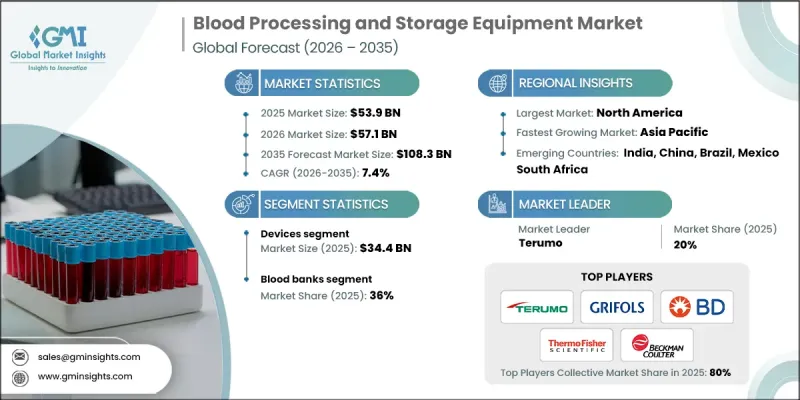
慢性病发病率上升、血液管理系统技术的不断进步以及需要输血的创伤相关急诊病例增加,是推动市场扩张的主要因素。人们对自愿捐血的认识不断提高,也对产业成长起到了重要作用。政府主导的措施、医疗宣传活动和非营利计画正在加强全球捐血网络,从而提高了血液采集量。采集量的激增对可靠的基础设施提出了更高的要求,包括先进的製冷系统、血浆储存装置、低温冷冻库以及相关耗材,以确保血液产品的完整性。现代化的设备能够帮助医疗机构维持血液品质、简化库存管理并最大限度地减少产品损耗。随着全球医疗系统将输血安全和营运效率置于优先地位,对先进血液处理和储存技术的投资正在加速,医院和血液采集中心也积极建构扩充性且合规的血液管理框架。
| 市场范围 | |
|---|---|
| 开始年份 | 2025 |
| 预测年份 | 2026-2035 |
| 起始值 | 539亿美元 |
| 预测金额 | 1083亿美元 |
| 复合年增长率 | 7.4% |
血液处理和储存设备包含一系列专门的医疗技术,旨在严格控制温度和安全标准,对血液及其成分进行采集、分离、分析、储存和管理。这些系统包括离心机、可控製冷系统、冷冻库、过滤平台以及相关的处理技术,以确保输血所需的无菌性,防止污染,并维持产品的有效性。精确的温度控制和监测对于维持临床标准、延长储存期以及满足监管合规要求至关重要。
预计到2025年,设备市场规模将达到344亿美元,占市占率的63.8%。此类别包括专为血液采集、分离、储存和监测而设计的高性能係统。血浆储存设备、血库冷藏系统、实验室冷冻冷冻库、低温系统、快速冷冻设备、血型分析仪、热疗系统、血球比容离心机和自动化细胞处理设备等,构成了输血服务的基础。这些设备在整个处理和储存週期内保护血液质量,并符合严格的安全标准。医院、诊断检查室和血液采集中心的需求不断增长,推动了对技术先进、节能高效的设备平台的持续投资。
到2025年,血库将占据36%的市场份额,这反映了其在输血医学中的核心角色。血库是血液製品采集、检测、处理、储存和分发的关键枢纽。为确保安全合规,这些机构依赖先进的冷冻系统、血浆储存设备、低温储存方案和专业的离心技术。随着外科手术的增加、急诊医疗需求的增长以及慢性病管理项目的扩展,血液成分的需求不断增长,血库不得不扩大基础设施,并部署能够维持严格环境控制标准的下一代储存系统。
预计到2025年,北美血液处理和储存设备市场份额将达到40.5%,这得益于先进的医疗基础设施和技术的快速普及。该地区拥有健全的法规结构、完善的输血网络以及对医疗创新持续不断的投资。持续成长的输血治疗和慢性病管理计画需求,使得可靠的储存和处理系统至关重要。高性能冷冻设备、低温冷冻库、细胞处理技术及相关耗材对于医疗机构维持合规性和保障病人安全至关重要。
目录
第一章:调查方法和范围
第二章执行摘要
第三章业界考察
- 生态系分析
- 影响产业的因素
- 促进因素
- 慢性病发生率呈上升趋势
- 血液处理和储存设备的技术进步
- 道路交通事故数量急剧增加。
- 人们对捐血的认识不断提高
- 产业潜在风险与挑战
- 血液处理设备高成本
- 严格的法规环境
- 市场机会
- 在生物製药和再生医学领域不断拓展应用。
- 促进因素
- 成长潜力分析
- 监管环境
- 技术进步
- 当前技术趋势
- 新兴技术
- 2024年价格分析
- 未来市场趋势
- 波特五力分析
- PESTEL 分析
第四章 竞争情势
- 介绍
- 企业市占率分析
- 公司矩阵分析
- 主要市场公司的竞争分析
- 竞争定位矩阵
- 主要进展
- 併购
- 合作伙伴关係和合资企业
- 新产品发布
- 扩张计划
第五章 市场估计与预测:依类型划分,2022-2035年
- 装置
- 等离子冷冻库
- 血库用冷藏库
- 实验室冷藏库
- 实验室冷冻库
- 超低温冷冻库
- 快速冷冻库
- 血型鑑定装置
- 保温器
- 血球容积比离心机
- 细胞处理装置
- 消耗品
- 输血包
- 血袋
- 采血针
- 采血管
- 血液过滤器
- 采血采血针
- 血型检测试剂
- 血液凝固试剂
- 血液学试剂
- 其他消耗品
第六章 市场估算与预测:依最终用途划分,2022-2035年
- 血库
- 诊断检查室
- 医院和诊所
- 其他最终用户
第七章 市场估计与预测:依地区划分,2022-2035年
- 北美洲
- 我们
- 加拿大
- 欧洲
- 德国
- 英国
- 法国
- 西班牙
- 义大利
- 荷兰
- 亚太地区
- 中国
- 印度
- 日本
- 澳洲
- 韩国
- 拉丁美洲
- 巴西
- 墨西哥
- 阿根廷
- 中东和非洲
- 沙乌地阿拉伯
- 南非
- 阿拉伯聯合大公国
第八章:公司简介
- Beckman Coulter, Inc.
- Thermogenesis Holdings, Inc.
- Maco Pharma International GmbH
- Immucor, Inc.
- Becton, Dickinson and Company
- Bio-Rad Laboratories, Inc.
- Grifols, SA
- Abbott Laboratories
- Sigma Laborzentrifugen GmbH
- Terumo BCT, Inc.
- Poly Medicure Ltd
- Thermo Fisher Scientific, Inc.
- Biomerieux
- F. Hoffmann-La Roche Ltd
The Global Blood Processing and Storage Equipment Market was valued at USD 53.9 billion in 2025 and is estimated to grow at a CAGR of 7.4% to reach USD 108.3 billion by 2035.
Market expansion is supported by the growing burden of chronic diseases, continuous technological progress in blood management systems, and a rising number of trauma-related emergencies requiring transfusions. Increasing awareness surrounding voluntary blood donation is also playing a critical role in shaping industry growth. Government-led initiatives, healthcare campaigns, and nonprofit programs are strengthening donation networks worldwide, resulting in higher blood collection volumes. This surge in collection requires reliable infrastructure, including advanced refrigeration systems, plasma storage units, ultralow temperature freezers, and supporting consumables to maintain product integrity. Modern equipment enables healthcare facilities to preserve blood quality, streamline inventory management, and minimize product loss. As global healthcare systems prioritize transfusion safety and operational efficiency, investments in advanced blood processing and storage technologies are accelerating, reinforcing the development of scalable and compliant blood management frameworks across hospitals and collection centers.
| Market Scope | |
|---|---|
| Start Year | 2025 |
| Forecast Year | 2026-2035 |
| Start Value | $53.9 Billion |
| Forecast Value | $108.3 Billion |
| CAGR | 7.4% |
Blood processing and storage equipment comprises specialized medical technologies designed to collect, separate, analyze, preserve, and manage blood and its components under tightly regulated temperature and safety parameters. These systems include centrifugation units, controlled refrigeration systems, deep freezers, filtration platforms, and related handling technologies that ensure sterility, prevent contamination, and maintain product viability for transfusion purposes. Precision temperature control and monitoring capabilities are essential to uphold clinical standards and extend shelf life while meeting regulatory compliance requirements.
The devices segment generated USD 34.4 billion in 2025, accounting for a 63.8% share. This category includes high-performance systems engineered for blood collection, separation, preservation, and monitoring. Equipment such as plasma storage units, blood bank refrigeration systems, laboratory-grade freezers, ultralow temperature systems, shock freezing units, blood grouping analyzers, warming systems, hematocrit centrifuges, and automated cell processors form the backbone of transfusion services. These devices safeguard blood quality throughout processing and storage cycles while meeting stringent safety benchmarks. Growing demand from hospitals, diagnostic laboratories, and blood collection centers continues to drive investments in technologically advanced and energy-efficient device platforms.
The blood banks segment held a 36% share in 2025, reflecting its central role in transfusion medicine. Blood banks function as primary hubs for the collection, testing, processing, storage, and distribution of blood products. To ensure safety and compliance, these facilities depend on advanced refrigeration systems, plasma preservation units, ultralow temperature storage solutions, and specialized centrifugation technologies. Rising surgical volumes, emergency care requirements, and chronic disease management programs are increasing demand for blood components, prompting blood banks to expand infrastructure and adopt next-generation storage systems capable of maintaining strict environmental control standards.
North America Blood Processing and Storage Equipment Market held 40.5% share in 2025, supported by its advanced healthcare infrastructure and rapid technology adoption. The region benefits from strong regulatory frameworks, well-established transfusion networks, and sustained investment in medical innovation. Continuous demand for transfusion therapies and chronic disease management programs requires dependable storage and processing systems. High-performance refrigeration units, ultralow temperature freezers, cell processing technologies, and supporting consumables are essential to maintain compliance and ensure patient safety across healthcare institutions.
Key companies operating in the Global Blood Processing and Storage Equipment Market include Thermo Fisher Scientific, Inc., Beckman Coulter, Inc., Grifols, Abbott Laboratories, Becton, Dickinson and Company, Terumo, F. Hoffmann-La Roche Ltd, Bio-Rad Laboratories, Inc., Maco Pharma International GmbH, Thermogenesis Holdings, Inc., Immucor, Inc., Sigma Laborzentrifugen, Poly Medicure Ltd, and Biomerieux. Companies in the Blood Processing and Storage Equipment Market are strengthening their competitive positioning through innovation, regulatory compliance, and global expansion strategies. Leading manufacturers are investing in energy-efficient refrigeration systems, automated processing platforms, and digital monitoring solutions that enhance traceability and quality control. Strategic partnerships with hospitals and blood collection networks help expand distribution reach and ensure recurring demand. Firms are also prioritizing research and development to introduce advanced temperature monitoring technologies and integrated data management systems.
Table of Contents
Chapter 1 Methodology and Scope
- 1.1 Market scope and definition
- 1.2 Research design
- 1.2.1 Research approach
- 1.2.2 Data collection methods
- 1.3 Data mining sources
- 1.3.1 Global
- 1.3.2 Regional/Country
- 1.4 Base estimates and calculations
- 1.4.1 Base year calculation
- 1.4.2 Key trends for market estimation
- 1.5 Primary research and validation
- 1.5.1 Primary sources
- 1.6 Forecast model
- 1.7 Research assumptions and limitations
Chapter 2 Executive Summary
- 2.1 Industry 360° synopsis
- 2.2 Key market trends
- 2.2.1 Regional trends
- 2.2.2 Product trends
- 2.2.3 End use trends
- 2.3 CXO perspectives: Strategic imperatives
- 2.3.1 Key decision points for industry executives
- 2.3.2 Critical success factors for market players
- 2.4 Future outlook and strategic recommendations
Chapter 3 Industry Insights
- 3.1 Industry ecosystem analysis
- 3.2 Industry impact forces
- 3.2.1 Growth drivers
- 3.2.1.1 Increasing prevalence of chronic diseases
- 3.2.1.2 Technological advancement in blood processing and storage equipment
- 3.2.1.3 Surge in the number of road traffic accidents
- 3.2.1.4 Growing awareness regarding blood donation
- 3.2.2 Industry pitfalls and challenges
- 3.2.2.1 High cost associated with blood processing devices
- 3.2.2.2 Stringent regulatory scenario
- 3.2.3 Market opportunities
- 3.2.3.1 Increased applications in biotherapy and regenerative medicine
- 3.2.1 Growth drivers
- 3.3 Growth potential analysis
- 3.4 Regulatory landscape
- 3.4.1 North America
- 3.4.2 Europe
- 3.4.3 Asia Pacific
- 3.4.4 Latin America
- 3.4.5 Middle East and Africa
- 3.5 Technological advancements
- 3.5.1 Current technological trends
- 3.5.2 Emerging technologies
- 3.6 Pricing analysis, 2024
- 3.7 Future market trends
- 3.8 Porter's analysis
- 3.9 PESTEL analysis
Chapter 4 Competitive Landscape, 2024
- 4.1 Introduction
- 4.2 Company market share analysis
- 4.3 Company matrix analysis
- 4.4 Competitive analysis of major market players
- 4.5 Competitive positioning matrix
- 4.6 Key developments
- 4.6.1 Mergers and acquisitions
- 4.6.2 Partnerships and collaborations
- 4.6.3 New product launches
- 4.6.4 Expansion plans
Chapter 5 Market Estimates and Forecast, By Type, 2022 - 2035 ($ Mn)
- 5.1 Key trends
- 5.2 Devices
- 5.2.1 Plasma freezers
- 5.2.2 Blood bank refrigerators
- 5.2.3 Lab refrigerators
- 5.2.4 Lab freezers
- 5.2.5 Ultralow temperature freezers
- 5.2.6 Shock freezers
- 5.2.7 Grouping analyzers
- 5.2.8 Warmers
- 5.2.9 Hematocrit centrifuges
- 5.2.10 Cell processors
- 5.3 Consumables
- 5.3.1 Blood administration sets
- 5.3.2 Blood bags
- 5.3.3 Blood collection needles
- 5.3.4 Blood collection tube
- 5.3.5 Blood filters
- 5.3.6 Blood lancets
- 5.3.7 Blood grouping reagents
- 5.3.8 Blood coagulation reagents
- 5.3.9 Hematology reagents
- 5.3.10 Other consumables
Chapter 6 Market Estimates and Forecast, By End Use, 2022 - 2035 ($ Mn)
- 6.1 Key trends
- 6.2 Blood banks
- 6.3 Diagnostic laboratories
- 6.4 Hospitals & clinics
- 6.5 Other end users
Chapter 7 Market Estimates and Forecast, By Region, 2022 - 2035 ($ Mn)
- 7.1 Key trends
- 7.2 North America
- 7.2.1 U.S.
- 7.2.2 Canada
- 7.3 Europe
- 7.3.1 Germany
- 7.3.2 UK
- 7.3.3 France
- 7.3.4 Spain
- 7.3.5 Italy
- 7.3.6 Netherlands
- 7.4 Asia Pacific
- 7.4.1 China
- 7.4.2 India
- 7.4.3 Japan
- 7.4.4 Australia
- 7.4.5 South Korea
- 7.5 Latin America
- 7.5.1 Brazil
- 7.5.2 Mexico
- 7.5.3 Argentina
- 7.6 Middle East and Africa
- 7.6.1 Saudi Arabia
- 7.6.2 South Africa
- 7.6.3 UAE
Chapter 8 Company Profiles
- 8.1 Beckman Coulter, Inc.
- 8.2 Thermogenesis Holdings, Inc.
- 8.3 Maco Pharma International GmbH
- 8.4 Immucor, Inc.
- 8.5 Becton, Dickinson and Company
- 8.6 Bio-Rad Laboratories, Inc.
- 8.7 Grifols, S.A.
- 8.8 Abbott Laboratories
- 8.9 Sigma Laborzentrifugen GmbH
- 8.10 Terumo BCT, Inc.
- 8.11 Poly Medicure Ltd
- 8.12 Thermo Fisher Scientific, Inc.
- 8.13 Biomerieux
- 8.14 F. Hoffmann-La Roche Ltd

 血液处理设备及耗材市场:按产品类型、技术、应用、最终用户和分销管道分類的全球市场预测,2026年至2032年血液处理用抛弃式产品市场:2026-2032年全球市场预测(依产品类型、血液成分、材料、应用、最终用户和销售管道)自动化血液处理设备市场:按产品类型、组件、操作模式、最终用户和应用划分 - 全球预测(2026-2032 年)
 2026年全球血液处理设备及耗材市场报告2026年卢克血液分离机全球市场报告一次性冷冻袋市场:按冷冻袋材料、腔室数量、灭菌等级、容量、封口机制、应用和最终用户划分,全球预测,2026-2032年血液处理和储存设备市场(按产品类型、技术、最终用户和分销管道划分)—2026-2032年全球预测
 全球血液处理与储存设备市场
 血液处理设备和耗材市场-全球产业规模、份额、趋势、机会和预测,按产品(设备、耗材)、按用途(红血球、血浆、血小板、其他)、按地区和竞争细分,2020-2030 年
 全球医用低温储存设备市场规模(按应用、设备、类型、地区和预测)