


 |
市场调查报告书
商品编码
1959649
航空货运货柜市场机会、成长要素、产业趋势分析及2026年至2035年预测。Air Cargo Container Market Opportunity, Growth Drivers, Industry Trend Analysis, and Forecast 2026 - 2035 |
||||||

2025年全球航空货运货柜市场价值4.112亿美元,预计到2035年将以4.9%的复合年增长率成长,达到6.62亿美元。
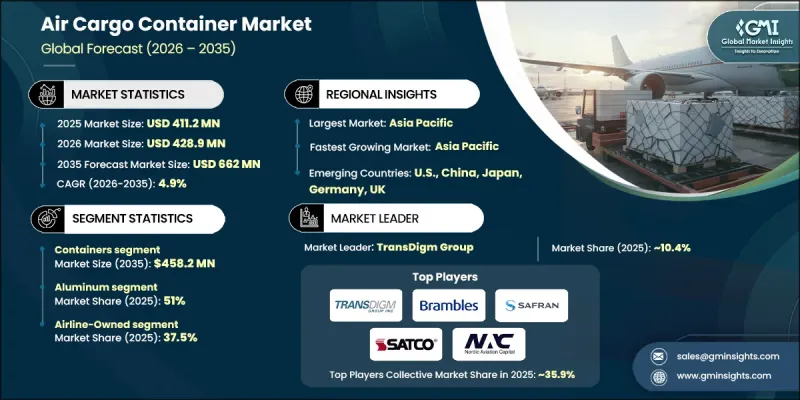
市场扩张主要得益于单元货载(ULD)製造技术的持续变革,特别是从传统铝结构转向轻质复合材料和混合材料的转变。这种材料转型显着降低了货柜重量,从而降低了燃油消耗并增加了飞机有效负载容量,显着提升了航空公司的经济效益。先进复合材料具有更高的结构强度、耐腐蚀性和使用寿命,减少了长期维护需求。随着燃油成本的波动和日益严格的环保法规,航空公司和货运业者正将重量优化和永续性措施列为优先事项。货柜现代化符合航空业以提升营运效率、减少排放和优化全生命週期成本为核心的总体目标。全球航空货运量的成长以及对稳健、高性能货物装卸解决方案日益增长的需求,进一步推动了全球航空货运货柜市场的稳定发展。
| 市场范围 | |
|---|---|
| 开始年份 | 2025 |
| 预测年份 | 2026-2035 |
| 起始值 | 4.112亿美元 |
| 预测金额 | 6.62亿美元 |
| 复合年增长率 | 4.9% |
航空货运货柜市场是全球航空货运基础设施的基础组成部分,它提供标准化的货柜和托盘,从而简化客机和货机的货物装卸和处理流程。该行业涵盖各类货柜的製造、租赁和销售,例如通用货柜、温控货柜和专用货柜,以及航空公司、货运代理和第三方物流供应商使用的飞机专用托盘。推动该市场发展的一个重要变化是ULD系统中数位技术的日益整合。嵌入式物联网设备、RFID追踪系统和GPS监控平台能够即时显示资产位置、环境状况和安全状态,进而提高营运透明度和供应链可靠性。
预计到2035年,货柜市场规模将达到4.582亿美元,主要得益于市场对安全、标准化货物运输解决方案日益增长的需求,这些方案能够有效利用飞机空间并保护关键货物。航空货运货柜是坚固耐用、与飞机相容的结构,旨在确保高效的货物装卸和全球航线上的安全运输。这些货柜包括普通货物集装箱,以及用于保护特殊货物的温控和客製化解决方案。货柜是航空货运营运的核心,它支援高价值、时效性强的货物运输,同时提高装载精度和周转效率。
预计到2025年,铝製货柜将占据51%的市场份额,这主要得益于其价格优势、久经考验的耐用性以及在全球航空网络中长期获得的监管核准。航空公司持续依赖铝製货柜,因为其营运记录可靠、易于维护,且与复合材料货柜相比,初始投资更低。大规模部署、与不同机型相容以及适应高频次营运週期等优势支撑了市场需求,尤其受到那些寻求以标准化和成本效益为优先考虑的货运设备解决方案的航空公司的青睐。
预计到2025年,北美航空货运货柜市场份额将达到23.5%,这反映了其作为成熟且货运量巨大的航空货运区域的地位。强大的电子商务分销网络和不断增长的快递业务支撑着对货柜和托盘的稳定需求。快速的运输週期、准时的物流模式和集中式枢纽配送系统进一步增加了对耐用且高效的ULD(货柜)资产的需求。此外,该地区的货运业者正在对其老旧的货柜机队进行现代化改造,以提高燃油效率、加强资产追踪并符合不断发展的航空标准。
目录
第一章:调查方法和范围
第二章执行摘要
第三章业界考察
- 生态系分析
- 供应商情况
- 利润率分析
- 成本结构
- 每个阶段增加的价值
- 影响价值链的因素
- 中断
- 影响产业的因素
- 促进因素
- 国际贸易和货运航班的成长
- 扩大机队规模并开闢新航线
- ULD(超轻量货柜)的技术进步
- 电子商务与快捷邮件业务的拓展
- 对轻型和节能型ULD的需求不断增长
- 产业潜在风险与挑战
- 高昂的资本投资和维护成本
- ULD(单元货载设备)的复杂供应链管理
- 市场机会
- 使用轻质高强度容器材料
- 扩大低温运输空运服务
- 促进因素
- 监管环境
- 北美洲
- 欧洲
- 亚太地区
- 拉丁美洲
- 中东和非洲
- 波特的分析
- PESTEL 分析
- 科技与创新趋势
- 当前技术趋势
- 新兴技术
- 新兴经营模式
- 合规要求
- 专利和智慧财产权分析
- 地缘政治和贸易趋势
第四章 竞争情势
- 介绍
- 企业市占率分析
- 按地区
- 北美洲
- 欧洲
- 亚太地区
- 拉丁美洲
- 中东和非洲
- 按地区
- 主要企业的竞争标竿分析
- 财务绩效比较
- 收入
- 利润率
- 研究与开发
- 产品系列比较
- 产品线广度
- 科技
- 创新
- 地理位置比较
- 全球扩张分析
- 服务网路覆盖
- 按地区分類的市场渗透率
- 竞争定位矩阵
- 领导企业
- 受让人
- 追踪者
- 小众玩家
- 战略展望矩阵
- 财务绩效比较
- 2021-2024 年重大发展
- 併购
- 合作伙伴关係和合资企业
- 技术进步
- 扩张和投资策略
- 数位转型计划
- 新兴/Start-Ups竞争对手的发展趋势
第五章 市场估价与预测:依货柜类型划分,2022-2035年
- 容器
- 标准容器
- 冷藏/保温容器
- 特殊容器
- 调色盘
- 标准托盘
- 特殊托盘
第六章 市场估计与预测:依材料划分,2022-2035年
- 铝
- 复合材料
- 塑胶/热塑性塑料
- 混合/复合材料
第七章 市场估计与预测:依所有权类型划分,2022-2035年
- 航空公司所有
- 租
- 共同所有/管理
第八章 市场估计与预测:依地区划分,2022-2035年
- 北美洲
- 我们
- 加拿大
- 欧洲
- 德国
- 英国
- 法国
- 西班牙
- 义大利
- 荷兰
- 亚太地区
- 中国
- 印度
- 日本
- 澳洲
- 韩国
- 拉丁美洲
- 巴西
- 墨西哥
- 阿根廷
- 中东和非洲
- 南非
- 沙乌地阿拉伯
- 阿拉伯聯合大公国
第九章:公司简介
- TransDigm Group
- Brambles
- Safran
- ACL Airshop
- DoKaSch GmbH
- Envirotainer AB
- CSafe
- Satco Inc.
- PalNet GmbH
- VRR Aviation
- Nordisk Aviation
- aerotuf
The Global Air Cargo Container Market was valued at USD 411.2 million in 2025 and is estimated to grow at a CAGR of 4.9% to reach USD 662 million by 2035.
Market expansion is strongly influenced by the ongoing transformation in unit load device (ULD) manufacturing, particularly the shift from conventional aluminum structures to lightweight composite and hybrid materials. This material transition significantly enhances airline economics by lowering container weight, which in turn reduces fuel consumption and increases aircraft payload capacity. Advanced composites provide enhanced structural strength, corrosion resistance, and extended service life, lowering long-term maintenance requirements. As fuel costs fluctuate and environmental regulations tighten, airlines and cargo operators are prioritizing weight optimization and sustainability initiatives. The modernization of ULD fleets aligns with broader aviation industry goals focused on operational efficiency, emissions reduction, and lifecycle cost optimization. Growing global air freight volumes and rising expectations for resilient, high-performance cargo handling solutions further reinforce the steady development of the air cargo container market worldwide.
| Market Scope | |
|---|---|
| Start Year | 2025 |
| Forecast Year | 2026-2035 |
| Start Value | $411.2 Million |
| Forecast Value | $662 Million |
| CAGR | 4.9% |
The air cargo container market represents a foundational segment of the global air freight infrastructure, supplying standardized containers and pallets that streamline cargo loading, unloading, and in-flight handling across passenger and dedicated cargo aircraft. The industry includes the production, leasing, and sale of various container types, including general-purpose, temperature-controlled, and specialty units, along with aircraft-compatible pallets utilized by airlines, freight forwarders, and third-party logistics providers. A notable transformation shaping this market is the increasing integration of digital technologies within ULD systems. Embedded IoT devices, RFID-enabled tracking, and GPS monitoring platforms allow real-time visibility of asset location, environmental conditions, and security status, strengthening operational transparency and supply chain reliability.
The containers segment is expected to reach USD 458.2 million by 2035, driven by growing demand for secure, standardized cargo solutions that maximize aircraft space utilization and safeguard sensitive shipments. Air cargo containers are rigid, aircraft-compatible structures engineered to ensure efficient cargo handling and safe transportation across global routes. These units include general cargo containers as well as temperature-regulated and customized solutions designed to protect specialized freight. Containers remain central to air freight operations, supporting high-value and time-sensitive cargo movements while enhancing loading precision and turnaround efficiency.
The aluminum segment accounted for 51% share in 2025, supported by its affordability, established durability, and long-standing regulatory approval across global aviation networks. Airlines continue to rely on aluminum ULDs due to their proven operational track record, ease of maintenance, and lower upfront capital investment compared to composite alternatives. The large installed base, compatibility with diverse aircraft fleets, and suitability for intensive operational cycles sustain demand, particularly among carriers focused on standardized and cost-efficient cargo equipment solutions.
North America Air Cargo Container Market held a 23.5% share in 2025, reflecting its position as a mature and high-volume air freight region. Strong e-commerce distribution networks and expanding express cargo operations contribute to consistent demand for containers and pallets. Rapid shipment cycles, time-sensitive logistics models, and centralized hub distribution systems reinforce the need for durable and efficient ULD assets. Additionally, cargo operators in the region are upgrading aging container fleets to enhance fuel performance, asset tracking, and compliance with evolving aviation standards.
Key participants in the Global Air Cargo Container Market include Safran, TransDigm Group, Brambles, ACL Airshop, DoKaSch GmbH, Envirotainer AB, CSafe, VRR Aviation, Nordisk Aviation, PalNet GmbH, Satco Inc., and aerotuf. Companies operating in the air cargo container market are strengthening their competitive advantage through material innovation, fleet modernization programs, and digital integration strategies. Manufacturers are investing in lightweight composite engineering to enhance fuel efficiency and lifecycle durability while maintaining structural integrity. Strategic leasing partnerships with airlines and logistics operators are expanding market reach and ensuring recurring revenue streams. Firms are also incorporating smart tracking technologies to provide real-time asset visibility and improve fleet management efficiency. Expanding global distribution networks, enhancing repair and maintenance services, and aligning product portfolios with evolving sustainability regulations further reinforce market positioning.
Table of Contents
Chapter 1 Methodology and Scope
- 1.1 Market scope and definition
- 1.2 Research design
- 1.2.1 Research approach
- 1.2.2 Data collection methods
- 1.3 Data mining sources
- 1.3.1 Global
- 1.3.2 Regional/Country
- 1.4 Base estimates and calculations
- 1.4.1 Base year calculation
- 1.4.2 Key trends for market estimation
- 1.5 Primary research and validation
- 1.5.1 Primary sources
- 1.6 Forecast model
- 1.7 Research assumptions and limitations
Chapter 2 Executive Summary
- 2.1 Industry 360° synopsis, 2022 - 2035
- 2.2 Key market trends
- 2.2.1 System type trends
- 2.2.2 Deployment model trends
- 2.2.3 End-user industry trends
- 2.2.4 Regional trends
- 2.3 TAM analysis, 2025-2034
- 2.4 CXO perspectives: Strategic imperatives
- 2.4.1 Executive decision points
- 2.4.2 Critical success factors
- 2.5 Future outlook and strategic recommendations
Chapter 3 Industry Insights
- 3.1 Industry ecosystem analysis
- 3.1.1 Supplier landscape
- 3.1.2 Profit margin analysis
- 3.1.3 Cost structure
- 3.1.4 Value addition at each stage
- 3.1.5 Factor affecting the value chain
- 3.1.6 Disruptions
- 3.2 Industry impact forces
- 3.2.1 Growth drivers
- 3.2.1.1 Growth in international trade and cargo flights
- 3.2.1.2 Expansion of airline fleets & new routes
- 3.2.1.3 Technological Advancements in ULDs
- 3.2.1.4 Expansion of e-commerce & express delivery
- 3.2.1.5 Growing demand for lightweight and fuel-efficient ulds
- 3.2.2 Industry pitfalls and challenges
- 3.2.2.1 High capital investment and maintenance costs
- 3.2.2.2 Complicated supply chain management for ULDs
- 3.2.3 Market opportunities
- 3.2.3.1 Use of lightweight and high-strength container materials
- 3.2.3.2 Expansion of cold-chain air cargo services
- 3.2.1 Growth drivers
- 3.3 Regulatory landscape
- 3.3.1 North America
- 3.3.2 Europe
- 3.3.3 Asia Pacific
- 3.3.4 Latin America
- 3.3.5 Middle East & Africa
- 3.4 Porter’s analysis
- 3.5 PESTEL analysis
- 3.6 Technology and innovation landscape
- 3.6.1 Current technological trends
- 3.6.2 Emerging technologies
- 3.7 Emerging business models
- 3.8 Compliance requirements
- 3.9 Patent and IP analysis
- 3.10 Geopolitical and trade dynamics
Chapter 4 Competitive Landscape, 2024
- 4.1 Introduction
- 4.2 Company market share analysis
- 4.2.1 By region
- 4.2.1.1 North America
- 4.2.1.2 Europe
- 4.2.1.3 Asia Pacific
- 4.2.1.4 Latin America
- 4.2.1.5 Middle East & Africa
- 4.2.1 By region
- 4.3 Competitive benchmarking of key players
- 4.3.1 Financial performance comparison
- 4.3.1.1 Revenue
- 4.3.1.2 Profit margin
- 4.3.1.3 R&D
- 4.3.2 Product portfolio comparison
- 4.3.2.1 Product range breadth
- 4.3.2.2 Technology
- 4.3.2.3 Innovation
- 4.3.3 Geographic presence comparison
- 4.3.3.1 Global footprint analysis
- 4.3.3.2 Service network coverage
- 4.3.3.3 Market penetration by region
- 4.3.4 Competitive positioning matrix
- 4.3.4.1 Leaders
- 4.3.4.2 Challengers
- 4.3.4.3 Followers
- 4.3.4.4 Niche players
- 4.3.5 Strategic outlook matrix
- 4.3.1 Financial performance comparison
- 4.4 Key developments, 2021-2024
- 4.4.1 Mergers and acquisitions
- 4.4.2 Partnerships and collaborations
- 4.4.3 Technological advancements
- 4.4.4 Expansion and investment strategies
- 4.4.5 Digital transformation initiatives
- 4.5 Emerging/ startup competitors’ landscape
Chapter 5 Market Estimates and Forecast, By Containers Type, 2022 - 2035 (USD Mn)
- 5.1 Key trends
- 5.2 Containers
- 5.2.1 Standard containers
- 5.2.2 Refrigerated/Insulated containers
- 5.2.3 Specialized containers
- 5.3 Pallets
- 5.3.1 Standard pallets
- 5.3.2 Specialized pallets
Chapter 6 Market Estimates and Forecast, By Material, 2022 - 2035 (USD Mn)
- 6.1 Key trends
- 6.2 Aluminum
- 6.3 Composite
- 6.4 Plastic / Thermoplastic
- 6.5 Hybrid / Mixed-material
Chapter 7 Market Estimates and Forecast, By Ownership Model, 2022 - 2035 (USD Mn)
- 7.1 Key trends
- 7.2 Airline-owned
- 7.3 Leased
- 7.4 Pooled / Managed
Chapter 8 Market Estimates and Forecast, By Region, 2022 - 2035 (USD Mn)
- 8.1 Key trends
- 8.2 North America
- 8.2.1 U.S.
- 8.2.2 Canada
- 8.3 Europe
- 8.3.1 Germany
- 8.3.2 UK
- 8.3.3 France
- 8.3.4 Spain
- 8.3.5 Italy
- 8.3.6 Netherlands
- 8.4 Asia Pacific
- 8.4.1 China
- 8.4.2 India
- 8.4.3 Japan
- 8.4.4 Australia
- 8.4.5 South Korea
- 8.5 Latin America
- 8.5.1 Brazil
- 8.5.2 Mexico
- 8.5.3 Argentina
- 8.6 Middle East and Africa
- 8.6.1 South Africa
- 8.6.2 Saudi Arabia
- 8.6.3 UAE
Chapter 9 Company Profiles
- 9.1 TransDigm Group
- 9.2 Brambles
- 9.3 Safran
- 9.4 ACL Airshop
- 9.5 DoKaSch GmbH
- 9.6 Envirotainer AB
- 9.7 CSafe
- 9.8 Satco Inc.
- 9.9 PalNet GmbH
- 9.10 VRR Aviation
- 9.11 Nordisk Aviation
- 9.12 aerotuf


