


 |
市场调查报告书
商品编码
1959662
睡眠障碍市场机会、成长要素、产业趋势分析及2026年至2035年预测Sleep Disorder Market Opportunity, Growth Drivers, Industry Trend Analysis, and Forecast 2026 - 2035 |
||||||

2025 年全球睡眠障碍市场价值 305 亿美元,预计到 2035 年将达到 786 亿美元,年复合成长率为 9.8%。
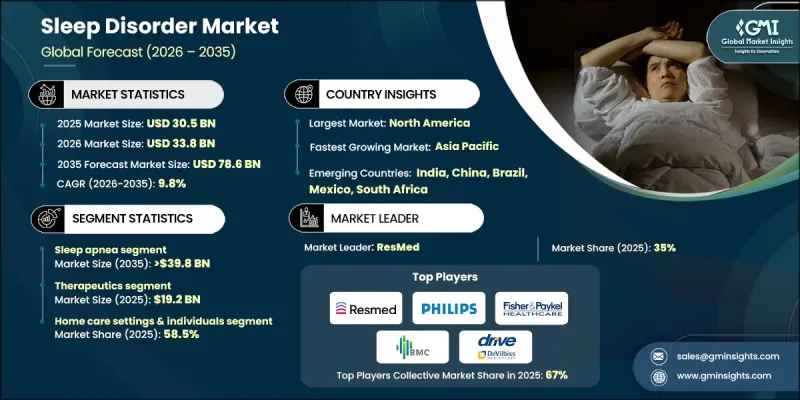
睡眠相关疾病发生率的上升、意识提升以及已开发市场和新兴市场医疗保健系统诊断率的提高,共同推动了这一强劲的成长势头。诊断技术和筛检方案的持续创新进一步加速了产业的扩张。医疗保健机构日益认识到睡眠健康是整体健康的重要组成部分,从而改善了筛检技术和早期疗育策略。同时,数位健康平台、互联医疗设备和数据驱动疗法的进步正在改变睡眠障碍的识别和管理方式。患者对便利、易用且科技驱动的医疗模式日益增长的需求,也为市场发展提供了助力。
| 市场范围 | |
|---|---|
| 开始年份 | 2025 |
| 预测期 | 2026-2035 |
| 起始值 | 305亿美元 |
| 预测金额 | 786亿美元 |
| 复合年增长率 | 9.8% |
睡眠障碍是指影响睡眠品质、时间长度和时间的临床疾病,会对日常生活和长期健康产生负面影响。这些疾病源自于生理、心理或行为因素,需要准确的诊断和系统的管理。由于居家诊断解决方案和远距医疗模式的兴起,睡眠障碍市场正在经历显着增长。携带式检测系统和连网治疗设备能够实现即时数据采集和监测,从而减少对医疗机构诊疗的依赖。远端医疗服务有助于优化诊断和治疗,使更多人群能够获得医疗服务。随着穿戴式监测设备和智慧睡眠追踪系统的普及,消费者对睡眠健康管理的参与度也不断提高。透过数位平台产生的数据正逐步整合到临床工作流程中,从而促进个人化治疗并提高患者依从性。
预计到2025年,睡眠呼吸中止症细分市场将占据48.2%的市场。这一主导地位归功于其高发病率、临床认知度的提高以及家用诊断系统和持续治疗技术的广泛应用。代谢和生活方式相关风险因素的日益普遍,扩大了呼吸道相关睡眠障碍的高风险族群,直接推动了对诊断和治疗方案的需求。人们对未经治疗的呼吸相关睡眠障碍的健康影响的认识不断提高,促进了积极筛检和早期疗育,进一步巩固了该细分市场在整个睡眠障碍市场中的主导地位。
预计2026年至2035年,诊断领域将以9.1%的复合年增长率成长。市场成长的主要驱动力是人们日益重视睡眠障碍的早期检测以及睡眠监测系统的持续技术进步。先进的监控工具,结合人工智慧驱动的数据分析和云端整合平台,正在提高诊断准确性和营运效率。朝向更便捷、更人性化的检测解决方案的转变,持续推动着医疗保健领域的应用。
预计到2025年,北美睡眠障碍市场将占据38.1%的份额。该地区受益于先进的诊断服务、专业的治疗中心以及完善的医疗保健基础设施,这些都为治疗的广泛应用提供了支持。医护人员和病患对睡眠障碍与慢性疾病之间关联的认识不断提高,这促进了筛检计画和预防性照护的整合。技术先进的诊断工具和连网治疗设备的普及进一步加速了市场渗透,并巩固了该地区的市场主导地位。
目录
第一章:调查方法
- 研究途径
- 品质改进计划
- GMI人工智慧政策和资料完整性倡议
- 资讯来源完整性通讯协定
- GMI人工智慧政策和资料完整性倡议
- 研究的可追踪性和可靠性评分
- 调查和路线的组成部分
- 评分组成部分
- 数据收集
- 主要来源部分列表
- 资料探勘资讯来源
- 付费资讯来源
- 区域资讯来源
- 付费资讯来源
- 基本估计值与计算
- 两种方法计算基准年均已完成。
- 预测模型
- 量化市场影响分析
- 生长参数对预测的数学影响
- 量化市场影响分析
- 调查透明度附录
- 资讯来源归属框架
- 品质保证指标
- 对信任的承诺
第二章执行摘要
第三章业界考察
- 生态系分析
- 影响产业的因素
- 促进因素
- 睡眠障碍盛行率增加
- 睡眠诊断和治疗技术的技术进步
- 人们对睡眠健康的认识不断提高
- 治疗睡眠障碍的便携式、高效能、高性能设备的需求日益增长。
- 产业潜在风险与挑战
- 诊断和治疗设备高成本
- 发展中地区睡眠检测设施进入受限
- 市场机会
- 家庭睡眠检测和治疗的增长
- 将人工智慧和数位健康融入睡眠管理
- 促进因素
- 成长潜力分析
- 监管环境
- 北美洲
- 欧洲
- 亚太地区
- 科技趋势
- 当前技术趋势
- 新兴技术
- 救赎方案
- 未来市场趋势
- 消费者洞察
- Start-Ups场景
- 价值链分析
- 波特五力分析
- PESTEL 分析
- 差距分析
第四章 竞争情势
- 介绍
- 公司矩阵分析
- 企业市占率分析
- 世界
- 北美洲
- 欧洲
- 亚太地区
- 竞争定位矩阵
- 主要市场公司的竞争分析
- 主要进展
- 併购
- 伙伴关係与合作
- 新产品发布
- 扩张计划
第五章 市场估计与预测:依疾病类型划分,2022-2035年
- 睡眠呼吸中止症
- 阻塞型睡眠呼吸中止症症
- 中枢性睡眠呼吸中止症
- 复杂性睡眠呼吸中止症
- 失眠
- 不宁腿(RLS)
- 嗜睡症
- 其他疾病类型
第六章 市场估算与预测:依产品划分,2022-2035年
- 治疗设备
- 治疗设备
- 正压通气(PAP)装置
- 持续性呼吸道正压通气(CPAP)装置
- 双级正压通气(BiPAP)装置
- 自动正压呼吸装置(APAP)
- 口内矫正器
- 下颚前突装置
- 舌固定装置
- 快速上颚扩张
- 护齿
- 自适应伺服通气(ASV)
- 呼吸道清洁系统
- 氧气供应装置
- 其他医疗器材
- 正压通气(PAP)装置
- 认知行为疗法
- 治疗设备
- 诊断设备
- 睡眠多项生理检查(PSG)设备
- 携带式多导睡眠图仪
- 临床多导睡眠图设备
- 居家睡眠监测(HST)设备
- 类型 2
- 3型
- 4型
- 活动记录器系统
- 睡眠筛检设备
- 脉动式血氧监测仪系统
- 呼吸多导仪
- 穿戴式装置
- 智慧型手錶和手环
- 其他穿戴式装置
- 非穿戴式装置
- 睡眠多项生理检查(PSG)设备
第七章 市场估计与预测:依最终用途划分,2022-2035年
- 居家医疗机构和个人
- 睡眠检测机构和医院
第八章 市场估计与预测:依地区划分,2022-2035年
- 北美洲
- 我们
- 加拿大
- 欧洲
- 德国
- 英国
- 法国
- 西班牙
- 义大利
- 荷兰
- 亚太地区
- 中国
- 日本
- 印度
- 澳洲
- 韩国
- 拉丁美洲
- 巴西
- 墨西哥
- 阿根廷
- 中东和非洲
- 南非
- 沙乌地阿拉伯
- 阿拉伯聯合大公国
第九章:公司简介
- Apple
- BMC Medical
- Cadwell
- Drive Devilbiss
- Fisher &Paykel Healthcare
- Natus
- Nihon Kohden
- Oura Health
- PHILIPS
- ResMed
- Sleep Shepherd
- Sleepace
- WEINMANN Medical
- WITHINGS
- ZOLL Medical
The Global Sleep Disorder Market was valued at USD 30.5 billion in 2025 and is estimated to grow at a CAGR of 9.8% to reach USD 78.6 billion by 2035.
The strong growth trajectory is driven by the rising incidence of sleep-related conditions, growing public awareness, and higher diagnosis rates across both developed and emerging healthcare systems. Continuous innovation in diagnostic technologies and therapeutic solutions is further accelerating industry expansion. Healthcare providers are increasingly recognizing sleep health as a critical component of overall well-being, leading to improved screening practices and early intervention strategies. In parallel, advancements in digital health platforms, connected medical devices, and data-driven treatment approaches are reshaping how sleep disorders are identified and managed. The market is also benefiting from growing patient demand for convenient, accessible, and technology-enabled care models.
| Market Scope | |
|---|---|
| Start Year | 2025 |
| Forecast Year | 2026-2035 |
| Start Value | $30.5 Billion |
| Forecast Value | $78.6 Billion |
| CAGR | 9.8% |
Sleep disorders are clinical conditions that interfere with sleep quality, duration, and timing, negatively affecting daily functioning and long-term health outcomes. These conditions arise from physiological, psychological, or behavioral factors and require accurate diagnosis and structured management. The sleep disorder market is experiencing notable expansion due to the transition toward home-based diagnostic solutions and remote care models. Portable testing systems and connected therapeutic devices enable real-time data collection and monitoring, reducing reliance on facility-based procedures. Telehealth services support consultation and treatment optimization, improving accessibility across broader populations. Consumer adoption of wearable monitoring devices and smart sleep tracking systems is increasing engagement in sleep health management. Data generated through digital platforms is progressively incorporated into clinical workflows, enhancing treatment personalization and improving patient adherence.
The sleep apnea segment held 48.2% share in 2025. Its dominance is attributed to high prevalence rates, expanding clinical awareness, and widespread utilization of home-based diagnostic systems and continuous therapeutic technologies. Increasing metabolic and lifestyle-related risk factors have expanded the population susceptible to airway-related sleep conditions, directly elevating demand for diagnostic and management solutions. Growing recognition of the health consequences associated with untreated breathing-related sleep disorders has encouraged proactive screening and early intervention, reinforcing this segment's leadership position within the broader sleep disorder market.
The diagnostics segment is projected to grow at a CAGR of 9.1% through 2026-2035. Market growth is being supported by rising emphasis on early identification of sleep abnormalities and continuous technological enhancements in sleep testing systems. Advanced monitoring tools, combined with artificial intelligence-enabled data analysis and cloud-integrated platforms, are improving diagnostic accuracy and operational efficiency. The shift toward accessible and patient-friendly testing solutions continues to stimulate adoption across healthcare settings.
North America Sleep Disorder Market held a 38.1% share in 2025. The region benefits from a well-developed healthcare infrastructure that supports advanced diagnostic services, specialized treatment centers, and widespread therapy adoption. Strong awareness among healthcare professionals and patients regarding the association between sleep disorders and chronic health conditions has strengthened screening initiatives and preventive healthcare integration. Availability of technologically advanced diagnostic tools and connected treatment devices further accelerates market penetration, reinforcing regional dominance.
Key companies operating in the Global Sleep Disorder Market include ResMed, PHILIPS, Apple, Fisher & Paykel Healthcare, Natus, Nihon Kohden, BMC Medical, Drive Devilbiss, Oura Health, Cadwell, Sleepace, WITHINGS, WEINMANN Medical, Sleep Shepherd, and ZOLL Medical. Companies in the sleep disorder market are reinforcing their competitive positioning through innovation, strategic collaborations, and portfolio diversification. Leading players are investing in research and development to introduce advanced diagnostic devices, connected therapeutic systems, and AI-enabled analytics platforms. Partnerships with healthcare providers and digital health firms are enhancing integrated care delivery and expanding market reach. Many organizations are focusing on expanding home-based testing solutions and remote monitoring capabilities to align with evolving patient preferences. Geographic expansion into high-growth regions and strengthening distribution networks are also key priorities.
Table of Contents
Chapter 1 Research Methodology
- 1.1 Research approach
- 1.2 Quality commitments
- 1.2.1 GMI AI policy & data integrity commitment
- 1.2.1.1 Source consistency protocol
- 1.2.1 GMI AI policy & data integrity commitment
- 1.3 Research trail & confidence scoring
- 1.3.1 Research trail components
- 1.3.2 Scoring components
- 1.4 Data collection
- 1.4.1 Partial list of primary sources
- 1.5 Data mining sources
- 1.5.1 Paid sources
- 1.5.1.1 Sources, by region
- 1.5.1 Paid sources
- 1.6 Base estimates and calculations
- 1.6.1 Base year calculation for any one approach
- 1.7 Forecast model
- 1.7.1 Quantified market impact analysis
- 1.7.1.1 Mathematical impact of growth parameters on forecast
- 1.7.1 Quantified market impact analysis
- 1.8 Research transparency addendum
- 1.8.1 Source attribution framework
- 1.8.2 Quality assurance metrics
- 1.8.3 Our commitment to trust
Chapter 2 Executive Summary
- 2.1 Industry 3600 synopsis
- 2.2 Key market trends
- 2.2.1 Regional trends
- 2.2.2 Disorder type trends
- 2.2.3 Product trends
- 2.2.4 End use trends
- 2.3 CXO perspectives: Strategic imperatives
- 2.3.1 Key decision points for industry executives
- 2.3.2 Critical success factors for market players
- 2.4 Future outlook and strategic recommendations
Chapter 3 Industry Insights
- 3.1 Industry ecosystem analysis
- 3.2 Industry impact forces
- 3.2.1 Growth drivers
- 3.2.1.1 Rising prevalence of sleep disorders
- 3.2.1.2 Technological advancements in sleep diagnostics and therapeutics
- 3.2.1.3 Growing awareness of sleep health
- 3.2.1.4 Rising demand for portable, efficient, and superior devices for sleep disorders
- 3.2.2 Industry pitfalls and challenges
- 3.2.2.1 High cost of diagnostic and therapeutic devices
- 3.2.2.2 Limited access to sleep laboratories in developing regions
- 3.2.3 Market opportunities
- 3.2.3.1 Growth in home-based sleep testing and therapy
- 3.2.3.2 Integration of AI and digital health in sleep management
- 3.2.1 Growth drivers
- 3.3 Growth potential analysis
- 3.4 Regulatory landscape
- 3.4.1 North America
- 3.4.2 Europe
- 3.4.3 Asia Pacific
- 3.5 Technology landscape
- 3.5.1 Current technological trends
- 3.5.2 Emerging technologies
- 3.6 Reimbursement scenario
- 3.7 Future market trends
- 3.8 Consumer insights
- 3.9 Start-up scenarios
- 3.10 Value chain analysis
- 3.11 Porter's analysis
- 3.12 PESTEL analysis
- 3.13 Gap analysis
Chapter 4 Competitive Landscape, 2025
- 4.1 Introduction
- 4.2 Company matrix analysis
- 4.3 Company market share analysis
- 4.3.1 Global
- 4.3.2 North America
- 4.3.3 Europe
- 4.3.4 Asia Pacific
- 4.4 Competitive positioning matrix
- 4.5 Competitive analysis of major market players
- 4.6 Key developments
- 4.6.1 Mergers & acquisitions
- 4.6.2 Partnerships & collaborations
- 4.6.3 New product launches
- 4.6.4 Expansion plans
Chapter 5 Market Estimates and Forecast, By Disorder Type, 2022 - 2035 ($ Mn)
- 5.1 Key trends
- 5.2 Sleep apnea
- 5.2.1 Obstructive sleep apnea
- 5.2.2 Central sleep apnea
- 5.2.3 Complex sleep apnea
- 5.3 Insomnia
- 5.4 Restless legs syndrome (RLS)
- 5.5 Narcolepsy
- 5.6 Other disorder types
Chapter 6 Market Estimates and Forecast, By Product, 2022 - 2035 ($ Mn)
- 6.1 Key trends
- 6.2 Therapeutics
- 6.2.1 Therapeutic devices
- 6.2.1.1 Positive airway pressure (PAP) devices
- 6.2.1.1.1 Continuous positive airway pressure (CPAP) devices
- 6.2.1.1.2 Bilevel positive airway pressure (BiPAP) devices
- 6.2.1.1.3 Automatic positive airway pressure (APAP) devices
- 6.2.1.2 Oral appliances
- 6.2.1.2.1 Mandibular advancement devices
- 6.2.1.2.2 Tongue-retaining devices
- 6.2.1.2.3 Rapid maxillary expansion
- 6.2.1.2.4 Mouth guards
- 6.2.1.3 Adaptive servo-ventilation (ASV)
- 6.2.1.4 Airway clearance system
- 6.2.1.5 Oxygen devices
- 6.2.1.6 Other therapeutic devices
- 6.2.1.1 Positive airway pressure (PAP) devices
- 6.2.2 Cognitive behavioral therapy
- 6.2.1 Therapeutic devices
- 6.3 Diagnostics
- 6.3.1 Polysomnography (PSG) device
- 6.3.1.1 Ambulatory PSG devices
- 6.3.1.2 Clinical PSG devices
- 6.3.2 Home sleep testing (HST) devices
- 6.3.2.1 Type 2
- 6.3.2.2 Type 3
- 6.3.2.3 Type 4
- 6.3.3 Actigraphy systems
- 6.3.4 Sleep screening devices
- 6.3.5 Pulse oximeter
- 6.3.6 Respiratory polygraph
- 6.3.7 Wearables
- 6.3.7.1 Smart watches & bands
- 6.3.7.2 Other wearables
- 6.3.8 Non-wearbles
- 6.3.1 Polysomnography (PSG) device
Chapter 7 Market Estimates and Forecast, By End Use, 2022 - 2035 ($ Mn)
- 7.1 Key trends
- 7.2 Home care settings & individuals
- 7.3 Sleep laboratories & hospitals
Chapter 8 Market Estimates and Forecast, By Region, 2022 - 2035 ($ Mn)
- 8.1 Key trends
- 8.2 North America
- 8.2.1 U.S.
- 8.2.2 Canada
- 8.3 Europe
- 8.3.1 Germany
- 8.3.2 UK
- 8.3.3 France
- 8.3.4 Spain
- 8.3.5 Italy
- 8.3.6 Netherlands
- 8.4 Asia Pacific
- 8.4.1 China
- 8.4.2 Japan
- 8.4.3 India
- 8.4.4 Australia
- 8.4.5 South Korea
- 8.5 Latin America
- 8.5.1 Brazil
- 8.5.2 Mexico
- 8.5.3 Argentina
- 8.6 Middle East and Africa
- 8.6.1 South Africa
- 8.6.2 Saudi Arabia
- 8.6.3 UAE
Chapter 9 Company Profiles
- 9.1 Apple
- 9.2 BMC Medical
- 9.3 Cadwell
- 9.4 Drive Devilbiss
- 9.5 Fisher & Paykel Healthcare
- 9.6 Natus
- 9.7 Nihon Kohden
- 9.8 Oura Health
- 9.9 PHILIPS
- 9.10 ResMed
- 9.11 Sleep Shepherd
- 9.12 Sleepace
- 9.13 WEINMANN Medical
- 9.14 WITHINGS
- 9.15 ZOLL Medical

 磨牙症治疗市场规模、占有率、成长及全球产业分析:依类型、应用和地区划分的洞察与预测(2026-2034 年)
 睡眠应用市场 - 全球产业规模、份额、趋势、机会及预测(按设备类型、功能、年龄层、最终用户、地区和竞争格局划分,2021-2031 年)睡眠障碍治疗市场-2026-2031年预测
 睡眠障碍市场规模、份额和成长分析(按疾病类型、产品类型、最终用途和地区划分)-2026-2033年产业预测
 全球睡眠应用市场:按装置类型、按功能、按年龄层、按最终用户、按地区。
 睡眠障碍的全球市场:市场规模·占有率·趋势,产业分析 (不同症状·各产品·各终端用户·各地区),未来预测 (2025年~2034年)
 昼夜节律照明市场报告:2030 年趋势、预测与竞争分析