


 |
市场调查报告书
商品编码
1982261
资料中心暖通空调市场:成长机会、成长要素、产业趋势分析及2026-2035年预测Data Center HVAC Market Opportunity, Growth Drivers, Industry Trend Analysis, and Forecast 2026 - 2035 |
||||||

全球资料中心暖通空调市场预计到 2025 年将达到 137 亿美元,预计到 2035 年将以 9.8% 的复合年增长率增长至 360 亿美元。
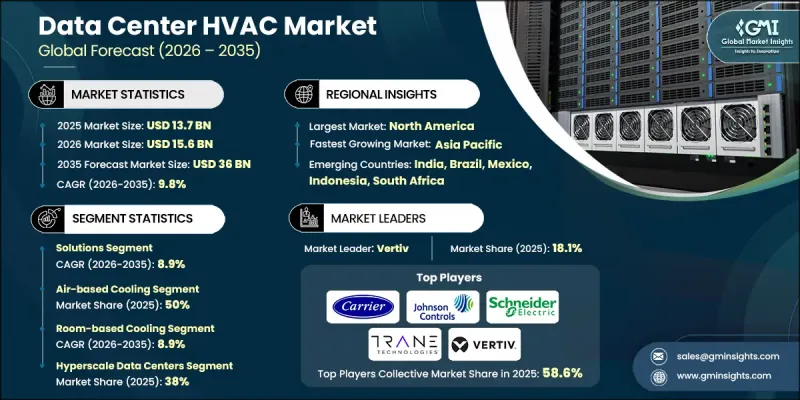
全球资料中心暖通空调(HVAC)市场的成长主要受运算强度不断提高、人工智慧主导工作负载不断扩展以及超大规模和企业级设施持续发展所驱动。随着伺服器密度的增加和高效能运算环境热负荷的不断增长,先进的冷却基础设施对于维持运作稳定性和运作至关重要。整个暖通空调产业的研发工作日益集中于液冷技术和能够处理高功率密度的新一代温度控管系统。同时,日益严格的能源消耗和环境绩效法规迫使营运商提高系统效率并减少碳排放。以环境、社会和治理(ESG)为重点的措施和净零排放承诺正在推动设施升级,旨在优化电源使用效率(PUE)并降低营运成本。基础设施策略正在透过改善气流设计、采用永续冷媒以及整合节能冷却架构进行重组。在持续的监管要求和不断上涨的能源成本的背景下,资料中心对智慧高效能暖通空调解决方案的需求预计将显着加速成长。
| 市场范围 | |
|---|---|
| 开始年份 | 2025 |
| 预测期 | 2026-2035 |
| 上市时的市场规模 | 137亿美元 |
| 预测金额 | 360亿美元 |
| 复合年增长率 | 9.8% |
不断增长的负载能力、永续发展目标以及监管合规要求,推动了对紧凑型、扩充性且适应性强的暖通空调系统日益增长的需求。产业相关人员正透过设计模组化冷却平台来满足这项需求,这些平台能够最大限度地利用空间,提高能源效率,同时还能在不同地区高效运作。
预计到2025年,解决方案领域将占据76%的市场份额,并在2026年至2035年间以8.9%的复合年增长率成长。由人工智慧(AI)驱动的先进监控工具能够实现预测性维护、改善气流管理并降低不必要的电力消耗。液冷技术的日益普及支持高密度伺服器环境,透过节能设计提高可靠性并延长设备使用寿命。
预计到2025年,风冷技术领域将占50%的市场份额,并在2026年至2035年间以8.8%的复合年增长率成长。先进的气流优化系统、变速风扇配置和智慧环境控制可提高热稳定性并最大限度地减少能源浪费。相容节热器的设计促进了外部空气的利用,而模组化冷却单元则支援超大规模和边缘运算环境中的扩充性。随着伺服器功率密度的增加,人们对直接冷却和浸没式冷却方法的兴趣日益浓厚,而先进的冷却液配方则可提高传热效率。
预计到2025年,美国资料中心暖通空调(HVAC)市场规模将达到47亿美元。日益增强的云端运算整合和人工智慧密集型应用的兴起,正在推动对更高效冷却架构的需求。电气化政策和脱碳倡议的投资支持,正在加速智慧暖通空调控制和能源优化系统的应用。与智慧建筑平台和併网技术的集成,使设施能够管理尖峰负载、降低需求费用并整合再生能源来源。
目录
第一章:调查方法
第二章执行摘要
第三章业界考察
- 生态系分析
- 供应商情况
- 利润率
- 成本结构
- 每个阶段增加的价值
- 影响价值链的因素
- 中断
- 影响产业的因素
- 促进因素
- 资料中心能源消耗增加
- 更严格的温度控管标准
- 云端和超大规模基础设施的成长
- 高密度计算的引入
- 产业潜在风险与挑战
- 高初始资本投入
- 与旧有系统的复杂集成
- 市场机会
- 引入液冷技术
- 人工智慧驱动的暖通空调优化
- 扩展边缘资料中心
- 暖通空调即服务 (HaaS)
- 促进因素
- 成长潜力分析
- 监理情势
- 北美洲
- 美国暖气、冷气与空调工程师协会
- 美国能源局
- 欧洲
- 欧盟委员会
- Eurovent Certita认证
- 亚太地区
- 新加坡建设局 (BCA)
- JIS-日本工业标准
- 拉丁美洲
- 巴西技术标准协会
- 国家能源委员会
- 中东和非洲
- 阿拉伯联合大公国(阿联酋)能源与基础设施部
- 沙乌地阿拉伯标准、计量和品质组织
- 北美洲
- 波特五力分析
- PESTEL 分析
- 科技与创新趋势
- 当前技术趋势
- 新兴技术
- 价格分析
- 产品特定定价
- 区域定价
- 生产统计
- 生产基地
- 消费者群体
- 出口和进口
- 成本細項分析
- 专利分析
- 永续性和环境方面
- 永续倡议
- 减少废弃物策略
- 生产中的能源效率
- 具有环保意识的倡议
- 关于碳足迹的考量
- 能源效率指标和基准
- 电源使用效率 (PUE) 趋势
- 水分利用效率(WUE)分析
- 碳利用效率(CUE)指数
第四章 竞争情势
- 介绍
- 企业市占率分析
- 北美洲
- 欧洲
- 亚太地区
- 拉丁美洲
- 中东和非洲(MEA)
- 主要市场公司的竞争分析
- 竞争定位矩阵
- 主要进展
- 併购
- 伙伴关係与合作
- 新产品发布
- 业务拓展计划及资金筹措
第五章 市场估算与预测:依服务类型划分,2022-2035年
- 解决方案
- 冷却基础设施解决方案
- 气流管理和控制解决方案
- 整合式液冷解决方案
- 暖通空调自动化与控制解决方案
- 热监测与管理解决方案
- 能源优化和自然冷却解决方案
- 模组化/可扩充冷却解决方案
- 边缘资料中心冷却解决方案
- 服务
- 专业服务
- 咨询与设计
- 维护和支援
- 安装和部署
- 託管服务
- 专业服务
第六章 市场估算与预测:依冷冻技术划分,2022-2035年
- 空气冷却
- 液冷
- 蒸发冷却
- 混合冷却
第七章 市场估计与预测:依设备类型划分,2022-2035年
- 空调系统
- 冷却器
- 空调机组(AHU)
- 液冷系统
- 冷却塔
- 节热器系统
- 控制系统
- 其他的
第八章 市场估算与预测:以冷却方式划分,2022-2035年
- 房间底部冷却
- 逐行冷却
- 机架式冷却
第九章 市场估计与预测:依资料中心划分,2022-2035年
- 企业资料中心
- 託管资料中心
- 超大规模资料中心
- 边缘资料中心
第十章 市场估价与预测:依最终用途划分,2022-2035年
- 资讯科技/通讯
- BFSI
- 政府/国防
- 卫生保健
- 製造业
- 零售与电子商务
- 能源与公共产业
- 研究与学术
- 其他的
第十一章 市场估价与预测:按地区划分,2022-2035年
- 北美洲
- 我们
- 加拿大
- 欧洲
- 德国
- 英国
- 法国
- 义大利
- 西班牙
- 北欧国家
- 俄罗斯
- 波兰
- 罗马尼亚
- 亚太地区
- 中国
- 印度
- 日本
- 韩国
- ANZ
- 越南
- 印尼
- 拉丁美洲
- 巴西
- 墨西哥
- 阿根廷
- 中东和非洲(MEA)
- 南非
- 沙乌地阿拉伯
- 阿拉伯聯合大公国
第十二章:公司简介
- 世界公司
- Alfa Laval
- Carrier Global
- Daikin Industries
- Danfoss
- Hitachi
- Johnson Controls
- Modine
- Schneider Electric
- STULZ
- Trane Technologies
- Vertiv
- 当地公司
- Climaveneta
- Envicool
- Huawei Digital Power
- KyotoCooling
- Mitsubishi Electric
- 新兴企业
- Asetek
- CoolIT Systems
- Green Revolution Cooling
- Iceotope Technologies
The Global Data Center HVAC Market was valued at USD 13.7 billion in 2025 and is estimated to grow at a CAGR of 9.8% to reach USD 36 billion by 2035.
Growth in the global data center HVAC market is being fueled by rising computing intensity, expanding AI-driven workloads, and the continued development of hyperscale and enterprise facilities. As server densities increase and high-performance computing environments generate greater thermal loads, advanced cooling infrastructure has become essential to maintain operational stability and uptime. Research and development efforts across the HVAC industry are increasingly focused on liquid cooling technologies and next-generation thermal management systems capable of handling elevated power densities. At the same time, stricter regulatory oversight related to energy consumption and environmental performance is encouraging operators to enhance system efficiency and reduce carbon output. ESG-focused initiatives and net-zero commitments are prompting facility upgrades aimed at optimizing Power Usage Effectiveness and lowering operating expenses. Improvements in airflow engineering, adoption of sustainable refrigerants, and integration of energy-efficient cooling architectures are reshaping infrastructure strategies. As regulatory expectations and energy costs continue to rise, demand for intelligent, high-efficiency HVAC solutions in data centers is expected to accelerate significantly.
| Market Scope | |
|---|---|
| Start Year | 2025 |
| Forecast Year | 2026-2035 |
| Start Value | $13.7 Billion |
| Forecast Value | $36 Billion |
| CAGR | 9.8% |
Rising load capacities, sustainability targets, and regulatory compliance requirements are creating pressure for compact, scalable, and adaptable HVAC systems. Industry participants are responding by designing modular cooling platforms that can operate effectively across diverse geographies while maximizing space utilization and energy performance.
The solutions segment accounted for 76% share in 2025 and is forecast to grow at a CAGR of 8.9% from 2026 to 2035. Advanced monitoring tools equipped with artificial intelligence enable predictive maintenance, improve airflow management, and reduce unnecessary power consumption. Increased adoption of liquid-based cooling technologies is supporting high-density server environments while enhancing reliability and extending equipment lifespan through energy-conscious design.
The air-based cooling technologies segment held a 50% share in 2025 and is projected to grow at a CAGR of 8.8% during 2026-2035. Enhanced airflow optimization systems, variable-speed fan configurations, and intelligent environmental controls are improving thermal consistency and minimizing energy waste. Economizer-enabled designs are facilitating greater use of ambient air, while modular cooling units support scalability across both hyperscale and edge environments. Growing server power density is also accelerating interest in direct cooling and immersion-based methods supported by advanced coolant formulations that enhance heat transfer efficiency.
United States Data Center HVAC Market reached USD 4.7 billion in 2025. Increasing cloud integration and AI-intensive applications are driving demand for more efficient cooling architectures. Investments are being supported by electrification incentives and decarbonization initiatives, encouraging broader adoption of intelligent HVAC controls and energy-optimized systems. Integration with smart building platforms and grid-responsive technologies is enabling facilities to manage peak loads, reduce demand charges, and incorporate renewable energy sources.
Key companies operating in the Global Data Center HVAC Market include Vertiv, Schneider Electric, Carrier Global, Daikin Industries, Trane Technologies, Johnson Controls, STULZ, Alfa Laval, Danfoss, and Modine Manufacturing. Companies in the Global Data Center HVAC Market are strengthening their competitive position through continuous innovation, strategic partnerships, and geographic expansion. Leading players are investing heavily in research and development to enhance liquid cooling efficiency, improve airflow intelligence, and integrate AI-driven monitoring systems. Collaborations with cloud service providers and data center developers are enabling customized cooling deployments for high-density environments. Firms are also expanding manufacturing capacity and regional service networks to support rapid infrastructure growth. Sustainability-focused product development, including low-global-warming-potential refrigerants and energy-efficient system architectures, is becoming a central competitive differentiator.
Table of Contents
Chapter 1 Methodology
- 1.1 Research approach
- 1.2 Quality commitments
- 1.3 GMI AI policy & data integrity commitment
- 1.4 Research trail & confidence scoring
- 1.4.1 Research trail components
- 1.4.2 Scoring components
- 1.5 Data collection
- 1.5.1 Partial list of primary sources
- 1.6 Data mining sources
- 1.6.1 Paid sources
- 1.7 Base estimates and calculations
- 1.7.1 Base year calculation
- 1.8 Forecast model
- 1.9 Research transparency addendum
Chapter 2 Executive Summary
- 2.1 Industry 360° synopsis
- 2.2 Key market trends
- 2.2.1 Regional
- 2.2.2 Offering
- 2.2.3 Cooling technology
- 2.2.4 Equipment level
- 2.2.5 Cooling technique
- 2.2.6 Data center
- 2.2.7 End use
- 2.3 TAM analysis, 2026-2035
- 2.4 CXO perspectives: Strategic imperatives
Chapter 3 Industry Insights
- 3.1 Industry ecosystem analysis
- 3.1.1 Supplier landscape
- 3.1.2 Profit margin
- 3.1.3 Cost structure
- 3.1.4 Value addition at each stage
- 3.1.5 Factor affecting the value chain
- 3.1.6 Disruptions
- 3.2 Industry impact forces
- 3.2.1 Growth drivers
- 3.2.1.1 Rising data center energy consumption
- 3.2.1.2 Stricter thermal management standards
- 3.2.1.3 Growth in cloud & hyperscale infrastructure
- 3.2.1.4 Adoption of high-density computing
- 3.2.2 Industry pitfalls and challenges
- 3.2.2.1 High initial capital expenditure
- 3.2.2.2 Complex integration with legacy systems
- 3.2.3 Market opportunities
- 3.2.3.1 Liquid cooling adoption
- 3.2.3.2 AI-driven HVAC optimization
- 3.2.3.3 Edge data center expansion
- 3.2.3.4 HVAC as a service (HaaS)
- 3.2.1 Growth drivers
- 3.3 Growth potential analysis
- 3.4 Regulatory landscape
- 3.4.1 North America
- 3.4.1.1 American Society of Heating, Refrigerating and Air-Conditioning Engineers
- 3.4.1.2 U.S. Department of Energy
- 3.4.2 Europe
- 3.4.2.1 European Commission
- 3.4.2.2 Eurovent Certita Certification
- 3.4.3 Asia Pacific
- 3.4.3.1 BCA - Building and Construction Authority (Singapore)
- 3.4.3.2 JIS - Japanese Industrial Standards
- 3.4.4 Latin America
- 3.4.4.1 Associacao Brasileira de Normas Tecnicas
- 3.4.4.2 Comision Nacional de Energia
- 3.4.5 Middle East & Africa
- 3.4.5.1 UAE Ministry of Energy and Infrastructure
- 3.4.5.2 Saudi Standards, Metrology and Quality Organization
- 3.4.1 North America
- 3.5 Porter's analysis
- 3.6 PESTEL analysis
- 3.7 Technology and innovation landscape
- 3.7.1 Current technological trends
- 3.7.2 Emerging technologies
- 3.8 Pricing analysis
- 3.8.1 Pricing by product
- 3.8.2 Pricing by region
- 3.9 Production statistics
- 3.9.1 Production hubs
- 3.9.2 Consumption hubs
- 3.9.3 Export and import
- 3.10 Cost breakdown analysis
- 3.11 Patent analysis
- 3.12 Sustainability and environmental aspects
- 3.12.1 Sustainable practices
- 3.12.2 Waste reduction strategies
- 3.12.3 Energy efficiency in production
- 3.12.4 Eco-friendly initiatives
- 3.12.5 Carbon footprint considerations
- 3.13 Energy Efficiency Metrics & Benchmarking
- 3.13.1 Power Usage Effectiveness (PUE) Trends
- 3.13.2 Water Usage Effectiveness (WUE) Analysis
- 3.13.3 Carbon Usage Effectiveness (CUE) Metrics
Chapter 4 Competitive Landscape, 2025
- 4.1 Introduction
- 4.2 Company market share analysis
- 4.2.1 North America
- 4.2.2 Europe
- 4.2.3 Asia Pacific
- 4.2.4 LATAM
- 4.2.5 MEA
- 4.3 Competitive analysis of major market players
- 4.4 Competitive positioning matrix
- 4.5 Key developments
- 4.5.1 Mergers & acquisitions
- 4.5.2 Partnerships & collaborations
- 4.5.3 New product launches
- 4.5.4 Expansion plans and funding
Chapter 5 Market Estimates & Forecast, By Offering, 2022 - 2035 ($Mn)
- 5.1 Key trends
- 5.2 Solutions
- 5.2.1 Cooling infrastructure solutions
- 5.2.2 Airflow management & containment solutions
- 5.2.3 Liquid cooling integration solutions
- 5.2.4 HVAC automation & control solutions
- 5.2.5 Thermal monitoring & management solutions
- 5.2.6 Energy optimization & free cooling solutions
- 5.2.7 Modular / scalable cooling solutions
- 5.2.8 Edge data center cooling solutions
- 5.3 Services
- 5.3.1 Professional services
- 5.3.1.1 Consulting & design
- 5.3.1.2 Maintenance and support
- 5.3.1.3 Installation and deployment
- 5.3.2 Managed services
- 5.3.1 Professional services
Chapter 6 Market Estimates & Forecast, By Cooling Technology, 2022 - 2035 ($Mn)
- 6.1 Key trends
- 6.2 Air-based cooling
- 6.3 Liquid cooling
- 6.4 Evaporative cooling
- 6.5 Hybrid cooling
Chapter 7 Market Estimates & Forecast, By Equipment-Level, 2022 - 2035 ($Mn, Units)
- 7.1 Key trends
- 7.2 Air conditioning systems
- 7.3 Chillers
- 7.4 Air handling units (AHU)
- 7.5 Liquid cooling systems
- 7.6 Cooling towers
- 7.7 Economizer systems
- 7.8 Control systems
- 7.9 Others
Chapter 8 Market Estimates & Forecast, By Cooling Technique, 2022 - 2035 ($Mn)
- 8.1 Key trends
- 8.2 Room-based cooling
- 8.3 Row-based cooling
- 8.4 Rack-based cooling
Chapter 9 Market Estimates & Forecast, By Data Center, 2022 - 2035 ($Mn)
- 9.1 Key trends
- 9.2 Enterprise data centers
- 9.3 Colocation data centers
- 9.4 Hyperscale data centers
- 9.5 Edge data centers
Chapter 10 Market Estimates & Forecast, By End Use, 2022 - 2035 ($Mn)
- 10.1 Key trends
- 10.2 IT & telecommunications
- 10.3 BFSI
- 10.4 Government & defense
- 10.5 Healthcare
- 10.6 Manufacturing
- 10.7 Retail & e-commerce
- 10.8 Energy & utilities
- 10.9 Research & academic
- 10.10 Others
Chapter 11 Market Estimates & Forecast, By Region, 2022 - 2035 ($Mn)
- 11.1 Key trends
- 11.2 North America
- 11.2.1 US
- 11.2.2 Canada
- 11.3 Europe
- 11.3.1 Germany
- 11.3.2 UK
- 11.3.3 France
- 11.3.4 Italy
- 11.3.5 Spain
- 11.3.6 Nordics
- 11.3.7 Russia
- 11.3.8 Poland
- 11.3.9 Romania
- 11.4 Asia Pacific
- 11.4.1 China
- 11.4.2 India
- 11.4.3 Japan
- 11.4.4 South Korea
- 11.4.5 ANZ
- 11.4.6 Vietnam
- 11.4.7 Indonesia
- 11.5 Latin America
- 11.5.1 Brazil
- 11.5.2 Mexico
- 11.5.3 Argentina
- 11.6 MEA
- 11.6.1 South Africa
- 11.6.2 Saudi Arabia
- 11.6.3 UAE
Chapter 12 Company Profiles
- 12.1 Global companies
- 12.1.1 Alfa Laval
- 12.1.2 Carrier Global
- 12.1.3 Daikin Industries
- 12.1.4 Danfoss
- 12.1.5 Hitachi
- 12.1.6 Johnson Controls
- 12.1.7 Modine
- 12.1.8 Schneider Electric
- 12.1.9 STULZ
- 12.1.10 Trane Technologies
- 12.1.11 Vertiv
- 12.2 Regional players
- 12.2.1 Climaveneta
- 12.2.2 Envicool
- 12.2.3 Huawei Digital Power
- 12.2.4 KyotoCooling
- 12.2.5 Mitsubishi Electric
- 12.3 Emerging players
- 12.3.1 Asetek
- 12.3.2 CoolIT Systems
- 12.3.3 Green Revolution Cooling
- 12.3.4 Iceotope Technologies


