


 |
市场调查报告书
商品编码
1982263
携带式洩漏检测仪市场机会、成长要素、产业趋势分析及2026-2035年预测Portable Water Leak Detector Market Opportunity, Growth Drivers, Industry Trend Analysis, and Forecast 2026 - 2035 |
||||||

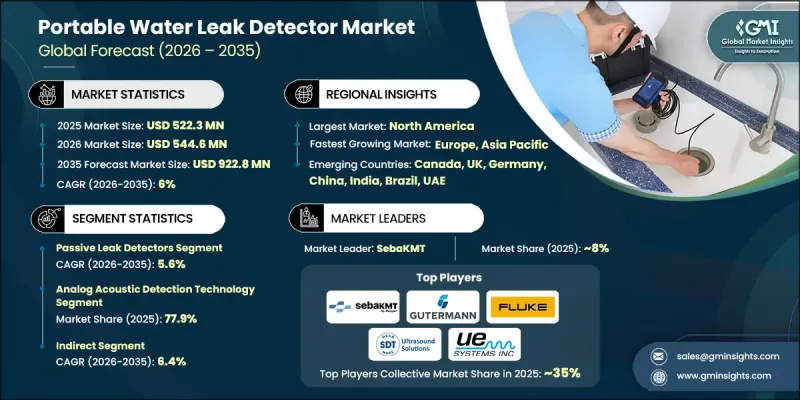
全球携带式漏水侦测仪市场预计到 2025 年将达到 5.223 亿美元,年复合成长率为 6%,到 2035 年将达到 9.228 亿美元。
全球携带式洩漏检测市场的成长得益于技术的快速发展,这些技术正在重新定义检测精度和运行性能。物联网 (IoT) 连接、人工智慧和即时资料处理的先进整合显着提高了携带式洩漏检测设备的精度。现代设备旨在透过评估声学模式、压力波动和环境指标,快速且有效率地识别洩漏源。增强的连接性使技术人员能够即时获取可操作的信息,从而加快维修速度并提升整体决策水平。基于云端的监控功能和预测分析进一步优化了维护计划,同时最大限度地减少了基础设施损坏和水资源损失。无线通讯、智慧演算法和紧凑型系统设计的持续创新正在拓展其在公共产业、商业设施和工业领域的应用范围。此外,与永久性监控基础设施相比,可携式系统由于初始投资更低、运作更柔软性,使其成为寻求敏捷性和成本效益的组织的理想解决方案。
| 市场范围 | |
|---|---|
| 开始年份 | 2025 |
| 预测期 | 2026-2035 |
| 上市时的市场规模 | 5.223亿美元 |
| 预测金额 | 9.228亿美元 |
| 复合年增长率 | 6% |
被动式洩漏检测市场预计到2025年将达到3.94亿美元,并在2026年至2035年间以5.6%的复合年增长率成长。日益普及的原因在于其功能简单、价格实惠,并且能够适应住宅、商业和工业环境,在这些环境中,持续监测至关重要,但不一定需要高度复杂的系统。其低维护成本和极低的能耗使其适合广泛部署。除了人们对洪水风险的日益关注外,基础设施老化和更严格的建筑规范也促使终端用户采用被动式设备作为早期措施,以防止代价高昂的结构损失。
预计到2025年,模拟声学检测技术将占据77.9%的市场份额,并在2035年之前以5.6%的复合年增长率成长。这些系统因其无需依赖复杂的数位架构即可透过分析声波频率来检测洩漏而广受认可。其成本效益高、易于维护且操作无损,使技术人员能够有效率地定位洩漏点,并将服务中断降至最低。基础设施现代化投资的增加以及对减少漏水日益增长的关注,正在推动对可携式声学检测工具的需求。
美国携带式漏水检测仪市场预计到2025年将达到1.355亿美元,并在2026年至2035年间以5.9%的复合年增长率成长。严格的节水和设施安全监管标准正促使供水事业和业主采用先进的检测解决方案,以减少未计费水量(NRW)并防止结构损坏。商业和住宅开发项目中的采用率持续上升,反映出全国范围内向积极主动的水资源管理策略转变的趋势。
目录
第一章:调查方法和范围
第二章执行摘要
第三章业界考察
- 生态系分析
- 供应商情况
- 利润率
- 每个阶段增加的价值
- 影响价值链的因素
- 影响产业的因素
- 促进因素
- 对高效洩漏检测和节水的需求日益增长。
- 物联网、人工智慧和即时分析领域的技术进步
- 成本效益和柔软性
- 产业潜在风险与挑战
- 噪音干扰与误检
- 缺乏标准化通讯协定
- 促进因素
- 成长潜力分析
- 未来市场趋势
- 科技与创新趋势
- 当前技术趋势
- 新兴技术
- 价格趋势
- 按地区
- 按类型
- 监理情势
- 标准和合规要求
- 区域法规结构
- 认证标准
- 波特五力分析
- PESTEL 分析
第四章 竞争情势
- 介绍
- 企业市占率分析
- 按地区
- 北美洲
- 欧洲
- 亚太地区
- 拉丁美洲
- 中东和非洲
- 按地区
- 企业矩阵分析
- 主要市场公司的竞争分析
- 竞争定位矩阵
- 主要进展
- 併购
- 伙伴关係与合作
- 新产品发布
- 业务拓展计划
第五章 市场估计与预测:依营运模式划分,2022-2035年
- 主动洩漏检测器
- 被动式洩漏检测器
第六章 市场估计与预测:依技术划分,2022-2035年
- 智慧声学检测技术
- 类比声学检测技术
第七章 市场估计与预测:依技术划分,2022-2035年
- 麦克风类型
- 基于相关性的分析
- 其他的
第八章 市场估计与预测:依应用领域划分,2022-2035年
- 住宅
- 商业的
- 工业的
第九章 市场估价与预测:依最终用户划分,2022-2035年
- 地方政府/管线网络
- 工业应用
- 商业设施
- 住宅房地产
第十章 市场估价与预测:依通路划分,2022-2035年
- 直销
- 间接销售
第十一章 市场估价与预测:按地区划分,2022-2035年
- 北美洲
- 我们
- 加拿大
- 欧洲
- 德国
- 英国
- 法国
- 义大利
- 西班牙
- 亚太地区
- 中国
- 印度
- 日本
- 韩国
- 澳洲
- 印尼
- 马来西亚
- 拉丁美洲
- 巴西
- 墨西哥
- 阿根廷
- 中东和非洲(MEA)
- 沙乌地阿拉伯
- 阿拉伯聯合大公国
- 南非
第十二章:公司简介
- Fluid Conservation Systems
- Fluke
- GAO Tek
- GE Measurement &Control
- Guangdong Hongsimai Technology
- Gutermann
- Hunan Puqi Water Environment Institute
- MSA(Mine Safety Appliances Company)
- SDT Ultrasound
- SebaKMT
- Shandong Relied Heavy Industry
- SONOTEC GmbH
- TECHNO-AC
- UE Systems
The Global Portable Water Leak Detector Market was valued at USD 522.3 million in 2025 and is estimated to grow at a CAGR of 6% to reach USD 922.8 million by 2035.
Growth in the global portable water leak detector market is supported by rapid technological progress that is reshaping detection accuracy and operational performance. Advanced integration of Internet of Things connectivity, artificial intelligence, and real-time data processing has significantly improved the precision of portable leak detection equipment. Modern devices are engineered to evaluate acoustic patterns, pressure fluctuations, and environmental indicators to identify leak sources quickly and efficiently. Enhanced connectivity allows technicians to access actionable insights instantly, accelerating repair timelines and strengthening overall decision-making. Cloud-based monitoring capabilities and predictive analytics are further optimizing maintenance planning while minimizing infrastructure damage and water loss. Continuous innovation in wireless communication, smart algorithms, and compact system design is expanding application versatility across utilities, commercial facilities, and industrial operations. In addition, portable systems remain attractive due to their lower capital investment requirements and operational flexibility when compared to permanent monitoring infrastructure, making them a practical solution for organizations seeking mobility and cost efficiency.
| Market Scope | |
|---|---|
| Start Year | 2025 |
| Forecast Year | 2026-2035 |
| Start Value | $522.3 Million |
| Forecast Value | $922.8 Million |
| CAGR | 6% |
The passive leak detectors segment generated USD 394 million in 2025 and is expected to grow at a CAGR of 5.6% between 2026 and 2035. Their increasing adoption is linked to straightforward functionality, budget-friendly pricing, and suitability across residential, commercial, and industrial environments where uninterrupted monitoring is important but highly complex systems may not be necessary. Low-maintenance configurations and minimal power requirements make them well-suited for broad deployment. Growing awareness of water damage risks, combined with aging infrastructure and stricter building compliance standards, is encouraging end users to implement passive devices as an initial safeguard against costly structural losses.
The analog acoustic detection technology segment held 77.9% share in 2025 and is forecast to grow at a CAGR of 5.6% through 2035. These systems are widely recognized for their ability to detect leaks by analyzing sound frequencies without relying on intricate digital architectures. Their cost-effectiveness, ease of maintenance, and non-invasive operation enable technicians to locate leaks efficiently while minimizing service disruptions. Rising investment in infrastructure upgrades and heightened focus on reducing water loss are reinforcing demand for acoustic-based portable detection tools.
United States Portable Water Leak Detector Market reached USD 135.5 million in 2025 and is anticipated to grow at a CAGR of 5.9% from 2026 to 2035. Strict regulatory standards related to water conservation and facility safety are driving utilities and property owners to deploy advanced detection solutions to reduce non-revenue water and prevent structural damage. Adoption rates continue to rise across both commercial and residential developments, reflecting a broader national shift toward proactive water management strategies.
Key companies operating in the Global Portable Water Leak Detector Market include Fluke, SebaKMT, UE Systems, SONOTEC GmbH, MSA (Mine Safety Appliances Company), Gutermann, GAO Tek, GE Measurement & Control, SDT Ultrasound, TECHNO-AC, Fluid Conservation Systems, Guangdong Hongsimai Technology, Hunan Puqi Water Environment Institute, and Shandong Relied Heavy Industry. Companies in the Portable Water Leak Detector Market are reinforcing their competitive advantage through continuous technological enhancement and global expansion strategies. Manufacturers are prioritizing research and development to refine acoustic sensitivity, integrate AI-driven diagnostics, and enhance wireless data transmission capabilities. Strategic partnerships with utilities and infrastructure contractors are strengthening distribution channels and long-term service agreements. Many firms are expanding product portfolios to address diverse end-user requirements, from compact handheld units to advanced multi-sensor systems.
Table of Contents
Chapter 1 Methodology & Scope
- 1.1 Market scope and definition
- 1.2 Research design
- 1.2.1 Research approach
- 1.2.2 Data collection methods
- 1.3 Data mining sources
- 1.3.1 Global
- 1.3.2 Regional/Country
- 1.4 Base estimates and calculations
- 1.4.1 Base year calculation
- 1.4.2 Key trends for market estimation
- 1.5 Primary research and validation
- 1.5.1 Primary sources
- 1.6 Forecast model
- 1.7 Research assumptions and limitations
Chapter 2 Executive Summary
- 2.1 Industry 360° synopsis
- 2.2 Key market trends
- 2.2.1 Regional
- 2.2.2 Operating mode
- 2.2.3 Technology
- 2.2.4 Technology type
- 2.2.5 Application
- 2.2.6 End-user type
- 2.2.7 Distribution channel
- 2.3 CXO perspectives: Strategic imperatives
- 2.3.1 Key decision points for industry executives
- 2.3.2 Critical success factors for market players
- 2.4 Future outlook and strategic recommendations
Chapter 3 Industry Insights
- 3.1 Industry ecosystem analysis
- 3.1.1 Supplier landscape
- 3.1.2 Profit margin
- 3.1.3 Value addition at each stage
- 3.1.4 Factor affecting the value chain
- 3.2 Industry impact forces
- 3.2.1 Growth drivers
- 3.2.1.1 Rising demand for efficient leak detection and water conservation
- 3.2.1.2 Technological advancements in IoT, AI & real-time analytics
- 3.2.1.3 Cost efficiency and flexibility
- 3.2.2 Industry pitfalls & challenges
- 3.2.2.1 Noise interference & false positives
- 3.2.2.2 Lack of standardized protocols
- 3.2.1 Growth drivers
- 3.3 Growth potential analysis
- 3.4 Future market trends
- 3.5 Technology and innovation landscape
- 3.5.1 Current technological trends
- 3.5.2 Emerging technologies
- 3.6 Price trends
- 3.6.1 By region
- 3.6.2 By type
- 3.7 Regulatory landscape
- 3.7.1 Standards and compliance requirements
- 3.7.2 Regional regulatory frameworks
- 3.7.3 Certification standards
- 3.8 Porter's analysis
- 3.9 PESTEL analysis
Chapter 4 Competitive Landscape, 2025
- 4.1 Introduction
- 4.2 Company market share analysis
- 4.2.1 By Region
- 4.2.1.1 North America
- 4.2.1.2 Europe
- 4.2.1.3 Asia Pacific
- 4.2.1.4 Latin America
- 4.2.1.5 Middle East & Africa
- 4.2.1 By Region
- 4.3 Company matrix analysis
- 4.4 Competitive analysis of major market players
- 4.5 Competitive positioning matrix
- 4.6 Key developments
- 4.6.1 Mergers & acquisitions
- 4.6.2 Partnerships & collaborations
- 4.6.3 New product launches
- 4.6.4 Expansion plans
Chapter 5 Market Estimates & Forecast, By Operating Mode, 2022 - 2035, (USD Million) (Thousand Units)
- 5.1 Key trends
- 5.2 Active leak detectors
- 5.3 Passive leak detectors
Chapter 6 Market Estimates & Forecast, By Technology, 2022 - 2035, (USD Million) (Thousand Units)
- 6.1 Key trends
- 6.2 Smart acoustic detection technology
- 6.3 Analog acoustic detection technology
Chapter 7 Market Estimates & Forecast, By Technology type, 2022 - 2035, (USD Million) (Thousand Units)
- 7.1 Key trends
- 7.2 Microphone-based
- 7.3 Correlator-based
- 7.4 Others
Chapter 8 Market Estimates & Forecast, By Application, 2022 - 2035, (USD Million) (Thousand Units)
- 8.1 Key trends
- 8.2 Residential
- 8.3 Commercial
- 8.4 Industrial
Chapter 9 Market Estimates & Forecast, By End-User Type, 2022 - 2035, (USD Million) (Thousand Units)
- 9.1 Key trends
- 9.2 Municipal/pipeline networks
- 9.3 Industrial applications
- 9.4 Commercial facilities
- 9.5 Residential properties
Chapter 10 Market Estimates & Forecast, By Distribution Channel, 2022 - 2035, (USD Million) (Thousand Units)
- 10.1 Key trends
- 10.2 Direct
- 10.3 Indirect
Chapter 11 Market Estimates & Forecast, By Region, 2022 - 2035, (USD Million) (Thousand Units)
- 11.1 Key trends
- 11.2 North America
- 11.2.1 U.S.
- 11.2.2 Canada
- 11.3 Europe
- 11.3.1 Germany
- 11.3.2 UK
- 11.3.3 France
- 11.3.4 Italy
- 11.3.5 Spain
- 11.4 Asia Pacific
- 11.4.1 China
- 11.4.2 India
- 11.4.3 Japan
- 11.4.4 South Korea
- 11.4.5 Australia
- 11.4.6 Indonesia
- 11.4.7 Malaysia
- 11.5 Latin America
- 11.5.1 Brazil
- 11.5.2 Mexico
- 11.5.3 Argentina
- 11.6 MEA
- 11.6.1 Saudi Arabia
- 11.6.2 UAE
- 11.6.3 South Africa
Chapter 12 Company Profiles
- 12.1 Fluid Conservation Systems
- 12.2 Fluke
- 12.3 GAO Tek
- 12.4 GE Measurement & Control
- 12.5 Guangdong Hongsimai Technology
- 12.6 Gutermann
- 12.7 Hunan Puqi Water Environment Institute
- 12.8 MSA (Mine Safety Appliances Company)
- 12.9 SDT Ultrasound
- 12.10 SebaKMT
- 12.11 Shandong Relied Heavy Industry
- 12.12 SONOTEC GmbH
- 12.13 TECHNO-AC
- 12.14 UE Systems

 超音波气体洩漏检测仪市场:全球市场预测(按产品类型、技术、最终用户、应用和销售管道),2026-2032年洩漏检测灯市场:按技术、检测类型、组件、服务类型、应用和最终用户划分-2026-2032年全球预测扫描式雷射甲烷遥测仪市场:依技术、产品类型、组织规模、应用、最终用户和销售管道,全球预测,2026-2032年锂电池真空室洩漏检测系统市场:按洩漏检测技术、电池类型、真空室配置、电池规格和最终用户产业划分-全球预测,2026-2032年携带式雷射甲烷检测器市场:按技术、应用、分销管道和最终用户分類的全球预测(2026-2032年)前置式超音波检测器市场按应用、最终用途、分销管道、技术、安装类型、电源、频率范围和输出类型划分,全球预测(2026-2032年)线上洩漏检测和警报系统解决方案市场:按组件、部署方式、组织规模、最终用户产业和应用划分,全球预测,2026-2032年
 全球洩漏感测器市场规模、份额、趋势和成长分析报告(2026-2034年)
 日本洩漏检测市场:规模、份额、趋势和预测:按技术、最终用户和地区划分,2026-2034年
 2026年全球智慧气体外洩检测机器人市场报告