


 |
市场调查报告书
商品编码
1982273
脊椎生长棒市场机会、成长要素、产业趋势分析及2026-2035年预测。Spine Growing Rods Market Opportunity, Growth Drivers, Industry Trend Analysis, and Forecast 2026 - 2035 |
||||||

全球脊椎生长棒市场预计到 2025 年价值 4,170 万美元,预计到 2035 年将以 8.8% 的复合年增长率增长至 9,760 万美元。
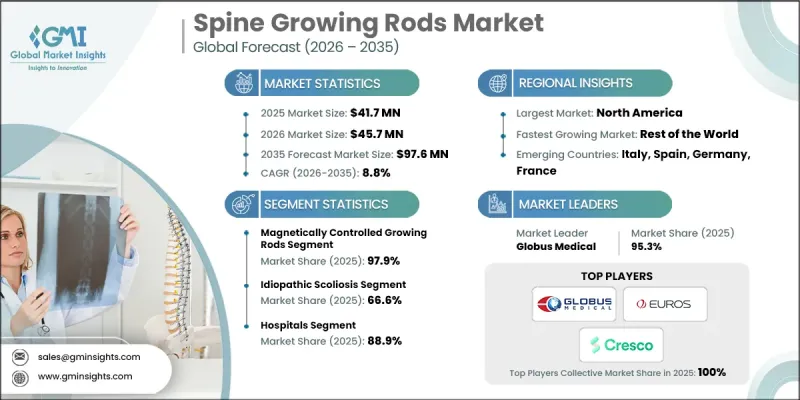
全球脊椎生长棒产业的发展主要受早期发病型脊椎侧弯 (EOS) 诊断病例的增加以及临床上对保留生长功能的脊椎矫正术日益增长的需求所驱动。脊椎生长棒是一种植入式系统,旨在治疗儿童患者的复杂脊椎畸形,可在逐步矫正脊椎弯曲的同时,促进脊椎的持续发育。 10 岁以下儿童 EOS 发生率的上升是市场扩张的主要因素,因为这种疾病通常在关键生长发育期迅速进展。医疗专业人员越来越关注能够在不限制胸椎和骨骼发育的情况下稳定脊椎畸形的解决方案。手术技术的进步、治疗途径的扩大、医保报销机制的支持以及植入设计的持续创新,都进一步加速了脊椎生长棒的普及。随着公众意识的提高和早期诊断水平的改善,对技术先进、微创的脊椎移植的需求不断增长,全球脊椎生长棒市场的前景仍然强劲。
| 市场范围 | |
|---|---|
| 开始年份 | 2025 |
| 预测期 | 2026-2035 |
| 上市时的市场规模 | 4170万美元 |
| 预测金额 | 9760万美元 |
| 复合年增长率 | 8.8% |
特发性脊椎侧弯约占所有确诊病例的80%至85%,并且正日益成为儿童脊椎畸形的主要类型之一。除了结构性併发症外,特发性脊椎侧弯还会影响儿童的情绪和心理健康,导致他们面临许多压力相关的挑战。随着专科医疗服务的普及和医疗技术的不断进步,脊椎生长棒作为长期矫正方法的需求日益增长。
磁控生长棒具有可进行非侵入性棒材调整的优势,预计2025年将占97.9%的市场。这项技术显着降低了再次手术的频率,并减轻了整体治疗负担。磁控生长棒内建磁性致动器,可实现外部延伸,从而在适应持续生长的同时,维持脊椎稳定性并持续矫正畸形。其优于传统系统的临床优势已获得外科医生和医疗机构的广泛认可。
预计到2025年,神经肌肉型脊椎脊椎市场规模将达到680万美元,并在2026年至2035年间以8.7%的复合年增长率成长。该领域是脊椎生长棒应用的关键治疗领域,这得益于神经肌肉疾病患者存活率的提高。随着这类患者族群平均寿命的延长,需要矫正治疗的进行性脊椎侧弯的发生率也在上升,对能够促进生长发育的先进植入系统产生了持续的需求。
预计到2025年,北美脊椎生长棒市占率将达到59.4%。该地区受益于先进的医疗基础设施、对创新脊椎移植技术的早期应用以及对儿童畸形治疗的高度重视。生长棒系统广泛应用于专业的儿童脊椎中心和整形外科机构,在这些机构中,维持胸椎发育和实现长期功能恢復仍然是主要的治疗目标。
目录
第一章:调查方法
- 研究途径
- 品质改进计划
- GMI人工智慧政策和资料完整性倡议
- 资讯来源一致性通讯协定
- GMI人工智慧政策和资料完整性倡议
- 调查过程和可靠性评分
- 调查过程的组成部分
- 评分组成部分
- 数据收集
- 主要来源部分列表
- 资料探勘资讯来源
- 付费资讯来源
- 区域资讯来源
- 付费资讯来源
- 基本估算和计算方法
- 每种方法中基准年的计算
- 预测模型
- 量化市场影响分析
- 生长参数对预测的数学影响
- 量化市场影响分析
- 关于调查透明度的补充信息
- 资讯来源归属框架
- 品质保证指标
- 对信任的承诺
第二章执行摘要
第三章业界考察
- 生态系分析
- 影响产业的因素
- 促进因素
- 早发性脊椎侧弯(EOS)盛行率增加
- 维持生长脊椎治疗的需求
- 脊椎移植设计方面的技术进步
- 产业潜在风险与挑战
- 生长棒植入系统高成本
- 机械故障和桿断裂的风险
- 市场机会
- 在新兴市场扩大MCGR的应用
- 将智慧感测器整合到生长棒系统中
- 促进因素
- 成长潜力分析
- 监理情势
- 北美洲
- 欧洲
- 科技趋势
- 当前技术趋势
- 新兴技术
- 未来市场趋势
- 专利分析
- 管道分析
- 患者人口统计学和流行病学
- 波特五力分析
- PESTEL 分析
第四章 竞争情势
- 介绍
- 企业矩阵分析
- 企业市占率分析
- 北美洲
- 欧洲
- 其他地区
- 竞争定位矩阵
- 主要市场公司的竞争分析
- 主要进展
- 併购
- 伙伴关係与合作
- 新技术的引入
- 业务拓展计划
第五章 市场估计与预测:依技术划分,2022-2035年
- 磁控伸缩桿
- 机械式单向自伸缩桿
- 弹簧式自膨胀系统
第六章 市场估计与预测:依应用领域划分,2022-2035年
- 特发性脊椎侧弯
- 神经肌肉脊椎侧弯
- 脊椎脊椎侧弯
- 症状性脊椎
第七章 市场估计与预测:依最终用途划分,2022-2035年
- 医院
- 专业整形外科诊所
- 门诊手术中心(ASC)
第八章 市场估计与预测:依地区划分,2022-2035年
- 北美洲
- 我们
- 加拿大
- 欧洲
- 德国
- 法国
- 义大利
- 西班牙
- 荷兰
- 瑞典
- 其他欧洲地区
- 其他地区
第九章:公司简介
- Cresco
- EUROS
- Globus Medical
The Global Spine Growing Rods Market was valued at USD 41.7 million in 2025 and is estimated to grow at a CAGR of 8.8% to reach USD 97.6 million by 2035.
Growth across the global spine growing rods industry is propelled by the increasing diagnosis of early-onset scoliosis (EOS) and the growing clinical preference for growth-preserving spinal correction procedures. Spine growing rods are implantable systems designed to manage complex spinal deformities in pediatric patients, allowing for continued spinal development while gradually correcting the curvature. The rising incidence of EOS in children under the age of 10 is significantly contributing to market expansion, as this condition often progresses rapidly during critical growth years. Healthcare providers are increasingly focused on solutions that stabilize spinal deformities without limiting thoracic and skeletal development. Advancements in surgical techniques, broader treatment accessibility, supportive reimbursement frameworks, and continuous innovation in implant design are further accelerating adoption. As awareness grows and early diagnosis improves, demand for technologically advanced and minimally disruptive spinal implants continues to strengthen the outlook for the spine growing rods market worldwide.
| Market Scope | |
|---|---|
| Start Year | 2025 |
| Forecast Year | 2026-2035 |
| Start Value | $41.7 Million |
| Forecast Value | $97.6 Million |
| CAGR | 8.8% |
Idiopathic scoliosis accounts for nearly 80-85% of total diagnosed cases, reinforcing its position as the leading category within pediatric spinal deformities. Beyond structural complications, EOS can also influence emotional and psychological well-being, contributing to stress-related challenges in affected children. Expanding access to specialized care and continuous improvements in medical technology are supporting a stronger demand for spine growing rods as a long-term corrective approach.
The magnetically controlled growing rods segment held 97.9% share in 2025, owing to their ability to enable non-invasive rod adjustments. This technology significantly reduces the frequency of repeat surgical interventions and lowers the overall treatment burden. Magnetically controlled growing rods integrate an internal magnetic actuator that permits external lengthening, supporting spinal stability and sustained deformity correction while accommodating ongoing growth. Their clinical advantages over conventional systems continue to drive widespread preference among surgeons and healthcare institutions.
The neuromuscular scoliosis segment generated USD 6.8 million in 2025 and is anticipated to grow at a CAGR of 8.7% during 2026-2035. This segment represents a critical therapeutic area within spine growing rod applications, supported by improving survival outcomes among patients with neuromuscular disorders. As life expectancy increases within these patient populations, the incidence of progressive spinal curvature requiring corrective intervention is also rising, creating sustained demand for advanced growth-preserving implant systems.
North America Spine Growing Rods Market held a 59.4% share in 2025. The region benefits from advanced healthcare infrastructure, early integration of innovative spinal implant technologies, and strong clinical emphasis on pediatric deformity management. Growing rod systems are widely utilized across specialized pediatric spine centers and orthopedic facilities, where preserving thoracic development and long-term functional outcomes remain a primary treatment objective.
Key companies operating in the Global Spine Growing Rods Market include Globus Medical, EUROS, and Cresco. Companies in the Spine Growing Rods Market are reinforcing their market position through continuous product innovation and strategic expansion initiatives. Manufacturers are prioritizing research and development to enhance implant durability, improve magnetic control mechanisms, and optimize patient outcomes. Strategic collaborations with hospitals and specialty clinics are helping firms strengthen clinical adoption and brand recognition. Businesses are also expanding geographic reach through distribution partnerships and regulatory approvals in high-growth regions. Investment in surgeon training programs and post-market clinical studies is further supporting credibility and long-term demand. Additionally, companies are focusing on improving manufacturing efficiency and supply chain resilience to ensure consistent product availability while maintaining competitive pricing strategies in the global spine growing rods market.
Table of Contents
Chapter 1 Research Methodology
- 1.1 Research approach
- 1.2 Quality commitments
- 1.2.1 GMI AI policy & data integrity commitment
- 1.2.1.1 Source consistency protocol
- 1.2.1 GMI AI policy & data integrity commitment
- 1.3 Research trail & confidence scoring
- 1.3.1 Research trail components
- 1.3.2 Scoring components
- 1.4 Data collection
- 1.4.1 Partial list of primary sources
- 1.5 Data mining sources
- 1.5.1 Paid sources
- 1.5.1.1 Sources, by region
- 1.5.1 Paid sources
- 1.6 Base estimates and calculations
- 1.6.1 Base year calculation for any one approach
- 1.7 Forecast model
- 1.7.1 Quantified market impact analysis
- 1.7.1.1 Mathematical impact of growth parameters on forecast
- 1.7.1 Quantified market impact analysis
- 1.8 Research transparency addendum
- 1.8.1 Source attribution framework
- 1.8.2 Quality assurance metrics
- 1.8.3 Our commitment to trust
Chapter 2 Executive Summary
- 2.1 Industry 3600 synopsis
- 2.2 Key market trends
- 2.2.1 Regional trends
- 2.2.2 Technology trends
- 2.2.3 Indication trends
- 2.2.4 End use trends
- 2.3 CXO perspectives: Strategic imperatives
Chapter 3 Industry Insights
- 3.1 Industry ecosystem analysis
- 3.2 Industry impact forces
- 3.2.1 Growth drivers
- 3.2.1.1 Rising prevalence of early-onset scoliosis (EOS)
- 3.2.1.2 Demand for growth-preserving spinal interventions
- 3.2.1.3 Technological advancements in spinal implant design
- 3.2.2 Industry pitfalls and challenges
- 3.2.2.1 High cost of growing rod implant systems
- 3.2.2.2 Risk of mechanical failure and rod breakage
- 3.2.3 Market opportunities
- 3.2.3.1 Expansion of MCGR adoption in emerging economies
- 3.2.3.2 Integration of smart sensors in growing rod systems
- 3.2.1 Growth drivers
- 3.3 Growth potential analysis
- 3.4 Regulatory landscape
- 3.4.1 North America
- 3.4.2 Europe
- 3.5 Technology landscape
- 3.5.1 Current technological trends
- 3.5.2 Emerging technologies
- 3.6 Future market trends
- 3.7 Patent analysis
- 3.8 Pipeline analysis
- 3.9 Patient demographics and epidemiology
- 3.10 Porter's analysis
- 3.11 PESTEL analysis
Chapter 4 Competitive Landscape, 2025
- 4.1 Introduction
- 4.2 Company matrix analysis
- 4.3 Company market share analysis
- 4.3.1 North America
- 4.3.2 Europe
- 4.3.3 RoW
- 4.4 Competitive positioning matrix
- 4.5 Competitive analysis of major market players
- 4.6 Key developments
- 4.6.1 Mergers & acquisitions
- 4.6.2 Partnerships & collaborations
- 4.6.3 New technology launches
- 4.6.4 Expansion plans
Chapter 5 Market Estimates and Forecast, By Technology, 2022 - 2035 ($ Mn)
- 5.1 Key trends
- 5.2 Magnetically controlled growing rods
- 5.3 Mechanical one way self expanding rods
- 5.4 Spring-based self expanding systems
Chapter 6 Market Estimates and Forecast, By Indication, 2022 - 2035 ($ Mn)
- 6.1 Key trends
- 6.2 Idiopathic Scoliosis
- 6.3 Neuromuscular scoliosis
- 6.4 Congenital scoliosis
- 6.5 Syndromic scoliosis
Chapter 7 Market Estimates and Forecast, By End Use, 2022 - 2035 ($ Mn)
- 7.1 Key trends
- 7.2 Hospitals
- 7.3 Specialty orthopedic clinics
- 7.4 Ambulatory surgical centers (ASCs)
Chapter 8 Market Estimates and Forecast, By Region, 2022 - 2035 ($ Mn)
- 8.1 Key trends
- 8.2 North America
- 8.2.1 U.S.
- 8.2.2 Canada
- 8.3 Europe
- 8.3.1 Germany
- 8.3.2 France
- 8.3.3 Italy
- 8.3.4 Spain
- 8.3.5 Netherlands
- 8.3.6 Sweden
- 8.3.7 Rest of Europe
- 8.4 RoW
Chapter 9 Company Profiles
- 9.1 Cresco
- 9.2 EUROS
- 9.3 Globus Medical

 整形外科医疗设备市场:2026-2032年全球市场预测(依器材类型、材料类型、病患类型、固定方法、应用、最终用户和分销管道划分)
 2026年全球脊椎固定装置市场报告
 整形外科医疗设备市场规模、份额和成长分析:按最终用户、安装地点、应用和地区划分-2026-2033年产业预测2026年全球整形外科器械市场报告
 整形外科医疗设备市场分析及预测(至2035年):依类型、产品类型、服务、技术、材质、应用、最终用户、设备、製程及功能划分
 2026-2034年全球整形外科医疗设备市场规模、份额、趋势与成长分析报告碳纤维整形外科牵引架市场(按产品类型、年龄层、应用、最终用户和分销管道划分)—2026-2032年全球预测
 骨科器材市场机会、成长驱动因素、产业趋势分析及预测(2025-2034年)
 2025-2029年全球整形外科器械市场全球整形外科器械市场规模(按应用、最终用户、区域范围、预测)