


 |
市场调查报告书
商品编码
1982276
2026 年至 2035 年住宅照明市场的商业机会、成长要素、产业趋势与预测。Residential Lighting Fixtures Market Opportunity, Growth Drivers, Industry Trend Analysis, and Forecast 2026 - 2035 |
||||||

全球住宅照明市场预计到 2025 年价值 194 亿美元,预计到 2035 年将达到 369 亿美元,年复合成长率为 6.7%。
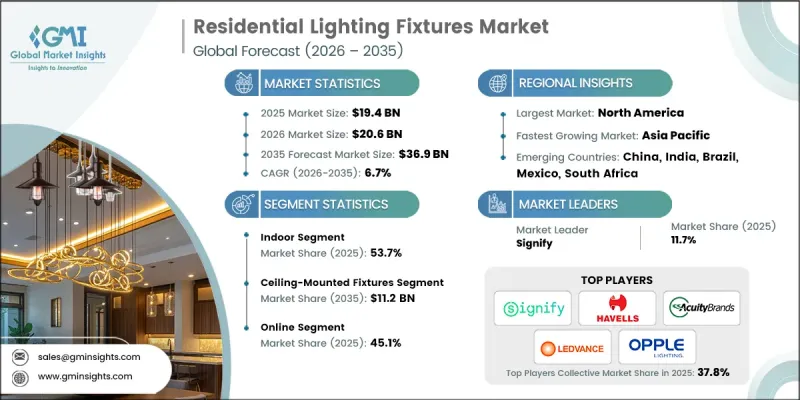
人口快速成长和城市化进程加速,持续推动新建住宅的强劲需求,直接带动了照明灯具的销售。传统萤光和卤素灯向LED照明解决方案的广泛转变,为市场带来了巨大的成长潜力。消费者越来越多地选择LED技术,因为它具有使用寿命长、能源效率高、发热量低等优点。鼓励采用节能照明的扶持性监管措施,进一步增强了市场动力。技术创新也正在重塑市场竞争格局,人工智慧(AI)的整合提升了吸顶灯和檯灯的功能性。消费者对智慧家庭、互联生态系统和身临其境型零售环境的日益关注,正在推动消费者参与并影响其购买决策。製造商正大力投资研发,以推出差异化、设计导向且节能的解决方案,从而满足全球市场不断变化的住宅需求。
| 市场范围 | |
|---|---|
| 开始年份 | 2025 |
| 预测期 | 2026-2035 |
| 上市时的市场规模 | 194亿美元 |
| 预计金额 | 369亿美元 |
| 复合年增长率 | 6.7% |
到2025年,室内照明市占率将达到53.7%。消费者对室内照明的偏好日益转向舒适、个人化和健康型照明。对暖色调照明、基于昼夜节律的照明系统以及多层次照明方案的需求持续增长。具备自动化功能、语音控制和可自订场景设定的智慧照明解决方案正逐渐成为住宅的主流选择。与各种智慧家庭助理和物联网平台的整合正成为消费者购买时的关键考量因素,进一步提升了智慧住宅照明系统的吸引力。
预计到2035年,吸顶式照明灯具市场规模将达112亿美元。由于其在住宅空间中的多功能性,市场对这类灯具的需求仍然强劲。消费者青睐兼具节能性和视觉美感的精緻简约设计,这类灯具通常整合LED模组和智慧调光技术。紧凑型模组化住宅设计的日益普及进一步刺激了对纤薄嵌入式吸顶照明解决方案的需求。製造商正优先考虑色温调节和应用程式控制等功能,以确保与不断扩展的智慧家庭生态系统相容。
到2025年,北美住宅照明市占率将达到31.3%。该地区的成长得益于建筑美学、先进数位控制系统和智慧住宅基础设施的融合。照明技术供应商与智慧建筑解决方案开发商之间日益密切的合作正在重新定义产品创新。 2025年11月由法兰克福展览公司主办的「北美照明+智慧建筑展」的推出,凸显了产业向融合照明产品、控制技术和连网家庭系统的整合平台转型。这种整合模式促进了跨产业伙伴关係,并进一步强化了照明在先进住宅环境中的战略重要性。
目录
第一章:调查方法和范围
第二章执行摘要
第三章业界考察
- 生态系分析
- 供应商情况
- 利润率分析
- 成本结构
- 每个阶段增加的价值
- 影响价值链的因素
- 中断
- 影响产业的因素
- 促进因素
- 全球住宅领域LED照明应用日益普及
- 全球人口成长与都市化
- 支持节能照明的法规
- 美学偏好和对现代、可自订照明设计的需求。
- 住宅照明领域体验式与高端零售模式的拓展
- 产业潜在风险与挑战
- 先进智慧住宅照明设备的初始成本较高
- 开发中国家和价格敏感型市场的住宅敏感性
- 市场机会
- 由于住宅照明基础设施老化,对维修和更换的需求日益增长。
- 出租住宅和合租空间对标准化照明昇级的需求日益增长。
- 促进因素
- 监理情势
- 北美洲
- 欧洲
- 亚太地区
- 拉丁美洲
- 中东和非洲
- 波特五力分析
- PESTEL 分析
- 科技与创新趋势
- 当前技术趋势
- 新兴技术
- 新兴经营模式
- 合规要求
- 专利和智慧财产权分析
- 地缘政治和贸易趋势
第四章 竞争情势
- 介绍
- 企业市占率分析
- 按地区
- 北美洲
- 欧洲
- 亚太地区
- 拉丁美洲
- 中东和非洲
- 按地区
- 主要企业的竞争标竿分析
- 财务绩效比较
- 销售量
- 利润率
- 研究与开发
- 产品系列比较
- 产品线宽度
- 科技
- 创新
- 区域扩张比较
- 全球扩张分析
- 服务网路覆盖
- 按地区分類的市场渗透率
- 竞争定位矩阵
- 领导者
- 挑战者
- 追踪者
- 小众玩家
- 战略展望矩阵
- 财务绩效比较
- 2021-2024 年重大发展
- 併购
- 伙伴关係和联盟
- 技术进步
- 业务拓展与投资策略
- 数位转型计划
- 新兴/Start-Ups竞争对手的发展趋势
第五章 市场估算与预测:依产品类型划分,2022-2035年
- 吸顶式照明灯具
- 吊挂
- 嵌入式照明灯具
- 壁挂式照明灯具
- 其他的
第六章 市场估算与预测:依光源划分,2022-2035年
- LED(发光二极体)
- 萤光
- 卤素
- 白炽灯
第七章 市场估价与预测:依安装地点划分,2022-2035年
- 室内的
- 户外的
第八章 市场估算与预测:依通路划分,2022-2035年
- 在线的
- 离线
第九章 市场估计与预测:依地区划分,2022-2035年
- 北美洲
- 我们
- 加拿大
- 欧洲
- 德国
- 英国
- 法国
- 西班牙
- 义大利
- 荷兰
- 亚太地区
- 中国
- 印度
- 日本
- 澳洲
- 韩国
- 拉丁美洲
- 巴西
- 墨西哥
- 阿根廷
- 中东和非洲
- 南非
- 沙乌地阿拉伯
- 阿拉伯聯合大公国
第十章:公司简介
- 主要企业
- Signify
- Acuity Brands
- Havells
- Ledvance GmbH
- 按地区分類的主要企业
- 北美洲
- Cooper Lighting Solutions
- Hubbell Incorporated
- Lutron
- 欧洲
- ERCO
- Louis Poulsen
- Siteco GmbH
- 亚太地区
- Opple Lighting
- NVC Lighting
- Panasonic
- 北美洲
- 特殊玩家/干扰者
- Cree Lighting USA, LLC.
- GE Lighting(Savant Systems)
- Kichler Lighting
- Thorn Lighting(Zumtobel-Group)
- Visual Comfort &Co.
- WAC Lighting
The Global Residential Lighting Fixtures Market was valued at USD 19.4 billion in 2025 and is estimated to grow at a CAGR of 6.7% to reach USD 36.9 billion by 2035.
Rapid population growth and accelerating urban development continue to generate strong demand for new residential construction, directly supporting lighting fixture sales. The widespread transition from conventional fluorescent and halogen bulbs to LED lighting solutions is creating substantial growth prospects. Consumers are increasingly choosing LED technology due to its extended lifespan, superior energy efficiency, and minimal heat emission. Supportive regulatory initiatives encouraging energy-efficient lighting adoption are further reinforcing market momentum. Technological innovation is also reshaping the competitive landscape, as artificial intelligence integration enhances the functionality of ceiling and table lighting products. Growing interest in smart homes, connected ecosystems, and immersive retail environments is driving consumer engagement and influencing purchase decisions. Manufacturers are allocating significant investments toward research and development to introduce differentiated, design-focused, and energy-efficient solutions that align with evolving residential preferences across global markets.
| Market Scope | |
|---|---|
| Start Year | 2025 |
| Forecast Year | 2026-2035 |
| Start Value | $19.4 Billion |
| Forecast Value | $36.9 Billion |
| CAGR | 6.7% |
The indoor category accounted for 53.7% share in 2025. Consumer preferences within indoor lighting increasingly emphasize comfort, customization, and wellness-focused illumination. Demand for warm lighting tones, circadian-based systems, and multi-layered lighting arrangements continues to gain traction. Smart lighting solutions equipped with automation features, voice-enabled controls, and customizable scene settings are becoming mainstream choices among homeowners. Integration with broader smart home assistants and Internet of Things platforms is emerging as a critical purchase consideration, strengthening the appeal of connected residential lighting systems.
The ceiling-mounted fixtures segment is forecast to reach USD 11.2 billion by 2035. Demand for these fixtures remains strong due to their versatility across multiple residential spaces. Buyers are gravitating toward sleek, minimalist designs incorporating integrated LED modules and intelligent dimming technologies that enhance both energy efficiency and visual appeal. The growing popularity of compact and modular housing designs is further stimulating demand for slim and flush-mounted ceiling lighting solutions. Manufacturers are prioritizing adjustable color temperature features and app-based controls to ensure compatibility with expanding smart home ecosystems.
North America Residential Lighting Fixtures Market held a 31.3% share in 2025. Regional growth is being shaped by the integration of architectural aesthetics, advanced digital control systems, and intelligent residential infrastructure. Increasing collaboration between lighting technology providers and smart building solution developers is redefining product innovation. The introduction of Light + Intelligent Building North America by Messe Frankfurt in November 2025 highlights the industry's shift toward unified platforms that merge lighting products with control technologies and connected home systems. This integrated approach is encouraging cross-industry partnerships and reinforcing the strategic importance of lighting within advanced residential environments.
Key companies operating in the Global Residential Lighting Fixtures Market include Opple Lighting, Signify, Havells, Acuity Brands, Ledvance GmbH, Kichler Lighting, GE Lighting (Savant Systems), Visual Comfort & Co., and Thorn Lighting (Zumtobel Group). Leading participants in the Residential Lighting Fixtures Market are strengthening their competitive positions through innovation-driven product development, strategic partnerships, and geographic expansion. Companies are investing heavily in research and development to introduce AI-enabled and IoT-compatible lighting systems that align with smart home trends. Many players are expanding their LED portfolios with energy-efficient, design-oriented solutions to address shifting consumer preferences. Collaborations with technology firms and smart ecosystem providers are enhancing product interoperability and market reach. Businesses are also focusing on brand differentiation through premiumization strategies and experiential retail concepts that allow customers to interact with advanced lighting solutions.
Table of Contents
Chapter 1 Methodology and Scope
- 1.1 Market scope and definition
- 1.2 Research design
- 1.2.1 Research approach
- 1.2.2 Data collection methods
- 1.3 Data mining sources
- 1.3.1 Global
- 1.3.2 Regional/Country
- 1.4 Base estimates and calculations
- 1.4.1 Base year calculation
- 1.4.2 Key trends for market estimation
- 1.5 Primary research and validation
- 1.5.1 Primary sources
- 1.6 Forecast model
- 1.7 Research assumptions and limitations
Chapter 2 Executive Summary
- 2.1 Industry 360° synopsis, 2021 - 2034
- 2.2 Key market trends
- 2.2.1 Product type trends
- 2.2.2 Light source trends
- 2.2.3 Installation location trends
- 2.2.4 Distribution channel trends
- 2.2.5 Regional trends
- 2.3 TAM analysis, 2025-2034
- 2.4 CXO perspectives: Strategic imperatives
- 2.4.1 Executive decision points
- 2.4.2 Critical success factors
- 2.5 Future outlook and strategic recommendations
Chapter 3 Industry Insights
- 3.1 Industry ecosystem analysis
- 3.1.1 Supplier landscape
- 3.1.2 Profit margin analysis
- 3.1.3 Cost structure
- 3.1.4 Value addition at each stage
- 3.1.5 Factor affecting the value chain
- 3.1.6 Disruptions
- 3.2 Industry impact forces
- 3.2.1 Growth drivers
- 3.2.1.1 Growing adoption of LEDs in residential sectors across the globe
- 3.2.1.2 Growing population and urbanization across the globe
- 3.2.1.3 Supportive regulations for energy efficient lightings
- 3.2.1.4 Aesthetic preferences and demand for modern, customizable lighting designs
- 3.2.1.5 Expansion of experiential and premium retail formats in residential lighting
- 3.2.2 Industry pitfalls and challenges
- 3.2.2.1 High initial cost of advanced and smart residential lighting fixtures
- 3.2.2.2 Price sensitivity among residential consumers in developing and cost-conscious markets
- 3.2.3 Market opportunities
- 3.2.3.1 Retrofit and replacement demand from aging residential lighting infrastructure
- 3.2.3.2 Growth in rental housing and co-living spaces requiring standardized lighting upgrades
- 3.2.1 Growth drivers
- 3.3 Regulatory landscape
- 3.3.1 North America
- 3.3.2 Europe
- 3.3.3 Asia Pacific
- 3.3.4 Latin America
- 3.3.5 Middle East & Africa
- 3.4 Porter's analysis
- 3.5 PESTEL analysis
- 3.6 Technology and innovation landscape
- 3.6.1 Current technological trends
- 3.6.2 Emerging technologies
- 3.7 Emerging business models
- 3.8 Compliance requirements
- 3.9 Patent and IP analysis
- 3.10 Geopolitical and trade dynamics
Chapter 4 Competitive Landscape, 2024
- 4.1 Introduction
- 4.2 Company market share analysis
- 4.2.1 By region
- 4.2.1.1 North America
- 4.2.1.2 Europe
- 4.2.1.3 Asia Pacific
- 4.2.1.4 Latin America
- 4.2.1.5 Middle East & Africa
- 4.2.1 By region
- 4.3 Competitive benchmarking of key players
- 4.3.1 Financial performance comparison
- 4.3.1.1 Revenue
- 4.3.1.2 Profit margin
- 4.3.1.3 R&D
- 4.3.2 Product portfolio comparison
- 4.3.2.1 Product range breadth
- 4.3.2.2 Technology
- 4.3.2.3 Innovation
- 4.3.3 Geographic presence comparison
- 4.3.3.1 Global footprint analysis
- 4.3.3.2 Service network coverage
- 4.3.3.3 Market penetration by region
- 4.3.4 Competitive positioning matrix
- 4.3.4.1 Leaders
- 4.3.4.2 Challengers
- 4.3.4.3 Followers
- 4.3.4.4 Niche players
- 4.3.5 Strategic outlook matrix
- 4.3.1 Financial performance comparison
- 4.4 Key developments, 2021-2024
- 4.4.1 Mergers and acquisitions
- 4.4.2 Partnerships and collaborations
- 4.4.3 Technological advancements
- 4.4.4 Expansion and investment strategies
- 4.4.5 Digital transformation initiatives
- 4.5 Emerging/ startup competitors landscape
Chapter 5 Market Estimates and Forecast, By Product Type, 2022 - 2035 ($ Mn)
- 5.1 Key trends
- 5.2 Ceiling-mounted fixtures
- 5.3 Suspended/hanging fixtures
- 5.4 Recessed fixtures
- 5.5 Wall-mounted fixtures
- 5.6 Others
Chapter 6 Market Estimates and Forecast, By Light Source, 2022 - 2035 ($ Mn)
- 6.1 Key trends
- 6.2 Led (light emitting diode)
- 6.3 Fluorescent
- 6.4 Halogen
- 6.5 Incandescent
Chapter 7 Market Estimates and Forecast, By Installation Location, 2022 - 2035 ($ Mn)
- 7.1 Key trends
- 7.2 Indoor
- 7.3 Outdoor
Chapter 8 Market Estimates and Forecast, By Distribution Channel, 2022 - 2035 ($ Mn)
- 8.1 Key trends
- 8.2 Online
- 8.3 Offline
Chapter 9 Market Estimates and Forecast, By Region, 2022 - 2035 ($ Mn)
- 9.1 Key trends
- 9.2 North America
- 9.2.1 U.S.
- 9.2.2 Canada
- 9.3 Europe
- 9.3.1 Germany
- 9.3.2 UK
- 9.3.3 France
- 9.3.4 Spain
- 9.3.5 Italy
- 9.3.6 Netherlands
- 9.4 Asia Pacific
- 9.4.1 China
- 9.4.2 India
- 9.4.3 Japan
- 9.4.4 Australia
- 9.4.5 South Korea
- 9.5 Latin America
- 9.5.1 Brazil
- 9.5.2 Mexico
- 9.5.3 Argentina
- 9.6 Middle East and Africa
- 9.6.1 South Africa
- 9.6.2 Saudi Arabia
- 9.6.3 UAE
Chapter 10 Company Profiles
- 10.1 Global Key Players
- 10.1.1 Signify
- 10.1.2 Acuity Brands
- 10.1.3 Havells
- 10.1.4 Ledvance GmbH
- 10.2 Regional Key Players
- 10.2.1 North America
- 10.2.1.1 Cooper Lighting Solutions
- 10.2.1.2 Hubbell Incorporated
- 10.2.1.3 Lutron
- 10.2.2 Europe
- 10.2.2.1 ERCO
- 10.2.2.2 Louis Poulsen
- 10.2.2.3 Siteco GmbH
- 10.2.3 APAC
- 10.2.3.1 Opple Lighting
- 10.2.3.2 NVC Lighting
- 10.2.3.3 Panasonic
- 10.2.1 North America
- 10.3 Niche Players / Disruptors
- 10.3.1 Cree Lighting USA, LLC.
- 10.3.2 GE Lighting (Savant Systems)
- 10.3.3 Kichler Lighting
- 10.3.4 Thorn Lighting (Zumtobel-Group)
- 10.3.5 Visual Comfort & Co.
- 10.3.6 WAC Lighting

 全球住宅照明市场规模、份额、趋势和成长分析报告(2026-2034)
 2026年全球厨房照明市场报告
 厨房照明市场-全球产业规模、份额、趋势、机会及预测(依产品类型、通路、最终用户、地区及竞争格局划分,2021-2031年预测)
 全球厨房照明市场全球景观照明市场全球住宅照明市场
 北美户外甲板照明市场规模、份额、趋势分析报告:按产品、应用、国家和细分市场预测,2025 年至 2033 年
 全球户外露臺照明市场:市场规模、占有率、趋势、产业分析(依产品、应用和地区)、未来预测(2025-2034)
 景观照明市场按光源、营运和地区划分厨房照明市场规模、份额和趋势分析报告:按产品类型、按来源、按最终用途、按技术、按分销管道、按地区、细分市场预测,2024-2030 年