


 |
市场调查报告书
商品编码
1982278
自动化市场预分析:成长机会、成长要素、产业趋势以及 2026-2035 年预测。Pre Analytical Automation Market Opportunity, Growth Drivers, Industry Trend Analysis, and Forecast 2026 - 2035 |
||||||

2025 年全球预检自动化市场价值为 73 亿美元,预计到 2035 年将以 8.6% 的复合年增长率增长至 166 亿美元。
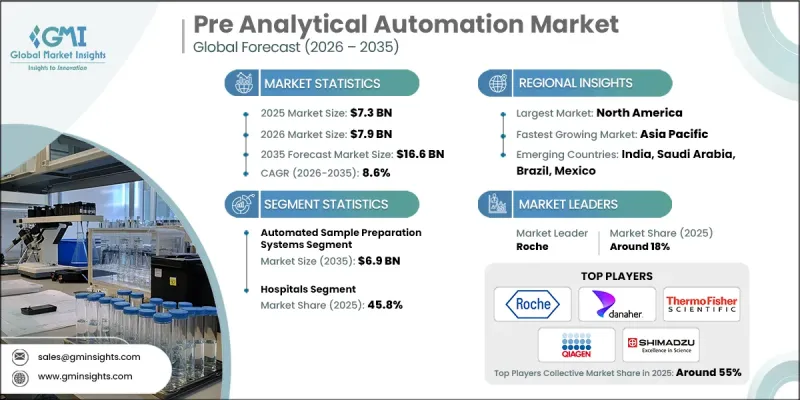
市场成长主要受诊断检测数量稳定增加、检查室自动化需求不断增长以及为实现快速出具检测结果而加大对先进检测设备的资本投入所驱动。全球临床检查室面临着在保持准确性和品质标准的同时提高营运效率的压力。由于早期疾病检测的努力以及慢性病和急性疾病负担的日益加重,每日检测量显着增加。为了应对当前和预期的工作量,检查室正在加速数位转型,并在其营运架构中部署互联的自动化平台。现代化的检体自动化系统简化了检体处理流程,提高了工作流程的连续性,并减少了人工干预。这些解决方案支援提高处理能力、优化检体路径、优先处理紧急病例以及加快处理速度,而无需相应增加人员配备,从而提升了检查室的整体生产力。
| 市场范围 | |
|---|---|
| 开始年份 | 2025 |
| 预测期 | 2026-2035 |
| 上市时的市场规模 | 73亿美元 |
| 预计金额 | 166亿美元 |
| 复合年增长率 | 8.6% |
到2025年,自动化样品製备系统市占率将达到39.5%。对快速检测结果的需求持续推动着处理复杂、高通量检测的实验室采用自动化系统。自动化系统透过标准化和可程式设计的工作流程执行必要的预处理任务,从而简化了复杂的分析前流程。这些平台最大限度地减少了人工操作,降低了人为错误的风险,并提高了检测的一致性和操作准确性。采用先进检测通讯协定的检查室越来越依赖自动化样品製备技术来维持效率、可重复性和品管。
到2025年,医院领域将占据45.8%的市场。随着医院检查室诊断工作量的不断增长,医疗机构正在推进关键分析前阶段的自动化,以保持效率和准确性。大规模医疗机构由于需要处理大量的住院和门诊病人,正在实施自动化,以保持最佳的检测响应时间并减轻员工的工作负担。整合分析前功能的综合自动化生产线正在提升操作标准化程度,并最大限度地减少检体处理过程中的差异。医院检查室采用自动化有助于及时报告、加强品质保证措施并减少对人工操作的依赖。
到2025年,北美实验室前自动化市占率将达到38.6%。这一增长主要得益于诊断需求的不断增长,以及大中型医疗机构在研究、基础设施和检查室现代化方面的大量投资。对高通量检测能力、先进分子诊断和人工智慧驱动的检测系统日益增长的需求,巩固了该地区的主导地位。随着旨在简化工作流程和提高分析准确性的技术不断应用,北美将继续引领检查室自动化创新。
目录
第一章:调查方法和范围
第二章执行摘要
第三章业界考察
- 生态系分析
- 影响产业的因素
- 促进因素
- 检查室自动化的需求日益增长
- 临床诊断中进行的检测数量增加
- 增加对临床检查室的投资,以加快检测结果出炉速度
- 产业潜在风险与挑战
- 高昂的资本成本和实施成本
- 与现有LIS系统整合面临的挑战
- 机会
- 新兴市场自动化扩张
- 促进因素
- 成长潜力分析
- 监理情势(基于初步调查)
- 北美洲
- 欧洲
- 亚太地区
- 技术与创新趋势(基于初步调查)
- 当前技术趋势
- 新兴技术
- 消费者洞察
- 自动化预处理 - 解决方案架构概述
- 供应链分析
- 投资环境
- 波特五力分析
- PESTEL 分析
- 差距分析
- 未来市场趋势(基于初步研究)
第四章 竞争情势
- 介绍
- 企业矩阵分析
- 企业市占率分析
- 世界
- 北美洲
- 欧洲
- 主要市场公司的竞争分析
- 竞争定位矩阵
- 主要进展
- 併购
- 伙伴关係与合作
- 新产品发布
- 业务拓展计划
第五章 市场估算与预测:依产品类型划分,2022-2035年
- 自动化样品製备系统
- 自动化样品处理系统
- 自动化样品分类系统
- 自动化样品储存系统
- 其他产品类型
第六章 市场估算与预测:依最终用途划分,2022-2035年
- 医院
- 临床检查室
- 研究机构
- 其他最终用户
第七章 市场估计与预测:依地区划分,2022-2035年
- 北美洲
- 我们
- 加拿大
- 欧洲
- 德国
- 英国
- 法国
- 西班牙
- 义大利
- 荷兰
- 亚太地区
- 中国
- 日本
- 印度
- 澳洲
- 韩国
- 拉丁美洲
- 巴西
- 墨西哥
- 阿根廷
- 中东和非洲
- 南非
- 沙乌地阿拉伯
- 阿拉伯聯合大公国
第八章:公司简介
- Abbott
- Beckman Coulter(Danaher Corporation)
- Becton, Dickinson and Company
- Copan Diagnostics
- Greiner Bio-One
- HAMILTON
- Inpeco
- QIAGEN
- Roche
- SARSTEDT
- SHIMADZU
- SIEMENS Healthineers
- Sysmex
- TECAN
- Thermo Fisher SCIENTIFIC
The Global Pre Analytical Automation Market was valued at USD 7.3 billion in 2025 and is estimated to grow at a CAGR of 8.6% to reach USD 16.6 billion by 2035.
Market growth is propelled by the steady rise in diagnostic test volumes, increasing demand for laboratory automation, and growing capital investments in advanced laboratory instrumentation aimed at accelerating result delivery. Clinical laboratories worldwide are under mounting pressure to enhance operational efficiency while maintaining accuracy and quality standards. The push for early disease detection, coupled with the rising burden of chronic and acute health conditions, has significantly increased the number of tests processed daily. To manage current and anticipated workloads, laboratories are accelerating digital transformation initiatives and implementing interconnected automation platforms within their operational frameworks. Modern pre-analytical automation systems streamline sample handling processes, improve workflow continuity, and reduce manual intervention. These solutions support higher throughput capacity, optimize sample routing, prioritize urgent cases, and enhance processing speed without proportionally increasing staffing requirements, thereby strengthening overall laboratory productivity.
| Market Scope | |
|---|---|
| Start Year | 2025 |
| Forecast Year | 2026-2035 |
| Start Value | $7.3 Billion |
| Forecast Value | $16.6 Billion |
| CAGR | 8.6% |
The automated sample preparation systems segment captured a 39.5% share in 2025. The demand for faster turnaround times continues to drive adoption across laboratories handling complex and high-volume testing environments. Automated systems simplify intricate pre-analytical procedures by executing essential preparation tasks through standardized and programmable workflows. By minimizing manual handling and reducing the risk of human error, these platforms enhance consistency and operational precision. Laboratories managing sophisticated testing protocols increasingly rely on automated sample preparation technologies to maintain efficiency, reproducibility, and quality control.
The hospitals segment accounted for 45.8% share in 2025. Rising diagnostic workloads within hospital-based laboratories are prompting institutions to automate key pre-analytical stages to preserve efficiency and accuracy. Large healthcare facilities processing high inpatient and outpatient volumes are integrating automation to sustain optimal turnaround times and alleviate workforce strain. Comprehensive automation lines that unify pre-analytical functions have strengthened operational standardization and minimized variability in sample processing. Automation deployment in hospital laboratories contributes to timely reporting, reinforced quality assurance measures, and reduced reliance on manual processes.
North America Pre Analytical Automation Market held a 38.6% share in 2025. The region's growth is supported by rising diagnostic demand and substantial investments in research, infrastructure, and laboratory modernization by both large-scale and mid-sized healthcare institutions. The increasing need for high-throughput testing capabilities, advanced molecular diagnostics, and AI-enhanced laboratory systems is reinforcing regional leadership. Ongoing technological adoption aimed at improving workflow efficiency and analytical accuracy continues to position North America at the forefront of laboratory automation innovation.
Key companies operating in the Global Pre Analytical Automation Market include Roche, Beckman Coulter (Danaher Corporation), Abbott, SIEMENS Healthineers, Thermo Fisher SCIENTIFIC, Becton Dickinson and Company, QIAGEN, Sysmex, HAMILTON, TECAN, SHIMADZU, SARSTEDT, Inpeco, Copan Diagnostics, and Greiner Bio-One. Companies in the Global Pre Analytical Automation Market are reinforcing their competitive positions through sustained investment in innovation, strategic collaborations, and global expansion initiatives. Market leaders are prioritizing the development of integrated and scalable automation platforms designed to accommodate rising test volumes and evolving laboratory requirements. Partnerships with healthcare institutions and diagnostic networks are enhancing system interoperability and long-term service contracts. Organizations are also incorporating artificial intelligence and advanced data analytics to optimize workflow management and predictive maintenance capabilities. Expansion into emerging healthcare markets and strengthening regional distribution networks remain key growth strategies.
Table of Contents
Chapter 1 Methodology and Scope
- 1.1 Market scope and definition
- 1.2 Research design
- 1.2.1 Research approach
- 1.2.2 Data collection methods
- 1.3 Data mining sources
- 1.3.1 Global
- 1.3.2 Regional/Country
- 1.4 Base estimates and calculations
- 1.4.1 Base year calculation
- 1.4.2 Key trends for market estimation
- 1.5 Primary research and validation
- 1.5.1 Primary sources
- 1.6 Forecast model
- 1.7 Research assumptions and limitations
Chapter 2 Executive Summary
- 2.1 Industry 360° synopsis
- 2.2 Key market trends
- 2.2.1 Regional trends
- 2.2.2 Product type trends
- 2.2.3 End use trends
- 2.3 CXO perspectives: Strategic imperatives
Chapter 3 Industry Insights
- 3.1 Industry ecosystem analysis
- 3.2 Industry impact forces
- 3.2.1 Growth drivers
- 3.2.1.1 Rising demand for laboratory automation
- 3.2.1.2 Increasing test volumes in clinical diagnostics
- 3.2.1.3 Growing investments in clinical laboratories for faster turnaround times
- 3.2.2 Industry pitfalls and challenges
- 3.2.2.1 High capital and installation costs
- 3.2.2.2 Integration challenges with existing LIS systems
- 3.2.3 Opportunities
- 3.2.3.1 Expansion of automation in emerging markets
- 3.2.1 Growth drivers
- 3.3 Growth potential analysis
- 3.4 Regulatory landscape (Driven by Primary Research)
- 3.4.1 North America
- 3.4.2 Europe
- 3.4.3 Asia Pacific
- 3.5 Technology and innovation landscape (Driven by Primary Research)
- 3.5.1 Current technological trends
- 3.5.2 Emerging technologies
- 3.6 Consumer insights
- 3.7 Pre analytical automation - Solution Architecture overview
- 3.8 Supply chain analysis
- 3.9 Investment landscape
- 3.10 Porter's analysis
- 3.11 PESTEL analysis
- 3.12 Gap analysis
- 3.13 Future market trends (Driven by Primary Research)
Chapter 4 Competitive Landscape, 2025
- 4.1 Introduction
- 4.2 Company matrix analysis
- 4.3 Company market share analysis
- 4.3.1 Global
- 4.3.2 North America
- 4.3.3 Europe
- 4.4 Competitive analysis of major market players
- 4.5 Competitive positioning matrix
- 4.6 Key developments
- 4.6.1 Mergers & acquisitions
- 4.6.2 Partnerships & collaborations
- 4.6.3 New product launches
- 4.6.4 Expansion plans
Chapter 5 Market Estimates and Forecast, By Product Type, 2022 - 2035 ($ Mn)
- 5.1 Key trends
- 5.2 Automated sample preparation systems
- 5.3 Automated sample transport systems
- 5.4 Automated sample sorting systems
- 5.5 Automated sample storage systems
- 5.6 Other product types
Chapter 6 Market Estimates and Forecast, By End Use, 2022 - 2035 ($ Mn)
- 6.1 Key trends
- 6.2 Hospitals
- 6.3 Clinical laboratories
- 6.4 Research institutes
- 6.5 Other end users
Chapter 7 Market Estimates and Forecast, By Region, 2022 - 2035 ($ Mn)
- 7.1 Key trends
- 7.2 North America
- 7.2.1 U.S.
- 7.2.2 Canada
- 7.3 Europe
- 7.3.1 Germany
- 7.3.2 UK
- 7.3.3 France
- 7.3.4 Spain
- 7.3.5 Italy
- 7.3.6 Netherlands
- 7.4 Asia Pacific
- 7.4.1 China
- 7.4.2 Japan
- 7.4.3 India
- 7.4.4 Australia
- 7.4.5 South Korea
- 7.5 Latin America
- 7.5.1 Brazil
- 7.5.2 Mexico
- 7.5.3 Argentina
- 7.6 MEA
- 7.6.1 South Africa
- 7.6.2 Saudi Arabia
- 7.6.3 UAE
Chapter 8 Company Profiles
- 8.1 Abbott
- 8.2 Beckman Coulter (Danaher Corporation)
- 8.3 Becton, Dickinson and Company
- 8.4 Copan Diagnostics
- 8.5 Greiner Bio-One
- 8.6 HAMILTON
- 8.7 Inpeco
- 8.8 QIAGEN
- 8.9 Roche
- 8.10 SARSTEDT
- 8.11 SHIMADZU
- 8.12 SIEMENS Healthineers
- 8.13 Sysmex
- 8.14 TECAN
- 8.15 Thermo Fisher SCIENTIFIC

 蛋白质工程实验室自动化市场:按产品类型、自动化平台、技术、应用和最终用户分類的全球市场预测 – 2026-2032 年
 2026年全球实验室自动化市场报告
 全球实验室自动化市场规模、份额、趋势和成长分析报告(2026-2034年)实验室自动化市场:按类型、交付方式、部署方式、应用程式和最终用户划分-2026-2032年全球市场预测2026年全球药物研发实验室自动化市场报告2026年全球实验室自动化系统市场报告
 基因组学实验室自动化市场分析及预测(至2035年):按类型、产品类型、服务、技术、组件、应用、最终用户、流程、设备和解决方案划分实验室桌上型自动化市场分析及预测(至2035年):依类型、产品类型、服务、技术、组件、应用、最终使用者、流程及部署类型划分实验室自动化市场分析及预测(至2035年):依类型、产品类型、服务、技术、组件、应用、流程、最终使用者、功能、设备划分生物分析实验室自动化市场分析及预测(至2035年):按类型、产品类型、服务、技术、组件、应用、最终用户、流程、设备和解决方案划分