


 |
市场调查报告书
商品编码
1982311
ID卡印表机市场机会、成长要素、产业趋势分析及2026-2035年预测ID Card Printers Market Opportunity, Growth Drivers, Industry Trend Analysis, and Forecast 2026 - 2035 |
||||||

2025年全球ID卡印表机市场价值为9.533亿美元,预计到2035年将以5.6%的复合年增长率成长至16.2亿美元。
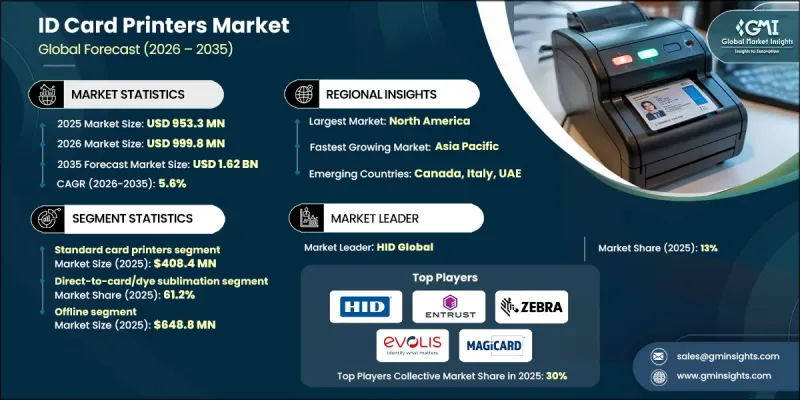
随着各组织不断加强职场安全和身分保护,ID卡印表机产业正稳步发展。对未授权存取、资料外洩和资产保护日益增长的担忧,促使企业在其所有设施中部署安全的识别系统。ID卡仍然是门禁控制和验证员工身分的主要认证工具。随着企业将业务扩展到多个地点并支援混合办公模式,对标准化身分管理系统的需求持续成长。各组织优先考虑按需发放ID卡,以便员工、承包商和访客能够立即获得符合规定的身份证明。将ID卡印表机与门禁控制和数位身分平台集成,可实现身分的即时续约和撤销,从而提高营运效率和安全性。更严格的监管要求和对高级安全功能日益增长的需求,进一步推动了全球对现代化ID卡列印解决方案的投资。
| 市场范围 | |
|---|---|
| 开始年份 | 2025 |
| 预测期 | 2026-2035 |
| 初始市场规模 | 9.533亿美元 |
| 预测金额 | 16.2亿美元 |
| 复合年增长率 | 5.6% |
预计到2025年,标准证卡印表机的市场规模将达到4.084亿美元。这些印表机被众多机构广泛采用,它们需要可靠的解决方案来建立包含必要视觉和文字资讯的基本识别文件。标准型号通常采用简化的列印流程,直接在卡片表面进行列印,确保输出品质的一致性。其经济高效且易于操作的特点,使其适用于对安全性要求不高的环境。因此,对于需要高效率、入门级身分验证卡製作的企业而言,标准ID卡印表机仍然是首选。
预计到2025年,直接印卡(DTC)或热昇华印卡技术将占据61.6%的市场。该技术利用热能将染料直接转移到卡片表面,从而实现高解析度影像和流畅的色彩渐变。 DTC印表机因其能够有效率地製作精细影像并有效控製成本而备受青睐。其速度和扩充性使其成为需要在短时间内生产中大量ID卡的机构的理想选择。
美国ID卡印表机市占率高达78.8%,预计2025年市场规模将达2.398亿美元。美国市场成长的主要驱动力是政府机构、企业、医疗机构和教育机构对安全身分系统的强劲需求。严格的合规标准推动了高解析度输出、智慧卡编码和多层安全功能的先进印表机的普及。此外,门禁控制基础设施和云端身分管理平台的日益普及,进一步巩固了美国作为ID卡列印技术创新中心的地位。
目录
第一章:调查方法和范围
第二章执行摘要
第三章业界考察
- 生态系分析
- 供应商情况
- 利润率
- 每个阶段增加的价值
- 影响价值链的因素
- 影响产业的因素
- 促进因素
- 安全和存取控制需求
- 智慧卡与非接触式技术
- 客製化和品牌推广
- 产业潜在风险与挑战
- 初始成本高
- 维护/耗材
- 机会
- 与云端和行动端集成
- 环保解决方案
- 促进因素
- 成长潜力分析
- 未来市场趋势
- 科技与创新趋势
- 当前技术趋势
- 新兴技术
- 价格趋势
- 按地区
- 依产品类型
- 监理情势
- 标准和合规要求
- 区域法规结构
- 认证标准
- 波特的分析
- PESTEL 分析
第四章 竞争情势
- 介绍
- 企业市占率分析
- 按地区
- 企业矩阵分析
- 主要市场公司的竞争分析
- 竞争定位矩阵
- 主要进展
- 併购
- 伙伴关係与合作
- 新产品发布
- 业务拓展计划
第五章 市场估算与预测:依产品类型划分,2022-2035年
- 单面卡印表机
- 双面卡片印表机
- 高性能卡片印表机
- 标准卡片印表机
第六章 市场估计与预测:依技术类型划分,2022-2035年
- 反向转帐
- 直接印製到卡片上/热昇华型
- 可重写
第七章 市场估计与预测:依最终用户划分,2022-2035年
- 公司
- 教育机构
- 政府
- 商业的
第八章 市场估算与预测:依通路划分,2022-2035年
- 离线
- 超级市场
- 专卖店
- 其他(百货公司等)
- 在线的
- 电子商务
- 品牌官方网站
第九章 市场估计与预测:依地区划分,2022-2035年
- 北美洲
- 我们
- 加拿大
- 欧洲
- 德国
- 英国
- 法国
- 义大利
- 西班牙
- 亚太地区
- 中国
- 日本
- 印度
- 澳洲
- 韩国
- 拉丁美洲
- 巴西
- 墨西哥
- 阿根廷
- 中东和非洲
- 南非
- 沙乌地阿拉伯
- 阿拉伯聯合大公国
第十章:公司简介
- Alpha Card
- CIM USA
- Dai Nippon
- DASCOM
- Entrust Datacard
- Evolis
- Goldpac
- HID Global
- Magicard
- Matica Technologies
- NBS Technologies
- Nisca
- Swiftcolor
- Valid USA
- Zebra
The Global ID Card Printers Market was valued at USD 953.3 million in 2025 and is estimated to grow at a CAGR of 5.6% to reach USD 1.62 billion by 2035.
The ID card printers industry is expanding steadily as organizations intensify efforts to strengthen workplace security and identity protection. Rising concerns about unauthorized access, data breaches, and asset protection are prompting businesses to adopt secure identification systems across facilities. ID cards remain a primary authentication tool for controlling entry and verifying personnel credentials. As companies expand operations across multiple sites and support hybrid work models, the need for standardized identity management systems continues to increase. Organizations are prioritizing on-demand ID card issuance to ensure employees, contractors, and visitors receive compliant credentials immediately. Integration of ID card printers with access control and digital identity platforms enables real-time credential updates and revocation, enhancing operational efficiency and safety. Growing regulatory requirements and the demand for advanced security features are further driving investment in modern ID card printing solutions worldwide.
| Market Scope | |
|---|---|
| Start Year | 2025 |
| Forecast Year | 2026-2035 |
| Start Value | $953.3 Million |
| Forecast Value | $1.62 Billion |
| CAGR | 5.6% |
In 2025, the standard card printers accounted for USD 408.4 million. These printers are widely adopted by organizations seeking reliable solutions for producing essential identification cards with necessary visual and text-based information. Standard models are typically designed for direct printing onto card surfaces using streamlined printing processes that ensure consistent output quality. Their cost-effectiveness and ease of operation make them suitable for environments where advanced security elements are not mandatory. As a result, standard ID card printers remain a preferred choice for businesses requiring efficient, entry-level credential production.
The direct-to-card (DTC) or dye sublimation segment held 61.6% share in 2025. This technology transfers dye directly onto the card surface through heat application, enabling high-resolution imagery and smooth color gradients. DTC printers are valued for their ability to produce detailed graphics efficiently while maintaining cost control. Their speed and scalability make them suitable for organizations that need to generate medium-to-high volumes of ID cards within short timeframes.
United States ID Card Printers Market held 78.8% share, generating USD 239.8 million in 2025. Market growth in the country is supported by strong demand for secure identification systems across government, corporate, healthcare, and educational institutions. Strict compliance standards are encouraging the adoption of advanced printers capable of high-resolution output, smart card encoding, and layered security features. Expanding implementation of access control infrastructure and cloud-based identity management platforms is further strengthening the U.S. position as a hub for innovation in ID card printing technologies.
Key companies operating in the Global ID Card Printers Market include Zebra, HID Global, Evolis, Entrust Datacard, Magicard, Matica Technologies, NBS Technologies, Nisca, DASCOM, Dai Nippon, Goldpac, Valid USA, Swiftcolor, CIM USA, and AlphaCard. Companies in the ID Card Printers Market are enhancing their competitive position through product innovation and digital integration strategies. Leading manufacturers are investing in advanced security features such as smart card encoding, holographic overlays, and secure data encryption capabilities. Partnerships with access control providers and identity management software firms are enabling seamless system integration. Firms are also expanding cloud-based printing solutions and remote management capabilities to support distributed workforces.
Table of Contents
Chapter 1 Methodology and Scope
- 1.1 Market scope and definition
- 1.2 Research design
- 1.2.1 Research approach
- 1.2.2 Data collection methods
- 1.3 Data mining sources
- 1.3.1 Global
- 1.3.2 Regional/Country
- 1.4 Base estimates and calculations
- 1.4.1 Base year calculation
- 1.4.2 Key trends for market estimation
- 1.5 Primary research and validation
- 1.5.1 Primary sources
- 1.6 Forecast model
- 1.7 Research assumptions and limitations
Chapter 2 Executive Summary
- 2.1 Industry 360° synopsis
- 2.2 Key market trends
- 2.2.1 Regional
- 2.2.2 Product type
- 2.2.3 Technology type
- 2.2.4 End user
- 2.2.5 Distribution channel
- 2.3 CXO perspectives: Strategic imperatives
- 2.3.1 Key decision points for industry executives
- 2.3.2 Critical success factors for market players
- 2.4 Future outlook and strategic recommendations
Chapter 3 Industry Insights
- 3.1 Industry ecosystem analysis
- 3.1.1 Supplier landscape
- 3.1.2 Profit margin
- 3.1.3 Value addition at each stage
- 3.1.4 Factor affecting the value chain
- 3.2 Industry impact forces
- 3.2.1 Growth drivers
- 3.2.1.1 Security & access control needs
- 3.2.1.2 Smart card & contactless technology
- 3.2.1.3 Customization & branding
- 3.2.2 Industry pitfalls & challenges
- 3.2.2.1 High initial cost
- 3.2.2.2 Maintenance & consumables
- 3.2.3 Opportunities
- 3.2.3.1 Cloud & mobile integration
- 3.2.3.2 Eco-friendly solutions
- 3.2.1 Growth drivers
- 3.3 Growth potential analysis
- 3.4 Future market trends
- 3.5 Technology and innovation landscape
- 3.5.1 Current technological trends
- 3.5.2 Emerging technologies
- 3.6 Price trends
- 3.6.1 By region
- 3.6.2 By product type
- 3.7 Regulatory landscape
- 3.7.1 Standards and compliance requirements
- 3.7.2 Regional regulatory frameworks
- 3.7.3 Certification standards
- 3.8 Porter’s analysis
- 3.9 PESTEL analysis
Chapter 4 Competitive Landscape, 2025
- 4.1 Introduction
- 4.2 Company market share analysis
- 4.2.1 By region
- 4.2.1.1 North America
- 4.2.1.2 Europe
- 4.2.1.3 Asia Pacific
- 4.2.1.4 Latin America
- 4.2.1.5 Middle East and Africa
- 4.2.1 By region
- 4.3 Company matrix analysis
- 4.4 Competitive analysis of major market players
- 4.5 Competitive positioning matrix
- 4.6 Key developments
- 4.6.1 Mergers & acquisitions
- 4.6.2 Partnerships & collaborations
- 4.6.3 New product launches
- 4.6.4 Expansion plans
Chapter 5 Market Estimates and Forecast, By Product Type, 2022 - 2035 (USD Million) (Thousand Units)
- 5.1 Key trends
- 5.2 Single-sided card printers
- 5.3 Double-sided card printers
- 5.4 High-performance card printers
- 5.5 Standard card printers
Chapter 6 Market Estimates and Forecast, By Technology Type, 2022 - 2035 (USD Million) (Thousand Units)
- 6.1 Key trends
- 6.2 Reverse transfer
- 6.3 Direct-to-Card/Dye sublimation
- 6.4 Rewritable
Chapter 7 Market Estimates and Forecast, By End User, 2022 - 2035 (USD Million) (Thousand Units)
- 7.1 Key trends
- 7.2 Enterprise
- 7.3 Educational institutions
- 7.4 Government
- 7.5 Commercial
Chapter 8 Market Estimates and Forecast, By Distribution Channel, 2022 - 2035 (USD Million) (Thousand Units)
- 8.1 Key trends
- 8.2 Offline
- 8.2.1 Supermarkets
- 8.2.2 Specialty stores
- 8.2.3 Others (Departmental stores, etc.)
- 8.3 Online
- 8.3.1 E-commerce
- 8.3.2 Brand websites
Chapter 9 Market Estimates and Forecast, By Region, 2022 - 2035 (USD Million) (Thousand Units)
- 9.1 Key trends
- 9.2 North America
- 9.2.1 U.S.
- 9.2.2 Canada
- 9.3 Europe
- 9.3.1 Germany
- 9.3.2 UK
- 9.3.3 France
- 9.3.4 Italy
- 9.3.5 Spain
- 9.4 Asia Pacific
- 9.4.1 China
- 9.4.2 Japan
- 9.4.3 India
- 9.4.4 Australia
- 9.4.5 South Korea
- 9.5 Latin America
- 9.5.1 Brazil
- 9.5.2 Mexico
- 9.5.3 Argentina
- 9.6 Middle East and Africa
- 9.6.1 South Africa
- 9.6.2 Saudi Arabia
- 9.6.3 UAE
Chapter 10 Company Profiles
- 10.1 Alpha Card
- 10.2 CIM USA
- 10.3 Dai Nippon
- 10.4 DASCOM
- 10.5 Entrust Datacard
- 10.6 Evolis
- 10.7 Goldpac
- 10.8 HID Global
- 10.9 Magicard
- 10.10 Matica Technologies
- 10.11 NBS Technologies
- 10.12 Nisca
- 10.13 Swiftcolor
- 10.14 Valid USA
- 10.15 Zebra


