


 |
市场调查报告书
商品编码
1982320
2026 年至 2035 年环保清洁产品的市场机会、成长要素、产业趋势与预测。Eco-friendly Cleaning Products Market Opportunity, Growth Drivers, Industry Trend Analysis, and Forecast 2026 - 2035 |
||||||

预计到 2025 年,全球环保清洁产品市场价值将达到 132 亿美元,并预计以 10% 的复合年增长率成长,到 2035 年达到 336 亿美元。
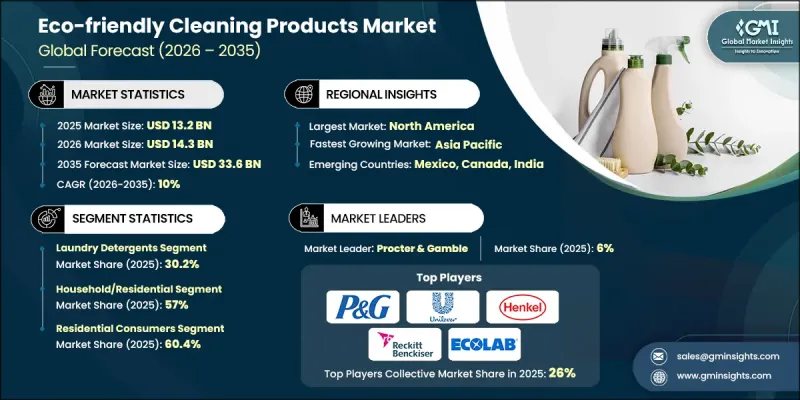
随着永续性、健康意识和产品创新重塑全球消费者的期望,清洁产业正经历一场重大变革。製造商正在重新设计产品,以植物来源的酵素、生物基界面活性剂和矿物来源的消毒剂取代传统的合成成分,在保持同等清洁性能的同时,降低对环境的影响。配方技术的进步使得环保产品对各种家庭和工业污染物的清除率达到95%至99%,显示永续性不再以牺牲有效性为代价。同时,企业也在重新思考包装和分销策略,以最大限度地减少对环境的影响。消费者对室内空气品质、化学物质暴露和整体健康的日益关注,正在加速向更安全、可生物降解的清洁解决方案的转变。随着法律规范的加强和生态标籤认证影响力的不断扩大,製造商正在使产品开发符合环境合规标准。这些变化共同重塑了环保清洁产品在住宅和商业市场的配方、生产、行销和分销方式。
| 市场范围 | |
|---|---|
| 开始年份 | 2025 |
| 预测期 | 2026-2035 |
| 上市时的市场规模 | 132亿美元 |
| 预测金额 | 336亿美元 |
| 复合年增长率 | 10% |
浓缩型、可重复填充型和节水型产品的日益普及,标誌着环保清洁产品市场正在发生重大转变。浓缩型产品透过减少包装废弃物、降低运输排放和优化储存效率,强化了永续性目标。大众对健康问题和接触有害化学物质的日益关注,并显着提升了家庭和商业环境中对环保清洁解决方案的需求。
到2025年,洗衣精市场占有率将达到30.2%。高使用频率和消费者对植物来源、亲肤配方产品日益增长的需求将继续推动该品类的市场主导地位。消费者越来越倾向于选择可生物降解、无磷、低毒性的清洁剂,以最大限度地减少水污染并降低刺激风险。住宅和公共设施中洗衣液使用量的增加将进一步促进该品类的持续成长,尤其是在废水排放法规严格的地区。
到2025年,家庭和住宅市场将占据57%的市场。这一主导地位反映出消费者对传统化学清洁剂潜在健康风险的认识不断提高,尤其是在有健康风险族群的家庭中。零售商店产品供应的增加和电子商务通路的拓展正在加速住宅领域的普及,并提升市场渗透率。
预计2025年,美国环保清洁产品市场规模将达34亿美元,市占率高达76.8%,年复合成长率达10.2%。消费者环保意识的提高、对无毒可生物降解产品的偏好日益增长以及对室内环境品质的关注度不断提高,是推动市场扩张的主要因素。此外,严格的环境政策、生态标章标准的实施以及企业永续发展要求,也促进了商业设施、医疗机构和教育机构采用环保清洁解决方案,从而推动了该地区市场的成长。
目录
第一章:调查方法和范围
第二章执行摘要
第三章业界考察
- 生态系分析
- 供应商情况
- 利润率
- 每个阶段增加的价值
- 影响价值链的因素
- 影响产业的因素
- 促进因素
- 消费者对永续和无害产品的需求日益增长
- 严格的环境法规和生态标章的引入
- 在商业和公共设施中推广绿色清洁计划
- 产业潜在风险与挑战
- 生产成本上升和原物料价格波动
- 对产品性能的感知与消费者的怀疑态度
- 机会
- 浓缩型、可重复填充型及低废弃物产品形式
- 企业ESG倡议与绿色采购政策
- 促进因素
- 成长潜力分析
- 未来市场趋势
- 科技与创新趋势
- 当前技术趋势
- 新兴技术
- 价格趋势
- 按地区
- 按类型
- 监理情势
- 标准和合规要求
- 区域法规结构
- 认证标准
- 波特五力分析
- PESTEL 分析
第四章 竞争情势
- 介绍
- 企业市占率分析
- 按地区
- 企业矩阵分析
- 主要市场公司的竞争分析
- 竞争定位矩阵
- 主要进展
- 併购
- 伙伴关係与合作
- 新产品发布
- 业务拓展计划
第五章 市场估算与预测:依产品类型划分,2022-2035年
- 一般清洁剂
- 多用途家用清洁剂
- 商用多用途清洁剂
- 浴室和水疗中心清洁剂
- 浴缸和瓷砖清洁剂
- 马桶清洁剂
- 淋浴设备玻璃清洁剂
- 玻璃和窗户清洁剂
- 住宅玻璃清洁剂
- 商用窗户清洁解决方案
- 汽车玻璃清洁剂
- 地板清洁剂和保护剂
- 硬地板清洁剂
- 地毯和家具清洁剂
- 地板保护和饰面材料
- 清洁剂
- 洗手用的清洁剂
- 洗碗机清洁剂
- 冲洗剂和添加剂
- 洗衣精
- 通用洗衣产品
- 浓缩液体清洁剂
- 粉末和胶囊配方
- 衣物柔软精和护理剂
- 消毒剂和清洁剂
- 经美国环保署DFE认证的抗菌产品
- 干洗手剂和个人保健产品
- 表面消毒剂
- 特殊清洁剂
- 烤箱和烧烤架清洁剂
- 金属清洁剂和抛光剂
- 地毯和家具清洁剂
- 排水管维护产品
第六章 市场估计与预测:依应用领域划分,2022-2035年
- 首页/住宅
- 商业的
- 工业的
第七章 市场估计与预测:依价格区间划分,2022-2035年
- 低价位
- 中价位
- 高价位范围
第八章 市场估算与预测:依通路划分,2022-2035年
- 在线的
- 电子商务网站
- 公司网站
- 离线
- 超级市场/大卖场
- 零售商店
- 其他的
第九章 市场估计与预测:依地区划分,2022-2035年
- 北美洲
- 我们
- 加拿大
- 欧洲
- 英国
- 德国
- 法国
- 义大利
- 西班牙
- 俄罗斯
- 亚太地区
- 中国
- 印度
- 日本
- 韩国
- 澳洲
- 拉丁美洲
- 巴西
- 墨西哥
- 阿根廷
- 中东和非洲(MEA)
- 南非
- 沙乌地阿拉伯
- 阿拉伯聯合大公国
第十章:公司简介
- BASF SE
- Biokleen
- Church &Dwight Co., Inc.
- Croda International PLC
- Diamond Wipes International, Inc.
- Diversey, Inc.
- Earth Friendly Products
- Ecolab Inc.
- Ecover
- Evonik Industries AG
- Henkel AG &Co. KGaA
- Novozymes A/S(Novonesis)
- Procter &Gamble
- Reckitt Benckiser Group PLC
- Seventh Generation
- Spartan Chemical Company, Inc.
- Unilever
The Global Eco-friendly Cleaning Products Market was valued at USD 13.2 billion in 2025 and is estimated to grow at a CAGR of 10% to reach USD 33.6 billion by 2035.
The industry is undergoing a significant transformation as sustainability, health awareness, and product innovation reshape consumer expectations worldwide. Manufacturers are reformulating products by replacing conventional synthetic ingredients with plant-derived enzymes, bio-based surfactants, and mineral-based disinfecting agents that deliver comparable cleaning performance while reducing environmental impact. Advances in formulation science now allow eco-friendly products to achieve 95%-99% effectiveness against a broad spectrum of household and industrial contaminants, demonstrating that sustainability no longer compromises efficacy. In parallel, companies are redesigning packaging and distribution strategies to minimize environmental footprints. Growing consumer focus on indoor air quality, chemical exposure, and overall wellness is accelerating the transition toward safer and biodegradable cleaning solutions. As regulatory oversight strengthens and eco-label certifications gain influence, manufacturers are aligning product development with environmental compliance standards. Collectively, these shifts are redefining how eco-friendly cleaning products are formulated, produced, marketed, and adopted across residential and commercial markets.
| Market Scope | |
|---|---|
| Start Year | 2025 |
| Forecast Year | 2026-2035 |
| Start Value | $13.2 Billion |
| Forecast Value | $33.6 Billion |
| CAGR | 10% |
The increasing introduction of concentrated, refillable, and water-efficient product formats marks a substantial shift in the eco-friendly cleaning products market. Concentrated solutions reduce packaging waste, lower transportation emissions, and optimize storage efficiency, reinforcing sustainability objectives. Rising public awareness regarding health considerations and exposure to harsh chemicals is significantly boosting demand for environmentally responsible cleaning solutions in both households and commercial environments.
In 2025, the laundry detergents segment accounted for 30.2% share. High usage frequency and growing demand for plant-based, skin-friendly formulations continue to drive this category's dominance. Consumers increasingly favor biodegradable, phosphate-free, and low-toxicity detergent options that help minimize water contamination and reduce irritation risks. Adoption across residential settings and institutional facilities further supports sustained segment growth, particularly in regions with strict wastewater discharge regulations.
The household and residential segment represented 57% share in 2025. This leadership position reflects heightened consumer awareness regarding potential health risks associated with conventional chemical cleaners, especially in homes with vulnerable populations. Broader product availability through retail outlets and expanding e-commerce channels is accelerating adoption and strengthening market penetration within the residential sector.
U.S. Eco-friendly Cleaning Products Market accounted for 76.8% share in 2025, equivalent to USD 3.4 billion, and is projected to grow at a CAGR of 10.2%. Strong consumer awareness, increasing preference for non-toxic and biodegradable products, and rising concern about indoor environmental quality are key drivers of market expansion. The region also benefits from rigorous environmental policies, enforcement of eco-labeling standards, and corporate sustainability mandates that encourage the adoption of green cleaning solutions across commercial facilities, healthcare institutions, and educational establishments.
Major companies operating in the Global Eco-friendly Cleaning Products Market include Procter & Gamble, Unilever, Reckitt Benckiser Group PLC, Henkel AG & Co. KGaA, Ecolab Inc., Seventh Generation, Church & Dwight Co., Inc., BASF SE, Evonik Industries AG, Croda International PLC, Novozymes A/S, Diversey, Inc., Spartan Chemical Company, Inc., Ecover, Earth Friendly Products, Biokleen, and Diamond Wipes International, Inc. Companies competing in the Global Eco-friendly Cleaning Products Market are strengthening their market position through sustainable innovation and strategic brand differentiation. Leading players are investing in bio-based ingredient research, biodegradable formulations, and refillable packaging systems to meet evolving regulatory and consumer expectations. Strategic partnerships with retailers and online platforms are expanding product visibility and distribution reach. Many organizations are enhancing transparency through eco-certifications and sustainability reporting to build consumer trust. Portfolio expansion into concentrated and water-efficient solutions is helping brands address environmental concerns while improving cost efficiency.
Table of Contents
Chapter 1 Methodology and Scope
- 1.1 Market scope and definition
- 1.2 Research design
- 1.2.1 Research approach
- 1.2.2 Data collection methods
- 1.3 Data mining sources
- 1.3.1 Global
- 1.3.2 Regional/Country
- 1.4 Base estimates and calculations
- 1.4.1 Base year calculation
- 1.4.2 Key trends for market estimation
- 1.5 Primary research and validation
- 1.5.1 Primary sources
- 1.6 Forecast model
- 1.7 Research assumptions and limitations
Chapter 2 Executive Summary
- 2.1 Industry 360° synopsis
- 2.2 Key market trends
- 2.2.1 Regional
- 2.2.2 Product type
- 2.2.3 Application
- 2.2.4 Price range
- 2.2.5 Distribution channel
- 2.3 CXO perspectives: Strategic imperatives
- 2.3.1 Key decision points for industry executives
- 2.3.2 Critical success factors for market players
- 2.4 Future outlook and strategic recommendations
Chapter 3 Industry Insights
- 3.1 Industry ecosystem analysis
- 3.1.1 Supplier landscape
- 3.1.2 Profit margin
- 3.1.3 Value addition at each stage
- 3.1.4 Factor affecting the value chain
- 3.2 Industry impact forces
- 3.2.1 Growth drivers
- 3.2.1.1 Rising consumer demand for sustainable & non toxic products
- 3.2.1.2 Stringent environmental regulations & eco label adoption
- 3.2.1.3 Growth of commercial & institutional green cleaning programs
- 3.2.2 Industry pitfalls & challenges
- 3.2.2.1 Higher production costs & raw material price volatility
- 3.2.2.2 Performance perception & consumer skepticism
- 3.2.3 Opportunities
- 3.2.3.1 Concentrated, refill & low waste product formats
- 3.2.3.2 Corporate ESG commitments & green procurement policies
- 3.2.1 Growth drivers
- 3.3 Growth potential analysis
- 3.4 Future market trends
- 3.5 Technology and innovation landscape
- 3.5.1 Current technological trends
- 3.5.2 Emerging technologies
- 3.6 Price trends
- 3.6.1 By region
- 3.6.2 By type
- 3.7 Regulatory landscape
- 3.7.1 Standards and compliance requirements
- 3.7.2 Regional regulatory frameworks
- 3.7.3 Certification standards
- 3.8 Porter’s analysis
- 3.9 PESTEL analysis
Chapter 4 Competitive Landscape, 2025
- 4.1 Introduction
- 4.2 Company market share analysis
- 4.2.1 By region
- 4.2.1.1 North America
- 4.2.1.2 Europe
- 4.2.1.3 Asia Pacific
- 4.2.1.4 Latin America
- 4.2.1.5 Middle East and Africa
- 4.2.1 By region
- 4.3 Company matrix analysis
- 4.4 Competitive analysis of major market players
- 4.5 Competitive positioning matrix
- 4.6 Key developments
- 4.6.1 Mergers & acquisitions
- 4.6.2 Partnerships & collaborations
- 4.6.3 New product launches
- 4.6.4 Expansion plans
Chapter 5 Market Estimates & Forecast, By Product Type, 2022 - 2035 (USD Billion) (Thousand Units)
- 5.1 Key trends
- 5.2 General purpose cleaner
- 5.2.1 Multi-surface household cleaners
- 5.2.2 Commercial all-purpose cleaners
- 5.3 Bathroom & spa cleaners
- 5.3.1 Tub & tile cleaners
- 5.3.2 Toilet bowl cleaners
- 5.4 Shower & glass cleaners
- 5.5 Glass & window cleaners
- 5.5.1 Residential glass cleaners
- 5.5.2 Commercial window cleaning solutions
- 5.5.3 Automotive glass cleaners
- 5.6 Floor cleaners & protectors
- 5.6.1 Hard surface floor cleaners
- 5.6.2 Carpet & upholstery cleaners
- 5.6.3 Floor protectors & finishes
- 5.7 Dishwashing products
- 5.7.1 Manual dishwashing liquids
- 5.7.2 Automatic dishwasher detergents
- 5.7.3 Rinse aids & additives
- 5.8 Laundry detergents
- 5.8.1 General purpose laundry products
- 5.8.2 Concentrated liquid detergents
- 5.8.3 Powder & pod formulations
- 5.8.4 Fabric softeners & conditioners
- 5.9 Disinfectants & sanitizers
- 5.9.1 EPA DFE certified antimicrobial products
- 5.9.2 Hand sanitizers & personal care
- 5.9.3 Surface disinfectants
- 5.10 Specialty cleaners
- 5.10.1 Oven & grill cleaners
- 5.10.2 Metal cleaners & polishes
- 5.10.3 Carpet & upholstery cleaners
- 5.10.4 Drain maintenance products
Chapter 6 Market Estimates & Forecast, By Application, 2022 - 2035 (USD Billion) (Thousand Units)
- 6.1 Key trends
- 6.2 Household/residential
- 6.3 Commercial
- 6.4 Industrial
Chapter 7 Market Estimates & Forecast, By Price Range, 2022 - 2035 (USD Billion) (Thousand Units)
- 7.1 Key trends
- 7.2 Low
- 7.3 Mid
- 7.4 High
Chapter 8 Market Estimates & Forecast, By Distribution Channel, 2022 - 2035 (USD Billion) (Thousand Units)
- 8.1 Key trends
- 8.2 Online
- 8.2.1 E-commerce websites
- 8.2.2 Company-owned websites
- 8.3 Offline
- 8.3.1 Supermarket/hyper market
- 8.3.2 Retailer stores
- 8.3.3 Others
Chapter 9 Market Estimates & Forecast, By Region, 2022 - 2035 (USD Billion) (Thousand Units)
- 9.1 Key trends
- 9.2 North America
- 9.2.1 U.S.
- 9.2.2 Canada
- 9.3 Europe
- 9.3.1 UK
- 9.3.2 Germany
- 9.3.3 France
- 9.3.4 Italy
- 9.3.5 Spain
- 9.3.6 Russia
- 9.4 Asia Pacific
- 9.4.1 China
- 9.4.2 India
- 9.4.3 Japan
- 9.4.4 South Korea
- 9.4.5 Australia
- 9.5 Latin America
- 9.5.1 Brazil
- 9.5.2 Mexico
- 9.5.3 Argentina
- 9.6 MEA
- 9.6.1 South Africa
- 9.6.2 Saudi Arabia
- 9.6.3 UAE
Chapter 10 Company Profiles
- 10.1 BASF SE
- 10.2 Biokleen
- 10.3 Church & Dwight Co., Inc.
- 10.4 Croda International PLC
- 10.5 Diamond Wipes International, Inc.
- 10.6 Diversey, Inc.
- 10.7 Earth Friendly Products
- 10.8 Ecolab Inc.
- 10.9 Ecover
- 10.10 Evonik Industries AG
- 10.11 Henkel AG & Co. KGaA
- 10.12 Novozymes A/S (Novonesis)
- 10.13 Procter & Gamble
- 10.14 Reckitt Benckiser Group PLC
- 10.15 Seventh Generation
- 10.16 Spartan Chemical Company, Inc.
- 10.17 Unilever

 清洁用品市场报告:趋势、预测和竞争分析(至2035年)
 家用环保清洁产品市场:依产品类型、成分类型、剂型及销售管道划分-2026-2032年全球市场预测微生物洗涤剂市场:2026-2032年全球市场预测(按产品类型、微生物组成、应用领域、最终用户和销售管道划分)生物基清洁剂市场:2026-2032 年全球市场预测,依产品类型、配方、原料、包装、最终用户和分销管道划分。清洁站市场:按类型、材料、最终用户、分销管道和应用划分-2026-2032年全球市场预测
 无毒清洁市场预测至 2034 年:按产品类型、成分类型、形式、包装类型、最终用户、分销管道和地区进行全球分析。
 清洁产品市场分析及预测(至2035年):依类型、产品、应用、技术、最终用户、形态、材料类型、销售形式、功能及解决方案划分
 2026-2034年全球家用清洁工具市场规模、份额、趋势和成长分析报告全球无线吸尘器市场规模、份额、趋势和成长分析报告(2026-2034)
 日本扫帚和拖把市场规模、份额、趋势和预测:按产品类型、分销管道和地区划分,2026-2034年