


 |
市场调查报告书
商品编码
1982344
洗面乳市场:商机、成长要素、产业趋势分析及2026-2035年预测Facial Cleanser Market Opportunity, Growth Drivers, Industry Trend Analysis, and Forecast 2026 - 2035 |
||||||

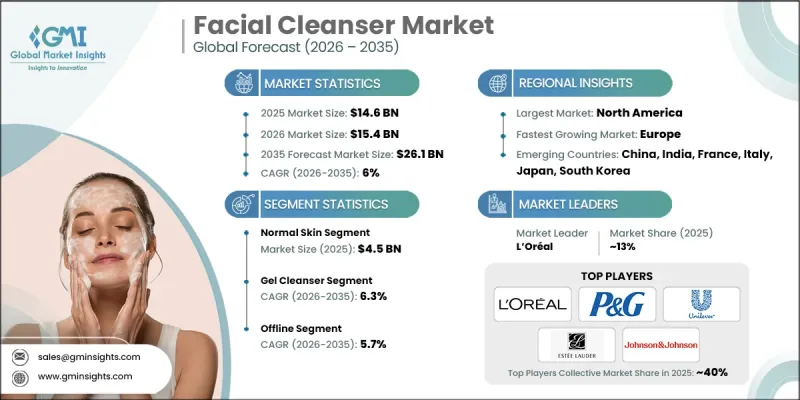
预计到 2025 年,全球洗面乳市场价值将达到 146 亿美元,并有望以 6% 的复合年增长率成长,到 2035 年达到 261 亿美元。
消费者对日常护肤程序的日益重视推动了洗面乳的需求成长。越来越多的人认识到保持健康亮丽肌肤的重要性。随着都市区污染的加剧以及人们对整装仪容的日益关注,消费者开始购买那些承诺有效清洁且不损害皮肤健康的专业产品。社群媒体和美妆内容的普及使人们更容易了解护肤方法,从而提升了对高端洗面乳的需求。年轻消费者尤其容易受到美妆潮流的影响,而男性也越来越多地将洗面乳纳入日常整装仪容程序。电商平台和线上美妆零售商的蓬勃发展也促进了销售成长,使消费者能够轻鬆购买到种类繁多的产品。
| 市场规模 | |
|---|---|
| 开始年份 | 2025 |
| 预测期 | 2026-2035 |
| 上市时的市场规模 | 146亿美元 |
| 预计金额 | 261亿美元 |
| 复合年增长率 | 6% |
预计到2025年,中性肌肤市场规模将达到45亿美元,并在2026年至2035年间以6.3%的复合年增长率成长。中性肌肤市场占据主导地位,因为许多消费者偏好温和配方,既能清洁肌肤,又不会带走肌肤的天然水分。各年龄层消费者坚持每日使用,加上高端和大众市场产品线的广泛覆盖,确保了销售额的稳定成长。
预计到2025年,线下零售通路将占据74.96%的市场份额,并在2026年至2035年间以5.7%的复合年增长率成长。实体店凭藉其即时的购物体验、清晰的产品展示以及影响购买决策的店内促销活动,在洗面乳销售中继续发挥着核心作用。消费者可以在超级市场、药妆店和专卖店轻鬆找到产品,并在购买前查看包装、品质和品牌信誉。
美国洗面乳市场预计到2025年将达到37亿美元,并在2026年至2035年间以5.9%的复合年增长率成长。个人照护支出的增加以及社群媒体上日益增长的关注度,正促使消费者选择适合自身肤质和肌肤问题的洗面乳。男士护理的日益普及以及皮肤科医生的建议,推动了对经临床验证、能够满足特定需求的洗面乳的需求。订阅服务也促进了消费者的重复购买和持续使用。
目录
第一章:调查方法和范围
第二章执行摘要
第三章业界考察
- 生态系分析
- 供应商情况
- 利润率
- 每个阶段增加的价值
- 影响价值链的因素
- 影响产业的因素
- 促进因素
- 消费者对护肤和整装仪容的兴趣日益浓厚
- 影响者主导的数位美妆内容成长
- 电子商务和线上美妆零售的扩张
- 陷阱与挑战
- 激烈的竞争压力和品牌数量的激增
- 对化妆品成分的监管限制
- 机会
- 个性化和人工智慧驱动的护肤建议
- 清洁、永续、可重复填充包装的创新。
- 促进因素
- 成长潜力分析
- 未来市场趋势
- 科技与创新趋势
- 当前技术趋势
- 新兴技术
- 价格趋势
- 按地区
- 副产品
- 监理情势
- 标准和合规要求
- 区域法规结构
- 认证标准
- 波特的分析
- PESTEL 分析
第四章 竞争情势
- 介绍
- 企业市占率分析
- 按地区
- 北美洲
- 欧洲
- 亚太地区
- 拉丁美洲
- 中东和非洲
- 按地区
- 企业矩阵分析
- 主要市场公司的竞争分析
- 竞争定位矩阵
- 主要进展
- 併购
- 伙伴关係与合作
- 新产品发布
- 业务拓展计划
第五章 市场估价与预测:依肤质划分,2022-2035年
- 正常皮肤
- 油性肌肤
- 干性皮肤
- 敏感肌肤
- 混合性肌肤
- 其他的
第六章 市场估算与预测:依产品类型划分,2022-2035年
- 凝胶洁面乳
- 乳霜/乳液型洗面乳
- 泡沫洗面乳
- 固态
- 其他的
第七章 市场估计与预测:依消费群组划分,2022-2035年
- 男性
- 女士
- 男女通用的
第八章 市场估算与预测:依最终使用者划分,2022-2035年
- 个人
- 商业的
第九章 市场估价与预测:依通路划分,2022-2035年
- 在线的
- 电子商务网站
- 企业网站
- 离线
- 大卖场/超级市场
- 百货公司
- 其他的
第十章 市场估价与预测:依地区划分,2022-2035年
- 北美洲
- 我们
- 加拿大
- 欧洲
- 德国
- 英国
- 法国
- 义大利
- 西班牙
- 亚太地区
- 中国
- 印度
- 日本
- 韩国
- 澳洲
- 拉丁美洲
- 巴西
- 墨西哥
- 阿根廷
- 中东和非洲(MEA)
- 沙乌地阿拉伯
- 阿拉伯聯合大公国
- 南非
第十一章:公司简介
- Amorepacific Corporation
- Beiersdorf AG
- Clarins Group
- Coty Inc.
- Estee Lauder
- Johnson &Johnson
- Kao Corporation
- L'Oreal
- Mary Kay Inc.
- Natura &Co
- Pierre Fabre Group
- Procter &Gamble
- Revlon, Inc.
- Shiseido Company
- Unilever
The Global Facial Cleanser Market was valued at USD 14.6 billion in 2025 and is estimated to grow at a CAGR of 6% to reach USD 26.1 billion by 2035.
Consumer awareness about daily skincare routines is driving demand for facial cleansers, as more people recognize the importance of maintaining healthy, clear skin. With increased exposure to urban pollutants and the rising emphasis on personal grooming, consumers are purchasing specialized products that promise effective cleansing without compromising skin health. Social media and beauty content have made it easier for individuals to understand skincare practices, fueling demand for advanced facial cleansers. Younger consumers are particularly influenced by beauty trends, while men are increasingly adopting facial cleansers as part of their daily grooming habits. The growth of e-commerce platforms and online beauty retailing also supports higher sales, offering consumers convenient access to a wide range of products.
| Market Scope | |
|---|---|
| Start Year | 2025 |
| Forecast Year | 2026-2035 |
| Start Value | $14.6 Billion |
| Forecast Value | $26.1 Billion |
| CAGR | 6% |
In 2025, the normal skin segment accounted for USD 4.5 billion and is expected to grow at a CAGR of 6.3% between 2026 and 2035. Normal skin dominates the market as a large portion of consumers prefer mild formulations that cleanse without disturbing natural moisture. Consistent daily use across all age groups, along with widespread product availability in both premium and mass-market categories, ensures steady sales growth.
The offline retail channels segment held 74.96% share in 2025 and is projected to grow at a CAGR of 5.7% from 2026 to 2035. Brick-and-mortar stores remain central to facial cleanser sales, as they offer immediate access, product visibility, and in-store promotions that influence buying decisions. The accessibility of products in supermarkets, pharmacies, and specialty stores allows consumers to evaluate packaging, quality, and brand trust before purchasing.
U.S. Facial Cleanser Market reached USD 3.7 billion in 2025 and is projected to grow at a CAGR of 5.9% from 2026 to 2035. Rising personal care spending and social media awareness encourage consumers to select cleansers suited to their skin types and concerns. Increasing interest in men's grooming and professional dermatology endorsements boosts demand for targeted and clinically recommended facial cleansing products. Subscription-based services also drive repeat purchases and consistent product usage.
Major players in the Global Facial Cleanser Market include Beiersdorf AG, Shiseido Company, L'Oreal, Clarins Group, Coty Inc., Procter & Gamble, Johnson & Johnson, Mary Kay Inc., Unilever, Amorepacific Corporation, Natura &Co, Estee Lauder, Revlon, Inc., Pierre Fabre Group, and Kao Corporation. Leading companies are adopting multiple strategies to strengthen their market presence. They are investing in research and development to launch innovative and skin-specific products, expanding online and offline distribution networks, and collaborating with dermatologists to enhance credibility. Many brands focus on influencer partnerships and social media campaigns to connect with younger consumers, while premium and subscription offerings encourage repeat purchases. Aggressive promotional activities, brand loyalty programs, and global market expansion remain key tactics to maintain competitive positioning and capture a larger share of the growing facial cleanser market.
Table of Contents
Chapter 1 Methodology & Scope
- 1.1 Market scope and definition
- 1.2 Research design
- 1.2.1 Research approach
- 1.2.2 Data collection methods
- 1.3 Data mining sources
- 1.3.1 Global
- 1.3.2 Regional/Country
- 1.4 Base estimates and calculations
- 1.4.1 Base year calculation
- 1.4.2 Key trends for market estimation
- 1.5 Primary research and validation
- 1.5.1 Primary sources
- 1.6 Forecast model
- 1.7 Research assumptions and limitations
Chapter 2 Executive Summary
- 2.1 Industry 360° synopsis
- 2.2 Key market trends
- 2.2.1 Skin Type
- 2.2.2 Product Type
- 2.2.3 Consumer Group
- 2.2.4 End User
- 2.2.5 Distribution channel
- 2.3 CXO perspectives: Strategic imperatives
- 2.3.1 Key decision points for industry executives
- 2.3.2 Critical success factors for market players
- 2.4 Future outlook and strategic recommendations
Chapter 3 Industry Insights
- 3.1 Industry ecosystem analysis
- 3.1.1 Supplier landscape
- 3.1.2 Profit margin
- 3.1.3 Value addition at each stage
- 3.1.4 Factor affecting the value chain
- 3.2 Industry impact forces
- 3.2.1 Growth drivers
- 3.2.1.1 Increasing consumer focus on skincare and personal grooming
- 3.2.1.2 Growth in influencer-led and digital beauty content
- 3.2.1.3 Expansion of e-commerce and online beauty retailing
- 3.2.2 Pitfalls & Challenges
- 3.2.2.1 Intense competitive pressure and brand proliferation
- 3.2.2.2 Regulatory constraints on cosmetic ingredients
- 3.2.3 Opportunities
- 3.2.3.1 Customization and AI-driven skincare recommendations
- 3.2.3.2 Clean, sustainable and refillable packaging innovations
- 3.2.1 Growth drivers
- 3.3 Growth potential analysis
- 3.4 Future market trends
- 3.5 Technology and innovation landscape
- 3.5.1 Current technological trends
- 3.5.2 Emerging technologies
- 3.6 Price trends
- 3.6.1 By region
- 3.6.2 By product
- 3.7 Regulatory landscape
- 3.7.1 Standards and compliance requirements
- 3.7.2 Regional regulatory frameworks
- 3.7.3 Certification standards
- 3.8 Porter’s analysis
- 3.9 PESTEL analysis
Chapter 4 Competitive Landscape, 2025
- 4.1 Introduction
- 4.2 Company market share analysis
- 4.2.1 By Region
- 4.2.1.1 North America
- 4.2.1.2 Europe
- 4.2.1.3 Asia Pacific
- 4.2.1.4 Latin America
- 4.2.1.5 Middle East & Africa
- 4.2.1 By Region
- 4.3 Company matrix analysis
- 4.4 Competitive analysis of major market players
- 4.5 Competitive positioning matrix
- 4.6 Key developments
- 4.6.1 Mergers & acquisitions
- 4.6.2 Partnerships & collaborations
- 4.6.3 New product launches
- 4.6.4 Expansion plans
Chapter 5 Market Estimates & Forecast, By Skin Type, 2022 - 2035, (USD Billion) (Thousand Units)
- 5.1 Key trends
- 5.2 Normal Skin
- 5.3 Oily skin
- 5.4 Dry skin
- 5.5 Sensitive skin
- 5.6 Combination skin
- 5.7 Others
Chapter 6 Market Estimates & Forecast, By Product Type, 2022 - 2035, (USD Billion) (Thousand Units)
- 6.1 Key trends
- 6.2 Gel cleanser
- 6.3 Cream & lotion cleanser
- 6.4 Foaming cleanser
- 6.5 Bar cleanser
- 6.6 Others
Chapter 7 Market Estimates & Forecast, By Consumer Group, 2022 - 2035, (USD Billion) (Thousand Units)
- 7.1 Key trends
- 7.2 Male
- 7.3 Female
- 7.4 Unisex
Chapter 8 Market Estimates & Forecast, By End User, 2022 - 2035, (USD Billion) (Thousand Units)
- 8.1 Key trends
- 8.2 Individual
- 8.3 Commercial
Chapter 9 Market Estimates & Forecast, By Distribution Channel, 2022 - 2035, (USD Billion) (Thousand Units)
- 9.1 Key trends
- 9.2 Online
- 9.2.1 E-commerce websites
- 9.2.2 Company websites
- 9.3 Offline
- 9.3.1 Hypermarket/supermarket
- 9.3.2 Departmental stores
- 9.3.3 Others
Chapter 10 Market Estimates & Forecast, By Region, 2022 - 2035, (USD Billion) (Thousand Units)
- 10.1 Key trends
- 10.2 North America
- 10.2.1 U.S.
- 10.2.2 Canada
- 10.3 Europe
- 10.3.1 Germany
- 10.3.2 UK
- 10.3.3 France
- 10.3.4 Italy
- 10.3.5 Spain
- 10.4 Asia Pacific
- 10.4.1 China
- 10.4.2 India
- 10.4.3 Japan
- 10.4.4 South Korea
- 10.4.5 Australia
- 10.5 Latin America
- 10.5.1 Brazil
- 10.5.2 Mexico
- 10.5.3 Argentina
- 10.6 MEA
- 10.6.1 Saudi Arabia
- 10.6.2 UAE
- 10.6.3 South Africa
Chapter 11 Company Profiles
- 11.1 Amorepacific Corporation
- 11.2 Beiersdorf AG
- 11.3 Clarins Group
- 11.4 Coty Inc.
- 11.5 Estee Lauder
- 11.6 Johnson & Johnson
- 11.7 Kao Corporation
- 11.8 L’Oreal
- 11.9 Mary Kay Inc.
- 11.10 Natura &Co
- 11.11 Pierre Fabre Group
- 11.12 Procter & Gamble
- 11.13 Revlon, Inc.
- 11.14 Shiseido Company
- 11.15 Unilever

 洗面乳市场:2026-2032年全球预测,依年龄层、性别、肤质、产品类型、配方及分销管道划分
 全球洗面乳及洁面产品市场规模、份额、趋势及成长分析报告(2026-2034年)全球洗面乳市场规模、份额、趋势及成长分析报告(2026-2034年)
 洗面乳市场-全球产业规模、份额、趋势、机会、预测:按形状、应用、销售管道、地区和竞争格局划分,2021-2031年活性碳面部护理产品市场-全球产业规模、份额、趋势、机会及预测(按产品类型、性别、分销管道、地区和竞争格局划分,2021-2031年)
 全球洗面乳和清洁产品市场全球脸部磨砂膏市场全球洗面乳市场全球脸部磨砂膏市场规模(按类型、应用、分销管道、地区、范围和预测)
 洗面乳市场规模、份额、成长分析(按产品类型、按应用、按销售管道、按价格分布、按最终用户、按地区)- 行业预测 2025-2032