


 |
市场调查报告书
商品编码
1982355
太空机器人市场机会、成长要素、产业趋势以及 2026-2035 年预测的分析。Space Robotics Market Opportunity, Growth Drivers, Industry Trend Analysis, and Forecast 2026 - 2035 |
||||||

预计到 2025 年,全球空间机器人市场价值将达到 54 亿美元,并预计以 8.6% 的复合年增长率成长,到 2035 年达到 124 亿美元。
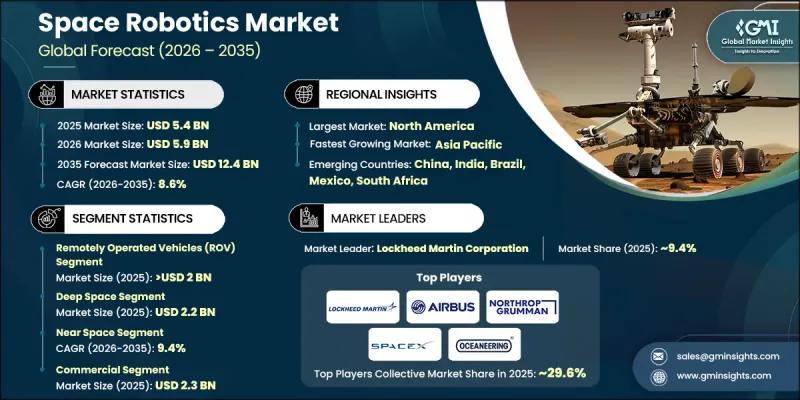
随着太空任务日益复杂和规模化,该领域也在不断扩展,对能够在各种地外环境中运行的先进机器人和自动化技术的需求也随之增长。航太机构和私人企业正在开发机器人系统,以支援深空长期任务,减少对太空人的依赖,并提高运作效率。这些系统旨在应用于包括太空维护、组装和行星探勘在内的广泛领域,从而实现更频繁、更复杂、更经济高效的任务。将机器人技术整合到太空计划中,可以实现即时监控、自动化任务执行和任务支持,而这些工作原本会给人力资源带来沉重负担。各国政府、研究机构和私人企业正携手合作,推动创新,确保机器人技术在未来的太空行动中发挥关键作用。
| 市场范围 | |
|---|---|
| 开始年份 | 2025 |
| 预测期 | 2026-2035 |
| 上市时的市场规模 | 54亿美元 |
| 预测金额 | 124亿美元 |
| 复合年增长率 | 8.6% |
由于远程操作车辆(ROV)在太空探勘、在轨道检查、探测车和太空站运行中发挥至关重要的作用,预计到2025年,ROV市场规模将达到20亿美元。 ROV作为一种多功能平台,能够在危险和难以进入的环境中进行远端作业,利用即时控制和自主能力来支援表面探勘、样本采集和在轨维护。
预计到2025年,商业航太领域市场规模将达到23亿美元,主要得益于从事卫星部署、太空旅游、在轨製造和商业太空站建设的私人航太公司的快速扩张。商业航太机器人技术广泛应用于卫星管理、发射操作、检查和维护,从而实现扩充性且经济高效的营运。强劲的私人投资、不断提高的发射频率以及技术创新正在进一步加速商业任务中航天机器人技术的应用。
预计到2025年,北美太空机器人市占率将达到38.5%。这一增长主要得益于政府的大量投入、蓬勃发展的太空探勘计划、国防相关倡议以及对太空基础设施的投资。北美政府机构和企业正利用长期专案开发先进的机器人平台,从而巩固该地区在太空机器人技术领域的领先地位。
目录
第一章:调查方法和范围
第二章执行摘要
第三章业界考察
- 生态系分析
- 供应商情况
- 利润率分析
- 成本结构
- 每个阶段增加的价值
- 影响价值链的因素
- 中断
- 影响产业的因素
- 促进因素
- 卫星星系和深空任务的扩展
- 对自主和人工智慧驱动的太空行动的需求日益增长
- 太空旅游和商业航太活动的成长
- 扩大太空计画中的公私合营
- 对在轨服务、太空碎片清除和卫星维护的需求。
- 产业潜在风险与挑战
- 开发成本高且技术复杂
- 在恶劣且不可预测的太空环境中开展业务的风险
- 市场机会
- 扩大自主机器人系统在太空任务中的应用
- 对在轨服务、组装和製造(ISAM)的需求不断增长
- 促进因素
- 成长潜力分析
- 监理情势
- 北美洲
- 欧洲
- 亚太地区
- 拉丁美洲
- 中东和非洲
- 波特的分析
- PESTEL 分析
- 科技与创新趋势
- 当前技术趋势
- 新兴技术
- 价格趋势
- 按地区
- 副产品
- 定价策略
- 新兴经营模式
- 合规要求
- 地缘政治和贸易趋势
第四章 竞争情势
- 介绍
- 企业市占率分析
- 按地区
- 北美洲
- 欧洲
- 亚太地区
- 拉丁美洲
- 中东和非洲
- 按地区
- 主要企业的竞争标竿分析
- 财务绩效比较
- 销售量
- 利润率
- 研究与开发
- 产品系列比较
- 产品线宽度
- 科技
- 创新
- 区域部署对比
- 全球扩张分析
- 服务网路覆盖
- 按地区分類的市场渗透率
- 竞争定位矩阵
- 领导者
- 挑战者
- 追踪者
- 小众玩家
- 财务绩效比较
- 2022-2025 年重大发展
- 併购
- 伙伴关係和联盟
- 技术进步
- 业务拓展与投资策略
- 数位转型计划
- 新兴/Start-Ups竞争对手的发展趋势
第五章 市场估计与预测:依解法划分,2022-2035年
- 远程操作车辆(ROV)
- 探测车/太空船着陆器
- 太空探勘
- 其他的
- 远端控制系统(RMS)
- 机械臂/机械手臂系统
- 抓取和对接系统
- 其他的
- 软体
- 服务
第六章 市场估计与预测:依技术划分,2022-2035年
- 遥感探测
- 自主系统
- 遥控
- 机器人软体
- 人工智慧(AI)和机器学习(ML)
- 人机交互
第七章 市场估计与预测:依应用领域划分,2022-2035年
- 深空
- 行星探勘
- 小行星采矿
- 太空探索
- 近太空
- 卫星运行
- 太空站的维护
- 轨道运输
- 其他的
- 地面以上
- 发射操作
- 地面管制操作
- 空间研究设施
第八章 市场估算与预测:依最终使用者划分,2022-2035年
- 商业的
- 政府
- 防御
第九章 市场估计与预测:依地区划分,2022-2035年
- 北美洲
- 我们
- 加拿大
- 欧洲
- 德国
- 英国
- 法国
- 西班牙
- 义大利
- 荷兰
- 亚太地区
- 中国
- 印度
- 日本
- 澳洲
- 韩国
- 拉丁美洲
- 巴西
- 墨西哥
- 阿根廷
- 中东和非洲
- 南非
- 沙乌地阿拉伯
- 阿拉伯聯合大公国
第十章:公司简介
- 世界公司
- Airbus SE
- ITT Corporation
- Lockheed Martin Corporation
- MAXAR TECHNOLOGIES
- MDA Space
- Northrop Grumman
- SpaceX
- 本地球员
- Altius Space Machine
- Astrobotic Technology
- Astroscale Holdings Inc.
- Honeybee Robotics
- Intuitive Machines, LLC.
- Ispace
- Made In Space Inc.(Redwire LLC)
- Metecs, LLC.
- Oceaneering International, Inc.
- 区域/利基公司
- BluHaptics, Inc.
- Motiv Space Systems, Inc.
- Olis Robotics
The Global Space Robotics Market was valued at USD 5.4 billion in 2025 and is estimated to grow at a CAGR of 8.6% to reach USD 12.4 billion by 2035.
The sector is expanding as the complexity and scope of space missions grow, creating demand for advanced robotic and automation technologies that can operate across diverse extraterrestrial environments. Space agencies and commercial enterprises are developing robotic systems to support long-duration missions in deep space, reduce reliance on astronauts, and enhance operational efficiency. These systems are being designed for multiple applications, including in-space servicing, assembly, and planetary exploration, enabling more frequent, complex, and cost-effective missions. Integration of robotics into space programs allows for real-time monitoring, automated task execution, and mission support that would otherwise strain human resources. Governments, research institutions, and private players are collectively driving innovation, ensuring that robotics plays a pivotal role in the future of space operations.
| Market Scope | |
|---|---|
| Start Year | 2025 |
| Forecast Year | 2026-2035 |
| Start Value | $5.4 Billion |
| Forecast Value | $12.4 Billion |
| CAGR | 8.6% |
The remotely operated vehicles (ROV) segment reached USD 2 billion in 2025, owing to their critical role in space exploration, orbital inspections, planetary rovers, and space station operations. ROVs act as versatile platforms capable of performing remote tasks in hazardous or inaccessible environments, supporting surface exploration, sample collection, and in-orbit maintenance with both real-time control and autonomous capabilities.
The commercial segment reached USD 2.3 billion in 2025, driven by the rapid expansion of private space companies engaged in satellite deployment, space tourism, in-orbit manufacturing, and commercial stations. Commercial space robotics is extensively applied for satellite management, launch operations, inspection, and maintenance, allowing scalable and cost-efficient operations. Strong private investments, increasing launch cadence, and technological innovation further accelerate adoption across commercial missions.
North America Space Robotics Market held a 38.5% share in 2025. The region's growth is fueled by substantial government funding, robust space exploration programs, defense initiatives, and investment in space infrastructure. Agencies and enterprises in North America are leveraging long-term programs to develop advanced robotic platforms, strengthening the region's leadership in space robotics technologies.
Key players operating in the Global Space Robotics Market include Lockheed Martin Corporation, Honeybee Robotics, Astroscale Holdings Inc., Northrop Grumman, Astrobotic Technology, Intuitive Machines LLC, Made In Space Inc. (Redwire LLC), SpaceX, MAXAR TECHNOLOGIES, Airbus SE, Oceaneering International Inc., MDA Space, Altius Space Machine, ITT Corporation, Motiv Space Systems Inc., Olis Robotics, BluHaptics Inc., Ispace, and Metecs LLC. Companies in the Global Space Robotics Market are adopting several strategies to solidify their market presence and expand their global footprint. Leading players are investing in research and development to design autonomous and semi-autonomous robotic systems for deep-space exploration, orbital servicing, and planetary operations. Strategic collaborations with space agencies, commercial launch providers, and satellite operators enable deployment at scale. Firms are also focusing on modular, reconfigurable robotic platforms to support multiple mission profiles and reduce operational costs. Technological innovation in AI, machine learning, sensors, and teleoperation is a priority to enhance precision, reliability, and safety.
Table of Contents
Chapter 1 Methodology and Scope
- 1.1 Research approach
- 1.2 Quality Commitments
- 1.2.1 GMI AI policy & data integrity commitment
- 1.2.1.1 Source consistency protocol
- 1.2.1 GMI AI policy & data integrity commitment
- 1.3 Research Trail & Confidence Scoring
- 1.3.1 Research Trail Components
- 1.3.2 Scoring Components
- 1.4 Data Collection
- 1.4.1 Partial list of primary sources
- 1.5 Data mining sources
- 1.5.1 Paid sources
- 1.5.1.1 Sources, by region
- 1.5.1 Paid sources
- 1.6 Base estimates and calculations
- 1.6.1 Base year calculation for any one approach
- 1.7 Forecast model
- 1.7.1 Quantified market impact analysis
- 1.8 Mathematical impact of growth parameters on forecast
- 1.9 Research transparency addendum
- 1.9.1 Source attribution framework
- 1.9.2 Quality assurance metrics
- 1.9.3 Our commitment to trust
Chapter 2 Executive Summary
- 2.1 Industry 360° synopsis, 2022 - 2035
- 2.2 Key market trends
- 2.2.1 Solution trends
- 2.2.2 Technology trends
- 2.2.3 Application trends
- 2.2.4 End User trends
- 2.3 TAM analysis, 2025-2035
- 2.4 CXO perspectives: Strategic imperatives
Chapter 3 Industry Insights
- 3.1 Industry ecosystem analysis
- 3.1.1 Supplier landscape
- 3.1.2 Profit margin analysis
- 3.1.3 Cost structure
- 3.1.4 Value addition at each stage
- 3.1.5 Factor affecting the value chain
- 3.1.6 Disruptions
- 3.2 Industry impact forces
- 3.2.1 Growth drivers
- 3.2.1.1 Expansion of Satellite Constellations and Deep-Space Missions
- 3.2.1.2 Rising Demand for Autonomous and AI-Enabled Space Operations
- 3.2.1.3 Growth in Space Tourism and Commercial Space Activities
- 3.2.1.4 Increasing Public-Private Sector Collaboration in Space Programs
- 3.2.1.5 Need for In-Orbit Servicing, Debris Removal, and Satellite Maintenance
- 3.2.2 Industry pitfalls and challenges
- 3.2.2.1 High Development Costs and Technical Complexity
- 3.2.2.2 Operational Risks in Harsh and Unpredictable Space Environments
- 3.2.3 Market opportunities
- 3.2.3.1 Increasing adoption of autonomous robotic systems for space missions
- 3.2.3.2 Growing demand for in-orbit servicing, assembly, and manufacturing (ISAM)
- 3.2.1 Growth drivers
- 3.3 Growth potential analysis
- 3.4 Regulatory landscape
- 3.4.1 North America
- 3.4.2 Europe
- 3.4.3 Asia Pacific
- 3.4.4 Latin America
- 3.4.5 Middle East & Africa
- 3.5 Porter’s analysis
- 3.6 PESTEL analysis
- 3.7 Technology and innovation landscape
- 3.7.1 Current technological trends
- 3.7.2 Emerging technologies
- 3.8 Price trends
- 3.8.1 By region
- 3.8.2 By product
- 3.9 Pricing Strategies
- 3.10 Emerging Business Models
- 3.11 Compliance Requirements
- 3.12 Geopolitical and trade dynamics
Chapter 4 Competitive Landscape, 2025
- 4.1 Introduction
- 4.2 Company market share analysis
- 4.2.1 By region
- 4.2.1.1 North America
- 4.2.1.2 Europe
- 4.2.1.3 Asia Pacific
- 4.2.1.4 Latin America
- 4.2.1.5 Middle East & Africa
- 4.2.1 By region
- 4.3 Competitive benchmarking of key players
- 4.3.1 Financial performance comparison
- 4.3.1.1 Revenue
- 4.3.1.2 Profit margin
- 4.3.1.3 R&D
- 4.3.2 Product portfolio comparison
- 4.3.2.1 Product range breadth
- 4.3.2.2 Technology
- 4.3.2.3 Innovation
- 4.3.3 Geographic presence comparison
- 4.3.3.1 Global footprint analysis
- 4.3.3.2 Service network coverage
- 4.3.3.3 Market penetration by region
- 4.3.4 Competitive positioning matrix
- 4.3.4.1 Leaders
- 4.3.4.2 Challengers
- 4.3.4.3 Followers
- 4.3.4.4 Niche players
- 4.3.1 Financial performance comparison
- 4.4 Key developments, 2022-2025
- 4.4.1 Mergers and acquisitions
- 4.4.2 Partnerships and collaborations
- 4.4.3 Technological advancements
- 4.4.4 Expansion and investment strategies
- 4.4.5 Digital transformation initiatives
- 4.5 Emerging/ startup competitors landscape
Chapter 5 Market Estimates and Forecast, By Solution, 2022 - 2035 (USD Billion)
- 5.1 Key trends
- 5.2 Remotely Operated Vehicles (ROV)
- 5.2.1 Rovers/Spacecraft Landers
- 5.2.2 Space Probes
- 5.2.3 Others
- 5.3 Remote Manipulator System (RMS)
- 5.3.1 Robotic Arms/Manipulator Systems
- 5.3.2 Gripping & Docking Systems
- 5.3.3 Others
- 5.4 Software
- 5.5 Services
Chapter 6 Market Estimates and Forecast, By Technology, 2022 - 2035 (USD Billion)
- 6.1 Key trends
- 6.2 Remote Sensing
- 6.3 Autonomous Systems
- 6.4 Teleoperation
- 6.5 Robotic Software
- 6.6 Artificial Intelligence (AI) and Machine Learning (ML)
- 6.7 Human-Robot Interaction
Chapter 7 Market Estimates and Forecast, By Application, 2022 - 2035 (USD Billion)
- 7.1 Key trends
- 7.2 Deep Space
- 7.2.1 Planetary Exploration
- 7.2.2 Asteroid Mining
- 7.2.3 Space Research
- 7.3 Near Space
- 7.3.1 Satellite Operations
- 7.3.2 Space Station Maintenance
- 7.3.3 Orbital Transportation
- 7.3.4 Others
- 7.4 Ground
- 7.4.1 Launch Operations
- 7.4.2 Ground Control Operations
- 7.4.3 Space Research Labs
Chapter 8 Market Estimates and Forecast, By End User, 2022 - 2035 (USD Billion)
- 8.1 Key trends
- 8.2 Commercial
- 8.3 Government
- 8.4 Defence
Chapter 9 Market Estimates and Forecast, By Region, 2022 - 2035 (USD Billion)
- 9.1 Key trends
- 9.2 North America
- 9.2.1 U.S.
- 9.2.2 Canada
- 9.3 Europe
- 9.3.1 Germany
- 9.3.2 UK
- 9.3.3 France
- 9.3.4 Spain
- 9.3.5 Italy
- 9.3.6 Netherlands
- 9.4 Asia Pacific
- 9.4.1 China
- 9.4.2 India
- 9.4.3 Japan
- 9.4.4 Australia
- 9.4.5 South Korea
- 9.5 Latin America
- 9.5.1 Brazil
- 9.5.2 Mexico
- 9.5.3 Argentina
- 9.6 Middle East and Africa
- 9.6.1 South Africa
- 9.6.2 Saudi Arabia
- 9.6.3 UAE
Chapter 10 Company Profiles
- 10.1 Global Players
- 10.1.1 Airbus SE
- 10.1.2 ITT Corporation
- 10.1.3 Lockheed Martin Corporation
- 10.1.4 MAXAR TECHNOLOGIES
- 10.1.5 MDA Space
- 10.1.6 Northrop Grumman
- 10.1.7 SpaceX
- 10.2 Regional Players
- 10.2.1 Altius Space Machine
- 10.2.2 Astrobotic Technology
- 10.2.3 Astroscale Holdings Inc.
- 10.2.4 Honeybee Robotics
- 10.2.5 Intuitive Machines, LLC.
- 10.2.6 Ispace
- 10.2.7 Made In Space Inc. (Redwire LLC)
- 10.2.8 Metecs, LLC.
- 10.2.9 Oceaneering International, Inc.
- 10.3 Local / Niche Players
- 10.3.1 BluHaptics, Inc.
- 10.3.2 Motiv Space Systems, Inc.
- 10.3.3 Olis Robotics


