


 |
市场调查报告书
商品编码
1982356
远程操作车辆市场机会、成长要素、产业趋势分析及2026-2035年预测。Remote Operated Vehicle Market Opportunity, Growth Drivers, Industry Trend Analysis, and Forecast 2026 - 2035 |
||||||

全球遥控潜水器(ROV)市场预计到 2025 年价值 19 亿美元,预计到 2035 年将以 7.2% 的复合年增长率增长至 39 亿美元。
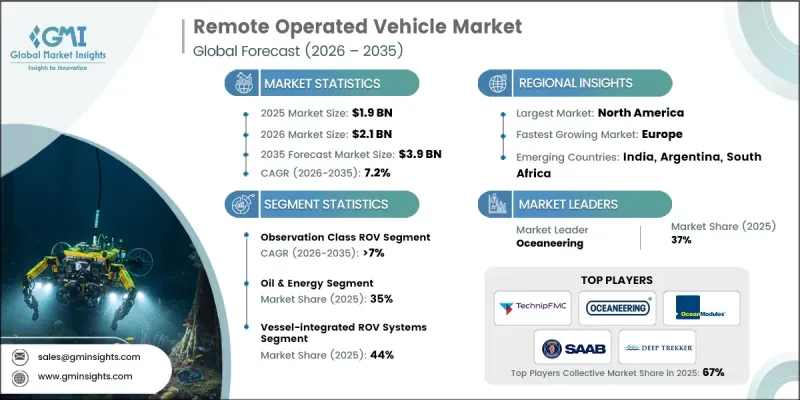
研究机构和政府部门对先进海洋技术的资金支持不断增加,显着加速了市场成长。遥控探勘(ROV)越来越多地被部署到复杂的海底任务中,这些任务需要高解析度影像、先进感测器以及在人类无法触及的深海中进行精确操控。这些系统在收集环境资讯方面发挥着至关重要的作用,为海洋科学、海洋学评估、生物多样性分析和气候相关研究提供支援。人们对永续海洋管理和全球环境监测计画日益增长的兴趣进一步推动了ROV的应用。同时,石油、天然气和可再生能源领域的海上基础设施扩张也持续催生了对可靠水下机器人的需求。 ROV能够提高作业安全性、提升成本效益,并最大限度地减少人员暴露于危险海底环境的风险。其实即时资料传输、精确的操作能力和远端介入能力支援持续的水下作业。 ROV在国防和海上安全领域的应用不断扩展,进一步巩固了全球远程操作车辆(ROV)产业的长期成长动能。
| 市场范围 | |
|---|---|
| 开始年份 | 2025 |
| 预测期 | 2026-2035 |
| 上市时的市场规模 | 19亿美元 |
| 预测金额 | 39亿美元 |
| 复合年增长率 | 7.2% |
远程操作车辆(ROV)市场的产业相关人员正积极寻求非内部成长策略,例如推出新产品、收购和建立策略联盟,以保持竞争优势。对海上能源投资的增加显着提升了对海底检测、干预和建造服务的需求。 ROV系统能够在确保作业精度和成本控制的同时,安全地进入恶劣的水下环境。它们能够以最小的停机时间完成技术难度极高的任务,这增强了ROV在整个能源相关产业(该产业依赖不间断的海底作业)的价值提案。此外,国防领域的现代化建设也正在推动先进遥控系统在海上作业的应用。
预计到2025年,观测型ROV市占率将达到35%,并在2026年至2035年间以7%的复合年增长率成长。这些紧凑型系统因其价格实惠、易于部署和高机动性,被广泛应用于各行各业的常规水下评估。它们尤其适用于对水下基础设施和需要持续监测的关键资产进行目视检查。法律规范和不断增长的资产保护要求正在加速对高清视觉数据解决方案的需求,从而推动全球观测型ROV市场的持续扩张。
预计到2025年,石油和能源产业将占据35%的市场份额,并在2026年至2035年间以6.5%的复合年增长率成长。在更深、技术更复杂的储存中持续进行的海上油气探勘活动,大大推动了水下机器人(ROV)的应用。作业者依靠先进的系统来支援钻井作业、检查设备、安装海底组件以及维护管道基础设施。这些水下机器人能够在恶劣的海底环境中提供高效、高精度的干预能力,从而保障作业的连续性,提升安全标准,并提高整体油气采收率。
美国远程操作车辆(ROV)市场占有71%的份额,预计到2025年市场规模将达到5.28亿美元。推动美国对先进ROV系统需求的主要动力是持续的海洋能源生产活动。高效能的远端操作技术对于海洋资产的日常维护、深海开发和海底基础设施的升级改造至关重要。透过持续监测和系统升级来延长老旧海洋设施的运作,进一步提升了船队的稳定运作和市场的长期稳定性。
目录
第一章:调查方法
第二章执行摘要
第三章业界考察
- 生态系分析
- 供应商情况
- 利润率分析
- 成本结构
- 每个阶段增加的价值
- 影响价值链的因素
- 中断
- 影响产业的因素
- 促进因素
- 扩大海上油气探勘
- 离岸风力发电的快速发展
- 扩大国防和海军现代化计划
- 海底通讯和电力电缆基础设施的成长
- 机器人技术和人工智慧整合的技术进步
- 产业潜在风险与挑战
- 高昂的资本和营运成本
- 熟练操作人员短缺
- 恶劣的海洋作业环境
- 对海洋能量循环的依赖
- 市场机会
- 深海采矿活动的扩张
- 扩大海洋研究和环境监测
- 水产养殖和近海养殖业务的扩张
- 与自主水下航行器(AUV)的集成
- 促进因素
- 成长潜力分析
- 监理情势
- 北美洲
- 美国船舶意外排放法案
- 美国海岸警卫队防卫队安全规章
- 美国安全与环境执法局(BSEE)海事规则
- 欧洲
- 欧盟海事安全指令
- 符合CE标誌和机械指令。
- 各国海事当局之间的差异
- 海上可再生能源法规
- 有关潜水员安全和水下作业的规定
- 亚太地区
- 中国的离岸法律规范
- 印度的离岸法规环境
- 东协在海洋协调方面所做的努力
- 日本海洋和近海框架
- 澳洲和韩国离岸合规标准
- 拉丁美洲
- 巴西海事法律规范
- 墨西哥海事安全与环境法规
- 为协调区域海洋开发法规所做的努力
- 中东和非洲
- 海湾合作委员会海事法规结构
- 南非海事安全法规
- 西非和红海海洋开发法规
- 北美洲
- 关键市场趋势与转型
- 未来市场趋势
- 波特的分析
- PESTEL 分析
- 科技与创新趋势
- 当前技术趋势
- 新兴技术
- 价格趋势
- 按地区
- 副产品
- 生产统计
- 生产基地
- 消费者群体
- 进出口
- 成本細項分析
- 专利分析
- 永续性和环境方面
- 永续倡议
- 减少废弃物策略
- 生产中的能源效率
- 具有环保意识的倡议
- 关于碳足迹的考量
第四章 竞争情势
- 介绍
- 企业市占率分析
- 北美洲
- 欧洲
- 亚太地区
- 拉丁美洲
- 中东和非洲(MEA)
- 主要市场公司的竞争分析
- 竞争定位矩阵
- 主要进展
- 併购
- 伙伴关係与合作
- 新产品发布
- 业务拓展计划及资金筹措
第五章 市场估计与预测:依类型划分,2022-2035年
- 工作用遥控潜水器
- 用于轻型作业的遥控潜水器
- 用于观察的遥控潜水器
- 微型/迷你型遥控潜水器
第六章 市场估计与预测:依应用领域划分,2022-2035年
- 水产养殖
- 商业潜水和打捞潜水
- 地方政府基础设施
- 军队
- 石油与能源
- 其他的
第七章 市场估计与预测:依深度划分,2022-2035年
- 浅海遥控潜水器(水深1000公尺以下)
- 中深度ROV(1,000-3,000公尺海水)
- 深海遥控潜水器(水深3000-6000公尺)
- 超深海遥控潜水器(水深6000公尺或以上)
第八章 市场估算与预测:依系统结构,2022-2035年
- 船载整合式ROV系统
- 模组化货柜式水下机器人系统
- 全容器化水下机器人系统
第九章 市场估计与预测:依地区划分,2021-2034年
- 北美洲
- 我们
- 加拿大
- 欧洲
- 英国
- 德国
- 法国
- 义大利
- 西班牙
- 俄罗斯
- 荷兰
- 北欧国家
- 亚太地区
- 中国
- 印度
- 日本
- 韩国
- 澳洲
- 东南亚
- 拉丁美洲
- 巴西
- 阿根廷
- 墨西哥
- 中东和非洲(MEA)
- 阿拉伯聯合大公国
- 沙乌地阿拉伯
- 南非
第十章:公司简介
- 世界公司
- DeepOcean
- DOF Subsea
- Forum Energy Technologies
- Fugro
- Kongsberg Maritime
- Oceaneering International
- Saab Seaeye
- Saipem
- SLB(Schlumberger)
- TechnipFMC
- 当地公司
- ROVOP
- AC-CESS Co UK
- Anritsu Corp
- Deep Ocean Engineering
- Deep Ocean Search
- SEAMOR Marine
- Seatronics
- 新兴企业
- Deep Trekker
- Rovtech
- VideoRay
The Global Remote Operated Vehicle Market was valued at USD 1.9 billion in 2025 and is estimated to grow at a CAGR of 7.2% to reach USD 3.9 billion by 2035.
Growing financial support from research institutions and government bodies for advanced marine technologies is significantly accelerating market growth. Remote operated vehicles are increasingly deployed for complex subsea missions that require high-resolution imaging, advanced sensors, and precise maneuverability at extreme depths beyond human reach. These systems play a critical role in collecting environmental intelligence that supports marine science, oceanographic assessments, biodiversity analysis, and climate-related studies. The rising emphasis on sustainable ocean management and global environmental monitoring programs continues to strengthen adoption. In parallel, expanding offshore infrastructure across oil, gas, and renewable energy sectors is creating sustained demand for dependable underwater robotics. ROVs enhance operational safety, improve cost efficiency, and minimize human exposure to hazardous subsea environments. Their ability to deliver real-time data transmission, accurate manipulation capabilities, and remote-controlled intervention supports continuous underwater operations. Increased utilization across defense and maritime security applications further reinforces the long-term expansion trajectory of the global remote operated vehicle industry.
| Market Scope | |
|---|---|
| Start Year | 2025 |
| Forecast Year | 2026-2035 |
| Start Value | $1.9 Billion |
| Forecast Value | $3.9 Billion |
| CAGR | 7.2% |
Industry participants in the remote operated vehicle market are actively implementing inorganic growth initiatives, including product introductions, acquisitions, and strategic collaborations, to maintain competitive positioning. Rising offshore energy investments are driving substantial demand for subsea inspection, intervention, and construction services. ROV systems provide safe access to challenging underwater environments while ensuring operational precision and cost control. Their capability to execute technically demanding tasks with minimal downtime has strengthened their value proposition across energy-driven industries that rely on uninterrupted subsea performance. Additionally, expanding defense modernization efforts are contributing to greater integration of advanced remotely operated systems within maritime operations.
The observation class ROV segment accounted for 35% share in 2025 and is anticipated to grow at a CAGR of 7% from 2026 to 2035. These compact systems are widely adopted for routine underwater assessments across multiple industries due to their affordability, ease of deployment, and high maneuverability. They are particularly suited for visual inspections of submerged infrastructure and critical assets requiring consistent monitoring. Increasing regulatory oversight and asset integrity requirements are accelerating demand for high-definition visual data solutions, supporting sustained expansion of the observation class category worldwide.
The oil & energy segment held a 35% share in 2025 and is forecast to grow at a CAGR of 6.5% between 2026 and 2035. Continued offshore hydrocarbon exploration activities in deeper and more technically complex reservoirs are significantly contributing to ROV deployment. Operators rely on advanced systems to assist drilling operations, perform equipment inspections, install subsea components, and maintain pipeline infrastructure. These vehicles provide efficient, high-precision intervention capabilities that support operational continuity, enhance safety standards, and improve overall hydrocarbon recovery performance in demanding subsea conditions.
United States Remote Operated Vehicle Market held 71% share, generating USD 528 million in 2025. Sustained offshore energy production activities are a major driver of demand for advanced work-class ROV systems in the country. Ongoing maintenance of offshore assets, deepwater developments, and subsea infrastructure upgrades requires highly capable remotely operated technologies. Efforts to extend the operational life of mature offshore facilities through continuous monitoring and system upgrades further support steady fleet utilization and long-term market stability.
Key companies operating in the Global Remote Operated Vehicle Market include Forum Energy Technologies, Halma Deep Trekker, Ocean Modules, Oceaneering, Saab Seaeye, Saipem, Seamor, SLB, TechnipFMC, and VideoRay. Companies within the Global Remote Operated Vehicle Market are strengthening their competitive position by investing in research and development to introduce technologically advanced and energy-efficient systems. Strategic mergers, acquisitions, and partnerships enable broader product portfolios and expanded geographic reach. Many firms are focusing on modular system designs, enhanced data analytics integration, and improved sensor capabilities to increase operational flexibility. Establishing regional service hubs and long-term maintenance agreements with offshore operators helps secure recurring revenue streams.
Table of Contents
Chapter 1 Methodology
- 1.1 Research approach
- 1.2 Quality Commitments
- 1.2.1 GMI AI policy & data integrity commitment
- 1.2.1.1 Source consistency protocol
- 1.2.1 GMI AI policy & data integrity commitment
- 1.3 Research Trail & Confidence Scoring
- 1.3.1 Research Trail Components
- 1.3.2 Scoring Components
- 1.4 Data Collection
- 1.4.1 Partial list of primary sources
- 1.5 Data mining sources
- 1.5.1 Paid sources
- 1.5.2 Sources, by region
- 1.6 Base estimates and calculations
- 1.6.1 Base year calculation for any one approach
- 1.7 Forecast model
- 1.7.1 Quantified market impact analysis
- 1.7.1.1 Mathematical impact of growth parameters on forecast
- 1.7.1 Quantified market impact analysis
- 1.8 Research transparency addendum
- 1.8.1 Source attribution framework
- 1.8.2 Quality assurance metrics
- 1.8.3 Our commitment to trust
Chapter 2 Executive Summary
- 2.1 Industry 360° synopsis, 2022 - 2035
- 2.2 Key market trends
- 2.2.1 Regional
- 2.2.2 Class
- 2.2.3 Application
- 2.2.4 Depth rating
- 2.2.5 System architecture
- 2.3 TAM Analysis, 2026-2035
- 2.4 CXO perspectives: Strategic imperatives
Chapter 3 Industry Insights
- 3.1 Industry ecosystem analysis
- 3.1.1 Supplier landscape
- 3.1.2 Profit margin analysis
- 3.1.3 Cost structure
- 3.1.4 Value addition at each stage
- 3.1.5 Factor affecting the value chain
- 3.1.6 Disruptions
- 3.2 Industry impact forces
- 3.2.1 Growth drivers
- 3.2.1.1 Expansion of offshore oil & gas exploration
- 3.2.1.2 Rapid growth of offshore wind energy
- 3.2.1.3 Rising defense and naval modernization programs
- 3.2.1.4 Growth in subsea telecom and power cable infrastructure
- 3.2.1.5 Technological advancements in robotics and AI integration
- 3.2.2 Industry pitfalls and challenges
- 3.2.2.1 High capital and operational costs
- 3.2.2.2 Skilled operator shortage
- 3.2.2.3 Harsh offshore operating environments
- 3.2.2.4 Dependency on offshore energy cycles
- 3.2.3 Market opportunities
- 3.2.3.1 Expansion of deep-sea mining activities
- 3.2.3.2 Growth in marine research and environmental monitoring
- 3.2.3.3 Rising aquaculture and offshore farming operations
- 3.2.3.4 Integration with autonomous underwater vehicles (AUVs)
- 3.2.1 Growth drivers
- 3.3 Growth potential analysis
- 3.4 Regulatory landscape
- 3.4.1 North America
- 3.4.1.1 US Vessel Incidental Discharge Act
- 3.4.1.2 US coast guard safety regulations
- 3.4.1.3 Bureau of Safety and Environmental Enforcement (BSEE) Offshore Rules
- 3.4.2 Europe
- 3.4.2.1 EU Offshore Safety Directive
- 3.4.2.2 CE Marking & Machinery Directive Compliance
- 3.4.2.3 National Maritime Authority Variations
- 3.4.2.4 Offshore Renewable Energy Regulations
- 3.4.2.5 Diver Safety & Subsea Intervention Regulations
- 3.4.3 Asia Pacific
- 3.4.3.1 Chinese Offshore Regulatory Framework
- 3.4.3.2 Indian Offshore Regulatory Environment
- 3.4.3.3 ASEAN Maritime Harmonization Efforts
- 3.4.3.4 Japanese Maritime & Offshore Framework
- 3.4.3.5 Australia & South Korea Offshore Compliance Standards
- 3.4.4 Latin America
- 3.4.4.1 Brazilian Offshore Regulatory Framework
- 3.4.4.2 Mexican Offshore Safety & Environmental Regulations
- 3.4.4.3 Regional Offshore Harmonization Initiatives
- 3.4.5 Middle East & Africa
- 3.4.5.1 GCC Offshore Regulatory Framework
- 3.4.5.2 South African Maritime Safety Regulations
- 3.4.5.3 West Africa & Red Sea Offshore Development Regulations
- 3.4.1 North America
- 3.5 Major market trends and disruptions
- 3.6 Future market trends
- 3.7 Porter’s analysis
- 3.8 PESTEL analysis
- 3.9 Technology and innovation landscape
- 3.9.1 Current technological trends
- 3.9.2 Emerging technologies
- 3.10 Price trends
- 3.10.1 By region
- 3.10.2 By product
- 3.11 Production statistics
- 3.11.1 Production hubs
- 3.11.2 Consumption hubs
- 3.11.3 Export and import
- 3.12 Cost breakdown analysis
- 3.13 Patent analysis
- 3.14 Sustainability and environmental aspects
- 3.14.1 Sustainable practices
- 3.14.2 Waste reduction strategies
- 3.14.3 Energy efficiency in production
- 3.14.4 Eco-friendly Initiatives
- 3.14.5 Carbon footprint considerations
Chapter 4 Competitive Landscape, 2024
- 4.1 Introduction
- 4.2 Company market share analysis
- 4.2.1 North America
- 4.2.2 Europe
- 4.2.3 Asia Pacific
- 4.2.4 LATAM
- 4.2.5 MEA
- 4.3 Competitive analysis of major market players
- 4.4 Competitive positioning matrix
- 4.5 Key developments
- 4.5.1 Mergers & acquisitions
- 4.5.2 Partnerships & collaborations
- 4.5.3 New Product Launches
- 4.5.4 Expansion Plans and funding
Chapter 5 Market Estimates & Forecast, By Class, 2022 - 2035 ($Mn, Units)
- 5.1 Key trends
- 5.2 Work class ROV
- 5.3 Light work class ROV
- 5.4 Observation class ROV
- 5.5 Micro/mini ROV
Chapter 6 Market Estimates & Forecast, By Application, 2022 - 2035 ($Mn, Units)
- 6.1 Key trends
- 6.2 Aquaculture
- 6.3 Commercial & salvage diving
- 6.4 Municipal INFRASTRUCTURE
- 6.5 Military
- 6.6 Oil & Energy
- 6.7 Others
Chapter 7 Market Estimates & Forecast, By Depth Rating, 2022 - 2035 ($Mn, Units)
- 7.1 Key trends
- 7.2 Shallow water ROVs (≤1,000 msw)
- 7.3 Mid-water ROVs (1,000-3,000 msw)
- 7.4 Deepwater ROVs (3,000-6,000 msw)
- 7.5 Ultra-deepwater ROVs (more than 6,000 msw)
Chapter 8 Market Estimates & Forecast, By System Architecture, 2022 - 2035 ($Mn, Units)
- 8.1 Key trends
- 8.2 Vessel-integrated ROV systems
- 8.3 Modular containerized ROV systems
- 8.4 Fully containerized ROV systems
Chapter 9 Market Estimates & Forecast, By Region, 2021 - 2034 ($Mn, Units)
- 9.1 Key trends
- 9.2 North America
- 9.2.1 US
- 9.2.2 Canada
- 9.3 Europe
- 9.3.1 UK
- 9.3.2 Germany
- 9.3.3 France
- 9.3.4 Italy
- 9.3.5 Spain
- 9.3.6 Russia
- 9.3.7 Netherlands
- 9.3.8 Nordics
- 9.4 Asia Pacific
- 9.4.1 China
- 9.4.2 India
- 9.4.3 Japan
- 9.4.4 South Korea
- 9.4.5 Australia
- 9.4.6 Southeast Asia
- 9.5 Latin America
- 9.5.1 Brazil
- 9.5.2 Argentina
- 9.5.3 Mexico
- 9.6 MEA
- 9.6.1 UAE
- 9.6.2 Saudi Arabia
- 9.6.3 South Africa
Chapter 10 Company Profiles
- 10.1 Global Players
- 10.1.1 DeepOcean
- 10.1.2 DOF Subsea
- 10.1.3 Forum Energy Technologies
- 10.1.4 Fugro
- 10.1.5 Kongsberg Maritime
- 10.1.6 Oceaneering International
- 10.1.7 Saab Seaeye
- 10.1.8 Saipem
- 10.1.9 SLB (Schlumberger)
- 10.1.10 TechnipFMC
- 10.2 Regional Players
- 10.2.1 ROVOP
- 10.2.2 AC-CESS Co UK
- 10.2.3 Anritsu Corp
- 10.2.4 Deep Ocean Engineering
- 10.2.5 Deep Ocean Search
- 10.2.6 SEAMOR Marine
- 10.2.7 Seatronics
- 10.3 Emerging Players
- 10.3.1 Deep Trekker
- 10.3.2 Rovtech
- 10.3.3 VideoRay

 远端车辆关闭市场规模、份额和成长分析(按系统、车辆类型和地区划分)-2026-2033年产业预测
 远端车辆诊断市场机会、成长驱动因素、产业趋势分析及预测(2025-2034年)
 2025年远距离诊断全球市场报告
 远端车辆关闭的全球市场
 商用车远端诊断市场-全球产业规模、份额、趋势、机会和预测,按应用、车辆类型、产品类型、地区和竞争细分,2020-2030 年全球电动汽车远距离诊断市场
 到 2030 年汽车远端车辆诊断市场预测:按产品类型、车辆类型、连接性、应用、最终用户和地区进行的全球分析商用车远端诊断市场机会、成长动力、产业趋势分析与预测 2024 - 2032到 2030 年遥控潜水器 (ROV) 市场预测:按类别、工作深度、组件、功率、技术、应用和地区进行的全球分析
 远端操作车辆市场,按车辆类型、部件、推进系统、应用、国家和地区 - 2024-2032 年行业分析、市场规模、市场份额和预测