


 |
市场调查报告书
商品编码
1982370
运动文胸市场机会、成长要素、产业趋势分析及2026-2035年预测。Sports Bra Market Opportunity, Growth Drivers, Industry Trend Analysis, and Forecast 2026 - 2035 |
||||||

全球运动胸罩市场预计到 2025 年将价值 160 亿美元,预计到 2035 年将以 5% 的复合年增长率增长至 277 亿美元。
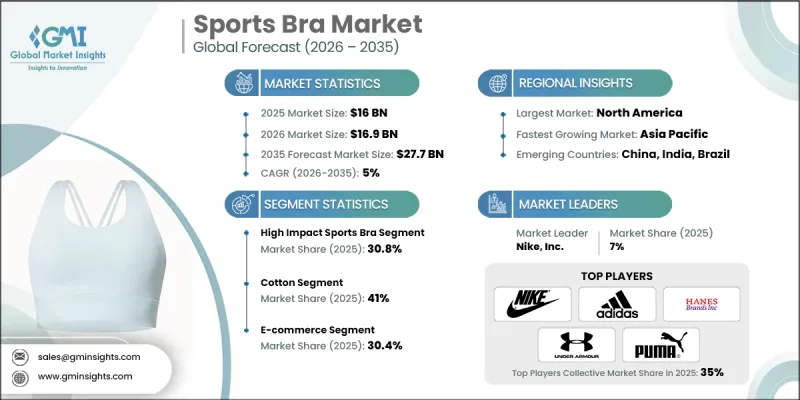
健身活动的参与度不断提高、休閒服饰的日益普及以及消费者对健康和保健的日益关注,正显着推动高性能运动文胸的需求增长。随着全球健身产业的持续扩张,消费者寻求兼具卓越支撑性、耐用性和舒适性的服装。领先品牌正透过拓展其高性能服装产品线、引入先进技术材料和创新设计来强化其全球企业发展。与传统胸罩相比,运动胸罩旨在增强运动的稳定性和控制力,以满足积极生活方式不断变化的需求。领先体育用品公司持续的产品研发,加上强大的品牌影响力和策略性业务拓展,进一步推动了市场成长。消费者对身体支撑、舒适性和长期健康益处的日益重视,也促使他们投资购买高品质的运动内衣。数位化零售平台的整合和数据驱动的产品创新正在重塑全球运动胸罩市场的竞争格局。
| 市场范围 | |
|---|---|
| 开始年份 | 2025 |
| 预测期 | 2026-2035 |
| 上市时的市场规模 | 160亿美元 |
| 预测金额 | 277亿美元 |
| 复合年增长率 | 5% |
永续性正成为产品开发的核心重点,製造商纷纷采用环保材料,例如再生纤维、植物来源混纺布料和耐用拉伸布料。生产流程也朝着无缝针织和低废弃物黏合技术的方向发展,以提高效率并减少对环境的影响。这一转变与消费者对永续运动服的广泛需求相契合,尤其是在北美和欧洲,这些地区环保意识日益增强的消费行为正发挥越来越重要的作用。全通路零售策略、数位互动以及布料工程技术的不断进步也进一步推动了市场扩张。
高强度运动胸罩市占率占30.8%,预计到2025年市场规模将达49亿美元。消费者对最大支撑力、更佳运动控制和高性能结构的需求不断增长,是推动该细分市场成长的主要动力。高强度和中型强度运动胸罩合计占整个市场的55%以上,这反映出消费者对结构良好、支撑性强且经久耐用的运动胸罩的强烈偏好,这类胸罩适合高强度运动。
到2025年,棉质内衣将占据41%的市场。棉质运动内衣因其柔软、透气和日常穿着舒适而广受好评。由于采用天然纤维製成,棉质内衣深受追求亲肤舒适感、希望最大限度减少皮肤刺激的消费者的青睐。此外,与合成纤维产品相比,棉质产品的价格通常更为亲民,对于注重性价比、又希望兼顾舒适性和功能性的消费者而言,棉质产品无疑是一个极具吸引力的选择。
预计2025年,美国运动内衣市场规模将达到31亿美元,主要得益于消费者对高端运动服和高支撑性运动内衣的强劲需求。健身的普及、休閒以及电商平台(成长最快的销售管道)的快速扩张,都为美国运动内衣市场的成长提供了支撑。消费者尤其偏好功能性强、穿着舒适且具有专业支撑系统、无缝结构技术和吸湿排汗混纺面料的运动内衣。此外,人们对身体健康的日益关注、对自我护理的重视以及居家健身的普及,都进一步推动了市场需求的持续成长,并降低了消费者对传统零售通路的依赖。
目录
第一章:调查方法和范围
第二章执行摘要
第三章业界考察
- 生态系分析
- 供应商情况
- 利润率
- 每个阶段增加的价值
- 影响价值链的因素
- 影响产业的因素
- 促进因素
- 女性健身参与度的提升与休閒的流行
- 智慧尺寸、数位合身工具、虚拟试穿
- 可持续且环保的材料
- 产业潜在风险与挑战
- 高性能胸罩价格昂贵
- 网路通路中仿冒品的氾滥
- 机会
- 人工智慧驱动的个人化合身度
- 轻巧无缝设计,非常适合旅行。
- 促进因素
- 成长潜力分析
- 未来市场趋势
- 科技与创新趋势
- 当前技术趋势
- 新兴技术
- 价格趋势
- 按地区
- 按类型
- 监理情势
- 标准和合规要求
- 区域法规结构
- 认证标准
- 波特的分析
- PESTEL 分析
第四章 竞争情势
- 介绍
- 企业市占率分析
- 按地区
- 企业矩阵分析
- 主要市场公司的竞争分析
- 竞争定位矩阵
- 主要进展
- 併购
- 伙伴关係与合作
- 新产品发布
- 业务拓展计划
第五章 市场估价与预测:依产品划分,2022-2035年
- 重大影响
- 中等影响
- 影响较小
- 钢圈运动胸罩
- 无缝运动文胸
- 前扣式运动胸罩
- 其他(例如,钢圈式)
第六章 市场估计与预测:依材料划分,2022-2035年
- 棉布
- 氨纶
- 聚酯纤维
- 竹子
- 其他的
第七章 市场估计与预测:依年龄组别划分,2022-2035年
- 15-30岁
- 31-45岁
- 46-60岁
- 60岁或以上
第八章 市场估算与预测:依通路划分,2022-2035年
- 批发商/经销商
- 专卖店
- 大卖场/超级市场
- 电子商务
- 其他的
第九章 市场估计与预测:依地区划分,2022-2035年
- 北美洲
- 我们
- 加拿大
- 欧洲
- 德国
- 英国
- 法国
- 义大利
- 西班牙
- 亚太地区
- 中国
- 日本
- 印度
- 澳洲
- 韩国
- 拉丁美洲
- 巴西
- 墨西哥
- 阿根廷
- 中东和非洲
- 南非
- 沙乌地阿拉伯
- 阿拉伯聯合大公国
第十章:公司简介
- Adidas AG
- Berkshire Hathaway
- Bonobos
- Calvin Klein
- Giorgio Armani SpA
- Hanesbrands Inc.
- Hugo Boss AG
- Jockey International, Inc.
- Mack Weldon
- Nike, Inc.
- Puma SE
- Ralph Lauren Corporation
- Saxx Underwear Co.
- Tommy Hilfiger
- Under Armour, Inc.
The Global Sports Bra Market was valued at USD 16 billion in 2025 and is estimated to grow at a CAGR of 5% to reach USD 27.7 billion by 2035.
Rising participation in fitness activities, growing popularity of athleisure apparel, and increasing consumer focus on health and wellness are significantly accelerating demand for high-performance sports bras. As the global fitness industry continues to expand, consumers are seeking apparel that delivers superior support, durability, and comfort. Leading brands are reinforcing their global footprint by broadening their performance wear portfolios and introducing technologically advanced fabrics and innovative design features. Compared to traditional bras, sports bras are engineered to provide enhanced stability and movement control, aligning with the evolving requirements of active lifestyles. Continuous product development, combined with strong branding and strategic expansion by major sportswear companies, is further stimulating market growth. Increasing awareness around body support, comfort, and long-term wellness benefits is also encouraging consumers to invest in premium-quality sports bras. The integration of digital retail platforms and data-driven product innovation is reshaping competitive dynamics across the global sports bra market.
| Market Scope | |
|---|---|
| Start Year | 2025 |
| Forecast Year | 2026-2035 |
| Start Value | $16 Billion |
| Forecast Value | $27.7 Billion |
| CAGR | 5% |
Sustainability is becoming a core focus within product development, with manufacturers incorporating eco-friendly materials such as recycled fibers, plant-based blends, and durable stretch fabrics. Production processes are evolving toward seamless knitting and low-waste bonding technologies to improve efficiency and reduce environmental impact. This shift aligns with broader demand for sustainable activewear, particularly across North America and Europe, where eco-conscious purchasing decisions are increasingly influential. Market expansion is further supported by omnichannel retail strategies, digital engagement, and ongoing advancements in fabric engineering.
The high-impact sports bra segment captured 30.8% share, generating USD 4.9 billion in 2025. Growing demand for maximum support, improved motion control, and performance-focused construction is driving segment growth. High-impact and medium-impact categories collectively account for more than 55% of total market value, reflecting strong consumer preference for structured, supportive, and long-lasting designs suited for intensive physical activity.
In 2025, the cotton segment accounted for 41% share. Cotton-based sports bras are widely appreciated for their softness, breathability, and everyday comfort. Their natural fiber composition makes them appealing to consumers seeking gentle skin contact and reduced irritation. Additionally, cotton options are generally positioned at more accessible price points compared to advanced synthetic alternatives, making them attractive to cost-conscious buyers while maintaining comfort and functionality.
U.S. Sports Bra Market reached USD 3.1 billion in 2025, driven by strong demand for premium athletic wear and high-support sports bras. Market growth in the country is supported by widespread fitness adoption, athleisure fashion trends, and rapid expansion of e-commerce platforms, which represent the fastest-growing distribution channel. Consumers show strong preference for engineered support systems, seamless construction techniques, and moisture-managing fabric blends that combine performance with comfort. Rising awareness of physical wellness, increased emphasis on self-care, and growth in home-based fitness routines are further contributing to sustained demand while reducing reliance on traditional retail formats.
Key companies operating in the Global Sports Bra Market include Nike, Inc., Adidas AG, Puma SE, Under Armour, Inc., Hanesbrands Inc., Jockey International, Inc., Calvin Klein, Tommy Hilfiger, Ralph Lauren Corporation, Giorgio Armani S.p.A., Berkshire Hathaway, Bonobos, Mack Weldon, Saxx Underwear Co., and Hugo Boss AG. Companies in the Sports Bra Market are strengthening their competitive position through innovation, brand differentiation, and digital expansion. Leading players are investing in advanced fabric technologies, ergonomic design improvements, and inclusive sizing strategies to address diverse consumer needs. Sustainability initiatives, including recycled materials and responsible sourcing, are becoming central to brand positioning. Firms are also leveraging influencer marketing, social media engagement, and direct-to-consumer e-commerce platforms to enhance visibility and customer loyalty.
Table of Contents
Chapter 1 Methodology and Scope
- 1.1 Market scope and definition
- 1.2 Research design
- 1.2.1 Research approach
- 1.2.2 Data collection methods
- 1.3 Data mining sources
- 1.3.1 Global
- 1.3.2 Regional/Country
- 1.4 Base estimates and calculations
- 1.4.1 Base year calculation
- 1.4.2 Key trends for market estimation
- 1.5 Primary research and validation
- 1.5.1 Primary sources
- 1.6 Forecast model
- 1.7 Research assumptions and limitations
Chapter 2 Executive Summary
- 2.1 Industry 360° synopsis
- 2.2 Key market trends
- 2.2.1 Regional
- 2.2.2 Product Type
- 2.2.3 Consumer Group
- 2.2.4 Power Supply
- 2.2.5 End-Use Vertical
- 2.2.6 Distribution Channel
- 2.3 CXO perspectives: Strategic imperatives
- 2.3.1 Key decision points for industry executives
- 2.3.2 Critical success factors for market players
- 2.4 Future outlook and strategic recommendations
Chapter 3 Industry Insights
- 3.1 Industry ecosystem analysis
- 3.1.1 Supplier landscape
- 3.1.2 Profit margin
- 3.1.3 Value addition at each stage
- 3.1.4 Factor affecting the value chain
- 3.2 Industry impact forces
- 3.2.1 Growth drivers
- 3.2.1.1 Rise in women’s fitness participation & athleisure adoption
- 3.2.1.2 Smart sizing, digital fit tools & virtual try-ons
- 3.2.1.3 Sustainability & eco-conscious materials
- 3.2.2 Industry pitfalls & challenges
- 3.2.2.1 High cost of premium performance bras
- 3.2.2.2 Proliferation of counterfeits in online channels
- 3.2.3 Opportunities
- 3.2.3.1 AI-driven fit personalization
- 3.2.3.2 Travel-friendly, lightweight & seamless designs
- 3.2.1 Growth drivers
- 3.3 Growth potential analysis
- 3.4 Future market trends
- 3.5 Technology and innovation landscape
- 3.5.1 Current technological trends
- 3.5.2 Emerging technologies
- 3.6 Price trends
- 3.6.1 By region
- 3.6.2 By type
- 3.7 Regulatory landscape
- 3.7.1 Standards and compliance requirements
- 3.7.2 Regional regulatory frameworks
- 3.7.3 Certification standards
- 3.8 Porter’s analysis
- 3.9 PESTEL analysis
Chapter 4 Competitive Landscape, 2025
- 4.1 Introduction
- 4.2 Company market share analysis
- 4.2.1 By region
- 4.2.1.1 North America
- 4.2.1.2 Europe
- 4.2.1.3 Asia Pacific
- 4.2.1.4 Latin America
- 4.2.1.5 Middle East and Africa
- 4.2.1 By region
- 4.3 Company matrix analysis
- 4.4 Competitive analysis of major market players
- 4.5 Competitive positioning matrix
- 4.6 Key developments
- 4.6.1 Mergers & acquisitions
- 4.6.2 Partnerships & collaborations
- 4.6.3 New product launches
- 4.6.4 Expansion plans
Chapter 5 Market Estimates & Forecast, By Product, 2022-2035 (USD Billion) (Million Units)
- 5.1 Key trends
- 5.2 High Impact
- 5.3 Medium Impact
- 5.4 Low Impact
- 5.5 Sports Bra with Underwire
- 5.6 Seamless Sports Bra
- 5.7 Front Closure Sports Bra
- 5.8 Others (Underwired, etc.)
Chapter 6 Market Estimates & Forecast, By Material, 2022-2035 (USD Billion) (Million Units)
- 6.1 Key trends
- 6.2 Cotton
- 6.3 Spandex
- 6.4 Polyester
- 6.5 Bamboo
- 6.6 Others
Chapter 7 Market Estimates & Forecast, By Age Group, 2022-2035 (USD Billion) (Million Units)
- 7.1 15 - 30
- 7.2 31 - 45
- 7.3 46 - 60
- 7.4 Above 60
Chapter 8 Market Estimates & Forecast, By Distribution Channel, 2022-2035 (USD Billion) (Million Units)
- 8.1 Key trends
- 8.2 Wholesaler/Distributor
- 8.3 Specialty store
- 8.4 Hypermarket/Supermarket
- 8.5 E-commerce
- 8.6 Others
Chapter 9 Market Estimates and Forecast, By Region, 2022 - 2035 (USD Billion)
- 9.1 Key trends
- 9.2 North America
- 9.2.1 U.S.
- 9.2.2 Canada
- 9.3 Europe
- 9.3.1 Germany
- 9.3.2 UK
- 9.3.3 France
- 9.3.4 Italy
- 9.3.5 Spain
- 9.4 Asia Pacific
- 9.4.1 China
- 9.4.2 Japan
- 9.4.3 India
- 9.4.4 Australia
- 9.4.5 South Korea
- 9.5 Latin America
- 9.5.1 Brazil
- 9.5.2 Mexico
- 9.5.3 Argentina
- 9.6 Middle East and Africa
- 9.6.1 South Africa
- 9.6.2 Saudi Arabia
- 9.6.3 UAE
Chapter 10 Company Profiles
- 10.1 Adidas AG
- 10.2 Berkshire Hathaway
- 10.3 Bonobos
- 10.4 Calvin Klein
- 10.5 Giorgio Armani S.p.A.
- 10.6 Hanesbrands Inc.
- 10.7 Hugo Boss AG
- 10.8 Jockey International, Inc.
- 10.9 Mack Weldon
- 10.10 Nike, Inc.
- 10.11 Puma SE
- 10.12 Ralph Lauren Corporation
- 10.13 Saxx Underwear Co.
- 10.14 Tommy Hilfiger
- 10.15 Under Armour, Inc.


