


 |
市场调查报告书
商品编码
1998664
心臟监护设备市场:商机、成长要素、产业趋势分析及2026-2035年预测Cardiac Monitoring Devices Market Opportunity, Growth Drivers, Industry Trend Analysis, and Forecast 2026 - 2035 |
||||||

全球心臟监护设备市场预计到 2025 年将价值 150 亿美元,预计到 2035 年将以 6.8% 的复合年增长率增长至 290 亿美元。
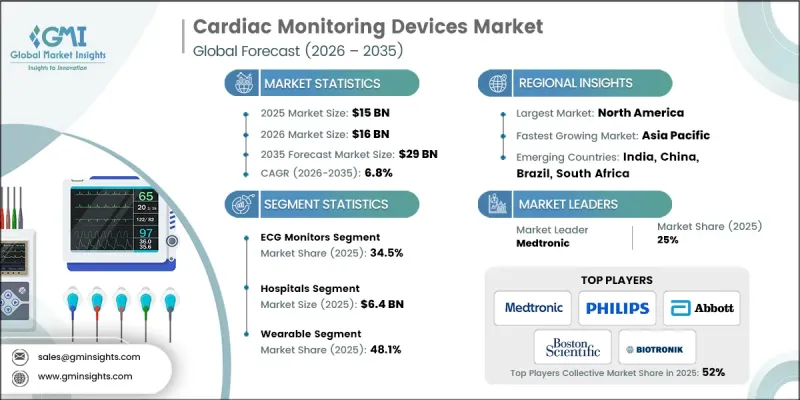
随着持续心血管监测和早期疾病检测在医疗保健系统中变得日益重要,该市场正持续加速成长。成长要素之一是全球老年人口的快速成长,而老年人罹患心血管疾病的风险很高。与老龄化相关的心臟变化会显着增加心律不整、心臟衰竭和其他心臟併发症的风险,因此对可靠的长期监测技术的需求日益增长。同时,数位健康技术的不断进步正在提升监测系统的功能性和易用性,使医疗专业人员不仅能够在传统医疗环境中监测心臟功能,还可以进行远端监测。这些改进有助于更早进行临床介入、改善病患管理并提升医疗效果。飞利浦、Medtronic、雅培、波士顿科学公司和百多力等行业领导者不断拓展产品功能,并大力投资先进的监测技术,从而巩固其在全球心臟监测设备市场的领先地位,并推动该行业的稳步增长。
| 市场范围 | |
|---|---|
| 开始年份 | 2025 |
| 预测期 | 2026-2035 |
| 上市时的市场规模 | 150亿美元 |
| 预测金额 | 290亿美元 |
| 复合年增长率 | 6.8% |
由于预期寿命延长和出生率下降,全球65岁及以上人口数量持续成长。这一人口趋势对心臟监测设备市场产生了重大影响,因为老年人罹患心血管併发症的风险更高,尤其是心律不整和心臟功能下降。生物老龄化会导致心臟结构和电生理变化,包括组织硬化、电传导减慢和自主神经系统调节改变。这些生理变化会增加心臟异常活动和循环系统併发症的风险,凸显了可靠的心臟监测技术的重要性日益凸显。
到2025年,心电图(ECG)监视器市占率将达到34.5%。心电图监护系统仍然是评估心臟电讯号和识别心律不整的重要工具。这些系统可帮助医师评估心律不整、电传导异常以及其他心臟功能变化。最新的心电图监护技术透过改良的降噪和数位滤波功能,实现了高度精确的讯号撷取。这提高了诊断准确性,有助于及时做出临床决策,同时确保患者在所有医疗环境中的安全。
预计到2025年,穿戴式心电图监测设备市场将占据48.1%的市场份额,到2035年市场规模将达到142亿美元。穿戴式监测技术包括小巧便捷的设备,旨在持续监测日常活动中的心率。推动这些设备普及的主要因素包括:佩戴舒适度的提升、监测时间的延长以及能够检测到短期临床评估可能遗漏的间歇性心率异常。随着医疗保健不断向远距患者管理转型,穿戴式监测解决方案对患者和医疗服务提供者都变得越来越重要。这些设备轻巧、无线,专为长期佩戴而设计,使用户能够在日常生活中不间断地收集心率数据。
预计到2025年,北美心电图(ECG)监测设备市场规模将达56亿美元。该地区受益于完善的医疗保健生态系统、先进医疗技术的高普及率以及健全的法规结构,这些框架都确保了心电图监测设备的安全性和性能标准。此外,该地区面临沉重的心血管疾病负担,这持续推动对先进监测技术的强劲需求。医疗机构越来越依赖连续心电图监测解决方案来帮助早期发现心律不整和其他心血管併发症,从而改善疾病管理并提升患者预后。
目录
第一章:调查方法
- 研究途径
- 品质改进计划
- GMI人工智慧政策和资料完整性倡议
- 资讯来源一致性通讯协定
- GMI人工智慧政策和资料完整性倡议
- 调查过程和可靠性评分
- 调查过程的组成部分
- 评分组成部分
- 数据收集
- 主要来源部分列表
- 资料探勘资讯来源
- 付费资讯来源
- 区域资讯来源
- 付费资讯来源
- 基本估算和计算方法
- 每种方法中基准年的计算
- 预测模型
- 量化市场影响分析
- 生长参数对预测的数学影响
- 量化市场影响分析
- 关于调查透明度的补充信息
- 资讯来源归属框架
- 品质保证指标
- 对信任的承诺
第二章执行摘要
第三章业界考察
- 生态系分析
- 影响产业的因素
- 促进因素
- 人口老化和心血管疾病风险增加
- 生活方式的改变和心臟病盛行率的上升
- 远端监控和穿戴式科技的进步
- 数位医疗和人工智慧领域的进展
- 产业潜在风险与挑战
- 资料隐私和安全问题
- 先进监控解决方案高成本
- 市场机会
- 家庭和门诊心臟监测的需求日益增长
- 促进因素
- 成长潜力分析
- 监理情势
- 技术趋势(基于初步调查)
- 目前技术
- 新兴技术
- 未来市场趋势(基于初步研究)
- 人工智慧和生成式人工智慧对市场的影响
- 波特五力分析
- PESTEL 分析
- 价格分析(基于初步调查)
第四章 竞争情势
- 介绍
- 企业市占率分析
- 企业矩阵分析
- 主要市场公司的竞争分析
- 竞争定位矩阵
- 主要进展
- 併购
- 伙伴关係与合作
- 新产品发布
- 业务拓展计划
第五章 市场估算与预测:依设备类型划分,2022-2035年
- 心电图监测仪
- 心电图监测
- 事件记录器/外部循环记录器
- 携带式心电遥测装置
- 植入式心臟监测器
- 其他设备类型
第六章 市场估计与预测:依类型划分,2022-2035年
- 穿戴式装置
- 不可穿戴
第七章 市场估计与预测:依应用领域划分,2022-2035年
- 心律不整检测
- 心房颤动
- 心搏过速
- 心搏过缓
- 房性/室性早期心搏(PACs/PVCs)
- 心肌缺血和心肌梗塞的检测
- 心率和心率监测
- 监测晕厥和心悸
- 术前及术后监测
- 其他用途
第八章 市场估算与预测:依最终用途划分,2022-2035年
- 医院
- 诊断中心
- 门诊手术中心
- 居家医疗设施
- 其他最终用户
第九章 市场估计与预测:依地区划分,2022-2035年
- 北美洲
- 我们
- 加拿大
- 欧洲
- 德国
- 英国
- 法国
- 西班牙
- 义大利
- 荷兰
- 亚太地区
- 中国
- 日本
- 印度
- 澳洲
- 韩国
- 拉丁美洲
- 巴西
- 墨西哥
- 阿根廷
- 中东和非洲
- 南非
- 沙乌地阿拉伯
- 阿拉伯聯合大公国
第十章:公司简介
- Abbott Laboratories
- ACS Diagnostics
- AliveCor
- BIOTRONIK
- Boston Scientific Corporation
- BPL Medical
- GE Healthcare
- iRhythm
- Medtronic
- MicroPort
- Neurosoft
- Nihon Kohden
- Philips
- Schiller AG
The Global Cardiac Monitoring Devices Market was valued at USD 15 billion in 2025 and is estimated to grow at a CAGR of 6.8% to reach USD 29 billion by 2035.
Growth across this market continues to accelerate as healthcare systems increasingly prioritize continuous cardiovascular surveillance and early disease detection. A key growth catalyst is the rapidly rising elderly population worldwide, which carries a greater probability of developing cardiovascular disorders. Age-related cardiac changes significantly increase the likelihood of rhythm disturbances, heart failure, and other cardiac complications, thereby increasing the need for reliable long-term monitoring technologies. At the same time, ongoing advancements in digital health technologies are enhancing the functionality and accessibility of monitoring systems, allowing healthcare providers to remotely observe cardiac performance, as well as in traditional care environments. These improvements support earlier clinical intervention, better patient management, and improved healthcare outcomes. Leading industry participants, such as Philips, Medtronic, Abbott Laboratories, Boston Scientific Corporation, and BIOTRONIK, continue to expand their product capabilities while investing heavily in advanced monitoring technologies, reinforcing their leadership in the global cardiac monitoring devices market and contributing to the steady growth of this industry.
| Market Scope | |
|---|---|
| Start Year | 2025 |
| Forecast Year | 2026-2035 |
| Start Value | $15 Billion |
| Forecast Value | $29 Billion |
| CAGR | 6.8% |
The number of individuals aged 65 years and above continues to increase globally due to longer life expectancy and declining fertility rates. This demographic trend is playing an important role in shaping the cardiac monitoring devices market because older adults face a higher probability of developing cardiovascular complications, particularly rhythm-related disorders and reduced cardiac efficiency. Biological aging contributes to structural and electrical changes within the heart, including tissue stiffening, slower electrical conduction, and alterations in autonomic control. These physiological changes elevate the risk of abnormal cardiac activity and circulatory complications, which increases the importance of reliable cardiac monitoring technologies.
In 2025, the ECG monitors segment held 34.5% share. ECG monitoring systems remain a critical tool for assessing cardiac electrical signals and identifying irregular heart activity. These systems support physicians in evaluating rhythm disturbances, electrical conduction abnormalities, and other changes in cardiac function. Modern ECG monitoring technologies now deliver highly accurate signal acquisition supported by improved noise reduction and digital filtering capabilities, which strengthen diagnostic accuracy and enable timely clinical decisions while maintaining patient safety across healthcare environments.
The wearable cardiac monitoring devices segment captured 48.1% share in 2025 and is expected to reach USD 14.2 billion by 2035. Wearable monitoring technologies consist of compact and convenient devices designed to continuously track cardiac rhythm during normal daily activities. Their growing adoption is largely attributed to improved comfort, extended monitoring duration, and the ability to detect intermittent cardiac irregularities that might remain unnoticed during short clinical evaluations. As healthcare continues to shift toward remote patient management, wearable monitoring solutions are becoming increasingly valuable for both patients and healthcare providers. These devices are lightweight, wireless, and designed for long-term use, enabling uninterrupted cardiac data collection while individuals maintain their normal routines.
North America Cardiac Monitoring Devices Market reached USD 5.6 billion in 2025. The region benefits from a sophisticated healthcare ecosystem, high adoption of advanced medical technologies, and a well-structured regulatory framework that ensures safety and performance standards for cardiac monitoring equipment. In addition, the region faces a substantial burden of cardiovascular conditions, which continues to generate strong demand for advanced monitoring technologies. Healthcare providers increasingly rely on continuous cardiac monitoring solutions to support early identification of rhythm abnormalities and other cardiovascular complications, enabling improved disease management and better patient outcomes.
Prominent organizations operating in the Global Cardiac Monitoring Devices Market include Abbott Laboratories, Medtronic, Philips, Boston Scientific Corporation, BIOTRONIK, GE Healthcare, Nihon Kohden, Schiller AG, MicroPort, AliveCor, BPL Medical, iRhythm, Neurosoft, and ACS Diagnostics. Companies competing in the Cardiac Monitoring Devices Market are focusing on multiple strategic initiatives to strengthen their market position and expand global reach. Major players are prioritizing continuous investment in research and development to introduce technologically advanced monitoring solutions with improved accuracy, connectivity, and patient comfort. Strategic collaborations with healthcare institutions and digital health companies are also becoming common as firms aim to integrate remote monitoring capabilities and data analytics into their product ecosystems. Many organizations are expanding their geographic footprint through distribution partnerships and regional market entry strategies.
Table of Contents
Chapter 1 Research Methodology
- 1.1 Research approach
- 1.2 Quality commitments
- 1.2.1 GMI ai policy & data integrity commitment
- 1.2.1.1 Source consistency protocol
- 1.2.1 GMI ai policy & data integrity commitment
- 1.3 Research trail & confidence scoring
- 1.3.1 Research trail components
- 1.3.2 Scoring components
- 1.4 Data collection
- 1.4.1 Partial list of primary sources
- 1.5 Data mining sources
- 1.5.1 Paid sources
- 1.5.1.1 Sources, by region
- 1.5.1 Paid sources
- 1.6 Base estimates and calculations
- 1.6.1 Base year calculation for any one approach
- 1.7 Forecast model
- 1.7.1 Quantified market impact analysis
- 1.7.1.1 Mathematical impact of growth parameters on forecast
- 1.7.1 Quantified market impact analysis
- 1.8 Research transparency addendum
- 1.8.1 Source attribution framework
- 1.8.2 Quality assurance metrics
- 1.8.3 Our commitment to trust
Chapter 2 Executive Summary
- 2.1 Industry 360° synopsis
- 2.2 Key market trends
- 2.2.1 Device type trends
- 2.2.2 Type trends
- 2.2.3 Application
- 2.2.4 End use trends
- 2.3 CXO perspectives: Strategic imperatives
Chapter 3 Industry Insights
- 3.1 Industry ecosystem analysis
- 3.2 Industry impact forces
- 3.2.1 Growth drivers
- 3.2.1.1 Rising aging population and increased risk of cardiovascular diseases
- 3.2.1.2 Lifestyle changes and increasing prevalence of heart diseases
- 3.2.1.3 Advancements in remote monitoring and wearable technology
- 3.2.1.4 Advancements in digital health and AI
- 3.2.2 Industry pitfalls and challenges
- 3.2.2.1 Data privacy and security concerns
- 3.2.2.2 High cost of advanced monitoring solutions
- 3.2.3 Market opportunity
- 3.2.3.1 Growing preference for home-based and ambulatory cardiac monitoring
- 3.2.1 Growth drivers
- 3.3 Growth potential analysis
- 3.4 Regulatory landscape
- 3.5 Technological landscape (Driven by Primary Research)
- 3.5.1 Current technologies
- 3.5.2 Emerging technologies
- 3.6 Future market trends (Driven by Primary Research)
- 3.7 Impact of AI and generative AI on the market
- 3.8 Porter's analysis
- 3.9 PESTEL analysis
- 3.10 Pricing analysis (Driven by Primary Research)
Chapter 4 Competitive Landscape, 2025
- 4.1 Introduction
- 4.2 Company market share analysis
- 4.3 Company matrix analysis
- 4.4 Competitive analysis of major market players
- 4.5 Competitive positioning matrix
- 4.6 Key developments
- 4.6.1 Merger and acquisition
- 4.6.2 Partnership and collaboration
- 4.6.3 New product launches
- 4.6.4 Expansion plans
Chapter 5 Market Estimates and Forecast, By Device Type, 2022 - 2035 ($ Mn)
- 5.1 Key trends
- 5.2 ECG monitors
- 5.3 Holter monitors
- 5.4 Event recorders/external loop recorders
- 5.5 Mobile cardiac telemetry devices
- 5.6 Implantable cardiac monitors
- 5.7 Other device types
Chapter 6 Market Estimates and Forecast, By Type, 2022 - 2035 ($ Mn)
- 6.1 Key trends
- 6.2 Wearable
- 6.3 Non wearable
Chapter 7 Market Estimates and Forecast, By Application, 2022 - 2035 ($ Mn)
- 7.1 Key trends
- 7.2 Arrhythmia detection
- 7.2.1 Atrial fibrillation
- 7.2.2 Tachycardia
- 7.2.3 Bradycardia
- 7.2.4 Premature atrial and ventricular contractions (PACs/PVCs)
- 7.3 Cardiac ischemia and myocardial infarction detection
- 7.4 Heart rate and rhythm monitoring
- 7.5 Syncope and palpitation monitoring
- 7.6 Pre/post-operative monitoring
- 7.7 Other applications
Chapter 8 Market Estimates and Forecast, By End Use, 2022 - 2035 ($ Mn)
- 8.1 Key trends
- 8.2 Hospitals
- 8.3 Diagnostic centers
- 8.4 Ambulatory surgery centers
- 8.5 Homecare settings
- 8.6 Other end users
Chapter 9 Market Estimates and Forecast, By Region, 2022 - 2035 ($ Mn)
- 9.1 Key trends
- 9.2 North America
- 9.2.1 U.S.
- 9.2.2 Canada
- 9.3 Europe
- 9.3.1 Germany
- 9.3.2 UK
- 9.3.3 France
- 9.3.4 Spain
- 9.3.5 Italy
- 9.3.6 Netherlands
- 9.4 Asia Pacific
- 9.4.1 China
- 9.4.2 Japan
- 9.4.3 India
- 9.4.4 Australia
- 9.4.5 South Korea
- 9.5 Latin America
- 9.5.1 Brazil
- 9.5.2 Mexico
- 9.5.3 Argentina
- 9.6 Middle East and Africa
- 9.6.1 South Africa
- 9.6.2 Saudi Arabia
- 9.6.3 UAE
Chapter 10 Company Profiles
- 10.1 Abbott Laboratories
- 10.2 ACS Diagnostics
- 10.3 AliveCor
- 10.4 BIOTRONIK
- 10.5 Boston Scientific Corporation
- 10.6 BPL Medical
- 10.7 GE Healthcare
- 10.8 iRhythm
- 10.9 Medtronic
- 10.10 MicroPort
- 10.11 Neurosoft
- 10.12 Nihon Kohden
- 10.13 Philips
- 10.14 Schiller AG

 穿戴式心电图监测设备市场预测至2034年:按设备类型、监测方法、技术、应用、最终用户和地区分類的全球分析
 植入式心臟监测器市场:依产品类型、适应症、技术、最终用户和通路划分-2026-2032年全球市场预测远端心臟监测设备市场:按设备类型、连接方式、适应症、最终用户和分销管道划分-全球市场预测(2026-2032 年)携带式心电监视器市场:按类型、便携性、监护类型、应用、最终用户和分销管道划分-全球预测,2026-2032年
 2026年全球智慧型可携式心电图(ECG)设备市场报告2026年全球远距心臟监测市场报告2026年携带式心电图(ECG)设备订阅市场报告
 全球植入式心臟监测器市场规模、份额、趋势和成长分析报告(2026-2034年)依产品类型、技术、配戴时间、最终用户和通路连续型心电图监测设备市场-2026-2032年全球预测
 全球植入式心臟监视器市场:市场规模、份额和趋势分析(2025-2032 年)