


 |
市场调查报告书
商品编码
1998666
智慧播种机市场机会、成长要素、产业趋势分析及2026-2035年预测Smart Seed Planting Machine Market Opportunity, Growth Drivers, Industry Trend Analysis, and Forecast 2026 - 2035 |
||||||

全球智慧播种机市场预计到 2025 年价值 108 亿美元,预计到 2035 年将以 8.8% 的复合年增长率增长至 242 亿美元。
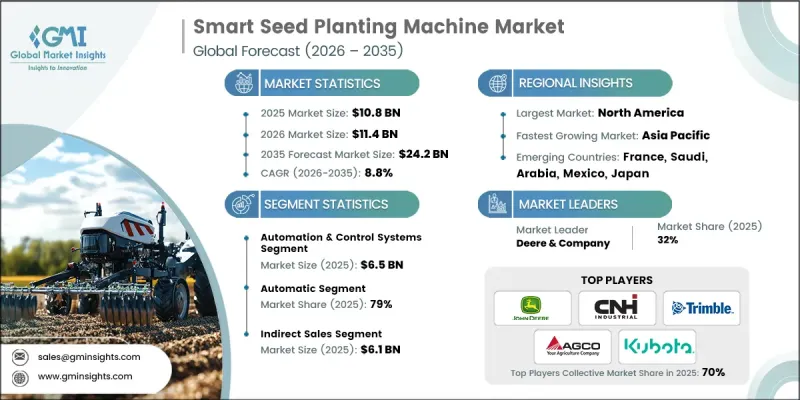
智慧播种机市场在智慧农业设备领域的扩张主要源自于人们对提高农业生产力和优化作业效率日益增长的需求。农民越来越多地采用先进设备,这些设备能够实现数据驱动的决策,使他们能够透过评估土壤品质、田间差异、水分分布和种子特性等因素来确定理想的播种条件。随着先进数位平台、感测技术和自动化系统的普及,精密农业工具的取得也日益便利。因此,农民们意识到,更精准的播种能够显着提高发芽率,减少投入浪费,并带来更稳定的产量。此外,数位化农业解决方案的整合正在改变播种作业,从而带来更稳定、更可预测的成果。随着农场作业的现代化以及对技术主导农业管理的持续依赖,对智慧播种机的需求预计将稳定成长。
| 市场范围 | |
|---|---|
| 开始年份 | 2025 |
| 预测期 | 2026-2035 |
| 上市时的市场规模 | 108亿美元 |
| 预测金额 | 242亿美元 |
| 复合年增长率 | 8.8% |
环境条件的变化进一步降低了依赖估算而非数据驱动洞察的传统播种方法的可靠性。精准播种系统提供了一种可靠的替代方案,能够在各种田间条件下提供稳定的性能。这些机器使农民能够持续监测播种效率,自动调整机器设置,并保存详细的田间记录,从而支持改进规划和製定长期作业策略。向精密农业的转变代表着现代农业实践的重大变革,它使种植者能够更好地控製播种作业,并实现更有效率的农业资源管理。
到2025年,自动化控制系统的市场规模将达到65亿美元。现代智慧播种设备高度依赖自动化控制技术,以确保种子播种的精准性和均匀性。这些系统结合了数位种子称重装置、电子控制执行器、即时可程式设计控制单元以及机器间通讯平台,用于调整种子位置、播种深度和行距的均匀性。透过自动化关键操作参数,这些技术减少了人工干预造成的误差,并提高了作物播种的均匀性。自动化控制系统的另一个重要优势在于其能够与先进的监控技术集成,使机器能够接收来自田间的即时回馈并据此调整作业。
到2025年,自动化播种机将占据79%的市场。自动化播种机旨在设定好操作参数后,以最少的人工干预完成基本的播种功能。整合的电子和机械执行器在整个作业过程中控制种子流量,保持精确的株距并调整播种深度。引导和对准技术确保田间行距一致。操作员输入所需设定后,即使田间条件变化,系统也能在播种过程中自主维持这些参数。这种自动化程度降低了操作员的工作量,并透过保持均匀的效能,提高了播种一致性,使其不受作业速度或地形条件的影响。
美国智慧播种机市场占79.7%的份额,预计2025年市场规模将达33亿美元。美国凭藉其高度机械化的农业部门和积极采用创新技术,在智慧农业机械的发展中扮演着至关重要的角色。大规模的农业生产、不断上涨的人事费用以及强大的资本投资能力,正促使生产者在其农业实践中采用自动化和精准播种技术。主要农业机械製造商的存在进一步巩固了美国的地位,使生产者能够便捷地获得先进的数位化农业设备。此外,农业技术创新生态系统的持续发展也为美国农业部门的智慧播种解决方案进步提供了支持。
目录
第一章:调查方法和范围
第二章执行摘要
第三章业界考察
- 生态系分析
- 供应商情况
- 利润率
- 每个阶段增加的价值
- 影响价值链的因素
- 影响产业的因素
- 促进因素
- 对精密农业的需求日益增长
- 向大规模机械化农业过渡
- 劳动力短缺和工资上涨
- 产业潜在风险与挑战
- 高昂的初始资本成本
- 农民缺乏技术知识
- 机会
- 人工智慧驱动的决策支援的集成
- 自动和电动种植机的普及
- 促进因素
- 成长潜力分析
- 未来市场趋势
- 科技与创新趋势
- 当前技术趋势
- 新兴技术
- 价格趋势
- 按地区
- 依产品类型
- 监理情势
- 标准和合规要求
- 区域法规结构
- 认证标准
- 波特五力分析
- PESTEL 分析
第四章 竞争情势
- 介绍
- 企业市占率分析
- 按地区
- 企业矩阵分析
- 主要市场公司的竞争分析
- 竞争定位矩阵
- 主要进展
- 併购
- 伙伴关係与合作
- 新产品发布
- 业务拓展计划
第五章 市场估算与预测:依产品类型划分,2022-2035年
- 自动化和控制系统
- 导航系统
- 驱动系统
- 显示系统
- 控制系统
- GPS接收器
- 无人机/无人飞行器
- 感测和监测设备
- 智慧电錶系统
- 感应器
- 相机
- 配送系统
第六章 市场估算与预测:依自动化程度划分,2022-2035年
- 自动的
- 手动的
第七章 市场估计与预测:依作物类型划分,2022-2035年
- 田间作物
- 谷物和谷类食品
- 豆类和油籽
- 蔬菜和水果
- 林业
第八章 市场估计与预测:依应用领域划分,2022-2035年
- 小规模农场(小于400公顷)
- 大型农场(超过400公顷)
第九章 市场估价与预测:依通路划分,2022-2035年
- 直销
- 间接销售
第十章 市场估价与预测:依地区划分,2022-2035年
- 北美洲
- 我们
- 加拿大
- 欧洲
- 德国
- 英国
- 法国
- 义大利
- 西班牙
- 亚太地区
- 中国
- 日本
- 印度
- 澳洲
- 韩国
- 拉丁美洲
- 巴西
- 墨西哥
- 阿根廷
- 中东和非洲
- 南非
- 沙乌地阿拉伯
- 阿拉伯聯合大公国
第十一章:公司简介
- AGCO
- Agrisem International
- Bourgault Industries
- CLAAS KGaA
- CNH Industrial
- Deere &Company
- Jumil
- Kinze Manufacturing
- Kubota
- Mahindra &Mahindra
- MaterMacc
- Semeato
- Trimble
- Vaderstad AB
- Yetter Farm Equipment
The Global Smart Seed Planting Machine Market was valued at USD 10.8 billion in 2025 and is estimated to grow at a CAGR of 8.8% to reach USD 24.2 billion by 2035.
Expansion in the smart seed planting machine market for smart agricultural equipment is largely supported by the growing emphasis on improving farming productivity while optimizing operational efficiency. Agricultural producers are increasingly adopting advanced equipment that enables data-based decision making, allowing them to determine ideal planting conditions by evaluating factors related to soil quality, field variability, moisture distribution, and seed characteristics. The availability of advanced digital platforms, sensing technologies, and automated systems is also improving accessibility to precision farming tools. As a result, growers are recognizing that more accurate seed placement can significantly improve germination performance and reduce input wastage, which contributes to more stable crop yields. In addition, the integration of digital agriculture solutions is transforming planting operations by enabling more consistent and predictable outcomes. As farms continue to modernize operations and rely on technology-driven agricultural management, the demand for smart seed planting machines is expected to grow steadily.
| Market Scope | |
|---|---|
| Start Year | 2025 |
| Forecast Year | 2026-2035 |
| Start Value | $10.8 Billion |
| Forecast Value | $24.2 Billion |
| CAGR | 8.8% |
Changing environmental conditions have further reduced the reliability of conventional planting approaches that rely on estimation rather than data-driven insights. Precision planting systems offer a dependable alternative by delivering consistent operational performance across varying field conditions. These machines allow farmers to monitor planting efficiency continuously, adjust machine settings automatically, and maintain detailed field records that support improved planning and long-term operational strategies. The shift toward precision agriculture represents a major transformation in modern farming practices, providing producers with improved control over planting operations and enabling more efficient management of agricultural resources.
In 2025, the automation & control systems segment accounted for USD 6.5 billion. Modern smart planting equipment relies heavily on automation and control technologies to ensure highly accurate and uniform seed distribution. These systems combine digital seed metering mechanisms, electronically controlled actuators, real-time programmable control units, and machine communication platforms to regulate seed placement, depth consistency, and row spacing. By automating key operational parameters, these technologies reduce variability caused by manual intervention and improve the uniformity of crop establishment. Another important advantage of automation and control systems is their ability to integrate with advanced monitoring technologies, allowing machines to receive real-time field feedback and adjust operations accordingly.
The automatic segment held 79% share in 2025. Automatic seed planting machines are designed to perform essential planting functions with minimal operator involvement once operational parameters have been configured. Integrated electronics and mechanical actuators control seed flow, maintain accurate spacing, and regulate planting depth throughout the operation. Guidance and alignment technologies ensure that rows remain consistent across the entire field. After the operator inputs the desired settings, the system independently maintains those parameters during the planting process, even when field conditions change. This level of automation reduces operator workload and enhances planting consistency by maintaining uniform performance regardless of operational speed or terrain conditions.
U.S. Smart Seed Planting Machine Market captured 79.7% share, generating USD 3.3 billion in 2025. The United States plays a significant role in advancing smart agricultural machinery due to its highly mechanized farming sector and strong adoption of innovative technologies. Large-scale farming operations, rising labor costs, and strong capital investment capabilities encourage producers to incorporate automation and precision planting technologies into their agricultural practices. The presence of major agricultural machinery manufacturers further strengthens the country's position by enabling easier access to advanced digital farming equipment. Additionally, the continued development of agritech innovation ecosystems is supporting the advancement of intelligent planting solutions across the U.S. agricultural landscape.
Major companies operating in the Global Smart Seed Planting Machine Market include Deere & Company, AGCO, CNH Industrial, Kubota, Mahindra & Mahindra, Trimble, CLAAS KGaA, Bourgault Industries, Kinze Manufacturing, Vaderstad AB, Agrisem International, MaterMacc, Semeato, Jumil, and Yetter Farm Equipment. Companies participating in the Smart Seed Planting Machine Market are implementing several strategic initiatives to strengthen their market position and expand their global footprint. Leading manufacturers are investing heavily in research and development to introduce advanced precision planting technologies that improve accuracy, automation, and operational efficiency. Many firms are focusing on integrating digital agriculture platforms, sensor-based technologies, and connectivity features to enhance machine intelligence and real-time data analysis capabilities. Strategic partnerships with agricultural technology providers and equipment distributors are also helping companies expand their reach across key farming regions. In addition, manufacturers are emphasizing product customization to meet diverse farming requirements and crop types.
Table of Contents
Chapter 1 Methodology and Scope
- 1.1 Market scope and definition
- 1.2 Research design
- 1.2.1 Research approach
- 1.2.2 Data collection methods
- 1.3 Data mining sources
- 1.3.1 Global
- 1.3.2 Regional/Country
- 1.4 Base estimates and calculations
- 1.4.1 Base year calculation
- 1.4.2 Key trends for market estimation
- 1.5 Primary research and validation
- 1.5.1 Primary sources
- 1.6 Forecast model
- 1.7 Research assumptions and limitations
Chapter 2 Executive Summary
- 2.1 Industry 360° synopsis
- 2.2 Key market trends
- 2.2.1 Regional
- 2.2.2 Product type
- 2.2.3 Automation level
- 2.2.4 Crop type
- 2.2.5 Application
- 2.2.6 Distribution channel
- 2.3 CXO perspectives: Strategic imperatives
- 2.3.1 Key decision points for industry executives
- 2.3.2 Critical success factors for market players
- 2.4 Future outlook and strategic recommendations
Chapter 3 Industry Insights
- 3.1 Industry ecosystem analysis
- 3.1.1 Supplier landscape
- 3.1.2 Profit margin
- 3.1.3 Value addition at each stage
- 3.1.4 Factor affecting the value chain
- 3.2 Industry impact forces
- 3.2.1 Growth drivers
- 3.2.1.1 Rising demand for precision agriculture
- 3.2.1.2 Shift toward large-scale mechanized farming
- 3.2.1.3 Labor shortages & rising wages
- 3.2.2 Industry pitfalls & challenges
- 3.2.2.1 High initial capital costs
- 3.2.2.2 Limited technical knowledge among farmers
- 3.2.3 Opportunities
- 3.2.3.1 Integration of AI-driven decision support
- 3.2.3.2 Growth of autonomous & electric planters
- 3.2.1 Growth drivers
- 3.3 Growth potential analysis
- 3.4 Future market trends
- 3.5 Technology and innovation landscape
- 3.5.1 Current technological trends
- 3.5.2 Emerging technologies
- 3.6 Price trends
- 3.6.1 By region
- 3.6.2 By product type
- 3.7 Regulatory landscape
- 3.7.1 Standards and compliance requirements
- 3.7.2 Regional regulatory frameworks
- 3.7.3 Certification standards
- 3.8 Porter’s analysis
- 3.9 PESTEL analysis
Chapter 4 Competitive Landscape, 2025
- 4.1 Introduction
- 4.2 Company market share analysis
- 4.2.1 By region
- 4.2.1.1 North America
- 4.2.1.2 Europe
- 4.2.1.3 Asia Pacific
- 4.2.1.4 Latin America
- 4.2.1.5 Middle East and Africa
- 4.2.1 By region
- 4.3 Company matrix analysis
- 4.4 Competitive analysis of major market players
- 4.5 Competitive positioning matrix
- 4.6 Key developments
- 4.6.1 Mergers & acquisitions
- 4.6.2 Partnerships & collaborations
- 4.6.3 New product launches
- 4.6.4 Expansion plans
Chapter 5 Market Estimates and Forecast, By Product Type, 2022 - 2035 (USD Billion) (Thousand Units)
- 5.1 Key trends
- 5.2 Automation & control systems
- 5.2.1 Guidance systems
- 5.2.2 Drive systems
- 5.2.3 Display systems
- 5.2.4 Control systems
- 5.2.5 GPS receivers
- 5.2.6 Drones/UAVS
- 5.3 Sensing & monitoring devices
- 5.3.1 Smart metering systems
- 5.3.2 Sensors
- 5.3.3 Cameras
- 5.3.4 Delivery systems
Chapter 6 Market Estimates and Forecast, By Automation Level, 2022 - 2035 (USD Billion) (Thousand Units)
- 6.1 Key trends
- 6.2 Automatic
- 6.3 Manual
Chapter 7 Market Estimates and Forecast, By Crop Type, 2022 - 2035 (USD Billion) (Thousand Units)
- 7.1 Key trends
- 7.2 Row crops
- 7.3 Grains & cereals
- 7.4 Pulses & oilseeds
- 7.5 Vegetables & fruits
- 7.6 Forestry
Chapter 8 Market Estimates and Forecast, By Application, 2022 - 2035 (USD Billion) (Thousand Units)
- 8.1 Key trends
- 8.2 Small farms (Below 400 hectares)
- 8.3 Large farms (Above 400 hectares)
Chapter 9 Market Estimates and Forecast, By Distribution Channel, 2022 - 2035 (USD Billion) (Thousand Units)
- 9.1 Key trends
- 9.2 Direct sales
- 9.3 Indirect sales
Chapter 10 Market Estimates and Forecast, By Region, 2022 - 2035 (USD Billion) (Thousand Units)
- 10.1 Key trends
- 10.2 North America
- 10.2.1 U.S.
- 10.2.2 Canada
- 10.3 Europe
- 10.3.1 Germany
- 10.3.2 UK
- 10.3.3 France
- 10.3.4 Italy
- 10.3.5 Spain
- 10.4 Asia Pacific
- 10.4.1 China
- 10.4.2 Japan
- 10.4.3 India
- 10.4.4 Australia
- 10.4.5 South Korea
- 10.5 Latin America
- 10.5.1 Brazil
- 10.5.2 Mexico
- 10.5.3 Argentina
- 10.6 Middle East and Africa
- 10.6.1 South Africa
- 10.6.2 Saudi Arabia
- 10.6.3 UAE
Chapter 11 Company Profiles
- 11.1 AGCO
- 11.2 Agrisem International
- 11.3 Bourgault Industries
- 11.4 CLAAS KGaA
- 11.5 CNH Industrial
- 11.6 Deere & Company
- 11.7 Jumil
- 11.8 Kinze Manufacturing
- 11.9 Kubota
- 11.10 Mahindra & Mahindra
- 11.11 MaterMacc
- 11.12 Semeato
- 11.13 Trimble
- 11.14 Vaderstad AB
- 11.15 Yetter Farm Equipment

 化肥机械市场:2026-2032年全球市场预测(依产品类型、动力来源、部署方式、技术、作物类型、最终用户和销售管道)种植工具市场:依产品类型、动力来源、材料、应用、通路和最终用户划分-全球预测,2026-2032年自走式蔬菜移植市场:按类型、引擎功率、种植行数、价格范围、通路、最终用户和应用划分-2026-2032年全球预测蔬菜移植市场:按类型、操作方式、动力来源、应用和最终用户划分,全球预测,2026-2032年农业植物保护无人机市场:按无人机类型、组件、作物类型、应用、最终用户划分,全球预测(2026-2032)
 2026年全球播种机市场报告2026年全球施肥机械市场报告2026年全球肥料施用与植物保护设备市场报告
 种植设备市场规模、份额和成长分析(按设备类型、动力来源、行类型、最终用途、分销通路和地区划分)-2026-2033年产业预测蔬菜种植机器人市场(依动力源、商业农场、自主机器人、露天农场、播种和机械臂)——2026-2032年全球预测