


 |
市场调查报告书
商品编码
1998679
2026 年至 2035 年人工智慧 (AI) 在药物发现领域的市场机会、成长要素、产业趋势和预测。Artificial Intelligence in Drug Discovery Market Opportunity, Growth Drivers, Industry Trend Analysis, and Forecast 2026 - 2035 |
||||||

2025 年全球药物发现领域的人工智慧 (AI) 市场价值为 31 亿美元,预计到 2035 年将达到 439 亿美元,年复合成长率为 30.5%。
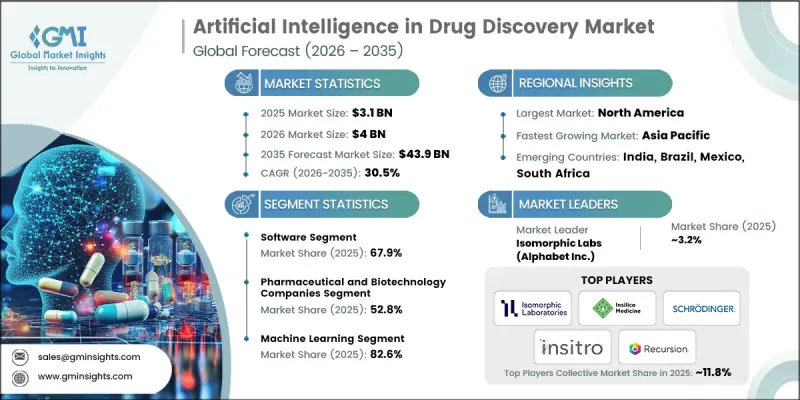
随着製药和生物技术公司越来越多地将先进的计算技术融入其研究方法,人工智慧(AI)在药物研发行业的应用正在迅速扩展。日益严重的复杂慢性健康问题促使各机构加速开发创新疗法,推动了人工智慧驱动的药物研发工具的普及。人工智慧技术透过提高效率、缩短研究週期和优化整个药物研发流程中的决策,正在改变传统的药物研发方法。这些平台支援各种研究活动,能够对广泛的生物医学数据集进行高级数据分析和预测建模。人工智慧解决方案被广泛用于识别生物标靶、优化候选化合物、设计新型分子结构以及改进早期测试流程。人们日益关注传统研发活动的高成本和漫长过程,这也推动了人工智慧平台的整合,以提高效率和准确性。此外,人们对精准医疗和个人化疗法的兴趣日益浓厚,也使得能够分析复杂生物资讯的智慧药物研发解决方案的需求不断增长。数位医疗基础设施的扩展和多个地区对生物技术创新投资的增加也促进了市场成长。我们持续进行的研究和开发倡议旨在开发更透明、更可靠的人工智慧模型,这将进一步增强人工智慧市场在全球药物发现领域的前景。
| 市场范围 | |
|---|---|
| 开始年份 | 2025 |
| 预测期 | 2026-2035 |
| 上市时的市场规模 | 31亿美元 |
| 预测金额 | 439亿美元 |
| 复合年增长率 | 30.5% |
预计到2025年,软体领域将占据67.9%的市场份额,并在2026年至2035年间以30.2%的复合年增长率成长。随着各机构越来越依赖数位化解决方案来管理庞大的生物医学资料集并进行复杂的预测分析,软体平台正成为人工智慧主导的药物发现生态系统的重要组成部分。这些平台透过支援研究人员进行计算模拟、分子建模和进阶数据解读,为药物发现工作流程的关键阶段提供支援。随着人工智慧架构(包括机器学习和深度学习技术)的不断进步,这些软体工具的分析能力也不断提升。先进演算法的整合使研究人员能够进行大规模化学模拟,并更有效率地识别有前景的候选药物。
到2025年,机器学习领域将占据82.6%的市场。机器学习技术凭藉其处理和解读极其复杂的科学数据集的能力,成为人工智慧药物研发领域创新发展的主要驱动力。这些演算法能够分析各种生物和化学资料来源,使研究人员能够获得预测性见解,从而改善早期药物研发决策。机器学习模型使科学家能够识别基因组资讯、分子库和实验资料集中的模式,显着加快潜在治疗候选药物的筛选。此外,将临床数据和真实世界数据整合到机器学习模型的趋势日益增长,正在促进个人化治疗策略的开发。云端运算基础设施和可扩展资料处理平台的进步进一步推动了机器学习技术在药物研发领域的广泛应用。
到2025年,北美人工智慧(AI)药物研发市场占有率将达到47.7%。北美人工智慧产业正经历强劲成长,这主要得益于製药和生物技术公司对先进数位技术的快速应用。该地区拥有高度发展的创新生态系统,有利于将人工智慧解决方案融入生物医学研究活动。对生物技术研究和数位医疗基础设施的大量投资进一步加速了先进的人工智慧药物研发平台的发展。此外,完善的法规结构也促进了新兴技术在医疗保健研究中的安全有效应用,从而推动了市场扩张。
目录
第一章:调查方法和范围
第二章执行摘要
第三章业界考察
- 生态系分析
- 影响产业的因素
- 促进因素
- 复杂慢性疾病的盛行率不断上升。
- 医疗保健领域数据的爆炸性增长数位化
- 人工智慧演算法和运算能力的进步
- 扩大科技公司与製药公司之间的合作
- 产业潜在风险与挑战
- 数据品质和整合方面的挑战
- 监理和伦理问题
- 市场机会
- 个人化医疗和精准医疗的扩展
- 生成式人工智慧在分子设计领域的兴起
- 促进因素
- 成长潜力分析
- 监理情势(基于初步调查)
- 北美洲
- 我们
- 加拿大
- 欧洲
- 亚太地区
- 拉丁美洲
- 中东和非洲
- 北美洲
- 未来市场趋势(基于初步研究)
- 技术格局
- 目前技术
- 新兴技术
- 投资和资金筹措趋势
- 人工智慧和生成式人工智慧对市场的影响
- 波特五力分析
- PESTEL 分析
第四章 竞争情势
- 介绍
- 企业市占率分析
- 北美洲
- 欧洲
- 亚太地区
- 企业矩阵分析
- 主要市场公司的竞争分析
- 竞争定位矩阵
- 主要进展
- 併购
- 伙伴关係与合作
- 新产品发布
- 业务拓展计划
第五章 市场估计与预测:依组件划分,2022-2035年
- 软体
- 现场
- 基于云端的
- 服务
第六章 市场估计与预测:依技术划分,2022-2035年
- 机器学习
- 深度学习
- 监督式学习
- 无监督学习
- 其他机器学习技术
- 其他技术
第七章 市场估计与预测:依应用领域划分,2022-2035年
- 分子库筛检
- 目标识别
- 药物优化与仿单标示外用药
- 德诺和製药
- 临床前试验
第八章 市场估计与预测:依治疗领域划分,2022-2035年
- 肿瘤学
- 神经退化性疾病
- 发炎性疾病
- 感染疾病
- 代谢性疾病
- 罕见疾病
- 心血管疾病
- 其他治疗领域
第九章 市场估计与预测:依最终用途划分,2022-2035年
- 製药和生物技术公司
- 合约研究组织(CRO)
- 其他最终用户
第十章 市场估价与预测:依地区划分,2022-2035年
- 北美洲
- 我们
- 加拿大
- 欧洲
- 德国
- 英国
- 法国
- 西班牙
- 义大利
- 荷兰
- 亚太地区
- 中国
- 日本
- 印度
- 澳洲
- 韩国
- 拉丁美洲
- 巴西
- 墨西哥
- 阿根廷
- 中东和非洲
- 南非
- 沙乌地阿拉伯
- 阿拉伯聯合大公国
第十一章:公司简介
- Isomorphic Labs(Alphabet)
- Microsoft Corporation
- NVIDIA Corporation
- International Business Machines Corporation
- Schrodinger
- Recursion Pharmaceuticals
- Insilico Medicine
- BenevolentAI
- Atomwise
- Insitro
- Deep Genomics
- Iktos
- Deargen
- 9Bio Therapeutics
- Aureka Biotechnologies
- CellCodex Technology Limited
- chAIron
- DenovAI Biotech
- Examol
- Helical.AI
- Orakl Oncology
- Therenia
The Global Artificial Intelligence in Drug Discovery Market was valued at USD 3.1 billion in 2025 and is estimated to grow at a CAGR of 30.5% to reach USD 43.9 billion by 2035.
The artificial intelligence in the drug discovery industry is witnessing rapid expansion as pharmaceutical and biotechnology companies increasingly integrate advanced computational technologies into research processes. The growing burden of complex and long-term health conditions is encouraging organizations to accelerate the development of innovative therapeutics, which in turn is driving the adoption of AI-driven discovery tools. Artificial intelligence technologies are transforming traditional drug development methods by improving efficiency, reducing research timelines, and optimizing decision-making across the discovery pipeline. These platforms support various research activities by enabling advanced data analysis and predictive modeling across extensive biomedical datasets. Solutions powered by artificial intelligence are widely used to identify biological targets, optimize candidate compounds, design novel molecular structures, and improve early-stage testing processes. Rising concerns regarding the high cost and lengthy duration associated with conventional research and development activities are also encouraging the integration of AI platforms that enhance productivity and accuracy. Furthermore, increasing interest in precision medicine and personalized therapeutic approaches is creating additional demand for intelligent drug discovery solutions capable of analyzing complex biological information. Expanding digital healthcare infrastructure and growing investments in biotechnology innovation across several regions are also contributing to market growth. Continuous research initiatives aimed at developing more transparent and reliable artificial intelligence models are further strengthening the outlook of the global artificial intelligence in drug discovery market.
| Market Scope | |
|---|---|
| Start Year | 2025 |
| Forecast Year | 2026-2035 |
| Start Value | $3.1 Billion |
| Forecast Value | $43.9 Billion |
| CAGR | 30.5% |
The software segment accounted for 67.9% share in 2025 and is projected to grow at a CAGR of 30.2% throughout 2026-2035. Software platforms have become a fundamental component of the AI-driven drug discovery ecosystem as organizations increasingly rely on digital solutions to manage vast biomedical datasets and conduct complex predictive analyses. These platforms support critical stages of the drug discovery workflow by enabling researchers to perform computational simulations, molecular modeling, and advanced data interpretation. Continuous advancements in artificial intelligence architectures, including machine learning and deep learning techniques, are enhancing the analytical capabilities of these software tools. The integration of sophisticated algorithms allows researchers to perform large-scale chemical simulations and identify promising therapeutic candidates more efficiently.
The machine learning segment held 82.6% share in 2025. Machine learning technologies have become the primary engine driving innovation in AI-based drug discovery because of their ability to process and interpret highly complex scientific datasets. These algorithms analyze diverse biological and chemical data sources, allowing researchers to generate predictive insights that improve early-stage drug development decisions. Machine learning models enable scientists to identify patterns within genomic information, molecular libraries, and experimental datasets, which significantly accelerates the identification of viable therapeutic candidates. In addition, the growing integration of clinical and real-world data into machine learning models is strengthening the development of personalized treatment strategies. Advancements in cloud computing infrastructure and scalable data processing platforms are further supporting the widespread deployment of machine learning technologies within pharmaceutical research environments.
North America Artificial Intelligence in Drug Discovery Market held 47.7% share in 2025. The North America artificial intelligence in drug discovery industry is experiencing strong growth due to the rapid adoption of advanced digital technologies across pharmaceutical and biotechnology organizations. The region benefits from a highly developed innovation ecosystem that encourages the integration of artificial intelligence solutions into biomedical research activities. Strong financial investment in biotechnology research and digital healthcare infrastructure is further accelerating the development of advanced AI-driven drug discovery platforms. Supportive regulatory frameworks also contribute to market expansion by encouraging the safe and effective use of emerging technologies in healthcare research.
Major companies operating in the Global Artificial Intelligence in Drug Discovery Market include Isomorphic Labs (Alphabet), Microsoft Corporation, NVIDIA Corporation, International Business Machines Corporation, Schrodinger, Recursion Pharmaceuticals, Insilico Medicine, BenevolentAI, Atomwise, Insitro, Deep Genomics, Iktos, Deargen, 9Bio Therapeutics, Aureka Biotechnologies, CellCodex Technology Limited, chAIron, DenovAI Biotech, Examol, Helical.AI, Orakl Oncology, and Therenia. Companies operating in the Global Artificial Intelligence in Drug Discovery Market are implementing multiple strategies to strengthen their technological capabilities and expand market influence. One key approach involves investing heavily in research and development to enhance the performance of AI algorithms used in molecular modeling and predictive analytics. Many organizations are also forming strategic collaborations with pharmaceutical firms, biotechnology companies, and research institutions to accelerate the development of innovative therapeutic solutions. Expanding cloud-based computing infrastructure and high-performance data platforms is another major focus area that allows companies to process large biomedical datasets more efficiently. Additionally, firms are prioritizing the integration of advanced analytics, automation tools, and scalable machine learning models to improve drug discovery workflows.
Table of Contents
Chapter 1 Methodology and Scope
- 1.1 Market scope and definition
- 1.2 Research approach
- 1.3 Quality commitments
- 1.3.1 GMI AI policy and data integrity commitment
- 1.3.1.1 Source consistency protocol
- 1.3.1 GMI AI policy and data integrity commitment
- 1.4 Research trail and confidence scoring
- 1.4.1 Research trail components
- 1.4.2 Scoring components
- 1.5 Data collection
- 1.5.1 Partial list of primary sources
- 1.6 Data mining sources
- 1.6.1 Paid sources
- 1.6.1.1 Sources, by region
- 1.6.1 Paid sources
- 1.7 Base estimates and calculations
- 1.7.1 Revenue share analysis
- 1.7.2 Base year calculation
- 1.8 Forecast model
- 1.9 Research transparency addendum
- 1.9.1 Source attribution framework
- 1.9.2 Quality assurance metrics
- 1.9.3 Our commitment to trust
Chapter 2 Executive Summary
- 2.1 Industry 3600 synopsis
- 2.2 Market Trends
- 2.2.1 Business trends
- 2.2.2 Regional trends
- 2.2.3 Component trends
- 2.2.4 Technology trends
- 2.2.5 Application type trends
- 2.2.6 Therapeutic area trends
- 2.2.7 End use trends
- 2.3 CXO perspectives: Strategic imperatives
Chapter 3 Industry Insights
- 3.1 Industry ecosystem analysis
- 3.2 Industry impact forces
- 3.2.1 Growth drivers
- 3.2.1.1 Increasing prevalence of complex and chronic diseases
- 3.2.1.2 Data explosion and digitization in healthcare
- 3.2.1.3 Advancements in AI algorithms and computing power
- 3.2.1.4 Growing collaboration between tech and pharma companies
- 3.2.2 Industry pitfalls and challenges
- 3.2.2.1 Data quality and integration issues
- 3.2.2.2 Regulatory and ethical concerns
- 3.2.3 Market opportunities
- 3.2.3.1 Expansion of personalized and precision medicine
- 3.2.3.2 Emergence of generative AI in molecule design
- 3.2.1 Growth drivers
- 3.3 Growth potential analysis
- 3.4 Regulatory landscape (Driven by Primary Research)
- 3.4.1 North America
- 3.4.1.1 U.S.
- 3.4.1.2 Canada
- 3.4.2 Europe
- 3.4.3 Asia Pacific
- 3.4.4 Latin America
- 3.4.5 Middle East and Africa
- 3.4.1 North America
- 3.5 Future market trends (Driven by Primary Research)
- 3.6 Technological landscape
- 3.6.1 Current technologies
- 3.6.2 Emerging technologies
- 3.7 Investment and funding landscape
- 3.8 Impact of AI and generative AI on the market
- 3.9 Porter's analysis
- 3.10 PESTEL analysis
Chapter 4 Competitive Landscape, 2025
- 4.1 Introduction
- 4.2 Company market share analysis
- 4.2.1 North America
- 4.2.2 Europe
- 4.2.3 Asia Pacific
- 4.3 Company matrix analysis
- 4.4 Competitive analysis of major market players
- 4.5 Competitive positioning matrix
- 4.6 Key developments
- 4.6.1 Merger and acquisition
- 4.6.2 Partnership and collaboration
- 4.6.3 New product launches
- 4.6.4 Expansion plans
Chapter 5 Market Estimates and Forecast, By Component, 2022 - 2035 ($ Mn)
- 5.1 Key trends
- 5.2 Software
- 5.2.1 On-premise
- 5.2.2 Cloud-based
- 5.3 Services
Chapter 6 Market Estimates and Forecast, By Technology, 2022 - 2035 ($ Mn)
- 6.1 Key trends
- 6.2 Machine learning
- 6.2.1 Deep learning
- 6.2.2 Supervised learning
- 6.2.3 Unsupervised learning
- 6.2.4 Other machine learning technologies
- 6.3 Other technologies
Chapter 7 Market Estimates and Forecast, By Application Type, 2022 - 2035 ($ Mn)
- 7.1 Key trends
- 7.2 Molecular library screening
- 7.3 Target identification
- 7.4 Drug optimization and repurposing
- 7.5 De novo drug designing
- 7.6 Preclinical testing
Chapter 8 Market Estimates and Forecast, By Therapeutic Area, 2022 - 2035 ($ Mn)
- 8.1 Key trends
- 8.2 Oncology
- 8.3 Neurodegenerative diseases
- 8.4 Inflammatory
- 8.5 Infectious diseases
- 8.6 Metabolic diseases
- 8.7 Rare diseases
- 8.8 Cardiovascular diseases
- 8.9 Other therapeutic areas
Chapter 9 Market Estimates and Forecast, By End Use, 2022 - 2035 ($ Mn)
- 9.1 Key trends
- 9.2 Pharmaceutical and biotechnology companies
- 9.3 Contract research organizations (CROs)
- 9.4 Other end users
Chapter 10 Market Estimates and Forecast, By Region, 2022 - 2035 ($ Mn)
- 10.1 Key trends
- 10.2 North America
- 10.2.1 U.S.
- 10.2.2 Canada
- 10.3 Europe
- 10.3.1 Germany
- 10.3.2 UK
- 10.3.3 France
- 10.3.4 Spain
- 10.3.5 Italy
- 10.3.6 Netherlands
- 10.4 Asia Pacific
- 10.4.1 China
- 10.4.2 Japan
- 10.4.3 India
- 10.4.4 Australia
- 10.4.5 South Korea
- 10.5 Latin America
- 10.5.1 Brazil
- 10.5.2 Mexico
- 10.5.3 Argentina
- 10.6 Middle East and Africa
- 10.6.1 South Africa
- 10.6.2 Saudi Arabia
- 10.6.3 UAE
Chapter 11 Company Profiles
- 11.1 Isomorphic Labs (Alphabet)
- 11.2 Microsoft Corporation
- 11.3 NVIDIA Corporation
- 11.4 International Business Machines Corporation
- 11.5 Schrodinger
- 11.6 Recursion Pharmaceuticals
- 11.7 Insilico Medicine
- 11.8 BenevolentAI
- 11.9 Atomwise
- 11.10 Insitro
- 11.11 Deep Genomics
- 11.12 Iktos
- 11.13 Deargen
- 11.14. 9Bio Therapeutics
- 11.15 Aureka Biotechnologies
- 11.16 CellCodex Technology Limited
- 11.17 chAIron
- 11.18 DenovAI Biotech
- 11.19 Examol
- 11.20 Helical.AI
- 11.21 Orakl Oncology
- 11.22 Therenia

 人工智慧在个人化医疗领域的市场:未来预测(至2034年)-按组件、技术、治疗领域、资料类型、应用、最终使用者和地区进行分析
 人工智慧在药物研发领域的市场:按技术、治疗领域、应用、最终用户和部署方式划分——全球市场预测(2026-2032 年)人工智慧药物发现平台市场预测至2034年—按平台类型、部署模式、技术、应用、最终用户和地区分類的全球分析
 人工智慧浪潮席捲夏威夷——电力和光纤瓶颈:
 2026-2034年人工智慧(AI)驱动药物发现全球市场规模、份额、趋势和成长分析报告
 日本人工智慧药物发现市场规模、市场份额、趋势和预测:按服务提供、应用、治疗领域、最终用户和地区划分(2026-2034 年)AI蛋白质设计市场:按蛋白质类型、技术平台、方法、应用、最终用户和部署类型划分-2026-2032年全球预测基于人工智慧的胜肽类药物发现平台市场(按技术类型、治疗用途、胜肽和最终用户划分)—2026-2032年全球预测
 人工智慧药物发现市场规模、份额和趋势分析报告:按应用、治疗领域、最终用途、地区和细分市场预测,2026-2033年
 人工智慧在药物研发领域的市场:产业趋势及全球预测(至2040年)-按应用、影像处理类型和主要地区划分