


 |
市场调查报告书
商品编码
1998680
肾结石治疗市场:商机、成长要素、产业趋势分析及2026-2035年预测Kidney Stone Management Market Opportunity, Growth Drivers, Industry Trend Analysis, and Forecast 2026 - 2035 |
||||||

2025 年全球肾结石治疗市场价值 29 亿美元,预计到 2035 年将达到 48 亿美元,年复合成长率为 4.9%。
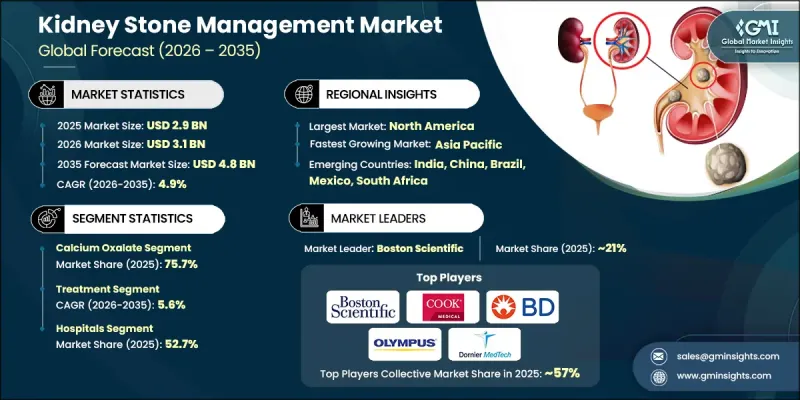
肾结石治疗市场的成长主要受以下因素驱动:全球肾结石发病率的上升、治疗技术的不断进步以及人口老化的持续加剧。医疗专业人员发现泌尿系统疾病患者数量不断增加,这导致对可靠的诊断工具和有效的治疗方案的需求日益增长。医疗技术的进步提高了结石检测的准确性,同时也提升了治疗效率和病人安全性。此外,微创治疗的普及正在改变治疗方式,缩短恢復时间并降低手术风险。医院和专科诊所越来越多地采用最新的医疗设备和先进的手术技术,以改善临床疗效并优化病患管理。此外,数位诊断和影像技术的融合使医疗专业人员能够更早发现肾结石并制定更精准的治疗策略。这些进步共同推动了肾结石治疗市场的稳定成长,同时也提升了患者照护的整体品质。
| 市场范围 | |
|---|---|
| 开始年份 | 2025 |
| 预测期 | 2026-2035 |
| 上市时的市场规模 | 29亿美元 |
| 预计金额 | 48亿美元 |
| 复合年增长率 | 4.9% |
肾结石的治疗包括透过影像学检查、药物治疗以及微创或外科手术等手段进行识别、治疗和长期管理。这些干预措施的主要目标是缓解症状、清除或碎石、预防復发以及恢復正常的泌尿系统功能。输尿管镜检查、雷射碎石术、体外震波碎石术和经皮手术等技术的进步显着提高了治疗效果。这些进步使临床医生能够以更小的併发症实施更精准的手术。此外,随着医疗机构越来越多地采用微创手术和门诊手术方案,该行业正经历快速成长。
预计到2025年,草酸钙结石市占率将达到75.7%。该细分市场的主导地位主要归因于此类肾结石的高发病率及其与代谢和饮食风险因素的密切关联。确诊患有此病的患者通常需要反覆后续观察和医疗干预,从而导致对诊断和治疗方案的持续需求。由于此类肾结石容易復发,医疗专业人员强调包括饮食指导、药物治疗和定期后续观察的长期管理策略。因此,此类结石的高发生率和易復发性持续推动着肾结石治疗市场中草酸钙结石细分市场的成长。
预计到2025年,肾结石治疗市场规模将达到17亿美元,并在2026年至2035年间以5.6%的复合年增长率成长。全球肾结石发生率的不断上升,尤其是復发病例的增加,推动了对治疗性介入的需求成长。由于疾病的复发性,需要即时治疗和持续的患者管理,导致全球医疗程序数量显着增加。此外,诊断技术的进步使医疗专业人员能够更早发现结石并更精确地确定其位置。影像能力的提升使得治疗方案的发展更加精准,有助于改善临床疗效。这些进步增强了医师对现代治疗方法的信心,同时也提高了医疗机构的诊疗效率。
预计到2025年,美国肾结石治疗市场规模将达12亿美元。全国范围内肾结石的高发病率持续推动着对外科手术和预防保健方案的稳定需求。相当一部分患者会出现结石復发,需要持续监测和多次治疗性介入。这一趋势促进了市场的持续活力,并推动了对先进医疗技术需求的成长。美国拥有完善的医疗保健基础设施,包括配备先进体外震波碎石机、输尿管镜设备和雷射治疗技术的医院和门诊手术中心,这也为市场发展提供了有利条件。先进的影像系统有助于早期发现疾病并改善治疗方案。随着医疗机构不断优先采用微创技术,整个医疗系统的治疗效率和病患处理能力也稳定提升。
主要企业正积极实施各项策略性倡议,以巩固市场地位并拓展全球业务。主要企业正大力投资研发,力求推出技术先进的治疗系统,进而提高手术精准度并改善病患预后。许多企业也致力于产品创新,将更强大的成像功能、数位化连接和先进的雷射技术整合到医疗设备中。与医疗机构和技术供应商建立策略合作伙伴关係,有助于企业加速产品开发,并扩大临床应用范围。此外,透过伙伴关係和销售协议进入新兴医疗市场,企业可以拓展其先进治疗方案的管道。
目录
第一章:调查方法
- 研究途径
- 品质改进计划
- GMI人工智慧政策和资料完整性倡议
- 资讯来源一致性通讯协定
- GMI人工智慧政策和资料完整性倡议
- 调查过程和可靠性评分
- 调查过程的组成部分
- 评分组成部分
- 数据收集
- 主要来源部分列表
- 资料探勘资讯来源
- 付费资讯来源
- 区域资讯来源
- 付费资讯来源
- 基本估算和计算方法
- 每种方法中基准年的计算
- 预测模型
- 量化市场影响分析
- 生长参数对预测的数学影响
- 量化市场影响分析
- 关于调查透明度的补充信息
- 资讯来源归属框架
- 品质保证指标
- 对信任的承诺
第二章执行摘要
第三章业界考察
- 生态系分析
- 影响产业的因素
- 促进因素
- 肾结石发生率和復发率增加
- 微创治疗的技术进步
- 体外震波碎石术的保险报销优惠
- 人们对肾臟健康的整体认识不断提高
- 产业潜在风险与挑战
- 先进医疗设备高成本
- 体外震波碎石术的潜在长期副作用
- 市场机会
- 新兴市场的扩张
- 远端医疗和远端患者监护的发展
- 促进因素
- 成长潜力分析
- 监理情势
- 北美洲
- 欧洲
- 亚太地区
- 科技趋势
- 当前技术趋势
- 新兴技术
- 救赎方案
- 未来市场趋势
- 波特五力分析
- PESTEL 分析
- 价值链分析
- 客户洞察
- Start-Ups场景
- 差距分析
- 人工智慧和生成式人工智慧对市场的影响
第四章 竞争情势
- 介绍
- 企业矩阵分析
- 企业市占率分析
- 世界
- 北美洲
- 欧洲
- 亚太地区
- 竞争定位矩阵
- 主要市场公司的竞争分析
- 主要进展
- 併购
- 伙伴关係与合作
- 新产品发布
- 业务拓展计划
第五章 市场估计与预测:依肾结石类型划分,2022-2035年
- 草酸钙
- 鸟粪石
- 尿酸
- 磷酸钙
- 半胱胺酸
第六章 市场估计与预测:依类别划分,2022-2035年
- 治疗
- 体外震波碎石术(ESWL)
- 输尿管镜检查
- 经皮肾镜取石术(PCNL)
- 其他治疗方法
- 诊断
- 电脑断层扫描
- 超音波检查
- 腹部X光检查
- 静脉肾盂造影
- 腹部磁振造影
- 其他诊断方法
第七章 市场估计与预测:依最终用途划分,2022-2035年
- 医院
- 专科诊所
- 门诊手术中心
- 其他最终用户
第八章 市场估计与预测:依地区划分,2022-2035年
- 北美洲
- 我们
- 加拿大
- 欧洲
- 德国
- 英国
- 法国
- 西班牙
- 义大利
- 荷兰
- 亚太地区
- 中国
- 日本
- 印度
- 澳洲
- 韩国
- 拉丁美洲
- 巴西
- 墨西哥
- 阿根廷
- 中东和非洲
- 南非
- 沙乌地阿拉伯
- 阿拉伯聯合大公国
第九章:公司简介
- Allengers
- Becton, Dickinson and Company
- Boston Scientific
- Coloplast
- COOK MEDICAL
- DirexGroup
- Dornier MedTech
- ELMED Medical Systems
- EMS ELECTRO MEDICAL SYSTEMS
- KARL STORZ
- MEDISPEC
- OLYMPUS
- PolyDiagnost
- Richard Wolf
- SIEMENS Healthineers
The Global Kidney Stone Management Market was valued at USD 2.9 billion in 2025 and is estimated to grow at a CAGR of 4.9% to reach USD 4.8 billion by 2035.
Growth in the kidney stone management market is supported by the increasing global incidence of kidney stone disorders, continuous advancements in treatment technologies, and the steady rise in the aging population. Healthcare providers are witnessing higher patient volumes associated with urinary tract disorders, which is intensifying the demand for reliable diagnostic tools and effective treatment solutions. Medical technology advancements are improving the accuracy of stone detection while also enhancing treatment efficiency and patient safety. Additionally, the shift toward minimally invasive therapeutic approaches is transforming the treatment landscape by offering shorter recovery times and reduced procedural risks. Hospitals and specialty clinics are increasingly adopting modern devices and advanced procedural techniques designed to improve clinical outcomes and optimize patient management. Furthermore, the integration of digital diagnostics and imaging technologies is enabling healthcare professionals to identify kidney stones earlier and plan more precise treatment strategies. Collectively, these developments are driving steady expansion of the kidney stone management market while improving the overall quality of patient care.
| Market Scope | |
|---|---|
| Start Year | 2025 |
| Forecast Year | 2026-2035 |
| Start Value | $2.9 Billion |
| Forecast Value | $4.8 Billion |
| CAGR | 4.9% |
Kidney stone management involves the identification, treatment, and long-term control of renal calculi through diagnostic imaging, medical therapy, and minimally invasive or surgical procedures. The primary objective of these interventions is to relieve symptoms, eliminate or break down stones, prevent recurrence, and restore normal urinary system function. Advancements in technologies used for ureteroscopy, laser-based stone fragmentation, extracorporeal shock wave lithotripsy, and percutaneous procedures have significantly enhanced treatment effectiveness. These improvements allow clinicians to perform procedures with greater precision while minimizing complications. The industry is also experiencing rapid growth as healthcare facilities expand their adoption of minimally invasive procedures and ambulatory surgical solutions.
The calcium oxalate segment held 75.7% share in 2025. The segment's leadership is largely attributed to the widespread occurrence of this type of kidney stone and its strong association with metabolic and dietary risk factors. Patients diagnosed with this condition often require repeated monitoring and medical intervention, which contributes to sustained demand for diagnostic and treatment solutions. Because this type of kidney stone frequently recurs, healthcare providers emphasize long-term management strategies that include dietary guidance, medical therapy, and routine monitoring. The high prevalence and recurrent nature of these stones, therefore, continue to support the growth of the calcium oxalate segment within the kidney stone management market.
The treatment segment generated USD 1.7 billion in 2025 and is expected to grow at a CAGR of 5.6% during 2026-2035. The increasing global incidence of kidney stone disease, particularly cases involving recurrence, is driving greater demand for therapeutic interventions. The recurring nature of the condition requires both immediate treatment procedures and continuous patient management, which significantly increases the volume of medical procedures performed worldwide. In addition, improvements in diagnostic technologies are enabling healthcare providers to detect stones at earlier stages and determine their exact location more accurately. Enhanced imaging capabilities support more precise treatment planning and improve clinical outcomes. These developments are increasing physician confidence in modern treatment methods while also contributing to higher procedural efficiency across healthcare facilities.
U.S. Kidney Stone Management Market reached USD 1.2 billion in 2025. The high occurrence of kidney stone disorders across the country continues to create consistent demand for both surgical procedures and preventive care solutions. A considerable portion of patients experience recurrent stone formation, which requires ongoing monitoring and multiple treatment interventions. This pattern contributes to sustained market activity and increased demand for advanced medical technologies. The United States also benefits from a well-developed healthcare infrastructure that includes hospitals and ambulatory surgical centers equipped with advanced lithotripsy systems, ureteroscopy devices, and laser-based treatment technologies. Access to sophisticated diagnostic imaging systems supports earlier disease detection and improved treatment planning. As healthcare providers continue to prioritize minimally invasive techniques, treatment efficiency and patient throughput are steadily improving across the healthcare system.
Several leading companies participate in the Global Kidney Stone Management Market, including Allengers, Becton, Dickinson and Company, Boston Scientific, Coloplast, COOK MEDICAL, DirexGroup, Dornier MedTech, ELMED Medical Systems, EMS ELECTRO MEDICAL SYSTEMS, KARL STORZ, MEDISPEC, OLYMPUS, PolyDiagnost, Richard Wolf, and SIEMENS Healthineers. Companies operating in the Global Kidney Stone Management Market are implementing a range of strategic initiatives to strengthen their market presence and expand their global footprint. Leading manufacturers are heavily investing in research and development to introduce technologically advanced treatment systems that enhance procedural precision and patient outcomes. Many firms are also focusing on product innovation by integrating improved imaging capabilities, digital connectivity, and advanced laser technologies into their medical devices. Strategic collaborations with healthcare institutions and technology providers are helping companies accelerate product development and broaden clinical adoption. Additionally, expansion into emerging healthcare markets through partnerships and distribution agreements is allowing companies to increase accessibility to advanced treatment solutions.
Table of Contents
Chapter 1 Research Methodology
- 1.1 Research approach
- 1.2 Quality commitments
- 1.2.1 GMI AI policy & data integrity commitment
- 1.2.1.1 Source consistency protocol
- 1.2.1 GMI AI policy & data integrity commitment
- 1.3 Research trail & confidence scoring
- 1.3.1 Research trail components
- 1.3.2 Scoring components
- 1.4 Data collection
- 1.4.1 Partial list of primary sources
- 1.5 Data mining sources
- 1.5.1 Paid sources
- 1.5.1.1 Sources, by region
- 1.5.1 Paid sources
- 1.6 Base estimates and calculations
- 1.6.1 Base year calculation for any one approach
- 1.7 Forecast model
- 1.7.1 Quantified market impact analysis
- 1.7.1.1 Mathematical impact of growth parameters on forecast
- 1.7.1 Quantified market impact analysis
- 1.8 Research transparency addendum
- 1.8.1 Source attribution framework
- 1.8.2 Quality assurance metrics
- 1.8.3 Our commitment to trust
Chapter 2 Executive Summary
- 2.1 Industry 3600 synopsis
- 2.2 Key market trends
- 2.2.1 Regional trends
- 2.2.2 Stone type trends
- 2.2.3 Category trends
- 2.2.4 End use trends
- 2.3 CXO perspectives: Strategic imperatives
- 2.3.1 Key decision points for industry executives
- 2.3.2 Critical success factors for market players
- 2.4 Future outlook and strategic recommendations
Chapter 3 Industry Insights
- 3.1 Industry ecosystem analysis
- 3.2 Industry impact forces
- 3.2.1 Growth drivers
- 3.2.1.1 Increasing prevalence and recurrence rate of kidney stones
- 3.2.1.2 Technological advancements in minimally invasive treatments
- 3.2.1.3 Favourable reimbursement for lithotripsy procedures
- 3.2.1.4 Rising awareness regarding overall kidney health
- 3.2.2 Industry pitfalls and challenges
- 3.2.2.1 High cost of advanced treatment devices
- 3.2.2.2 Potential long-term adverse effects of lithotripsy
- 3.2.3 Market opportunities
- 3.2.3.1 Expansion in emerging markets
- 3.2.3.2 Growth of telemedicine and remote patient monitoring
- 3.2.1 Growth drivers
- 3.3 Growth potential analysis
- 3.4 Regulatory landscape
- 3.4.1 North America
- 3.4.2 Europe
- 3.4.3 Asia Pacific
- 3.5 Technology landscape
- 3.5.1 Current technological trends
- 3.5.2 Emerging technologies
- 3.6 Reimbursement scenario
- 3.7 Future market trends
- 3.8 Porter's analysis
- 3.9 PESTEL analysis
- 3.10 Value chain analysis
- 3.11 Customer insights
- 3.12 Start-up scenarios
- 3.13 Gap analysis
- 3.14 Impact of AI and generative AI on the market
Chapter 4 Competitive Landscape, 2025
- 4.1 Introduction
- 4.2 Company matrix analysis
- 4.3 Company market share analysis
- 4.3.1 Global
- 4.3.2 North America
- 4.3.3 Europe
- 4.3.4 Asia Pacific
- 4.4 Competitive positioning matrix
- 4.5 Competitive analysis of major market players
- 4.6 Key developments
- 4.6.1 Mergers & acquisitions
- 4.6.2 Partnerships & collaborations
- 4.6.3 New product launches
- 4.6.4 Expansion plans
Chapter 5 Market Estimates and Forecast, By Stone Type, 2022 - 2035 ($ Mn)
- 5.1 Key trends
- 5.2 Calcium oxalate
- 5.3 Struvite
- 5.4 Uric acid
- 5.5 Calcium phosphate
- 5.6 Cysteine
Chapter 6 Market Estimates and Forecast, By Category, 2022 - 2035 ($ Mn)
- 6.1 Key trends
- 6.2 Treatment
- 6.2.1 Extracorporeal shock wave lithotripsy (ESWL)
- 6.2.2 Ureteroscopy
- 6.2.3 Percutaneous nephrolithotomy (PCNL)
- 6.2.4 Other treatments
- 6.3 Diagnostics
- 6.3.1 Computed tomography
- 6.3.2 Ultrasound
- 6.3.3 Abdominal x-ray
- 6.3.4 Intravenous pyelography
- 6.3.5 Abdominal MRI
- 6.3.6 Other diagnostics
Chapter 7 Market Estimates and Forecast, By End Use, 2022 - 2035 ($ Mn)
- 7.1 Key trends
- 7.2 Hospitals
- 7.3 Specialty clinics
- 7.4 Ambulatory surgical centers
- 7.5 Other end users
Chapter 8 Market Estimates and Forecast, By Region, 2022 - 2035 ($ Mn)
- 8.1 Key trends
- 8.2 North America
- 8.2.1 U.S.
- 8.2.2 Canada
- 8.3 Europe
- 8.3.1 Germany
- 8.3.2 UK
- 8.3.3 France
- 8.3.4 Spain
- 8.3.5 Italy
- 8.3.6 Netherlands
- 8.4 Asia Pacific
- 8.4.1 China
- 8.4.2 Japan
- 8.4.3 India
- 8.4.4 Australia
- 8.4.5 South Korea
- 8.5 Latin America
- 8.5.1 Brazil
- 8.5.2 Mexico
- 8.5.3 Argentina
- 8.6 Middle East and Africa
- 8.6.1 South Africa
- 8.6.2 Saudi Arabia
- 8.6.3 UAE
Chapter 9 Company Profiles
- 9.1 Allengers
- 9.2 Becton, Dickinson and Company
- 9.3 Boston Scientific
- 9.4 Coloplast
- 9.5 COOK MEDICAL
- 9.6 DirexGroup
- 9.7 Dornier MedTech
- 9.8 ELMED Medical Systems
- 9.9 EMS ELECTRO MEDICAL SYSTEMS
- 9.10 KARL STORZ
- 9.11 MEDISPEC
- 9.12 OLYMPUS
- 9.13 PolyDiagnost
- 9.14 Richard Wolf
- 9.15 SIEMENS Healthineers

 2026年全球肾结石清除设备市场报告
 全球肾结石清除设备市场规模、份额、趋势和成长分析报告(2026-2034年)
 全球石材搬运篮市场-产业规模、份额、趋势、机会及预测:按类型、形状、先进技术、最终用户、地区和竞争格局划分,2021-2031年全球肾结石治疗市场:市场规模、占有率、成长率、产业分析、依类型、应用和地区划分的考察、未来预测(2026-2034)
 肾结石治疗市场规模、份额及成长分析(按类型、治疗方法、诊断、最终用户和地区划分)-2026-2033年产业预测肾结石取出器材市场-全球产业规模、份额、趋势、机会和预测,依方法、原因、类型、最终用户(医院、门诊手术中心及其他)、地区和竞争格局划分,2020-2030年预测2025年全球肾结石管理市场报告
 全球肾结石取出设备市场全球去石篮市场
 2025-2029年全球肾结石药物市场