


 |
市场调查报告书
商品编码
1998691
铁路物流市场机会、成长要素、产业趋势分析及2026-2035年预测。Rail Logistics Market Opportunity, Growth Drivers, Industry Trend Analysis, and Forecast 2026 - 2035 |
||||||

2025年全球铁路物流市场价值4,282亿美元,预计2035年将以4.8%的复合年增长率成长至6,803亿美元。
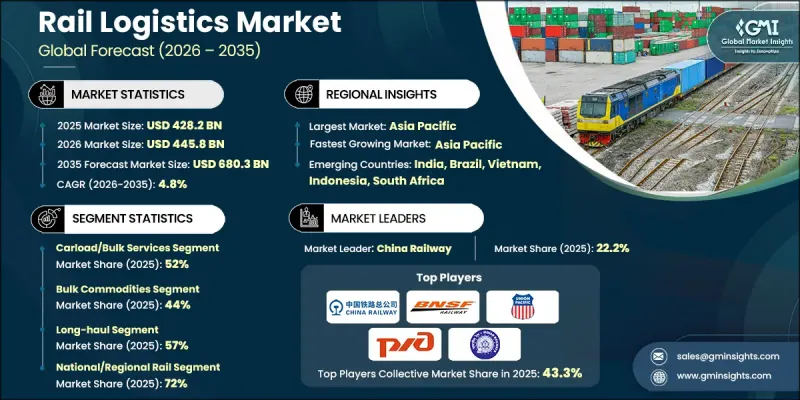
铁路货运业者正日益将铁路运输与公路和海运物流结合,建构能够满足多样化运输需求的综合供应链解决方案。这种多模态方式增强了营运柔软性,并实现了区域和国际贸易走廊间货物的高效运输。跨境铁路网络的扩张透过增加可用货运路线的数量和改善生产基地与消费市场之间的连结性,正在强化全球供应链。随着铁路走廊的扩展和运营网络的日益互联互通,货运运营商能够以更高的可靠性进行更远距离的货物运输。旨在改善铁路基础设施、扩大货运能力和提高运输效率的投资进一步推动了铁路在全球物流网络中日益重要的角色。这些趋势正在强化铁路货运作为主要全球贸易路线上长途货运的一种经济高效且环境永续的解决方案的重要性。
| 市场范围 | |
|---|---|
| 开始年份 | 2025 |
| 预测期 | 2026-2035 |
| 上市时的市场规模 | 4282亿美元 |
| 预测金额 | 6803亿美元 |
| 复合年增长率 | 4.8% |
数位转型在铁路物流市场的重组中也发挥着至关重要的作用。先进技术的应用使营运商能够提高营运可视性、优化线路规划并加强维护管理。铁路公司正在投资建造支援即时货物追踪、自动调度和预测性维护的数位化系统。人工智慧、物联网 (IoT) 连接和高级分析工具等技术正在帮助营运商更有效地监控货物运输,同时提高网路可靠性和营运效率。同时,对铁路货运基础设施的大规模投资正在扩大网路运力并提高货运速度。
预计到2025年,货车和散装运输服务市场份额将达到52%,并在2026年至2035年间以3.8%的复合年增长率增长。这些运输服务对于长途运输大批量货物至关重要。铁路营运商经常采用这种货运模式,使用专用货车运输大批量货物,尤其适用于工业货物和大规模製造供应链。需要大批量运输的行业通常依赖铁路货运,透过广泛的物流网络有效运输货物。对散装运输服务的稳定需求支撑着稳定的货运量,使铁路公司能够维持高运转率,并提供经济高效的长途物流解决方案。
预计到2025年,散装货物运输市场份额将达到44%,并在2026年至2035年间以3.1%的复合年增长率增长。由于其成本效益和高运力,铁路运输仍然是长途运输大量工业材料和原材料的首选方式。散装货物的运输通常涉及重型或特殊货物,因此需要能够处理大量货物的专用运输基础设施。铁路营运商不断致力于透过延长列车长度、优化装载能力和引入自动化装载系统来提高营运效率。这些营运改善缩短了周转时间,使物流业者更有效地处理不断增长的货运量。在工业生产和能源产业活动持续推动下,对大规模原料运输的需求保持稳定,预计铁路货运服务将在全球物流网络中保持强大的地位。
美国铁路物流市场预计到2025年将达到9,15亿美元,并在2026年至2035年间以4.7%的复合年增长率成长。多式联运正成为国内铁路物流业的主要驱动力。零售货运量和电商配送量的不断增长促使物流公司将铁路运输整合到更广泛的供应链营运中。多式联运使货物能够在港口、铁路货运站和最后一公里配送网络之间高效流动,从而建立一个能够处理大量货柜的无缝配送系统。铁路营运商也在投资先进技术,以支援即时货物追踪、智慧调度系统和预测分析,从而提高营运效率。这些技术能力有助于减少运输延误,优化复杂物流网络中的货物运输,从而强化铁路运输在国家不断发展的货运基础设施中的作用。
目录
第一章:调查方法
第二章执行摘要
第三章业界考察
- 生态系分析
- 铁路基础设施营运商
- 铁路车辆製造商
- 服务提供者
- 码头和转运设施
- 技术和软体供应商
- 最终用户
- 影响产业的因素
- 促进因素
- 多式联运的需求日益增长
- 电子商务和零售出货量增加
- 政府对货运走廊的投资
- 对经济高效且永续的运输方式的需求日益增长。
- 产业潜在风险与挑战
- 基础设施维修成本成本高昂
- 法规和跨境挑战
- 市场机会
- 利用数位化和物联网的铁路解决方案
- 新兴市场(印度、非洲)扩张
- 引进环保电力机车
- 与第三方物流和多模态物流网路合作
- 促进因素
- 成长潜力分析
- 监理情势
- 北美洲
- 联邦铁路管理局 (FRA)
- 美国铁路协会(AAR)
- 欧洲
- 欧洲铁路管理局(ERA)
- 国际铁路联盟(UIC)
- 亚太地区
- 印度铁道部
- 日本运输安全委员会/JR标准
- 拉丁美洲
- 巴西陆路运输管理局(ANTT)
- 墨西哥国家铁路运输委员会(Comision Nacional de Transporte Ferroviario)
- 中东和非洲
- 阿联酋联邦交通管理局 - 铁路
- 沙乌地阿拉伯铁路公司/标准化机构
- 北美洲
- 波特五力分析
- PESTEL 分析
- 专利分析(基于初步研究)
- 按技术领域分類的专利申请趋势
- 主要专利拥有者人和智慧财产权 (IP) 的定位
- 新兴技术的专利趋势
- 科技与创新趋势
- 当前技术趋势
- 新兴技术
- 价格分析(基于初步调查)
- 对过去价格趋势的分析
- 按业务类型分類的定价策略(溢价/价值/成本加成)
- 服务类型收费系统(多式联运与公路自驾)
- 燃油额外费用机制
- 拘留费和杂项费用
- 成本細項分析
- 专利分析(基于初步研究)
- 永续性和环境方面
- 永续倡议
- 减少废弃物策略
- 生产中的能源效率
- 具有环保意识的倡议
- 关于碳足迹的考量
- 交易数据分析(基于付费资料库)
- 进出口数量和价值的变化趋势
- 主要贸易走廊及关税的影响
- 跨境铁路货运
- 人工智慧和生成式人工智慧对市场的影响
- 利用人工智慧改造现有经营模式
- GenAI 各细分市场的应用案例与部署蓝图
- 风险、限制和监管考量
- 服务交付能力和提供者基础设施(基于初步调查)
- 区域医疗服务提供者网路密度和覆盖范围
- 供给能力缺口与可用需求不匹配
- 预测假设与情境分析(基于一手研究)
- 基本案例-驱动复合年增长率的关键宏观经济与产业变量
- 乐观情境-宏观经济与产业的顺风
- 悲观情景-宏观经济放缓或产业逆风
第四章 竞争情势
- 介绍
- 企业市占率分析
- 北美洲
- 欧洲
- 亚太地区
- 拉丁美洲
- 中东和非洲(MEA)
- 主要市场公司的竞争分析
- 竞争定位矩阵
- 主要进展
- 併购
- 伙伴关係与合作
- 新产品发布
- 业务拓展计划及资金筹措
第五章 市场估计与预测:依服务业划分,2022-2035年
- 多式联运服务
- 车辆间散装运输服务
- 转运服务
第六章 市场估价与预测:依货物类型划分,2022-2035年
- 散货
- 矿物和矿石
- 煤炭
- 谷物和农产品
- 货柜货物
- 消费品
- 电子设备
- 机械和设备
- 特种货物
- 车
- 药品和化学品
- 冷藏和生鲜产品
第七章 市场估计与预测:依距离划分,2022-2035年
- 短距离
- 中距离
- 长途
第八章 市场估算与预测:依最终用途划分,2022-2035年
- 矿业
- 农业
- 活力
- 製造业
- 建造
- 零售
- 车
- 化学
- 食品/饮料
- 其他的
第九章 市场估价与预测:依铁路类型划分,2022-2035年
- 国内和区域铁路
- 高速铁路物流
- 仅供货物通行的通道
第十章 市场估价与预测:依地区划分,2022-2035年
- 北美洲
- 我们
- 加拿大
- 欧洲
- 德国
- 英国
- 法国
- 义大利
- 西班牙
- 北欧国家
- 俄罗斯
- 波兰
- 罗马尼亚
- 亚太地区
- 中国
- 印度
- 日本
- 韩国
- ANZ
- 越南
- 印尼
- 拉丁美洲
- 巴西
- 墨西哥
- 阿根廷
- 中东和非洲(MEA)
- 南非
- 沙乌地阿拉伯
- 阿拉伯聯合大公国
- 埃及
第十一章:公司简介
- 世界公司
- BNSF Railway
- Canadian National Railway(CN)
- Canadian Pacific Kansas City(CPKC)
- China Railway Freight
- CSX Transportation
- Deutsche Bahn(DB Cargo)
- Indian Railways
- Norfolk Southern Railway
- Russian Railways(RZD)
- Union Pacific Railroad
- 本地企业
- Aurizon
- Euro Cargo Rail
- Ferromex
- Genesee & Wyoming
- Kansas City Southern
- OBB Rail Cargo
- PKP Cargo
- 新兴企业
- Japan Freight Railway Company
- SNCF Logistics
- VTG
The Global Rail Logistics Market was valued at USD 428.2 billion in 2025 and is estimated to grow at a CAGR of 4.8% to reach USD 680.3 billion by 2035.
Rail freight operators are increasingly combining rail transport with road and maritime logistics to create integrated supply chain solutions capable of supporting diverse shipping requirements. This multimodal approach improves operational flexibility while enabling cargo to move efficiently across regional and international trade corridors. Expanding cross-border rail networks are strengthening global supply chains by increasing the number of available freight routes and improving connectivity between production centers and consumption markets. As rail corridors expand and operational networks become more interconnected, freight operators are able to deliver goods across longer distances with improved reliability. The growing role of rail within global logistics networks is further supported by investments aimed at improving rail infrastructure, expanding freight capacity, and enhancing transportation efficiency. These developments are reinforcing the importance of rail freight as a cost-effective and environmentally sustainable solution for long-distance cargo transportation across major global trade routes.
| Market Scope | |
|---|---|
| Start Year | 2025 |
| Forecast Year | 2026-2035 |
| Start Value | $428.2 Billion |
| Forecast Value | $680.3 Billion |
| CAGR | 4.8% |
Digital transformation is also playing a significant role in reshaping the rail logistics market. Increasing adoption of advanced technologies is enabling operators to improve operational visibility, optimize route planning, and enhance maintenance management. Rail companies are investing in digital systems that support real-time freight tracking, automated scheduling, and predictive maintenance capabilities. Technologies such as artificial intelligence, Internet of Things connectivity, and advanced analytics tools are helping operators monitor freight movement more effectively while improving network reliability and operational efficiency. In parallel, large-scale investments in rail freight infrastructure are expanding network capacity and enabling faster cargo movement.
The carload and bulk freight services segment held 52% share in 2025 and is projected to grow at a CAGR of 3.8% between 2026 and 2035. These transportation services remain essential for moving large volumes of goods over long distances. Rail operators frequently rely on this freight model to transport substantial cargo loads in dedicated railcars, making it particularly suitable for industrial shipments and large-scale manufacturing supply chains. Industries requiring high-volume transportation often depend on rail freight to move goods efficiently across extensive logistics networks. The consistent demand for bulk transportation services supports stable freight volumes, enabling rail companies to maintain strong utilization rates while delivering cost-effective long-distance logistics solutions.
The bulk commodities segment captured 44% share in 2025 and is expected to grow at a CAGR of 3.1% from 2026 to 2035. Rail transportation remains a preferred solution for moving large quantities of industrial and raw materials across long distances due to its cost efficiency and high capacity. Bulk freight shipments often involve heavy cargo that requires specialized transportation infrastructure capable of handling substantial loads. Rail operators are continuously focusing on improving operational efficiency by increasing train lengths, optimizing cargo capacity, and implementing automated loading systems. These operational improvements are helping reduce turnaround times while enabling logistics providers to handle growing freight volumes more effectively. As industrial production and energy sector activities continue to generate consistent demand for large-scale raw material transportation, rail freight services are expected to maintain a strong presence within global logistics networks.
United States Rail Logistics Market reached USD 91.5 billion in 2025 and is expected to grow at a CAGR of 4.7% between 2026 and 2035. Intermodal freight transportation is emerging as a key growth driver within the country's rail logistics sector. The increasing volume of retail shipments and digital commerce deliveries is encouraging logistics companies to integrate rail transportation into broader supply chain operations. Intermodal transportation allows cargo to move efficiently between ports, rail terminals, and last-mile delivery networks, creating a seamless distribution system capable of handling large container volumes. Rail operators are also investing in advanced technologies that support real-time shipment tracking, intelligent scheduling systems, and predictive analytics to improve operational efficiency. These technological capabilities help reduce transit delays and optimize freight movement across complex logistics networks, strengthening the role of rail transportation in the country's evolving freight infrastructure.
Major companies operating in the Global Rail Logistics Market include BNSF Railway, Canadian National Railway, Canadian Pacific Kansas City, China Railway, CSX Transportation, Deutsche Bahn (DB Cargo), Indian Railways, Norfolk Southern, Russian Railways (RZD), and Union Pacific. Companies participating in the Global Rail Logistics Market are implementing several strategic initiatives to strengthen their market positions and expand operational capabilities. Rail operators are investing in infrastructure modernization programs to improve network capacity, enhance freight handling capabilities, and support higher cargo volumes. Many companies are also focusing on digital transformation by deploying advanced technologies such as AI-based scheduling systems, predictive maintenance tools, and real-time cargo monitoring platforms to optimize operational performance. Strategic partnerships with shipping companies, port authorities, and logistics providers are helping rail operators develop integrated multimodal transportation solutions that enhance supply chain efficiency. Additionally, companies are prioritizing sustainability initiatives by improving fuel efficiency and adopting environmentally responsible freight transportation practices to align with evolving regulatory standards and customer expectations.
Table of Contents
Chapter 1 Methodology
- 1.1 Research approach
- 1.2 Quality commitments
- 1.3 GMI AI policy & data integrity commitment
- 1.4 Research trail & confidence scoring
- 1.4.1 Research trail components
- 1.4.2 Scoring components
- 1.5 Data collection
- 1.5.1 Partial list of primary sources
- 1.6 Data mining sources
- 1.6.1 Paid sources
- 1.7 Base estimates and calculations
- 1.7.1 Base year calculation
- 1.8 Forecast model
- 1.9 Research transparency addendum
Chapter 2 Executive Summary
- 2.1 Industry 360° synopsis
- 2.2 Key market trends
- 2.2.1 Regional
- 2.2.2 Service
- 2.2.3 Cargo
- 2.2.4 Distance
- 2.2.5 End use
- 2.2.6 Rail
- 2.3 TAM analysis, 2026-2035
- 2.4 CXO perspectives: Strategic imperatives
Chapter 3 Industry Insights
- 3.1 Industry ecosystem analysis
- 3.1.1 Rail infrastructure providers
- 3.1.2 Rolling Stock Manufacturers
- 3.1.3 Service Operators
- 3.1.4 Terminal & Transloading Facilities
- 3.1.5 Technology & Software Provider
- 3.1.6 End user
- 3.2 Industry impact forces
- 3.2.1 Growth drivers
- 3.2.1.1 Growing intermodal transportation demand
- 3.2.1.2 Increasing e-commerce and retail shipments
- 3.2.1.3 Government investment in dedicated freight corridors
- 3.2.1.4 Rising need for cost-efficient and sustainable transport
- 3.2.2 Industry pitfalls and challenges
- 3.2.2.1 High infrastructure maintenance costs
- 3.2.2.2 Regulatory and cross-border challenges
- 3.2.3 Market opportunities
- 3.2.3.1 Digitalization and IoT-enabled rail solutions
- 3.2.3.2 Expansion in emerging markets (India, Africa)
- 3.2.3.3 Adoption of green and electrified locomotives
- 3.2.3.4 Integration with 3PL and multimodal logistics networks
- 3.2.1 Growth drivers
- 3.3 Growth potential analysis
- 3.4 Regulatory landscape
- 3.4.1 North America
- 3.4.1.1 Federal Railroad Administration (FRA)
- 3.4.1.2 Association of American Railroads (AAR)
- 3.4.2 Europe
- 3.4.2.1 European Union Agency for Railways (ERA)
- 3.4.2.2 International Union of Railways (UIC)
- 3.4.3 Asia Pacific
- 3.4.3.1 Ministry of Railways (India)
- 3.4.3.2 Japan Transport Safety Board / JR Standards
- 3.4.4 Latin America
- 3.4.4.1 Agencia Nacional de Transportes Terrestres (ANTT, Brazil)
- 3.4.4.2 Comision Nacional de Transporte Ferroviario (Mexico)
- 3.4.5 Middle East & Africa
- 3.4.5.1 UAE Federal Transport Authority - Railways
- 3.4.5.2 Saudi Railways Organization / Standards Authority
- 3.4.1 North America
- 3.5 Porter's analysis
- 3.6 PESTEL analysis
- 3.7 Patent analysis (Driven by primary research)
- 3.7.1 Patent Filing Trends by Technology Area
- 3.7.2 Key Patent Holders & IP Positioning
- 3.7.3 Emerging Technology Patent Activity
- 3.8 Technology and innovation landscape
- 3.8.1 Current technological trends
- 3.8.2 Emerging technologies
- 3.9 Pricing Analysis (Driven by primary research)
- 3.9.1 Historical Price Trend Analysis
- 3.9.2 Pricing Strategy by Player Type (Premium / Value / Cost-plus)
- 3.9.3 Rate Structure by Service Type (Intermodal vs Carload)
- 3.9.4 Fuel Surcharge Mechanisms
- 3.9.5 Demurrage & Accessorial Charges
- 3.10 Cost breakdown analysis
- 3.11 Patent analysis (Driven by primary research)
- 3.12 Sustainability and environmental aspects
- 3.12.1 Sustainable practices
- 3.12.2 Waste reduction strategies
- 3.12.3 Energy efficiency in production
- 3.12.4 Eco-friendly initiatives
- 3.12.5 Carbon footprint considerations
- 3.13 Trade Data Analysis (Driven by paid database)
- 3.13.1 Import/export volume & value trends
- 3.13.2 Key trade corridors & tariff impact
- 3.13.3 Cross-border rail freight flows
- 3.14 Impact of AI & Generative AI on the Market
- 3.14.1 AI-Driven Disruption of Existing Business Models
- 3.14.2 GenAI Use Cases & Adoption Roadmap by Segment
- 3.14.3 Risks, limitations & regulatory considerations
- 3.15 Service delivery capacity & provider infrastructure (Driven by primary research)
- 3.15.1 Provider network density & coverage by region
- 3.15.2 Capacity gaps & addressable demand mismatch
- 3.16 Forecast assumptions & scenario analysis (Driven by primary research)
- 3.16.1 Base Case - key macro & industry variables driving CAGR
- 3.16.2 Optimistic Scenarios - Favorable macro and industry tailwinds
- 3.16.3 Pessimistic Scenario - Macroeconomic slowdown or industry headwinds
Chapter 4 Competitive Landscape, 2025
- 4.1 Introduction
- 4.2 Company market share analysis
- 4.2.1 North America
- 4.2.2 Europe
- 4.2.3 Asia Pacific
- 4.2.4 LATAM
- 4.2.5 MEA
- 4.3 Competitive analysis of major market players
- 4.4 Competitive positioning matrix
- 4.5 Key developments
- 4.5.1 Mergers & acquisitions
- 4.5.2 Partnerships & collaborations
- 4.5.3 New product launches
- 4.5.4 Expansion plans and funding
Chapter 5 Market Estimates & Forecast, By Service, 2022 - 2035 ($Mn)
- 5.1 Key trends
- 5.2 Intermodal services
- 5.3 Carload/bulk services
- 5.4 Transloading services
Chapter 6 Market Estimates & Forecast, By Cargo, 2022 - 2035 ($Mn, Tons)
- 6.1 Key trends
- 6.2 Bulk commodities
- 6.2.1 Minerals & ores
- 6.2.2 Coal
- 6.2.3 Grains & agricultural products
- 6.3 Containerized cargo
- 6.3.1 Consumer goods
- 6.3.2 Electronics
- 6.3.3 Machinery & equipment
- 6.4 Specialized cargo
- 6.4.1 Automotive
- 6.4.2 Pharmaceuticals & chemicals
- 6.4.3 Refrigerated/perishable goods
Chapter 7 Market Estimates & Forecast, By Distance, 2022 - 2035 ($Mn, Tons)
- 7.1 Key trends
- 7.2 Short haul
- 7.3 Medium-haul
- 7.4 Long-haul
Chapter 8 Market Estimates & Forecast, By End Use, 2022 - 2035 ($Mn, Tons)
- 8.1 Key trends
- 8.2 Mining
- 8.3 Agriculture
- 8.4 Energy
- 8.5 Manufacturing
- 8.6 Construction
- 8.7 Retail
- 8.8 Automotive
- 8.9 Chemical
- 8.10 Food & beverages
- 8.11 Others
Chapter 9 Market Estimates & Forecast, By Rail, 2022 - 2035 ($Mn)
- 9.1 Key trends
- 9.2 National/regional rail
- 9.3 High-speed rail logistics
- 9.4 Dedicated freight corridors
Chapter 10 Market Estimates & Forecast, By Region, 2022 - 2035 ($Mn)
- 10.1 Key trends
- 10.2 North America
- 10.2.1 US
- 10.2.2 Canada
- 10.3 Europe
- 10.3.1 Germany
- 10.3.2 UK
- 10.3.3 France
- 10.3.4 Italy
- 10.3.5 Spain
- 10.3.6 Nordics
- 10.3.7 Russia
- 10.3.8 Poland
- 10.3.9 Romania
- 10.4 Asia Pacific
- 10.4.1 China
- 10.4.2 India
- 10.4.3 Japan
- 10.4.4 South Korea
- 10.4.5 ANZ
- 10.4.6 Vietnam
- 10.4.7 Indonesia
- 10.5 Latin America
- 10.5.1 Brazil
- 10.5.2 Mexico
- 10.5.3 Argentina
- 10.6 MEA
- 10.6.1 South Africa
- 10.6.2 Saudi Arabia
- 10.6.3 UAE
- 10.6.4 Egypt
Chapter 11 Company Profiles
- 11.1 Global companies
- 11.1.1 BNSF Railway
- 11.1.2 Canadian National Railway (CN)
- 11.1.3 Canadian Pacific Kansas City (CPKC)
- 11.1.4 China Railway Freight
- 11.1.5 CSX Transportation
- 11.1.6 Deutsche Bahn (DB Cargo)
- 11.1.7 Indian Railways
- 11.1.8 Norfolk Southern Railway
- 11.1.9 Russian Railways (RZD)
- 11.1.10 Union Pacific Railroad
- 11.2 Regional players
- 11.2.1 Aurizon
- 11.2.2 Euro Cargo Rail
- 11.2.3 Ferromex
- 11.2.4 Genesee & Wyoming
- 11.2.5 Kansas City Southern
- 11.2.6 OBB Rail Cargo
- 11.2.7 PKP Cargo
- 11.3 Emerging players
- 11.3.1 Japan Freight Railway Company
- 11.3.2 SNCF Logistics
- 11.3.3 VTG


