


 |
市场调查报告书
商品编码
1998719
DNA资料储存市场:商业机会、成长要素、产业趋势分析及2026-2035年预测DNA Data Storage Market Opportunity, Growth Drivers, Industry Trend Analysis, and Forecast 2026 - 2035 |
||||||

全球DNA资料储存市场预计到2025年将达到1.458亿美元,年复合成长率为88%,到2035年将达到802亿美元。
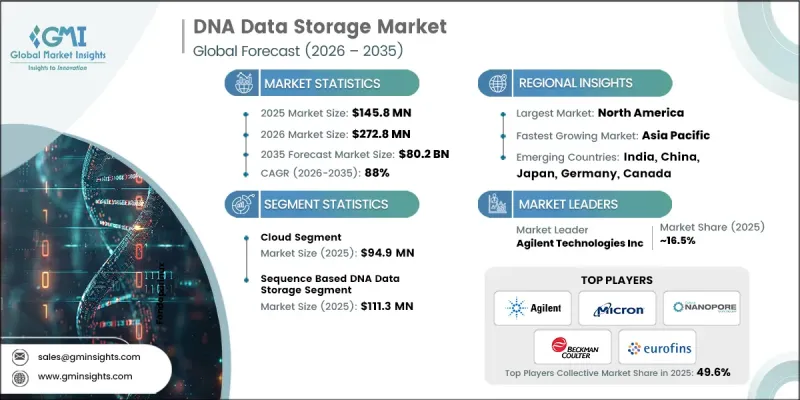
这种快速增长是由对高密度资料储存需求的激增、全球数位资料产生量的显着增长以及DNA合成和定序技术的突破性进展所驱动的。医疗、生物技术和研究领域的机构正越来越多地采用基于DNA的储存技术,以确保关键资讯的长期保存。传统储存介质难以应对呈指数级增长的资料量,而DNA则提供了无与伦比的分子密度、耐久性和扩充性。各国政府和标准化机构认识到DNA在变革长期资料保存方面的潜力,并积极支持将其作为下一代归檔介质。人工智慧、物联网、科学研究和线上服务的普及带来了前所未有的数据负载,迫使企业和学术机构考虑采用基于DNA的储存技术,因为它具有可靠性高、寿命长和占用面积小等优点。
| 市场范围 | |
|---|---|
| 开始年份 | 2025 |
| 预测期 | 2026-2035 |
| 上市时的市场规模 | 1.458亿美元 |
| 预测金额 | 802亿美元 |
| 复合年增长率 | 88% |
预计到2025年,云端储存领域将创造9,490万美元的收入,提供全球扩充性和远端储存功能。基于云端的DNA储存使企业能够管理大规模资料集,摆脱本地硬体的限制,同时提供安全集中的存取、即时协作以及与现有IT基础设施的无缝整合。其便利性和较低的前期投资使其成为管理基因组、科学和多媒体数据的首选解决方案。製造商正致力于提供加密、扩充性、多租户的云端解决方案,并整合API,以吸引需要高容量归檔系统的研究机构和企业。
预计到2025年,基于序列的DNA储存市场规模将达到1.113亿美元,主要得益于亲和性与现有定序技术和生物资讯学工作流程的兼容性。此方法能够确保大规模数位资料集的可靠编码、解码和搜寻。它与基因组研究和长期存檔的需求相契合,使其成为医疗、生物技术和学术机构极具吸引力的解决方案。製造商正致力于优化和自动化纠错功能,并提高读写准确率,以吸引大规模研究机构和存檔用户。
到2025年,北美将占据DNA资料储存市场35.2%的份额。该地区的主导地位得益于其先进的研究设施、对生物技术和IT的大量投资,以及来自政府和私营部门的强劲研发资金。美国拥有许多专注于DNA合成、定序和错误减少技术的领先科技公司和学术联盟,加速了市场应用。医疗、金融和国防领域海量数位资料的产生进一步推动了对高密度归檔解决方案的需求。大学、国家实验室和私人企业之间的合作计划正在加速DNA储存的原型设计、标准化和商业化,使北美成为创新和早期应用的中心。
目录
第一章:调查方法和范围
第二章执行摘要
第三章业界考察
- 生态系分析
- 供应商情况
- 利润率
- 成本结构
- 每个阶段增加的价值
- 影响价值链的因素
- 中断
- 影响产业的因素
- 促进因素
- 对高密度资料储存的需求日益增长
- 全球数位资料产生量不断成长
- DNA合成与定序技术的进步
- 长期资料储存需求
- 在医疗和生物技术领域的应用日益广泛。
- 陷阱与挑战
- DNA合成和定序高成本
- 法规和标准化方面的不确定性
- 促进因素
- 成长潜力分析
- 监理情势
- 北美洲
- 欧洲
- 亚太地区
- 拉丁美洲
- 中东和非洲
- 波特五力分析
- PESTEL 分析
- 科技与创新趋势
- 当前技术趋势
- 新兴技术
- 新兴经营模式
- 合规要求
- 供应链韧性
- 地缘政治分析
第四章 竞争情势
- 介绍
- 企业市占率分析
- 按地区
- 北美洲
- 欧洲
- 亚太地区
- 拉丁美洲
- 中东和非洲
- 市场集中度分析
- 按地区
- 主要企业的竞争标竿分析
- 产品系列比较
- 产品线
- 科技
- 创新
- 区域部署对比
- 全球扩张分析
- 服务网路覆盖
- 按地区分類的市场渗透率
- 竞争定位矩阵
- 领导者
- 挑战者
- 追踪者
- 小众玩家
- 战略展望矩阵
- 产品系列比较
- 2022-2025 年重大发展
- 併购
- 伙伴关係和联盟
- 技术进步
- 业务拓展与投资策略
- 永续发展倡议
- 数位转型计划
- 新兴/Start-Ups竞争对手的发展趋势
第五章 市场估计与预测:依类型划分,2022-2035年
- 云
- 现场
第六章 市场估计与预测:依技术划分,2022-2035年
- 主要趋势
- 基于序列的DNA资料存储
- 基于结构的DNA资料存储
第七章 市场估计与预测:依最终用途产业划分,2022-2035年
- 主要趋势
- 生物技术与医疗保健
- 银行与金融
- 政府/国防
- 媒体与娱乐
- 其他的
- 环境科学
- 学术和研究机构
第八章 市场估计与预测:依地区划分,2022-2035年
- 北美洲
- 我们
- 加拿大
- 欧洲
- 德国
- 英国
- 法国
- 西班牙
- 义大利
- 亚太地区
- 中国
- 印度
- 日本
- 澳洲
- 韩国
- 拉丁美洲
- 巴西
- 墨西哥
- 阿根廷
- 中东和非洲
- 沙乌地阿拉伯
- 南非
- 阿拉伯聯合大公国
第九章:公司简介
- 主要企业
- Thermo Fisher Scientific, Inc
- Microsoft
- Agilent Technologies, Inc
- Illumina, Inc
- Eurofins Scientific
- 按地区分類的主要企业
- 北美洲
- Beckman Coulter, Inc.
- Twist Bioscience
- Micron Technology, Inc.
- Quantum Corporation
- 欧洲
- Oxford Nanopore Technologies Plc.
- Evonetix
- 亚太地区
- BGI Group Guangdong ICP
- 北美洲
- 小众/颠覆者
- Iridia Inc.
- Catalog
- Helixworks Technologies, Ltd.
- Molecular Assemblies
The Global DNA Data Storage Market was valued at USD 145.8 million in 2025 and is estimated to grow at a CAGR of 88% to reach USD 80.2 billion by 2035.
The rapid growth is fueled by the skyrocketing need for high-density data storage, the massive increase in global digital data generation, and breakthroughs in DNA synthesis and sequencing technologies. Organizations in healthcare, biotechnology, and research are increasingly adopting DNA-based storage to ensure long-term preservation of critical information. Traditional storage media are struggling to cope with exponentially growing data volumes, while DNA offers unmatched molecular density, durability, and scalability. Governments and standards bodies are actively supporting DNA as a next-generation archival medium, recognizing its potential to transform long-term data preservation. The surge of AI, IoT, scientific research, and online services is creating unprecedented data loads, pushing enterprises and academic institutions to explore DNA-based storage for its reliability, longevity, and compact footprint.
| Market Scope | |
|---|---|
| Start Year | 2025 |
| Forecast Year | 2026-2035 |
| Start Value | $145.8 Million |
| Forecast Value | $80.2 Billion |
| CAGR | 88% |
The cloud segment generated USD 94.9 million in 2025, offering global scalability and remote storage capabilities. Cloud-based DNA storage allows enterprises to manage large datasets without local hardware limitations while enabling secure, centralized access, real-time collaboration, and seamless integration with existing IT infrastructure. Its convenience and minimal upfront investment make it a preferred solution for managing genomic, scientific, and multimedia data. Manufacturers are focusing on delivering encrypted, scalable, multi-tenant cloud solutions with API integration to attract research organizations and enterprises requiring high-capacity archival systems.
The sequence-based DNA storage segment generated USD 111.3 million in 2025, driven by its alignment with existing sequencing technologies and bioinformatics workflows. This approach ensures reliable encoding, decoding, and retrieval of large digital datasets. Its integration with genomic research and long-term archival needs makes it particularly attractive for healthcare, biotechnology, and academic institutions. Manufacturers are emphasizing error-correction optimization, automation, and read/write accuracy improvements to appeal to large-scale research and archival clients.
North America DNA Data Storage Market held a 35.2% share in 2025. The region leads due to its advanced research facilities, substantial investments in biotech and IT, and strong government and private R&D funding. The U.S. hosts key technology companies and academic consortia focused on DNA synthesis, sequencing, and error-reduction techniques, accelerating market adoption. High digital data generation across healthcare, finance, and defense further drives demand for dense archival solutions. Collaborative projects among universities, national laboratories, and private enterprises are accelerating prototype deployments, standardization, and commercialization of DNA storage, establishing North America as the hub for innovation and early adoption.
Key players operating in the Global DNA Data Storage Market include Microsoft, Twist Bioscience, Thermo Fisher Scientific, Inc, Illumina, Inc, Agilent Technologies, Inc, Beckman Coulter, Inc., Oxford Nanopore Technologies Plc., Catalog, Helixworks Technologies, Ltd., Evonetix, BGI Group Guangdong ICP, Quantum Corporation, Iridia Inc., Molecular Assemblies, and Eurofins Scientific. Companies in the DNA data storage market are focusing on strategies to strengthen their position by expanding R&D efforts to enhance synthesis accuracy, error correction, and data retrieval efficiency. Strategic partnerships with research institutions and tech firms allow for accelerated product development and access to large-scale projects. Investment in cloud-based platforms and scalable infrastructure ensures broader adoption by enterprises requiring high-density, secure storage. Companies are also exploring automation, AI integration, and standardized workflows to optimize performance and reduce operational costs.
Table of Contents
Chapter 1 Methodology and Scope
- 1.1 Market scope and definition
- 1.2 Research design
- 1.2.1 Research approach
- 1.2.2 Data collection methods
- 1.3 Data mining sources
- 1.3.1 Global
- 1.3.2 Regional/Country
- 1.4 Base estimates and calculations
- 1.4.1 Base year calculation
- 1.4.2 Key trends for market estimation
- 1.5 Primary research and validation
- 1.5.1 Primary sources
- 1.6 Forecast model
- 1.7 Research assumptions and limitations
Chapter 2 Executive Summary
- 2.1 Industry 360° synopsis
- 2.2 Key market trends
- 2.2.1 Type trends
- 2.2.2 Technology trends
- 2.2.3 End-use industry trends
- 2.2.4 Regional trends
- 2.3 TAM Analysis, 2026 - 2035 (USD Million)
- 2.4 CXO perspectives: Strategic imperatives
- 2.4.1 Executive decision points
- 2.4.2 Critical success factors
- 2.5 Future outlook and strategic recommendations
Chapter 3 Industry Insights
- 3.1 Industry ecosystem analysis
- 3.1.1 Supplier landscape
- 3.1.2 Profit margin
- 3.1.3 Cost structure
- 3.1.4 Value addition at each stage
- 3.1.5 Factor affecting the value chain
- 3.1.6 Disruptions
- 3.2 Industry impact forces
- 3.2.1 Growth drivers
- 3.2.1.1 Increasing demand for high-density data storage
- 3.2.1.2 Rising digital data generation globally
- 3.2.1.3 Advancements in DNA synthesis and sequencing technologies
- 3.2.1.4 Long-term data preservation needs
- 3.2.1.5 Growing adoption in healthcare and biotechnology sectors
- 3.2.2 Pitfalls and challenges
- 3.2.2.1 High cost of DNA synthesis and sequencing
- 3.2.2.2 Regulatory and standardization uncertainties
- 3.2.1 Growth drivers
- 3.3 Growth potential analysis
- 3.4 Regulatory landscape
- 3.4.1 North America
- 3.4.2 Europe
- 3.4.3 Asia Pacific
- 3.4.4 Latin America
- 3.4.5 Middle East & Africa
- 3.5 Porter's analysis
- 3.6 PESTEL analysis
- 3.7 Technology and Innovation landscape
- 3.7.1 Current technological trends
- 3.7.2 Emerging technologies
- 3.8 Emerging Business Models
- 3.9 Compliance Requirements
- 3.10 Supply Chain Resilience
- 3.11 Geopolitical Analysis
Chapter 4 Competitive Landscape, 2025
- 4.1 Introduction
- 4.2 Company market share analysis
- 4.2.1 By region
- 4.2.1.1 North America
- 4.2.1.2 Europe
- 4.2.1.3 Asia Pacific
- 4.2.1.4 Latin America
- 4.2.1.5 Middle East & Africa
- 4.2.2 Market concentration analysis
- 4.2.1 By region
- 4.3 Competitive benchmarking of key players
- 4.3.1 Product portfolio comparison
- 4.3.1.1 Product range breadth
- 4.3.1.2 Technology
- 4.3.1.3 Innovation
- 4.3.2 Geographic presence comparison
- 4.3.2.1 Global footprint analysis
- 4.3.2.2 Service network coverage
- 4.3.2.3 Market penetration by region
- 4.3.3 Competitive positioning matrix
- 4.3.3.1 Leaders
- 4.3.3.2 Challengers
- 4.3.3.3 Followers
- 4.3.3.4 Niche players
- 4.3.4 Strategic outlook matrix
- 4.3.1 Product portfolio comparison
- 4.4 Key developments, 2022-2025
- 4.4.1 Mergers and acquisitions
- 4.4.2 Partnerships and collaborations
- 4.4.3 Technological advancements
- 4.4.4 Expansion and investment strategies
- 4.4.5 Sustainability initiatives
- 4.4.6 Digital transformation initiatives
- 4.5 Emerging/ startup competitors landscape
Chapter 5 Market Estimates and Forecast, By Type, 2022 - 2035 (USD Million)
- 5.1 Key trends
- 5.2 Cloud
- 5.3 On-premises
Chapter 6 Market Estimates and Forecast, By Technology, 2022 - 2035 (USD Million)
- 6.1 Key Trends
- 6.2 Sequence based DNA data storage
- 6.3 Structure based DNA data storage
Chapter 7 Market Estimates and Forecast, By End-Use Industry, 2022 - 2035 (USD Million)
- 7.1 Key Trends
- 7.2 Biotechnology and healthcare
- 7.3 Banking & finance
- 7.4 Government and defense
- 7.5 Media and entertainment
- 7.6 Others
- 7.6.1 Environmental sciences
- 7.6.2 Academic and research institutions
Chapter 8 Market Estimates and Forecast, By Region, 2022 - 2035 (USD Million)
- 8.1 Key trends
- 8.2 North America
- 8.2.1 U.S.
- 8.2.2 Canada
- 8.3 Europe
- 8.3.1 Germany
- 8.3.2 UK
- 8.3.3 France
- 8.3.4 Spain
- 8.3.5 Italy
- 8.4 Asia Pacific
- 8.4.1 China
- 8.4.2 India
- 8.4.3 Japan
- 8.4.4 Australia
- 8.4.5 South Korea
- 8.5 Latin America
- 8.5.1 Brazil
- 8.5.2 Mexico
- 8.5.3 Argentina
- 8.6 Middle East and Africa
- 8.6.1 Saudi Arabia
- 8.6.2 South Africa
- 8.6.3 UAE
Chapter 9 Company Profiles
- 9.1 Global Key Players
- 9.1.1 Thermo Fisher Scientific, Inc
- 9.1.2 Microsoft
- 9.1.3 Agilent Technologies, Inc
- 9.1.4 Illumina, Inc
- 9.1.5 Eurofins Scientific
- 9.2 Regional Key Players
- 9.2.1 North America
- 9.2.1.1 Beckman Coulter, Inc.
- 9.2.1.2 Twist Bioscience
- 9.2.1.3 Micron Technology, Inc.
- 9.2.1.4 Quantum Corporation
- 9.2.2 Europe
- 9.2.2.1 Oxford Nanopore Technologies Plc.
- 9.2.2.2 Evonetix
- 9.2.3 Asia Pacific
- 9.2.3.1 BGI Group Guangdong ICP
- 9.2.1 North America
- 9.3 Niche / Disruptors
- 9.3.1 Iridia Inc.
- 9.3.2 Catalog
- 9.3.3 Helixworks Technologies, Ltd.
- 9.3.4 Molecular Assemblies

 2026-2030年全球RAID控制器卡市场
 DNA资料储存市场:按技术、部署模式、应用程式和最终用户划分-2026-2032年全球市场预测
 DNA资料储存系统市场分析与预测(至2035年):类型、产品类型、服务、技术、组件、应用、流程、部署模式、最终用户、解决方案DNA资料储存解决方案市场分析及至2035年预测:类型、产品类型、服务、技术、组件、应用、形式、流程、最终用户、解决方案NGS资料储存市场:2026-2032年全球市场预测(按储存类型、定序平台、资料类型、部署模式和最终用户划分)
 2026年全球个人及入门级储存市场报告
 2026-2030年全球企业资料储存市场2026年全球DNA数位资料储存市场报告2026年全球资料储存市场报告
 可携式资料储存市场规模、份额和成长分析:按类型、技术、外形规格、储存容量、应用和地区划分-2026-2033年产业预测