


 |
市场调查报告书
商品编码
1998748
汽车天窗市场机会、成长要素、产业趋势分析及2026-2035年预测。Automotive Sunroof Market Opportunity, Growth Drivers, Industry Trend Analysis, and Forecast 2026 - 2035 |
||||||

全球汽车天窗市场预计到 2025 年价值 159 亿美元,预计到 2035 年将以 6.7% 的复合年增长率增长至 303 亿美元。
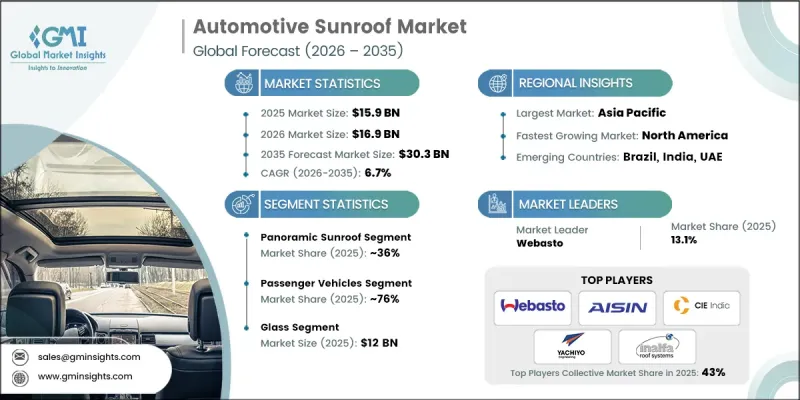
受汽车日益精密化、消费者对内饰美学的日益关注以及SUV、跨界车和电动汽车在全球范围内的快速普及所驱动,该市场正经历强劲增长。汽车製造商、一级供应商和车队营运商面临着提升车辆差异化、增强驾乘舒适度以及满足严格的安全和监管标准的压力,这推动了先进天窗技术的应用。电动倾斜滑动机构、全景多面板天窗、整合式太阳能面板、智慧电致变色玻璃和连网车顶系统等创新技术正在重新定义传统天窗。汽车製造商正在增加对模组化车顶平台、高性能玻璃和高性价比电动致动器系统的投入,使其能够应用于经济型、中檔和高端车型。这个不断发展的生态系统强调乘用车、SUV和电动车的驾驶舒适性、能源效率、美观性和整体价值创造。
| 市场范围 | |
|---|---|
| 开始年份 | 2025 |
| 预测期 | 2026-2035 |
| 上市时的市场规模 | 159亿美元 |
| 预测金额 | 303亿美元 |
| 复合年增长率 | 6.7% |
预计到2025年,全景天窗市占率将达到36%,并在2035年之前以5.4%的复合年增长率成长。其带来的豪华感、开阔的视野以及与SUV、跨界车和电动车的兼容性,赢得了许多汽车製造商的青睐。全景天窗能够提升车内舒适度、视觉吸引力和感知价值,进而推动中阶和豪华车型(包括乘用车和轻型商用车)的普及。
预计到2025年,乘用车市占率将达到76%,并在2026年至2035年间以6.2%的复合年增长率成长。推动这一细分市场成长的因素包括轿车、SUV和电动车日益普及,以及消费者对高端内装的偏好不断增强。汽车製造商正在对天窗整合进行标准化,以确保高品质的组装、可靠的运作以及符合安全和紫外线防护法规。天窗在欧洲、北美和亚太地区的广泛应用巩固了该细分市场的主导地位。
中国汽车天窗市场占51%的全球份额,预计2025年市场规模将达到25亿美元。这一增长得益于电动车的快速普及、SUV和乘用车产量的扩张,以及整车製造商和专业天窗生产商的强大实力。先进的製造能力、大规模的组装系统和完善的服务网络,推动了乘用车和轻型商用车对全景式、倾斜滑动式和多面板式天窗系统的强劲需求。
目录
第一章:调查方法和范围
第二章执行摘要
第三章业界考察
- 生态系分析
- 供应商情况
- 利润率
- 成本结构
- 每个阶段增加的价值
- 影响价值链的因素
- 中断
- 影响产业的因素
- 促进因素
- SUV和电动车销售成长
- 优质化和乘客体验
- 技术进步
- 遵守法规和安全标准
- 产业潜在风险与挑战
- 高昂的生产成本和维修成本
- 售后市场采用率有限
- 市场机会
- 与电动汽车和联网汽车的集成
- 新兴市场的成长
- 多厂商模组化平台
- 与智慧和永续功能集成
- 促进因素
- 成长潜力分析
- 监理情势
- 北美洲
- 美国:EPA、CARB、NHTSA 标准
- 加拿大:加拿大运输部,CMVSS 305
- 欧洲
- 德国:BMDV,欧6/7法规
- 法国:运输部,6/7欧元
- 英国:运输部,Euro 6/7
- 义大利:基础设施和运输部将遵守排放法规
- 亚太地区
- 中国:工业与资讯化部(工信部),中国6/7标准
- 日本:国土交通省,JIS标准
- 韩国:国土交通部(MOLIT),韩国排放标准
- 印度:道路和城市发展部 (MoRTH),BS6 标准
- 拉丁美洲
- 巴西:DENATRAN、CONAMA 标准
- 墨西哥:通讯与运输部
- 中东和非洲
- 阿联酋:RTA 和 ESMA 法规
- 沙乌地阿拉伯:运输部製定SASO排放标准
- 北美洲
- 波特五力分析
- PESTEL 分析
- 科技与创新趋势
- 当前技术趋势
- 新兴技术
- 价格分析(基于初步调查)
- 对过去价格趋势的分析
- 按球员类型分類的定价策略(高端/超值/成本加成)
- 原厂配件和售后配件之间的价格差异
- 生产统计
- 生产基地
- 消费者群体
- 出口和进口
- 成本細項分析
- 专利趋势(基于初步调查)
- 人工智慧和生成式人工智慧对市场的影响
- 利用人工智慧改造现有经营模式
- GenAI 各细分市场的应用案例与部署蓝图
- 风险、局限性和监管考量
- 永续性和环境方面
- 永续倡议
- 减少废弃物策略
- 生产中的能源效率
- 环保意识的倡议
- 关于碳足迹的考量
- 生产能力和生产趋势(基于初步调查)
- 按地区和主要生产商分類的设备产能
- 运转率和扩张计划
- 使用案例场景
- 预测假设和情境分析(基于初步研究)
- 基本案例-驱动复合年增长率的关键宏观经济与产业变量
- 乐观情境-宏观经济与产业的顺风
- 悲观情景-宏观经济放缓或产业逆风
第四章 竞争情势
- 介绍
- 企业市占率分析
- 北美洲
- 欧洲
- 亚太地区
- 拉丁美洲
- 中东和非洲
- 主要市场公司的竞争分析
- 竞争定位矩阵
- 主要进展
- 併购
- 伙伴关係与合作
- 新产品发布
- 业务拓展计划及资金筹措
第五章 市场估价与预测:依产品划分,2022-2035年
- 全景天窗
- 内建天窗
- 倾斜滑动式天窗
- 扰流板/顶部安装天窗
- 弹出式天窗
第六章 市场估价与预测:依车辆类型划分,2022-2035年
- 搭乘用车
- 掀背车
- 轿车
- SUV
- 商用车辆
- 轻型商用车(LCV)
- 中型商用车(MCV)
- 重型商用车(HCV)
第七章 市场估计与预测:依材料划分,2022-2035年
- 玻璃
- 材料
第八章 市场估算与预测:依运行机制,2022-2035年
- 自动/电动
- 手动输入
第九章 市场估价与预测:依通路划分,2022-2035年
- OEM
- 售后市场
第十章 市场估价与预测:依地区划分,2022-2035年
- 北美洲
- 我们
- 加拿大
- 欧洲
- 英国
- 德国
- 法国
- 义大利
- 西班牙
- 比利时
- 荷兰
- 瑞典
- 亚太地区
- 中国
- 印度
- 日本
- 澳洲
- 新加坡
- 韩国
- 越南
- 印尼
- 拉丁美洲
- 巴西
- 墨西哥
- 阿根廷
- 中东和非洲(MEA)
- 阿拉伯聯合大公国
- 南非
- 沙乌地阿拉伯
第十一章:公司简介
- Global Player
- Aisin Seiki
- CIE Automotive
- Hyundai Motor
- Inalfa Roof Systems
- Inteva Products
- Magna International
- Robert Bosch
- Tesla
- Webasto
- Yachiyo Industry
- Regional Player
- Edscha
- Faurecia
- Ficosa International
- Furukawa Electric
- Johnson Controls Interiors
- Magneti Marelli
- Samvardhana Motherson
- Suntech Sunroof Systems
- Tokai Rika
- Valeo
The Global Automotive Sunroof Market was valued at USD 15.9 billion in 2025 and is estimated to grow at a CAGR of 6.7% to reach USD 30.3 billion by 2035.
The market is witnessing robust growth, fueled by rising vehicle premiumization, increasing consumer focus on interior aesthetics, and the rapid expansion of SUVs, crossovers, and electric vehicles worldwide. Automakers, Tier-1 suppliers, and fleet operators are under pressure to differentiate vehicles, enhance passenger comfort, and meet stringent safety and regulatory standards, driving the adoption of advanced sunroof technologies. Innovations in electrically operated tilt & slide mechanisms, panoramic multi-panel roofs, solar-integrated panels, smart electrochromic glazing, and connected roof systems are transforming conventional sunroof design. OEMs are increasingly investing in modular roof platforms, high-performance glazing, and cost-efficient electric actuation systems, enabling adoption across economy, mid-range, and premium vehicles. The evolving ecosystem emphasizes passenger comfort, energy efficiency, aesthetics, and overall value creation in passenger cars, SUVs, and EVs.
| Market Scope | |
|---|---|
| Start Year | 2025 |
| Forecast Year | 2026-2035 |
| Start Value | $15.9 Billion |
| Forecast Value | $30.3 Billion |
| CAGR | 6.7% |
The panoramic sunroof segment held 36% share in 2025 and is expected to grow at a CAGR of 5.4% through 2035. Its premium appeal, ability to create a sense of spaciousness, and compatibility with SUVs, crossovers, and electric vehicles make it highly favored by manufacturers. Panoramic roofs enhance cabin comfort, visual appeal, and perceived value, driving adoption across mid-range and luxury vehicle segments, including passenger cars and light commercial vehicles.
The passenger vehicles segment held 76% share in 2025 and is expected to grow at a CAGR of 6.2% from 2026 to 2035. Widespread adoption of sedans, SUVs, and electric passenger cars, along with growing consumer preference for premium interiors, supports this segment. OEMs are standardizing sunroof integration to ensure high-quality assembly, reliable operation, and compliance with safety and UV-protection regulations. Extensive deployment across Europe, North America, and Asia-Pacific reinforces this segment's market leadership.
China Automotive Sunroof Market held 51% share, generating USD 2.5 billion in 2025. Rapid EV adoption, expanding SUV and passenger car production, and a strong presence of OEMs and specialized sunroof manufacturers support this growth. Advanced manufacturing capabilities, large-scale assembly, and established service networks drive high demand for panoramic, tilt & slide, and multi-panel systems across passenger and light commercial vehicles.
Key players in the Global Automotive Sunroof Market include Inalfa Roof Systems, Aisin Seiki, Magna International, CIE Automotive, Inteva Products, Robert Bosch, Webasto, Hyundai Motor, Tesla, and Yachiyo Industry. Companies in the Automotive Sunroof Market are employing several strategies to strengthen their market position. They are investing in R&D to develop advanced roof technologies such as panoramic, electrochromic, and solar-integrated systems. Collaborations with OEMs and Tier-1 suppliers ensure seamless integration of innovative sunroof features across multiple vehicle platforms. Strategic geographic expansion and partnerships in emerging markets help capture growing SUV and EV demand. Firms are optimizing production processes for cost efficiency, modularity, and scalability, enabling broader adoption across economy, mid-range, and premium vehicles. Emphasis on quality, compliance with safety regulations, and energy-efficient designs enhances brand credibility, boosts customer trust, and reinforces long-term competitive advantage.
Table of Contents
Chapter 1 Methodology & Scope
- 1.1 Research approach
- 1.2 Quality commitments
- 1.2.1 GMI AI policy & data integrity commitment
- 1.3 Research trail & confidence scoring
- 1.3.1 Research trail components
- 1.3.2 Scoring components
- 1.4 Data collection
- 1.4.1 Partial list of primary sources
- 1.5 Data mining sources
- 1.5.1 Paid sources
- 1.6 Base estimates and calculations
- 1.6.1 Base year calculation
- 1.7 Forecast model
- 1.8 Research transparency addendum
Chapter 2 Executive Summary
- 2.1 Industry 360° synopsis, 2022 - 2035
- 2.2 Key market trends
- 2.2.1 Regional
- 2.2.2 Product
- 2.2.3 Vehicle
- 2.2.4 Material
- 2.2.5 Operation mechanism
- 2.2.6 Distribution channel
- 2.3 TAM Analysis, 2026-2035
- 2.4 CXO perspectives: Strategic imperatives
Chapter 3 Industry Insights
- 3.1 Industry ecosystem analysis
- 3.1.1 Supplier Landscape
- 3.1.2 Profit Margin
- 3.1.3 Cost structure
- 3.1.4 Value addition at each stage
- 3.1.5 Factor affecting the value chain
- 3.1.6 Disruptions
- 3.2 Industry impact forces
- 3.2.1 Growth drivers
- 3.2.1.1 Rising SUV and EV Sales
- 3.2.1.2 Premiumization & passenger experience
- 3.2.1.3 Technological advancements
- 3.2.1.4 Regulatory & safety compliance
- 3.2.2 Industry pitfalls and challenges
- 3.2.2.1 High production & maintenance costs
- 3.2.2.2 Limited aftermarket adoption
- 3.2.3 Market opportunities
- 3.2.3.1 Integration with EV & Connected Vehicles
- 3.2.3.2 Emerging markets growth
- 3.2.3.3 Multi-OEM and modular platforms
- 3.2.3.4 Integration with smart and sustainable features
- 3.2.1 Growth drivers
- 3.3 Growth potential analysis
- 3.4 Regulatory landscape
- 3.4.1 North America
- 3.4.1.1 U.S.: EPA, CARB, NHTSA Standards
- 3.4.1.2 Canada: Transport Canada, CMVSS 305
- 3.4.2 Europe
- 3.4.2.1 Germany: BMDV, Euro 6/7 Regulations
- 3.4.2.2 France: Ministry of Transport, Euro 6/7
- 3.4.2.3 UK: Department for Transport, Euro 6/7
- 3.4.2.4 Italy: Ministry of Infrastructure & Transport, Emission Compliance
- 3.4.3 Asia Pacific
- 3.4.3.1 China: MIIT, China 6/7 Standards
- 3.4.3.2 Japan: MLIT, JIS Regulations
- 3.4.3.3 South Korea: MOLIT, KS Emission Standards
- 3.4.3.4 India: MoRTH, BS6 Norms
- 3.4.4 Latin America
- 3.4.4.1 Brazil: DENATRAN, CONAMA Standards
- 3.4.4.2 Mexico: Ministry of Communications & Transport
- 3.4.5 Middle East and Africa
- 3.4.5.1 UAE: RTA, ESMA Regulations
- 3.4.5.2 Saudi Arabia: Ministry of Transport, SASO Emission Standards
- 3.4.1 North America
- 3.5 Porter's analysis
- 3.6 PESTEL analysis
- 3.7 Technology and Innovation Landscape
- 3.7.1 Current technological trends
- 3.7.2 Emerging technologies
- 3.8 Pricing analysis (Driven by Primary Research)
- 3.8.1 Historical Price Trend Analysis
- 3.8.2 Pricing Strategy by Player Type (Premium / Value / Cost-Plus)
- 3.8.3 OEM vs Aftermarket Price Differentiation
- 3.9 Production statistics
- 3.9.1 Production hubs
- 3.9.2 Consumption hubs
- 3.9.3 Export and import
- 3.10 Cost breakdown analysis
- 3.11 Patent landscape (Driven by Primary Research)
- 3.12 Impact of AI & Generative AI on the Market
- 3.12.1 AI-driven disruption of existing business models
- 3.12.2 GenAI use cases & adoption roadmap by segment
- 3.12.3 Risks, limitations & regulatory considerations
- 3.13 Sustainability and Environmental Aspects
- 3.13.1 Sustainable practices
- 3.13.2 Waste reduction strategies
- 3.13.3 Energy efficiency in production
- 3.13.4 Eco-friendly initiatives
- 3.13.5 Carbon footprint considerations
- 3.14 Capacity & production landscape (Driven by Primary Research)
- 3.14.1 Installed capacity by region & key producer
- 3.14.2 Capacity utilization rates & expansion pipelines
- 3.15 Use case scenarios
- 3.16 Forecast assumptions & scenario analysis (Driven by Primary Research)
- 3.16.1 Base Case - key macro & industry variables driving CAGR
- 3.16.2 Optimistic Scenarios - Favorable macro and industry tailwinds
- 3.16.3 Pessimistic Scenario - Macroeconomic slowdown or industry headwinds
Chapter 4 Competitive Landscape, 2025
- 4.1 Introduction
- 4.2 Company market share analysis
- 4.2.1 North America
- 4.2.2 Europe
- 4.2.3 Asia Pacific
- 4.2.4 Latin America
- 4.2.5 Middle East & Africa
- 4.3 Competitive analysis of major market players
- 4.4 Competitive positioning matrix
- 4.5 Key developments
- 4.5.1 Mergers & acquisitions
- 4.5.2 Partnerships & collaborations
- 4.5.3 New product launches
- 4.5.4 Expansion plans and funding
Chapter 5 Market Estimates & Forecast, By Product, 2022 - 2035 ($Bn, Units)
- 5.1 Key trends
- 5.2 Panoramic Sunroof
- 5.3 Built-in/Inbuilt Sunroof
- 5.4 Tilt & Slide Sunroof
- 5.5 Spoiler/Top-mounted Sunroof
- 5.6 Pop-up Sunroof
Chapter 6 Market Estimates & Forecast, By Vehicle, 2022 - 2035 ($Bn, Units)
- 6.1 Key trends
- 6.2 Passenger vehicles
- 6.2.1 Hatchbacks
- 6.2.2 Sedans
- 6.2.3 SUV
- 6.3 Commercial vehicles
- 6.3.1 Light commercial vehicles (LCV)
- 6.3.2 Medium commercial vehicles (MCV)
- 6.3.3 Heavy commercial vehicles (HCV)
Chapter 7 Market Estimates & Forecast, By Material, 2022 - 2035 ($Bn, Units)
- 7.1 Key trends
- 7.2 Glass
- 7.3 Fabric
Chapter 8 Market Estimates & Forecast, By Operation Mechanism, 2022 - 2035 ($Bn, Units)
- 8.1 Key trends
- 8.2 Automatic/Electric
- 8.3 Manual
Chapter 9 Market Estimates & Forecast, By Distribution Channel, 2022 - 2035 ($Bn, Units)
- 9.1 Key trends
- 9.2 OEM
- 9.3 Aftermarket
Chapter 10 Market Estimates & Forecast, By Region, 2022 - 2035 ($Bn, Units)
- 10.1 Key trends
- 10.2 North America
- 10.2.1 US
- 10.2.2 Canada
- 10.3 Europe
- 10.3.1 UK
- 10.3.2 Germany
- 10.3.3 France
- 10.3.4 Italy
- 10.3.5 Spain
- 10.3.6 Belgium
- 10.3.7 Netherlands
- 10.3.8 Sweden
- 10.4 Asia Pacific
- 10.4.1 China
- 10.4.2 India
- 10.4.3 Japan
- 10.4.4 Australia
- 10.4.5 Singapore
- 10.4.6 South Korea
- 10.4.7 Vietnam
- 10.4.8 Indonesia
- 10.5 Latin America
- 10.5.1 Brazil
- 10.5.2 Mexico
- 10.5.3 Argentina
- 10.6 MEA
- 10.6.1 UAE
- 10.6.2 South Africa
- 10.6.3 Saudi Arabia
Chapter 11 Company Profiles
- 11.1 Global Player
- 11.1.1 Aisin Seiki
- 11.1.2 CIE Automotive
- 11.1.3 Hyundai Motor
- 11.1.4 Inalfa Roof Systems
- 11.1.5 Inteva Products
- 11.1.6 Magna International
- 11.1.7 Robert Bosch
- 11.1.8 Tesla
- 11.1.9 Webasto
- 11.1.10 Yachiyo Industry
- 11.2 Regional Player
- 11.2.1 Edscha
- 11.2.2 Faurecia
- 11.2.3 Ficosa International
- 11.2.4 Furukawa Electric
- 11.2.5 Johnson Controls Interiors
- 11.2.6 Magneti Marelli
- 11.2.7 Samvardhana Motherson
- 11.2.8 Suntech Sunroof Systems
- 11.2.9 Tokai Rika
- 11.2.10 Valeo

 小型车辆车顶系统市场:2026-2032年全球市场预测(按应用、分销管道、操作方式、材质、产品类型和车辆类型划分)
 2026年全球汽车天窗市场报告
 汽车天窗市场规模、份额、成长及全球产业分析:按类型、应用和地区划分,并提供2026-2034年的见解和预测全球汽车天窗市场规模、份额、趋势和成长分析报告(2026-2034)
 汽车全景天窗市场 - 全球产业规模、份额、趋势、机会、预测:按材料类型、车辆类型、类型、地区和竞争格局划分,2021-2031年汽车天窗市场 - 全球产业规模、份额、趋势、机会及预测(按车辆类型、材料类型、天窗类型、地区和竞争格局划分,2021-2031年)按车辆类型、面板结构、机构类型、玻璃材质和最终用户分類的电动车全景天窗市场-全球预测,2026-2032年智慧型控制全景天窗市场(按天窗类型、材质、技术类型、动力传动系统类型、销售管道和车辆类型划分)—全球预测,2026-2032年智慧汽车全景天窗市场:按天窗设计、控制智慧等级、车辆类型、最终用户和销售管道-全球预测,2026-2032年汽车天窗生产线市场按产品类型、操作模式、车辆类型、材质和分销管道划分-2026-2032年全球预测