


 |
市场调查报告书
商品编码
1998752
亚麻籽产品市场机会、成长要素、产业趋势分析及2026-2035年预测Flaxseed Products Market Opportunity, Growth Drivers, Industry Trend Analysis, and Forecast 2026 - 2035 |
||||||

预计到 2025 年,全球亚麻籽产品市场价值将达到 45 亿美元,并有望以 4.9% 的复合年增长率成长,到 2035 年达到 73 亿美元。
随着全球对植物来源营养的需求持续增长,该产业正稳步发展。素食主义者和永续生活方式的消费者越来越多地将富含Omega-3脂肪酸和优质蛋白质的亚麻籽纳入日常饮食中。这种营养优势使亚麻籽成为众多食品和饮料类别的首选成分。此外,亚麻仁油因其对维护心臟健康和控制发炎的贡献而备受关注,这进一步巩固了其在机能性食品和膳食补充剂中的地位。製造商正积极将亚麻籽衍生融入创新配方中,以满足消费者对洁净标示和植物来源成分日益增长的需求。除了食品应用之外,亚麻籽萃取物的抗氧化和调理功效也逐渐被个人护理领域所认可。已开发市场和新兴市场对消化系统和心血管健康的日益重视,推动了全球需求的持续成长。随着消费者对透明度和天然成分的关注度不断提高,亚麻籽产品市场将继续保持其长期成长势头。
| 市场范围 | |
|---|---|
| 开始年份 | 2025 |
| 预测期 | 2026-2035 |
| 上市时的市场规模 | 45亿美元 |
| 预计金额 | 73亿美元 |
| 复合年增长率 | 4.9% |
预计到2025年,亚麻仁油市场规模将达到21.6亿美元。由于其富含Omega-3脂肪酸,市场对该细分市场的需求不断增长,使其在营养保健品和功能性产品的开发中越来越受欢迎。亚麻籽粉也因其高纤维和高蛋白含量以及符合洁净标示配方趋势,正迅速被广泛接受,尤其是在谷物製品生产领域。
预计到2025年,超级市场和杂货店的销售额将达到17.6亿美元。这些零售商仍然是购买亚麻籽产品的主要场所,提供种类繁多的产品和便利的购物体验。便利商店等零售通路也继续为销售做出贡献,儘管其产品选择相对有限。同时,数位商务平台正吸引註重健康、寻求植物来源产品的消费者,宅配和订阅模式也日益普及。
北美亚麻籽产品市场预计将从2025年的14.9亿美元成长到2035年的23.5亿美元,反映出全部区域前景广阔。消费者对功能性营养和植物来源饮食日益增长的兴趣是推动区域需求的主要因素。在美国,亚麻仁油、亚麻籽粉及其相关衍生越来越多地被应用于食品和膳食补充剂配方中,这得益于消费者对预防性健康解决方案和洁净标示成分的偏好。
目录
第一章:调查方法和范围
第二章执行摘要
第三章业界考察
- 生态系分析
- 供应商情况
- 利润率
- 每个阶段增加的价值
- 影响价值链的因素
- 中断
- 影响产业的因素
- 促进因素
- 对植物来源食品的需求日益增长
- 健康意识日益增强
- 食物的多样性
- 产业潜在风险与挑战
- 消化器官系统问题
- 氧化和酸败
- 市场机会
- 开发成功机能性食品
- 对永续原料的需求日益增长
- 健康与保健趋势
- 促进因素
- 成长潜力分析
- 监理情势
- 波特五力分析
- PESTEL 分析
- 科技与创新趋势
- 当前技术趋势
- 新兴技术
- 价格趋势
- 按地区
- 按类型
- 未来市场趋势
- 科技与创新趋势
- 当前技术趋势
- 新兴技术
- 专利趋势
- 贸易统计(HS编码)
- 主要进口国
- 主要出口国
- 永续性和环境方面
- 永续倡议
- 减少废弃物策略
- 生产中的能源效率
- 环保意识的倡议
- 考虑碳足迹
第四章 竞争情势
- 介绍
- 企业市占率分析
- 按地区
- 北美洲
- 欧洲
- 亚太地区
- 拉丁美洲
- 中东和非洲
- 按地区
- 企业矩阵分析
- 主要市场公司的竞争分析
- 竞争定位矩阵
- 主要进展
- 併购
- 伙伴关係与合作
- 新产品发布
- 业务拓展计划
第五章 市场估计与预测:依类型划分,2022-2035年
- 亚麻仁油
- 亚麻仁粉
- 亚麻仁粉
- 亚麻籽片
- 其他的
第六章 市场估计与预测:依应用领域划分,2022-2035年
- 饮食
- 营养补充品
- 化妆品和个人护理
- 製药
- 动物饲料
- 其他的
第七章 市场估价与预测:依通路划分,2022-2035年
- 超级市场/杂货店
- 便利商店
- 网路市集
- 直销/品牌官方网站
- 批发商
- 其他的
第八章 市场估计与预测:依地区划分,2022-2035年
- 北美洲
- 我们
- 加拿大
- 欧洲
- 德国
- 英国
- 法国
- 西班牙
- 义大利
- 其他欧洲地区
- 亚太地区
- 中国
- 印度
- 日本
- 澳洲
- 韩国
- 亚太其他地区
- 拉丁美洲
- 巴西
- 墨西哥
- 阿根廷
- 其他拉丁美洲地区
- 中东和非洲
- 沙乌地阿拉伯
- 南非
- 阿拉伯聯合大公国
- 其他中东和非洲地区
第九章:公司简介
- ADM
- AG Organica
- AgMotion
- Barlean's
- Bioriginal
- Connoils
- Fengchen
- GFR Ingredients
- Hain Celestial
- Linwoods Health Foods
- Scoular
- Silverline Chemicals
- Spack International
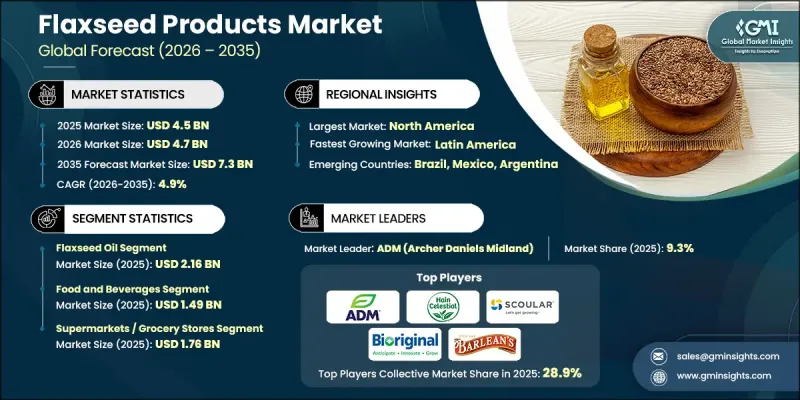
The Global Flaxseed Products Market was valued at USD 4.5 billion in 2025 and is estimated to grow at a CAGR of 4.9% to reach USD 7.3 billion by 2035.
The industry is advancing steadily as demand for plant-based nutrition continues to accelerate worldwide. Consumers embracing vegan and sustainable lifestyles are increasingly incorporating flaxseed into their diets due to its rich omega-3 fatty acid content and strong protein profile. This nutritional appeal is positioning flaxseed as a preferred ingredient across a broad range of food and beverage categories. In addition, flaxseed oil is gaining recognition for its contribution to heart health support and inflammation management, strengthening its role in the functional food and dietary supplement segments. Manufacturers are actively integrating flaxseed derivatives into innovative formulations to meet rising expectations for clean-label and plant-based ingredients. Beyond food applications, the personal care sector is also recognizing the value of flaxseed extracts for their antioxidant and conditioning properties. Growing awareness of digestive wellness and cardiovascular health across both developed and emerging economies is reinforcing consistent global demand. As consumer focus on transparency and naturally sourced ingredients intensifies, the flaxseed product market continues to build long-term growth momentum.
| Market Scope | |
|---|---|
| Start Year | 2025 |
| Forecast Year | 2026-2035 |
| Start Value | $4.5 Billion |
| Forecast Value | $7.3 Billion |
| CAGR | 4.9% |
The flaxseed oil segment generated USD 2.16 billion in 2025. Demand for this segment is expanding due to its high concentration of omega-3 fatty acids, which enhances its appeal in nutraceutical and functional product development. Flaxseed meal is also witnessing strong adoption, particularly within grain-based product manufacturing, as it delivers substantial fiber and protein content while aligning with clean-label formulation trends.
The supermarkets and grocery stores segment accounted for USD 1.76 billion in 2025. These retail outlets remain the primary purchasing destination for flaxseed-based products, offering broad product availability and consumer accessibility. Convenience retail channels continue to contribute to sales, although their assortments are comparatively narrower. At the same time, digital commerce platforms are attracting health-focused shoppers seeking plant-based options, with home delivery and subscription purchasing models gaining consistent traction.
North America Flaxseed Products Market is forecast to grow from USD 1.49 billion in 2025 to USD 2.35 billion by 2035, reflecting promising expansion across the region. Rising consumer emphasis on functional nutrition and plant-forward eating habits is fueling regional demand. In the United States, flaxseed oil, flaxseed meal, and related derivatives are increasingly incorporated into food applications and dietary formulations, supported by consumer preference for preventive wellness solutions and clean-label ingredients.
Key participants in the Global Flaxseed Products Market include Barlean's, Hain Celestial, ADM, AgMotion, AG Organica, Bioriginal, Connoils, Fengchen, GFR Ingredients, Linwoods Health Foods, Scoular, Silverline Chemicals, and Spack International. Companies operating in the Global Flaxseed Products Market are reinforcing their competitive position through innovation, supply chain integration, and strategic expansion. Industry leaders are investing in research and development to introduce high-purity flaxseed oils, specialty ingredients, and value-added formulations that meet evolving consumer expectations. Partnerships with food manufacturers and nutraceutical brands are strengthening distribution networks and broadening application areas. Firms are also expanding processing capacities to ensure consistent quality and traceability. Geographic diversification into high-growth regions is enabling companies to capture emerging demand.
Table of Contents
Chapter 1 Methodology & Scope
- 1.1 Market scope and definition
- 1.2 Research design
- 1.2.1 Research approach
- 1.2.2 Data collection methods
- 1.3 Data mining sources
- 1.3.1 Global
- 1.3.2 Regional/Country
- 1.4 Base estimates and calculations
- 1.4.1 Base year calculation
- 1.4.2 Key trends for market estimation
- 1.5 Primary research and validation
- 1.5.1 Primary sources
- 1.6 Forecast model
- 1.7 Research assumptions and limitations
Chapter 2 Executive Summary
- 2.1 Industry 360° synopsis
- 2.2 Key market trends
- 2.2.1 Type
- 2.2.2 Application
- 2.2.3 Distribution Channel
- 2.2.4 Regional
- 2.3 TAM Analysis, 2026-2035
- 2.4 CXO perspectives: Strategic imperatives
- 2.5 Future outlook and strategic recommendations
Chapter 3 Industry Insights
- 3.1 Industry ecosystem analysis
- 3.1.1 Supplier landscape
- 3.1.2 Profit margin
- 3.1.3 Value addition at each stage
- 3.1.4 Factor affecting the value chain
- 3.1.5 Disruptions
- 3.2 Industry impact forces
- 3.2.1 Growth drivers
- 3.2.1.1 Rising demand for plant-based foods
- 3.2.1.2 Increasing health consciousness
- 3.2.1.3 Versatility in food products
- 3.2.2 Industry pitfalls and challenges
- 3.2.2.1 Digestive discomfort
- 3.2.2.2 Oxidation and rancidity
- 3.2.3 Market opportunities
- 3.2.3.1 Expansion into functional foods
- 3.2.3.2 Growing demand for sustainable ingredients
- 3.2.3.3 Health and wellness trends
- 3.2.1 Growth drivers
- 3.3 Growth potential analysis
- 3.4 Regulatory landscape
- 3.4.1 North America
- 3.4.2 Europe
- 3.4.3 Asia Pacific
- 3.4.4 Latin America
- 3.4.5 Middle East & Africa
- 3.5 Porter's analysis
- 3.6 PESTEL analysis
- 3.7 Technology and innovation landscape
- 3.7.1 Current technological trends
- 3.7.2 Emerging technologies
- 3.8 Price trends
- 3.8.1 By region
- 3.8.2 By type
- 3.9 Future market trends
- 3.10 Technology and innovation landscape
- 3.10.1 Current technological trends
- 3.10.2 Emerging technologies
- 3.11 Patent landscape
- 3.12 Trade statistics (HS code)
- 3.12.1 Major importing countries
- 3.12.2 Major exporting countries
- 3.13 Sustainability and environmental aspects
- 3.13.1 Sustainable practices
- 3.13.2 Waste reduction strategies
- 3.13.3 Energy efficiency in production
- 3.13.4 Eco-friendly initiatives
- 3.14 Carbon footprint consideration
Chapter 4 Competitive Landscape, 2025
- 4.1 Introduction
- 4.2 Company market share analysis
- 4.2.1 By region
- 4.2.1.1 North America
- 4.2.1.2 Europe
- 4.2.1.3 Asia Pacific
- 4.2.1.4 LATAM
- 4.2.1.5 MEA
- 4.2.1 By region
- 4.3 Company matrix analysis
- 4.4 Competitive analysis of major market players
- 4.5 Competitive positioning matrix
- 4.6 Key developments
- 4.6.1 Mergers & acquisitions
- 4.6.2 Partnerships & collaborations
- 4.6.3 New product launches
- 4.6.4 Expansion plans
Chapter 5 Market Estimates and Forecast, By Type, 2022-2035 (USD Billion) (Kilo Tons)
- 5.1 Key trends
- 5.2 Flaxseed oil
- 5.3 Flaxseed meal
- 5.4 Flaxseed flour
- 5.5 Flaxseed flakes
- 5.6 Others
Chapter 6 Market Estimates and Forecast, By Application, 2022-2035 (USD Billion) (Kilo Tons)
- 6.1 Key trends
- 6.2 Food and beverages
- 6.3 Dietary supplements
- 6.4 Cosmetics and personal care
- 6.5 Pharmaceuticals
- 6.6 Animal feed
- 6.7 Others
Chapter 7 Market Estimates and Forecast, By Distribution Channel, 2022-2035 (USD Billion) (Kilo Tons)
- 7.1 Key trends
- 7.2 Supermarkets / Grocery stores
- 7.3 Convenience stores
- 7.4 Online marketplaces
- 7.5 Direct sales / Brand website
- 7.6 Wholesale distributors
- 7.7 Others
Chapter 8 Market Estimates and Forecast, By Region, 2022-2035 (USD Billion) (Kilo Tons)
- 8.1 Key trends
- 8.2 North America
- 8.2.1 U.S.
- 8.2.2 Canada
- 8.3 Europe
- 8.3.1 Germany
- 8.3.2 UK
- 8.3.3 France
- 8.3.4 Spain
- 8.3.5 Italy
- 8.3.6 Rest of Europe
- 8.4 Asia Pacific
- 8.4.1 China
- 8.4.2 India
- 8.4.3 Japan
- 8.4.4 Australia
- 8.4.5 South Korea
- 8.4.6 Rest of Asia Pacific
- 8.5 Latin America
- 8.5.1 Brazil
- 8.5.2 Mexico
- 8.5.3 Argentina
- 8.5.4 Rest of Latin America
- 8.6 Middle East and Africa
- 8.6.1 Saudi Arabia
- 8.6.2 South Africa
- 8.6.3 UAE
- 8.6.4 Rest of Middle East and Africa
Chapter 9 Company Profiles
- 9.1 ADM
- 9.2 AG Organica
- 9.3 AgMotion
- 9.4 Barlean's
- 9.5 Bioriginal
- 9.6 Connoils
- 9.7 Fengchen
- 9.8 GFR Ingredients
- 9.9 Hain Celestial
- 9.10 Linwoods Health Foods
- 9.11 Scoular
- 9.12 Silverline Chemicals
- 9.13 Spack International


