


 |
市场调查报告书
商品编码
1998766
无烟煤市场机会、成长要素、产业趋势分析及2026-2035年预测Anthracite Market Opportunity, Growth Drivers, Industry Trend Analysis, and Forecast 2026 - 2035 |
||||||

预计到 2025 年,全球无烟煤市场价值将达到 119 亿美元,并预计以 3.5% 的复合年增长率成长,到 2035 年达到 168 亿美元。
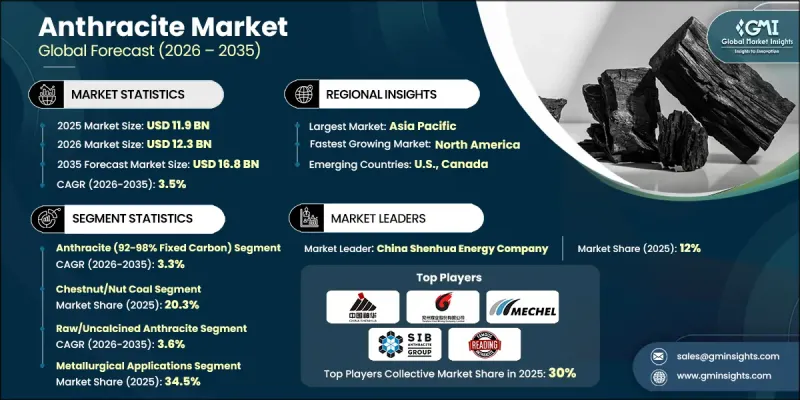
无烟煤是一种优质煤,碳含量极高,杂质含量极低,因此成为许多对加热效率、烟度和机械强度要求极高的行业的首选材料。其多功能性和可靠性使其成为发电、工业生产和冶金应用领域中一种永续且耐用的材料。无烟煤的低硫低挥发排放含量等特性,既满足了工业需求,也支持了全球永续性,从而推动了其市场成长。技术进步拓展了无烟煤的应用范围,使其涵盖碳基复合材料、先进过滤系统和环保工业解决方案等领域,反映了材料科学领域在效率、永续性和创新方面的更广泛发展趋势。工业界对无烟煤在传统和先进应用中的依赖,凸显了其在全球市场日益增长的重要性。
| 市场范围 | |
|---|---|
| 开始年份 | 2025 |
| 预测期 | 2026-2035 |
| 上市时的市场规模 | 119亿美元 |
| 预计金额 | 168亿美元 |
| 复合年增长率 | 3.5% |
预计到2025年,栗子木炭市占率将达到20.3%,并在2026年至2035年间以3.9%的复合年增长率成长。栗子木炭颗粒适中,品质稳定,用途广泛,从工业炉窑到住宅暖气系统均可适用。其均匀的颗粒大小确保了燃烧稳定、热输出高效且废弃物极少,使其成为高能耗製程的理想选择。此外,栗子木炭易于搬运、储存和运输,有助于提高工业和住宅用户的营运效率。
预计到2025年,冶金应用领域将占市场份额的34.5%,到2035年将以3%的复合年增长率成长。无烟煤具有高碳纯度和低挥发性,是炼钢和铁合金生产中必不可少的还原剂。此外,其过滤性能也应用于城市和工业水处理;在先进复合材料领域,无烟煤被用作电极和其他高性能产品的碳基材料。
北美无烟煤市场正在快速成长,预计到 2025 年将占据 10.3% 的市场。该地区的工业扩张,加上支持清洁能源和永续实践的法规,正在推动发电、冶金工艺和先进工业应用领域对高品质无烟煤的需求。
目录
第一章:调查方法和范围
第二章执行摘要
第三章业界考察
- 生态系分析
- 供应商情况
- 利润率
- 每个阶段增加的价值
- 影响价值链的因素
- 中断
- 影响产业的因素
- 促进因素
- 钢铁生产中对无烟煤的需求增加
- 发电中无烟煤的使用量增加
- 在水过滤系统中的应用不断扩展
- 产业潜在风险与挑战
- 高昂的采矿和加工成本
- 与采矿活动相关的环境问题
- 市场机会
- 采矿和加工领域的技术进步
- 新兴国家需求不断成长
- 促进因素
- 成长潜力分析
- 监理情势
- 北美洲
- 欧洲
- 亚太地区
- 拉丁美洲
- 中东和非洲
- 波特五力分析
- PESTEL 分析
- 价格趋势
- 按地区
- 按年级
- 未来市场趋势
- 科技与创新趋势
- 当前技术趋势
- 新兴技术
- 专利趋势
- 贸易统计(HS编码)
- 主要进口国
- 主要出口国
- 永续性和环境方面
- 永续倡议
- 减少废弃物策略
- 生产中的能源效率
- 环保意识的倡议
- 考虑碳足迹
第四章 竞争情势
- 介绍
- 企业市占率分析
- 按地区
- 北美洲
- 欧洲
- 亚太地区
- 拉丁美洲
- 中东和非洲
- 按地区
- 企业矩阵分析
- 主要市场公司的竞争分析
- 竞争定位矩阵
- 主要进展
- 併购
- 伙伴关係与合作
- 新产品发布
- 业务拓展计划
第五章 市场估算与预测:依等级划分,2022-2035年
- 聚安塔拉石(固定碳含量98%或以上)
- 无烟煤(固定碳含量92-98%)
- 半安塔拉石(固定碳含量86-92%)
第六章 市场估算与预测:依产品类型划分,2022-2035年
- 米炭
- 皮卡尔
- 荞麦炭
- 栗子和坚果木炭
- 炉灶用煤
- 蛋鸣
- 碎煤
第七章 市场估算与预测:依加工烧製方法划分,2022-2035年
- 未燃烧的无烟煤
- 瓦斯无烟煤(GCA)
- 电烧无烟煤(ECA)
第八章 市场估计与预测:依应用领域划分,2022-2035年
- 冶金应用
- 碳添加剂/再碳化剂
- 粉煤喷射(PCI)
- 烧结和造粒
- 水处理应用
- 饮用水过滤
- 污水处理
- 工业用水净化
- 海水淡化预处理
- 碳产品製造
- 碳电极
- 电极膏
- 活性碳
- 化学合成
- 碳化硅生产
- 碳化钙的生产
- 能源应用
- 住宅和空间供暖
- 发电
- 工业锅炉和熔炉
- 耐火材料及建筑材料
- 燃烧炉
- 其他的
第九章 市场估计与预测:依地区划分,2022-2035年
- 北美洲
- 我们
- 加拿大
- 欧洲
- 德国
- 英国
- 法国
- 西班牙
- 义大利
- 其他欧洲地区
- 亚太地区
- 中国
- 印度
- 日本
- 澳洲
- 韩国
- 亚太其他地区
- 拉丁美洲
- 巴西
- 墨西哥
- 阿根廷
- 其他拉丁美洲地区
- 中东和非洲
- 沙乌地阿拉伯
- 南非
- 阿拉伯聯合大公国
- 其他中东和非洲地区
第十章:公司简介
- China Shenhua Energy Company
- Yanzhou Coal Mining Company
- Mechel PAO
- Sibanthracite Group
- Reading Anthracite Company
- Blaschak Coal Corporation
- Atlantic Carbon Group Inc
- Vinacomin-Vietnam National Coal &Mineral Industries Group
- DTEK
- Sadovaya Group
- Xcoal Energy &Resources
- VostokCoal
- Glencore PLC
The Global Anthracite Market was valued at USD 11.9 billion in 2025 and is estimated to grow at a CAGR of 3.5% to reach USD 16.8 billion by 2035.
Anthracite is a premium-grade coal with exceptionally high carbon content and minimal impurities, making it a preferred choice across industries that demand high calorific efficiency, low smoke emissions, and superior mechanical strength. Its versatility and reliability have positioned it as a sustainable and durable material for energy generation, industrial processes, and metallurgical applications. The market is being propelled by anthracite's ability to meet industrial demands while supporting global sustainability initiatives, thanks to its low sulfur and volatile matter content. Technological advancements have expanded their applications to include carbon-based composites, advanced filtration systems, and eco-friendly industrial solutions, reflecting the broader trend toward efficiency, sustainability, and innovation in material science. Industries increasingly rely on anthracite for both traditional and advanced applications, highlighting its growing importance in global markets.
| Market Scope | |
|---|---|
| Start Year | 2025 |
| Forecast Year | 2026-2035 |
| Start Value | $11.9 Billion |
| Forecast Value | $16.8 Billion |
| CAGR | 3.5% |
The Chestnut or nut coal segment held 20.3% share in 2025 and is projected to grow at a CAGR of 3.9% from 2026 to 2035. Its medium-sized granules and consistent quality make it highly versatile, suitable for a broad spectrum of applications ranging from industrial furnaces to residential heating systems. The coal's uniform size ensures steady combustion, efficient heat output, and minimal waste, making it a preferred choice for energy-intensive processes. Additionally, its ease of handling, storage, and transport adds operational efficiency for industrial users and households alike.
The metallurgical applications segment held 34.5% share in 2025 and is expected to grow at a CAGR of 3% by 2035. Anthracite's high carbon purity and low volatile matter make it a vital reductant in steel-making and ferroalloy production. Additionally, its filtration capabilities are leveraged in municipal and industrial water treatment, while advanced composites utilize anthracite as a carbon base for electrodes and other high-performance products.
North America Anthracite Market accounted for 10.3% share in 2025 and is growing rapidly. The region's industrial expansion, coupled with supportive regulations promoting cleaner energy and sustainable practices, has bolstered demand for high-quality anthracite in power generation, metallurgical processes, and advanced industrial applications.
Key players operating in the Global Anthracite Market include China Shenhua Energy Company, Yanzhou Coal Mining Company, Mechel PAO, Sibanthracite Group, Reading Anthracite Company, Blaschak Coal Corporation, Atlantic Carbon Group Inc, Vinacomin - Vietnam National Coal & Mineral Industries Group, DTEK, Sadovaya Group, Xcoal Energy & Resources, VostokCoal, and Glencore PLC. Companies in the Global Anthracite Market strengthen their presence through strategic investments in mining technology and beneficiation techniques to improve coal purity and calorific efficiency. They expand production capacity and optimize logistics to meet growing regional and industrial demand. Collaborations with industrial users, including metallurgical and filtration companies, help secure long-term contracts. Firms also focus on sustainable practices and compliance with environmental standards to attract environmentally conscious clients. Product diversification, including specialized grades for advanced composites and clean energy applications, coupled with geographic expansion into emerging markets, enhances their competitiveness.
Table of Contents
Chapter 1 Methodology & Scope
- 1.1 Market scope and definition
- 1.2 Research design
- 1.2.1 Research approach
- 1.2.2 Data collection methods
- 1.3 Data mining sources
- 1.3.1 Global
- 1.3.2 Regional/Country
- 1.4 Base estimates and calculations
- 1.4.1 Base year calculation
- 1.4.2 Key trends for market estimation
- 1.5 Primary research and validation
- 1.5.1 Primary sources
- 1.6 Forecast model
- 1.7 Research assumptions and limitations
Chapter 2 Executive Summary
- 2.1 Industry 360° synopsis
- 2.2 Key market trends
- 2.2.1 Regional
- 2.2.2 Grade
- 2.2.3 Product Form
- 2.2.4 Processing & Calcination
- 2.2.5 Application
- 2.3 TAM Analysis, 2025-2035
- 2.4 CXO perspectives: Strategic imperatives
- 2.4.1 Executive decision points
- 2.4.2 Critical success factors
- 2.5 Future Outlook and Strategic Recommendations
Chapter 3 Industry Insights
- 3.1 Industry ecosystem analysis
- 3.1.1 Supplier landscape
- 3.1.2 Profit margin
- 3.1.3 Value addition at each stage
- 3.1.4 Factor affecting the value chain
- 3.1.5 Disruptions
- 3.2 Industry impact forces
- 3.2.1 Growth drivers
- 3.2.1.1 Increasing demand for anthracite in steel production.
- 3.2.1.2 Rising use of anthracite in power generation.
- 3.2.1.3 Growing applications in water filtration systems.
- 3.2.2 Industry pitfalls and challenges
- 3.2.2.1 High extraction and processing costs.
- 3.2.2.2 Environmental concerns related to mining activities.
- 3.2.3 Market opportunities
- 3.2.3.1 Technological advancements in mining and processing.
- 3.2.3.2 Expanding demand in emerging economies.
- 3.2.1 Growth drivers
- 3.3 Growth potential analysis
- 3.4 Regulatory landscape
- 3.4.1 North America
- 3.4.2 Europe
- 3.4.3 Asia Pacific
- 3.4.4 Latin America
- 3.4.5 Middle East & Africa
- 3.5 Porter's analysis
- 3.6 PESTEL analysis
- 3.7 Price trends
- 3.7.1 By region
- 3.7.2 By Grade
- 3.8 Future market trends
- 3.9 Technology and Innovation landscape
- 3.9.1 Current technological trends
- 3.9.2 Emerging technologies
- 3.10 Patent Landscape
- 3.11 Trade statistics (HS code)
- 3.11.1 Major importing countries
- 3.11.2 Major exporting countries
- 3.12 Sustainability and environmental aspects
- 3.12.1 Sustainable practices
- 3.12.2 Waste reduction strategies
- 3.12.3 Energy efficiency in production
- 3.12.4 Eco-friendly initiatives
- 3.13 Carbon footprint consideration
Chapter 4 Competitive Landscape, 2025
- 4.1 Introduction
- 4.2 Company market share analysis
- 4.2.1 By region
- 4.2.1.1 North America
- 4.2.1.2 Europe
- 4.2.1.3 Asia Pacific
- 4.2.1.4 LATAM
- 4.2.1.5 MEA
- 4.2.1 By region
- 4.3 Company matrix analysis
- 4.4 Competitive analysis of major market players
- 4.5 Competitive positioning matrix
- 4.6 Key developments
- 4.6.1 Mergers & acquisitions
- 4.6.2 Partnerships & collaborations
- 4.6.3 New Product Launches
- 4.6.4 Expansion Plans
Chapter 5 Market Estimates and Forecast, By Grade, 2022-2035 (USD Billion) (Kilo Tons)
- 5.1 Key trends
- 5.2 Meta-anthracite (≥98% fixed carbon)
- 5.3 Anthracite (92-98% fixed carbon)
- 5.4 Semi-anthracite (86-92% fixed carbon)
Chapter 6 Market Estimates and Forecast, By Product Form, 2022-2035 (USD Billion) (Kilo Tons)
- 6.1 Key trends
- 6.2 Rice Coal
- 6.3 Pea Coal
- 6.4 Buckwheat Coal
- 6.5 Chestnut/Nut Coal
- 6.6 Stove Coal
- 6.7 Egg Coal
- 6.8 Broken Coal
Chapter 7 Market Estimates and Forecast, By Processing & Calcination, 2022-2035 (USD Billion) (Kilo Tons)
- 7.1 Key trends
- 7.2 Raw/uncalcined anthracite
- 7.3 Gas calcined anthracite (GCA)
- 7.4 Electrically calcined anthracite (ECA)
Chapter 8 Market Estimates and Forecast, By Application, 2022-2035 (USD Billion) (Kilo Tons)
- 8.1 Key trends
- 8.2 Metallurgical Applications
- 8.2.1 Carbon Raiser/Recarburizer
- 8.2.2 Pulverized Coal Injection (PCI)
- 8.2.3 Sintering & Pelletizing
- 8.3 Water Treatment Applications
- 8.3.1 Drinking Water Filtration
- 8.3.2 Wastewater Treatment
- 8.3.3 Industrial Water Clarification
- 8.3.4 Desalination Pre-treatment
- 8.4 Carbon Products Manufacturing
- 8.4.1 Carbon Electrodes
- 8.4.2 Electrode Paste
- 8.4.3 Activated Carbon
- 8.5 Chemical Synthesis
- 8.5.1 Silicon Carbide Production
- 8.5.2 Calcium Carbide Production
- 8.6 Energy Applications
- 8.6.1 Residential/Space Heating
- 8.6.2 Power Generation
- 8.6.3 Industrial Boilers & Furnaces
- 8.7 Refractory & Construction Materials
- 8.8 Indurating Furnaces
- 8.9 Others
Chapter 9 Market Estimates and Forecast, By Region, 2022-2035 (USD Billion) (Kilo Tons)
- 9.1 Key trends
- 9.2 North America
- 9.2.1 U.S.
- 9.2.2 Canada
- 9.3 Europe
- 9.3.1 Germany
- 9.3.2 UK
- 9.3.3 France
- 9.3.4 Spain
- 9.3.5 Italy
- 9.3.6 Rest of Europe
- 9.4 Asia Pacific
- 9.4.1 China
- 9.4.2 India
- 9.4.3 Japan
- 9.4.4 Australia
- 9.4.5 South Korea
- 9.4.6 Rest of Asia Pacific
- 9.5 Latin America
- 9.5.1 Brazil
- 9.5.2 Mexico
- 9.5.3 Argentina
- 9.5.4 Rest of Latin America
- 9.6 Middle East and Africa
- 9.6.1 Saudi Arabia
- 9.6.2 South Africa
- 9.6.3 UAE
- 9.6.4 Rest of Middle East and Africa
Chapter 10 Company Profiles
- 10.1 China Shenhua Energy Company
- 10.2 Yanzhou Coal Mining Company
- 10.3 Mechel PAO
- 10.4 Sibanthracite Group
- 10.5 Reading Anthracite Company
- 10.6 Blaschak Coal Corporation
- 10.7 Atlantic Carbon Group Inc
- 10.8 Vinacomin - Vietnam National Coal & Mineral Industries Group
- 10.9 DTEK
- 10.10 Sadovaya Group
- 10.11 Xcoal Energy & Resources
- 10.12 VostokCoal
- 10.13 Glencore PLC

 煅烧无烟煤市场:依等级、製造流程、形态、碳含量及应用划分-2026-2032年全球市场预测无烟煤市场:2026-2032年全球市场预测(依最终用途产业、形状、开采类型及通路划分)
 2026年全球煅烧无烟煤市场报告2026年全球无烟煤市场报告
 锻烧无烟煤市场规模、份额和成长分析(按类型、形态、应用、最终用途产业和地区划分)—产业预测(2026-2033 年)
 无烟煤:全球市场占有率和排名、总销售量和需求预测(2025-2031年)
 2025-2033年煅烧无烟煤市场规模、份额、趋势及预测(依技术、应用、最终用途产业及地区)
 全球优质无烟煤市场
 全球煅烧无烟煤市场:产业分析、规模、份额、成长、趋势和预测(2025-2032 年)
 2030 年煅烧无烟煤市场预测:按类型、形式、纯度、生产方法、应用、最终用户和地区进行的全球分析