


 |
市场调查报告书
商品编码
1998791
陆基遥控武器站市场机会、成长驱动因素、产业趋势分析及预测(2026-2035年)Land-Based Remote Weapon Station Market Opportunity, Growth Drivers, Industry Trend Analysis, and Forecast 2026 - 2035 |
||||||

全球陆基遥控武器站市场预计到 2025 年价值 71 亿美元,年复合成长率为 5.1%,到 2035 年将达到 116 亿美元。
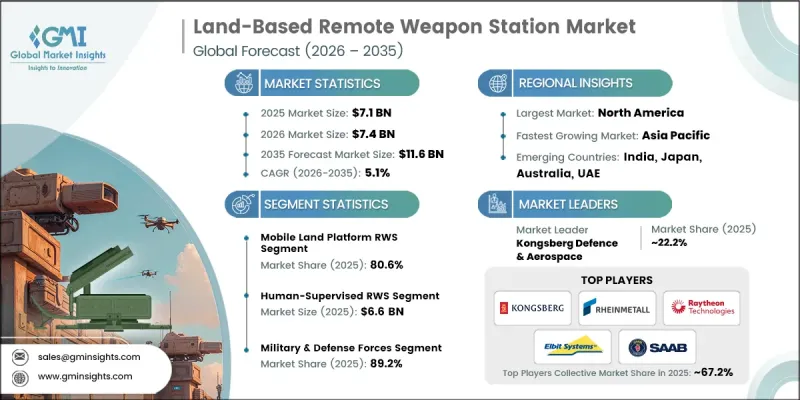
市场扩张的驱动因素包括北约和印太地区装甲车辆现代化项目的增加、非对称战争中对乘员生存能力的日益重视,以及反无人机系统(UAS)解决方案在战术车辆层面的日益整合。此外,各国军队正在将先进的远程致命系统整合到网路化战场架构中,并越来越多地采购轻型、可快速部署的武器站,用于边防安全和机动作战。北约东线现代化计画是主要驱动力,成员国正在提高车辆的生存能力,以应对该地区不断演变的威胁。随着各国政府为第一线车辆部署先进的远程射击系统,无人炮塔的应用也不断扩展。在2022年以后的高度复杂和非对称衝突中,反无人机能力将至关重要,预计车辆层面的整合将持续到2032年。这些创新将提高人员的战术性防护能力,同时扩展远程武器系统的作战多功能性,使其超越传统的直接射击能力。
| 市场范围 | |
|---|---|
| 开始年份 | 2025 |
| 预测期 | 2026-2035 |
| 上市时的市场规模 | 71亿美元 |
| 预计金额 | 116亿美元 |
| 复合年增长率 | 5.1% |
预计2026年至2035年间,固定式地面遥控武器站市场将以7.3%的复合年增长率成长。这一增长主要得益于在边境要塞、关键基础设施和前沿作战基地的部署。日益紧张的跨境局势和无人机的扩散正在推动对用于周界安全的远端操控防御系统的需求。这些系统能够提供持续监控、自动目标追踪并降低操作人员的风险,从而提高静态防御网路的效能,并刺激持续投资。
预计到2025年,有人值守监视遥控武器站(RWS)市场规模将达66亿美元。之所以偏好操作员在环(OITL)系统,是因为国际交战规则和法规结构要求在民用领域课责并降低风险。军方之所以青睐监视系统,是因为它们与现有的装甲车队和传统指挥网络相容。这使他们能够在遵守安全和人道主义标准的同时,保持作战优势。
到2025年,北美陆基遥控武器站市占率将达到33.8%。该地区的成长主要得益于持续的国防现代化项目、不断增长的国防预算以及先进遥控武器站技术的采购。美国陆军和国防部的现代化倡议、边境国防安全保障需求以及成熟的工业基础,都为该市场提供了支持,使其能够将遥控武器系统整合到军队和安全部队中。预计到2035年,北美地区对网路化武器、自主作战系统和边境防御能力的重视将持续推动市场稳定成长。
目录
第一章:调查方法和范围
第二章执行摘要
第三章业界考察
- 产业生态系分析
- 供应商情况
- 利润率
- 成本结构
- 每个阶段增加的价值
- 影响价值链的因素
- 中断
- 影响产业的因素
- 成长驱动因素
- 提高北约东线战车的生存能力
- 美国陆军 CROWS 现代化计划
- 对无人炮塔整合的需求日益增长
- 步兵战车数位化
- 轻型遥控武器系统(RWS)在战术车辆的应用
- 产业潜在风险与挑战
- 根据《国际武器贸易条例》(ITAR) 实施的出口限制
- 与现有装甲车辆单元整合的复杂性
- 市场机会
- 利用人工智慧升级自主目标辨识功能
- 混合动力战车的集成
- 成长驱动因素
- 成长潜力分析
- 监理情势
- 波特五力分析
- PESTEL 分析
- 科技与创新趋势
- 当前技术趋势
- 新兴技术
- 价格趋势
- 按地区
- 副产品
- 定价策略
- 新兴经营模式
- 合规要求
- 专利和智慧财产权分析
- 地缘政治和贸易趋势
第四章 竞争情势
- 介绍
- 企业市占率分析
- 按地区
- 市场集中度分析
- 主要企业的竞争标竿分析
- 财务绩效比较
- 销售量
- 利润率
- 研究与发展(R&D)
- 产品系列比较
- 产品线宽度
- 科技
- 创新
- 区域扩张比较
- 全球扩张分析
- 服务网路覆盖
- 按地区分類的市场渗透率
- 竞争定位矩阵
- 领导者
- 挑战者
- 追踪者
- 小众玩家
- 战略展望矩阵
- 财务绩效比较
- 主要进展
- 併购
- 伙伴关係与合作
- 技术进步
- 业务拓展与投资策略
- 数位转型计划
- 新兴/Start-Ups竞争对手的发展趋势
第五章 市场估算与预测:依平台类型划分,2022-2035年
- 用于移动地面平台的遥控武器系统(RWS)
- 作战车辆(装甲战车)
- 步兵战车(IFV)
- 装甲运兵车(APC)
- 主战坦克(MBT)-辅助武器
- 战术车辆
- 联合轻型战术车辆(JLTV)
- 防地雷和防伏击车辆(MRAP)
- 战术卡车和支援车辆
- 无人地面车辆(UGV)
- 作战车辆(装甲战车)
- 固定地面设施的RWS
- 永久安装
- 可部署/容器化系统
第六章 市场估价与预测:依武器类型划分,2022-2035年
- 轻武器(5.56毫米至7.62毫米)
- 中型武器(12.7毫米至14.5毫米)
- 重型武器(20毫米至40毫米或更大)
第七章 市场估价与预测:依自动驾驶等级划分,2022-2035年
- 人工监督的RWS
- 自主RWS
第八章 市场估算与预测:依最终使用者划分,2022-2035年
- 军事/国防部队
- 执法机关和边防部队
第九章 市场估计与预测:依地区划分,2022-2035年
- 北美洲
- 我们
- 加拿大
- 欧洲
- 德国
- 英国
- 法国
- 西班牙
- 义大利
- 俄罗斯
- 亚太地区
- 中国
- 印度
- 日本
- 澳洲
- 韩国
- 拉丁美洲
- 巴西
- 墨西哥
- 阿根廷
- 中东和非洲
- 南非
- 沙乌地阿拉伯
- 阿拉伯聯合大公国
第十章:公司简介
- 主要企业
- Rheinmetall AG
- BAE Systems plc
- Kongsberg Defence & Aerospace
- 该地区的主要企业
- 北美洲
- General Dynamics Corporation
- RTX Corporation
- 亚太地区
- ASELSAN AS
- Electro Optic Systems
- ST Engineering
- 欧洲
- Saab AB
- Leonardo SpA
- FN Herstal
- 北美洲
- 特殊玩家/干扰者
- Elbit Systems Ltd.
- Rafael Advanced Defense Systems
- Thales Group
The Global Land-Based Remote Weapon Station Market was valued at USD 7.1 billion in 2025 and is estimated to grow at a CAGR of 5.1% to reach USD 11.6 billion in 2035.
Market expansion is fueled by increasing armored vehicle modernization programs across NATO and Indo-Pacific regions, the growing emphasis on crew survivability in asymmetric warfare, and the rising integration of counter-UAS solutions at the tactical vehicle level. Military forces are also incorporating advanced remote lethality systems into networked battlefield architectures, while lightweight, rapidly deployable weapon stations are increasingly being procured for border security and mobile operations. NATO Eastern flank modernization programs are a key driver, with member states enhancing vehicle survivability to address evolving regional threats. The adoption of unmanned turrets is gaining traction as governments implement advanced remote fire systems for frontline vehicles. Counter-drone capabilities have become critical in high-intensity and asymmetric conflicts post-2022, and their integration at the vehicle level is expected to continue until 2032. These innovations improve tactical protection for personnel while expanding the operational versatility of remote weapon systems beyond traditional direct-fire functions.
| Market Scope | |
|---|---|
| Start Year | 2025 |
| Forecast Year | 2026-2035 |
| Start Value | $7.1 Billion |
| Forecast Value | $11.6 Billion |
| CAGR | 5.1% |
The fixed land installation remote weapon stations segment is expected to grow at a CAGR of 7.3% during 2026-2035. This growth is supported by deployments across fortified borders, critical infrastructure, and forward operating bases. Heightened cross-border tensions and the proliferation of drones are driving demand for remotely operated defense systems for perimeter security. These installations offer persistent surveillance, automated target tracking, and reduced operator exposure, which enhances the effectiveness of static defense networks and encourages continued investment.
The human-supervised RWS segment reached USD 6.6 billion in 2025. Preference for operator-in-the-loop systems is driven by international rules of engagement and regulatory frameworks that demand accountability and risk reduction in civilian areas. Military forces favor supervised systems for their compatibility with existing armored vehicle fleets and legacy command networks, which allows them to maintain operational dominance while adhering to safety and humanitarian standards.
North America Land-Based Remote Weapon Station Market held a 33.8% share in 2025. Growth in this region is driven by ongoing defense modernization programs, elevated defense budgets, and procurement of advanced RWS technologies. The market benefits from U.S. Army and Department of Defense modernization initiatives, homeland security requirements along borders, and a well-established industrial base that supports integration of remote weapon systems across military and security forces. North America's focus on networked weapons, autonomous engagement systems, and border defense capabilities is expected to sustain steady growth through 2035.
Key players in the Global Land-Based Remote Weapon Station Market include Kongsberg Defence & Aerospace, Electro Optic Systems, ASELSAN A.S, General Dynamics Corporation, Thales Group, FN Herstal, Elbit Systems Ltd., Rafael Advanced Defense Systems, BAE Systems plc, Leonardo S.p.A, Rheinmetall AG, Saab AB, ST Engineering, and RTX Corporation. Companies operating in the Global Land-Based Remote Weapon Station Market are employing multiple strategies to strengthen their position and expand market share. They are investing in R&D to develop autonomous engagement systems, counter-UAS technologies, and lightweight modular weapon stations. Strategic alliances with defense agencies and technology firms allow integration of advanced systems into existing fleets. Manufacturers are also expanding production capacity, establishing regional service centers, and offering operator training programs. Emphasis on interoperability, networked battlefield solutions, and modular designs enables rapid upgrades and multi-platform deployment.
Table of Contents
Chapter 1 Methodology and Scope
- 1.1 Market scope and definition
- 1.2 Research design
- 1.2.1 Research approach
- 1.2.2 Data collection methods
- 1.3 Data mining sources
- 1.3.1 Global
- 1.3.2 Regional/Country
- 1.4 Base estimates and calculations
- 1.4.1 Base year calculation
- 1.4.2 Key trends for market estimation
- 1.5 Primary research and validation
- 1.5.1 Primary sources
- 1.6 Forecast model
- 1.7 Research assumptions and limitations
Chapter 2 Executive Summary
- 2.1 Industry 360° synopsis, 2022 - 2035
- 2.2 Key market trends
- 2.2.1 Platform type trends
- 2.2.2 Weapon type trends
- 2.2.3 Autonomy level trends
- 2.2.4 End-user trends
- 2.2.5 Regional trends
- 2.3 TAM Analysis, 2026-2035
- 2.4 CXO perspectives: Strategic imperatives
- 2.4.1 Executive decision points
- 2.4.2 critical success factors
- 2.5 Future outlook and strategic recommendations
Chapter 3 Industry Insights
- 3.1 Industry ecosystem analysis
- 3.1.1 Supplier Landscape
- 3.1.2 Profit Margin
- 3.1.3 Cost structure
- 3.1.4 Value addition at each stage
- 3.1.5 Factor affecting the value chain
- 3.1.6 Disruptions
- 3.2 Industry impact forces
- 3.2.1 Growth drivers
- 3.2.1.1 NATO Eastern flank vehicle survivability upgrades
- 3.2.1.2 U.S. Army CROWS modernization programs
- 3.2.1.3 Rising demand for unmanned turret integration
- 3.2.1.4 Infantry fighting vehicle fleet digitization
- 3.2.1.5 Lightweight RWS adoption on tactical vehicles
- 3.2.2 Industry pitfalls and challenges
- 3.2.2.1 Export restrictions under ITAR regulations
- 3.2.2.2 Integration complexity with legacy armored fleets
- 3.2.3 Market opportunities
- 3.2.3.1 AI-enabled autonomous target recognition upgrades
- 3.2.3.2 Hybrid electric combat vehicle integration
- 3.2.1 Growth drivers
- 3.3 Growth potential analysis
- 3.4 Regulatory landscape
- 3.4.1 North America
- 3.4.2 Europe
- 3.4.3 Asia Pacific
- 3.4.4 Latin America
- 3.4.5 Middle East & Africa
- 3.5 Porter's analysis
- 3.6 PESTEL analysis
- 3.7 Technology and Innovation landscape
- 3.7.1 Current technological trends
- 3.7.2 Emerging technologies
- 3.8 Price trends
- 3.8.1 By region
- 3.8.2 By product
- 3.9 Pricing Strategies
- 3.10 Emerging Business Models
- 3.11 Compliance Requirements
- 3.12 Patent and IP analysis
- 3.13 Geopolitical and trade dynamics
Chapter 4 Competitive Landscape, 2025
- 4.1 Introduction
- 4.2 Company market share analysis
- 4.2.1 By region
- 4.2.1.1 North America
- 4.2.1.2 Europe
- 4.2.1.3 Asia Pacific
- 4.2.1.4 Latin America
- 4.2.1.5 Middle East & Africa
- 4.2.2 Market concentration analysis
- 4.2.1 By region
- 4.3 Competitive benchmarking of key players
- 4.3.1 Financial performance comparison
- 4.3.1.1 Revenue
- 4.3.1.2 Profit margin
- 4.3.1.3 R&D
- 4.3.2 Product portfolio comparison
- 4.3.2.1 Product range breadth
- 4.3.2.2 Technology
- 4.3.2.3 Innovation
- 4.3.3 Geographic presence comparison
- 4.3.3.1 Global footprint analysis
- 4.3.3.2 Service network coverage
- 4.3.3.3 Market penetration by region
- 4.3.4 Competitive positioning matrix
- 4.3.4.1 Leaders
- 4.3.4.2 Challengers
- 4.3.4.3 Followers
- 4.3.4.4 Niche players
- 4.3.5 Strategic outlook matrix
- 4.3.1 Financial performance comparison
- 4.4 Key developments
- 4.4.1 Mergers and acquisitions
- 4.4.2 Partnerships and collaborations
- 4.4.3 Technological advancements
- 4.4.4 Expansion and investment strategies
- 4.4.5 Digital transformation initiatives
- 4.5 Emerging/ startup competitors landscape
Chapter 5 Market Estimates and Forecast, By Platform Type, 2022 - 2035 (USD Million)
- 5.1 Key trends
- 5.2 Mobile land platform RWS
- 5.2.1 Combat vehicles (armored fighting vehicles)
- 5.2.1.1 Infantry fighting vehicles (IFVs)
- 5.2.1.2 Armored personnel carriers (APCs)
- 5.2.1.3 Main battle tanks (MBTs)-secondary armament
- 5.2.2 Tactical Vehicles
- 5.2.2.1 Joint light tactical vehicles (JLTV)
- 5.2.2.2 Mine-resistant ambush protected (MRAP) vehicles
- 5.2.2.3 Tactical trucks & logistics vehicles
- 5.2.3 Unmanned ground vehicles (UGVs)
- 5.2.1 Combat vehicles (armored fighting vehicles)
- 5.3 Fixed land installation RWS
- 5.3.1 Permanent installations
- 5.3.2 Deployable / containerized systems
Chapter 6 Market Estimates and Forecast, By Weapon Type, 2022 - 2035 (USD Million)
- 6.1 Key trends
- 6.2 Light (5.56mm - 7.62mm)
- 6.3 Medium (12.7mm - 14.5mm)
- 6.4 Heavy (20mm - 40mm+)
Chapter 7 Market Estimates and Forecast, By Autonomy Level, 2022 - 2035 (USD Million)
- 7.1 Key trends
- 7.2 Human-supervised RWS
- 7.3 Autonomous engagement RWS
Chapter 8 Market Estimates and Forecast, By End-User, 2022 - 2035 (USD Million)
- 8.1 Key trends
- 8.2 Military & defense forces
- 8.3 Law enforcement & border security forces
Chapter 9 Market Estimates and Forecast, By Region, 2022 - 2035 (USD Million)
- 9.1 Key trends
- 9.2 North America
- 9.2.1 U.S.
- 9.2.2 Canada
- 9.3 Europe
- 9.3.1 Germany
- 9.3.2 UK
- 9.3.3 France
- 9.3.4 Spain
- 9.3.5 Italy
- 9.3.6 Russia
- 9.4 Asia Pacific
- 9.4.1 China
- 9.4.2 India
- 9.4.3 Japan
- 9.4.4 Australia
- 9.4.5 South Korea
- 9.5 Latin America
- 9.5.1 Brazil
- 9.5.2 Mexico
- 9.5.3 Argentina
- 9.6 Middle East and Africa
- 9.6.1 South Africa
- 9.6.2 Saudi Arabia
- 9.6.3 UAE
Chapter 10 Company Profiles
- 10.1 Global Key Players
- 10.1.1 Rheinmetall AG
- 10.1.2 BAE Systems plc
- 10.1.3 Kongsberg Defence & Aerospace
- 10.2 Regional key players
- 10.2.1 North America
- 10.2.1.1 General Dynamics Corporation
- 10.2.1.2 RTX Corporation
- 10.2.2 Asia Pacific
- 10.2.2.1 ASELSAN A.S
- 10.2.2.2 Electro Optic Systems
- 10.2.2.3 ST Engineering
- 10.2.3 Europe
- 10.2.3.1 Saab AB
- 10.2.3.2 Leonardo S.p.A
- 10.2.3.3 FN Herstal
- 10.2.1 North America
- 10.3 Niche Players/Disruptors
- 10.3.1 Elbit Systems Ltd.
- 10.3.2 Rafael Advanced Defense Systems
- 10.3.3 Thales Group


