


 |
市场调查报告书
商品编码
1998794
冠状帽市场机会、成长要素、产业趋势分析及2026-2035年预测Crown Caps Market Opportunity, Growth Drivers, Industry Trend Analysis, and Forecast 2026 - 2035 |
||||||

全球冠状帽市场预计到 2025 年价值 18 亿美元,以 4.6% 的复合年增长率增长,到 2035 年达到 28 亿美元。
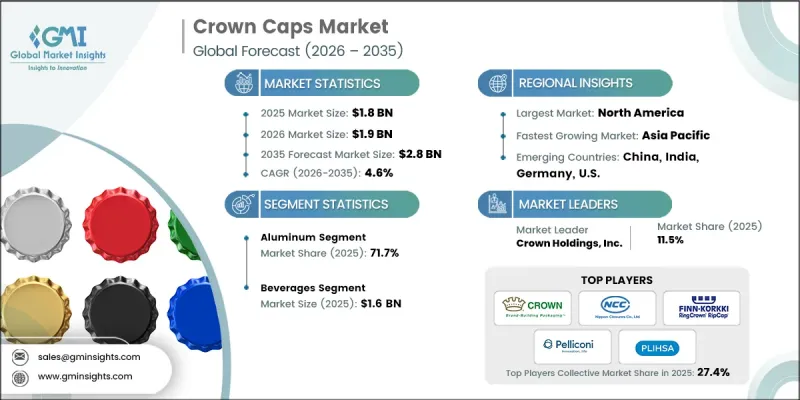
新兴地区碳酸饮料和瓶装饮料消费量的成长、环保包装中轻质铝盖的日益普及,以及精酿和特色饮料製造商对定製印刷瓶盖需求的增加,共同推动了市场扩张。此外,监管机构鼓励使用可回收和永续包装材料,也进一步促进了市场发展。饮料和食品製造商越来越多地采用创新瓶盖来提升品牌形象、实现产品差异化并增强商店吸引力。此外,数位印刷和压花技术的进步使品牌能够推出限量版和促销型皇冠瓶盖,从而增强消费者参与度,并推动已开发市场和新兴市场对这些瓶盖的接受度。
| 市场范围 | |
|---|---|
| 开始年份 | 2025 |
| 预测期 | 2026-2035 |
| 上市时的市场规模 | 18亿美元 |
| 预测金额 | 28亿美元 |
| 复合年增长率 | 4.6% |
亚太地区正经历强劲成长,这主要得益于印度、印尼和越南等国软性饮料消费量的成长。饮料产量的增加、政府对永续性的重视以及精酿啤酒和专门食品啤酒厂的兴起,都推动了市场需求。轻质铝盖技术的进步,加上消费者对高品质品牌饮料包装的偏好,进一步扩大了市场。季节性和促销产品线中数位印刷皇冠盖的日益普及,使饮料生产商能够更有效地与消费者互动。品牌利用独特瓶盖设计在竞争激烈的市场中脱颖而出的趋势预计将持续到2030年。
预计到2035年,马口铁盖市场将以3.7%的复合年增长率成长,主要得益于小规模手工生产商和小批量饮料製造商的青睐。他们之所以选择马口铁盖,是因为其耐用性以及与特殊内衬的兼容性。马口铁盖可实现高品质的压纹和印刷,使其成为限量版精酿饮料和促销包装的理想之选。其成本绩效和多功能性吸引了小众市场和注重成本的生产者。这些铁盖兼具美观性和功能性,推动了其在精酿、高端和手工饮料领域的应用日益广泛。
预计到2035年,食品业将以6%的复合年增长率成长。这一快速增长主要得益于即食包装食品(如酱料、调味品和罐头食品)需求的不断增长,而这些食品需要可靠、卫生且耐用的瓶盖。製造商越来越多地采用带有定制内衬、防篡改功能和环保材料的皇冠盖,以提升产品在商店上的吸引力,同时满足安全法规的要求。消费者对高端和手工食品日益增长的偏好也推动了食品包装领域对高品质皇冠盖的需求。
到2025年,北美皇冠盖市场将占全球市场的27%。该地区的成长主要得益于成熟的饮料行业,包括大规模软性饮料生产商和精酿啤酒厂,这些企业对可客製化的高品质皇冠盖的需求日益增长。此外,轻质可回收铝盖等永续发展措施正在影响生产趋势。灌装技术和自动化封盖系统的进步提高了营运效率,并支持了大规模生产,进一步巩固了市场地位。
目录
第一章:调查方法和范围
第二章执行摘要
第三章业界考察
- 生态系分析
- 供应商情况
- 利润率
- 成本结构
- 每个阶段增加的价值
- 影响价值链的因素
- 中断
- 影响产业的因素
- 促进因素
- 亚太地区对碳酸饮料的需求不断增长
- 对轻质铝合金牙冠盖的需求日益增长
- 需要定製瓶盖的精酿酒厂数量不断增长
- 饮料生产商正在逐步过渡到可回收的皇冠盖。
- 严格的包装和保鲜标准,以保持饮料的新鲜度
- 产业潜在风险与挑战
- 铝价波动会影响製造成本。
- 非洲和东南亚缺乏回收基础设施
- 市场机会
- 开发一种可生物降解且环境友善的冠状牙套。
- 带有QR码的智慧帽,方便追溯
- 促进因素
- 成长潜力分析
- 监理情势
- 北美洲
- 欧洲
- 亚太地区
- 拉丁美洲
- 中东和非洲
- 波特五力分析
- PESTEL 分析
- 科技与创新趋势
- 当前技术趋势
- 新兴技术
- 价格趋势
- 按地区
- 副产品
- 定价策略
- 新兴经营模式
- 合规要求
- 专利和智慧财产权分析
第四章 竞争情势
- 介绍
- 企业市占率分析
- 按地区
- 北美洲
- 欧洲
- 亚太地区
- 拉丁美洲
- 中东和非洲
- 市场集中度分析
- 按地区
- 主要企业的竞争标竿分析
- 财务绩效比较
- 销售量
- 利润率
- 研究与开发
- 产品系列比较
- 产品线宽度
- 科技
- 创新
- 区域扩张比较
- 全球扩张分析
- 服务网路覆盖
- 按地区分類的市场渗透率
- 竞争定位矩阵
- 领导者
- 挑战者
- 追踪者
- 小众玩家
- 战略展望矩阵
- 财务绩效比较
- 主要进展
- 併购
- 伙伴关係与合作
- 技术进步
- 扩张和投资策略
- 数位转型计划
- 新兴竞争对手和Start-Ups竞争对手的发展趋势
第五章 市场估计与预测:依材料划分,2022-2035年
- 锡
- 铝
第六章 市场估计与预测:依应用领域划分,2022-2035年
- 饮料
- 酒精饮料
- 不含酒精的饮料
- 食物
第七章 市场估计与预测:依地区划分,2022-2035年
- 北美洲
- 我们
- 加拿大
- 欧洲
- 德国
- 英国
- 法国
- 西班牙
- 义大利
- 荷兰
- 亚太地区
- 中国
- 印度
- 日本
- 澳洲
- 韩国
- 拉丁美洲
- 巴西
- 墨西哥
- 阿根廷
- 中东和非洲
- 南非
- 沙乌地阿拉伯
- 阿拉伯聯合大公国
第八章:公司简介
- 主要企业
- Crown Holdings, Inc.
- Pelliconi &C. SpA
- Finn-Korkki Oy
- Nippon Closures Co., Ltd.
- PLIHSA
- 按地区分類的主要企业
- 北美洲
- Crown Seal Public Company Limited
- MyBrewery
- Krome Brewing
- 亚太地区
- Ajanta Bottle
- Amigo Sampoorna Panacea Private Limited
- Brewnation
- Brijrani Enterprises
- 欧洲
- Brouwland bv
- Arishtam
- Insignia Limited
- 北美洲
- 特殊玩家/干扰者
- Ferropack Industries
- Rupali Departmental Stores
- Shree Balaji Closures
- The Malt Miller
The Global Crown Caps Market was valued at USD 1.8 billion in 2025 and is estimated to grow at a CAGR of 4.6% to reach USD 2.8 billion in 2035.
The market expansion is driven by rising consumption of carbonated and bottled beverages in emerging regions, increasing adoption of lightweight aluminum caps for environmentally friendly packaging, and growing demand for custom-printed closures from craft and specialty beverage producers. Regulatory pressures promoting recyclable and sustainable packaging materials further support market development. Beverage and food manufacturers are increasingly integrating innovative closures to enhance branding, differentiate products, and improve shelf appeal. Additionally, technological advancements in digital printing and embossing have enabled brands to offer limited-edition or promotional crown caps, strengthening consumer engagement and boosting adoption across both developed and emerging markets.
| Market Scope | |
|---|---|
| Start Year | 2025 |
| Forecast Year | 2026-2035 |
| Start Value | $1.8 Billion |
| Forecast Value | $2.8 Billion |
| CAGR | 4.6% |
The Asia Pacific region is witnessing strong growth due to rising soft drink consumption in countries such as India, Indonesia, and Vietnam. Increased beverage production, sustainability-focused government initiatives, and the proliferation of craft and specialty breweries have driven demand. Technological improvements in lightweight aluminum caps, along with consumer preferences for high-quality and branded beverage packaging, have further fueled market expansion. Digitally printed crown caps are increasingly employed to create seasonal and promotional editions, allowing beverage companies to engage with consumers more effectively. This trend is expected to continue until 2030 as brands leverage unique closure designs to differentiate themselves in competitive markets.
The tinplate segment is forecasted to grow at a CAGR of 3.7% through 2035, supported by artisanal and small-batch beverage producers who prefer tinplate closures for their durability and compatibility with specialty liners. Tinplate caps enable high-quality embossing and printing, making them ideal for limited-edition craft beverages and promotional packaging. Their cost-effectiveness and versatility make them appealing to both niche and budget-conscious producers. These closures combine aesthetic appeal with functional durability, promoting wider adoption in craft, premium, and artisanal beverage segments.
The food segment is projected to grow at a CAGR of 6% through 2035. The surge is driven by the growing demand for ready-to-eat and packaged foods, including sauces, condiments, and canned goods, which require reliable, hygienic, and durable closures. Manufacturers are increasingly turning to crown caps with custom liners, tamper-evident features, and eco-friendly materials to meet safety regulations while enhancing shelf presence. Rising consumer preference for premium and artisanal foods also encourages widespread adoption of high-quality crown caps in food packaging applications.
North America Crown Caps Market accounted for 27% in 2025. Growth in this region is fueled by a mature beverage industry, encompassing large-scale soft drink manufacturers and craft breweries that increasingly demand customizable and premium-quality crown caps. Sustainability initiatives, such as using lightweight and recyclable aluminum closures, are shaping production trends. Additionally, advancements in bottling technology and automated closure systems enhance operational efficiency and support high-volume beverage production, strengthening the market further.
Key companies operating in the Global Crown Caps Market include Crown Holdings, Inc., Ajanta Bottle, Amigo Sampoorna Panacea Private Limited, Brijrani Enterprises, Brewnation, Brouwland bv, Crown Seal Public Company Limited, Ferropack Industries, Finn-Korkki Oy, Insignia Limited, Krome Brewing, MyBrewery, Nippon Closures Co., Ltd., Pelliconi & C. SpA, PLIHSA, Rupali Departmental Stores, Shree Balaji Closures, and The Malt Miller. Companies in the Global Crown Caps Market are implementing strategies to strengthen their foothold and competitive positioning. Major approaches include investing in research and development to improve material innovation, such as lightweight aluminum and eco-friendly coatings, and developing advanced printing and embossing capabilities for limited-edition or promotional packaging. Firms are expanding production capacities and distribution networks to serve emerging markets with rising beverage demand. Strategic partnerships with breweries, beverage manufacturers, and packaging integrators enable collaborative product design and customization. Companies are also focusing on sustainability initiatives, such as recyclable and tamper-evident closures, to align with regulatory trends and consumer expectations.
Table of Contents
Chapter 1 Methodology and Scope
- 1.1 Market scope and definition
- 1.2 Research design
- 1.2.1 Research approach
- 1.2.2 Data collection methods
- 1.3 Data mining sources
- 1.3.1 Global
- 1.3.2 Regional/Country
- 1.4 Base estimates and calculations
- 1.4.1 Base year calculation
- 1.4.2 Key trends for market estimation
- 1.5 Primary research and validation
- 1.5.1 Primary sources
- 1.6 Forecast model
- 1.7 Research assumptions and limitations
Chapter 2 Executive Summary
- 2.1 Industry 360° synopsis, 2022 - 2035
- 2.2 Key market trends
- 2.2.1 Material trends
- 2.2.2 Application trends
- 2.2.3 Regional trends
- 2.3 TAM Analysis, 2026-2035
- 2.4 CXO perspectives: Strategic imperatives
Chapter 3 Industry Insights
- 3.1 Industry ecosystem analysis
- 3.1.1 Supplier Landscape
- 3.1.2 Profit Margin
- 3.1.3 Cost structure
- 3.1.4 Value addition at each stage
- 3.1.5 Factor affecting the value chain
- 3.1.6 Disruptions
- 3.2 Industry impact forces
- 3.2.1 Growth drivers
- 3.2.1.1 Increasing carbonated soft drinks demand in Asia Pacific
- 3.2.1.2 Higher demand for lightweight aluminum crown caps
- 3.2.1.3 Growth of craft breweries requiring custom caps
- 3.2.1.4 Beverage producers shifting to recyclable crown caps
- 3.2.1.5 Stringent packaging preservation standards for beverage freshness
- 3.2.2 Industry pitfalls and challenges
- 3.2.2.1 Aluminum price volatility affecting manufacturing costs
- 3.2.2.2 Limited recycling infrastructure in Africa, Southeast Asia
- 3.2.3 Market opportunities
- 3.2.3.1 Biodegradable, eco-friendly crown cap development
- 3.2.3.2 Smart caps with QR codes for traceability
- 3.2.1 Growth drivers
- 3.3 Growth potential analysis
- 3.4 Regulatory landscape
- 3.4.1 North America
- 3.4.2 Europe
- 3.4.3 Asia Pacific
- 3.4.4 Latin America
- 3.4.5 Middle East & Africa
- 3.5 Porter's analysis
- 3.6 PESTEL analysis
- 3.7 Technology and Innovation landscape
- 3.7.1 Current technological trends
- 3.7.2 Emerging technologies
- 3.8 Price trends
- 3.8.1 By region
- 3.8.2 By product
- 3.9 Pricing Strategies
- 3.10 Emerging Business Models
- 3.11 Compliance Requirements
- 3.12 Patent and IP analysis
Chapter 4 Competitive Landscape, 2025
- 4.1 Introduction
- 4.2 Company market share analysis
- 4.2.1 By region
- 4.2.1.1 North America
- 4.2.1.2 Europe
- 4.2.1.3 Asia Pacific
- 4.2.1.4 Latin America
- 4.2.1.5 Middle East & Africa
- 4.2.2 Market concentration analysis
- 4.2.1 By region
- 4.3 Competitive benchmarking of key players
- 4.3.1 Financial performance comparison
- 4.3.1.1 Revenue
- 4.3.1.2 Profit margin
- 4.3.1.3 R&D
- 4.3.2 Product portfolio comparison
- 4.3.2.1 Product range breadth
- 4.3.2.2 Technology
- 4.3.2.3 Innovation
- 4.3.3 Geographic presence comparison
- 4.3.3.1 Global footprint analysis
- 4.3.3.2 Service network coverage
- 4.3.3.3 Market penetration by region
- 4.3.4 Competitive positioning matrix
- 4.3.4.1 Leaders
- 4.3.4.2 Challengers
- 4.3.4.3 Followers
- 4.3.4.4 Niche players
- 4.3.5 Strategic outlook matrix
- 4.3.1 Financial performance comparison
- 4.4 Key developments
- 4.4.1 Mergers and acquisitions
- 4.4.2 Partnerships and collaborations
- 4.4.3 Technological advancements
- 4.4.4 Expansion and investment strategies
- 4.4.5 Digital transformation initiatives
- 4.5 Emerging/ startup competitors landscape
Chapter 5 Market Estimates and Forecast, By Material, 2022 - 2035 (USD Million)
- 5.1 Key trends
- 5.2 Tinplate
- 5.3 Aluminum
Chapter 6 Market Estimates and Forecast, By Application, 2022 - 2035 (USD Million)
- 6.1 Key trends
- 6.2 Beverages
- 6.2.1 Alcoholic Beverages
- 6.2.2 Non-Alcoholic Beverages
- 6.3 Food
Chapter 7 Market Estimates and Forecast, By Region, 2022 - 2035 (USD Million)
- 7.1 Key trends
- 7.2 North America
- 7.2.1 U.S.
- 7.2.2 Canada
- 7.3 Europe
- 7.3.1 Germany
- 7.3.2 UK
- 7.3.3 France
- 7.3.4 Spain
- 7.3.5 Italy
- 7.3.6 Netherlands
- 7.4 Asia Pacific
- 7.4.1 China
- 7.4.2 India
- 7.4.3 Japan
- 7.4.4 Australia
- 7.4.5 South Korea
- 7.5 Latin America
- 7.5.1 Brazil
- 7.5.2 Mexico
- 7.5.3 Argentina
- 7.6 Middle East and Africa
- 7.6.1 South Africa
- 7.6.2 Saudi Arabia
- 7.6.3 UAE
Chapter 8 Company Profiles
- 8.1 Global Key Players
- 8.1.1 Crown Holdings, Inc.
- 8.1.2 Pelliconi & C. SpA
- 8.1.3 Finn-Korkki Oy
- 8.1.4 Nippon Closures Co., Ltd.
- 8.1.5 PLIHSA
- 8.2 Regional key players
- 8.2.1 North America
- 8.2.1.1 Crown Seal Public Company Limited
- 8.2.1.2 MyBrewery
- 8.2.1.3 Krome Brewing
- 8.2.2 Asia Pacific
- 8.2.2.1 Ajanta Bottle
- 8.2.2.2 Amigo Sampoorna Panacea Private Limited
- 8.2.2.3 Brewnation
- 8.2.2.4 Brijrani Enterprises
- 8.2.3 Europe
- 8.2.3.1 Brouwland bv
- 8.2.3.2 Arishtam
- 8.2.3.3 Insignia Limited
- 8.2.1 North America
- 8.3 Niche Players/Disruptors
- 8.3.1 Ferropack Industries
- 8.3.2 Rupali Departmental Stores
- 8.3.3 Shree Balaji Closures
- 8.3.4 The Malt Miller

 瓶盖市场规模、份额、成长和行业分析:按材料(铝、钢、其他)、应用(啤酒、碳酸饮料、其他)和地区划分(至 2034 年)
 瓶盖及封盖市场分析及预测(至2035年):依类型、产品类型、材质、应用、技术、最终用户、功能、製程及安装类型划分
 繫绳帽市场规模、份额、成长及全球产业分析:按类型、应用和地区分類的洞察,2026-2034 年预测儿童安全锁扣全球市场规模、份额、趋势和成长分析报告(2026-2034年)全球消毒剂瓶盖市场规模、份额、趋势和成长分析报告(2026-2034年)
 盖子与封口装置市场规模、份额和趋势分析报告:按材料、产品、应用、地区和细分市场预测,2026-2033年
 2026年全球瓶盖及封口件市场报告2026年全球聚丙烯双盖分配盖市场报告
 中国白酒瓶盖市场依材质、封盖类型、封盖机制、最终用途及通路划分-2026-2032年全球预测按材质、封口类型、应用程式、最终用户和分销管道分類的全球按扣式封口市场预测(2026-2032年)