


 |
市场调查报告书
商品编码
1998807
电动汽车电池回收市场机会、成长要素、产业趋势分析及2026-2035年预测EV Battery Reuse Market Opportunity, Growth Drivers, Industry Trend Analysis, and Forecast 2026 - 2035 |
||||||

全球电动车电池回收市场预计到 2025 年价值 7.599 亿美元,预计到 2035 年将达到 329 亿美元,年复合成长率为 45.8%。
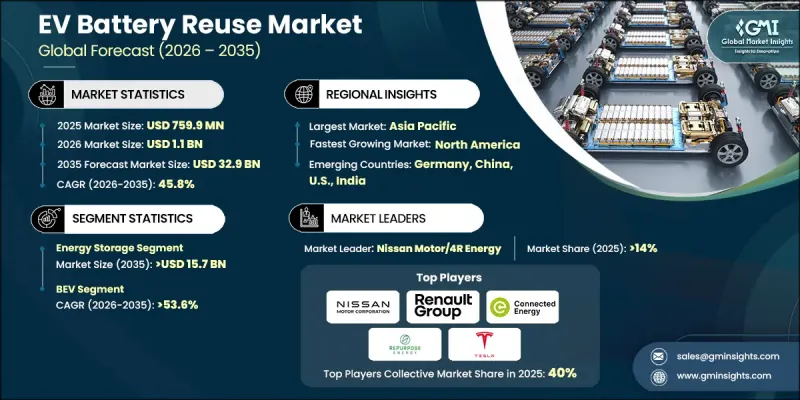
电动车的快速普及以及对电池生命週期进行永续且经济可行的管理的需求日益增长,是推动市场成长的主要因素。随着全球电动车普及率的持续加速,大量电池即将完成其在车辆中的初始使用寿命,这为电池的二次利用创造了机会。促进循环经济实践的政策、电池再生技术成本的下降以及对储能解决方案日益增长的需求,也正在塑造市场格局。回收利用的电动车电池正越来越多地应用于支援可再生能源併网和电力管理应用的能源储存系统中。汽车製造商和储能公司正大力投资电池二次利用项目,因为这些措施既能延长电池的价值,又能减少对环境的影响。此外,人工智慧驱动的诊断和预测分析技术的进步正在改进电池健康评估,并实现更有效率的分类、再生和再利用流程。世界各地的公司也在建立专门的业务部门,致力于将废弃电动车电池用于二次用途,这进一步加速了该行业的扩张。
| 市场范围 | |
|---|---|
| 开始年份 | 2025 |
| 预测期 | 2026-2035 |
| 上市时的市场规模 | 7.599亿美元 |
| 预测金额 | 329亿美元 |
| 复合年增长率 | 45.8% |
预计到2035年,电动车充电应用领域将以60.5%的复合年增长率成长。充电基础设施中翻新电池的日益普及,推动了对快速充电网路的支援需求,从而缓解了电网的尖峰负载压力。这些储能係统使充电营运商能够更有效地管理能源需求,提高能源分配效率,并降低高功率充电基础设施的营运成本。随着电动车充电生态系统的快速扩张,二手电池储能係统在维持电网稳定和提升充电网路整体性能方面发挥日益重要的作用。
预计到2025年,混合动力汽车(HEV)和插电式混合动力汽车(PHEV)将占据52.6%的市场份额。然而,由于这些车辆的电池充放电循环次数通常较低,因此与纯电动车相比,它们对电动车电池回收市场的贡献相对较小。混合动力汽车电池设计的改进和车辆使用寿命的延长正在减少进入回收市场的电池数量。因此,儘管HEV和PHEV仍然保持着相当大的市场份额,但该细分市场中可回收电池的数量仍然相对有限。
预计到2025年,美国电动车电池再利用市场规模将达7,510万美元。电动车的日益普及、雄心勃勃的永续性目标以及对经济高效的储能解决方案日益增长的需求,正在推动美国市场的发展。政府鼓励循环经济实践的政策,包括废弃物管理和永续性框架的法规,正在促使汽车製造商和能源公司投资电池再利用倡议。这些政策有助于在向清洁能源转型的大背景下,为电池二次利用应用建立一个有利的生态系统。
目录
第一章:调查方法和范围
第二章执行摘要
第三章业界考察
- 生态系分析
- 监理情势
- 影响产业的因素
- 促进因素
- 产业潜在风险与挑战
- 成长潜力分析
- 波特五力分析
- PESTEL 分析
- 价格趋势分析,2022-2035年
- 新机会和趋势
- 投资分析及未来展望
第四章 竞争情势
- 介绍
- 企业市占率分析
- 主要进展
- 併购
- 伙伴关係与合作
- 新产品发布
- 业务拓展计划及资金筹措
- 竞争性标竿分析
- 创新与永续发展趋势
第五章 市场规模及预测:依应用领域划分,2022-2035年
- 储能
- 电动车充电
- 基地台
- 低速车辆
第六章 市场规模与预测:依来源划分,2022-2035年
- BEV
- 油电混合车和插电式油电混合车
第七章 市场规模及预测:依地区划分,2022-2035年
- 北美洲
- 我们
- 加拿大
- 欧洲
- 英国
- 德国
- 义大利
- 西班牙
- 俄罗斯
- 法国
- 亚太地区
- 中国
- 日本
- 韩国
- 印度
- 澳洲
- 世界其他地区
第八章:公司简介
- 4R Energy Corporation
- B2U Storage
- BatteryLoop
- BeePlanet Factory
- Cactos
- Connected Energy
- EcarACCU
- Element Energy
- Enel X
- Evyon
- Higher Wire
- Moment Energy
- Nissan Motor
- OCTAVE
- RePurpose Energy
- Renault Group
- RWE+Audi
- Second Life EV Batteries
- Spiers New Technologies
- Stena Metall
- Tesla
The Global EV Battery Reuse Market was valued at USD 759.9 million in 2025 and is estimated to grow at a CAGR of 45.8% to reach USD 32.9 billion by 2035.
The market growth is supported by the rapid adoption of electric vehicles and the increasing need to manage battery lifecycles in a sustainable and economically viable manner. As EV deployment continues to accelerate worldwide, a significant number of batteries are reaching the end of their initial automotive usage phase, creating opportunities for second-life applications. Policies promoting circular economy practices, falling costs associated with battery refurbishment technologies, and the expanding demand for energy storage solutions are also shaping the market landscape. Reused EV batteries are increasingly deployed in energy storage systems that support renewable energy integration and power management applications. Automotive manufacturers and energy storage companies are heavily investing in second-life battery programs because these initiatives extend battery value while reducing environmental impact. Additionally, advancements in artificial intelligence-driven diagnostics and predictive analytics are improving the evaluation of battery health, enabling more efficient sorting, refurbishment, and repurposing processes. Companies across various regions are also establishing specialized business units focused on repurposing used EV batteries for secondary applications, which is further accelerating industry expansion.
| Market Scope | |
|---|---|
| Start Year | 2025 |
| Forecast Year | 2026-2035 |
| Start Value | $759.9 Million |
| Forecast Value | $32.9 Billion |
| CAGR | 45.8% |
The EV charging application segment is expected to grow at a CAGR of 60.5% through 2035. Reused batteries are increasingly integrated into charging infrastructure to support fast-charging networks by reducing peak load pressure on electricity grids. These storage systems allow charging operators to balance energy demand more effectively, enhance energy distribution efficiency, and lower operational costs associated with high-power charging infrastructure. As the EV charging ecosystem expands rapidly, the role of second-life battery storage systems is becoming increasingly important for maintaining grid stability while improving overall charging network performance.
The hybrid electric vehicles (HEVs) and plug-in hybrid electric vehicles (PHEVs) accounted for 52.6% share in 2025. However, these vehicles contribute relatively less to the EV battery reuse market compared to fully electric vehicles because their batteries generally experience less intensive charge and discharge cycles. Improvements in hybrid battery design and extended vehicle lifespan have reduced the number of batteries entering the reuse stream from these vehicle types. As a result, while HEVs and PHEVs maintain a notable share of the market landscape, the volume of reusable batteries from this segment remains comparatively limited.
U.S. EV Battery Reuse Market was valued at USD 75.1 million in 2025. Increasing adoption of electric vehicles, ambitious sustainability targets, and the rising need for cost-effective energy storage solutions are driving strong market momentum across the country. Government measures encouraging circular economy practices, including regulations related to waste management and sustainability frameworks, are motivating automotive manufacturers and energy companies to invest in battery repurposing initiatives. These policies are helping create a supportive ecosystem for second-life battery applications within the broader clean energy transition.
Major players operating in the Global EV Battery Reuse Market include Nissan Motor, Renault Group, Tesla, 4R Energy Corporation, Spiers New Technologies, B2U Storage, Connected Energy, Enel X, Moment Energy, BeePlanet Factory, BatteryLoop, RWE + Audi, Evyon, Element Energy, RePurpose Energy, Cactos, EcarACCU, OCTAVE, Higher Wire, Second Life EV Batteries, and Stena Metall. Companies operating in the EV Battery Reuse Market are focusing on multiple strategies to strengthen their market presence and expand their competitive position. Industry participants are investing in advanced battery diagnostics technologies, artificial intelligence-driven health assessment tools, and automated refurbishment systems to improve efficiency and scalability. Strategic partnerships between automakers, energy storage providers, and technology companies are becoming increasingly common to accelerate the development of second-life battery ecosystems. Firms are also expanding into energy storage markets by integrating reused batteries into renewable energy systems and charging infrastructure projects. Additionally, companies are establishing dedicated subsidiaries and pilot projects to refine repurposing processes and improve battery lifecycle management.
Table of Contents
Chapter 1 Methodology & Scope
- 1.1 Research design
- 1.1.1 Research approach
- 1.1.2 Data collection methods
- 1.2 Base estimates and calculations
- 1.2.1 Base year calculation
- 1.2.2 Market estimates & forecast parameters
- 1.3 Forecast
- 1.3.1 Key trends for market estimates
- 1.3.2 Quantified market impact analysis
- 1.3.2.1 Mathematical impact of growth parameters on forecast
- 1.3.3 Scenario analysis framework
- 1.4 Primary research and validation
- 1.4.1 Some of the primary sources (but not limited to)
- 1.5 Data mining sources
- 1.5.1 Paid Sources
- 1.5.2 Sources, by region
- 1.6 Research trail & scoring components
- 1.6.1 Research trail components
- 1.6.2 Scoring components
- 1.7 Research transparency addendum
- 1.7.1 Source attribution framework
- 1.7.2 Quality assurance metrics
- 1.7.3 Our commitment to trust
- 1.8 Market definitions
Chapter 2 Executive Summary
- 2.1 Industry synopsis, 2022 - 2035
- 2.2 Business trends
- 2.3 Application trends
- 2.4 Source trends
- 2.5 Regional trends
Chapter 3 Industry Insights
- 3.1 Industry ecosystem analysis
- 3.2 Regulatory landscape
- 3.3 Industry impact forces
- 3.3.1 Growth drivers
- 3.3.2 Industry pitfalls & challenges
- 3.4 Growth potential analysis
- 3.5 Porter's analysis
- 3.5.1 Bargaining power of suppliers
- 3.5.2 Bargaining power of buyers
- 3.5.3 Threat of new entrants
- 3.5.4 Threat of substitutes
- 3.6 PESTEL analysis
- 3.6.1 Political factors
- 3.6.2 Economic factors
- 3.6.3 Social factors
- 3.6.4 Technological factors
- 3.6.5 Legal factors
- 3.6.6 Environmental factors
- 3.7 Price trend analysis, 2022-2035
- 3.8 Emerging opportunities & trends
- 3.9 Investment analysis & future prospects
Chapter 4 Competitive landscape, 2025
- 4.1 Introduction
- 4.2 Company market share analysis, 2025
- 4.3 Key developments
- 4.3.1 Mergers & acquisitions
- 4.3.2 Partnerships & collaborations
- 4.3.3 New product launches
- 4.3.4 Expansion plans and funding
- 4.4 Competitive benchmarking
- 4.5 Innovation & sustainability landscape
Chapter 5 Market Size and Forecast, By Application, 2022 - 2035 (MWh & USD Million)
- 5.1 Key trends
- 5.2 Energy storage
- 5.3 EV charging
- 5.4 Base stations
- 5.5 Low speed vehicles
Chapter 6 Market Size and Forecast, By Source, 2022 - 2035 (MWh & USD Million)
- 6.1 Key trends
- 6.2 BEV
- 6.3 HEV & PHEV
Chapter 7 Market Size and Forecast, By Region, 2022 - 2035 (MWh & USD Million)
- 7.1 Key trends
- 7.2 North America
- 7.2.1 U.S.
- 7.2.2 Canada
- 7.3 Europe
- 7.3.1 UK
- 7.3.2 Germany
- 7.3.3 Italy
- 7.3.4 Spain
- 7.3.5 Russia
- 7.3.6 France
- 7.4 Asia Pacific
- 7.4.1 China
- 7.4.2 Japan
- 7.4.3 South Korea
- 7.4.4 India
- 7.4.5 Australia
- 7.5 Rest of the world
Chapter 8 Company Profiles
- 8.1 4R Energy Corporation
- 8.2 B2U Storage
- 8.3 BatteryLoop
- 8.4 BeePlanet Factory
- 8.5 Cactos
- 8.6 Connected Energy
- 8.7 EcarACCU
- 8.8 Element Energy
- 8.9 Enel X
- 8.10 Evyon
- 8.11 Higher Wire
- 8.12 Moment Energy
- 8.13 Nissan Motor
- 8.14 OCTAVE
- 8.15 RePurpose Energy
- 8.16 Renault Group
- 8.17 RWE + Audi
- 8.18 Second Life EV Batteries
- 8.19 Spiers New Technologies
- 8.20 Stena Metall
- 8.21 Tesla

 电动车电池回收市场规模、份额和趋势:按类型、车辆类型、应用和地区划分,预测至2026-2034年
 电动车电池回收市场:依化学成分、製程、应用、最终用户、国家及地区划分-全球产业分析、市场规模、市场份额及2025年至2032年预测
 2026-2030年全球电动车电池回收市场
 电动汽车电池回收市场规模、份额和成长分析(按供应来源、电池化学成分、车辆类型、应用、回收策略、产能范围和地区划分)—产业预测(2026-2033 年)
 按应用和地区分類的电动车电池回收市场
 全球电动汽车电池回收市场:预测至2032年-依化学成分、电池来源、回收流程、回收阶段、最终用户及地区进行分析
 电动车电池回收市场成长、规模和趋势分析(按类型、车辆类型和供应来源划分)—区域展望、竞争策略和细分市场预测(至 2034 年)
 电动汽车电池再利用的全球市场
 电动汽车电池回收市场规模、份额、成长分析,按来源、按电池化学、按回收工艺、按地区 - 行业预测,2025-2032 年