


 |
市场调查报告书
商品编码
1998814
混合微电网市场机会、成长要素、产业趋势分析及2026-2035年预测Hybrid Microgrid Market Opportunity, Growth Drivers, Industry Trend Analysis, and Forecast 2026 - 2035 |
||||||

全球混合微电网市场预计到 2025 年将价值 40 亿美元,预计到 2035 年将以 18.8% 的复合年增长率增长至 242 亿美元。
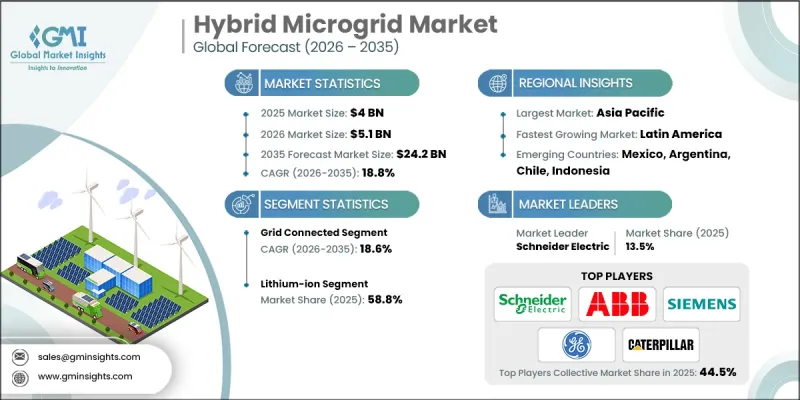
混合微电网整合了再生能源来源、储能和高效备用电源,能够优化商业、工业和偏远地区设施的电力使用,最大限度地降低燃料消耗,并减少长期能源成本。极端天气、自然灾害和频繁的停电加剧了关键基础设施和离网地区对可靠且具弹性的电力解决方案的需求。政府的奖励、补贴和可再生能源计画正在加速混合微电网的普及应用,而数位化、智慧电网技术、预测分析和先进控制系统则提高了运作效率。此外,持续的研发投入以及偏远地区对能源独立日益增长的需求,正在拓展混合微电网的部署机会,使其成为全球永续能源管理的重要策略解决方案。
| 市场范围 | |
|---|---|
| 开始年份 | 2025 |
| 预测期 | 2026-2035 |
| 上市时的市场规模 | 40亿美元 |
| 预测金额 | 242亿美元 |
| 复合年增长率 | 18.8% |
併网系统市占率占比高达71.8%,预计2035年将以18.6%的复合年增长率成长。与智慧电网技术、电网边缘解决方案和先进数位控制技术的集成,使得更复杂的部署成为可能。这些系统在易受停电、极端天气和自然灾害影响的地区尤其重要,能够为关键设施提供可靠的备用电源和持续供电。
预计到2035年,液流电池市场将以20.3%的复合年增长率成长,这主要得益于其模组化设计、扩充性以及从数小时到数天的储能容量。这些电池能够平滑电力波动,从而支持可再生能源的併网;其高能量效率和长循环寿命使其能够频繁充放电,且性能衰减极小。
预计到2025年,北美混合微电网市占率将达到81.6%,到2035年市场规模将达到13亿美元。推动这一市场成长的因素包括:美国向清洁能源转型、应对气候变迁的努力、可再生能源成本的下降以及对具有韧性和永续的电力解决方案日益增长的需求。专注于利用可再生能源、确保可靠性和降低营运成本的混合解决方案提供者正在推动市场成长。这一趋势反映了人们对能源独立、永续性和先进能源管理技术的需求。
目录
第一章:调查方法和范围
第二章执行摘要
第三章业界考察
- 产业生态系统
- 原物料供应及采购分析
- 生产能力评估
- 供应链韧性与风险因素
- 配电网路分析
- 监理情势
- 影响产业的因素
- 促进因素
- 产业潜在风险与挑战
- 成长潜力分析
- 波特五力分析
- PESTEL 分析
- 成本结构分析
- 价格趋势分析(美元/兆瓦)
- 连结性别
- 按地区
- 新机会和趋势
- 数位化和物联网集成
- 进入新兴市场
- 投资分析及未来展望
第四章 竞争情势
- 介绍
- 企业市占率分析:按地区划分
- 竞争性标竿分析
- 主要进展
- 併购
- 伙伴关係与合作
- 新产品发布
- 业务拓展计划及资金筹措
第五章 市场规模及预测:依连结类型划分,2022-2035年
- 并网型
- 离网
第六章 市场规模及预测:依电源类型划分,2022-2035年
- 柴油发电机
- 天然气
- 太阳能
- CHP
- 其他的
第七章 市场规模及预测:依储能设备划分,2022-2035年
- 锂离子
- 铅酸电池
- 液流电池
- 飞轮
- 其他的
第八章 市场规模及预测:依应用领域划分,2022-2035年
- 卫生保健
- 教育机构
- 军队
- 公共产业
- 工商
- 偏僻的
- 其他的
第九章 市场规模及预测:依地区划分,2022-2035年
- 北美洲
- 我们
- 加拿大
- 墨西哥
- 欧洲
- 德国
- 法国
- 英国
- 俄罗斯
- 西班牙
- 义大利
- 丹麦
- 亚太地区
- 中国
- 日本
- 韩国
- 印度
- 澳洲
- 马来西亚
- 印尼
- 中东和非洲
- 沙乌地阿拉伯
- 阿拉伯聯合大公国
- 南非
- 伊朗
- 奈及利亚
- 拉丁美洲
- 巴西
- 阿根廷
- 智利
第十章:公司简介
- ABB
- Ameresco
- BoxPower Inc
- Caterpillar Inc.
- Clarke Energy
- EnSync Energy Systems
- Elum
- FlexGen Power Systems
- General Electric Company
- Gridscape
- HOMER Energy
- Jakson
- MTU Solution
- Piller Power Systems
- S&C Electric Company
- Saft
- Schneider Electric
- Siemens
- Tesla Energy
- Yanmar Holdings Co., Ltd
The Global Hybrid Microgrid Market was valued at USD 4 billion in 2025 and is estimated to grow at a CAGR of 18.8% to reach USD 24.2 billion by 2035.
Hybrid microgrids, which integrate renewable energy sources, storage, and efficient backup generation, enable commercial, industrial, and remote facilities to optimize power usage, minimize fuel consumption, and reduce long-term energy costs. Rising frequency of extreme weather events, natural disasters, and grid outages has heightened the need for dependable, resilient power solutions for critical infrastructure and off-grid locations. Government incentives, subsidies, and renewable energy programs are accelerating adoption, while digitalization, smart grid technologies, predictive analytics, and advanced control systems enhance operational efficiency. Additionally, ongoing R&D efforts and the growing demand for energy autonomy in remote regions are expanding deployment opportunities, making hybrid microgrids a strategic solution for sustainable energy management worldwide.
| Market Scope | |
|---|---|
| Start Year | 2025 |
| Forecast Year | 2026-2035 |
| Start Value | $4 Billion |
| Forecast Value | $24.2 Billion |
| CAGR | 18.8% |
The grid-connected systems segment held 71.8% share and is expected to grow at a CAGR of 18.6% through 2035. Integration with smart grid technologies, grid-edge solutions, and advanced digital controls is enabling more sophisticated deployments. These systems are especially valuable in regions prone to outages, extreme weather, and natural disasters, providing reliable backup power and continuous electricity supply to essential facilities.
The flow battery segment is projected to grow at a CAGR of 20.3% by 2035, owing to its modular design, scalability, and ability to store energy for hours or even days. These batteries support renewable energy integration by leveling fluctuations, while their high energy efficiency and long cycle life allow frequent charge-discharge operations with minimal performance degradation.
North America Hybrid Microgrid Market held 81.6% share in 2025, generating USD 1.3 billion by 2035. The market is fueled by the country's transition to clean energy, climate change mitigation efforts, declining renewable energy costs, and rising demand for resilient, sustainable power solutions. Companies focusing on hybrid solutions to harness renewable energy, ensure reliability, and reduce operational costs are shaping the growth of the market. The trend reflects the need for energy autonomy, sustainability, and advanced energy management technologies.
Key players operating in the Global Hybrid Microgrid Market include ABB, Ameresco, BoxPower Inc., Caterpillar Inc., Clarke Energy, EnSync Energy Systems, Elum, FlexGen Power Systems, General Electric Company, Gridscape, HOMER Energy, Jakson, MTU Solution, Piller Power Systems, S&C Electric Company, Saft, Schneider Electric, Siemens, Tesla Energy, and Yanmar Holdings Co., Ltd. Companies in the Global Hybrid Microgrid Market are adopting multiple strategies to strengthen market presence and competitive positioning. Many are investing heavily in R&D to improve energy storage efficiency, system reliability, and integration with renewable energy sources. Strategic partnerships and joint ventures with industrial, commercial, and utility clients are expanding deployment opportunities and creating long-term contracts. Firms are also pursuing geographic expansion to enter emerging markets with high energy vulnerability, while developing modular and scalable solutions to cater to diverse customer needs.
Table of Contents
Chapter 1 Methodology & Scope
- 1.1 Research design
- 1.2 Quality commitment
- 1.2.1 GMI AI policy & data integrity commitment
- 1.2.1.1 Source consistency protocol
- 1.2.1 GMI AI policy & data integrity commitment
- 1.3 Research trail & confidence scoring
- 1.3.1 Research trail components
- 1.3.2 Scoring components
- 1.4 Data Collection
- 1.4.1 Partial list of primary sources
- 1.5 Data mining sources
- 1.5.1 Paid sources
- 1.5.1.1 Sources, by region
- 1.5.1 Paid sources
- 1.6 Base estimates and calculations
- 1.6.1 Base year calculation for any one approach
- 1.7 Forecast model
- 1.8 Research transparency addendum
- 1.8.1 Source attribution framework
- 1.8.2 Quality assurance metrics
- 1.8.3 Our commitment to trust
- 1.9 Market definitions
Chapter 2 Executive Summary
- 2.1 Industry synopsis, 2022 - 2035
- 2.2 Business trends
- 2.3 Connectivity trends
- 2.4 Power source trends
- 2.5 Storage device trends
- 2.6 Application trends
- 2.7 Regional trends
Chapter 3 Industry Insights
- 3.1 Industry ecosystem
- 3.1.1 Raw material availability & sourcing analysis
- 3.1.2 Manufacturing capacity assessment
- 3.1.3 Supply chain resilience & risk factors
- 3.1.4 Distribution network analysis
- 3.2 Regulatory landscape
- 3.3 Industry impact forces
- 3.3.1 Growth drivers
- 3.3.2 Industry pitfalls & challenges
- 3.4 Growth potential analysis
- 3.5 Porter's analysis
- 3.5.1 Bargaining power of suppliers
- 3.5.2 Bargaining power of buyers
- 3.5.3 Threat of new entrants
- 3.5.4 Threat of substitutes
- 3.6 PESTEL analysis
- 3.6.1 Political factors
- 3.6.2 Economic factors
- 3.6.3 Social factors
- 3.6.4 Technological factors
- 3.6.5 Legal factors
- 3.6.6 Environmental factors
- 3.7 Cost structure analysis
- 3.8 Price trend analysis (USD/MW)
- 3.8.1 By connectivity
- 3.8.2 By region
- 3.9 Emerging opportunities & trends
- 3.9.1 Digitalization & IoT integration
- 3.9.2 Emerging market penetration
- 3.10 Investment analysis and future outlook
Chapter 4 Competitive landscape, 2026
- 4.1 Introduction
- 4.2 Company market share analysis, by region, 2025
- 4.2.1 North America
- 4.2.2 Europe
- 4.2.3 Asia Pacific
- 4.2.4 Latin America
- 4.2.5 Middle East & Africa
- 4.3 Competitive benchmarking
- 4.4 Key developments
- 4.4.1 Mergers & acquisitions
- 4.4.2 Partnerships & collaborations
- 4.4.3 New product launches
- 4.4.4 Expansion plans and funding
Chapter 5 Market Size and Forecast, By Connectivity, 2022 - 2035 (USD Billion & MW)
- 5.1 Key trends
- 5.2 Grid connected
- 5.3 Off grid
Chapter 6 Market Size and Forecast, By Power Source, 2022 - 2035 (USD Billion & MW)
- 6.1 Key trends
- 6.2 Diesel generators
- 6.3 Natural gas
- 6.4 Solar PV
- 6.5 CHP
- 6.6 Others
Chapter 7 Market Size and Forecast, By Storage Device, 2022 - 2035 (USD Billion & MW)
- 7.1 Key trends
- 7.2 Lithium-ion
- 7.3 Lead acid
- 7.4 Flow battery
- 7.5 Flywheels
- 7.6 Others
Chapter 8 Market Size and Forecast, By Application, 2022 - 2035 (USD Billion & MW)
- 8.1 Key trends
- 8.2 Healthcare
- 8.3 Educational institutes
- 8.4 Military
- 8.5 Utility
- 8.6 Industrial/ commercial
- 8.7 Remote
- 8.8 Others
Chapter 9 Market Size and Forecast, By Region, 2022 - 2035 (USD Billion & MW)
- 9.1 Key trends
- 9.2 North America
- 9.2.1 U.S.
- 9.2.2 Canada
- 9.2.3 Mexico
- 9.3 Europe
- 9.3.1 Germany
- 9.3.2 France
- 9.3.3 UK
- 9.3.4 Russia
- 9.3.5 Spain
- 9.3.6 Italy
- 9.3.7 Denmark
- 9.4 Asia Pacific
- 9.4.1 China
- 9.4.2 Japan
- 9.4.3 South Korea
- 9.4.4 India
- 9.4.5 Australia
- 9.4.6 Malaysia
- 9.4.7 Indonesia
- 9.5 Middle East and Africa
- 9.5.1 Saudi Arabia
- 9.5.2 UAE
- 9.5.3 South Africa
- 9.5.4 Iran
- 9.5.5 Nigeria
- 9.6 Latin America
- 9.6.1 Brazil
- 9.6.2 Argentina
- 9.6.3 Chile
Chapter 10 Company Profiles
- 10.1 ABB
- 10.2 Ameresco
- 10.3 BoxPower Inc
- 10.4 Caterpillar Inc.
- 10.5 Clarke Energy
- 10.6 EnSync Energy Systems
- 10.7 Elum
- 10.8 FlexGen Power Systems
- 10.9 General Electric Company
- 10.10 Gridscape
- 10.11 HOMER Energy
- 10.12 Jakson
- 10.13 MTU Solution
- 10.14 Piller Power Systems
- 10.15 S&C Electric Company
- 10.16 Saft
- 10.17 Schneider Electric
- 10.18 Siemens
- 10.19 Tesla Energy
- 10.20 Yanmar Holdings Co., Ltd

 2026年全球并联型安装市场报告2026年全球微电网控制器软体市场报告
 微电网市场(至 2035 年):依组件、电源、容量范围、连接方式、技术、终端用户产业和地区划分:产业趋势和全球预测
 2026-2030年全球微电网市场
 即插即用型太阳能发电机市场:依容量范围、电池类型、应用、最终用户和分销管道划分,全球预测(2026-2032年)微电网软体市场:按软体类型、部署模式、最终用户和应用划分,全球预测(2026-2032年)
 2026-2034年全球交流微电网市场规模、份额、趋势和成长分析报告全球微电网市场规模、份额、趋势和成长分析报告(2026-2034年)2026年全球微电网市场报告
 微电网市场机会、成长要素、产业趋势分析及2026年至2035年预测