


 |
市场调查报告书
商品编码
1998843
医疗吊坠市场机会、成长要素、产业趋势分析及2026-2035年预测。Medical Pendant Market Opportunity, Growth Drivers, Industry Trend Analysis, and Forecast 2026 - 2035 |
||||||

预计到 2025 年,全球医疗吊坠市场价值将达到 6.167 亿美元,年复合成长率为 5.8%,到 2035 年将达到 11 亿美元。
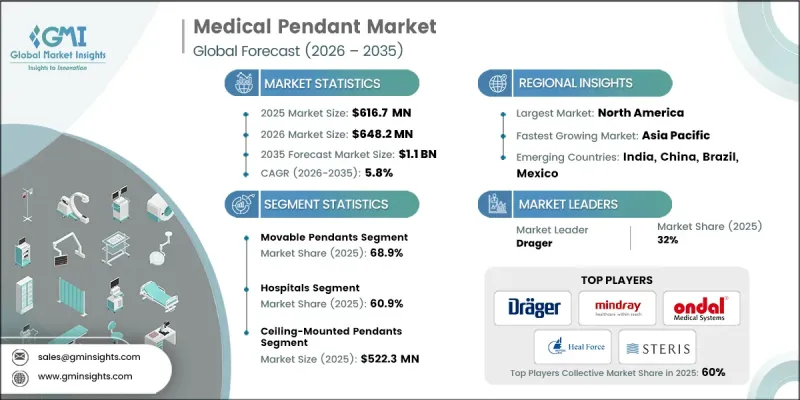
随着医疗机构致力于提升营运效率、保障病患安全并优化工作空间,医疗吊挂系统市场正稳定成长。医疗吊挂系统透过将设备悬挂于工作空间上方,在医院设备和设施的有序管理中发挥着至关重要的作用,从而减少地面杂乱,并提升医护人员和医疗设备的移动性。随着医院对手术室和加护病房进行现代化改造以支持先进医疗技术,对这类系统的需求也不断增长。医疗机构也优先考虑创建符合人体工学的临床环境,使医护人员能够在保持安全有序环境的同时快速存取关键系统。医疗基础设施投资的增加、手术数量的上升以及重症监护设施的扩建进一步推动了市场成长。智慧互联技术的集成,以及向可自订和模组化吊挂系统的转变,正在改变产品的功能。此外,人们对感染预防意识的提高以及对无菌环境的需求,正促使医疗机构采用先进的吊挂式公用设施管理系统,以支援高效的临床工作流程和空间优化。
| 市场范围 | |
|---|---|
| 开始年份 | 2025 |
| 预测期 | 2026-2035 |
| 上市时的市场规模 | 6.167亿美元 |
| 预测金额 | 11亿美元 |
| 复合年增长率 | 5.8% |
医疗吊塔是一种广泛应用于医疗机构的吊挂式系统,用于以便捷的方式组织和管理医疗设备、公用设施和临床仪器。这些系统通常安装在天花板上,方便取用医用气体、电源插座和通讯接口,同时最大限度地利用医院的可用占地面积。透过改善设备组织和工作流程管理,医疗吊塔显着提高了手术室和重症监护室的运作安全性。现代系统越来越多地采用模组化设计,使医院能够根据自身营运需求定製配置。这种模组化架构便于医疗机构在采用新技术或改变治疗环境时进行轻鬆升级和扩展。
预计到2025年,可移动吊塔市场将占据68.9%的市场份额,到2035年将达到7.533亿美元,年复合成长率(CAGR)为6%。可移动吊塔系统的柔软性是其在医疗机构广泛应用的主要驱动因素。这些系统使医护人员能够根据治疗要求和患者照护需求重新定位医疗设备。它们能够适应各种临床场景,因此特别适用于需要高度柔软性的技术先进的治疗区域。此外,可移动吊塔透过减少对固定设备结构的需求,并方便医护人员和医疗设备在临床空间内的移动,有助于改善工作空间管理。
预计到2025年,吸顶式吊灯市场规模将达5.223亿美元。这些系统因其耐用性以及在需求量大的临床环境中支援复杂且固定的设备配置而广受欢迎。虽然初始投资较高,但其使用寿命长且能够提高营运效率,使其成为先进医疗基础设施的理想解决方案。吸顶式系统有助于医疗机构优化空间利用率,同时保持设备摆放的有序性和符合人体工学。随着医院不断升级基础设施以适应先进的医疗技术和手术流程,对这些坚固耐用的吊灯系统的需求预计将稳定成长。
预计到2025年,美国医疗吊坠市场规模将达到2.274亿美元。需要长期重症监护的慢性病发病率不断上升,推动了对设备齐全的重症监护设施的需求成长。人口老化也促使人们对医疗保健服务和先进的医院基础设施的需求增加。在科技先进的医院环境中,医疗服务提供者正越来越多地采用具备增强控制、连接和监控功能的物联网吊坠系统。此外,医院和专科手术中心也越来越倾向于寻求针对特定科室(例如手术室和加护病房)定制的吊坠系统,这进一步推动了全国范围内对医疗吊坠解决方案的整体需求。
目录
第一章:调查方法
- 研究途径
- 品质改进计划
- GMI人工智慧政策及对资料完整性的承诺
- 资讯来源一致性通讯协定
- GMI人工智慧政策及对资料完整性的承诺
- 调查过程和可靠性评分
- 研究路径的组成部分
- 评分组成部分
- 数据收集
- 主要来源部分列表
- 资料探勘资讯来源
- 付费资讯来源
- 区域资讯来源
- 付费资讯来源
- 基本估算和计算方法
- 基准年的计算
- 预测模型
- 量化市场影响分析
- 生长参数对预测的数学影响
- 量化市场影响分析
- 关于调查透明度的补充信息
- 资讯来源归属框架
- 品质保证指标
- 对信任的承诺
第二章执行摘要
第三章业界考察
- 生态系分析
- 影响产业的因素
- 促进因素
- 医疗机构数量增加
- 住院和手术人数增加
- 简化临床工作流程的需求日益增长
- 医疗吊坠的技术进步
- 产业潜在风险与挑战
- 医疗吊坠高成本
- 熟练医护人员短缺
- 机会
- 物联网和自动化技术的融合
- 促进因素
- 成长潜力分析
- 监理情势(基于初步调查)
- 北美洲
- 欧洲
- 亚太地区
- 科技与创新趋势
- 当前技术趋势
- 新兴技术
- 未来市场趋势
- 政策环境
- 人工智慧和生成式人工智慧对市场的影响
- 利用人工智慧改造现有经营模式
- 针对特定领域的生成式人工智慧应用案例和实施蓝图
- 产品价格趋势(基于初步调查)
- 差距分析
- 波特五力分析
- PESTEL 分析
第四章 竞争情势
- 介绍
- 企业矩阵分析
- 企业市占率分析
- 世界
- 北美洲
- 欧洲
- 亚太地区
- 主要市场公司的竞争分析
- 竞争定位矩阵
- 主要进展
- 併购
- 伙伴关係与合作
- 新产品发布
- 业务拓展计划
第五章 市场估价与预测:依产品划分,2022-2035年
- 可移动吊坠
- 多臂可移动吊坠
- 单臂可移动吊坠
- 固定吊坠
第六章 市场估算与预测:依设备类型划分,2022-2035年
- 吸顶式吊灯
- 壁挂式吊灯
- 其他安装类型
第七章 市场估计与预测:依应用领域划分,2022-2035年
- 加护病房(ICU)
- 外科手术
- 麻醉
- 内视镜检查
- 其他用途
第八章 市场估算与预测:依最终用途划分,2022-2035年
- 医院
- 门诊手术中心
- 其他最终用户
第九章 市场估计与预测:依地区划分,2022-2035年
- 北美洲
- 我们
- 加拿大
- 欧洲
- 德国
- 英国
- 法国
- 西班牙
- 义大利
- 荷兰
- 亚太地区
- 中国
- 日本
- 印度
- 澳洲
- 韩国
- 拉丁美洲
- 巴西
- 墨西哥
- 阿根廷
- 中东和非洲
- 南非
- 沙乌地阿拉伯
- 阿拉伯聯合大公国
第十章:公司简介
- AEONMED
- Amico
- BeaconMedaes
- Brandon Medical
- COMEN
- Drager
- EMALED
- Heal Force
- Mindray
- NOVAIR MEDICAL
- Ondal Medical Systems
- pneumatik berlin medical systems
- Silbermann
- STERIS
- SURGIRIS
- TRIVITRON HEALTHCARE
The Global Medical Pendant Market was valued at USD 616.7 million in 2025 and is estimated to grow at a CAGR of 5.8% to reach USD 1.1 billion by 2035.
The medical pendant market is gaining consistent momentum as healthcare facilities focus on improving operational efficiency, patient safety, and workspace optimization. Medical pendants play an essential role in organizing equipment and utilities within hospitals by suspending devices above the workspace, which helps reduce floor congestion and enhances mobility for healthcare professionals and medical equipment. The demand for these systems is increasing as hospitals modernize operating rooms and critical care units to support advanced medical technologies. Healthcare institutions are also emphasizing ergonomic clinical environments that allow staff to access essential systems quickly while maintaining a safe and organized setting. Rising investments in healthcare infrastructure, increasing surgical procedures, and expanding critical care facilities are further strengthening market growth. The integration of smart and connected technologies, along with the shift toward customizable and modular pendant systems, is transforming product capabilities. In addition, increasing awareness of infection prevention and the need for sterile environments is encouraging healthcare facilities to adopt advanced suspended utility management systems that support efficient clinical workflows and space optimization.
| Market Scope | |
|---|---|
| Start Year | 2025 |
| Forecast Year | 2026-2035 |
| Start Value | $616.7 Million |
| Forecast Value | $1.1 Billion |
| CAGR | 5.8% |
Medical pendants are suspended systems widely installed in healthcare facilities to manage medical devices, utilities, and clinical equipment in an organized and accessible manner. These systems are generally installed on ceilings, allowing hospitals to maximize available floor space while providing convenient access to medical gases, electrical outlets, and communication interfaces. By improving equipment organization and workflow management, medical pendants contribute significantly to operational safety in surgical suites and critical care areas. Modern systems are increasingly designed with modular configurations that allow hospitals to customize setups according to their operational requirements. The modular architecture enables easy upgrades or expansions when healthcare facilities adopt new technologies or modify treatment environments.
The movable pendants segment held a 68.9% share in 2025 and is expected to reach USD 753.3 million by 2035, registering a CAGR of 6%. The flexibility provided by movable pendant systems is a major factor supporting their adoption across healthcare facilities. These systems allow healthcare professionals to reposition medical equipment according to procedural requirements and patient care needs. Their ability to adapt to different clinical scenarios makes them particularly suitable for technologically advanced treatment areas that require high levels of flexibility. Movable pendants also contribute to improved workspace management by reducing the need for fixed equipment structures and enabling better movement of personnel and medical devices throughout clinical spaces.
The ceiling-mounted pendants segment generated USD 522.3 million in 2025. These systems are widely preferred for their durability and their ability to support complex and permanent equipment configurations in high-demand clinical environments. Although they require higher upfront investment, their long service life and ability to improve operational efficiency make them a valuable solution for advanced healthcare infrastructure. Ceiling-mounted systems help healthcare facilities optimize space utilization while maintaining organized and ergonomic equipment placement. As hospitals continue upgrading their infrastructure to support sophisticated medical technologies and advanced procedures, the demand for these robust pendant systems is expected to expand steadily.
U.S. Medical Pendant Market was valued at USD 227.4 million in 2025. The rising incidence of chronic health conditions requiring long-term and intensive medical care is contributing to the growing demand for well-equipped critical care facilities. The increasing elderly population is also creating greater demand for healthcare services and advanced hospital infrastructure. Healthcare providers are progressively adopting IoT-enabled pendant systems that offer enhanced control, connectivity, and monitoring capabilities in technologically advanced hospital environments. In addition, hospitals and specialized surgical centers are increasingly seeking customized pendant systems tailored to different departments, including operating rooms and critical care units, which is strengthening the overall demand for medical pendant solutions across the country.
Prominent companies operating in the Global Medical Pendant Market include Mindray, Drager, STERIS, Amico, BeaconMedaes, Brandon Medical, AEONMED, COMEN, Heal Force, Ondal Medical Systems, NOVAIR MEDICAL, pneumatik berlin medical systems, Silbermann, EMALED, SURGIRIS, and TRIVITRON HEALTHCARE. Companies operating in the medical pendant market are implementing a variety of strategies to strengthen their market position and expand their global footprint. Many manufacturers are investing in research and development to introduce advanced modular systems that integrate digital monitoring capabilities and enhanced ergonomic designs. Strategic collaborations with healthcare providers and hospital infrastructure developers are helping companies expand product deployment in new medical facilities. Businesses are also focusing on product customization to meet the specific operational needs of different clinical departments. Expanding distribution networks and strengthening service capabilities such as installation, maintenance, and training support are also key priorities.
Table of Contents
Chapter 1 Research Methodology
- 1.1 Research approach
- 1.2 Quality commitments
- 1.2.1 GMI AI policy & data integrity commitment
- 1.2.1.1 Source consistency protocol
- 1.2.1 GMI AI policy & data integrity commitment
- 1.3 Research trail & confidence scoring
- 1.3.1 Research trail components
- 1.3.2 Scoring components
- 1.4 Data collection
- 1.4.1 Partial list of primary sources
- 1.5 Data mining sources
- 1.5.1 Paid sources
- 1.5.1.1 Sources, by region
- 1.5.1 Paid sources
- 1.6 Base estimates and calculations
- 1.6.1 Base year calculation
- 1.7 Forecast model
- 1.7.1 Quantified market impact analysis
- 1.7.1.1 Mathematical impact of growth parameters on forecast
- 1.7.1 Quantified market impact analysis
- 1.8 Research transparency addendum
- 1.8.1 Source attribution framework
- 1.8.2 Quality assurance metrics
- 1.8.3 Our commitment to trust
Chapter 2 Executive Summary
- 2.1 Industry 360° synopsis
- 2.2 Key market trends
- 2.2.1 Regional trends
- 2.2.2 Product trends
- 2.2.3 Installation trends
- 2.2.4 Application trends
- 2.2.5 End use trends
- 2.3 CXO perspectives: Strategic imperatives
Chapter 3 Industry Insights
- 3.1 Industry ecosystem analysis
- 3.2 Industry impact forces
- 3.2.1 Growth drivers
- 3.2.1.1 Rise in number of healthcare facilities
- 3.2.1.2 Increasing number of hospital admission & surgeries
- 3.2.1.3 Rising demand for clinical workflow efficiency
- 3.2.1.4 Technological advancements in medical pendants
- 3.2.2 Industry pitfalls and challenges
- 3.2.2.1 High cost of medical pendants
- 3.2.2.2 Lack of skilled healthcare workforce
- 3.2.3 Opportunities
- 3.2.3.1 Integration of IoT and automation technologies
- 3.2.1 Growth drivers
- 3.3 Growth potential analysis
- 3.4 Regulatory landscape (Driven by Primary Research)
- 3.4.1 North America
- 3.4.2 Europe
- 3.4.3 Asia Pacific
- 3.5 Technology and innovation landscape
- 3.5.1 Current technological trends
- 3.5.2 Emerging technologies
- 3.6 Future market trends
- 3.7 Policy landscape
- 3.8 Impact of AI & generative AI on the market
- 3.8.1 AI-Driven disruption of existing business models
- 3.8.2 GenAI use cases & adoption roadmap by segment
- 3.9 Price trends, by products (Driven by Primary Research)
- 3.10 Gap analysis
- 3.11 Porter's analysis
- 3.12 PESTEL analysis
Chapter 4 Competitive Landscape, 2025
- 4.1 Introduction
- 4.2 Company matrix analysis
- 4.3 Company market share analysis
- 4.3.1 Global
- 4.3.2 North America
- 4.3.3 Europe
- 4.3.4 Asia Pacific
- 4.4 Competitive analysis of major market players
- 4.5 Competitive positioning matrix
- 4.6 Key developments
- 4.6.1 Mergers & acquisitions
- 4.6.2 Partnerships & collaborations
- 4.6.3 New product launches
- 4.6.4 Expansion plans
Chapter 5 Market Estimates and Forecast, By Product, 2022 - 2035 ($ Mn)
- 5.1 Key trends
- 5.2 Movable pendants
- 5.2.1 Multi-arm movable pendants
- 5.2.2 Single-arm movable pendants
- 5.3 Fixed pendants
Chapter 6 Market Estimates and Forecast, By Installation, 2022 - 2035 ($ Mn)
- 6.1 Key trends
- 6.2 Ceiling-mounted pendants
- 6.3 Wall-mounted pendants
- 6.4 Other installation types
Chapter 7 Market Estimates and Forecast, By Application, 2022 - 2035 ($ Mn)
- 7.1 Key trends
- 7.2 Intensive Care Unit (ICU)
- 7.3 Surgery
- 7.4 Anesthesia
- 7.5 Endoscopy
- 7.6 Other applications
Chapter 8 Market Estimates and Forecast, By End Use, 2022 - 2035 ($ Mn)
- 8.1 Key trends
- 8.2 Hospitals
- 8.3 Ambulatory surgical centers
- 8.4 Other end users
Chapter 9 Market Estimates and Forecast, By Region, 2022 - 2035 ($ Mn)
- 9.1 Key trends
- 9.2 North America
- 9.2.1 U.S.
- 9.2.2 Canada
- 9.3 Europe
- 9.3.1 Germany
- 9.3.2 UK
- 9.3.3 France
- 9.3.4 Spain
- 9.3.5 Italy
- 9.3.6 Netherlands
- 9.4 Asia Pacific
- 9.4.1 China
- 9.4.2 Japan
- 9.4.3 India
- 9.4.4 Australia
- 9.4.5 South Korea
- 9.5 Latin America
- 9.5.1 Brazil
- 9.5.2 Mexico
- 9.5.3 Argentina
- 9.6 MEA
- 9.6.1 South Africa
- 9.6.2 Saudi Arabia
- 9.6.3 UAE
Chapter 10 Company Profiles
- 10.1 AEONMED
- 10.2 Amico
- 10.3 BeaconMedaes
- 10.4 Brandon Medical
- 10.5 COMEN
- 10.6 Drager
- 10.7 EMALED
- 10.8 Heal Force
- 10.9 Mindray
- 10.10 NOVAIR MEDICAL
- 10.11 Ondal Medical Systems
- 10.12 pneumatik berlin medical systems
- 10.13 Silbermann
- 10.14 STERIS
- 10.15 SURGIRIS
- 10.16 TRIVITRON HEALTHCARE


