


 |
市场调查报告书
商品编码
2019132
汽车触控萤幕控制系统市场:市场机会、成长要素、产业趋势分析及2026-2035年预测Automotive Touch Screen Control System Market Opportunity, Growth Drivers, Industry Trend Analysis, and Forecast 2026 - 2035 |
||||||

全球汽车触控萤幕控制系统市场预计到 2025 年将达到 88 亿美元,预计到 2035 年将以 4.9% 的复合年增长率增长至 144 亿美元。
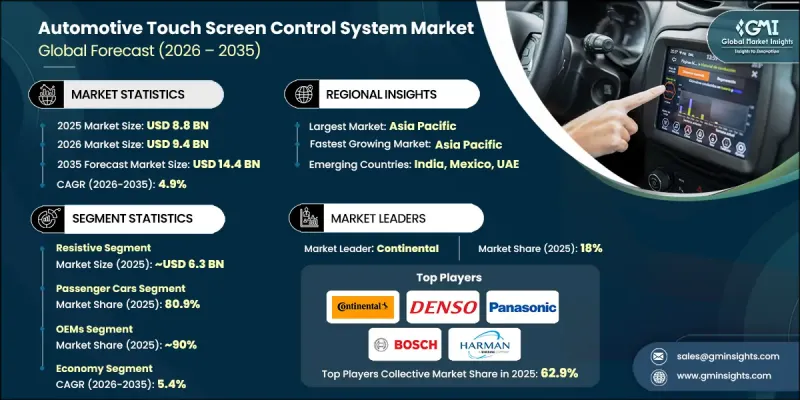
由于多功能显示器的日益普及,汽车触控萤幕控制系统市场正在不断扩张,这些显示器集中了车辆的各项操作。现代汽车越来越依赖触控萤幕介面来管理各种功能,从而提升了驾驶便利性并简化了仪錶板设计。此外,向数位化驾驶座架构的转变也图了汽车触控萤幕控制系统市场的发展,在这种架构中,集中式驾驶座作为存取车辆数据、连接功能和即时资讯的主要介面。使用者介面设计和系统整合的进步也提升了整体驾驶体验。随着汽车製造商不断致力于简化控制系统,同时保持性能和易用性,全球汽车触控萤幕控制系统市场预计将保持稳定成长。
| 市场范围 | |
|---|---|
| 开始年份 | 2025 |
| 预测期 | 2026-2035 |
| 上市时的市场规模 | 88亿美元 |
| 预测金额 | 144亿美元 |
| 复合年增长率 | 4.9% |
随着人工智慧技术不断提昇系统功能和使用者互动,汽车触控萤幕控制系统市场正蓬勃发展。汽车製造商正积极融入智慧功能,以提升易用性、安全性和整体驾驶体验。同时,对驾驶者分心的担忧也推动了混合介面解决方案的发展,这些方案将触控功能与触觉回馈元素结合。这些系统整合了触觉回馈和手势操作等功能,在确保安全性的同时,提供直觉的操控体验。此外,随着汽车製造商不断将先进的控制系统应用于最新车型,汽车产量的持续成长也促进了市场需求的成长。
预计2025年,电阻式市场占有率将达到70.8%,市场规模将达63亿美元。由于其成本效益高,且在各种工况下性能可靠,该细分市场仍被广泛采用。汽车触控萤幕控制系统市场受益于电阻式技术与现有车辆系统的兼容性以及其在各种工况下有效运作的能力。这些优势持续支撑着对电阻式触控萤幕解决方案的稳定需求。
预计到2035年,OEM市场规模将达133亿美元。该市场的成长主要得益于触控萤幕系统在汽车製造流程中日益增强的整合度。汽车製造商正将先进的显示系统和集中控制介面直接整合到其车辆架构中,推动了对OEM解决方案的需求。汽车製造商与技术供应商之间的紧密合作,使得系统能够实现更精细的客製化、更完善的整合以及更优化的使用者介面设计,进一步巩固了OEM在市场中的地位。
美国汽车触控萤幕控制系统市场预计到2025年将达到20亿美元,并在2026年至2035年间以3.9%的复合年增长率成长。受消费者对技术先进汽车的强劲需求以及对数位化介面的日益青睐的推动,美国汽车触控萤幕控制系统市场持续扩张。消费者对先进的资讯娱乐系统、大尺寸显示器和无缝连接功能的偏好日益浓厚。随着触控萤幕系统成为各种车型标配,对人机互动技术的持续投入将进一步加速其普及。
目录
第一章:调查方法
第二章执行摘要
第三章业界考察
- 生态系分析
- 供应商情况
- 利润率
- 成本结构
- 每个阶段增加的价值
- 影响价值链的因素
- 中断
- 影响产业的因素
- 促进因素
- 消费者对联网汽车和智慧汽车的需求日益增长
- 原始设备製造商正致力于改进数位驾驶座和用户体验。
- 与智慧型手机生态系统(CarPlay、Android Auto)集成
- 政府关于ADAS和安全功能的法规促进了显示器的集成
- 产业潜在风险与挑战
- 过度依赖触控萤幕会导致驾驶注意力分散和安全隐患。
- 经济型汽车领域整车製造商面临高昂的整合成本
- 市场机会
- 老旧车辆的售后改装需求
- 人工智慧驱动的个人化和自适应介面
- 商用车和车队车辆领域的扩张
- 汽车生产正在扩张的新兴市场
- 促进因素
- 成长潜力分析
- 监理情势
- 北美洲
- 美国国家公路交通安全管理局
- 联邦通讯委员会
- SAE International
- 加拿大标准协会
- 欧洲
- 欧盟委员会交通运输总司
- 欧洲电讯标准组织
- 欧洲标准化委员会
- 欧洲电工标准化委员会
- 亚太地区
- 国土交通省
- 工业和资讯化部
- 印度汽车研究所
- 韩国交通安全局
- 拉丁美洲
- 国家计量、品质和技术研究院
- 国立先进工业科学技术研究所
- 国家交通安全委员会
- 哥伦比亚技术标准与认证协会
- 中东和非洲
- 海湾标准化组织
- 沙乌地阿拉伯标准、计量和品质组织
- 阿联酋标准化和计量局
- 非洲标准化组织
- 北美洲
- 投资与资金筹措分析
- 波特五力分析
- PESTEL 分析
- 科技与创新趋势
- 目前技术
- 多媒体资讯娱乐系统的集成
- TFT-LCD显示器的集成
- 触觉回馈触控介面
- 新兴技术
- 汽车级OLED触控显示器
- 高级人工智慧语音助手
- 微型LED汽车显示器
- 内建触控显示技术
- 目前技术
- 价格分析(基于初步调查)
- 对过去价格趋势的分析
- 按业务类型分類的定价策略(溢价/价值/成本加成)
- 专利趋势(基于初步调查)
- 交易数据分析(基于付费资料库)
- 进出口量及进口额趋势
- 主要贸易走廊及关税的影响
- 生产能力和生产趋势(基于初步调查)
- 按地区和主要製造商分類的已安装产能
- 运转率和扩张计划
- 人工智慧和生成式人工智慧对市场的影响
- 利用人工智慧改造现有经营模式
- GenAI 各细分市场的应用案例与部署蓝图
- 风险、局限性和监管考量
- 电动车、高级驾驶辅助系统和自动驾驶的影响
- 电动车专用触控萤幕要求和设计变化
- ADAS整合与控制介面的演变
- 自动驾驶汽车人机互动介面的模式转移
- 电池状态和能量管理介面的设计
- 语音、手势和多模态介面
- 语音命令的整合和自然语言处理的引入
- 手势姿态辨识技术
- 多模态互动系统(触控+语音+手势)
- 触觉回馈和触觉响应技术
- 案例研究
- 预测假设和情境分析(基于初步研究)
- 基本案例-驱动复合年增长率的关键宏观经济与产业变量
- 乐观情境-宏观经济与产业的顺风
- 悲观情景-宏观经济放缓或产业逆风
第四章 竞争情势
- 介绍
- 企业市占率分析
- 北美洲
- 欧洲
- 亚太地区
- 拉丁美洲
- 中东和非洲(MEA)
- 主要市场公司的竞争分析
- 竞争定位矩阵
- 主要进展
- 併购
- 伙伴关係与合作
- 新产品发布
- 业务拓展计划及资金筹措
- 企业级分层基准测试
- 层级分类标准与选择标准
- 按收入、地区和创新能力分類的层级定位矩阵。
第五章 市场估计与预测:依技术划分,2022-2035年
- 电阻式
- 单触式电阻式
- 多点触控电阻式系统
- 电容式
- 表面电容
- 投射电容式(PCAP)
- 红外线的
- 光学成像
第六章 市场估价与预测:依萤幕大小划分,2022-2035年
- 小于9英寸
- 9-15英寸
- 15吋或更大
第七章 市场估计与预测:依应用领域划分,2022-2035年
- 资讯娱乐系统
- 音讯娱乐
- 连接性和智慧型手机集成
- 后座娱乐
- 导航系统
- 空调
- 驾驶辅助功能
- 车辆诊断
第八章 市场估价与预测:依车辆类型划分,2022-2035年
- 搭乘用车
- 掀背车
- 轿车
- SUV
- 商用车辆
- 轻型商用车(LCV)
- 中型商用车(MCV)
- 重型商用车(HCV)
第九章 市场估价与预测:依车辆类型划分,2022-2035年
- 经济
- 中产阶级
- 豪华车/高级车
第十章 市场估价与预测:依销售管道划分,2022-2035年
- OEM
- 售后市场
第十一章 市场估价与预测:按地区划分,2022-2035年
- 北美洲
- 我们
- 加拿大
- 欧洲
- 德国
- 英国
- 法国
- 义大利
- 西班牙
- 比利时
- 荷兰
- 亚太地区
- 中国
- 印度
- 日本
- 韩国
- 澳洲
- 新加坡
- 马来西亚
- 越南
- 泰国
- 拉丁美洲
- 巴西
- 墨西哥
- 阿根廷
- 哥伦比亚
- 中东和非洲(MEA)
- 南非
- 沙乌地阿拉伯
- 阿拉伯聯合大公国
第十二章:公司简介
- 世界公司
- Continental
- Robert Bosch
- Samsung(HARMAN)
- Panasonic
- Denso
- Visteon
- Alps Alpine
- Fujitsu
- Analog Devices
- Pioneer
- 本地公司
- Hyundai Mobis
- Nippon Seiki
- Goodix
- O-film
- Methode Electronics
- FocalTech
- 新兴企业
- TouchNetix
- XYT electronic
- Orient Display
- Dawar
The Global Automotive Touch Screen Control System Market was valued at USD 8.8 billion in 2025 and is estimated to grow at a CAGR of 4.9% to reach USD 14.4 billion by 2035.
The automotive touch screen control system market is expanding due to the growing integration of multifunctional displays that centralize vehicle operations. Modern vehicles increasingly rely on touchscreen interfaces to manage a wide range of functions, improving convenience and streamlining dashboard design. The automotive touch screen control system market is also benefiting from the ongoing shift toward digital cockpit architectures, where centralized displays serve as the primary interface for accessing vehicle data, connectivity, and real-time information. In addition, advancements in user interface design and system integration are enhancing overall driving experiences. As automakers continue to focus on simplifying control systems while maintaining performance and usability, the automotive touch screen control system market is expected to witness consistent growth across global automotive segments.
| Market Scope | |
|---|---|
| Start Year | 2025 |
| Forecast Year | 2026-2035 |
| Start Value | $8.8 Billion |
| Forecast Value | $14.4 Billion |
| CAGR | 4.9% |
The automotive touch screen control system market is gaining further traction as artificial intelligence technologies enhance system functionality and user interaction. Automakers are incorporating intelligent features to improve usability, safety, and overall driving experience. At the same time, concerns related to driver distraction are encouraging the development of hybrid interface solutions that combine touch functionality with tactile elements. These systems integrate features such as haptic response and gesture-based controls to provide intuitive operation while maintaining safety. Increasing vehicle production is also contributing to rising demand, as manufacturers continue to integrate advanced control systems into modern vehicles.
The resistive segment accounted for 70.8% share in 2025, generating USD 6.3 billion. This segment remains widely adopted due to its cost efficiency and reliable performance across various operating conditions. The automotive touch screen control system market benefits from the compatibility of resistive technology with existing vehicle systems, along with its ability to function effectively under different usage conditions. These advantages continue to support steady demand for resistive touch solutions.
The OEM segment is projected to reach USD 13.3 billion by 2035. Growth in this segment is driven by the increasing integration of touchscreen systems during the vehicle manufacturing process. Automakers are embedding advanced display systems and centralized control interfaces directly into vehicle architecture, which is driving demand for OEM-supplied solutions. Strong collaboration between automotive manufacturers and technology providers is further enabling customization, improved system integration, and enhanced user interface design, strengthening the role of OEMs in the market.
U.S. Automotive Touch Screen Control System Market reached USD 2 billion in 2025 and is expected to grow at a CAGR of 3.9% from 2026 to 2035. The automotive touch screen control system market in the United States continues to expand due to strong demand for technologically advanced vehicles and increasing preference for digital interfaces. Consumers are showing growing interest in enhanced infotainment systems, larger displays, and seamless connectivity features. Continuous investments in human-machine interface technologies are further accelerating adoption, as touchscreen systems become a standard feature across a wide range of vehicles.
Key companies operating in the Global Automotive Touch Screen Control System Market include Continental, Denso, Panasonic, Robert Bosch, Alps Alpine, Analog Devices, Fujitsu, Pioneer, Samsung (HARMAN), and Visteon. Companies in the Global Automotive Touch Screen Control System Market are strengthening their market position through continuous innovation and strategic collaborations. Leading players are investing in advanced display technologies, AI-driven interfaces, and improved user experience design to differentiate their offerings. Partnerships with automakers are enabling seamless integration of hardware and software systems, enhancing overall product performance. Companies are also focusing on expanding production capabilities to meet increasing demand while optimizing costs. In addition, emphasis on developing hybrid interface solutions that combine touch, gesture, and tactile feedback is improving usability and safety. Geographic expansion and portfolio diversification are further helping companies capture new opportunities and reinforce their competitive presence in the global automotive touch screen control system market.
Table of Contents
Chapter 1 Methodology
- 1.1 Research approach
- 1.2 Quality commitments
- 1.2.1 GMI AI policy & data integrity commitment
- 1.3 Research trail & confidence scoring
- 1.3.1 Research trail components
- 1.3.2 Scoring components
- 1.4 Data collection
- 1.4.1 Partial list of primary sources
- 1.5 Data mining sources
- 1.5.1 Paid sources
- 1.6 Base estimates and calculations
- 1.6.1 Base year calculation
- 1.7 Forecast model
- 1.8 Research transparency addendum
Chapter 2 Executive Summary
- 2.1 Industry 360° synopsis
- 2.2 Key market trends
- 2.2.1 Regional
- 2.2.2 Technology
- 2.2.3 Screen Size
- 2.2.4 Application
- 2.2.5 Vehicle
- 2.2.6 Vehicle Class
- 2.2.7 Sales Channel
- 2.3 TAM analysis, 2026-2035
- 2.4 CXO perspectives: Strategic imperatives
Chapter 3 Industry Insights
- 3.1 Industry ecosystem analysis
- 3.1.1 Supplier landscape
- 3.1.2 Profit margin
- 3.1.3 Cost structure
- 3.1.4 Value addition at each stage
- 3.1.5 Factor affecting the value chain
- 3.1.6 Disruptions
- 3.2 Industry impact forces
- 3.2.1 Growth drivers
- 3.2.1.1 Rising consumer demand for connected & smart vehicles
- 3.2.1.2 OEM focus on digital cockpit & enhanced user experience
- 3.2.1.3 Integration with smartphone ecosystems (CarPlay, Android Auto)
- 3.2.1.4 Government mandates for ADAS & safety features driving display integration
- 3.2.2 Industry pitfalls and challenges
- 3.2.2.1 Driver distraction & safety concerns from touchscreen overreliance
- 3.2.2.2 High integration costs for OEMs in economy vehicle segments
- 3.2.3 Market opportunities
- 3.2.3.1 Aftermarket retrofitting demand in aging vehicle fleet
- 3.2.3.2 AI-powered personalization & adaptive interfaces
- 3.2.3.3 Expansion in commercial & fleet vehicle segments
- 3.2.3.4 Emerging markets with growing vehicle production
- 3.2.1 Growth drivers
- 3.3 Growth potential analysis
- 3.4 Regulatory landscape
- 3.4.1 North America
- 3.4.1.1 National Highway Traffic Safety Administration
- 3.4.1.2 Federal Communications Commission
- 3.4.1.3 SAE International
- 3.4.1.4 Canadian Standards Association
- 3.4.2 Europe
- 3.4.2.1 European Commission Directorate-General for Mobility and Transport
- 3.4.2.2 European Telecommunications Standards Institute
- 3.4.2.3 European Committee for Standardization
- 3.4.2.4 European Committee for Electrotechnical Standardization
- 3.4.3 Asia Pacific
- 3.4.3.1 Ministry of Land Infrastructure Transport and Tourism
- 3.4.3.2 Ministry of Industry and Information Technology
- 3.4.3.3 Automotive Research Association of India
- 3.4.3.4 Korea Transportation Safety Authority
- 3.4.4 Latin America
- 3.4.4.1 Instituto Nacional de Metrologia Qualidade e Tecnologia
- 3.4.4.2 Instituto Nacional de Tecnologia Industrial
- 3.4.4.3 Comision Nacional de Seguridad de Transito
- 3.4.4.4 Instituto Colombiano de Normas Tecnicas y Certificacion
- 3.4.5 Middle East & Africa
- 3.4.5.1 Gulf Standardization Organization
- 3.4.5.2 Saudi Standards Metrology and Quality Organization
- 3.4.5.3 Emirates Authority for Standardization and Metrology
- 3.4.5.4 African Organisation for Standardisation
- 3.4.1 North America
- 3.5 Investment & Funding Analysis
- 3.6 Porter's analysis
- 3.7 PESTEL analysis
- 3.8 Technology and innovation landscape
- 3.8.1 Current technologies
- 3.8.1.1 Multimedia infotainment integration
- 3.8.1.2 TFT-LCD display integration
- 3.8.1.3 Haptic feedback touch interfaces
- 3.8.2 Emerging technologies
- 3.8.2.1 OLED automotive touch displays
- 3.8.2.2 Advanced AI voice assistants
- 3.8.2.3 MicroLED automotive displays
- 3.8.2.4 In-Cell touch display technology
- 3.8.1 Current technologies
- 3.9 Pricing analysis (Driven by Primary Research)
- 3.9.1 Historical price trend analysis
- 3.9.2 Pricing strategy by player type (Premium / Value / Cost-plus)
- 3.10 Patent landscape (Driven by Primary Research)
- 3.11 Trade data analysis (Driven by Paid Database)
- 3.11.1 Import/Export volume & value trends
- 3.11.2 Key trade corridors & tariff impact
- 3.12 Capacity & production landscape (Driven by Primary Research)
- 3.12.1 Installed capacity by region & key producer
- 3.12.2 Capacity utilization rates & expansion pipelines
- 3.13 Impact of AI & generative AI on the market
- 3.13.1 AI-driven disruption of existing business models
- 3.13.2 GenAI use cases & adoption roadmap by segment
- 3.13.3 Risks, limitations & regulatory considerations
- 3.14 EVs, ADAS & autonomous impacts
- 3.14.1 EV-Specific touchscreen requirements & design variations
- 3.14.2 ADAS integration & control interface evolution
- 3.14.3 Autonomous vehicle HMI paradigm shift
- 3.14.4 Battery status & energy management interface design
- 3.15 Voice, Gesture, and Multimodal Interfaces
- 3.15.1 Voice command integration & natural language processing adoption
- 3.15.2 Gesture recognition technology
- 3.15.3 Multimodal interaction systems (Touch + Voice + Gesture)
- 3.15.4 Haptic feedback & tactile response technologies
- 3.16 Case studies
- 3.17 Forecast assumptions & scenario analysis (Driven by Primary Research)
- 3.17.1 Base Case - key macro & industry variables driving CAGR
- 3.17.2 Optimistic Scenarios - Favorable macro and industry tailwinds
- 3.17.3 Pessimistic Scenario - Macroeconomic slowdown or industry headwinds
Chapter 4 Competitive Landscape, 2025
- 4.1 Introduction
- 4.2 Company market share analysis
- 4.2.1 North America
- 4.2.2 Europe
- 4.2.3 Asia Pacific
- 4.2.4 LATAM
- 4.2.5 MEA
- 4.3 Competitive analysis of major market players
- 4.4 Competitive positioning matrix
- 4.5 Key developments
- 4.5.1 Mergers & acquisitions
- 4.5.2 Partnerships & collaborations
- 4.5.3 New product launches
- 4.5.4 Expansion plans and funding
- 4.6 Company tier benchmarking
- 4.6.1 Tier classification criteria & qualifying thresholds
- 4.6.2 Tier positioning matrix by revenue, geography & innovation
Chapter 5 Market Estimates & Forecast, By Technology, 2022 - 2035 ($Mn, Thousand Units)
- 5.1 Key trends
- 5.2 Resistive
- 5.2.1 Single-Touch Resistive Systems
- 5.2.2 Multi-Touch Resistive Systems
- 5.3 Capacitive
- 5.3.1 Surface Capacitive
- 5.3.2 Projected Capacitive (PCAP)
- 5.4 Infrared
- 5.5 Optical Imaging
Chapter 6 Market Estimates & Forecast, By Screen Size, 2022 - 2035 ($Mn, Thousand Units)
- 6.1 Key trends
- 6.2 Below 9 inches
- 6.3 9 to 15 inches
- 6.4 Above 15 inches
Chapter 7 Market Estimates & Forecast, By Application, 2022 - 2035 ($Mn)
- 7.1 Key trends
- 7.2 Infotainment Systems
- 7.2.1 Audio & Entertainment
- 7.2.2 Connectivity & Smartphone Integration
- 7.2.3 Rear-Seat Entertainment
- 7.3 Navigation Systems
- 7.4 Climate Control
- 7.5 Driver Assistance Features
- 7.6 Vehicle Diagnostics
Chapter 8 Market Estimates & Forecast, By Vehicle, 2022 - 2035 ($Mn, Thousand Units)
- 8.1 Key trends
- 8.2 Passenger cars
- 8.2.1 Hatchback
- 8.2.2 Sedan
- 8.2.3 SUV
- 8.3 Commercial vehicles
- 8.3.1 Light Commercial Vehicles (LCV)
- 8.3.2 Medium Commercial Vehicles (MCV)
- 8.3.3 Heavy Commercial Vehicles (HCV)
Chapter 9 Market Estimates & Forecast, By Vehicle Class, 2022 - 2035 ($Mn, Thousand Units)
- 9.1 Key trends
- 9.2 Economy
- 9.3 Mid-range
- 9.4 Luxury/Premium
Chapter 10 Market Estimates & Forecast, By Sales Channel, 2022 - 2035 ($Mn, Thousand Units)
- 10.1 Key trends
- 10.2 OEM
- 10.3 Aftermarket
Chapter 11 Market Estimates & Forecast, By Region, 2022 - 2035 ($Mn, Thousand Units)
- 11.1 Key trends
- 11.2 North America
- 11.2.1 US
- 11.2.2 Canada
- 11.3 Europe
- 11.3.1 Germany
- 11.3.2 UK
- 11.3.3 France
- 11.3.4 Italy
- 11.3.5 Spain
- 11.3.6 Belgium
- 11.3.7 Netherlands
- 11.4 Asia Pacific
- 11.4.1 China
- 11.4.2 India
- 11.4.3 Japan
- 11.4.4 South Korea
- 11.4.5 Australia
- 11.4.6 Singapore
- 11.4.7 Malaysia
- 11.4.8 Vietnam
- 11.4.9 Thailand
- 11.5 Latin America
- 11.5.1 Brazil
- 11.5.2 Mexico
- 11.5.3 Argentina
- 11.5.4 Colombia
- 11.6 MEA
- 11.6.1 South Africa
- 11.6.2 Saudi Arabia
- 11.6.3 UAE
Chapter 12 Company Profiles
- 12.1 Global players
- 12.1.1 Continental
- 12.1.2 Robert Bosch
- 12.1.3 Samsung (HARMAN)
- 12.1.4 Panasonic
- 12.1.5 Denso
- 12.1.6 Visteon
- 12.1.7 Alps Alpine
- 12.1.8 Fujitsu
- 12.1.9 Analog Devices
- 12.1.10 Pioneer
- 12.2 Regional players
- 12.2.1 Hyundai Mobis
- 12.2.2 Nippon Seiki
- 12.2.3 Goodix
- 12.2.4 O-film
- 12.2.5 Methode Electronics
- 12.2.6 FocalTech
- 12.3 Emerging players
- 12.3.1 TouchNetix
- 12.3.2 XYT electronic
- 12.3.3 Orient Display
- 12.3.4 Dawar

 多点触控萤幕市场:依技术、应用、最终用户和麵板尺寸划分-2026-2032年全球市场预测
 TFT触控萤幕市场报告:趋势、预测与竞争分析(至2035年)
 2026-2030年全球汽车触控萤幕控制系统市场
 2026年全球零售触控萤幕显示器市场报告全球非接触式感测市场:产业分析、市场规模、份额及预测(按组件、产品类型、应用、技术、国家和地区划分)(2025-2032 年)坚固耐用的不銹钢触控平板电脑市场:按产品类型、萤幕大小、作业系统、应用和分销管道划分,全球预测(2026-2032年)2026年全球触控萤幕控制器市场报告
 触控萤幕控制器市场 - 全球产业规模、份额、趋势、机会、预测:按类型、最终用户、地区和竞争格局划分,2021-2031年非接触式感测市场-全球产业规模、份额、趋势、机会与预测:感测器、技术、产品、非接触式卫生、非接触式生物识别、区域和竞争格局,2021-2031年汽车触控萤幕控制系统市场 - 全球产业规模、份额、趋势、机会和预测,按车辆类型、应用、萤幕尺寸、地区和竞争格局划分,2020-2030 年预测