


 |
市场调查报告书
商品编码
1881225
按性别、经营模式、最终用户、电池类型、技术、行业垂直领域和地区分類的行动电源市场—预测至2035年Battery Passport Market by Industry, Battery Type, Technology, End User, Business Model, Region - Global Forecast to 2035 |
||||||


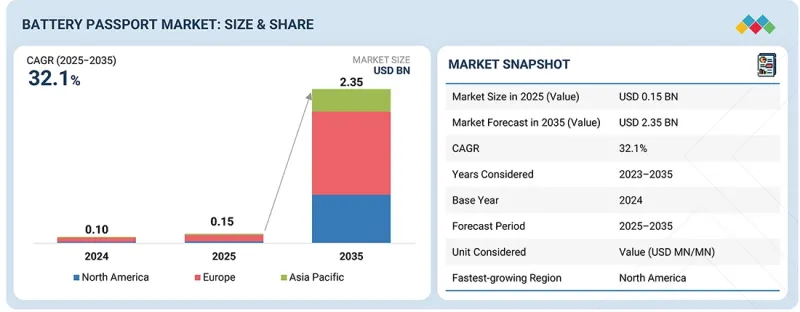
电池护照市场预计将从 2025 年的 1.5 亿美元成长到 2035 年的 23.5 亿美元,复合年增长率为 32.1%。
在欧洲,随着製造商遵守欧盟电池法规,电池护照的普及速度正在加速。各公司正采用基于区块链的标识符,并结合安全的云端连接、嵌入式储存单元以及加密QR码或NFC访问,来采集采购记录、碳排放指标、化学成分资料和耐久性参数。来自健康指标、循环模式、充电行为和热历史的传感器数据,支持在欧盟主要市场进行一致的检验。
| 调查范围 | |
|---|---|
| 调查期 | 2023-2035 |
| 基准年 | 2024 |
| 预测期 | 2025-2035 |
| 目标单元 | 金额(百万美元) |
| 部分 | 按适用性、经营模式、最终用户、电池类型、技术、行业和地区划分 |
| 目标区域 | 亚太地区、欧洲、北美 |
区块链平台提供防篡改的审核追踪、授权存取和可追溯的生命週期记录,使回收商能够自动获取材料成分和收集路径方面的资讯。模组化电池设计结合了机载诊断、电池管理系统 (BMS) 加密、OTA 升级功能和统一的资料格式,简化了合规流程,使得检验的生命週期透明度成为市场参与企业的必备条件。
预计汽车行业仍将是电池护照的最大采用者,因为从2025年到2032年,随着电动车(EV)和插电式混合动力汽车(PHEV)在乘用车和商用车领域的销量激增,锂电池的市场份额将保持在90-95%以上,这将推动对认证采购、碳排放、耐久性数据和回收指标的需求数据和回收成分检验的需求。 BMW、梅赛德斯-奔驰、大众、Stellantis和起亚等汽车製造商已经开始整合与电池护照相容的资料模型,以符合欧盟法规2023/1542的要求。起亚在北美和亚洲开展的公开测试及类似倡议,体现了从生产到报废的统一可追溯性趋势。这些系统简化了供应商报告流程,使电池管理系统(BMS)数据与生命週期指标保持一致,并为回收商和二次利用营运商提供检验的材料回收和再利用数据。即将到来的电动车普及、日益严格的资讯揭露要求以及全部区域协调努力,使得汽车製造商成为电池护照生态系统中报告标准、互通性框架和生命週期管治实践的关键促进者。
在中国、印度和欧洲等地,汽车产业和区域性计画的推动下,钠离子电池正经历密集的商业化发展,加速从试点生产线向大规模部署的过渡。行业领导企业正在推动实际进展。例如,宁德时代(CATL)正在拓展其Naxtra平台,以应用于行动出行和储能领域。 Northvolt已完成160Wh/kg电芯的检验,可用于大规模储能係统;Reliance旗下的Faradion公司正致力于提升能量密度和循环稳定性,以满足印度移动出行和电网的需求。这些发展反映出,在锂供应压力巨大的地区,人们正转向更具成本效益的替代技术。随着应用的不断深入,电池护照对于记录钠电池特有的参数至关重要,例如硬碳和普鲁士蓝特性、电导率阈值、稳定性指标以及电压曲线行为。钠电池具有独特的放电特性和热响应,与锂离子电池截然不同,因此需要专门的报告格式和电池管理系统(BMS)逻辑。随着这种电池技术的日益普及,客製化的护照框架将有助于供应链合格、运作可靠性和合规性。将这些参数整合到数位护照框架中,将增强检验流程,并支援对钠离子电池资产进行准确的报废规划。这种电池材料成本低、永续性强,与日益增长的可追溯生命週期数据需求高度契合,从而促进了数位电池护照架构在采购、碳排放指标和耐久性记录方面的早期应用。
根据欧盟第2023/1542号法规,欧洲是电池护照实施的主要区域。该法规定义了相关电池的机器可读取护照和互通性要求,并为超过监管容量阈值的电池设定了实施里程碑。产业和研究联盟正在奠定技术基础。在欧洲,多个欧盟成员国正在推进数位电池护照倡议。特别是德国,正主导成立电池护照联盟(Battery Pass),该联盟由FIWARE、IPCEI Batteries和BASE计划(合作伙伴包括西班牙、比利时、立陶宛、荷兰和爱尔兰)组成,致力于开发利用分散式帐本技术的去中心化、可互通的护照。法国透过一个符合GBA标准的回收先导计画主导,瑞典透过价值链工作小组参与其中,荷兰和比利时则参与了BASE计画。电池路径(Battery Path)、CIRPASS/CIRPASS 2 以及汽车生态系统 Catena X 等行业联盟正在开发统一的数据模型,涵盖材料来源、碳排放核算、电芯和电池包製造、劣化、报废路径以及安全数字标识符,并透过加密 API 连接电池管理系统 (BMS)、製造执行系统 报废路径以及安全数字标识符,并透过加密 API 连接电池管理系统 (BMS)、製造执行系统 企业资源计划 (MER) 和企业资源计划。德国、法国和瑞典的试点计画验证了跨方共识框架以及循环和热历史的即时检验,欧洲正逐步成为基于标准的电池护照实施方面最先进的地区。
本报告研究了全球电池护照市场,并按适用性、经营模式、最终用户、电池类型、技术、行业垂直领域和地区概述了市场趋势,以及参与该市场的公司的概况。
目录
第一章 引言
第二章调查方法
第三章执行摘要
第四章重要考察
第五章 市场概览
- 介绍
- 市场动态
- 未满足的需求和差距
- 相互关联的市场与跨产业机会
- 一级/二级/三级公司的策略性倡议
第六章 产业趋势
- 总体经济指标
- 生态系分析
- 定价分析
- 价值链分析
- 案例研究分析
- 美国2025年关税
- 大型会议和活动
- 影响客户业务的趋势/干扰因素
- 投资和资金筹措方案
- 电池护照初步试验
- 电池护照框架
- 电池护照资讯
- 电池护照生态系统中的关键联盟和倡议
- 电池护照实施计画及成本因素
第七章:技术进步、人工智慧的影响、专利、创新与未来应用
- 主要技术
- 互补技术
- 邻近技术
- 技术蓝图
- 人工智慧/生成式人工智慧的影响
- 专利分析
- 未来应用
第八章永续性和监管环境
- 法规结构
- 对永续性的承诺
- 永续性影响和监管政策倡议
- 认证、标籤和环境标准
第九章:顾客状况与购买行为
- 决策流程
- 主要相关人员和采购标准
- 招募障碍和内部挑战
- 终端用户产业未满足的需求
第十章 电池护照市场(由Suitable Artist创作)
- 介绍
- 欧盟电池法规 - 合规电池
- 试点系统下的电池
- 不合规/老旧电池
第十一章 电池护照市场(依经营模式划分)
- 介绍
- 按业务类型分類的经营模式
- 按收入来源分類的经营模式
第十二章 电池护照市场(依最终用户划分)
- 介绍
- 合规最终用户
- 营运最终用户
第十三章 电池护照市场(按电池类型划分)
- 介绍
- 锂离子
- 铅酸电池
- 钠离子
- 其他的
- 关键见解
第十四章 电池护照市场(依技术划分)
- 介绍
- 基于区块链
- 云端基础的
- 物联网和人工智慧集成
- 其他的
- 关键见解
第十五章 电池护照市场(按行业划分)
- 介绍
- 车
- 能源与公用事业
- 非公路/工业
- 其他的
- 关键见解
第十六章 电池护照市场(按地区划分)
- 介绍
- 亚太地区
- 中国
- 日本
- 韩国
- 印度
- 马来西亚
- 欧洲
- 德国
- 法国
- 荷兰
- 西班牙
- 芬兰
- 瑞典
- 挪威
- 北美洲
- 美国
- 加拿大
第十七章 竞争格局
- 介绍
- 主要参与企业的策略/优势,2023-2025年
- 2024年市占率分析
- 品牌/产品对比
- 公司估值矩阵:主要参与企业,2024 年
- 公司估值矩阵:新兴企业/中小企业,2024 年
- 竞争场景
第十八章:公司简介
- 主要参与企业
- MINESPIDER GMBH
- AVL
- SIEMENS
- CIRCULOR
- OPTEL GROUP
- CIRCULARISE
- DENSO CORPORATION
- IPOINT-SYSTEMS GMBH
- CHARGEZONE
- RCS GLOBAL
- 其他公司
- PERFICIENT INC
- BLOQSENS AG
- TATA ELXSI
- VOLVO CARS
- THINGSPIRE
- GLASSDOME
- BATX ENERGIES
- MICROVAST HOLDINGS, INC.
- FARASIS ENERGY GMBH
- EVERLEDGER LIMITED
- RESOURCE
- SPHERITY GMBH
第十九章附录
The battery passport market is projected to reach USD 2.35 billion by 2035, from USD 0.15 billion in 2025, with a CAGR of 32.1%. The rollout of battery passports in Europe is accelerating as manufacturers align with the EU Battery Regulation. Firms are adopting blockchain-backed identifiers with secure cloud links, embedded memory units, and encrypted QR or NFC access to capture sourcing records, carbon metrics, chemistry data, and durability parameters. Sensor feeds from state-of-health indicators, cycle patterns, charging behavior, and thermal traces support consistent validation across major EU markets.
| Scope of the Report | |
|---|---|
| Years Considered for the Study | 2023-2035 |
| Base Year | 2024 |
| Forecast Period | 2025-2035 |
| Units Considered | Value (USD Million) |
| Segments | Battery Passport Market by Industry, Battery Type, Technology, End User, Business Model, Region |
| Regions covered | Asia Pacific, Europe, and North America |
Blockchain platforms provide tamper-proof audit trails, permissioned access, and traceable lifecycle entries, while recyclers gain automated insights into material composition and recovery routes. Modular battery designs with onboard diagnostics, BMS encryption, OTA capability, and harmonized data formats streamline compliance, making verified lifecycle transparency mandatory for market participation.
"Automotive is expected to surpass other industries during the forecast period."
The automotive industry is expected to remain the largest adopter of battery passports as EV and PHEV volumes surge sharply across passenger and commercial segments from 2025 to 2032, with lithium-based chemistries maintaining a share of more than 90-95% and driving the need for authenticated sourcing, carbon metrics, durability data, and recycled-content validation. OEMs such as BMW, Mercedes-Benz, Volkswagen, Stellantis, and Kia are already integrating passport-ready data models to comply with EU Regulation 2023/1542, while Kia's public trials and similar initiatives across North America and Asia reflect the shift toward unified production-to-end-of-life traceability. These systems streamline supplier reporting, align BMS data with lifecycle indicators, and support recyclers and second-life operators with verified inputs for material recovery and reuse. The scale of upcoming EV deployment, tightening disclosure mandates, and region-wide harmonization efforts position automotive players as the primary drivers of reporting standards, interoperability frameworks, and lifecycle governance practices across the battery passport ecosystem.
"Sodium-ion is expected to exhibit the fastest growth during the forecast period."
The sodium-ion battery is advancing through focused commercial activity, with automotive and regional programs in China, India, and Europe accelerating its shift from pilot lines to scaled deployment. Industry leaders are pushing tangible progress. For instance, CATL is expanding its Naxtra platform for mobility and storage use cases. Northvolt has validated 160 Wh/kg cells for large-scale storage systems, while Faradion, under Reliance, is driving improvements in energy density and cycle stability to meet India's mobility and grid needs. These developments reflect a move toward cost-efficient alternatives where lithium supply pressures are significant. As adoption rises, battery passports will be essential for capturing sodium-specific parameters, such as hard-carbon or Prussian-blue characteristics, conductivity thresholds, stability markers, and voltage-curve behavior. This requires distinct reporting formats and BMS logic that differ from those of lithium-ion batteries due to their unique discharge signatures and thermal responses. A tailored passport framework will support supply chain qualification, operational reliability, and regulatory compliance as the chemistry gains industrial traction. Integrating these parameters into digital passport frameworks enhances validation processes and supports accurate end-of-life planning for sodium-ion assets. The chemistry's lower material cost and favorable sustainability characteristics align well with the rising need for traceable lifecycle data, prompting early adoption of digital battery passport structures for sourcing information, carbon metrics, and durability records.
"Europe is expected to be the largest market during the forecast period."
Europe is the primary operational region for the deployment of the Battery Passport under Regulation (EU) 2023/1542, which defines a machine-readable passport and interoperability requirements for relevant batteries, with implementation milestones applying to batteries exceeding the regulatory capacity threshold. Industry and research consortia are shaping the technical baseline. Across Europe, several EU member states are advancing digital battery passport initiatives. Notably, Germany leads the Battery Pass consortium, FIWARE, IPCEI Batteries, and the BASE project (with partners from Spain, Belgium, Lithuania, the Netherlands, and Ireland) in developing decentralized, interoperable passports utilizing distributed ledger technology. France contributes through recycling pilot projects linked to the GBA, while Sweden engages via value-chain working groups, and the Netherlands and Belgium participate in BASE. Industry consortia, such as Battery Pass, CIRPASS/CIRPASS 2, and the Catena X automotive ecosystem, are developing harmonized data models for material provenance, carbon accounting, cell and pack manufacturing, degradation, end-of-life routing, and secure digital identifiers with encrypted APIs that link BMS, MES, and ERP systems. Pilots in Germany, France, and Sweden are validating cross-party consent frameworks and real-time analytics for cycle and thermal history, positioning Europe as the most advanced region for standards-based battery passport deployment.
In-depth interviews were conducted with CEOs, marketing directors, other innovation and technology directors, and executives from various key organizations operating in this market.
- By Company Type: Battery Passport Providers - 69% and Others - 31%
- By Designation: CXOs - 46%, Managers - 23%, and Others - 31%
- By Region: North America - 8%, Europe - 61%, and Asia Pacific - 31%
The battery passport market is dominated by established players, including Minespider GmbH (Germany), AVL (Austria), Siemens (Germany), Circulor (UK), and Optel Group (Canada). These companies actively manufacture and develop new and advanced connectors. They have also set up R&D facilities and offer best-in-class products to their customers.
Research Coverage:
The study covers the battery passport market by industry (automotive, energy & utility, off-highway/industrial, other industries), battery type (lithium-ion, lead-acid, sodium-ion, other batteries), technology (blockchain-based battery passport, cloud-based battery passport, IoT & AI-integrated battery passport, other technologies), compliance (EU Battery Regulation-compliant batteries, batteries under pilot schemes, non-compliant/legacy batteries), end users (compliance end users, operational end users), business model (software-as-a-service platform, white-label solution, on-premise deployment, subscription, licensing, pay-per-use), and region (Asia Pacific, Europe, and North America). It also covers the competitive landscape and company profiles of the major players in the battery passport market.
Key Benefits of Purchasing this Report
The study provides a comprehensive competitive analysis of key market players, including their company profiles, key insights into product and business offerings, recent developments, and primary market strategies. The report will assist market leaders and new entrants with estimates of revenue figures for the overall battery passport market and its subsegments. It helps stakeholders understand the competitive landscape and gain additional insights to better position their businesses and develop effective go-to-market strategies. Additionally, the report provides information on key market drivers, restraints, challenges, and opportunities, enabling stakeholders to stay informed about market dynamics.
The report provides insights into the following points:
- Analysis of key drivers (battery supply chain transparency and sustainability, regulatory enforcement and compliance mandates, consumer-centric traceability and brand trust), restraints (data confidentiality and market reluctance, high CapEx and OpEx for compliance, fragmented standards and interoperability gaps), opportunities (circular economy, battery-as-a-service enablement), and challenges (transition and implementation challenges, technical complexity, data accuracy, governance, and cybersecurity) influencing market growth
- Product Development/Innovation: Detailed insights on upcoming technologies, R&D activities, and product launches in the battery passport market
- Market Development: Comprehensive information about lucrative markets; the report analyzes battery passports across various regions
- Market Diversification: Exhaustive information about new products, untapped geographies, recent developments, and investments in the battery passport market
- Competitive Assessment: In-depth assessment of market shares, growth strategies, and service offerings of leading players like Minespider GmbH (Germany), AVL (Austria), Siemens (Germany), Circulor (UK), and Optel Group (Canada)
TABLE OF CONTENTS
1 INTRODUCTION
- 1.1 STUDY OBJECTIVES
- 1.2 MARKET DEFINITION
- 1.3 STUDY SCOPE
- 1.3.1 MARKETS COVERED AND REGIONAL SCOPE
- 1.3.2 INCLUSIONS AND EXCLUSIONS
- 1.3.3 YEARS CONSIDERED
- 1.4 CURRENCY CONSIDERED
- 1.5 STAKEHOLDERS
2 RESEARCH METHODOLOGY
- 2.1 RESEARCH DATA
- 2.1.1 SECONDARY DATA
- 2.1.1.1 List of secondary sources
- 2.1.1.2 Key data from secondary sources
- 2.1.2 PRIMARY DATA
- 2.1.2.1 Primary interviewees from demand and supply sides
- 2.1.2.2 Breakdown of primary interviews
- 2.1.2.3 List of primary participants
- 2.1.1 SECONDARY DATA
- 2.2 MARKET SIZE ESTIMATION
- 2.2.1 BOTTOM-UP APPROACH
- 2.2.2 TOP-DOWN APPROACH
- 2.3 DATA TRIANGULATION
- 2.4 FACTOR ANALYSIS
- 2.5 RESEARCH ASSUMPTIONS AND RISK ASSESSMENT
- 2.6 RESEARCH LIMITATIONS
3 EXECUTIVE SUMMARY
- 3.1 KEY INSIGHTS AND MARKET HIGHLIGHTS
- 3.2 KEY MARKET PARTICIPANTS: SHARE INSIGHTS AND STRATEGIC DEVELOPMENTS
- 3.3 DISRUPTIVE TRENDS SHAPING MARKET
- 3.4 HIGH-GROWTH SEGMENTS AND EMERGING FRONTIERS
- 3.5 MNM INSIGHTS ON EU BATTERY REGULATIONS
- 3.6 SNAPSHOT: GLOBAL MARKET SIZE, GROWTH RATE, AND FORECAST
4 PREMIUM INSIGHTS
- 4.1 ATTRACTIVE OPPORTUNITIES FOR PLAYERS IN BATTERY PASSPORT MARKET
- 4.2 BATTERY PASSPORT MARKET, BY REGION
- 4.3 BATTERY PASSPORT MARKET, BY BATTERY TYPE
- 4.4 BATTERY PASSPORT MARKET, BY INDUSTRY
- 4.5 BATTERY PASSPORT MARKET, BY TECHNOLOGY
5 MARKET OVERVIEW
- 5.1 INTRODUCTION
- 5.2 MARKET DYNAMICS
- 5.2.1 DRIVERS
- 5.2.1.1 Battery supply chain transparency and sustainability
- 5.2.1.2 Regulatory enforcement and compliance mandates
- 5.2.1.3 Consumer-centric traceability and brand trust
- 5.2.2 RESTRAINTS
- 5.2.2.1 Data confidentiality and market reluctance
- 5.2.2.2 Fragmented standards and interoperability gaps
- 5.2.2.3 High CapEx and OpEx for compliance
- 5.2.3 OPPORTUNITIES
- 5.2.3.1 Battery industry's shift toward circular economy
- 5.2.3.2 Rise of Battery-as-a-Service model
- 5.2.4 CHALLENGES
- 5.2.4.1 Data accuracy, governance, and cybersecurity concerns
- 5.2.4.2 Transition and implementation constraints
- 5.2.4.3 Technical complexity
- 5.2.1 DRIVERS
- 5.3 UNMET NEEDS AND WHITE SPACES
- 5.3.1 UNMET NEEDS
- 5.3.2 WHITE SPACES
- 5.4 INTERCONNECTED MARKETS AND CROSS-SECTOR OPPORTUNITIES
- 5.4.1 SCALE OF COLLABORATION AND MARKET INTERDEPENDENCE
- 5.4.2 REGULATORY SYNCHRONIZATION AND COMPLIANCE TIMELINES
- 5.4.3 R&D COLLABORATION AND FUNDING SUPPORT
- 5.5 STRATEGIC MOVES BY TIER-1/2/3 PLAYERS
- 5.5.1 TIER 1
- 5.5.2 TIER 2
- 5.5.3 TIER 3
6 INDUSTRY TRENDS
- 6.1 MACROECONOMIC INDICATORS
- 6.1.1 INTRODUCTION
- 6.1.2 GDP TRENDS AND FORECAST
- 6.1.2.1 Regional GDP dynamics
- 6.1.2.1.1 Developed markets (US, EU, and Japan)
- 6.1.2.1.2 Emerging markets (China, India, and Southeast Asia)
- 6.1.2.2 Investment environment
- 6.1.2.3 Implications for battery passport adoption
- 6.1.2.1 Regional GDP dynamics
- 6.1.3 TRENDS IN EV AND EV BATTERY INDUSTRY
- 6.1.3.1 EV penetration and market dynamics
- 6.1.3.2 Battery manufacturing expansion
- 6.1.3.3 Regulatory and policy alignment
- 6.1.3.4 Strategic implications for stakeholders
- 6.2 ECOSYSTEM ANALYSIS
- 6.2.1 RAW MATERIAL SUPPLIERS AND MINERS
- 6.2.2 BATTERY MANUFACTURERS
- 6.2.3 OEMS
- 6.2.4 RECYCLERS AND SECOND-LIFE OPERATORS
- 6.2.5 DIGITAL PASSPORT AND TRACEABILITY PROVIDERS
- 6.2.6 REGULATORY AUTHORITIES AND GOVERNANCE ORGANIZATIONS
- 6.2.7 TECHNOLOGY AND AI PROVIDERS
- 6.2.8 AUDITORS AND CERTIFICATION AGENCIES
- 6.3 PRICING ANALYSIS
- 6.4 VALUE CHAIN ANALYSIS
- 6.5 CASE STUDY ANALYSIS
- 6.5.1 EFFICIENT RECYCLING PROCESSES THROUGH BATTERY PASSPORT DATA
- 6.5.2 BATTERY PASSPORT WITH QR AND BLOCKCHAIN TECHNOLOGY
- 6.5.3 BATTERY PASSPORT IMPLEMENTATION WITH MINESPIDER
- 6.6 US 2025 TARIFF
- 6.6.1 IMPACT OF US TARIFFS ON BATTERY VALUE CHAIN
- 6.6.1.1 Cost and import dynamics
- 6.6.1.2 Supply chain reorientation
- 6.6.2 REGULATORY ALIGNMENT AND TRANSPARENCY IMPLICATIONS
- 6.6.3 SPECIFIC IMPLICATIONS FOR BATTERY PASSPORT MARKET
- 6.6.3.1 Opportunity side
- 6.6.3.2 Risk/Headwind side
- 6.6.4 STRATEGIC CONSIDERATIONS FOR US BATTERY PASSPORT MARKET
- 6.6.5 RECOMMENDATIONS FOR STAKEHOLDERS
- 6.6.1 IMPACT OF US TARIFFS ON BATTERY VALUE CHAIN
- 6.7 KEY CONFERENCES AND EVENTS
- 6.8 TRENDS/DISRUPTIONS IMPACTING CUSTOMER BUSINESS
- 6.9 INVESTMENT AND FUNDING SCENARIO
- 6.10 BATTERY PASSPORT PILOT TRIALS
- 6.10.1 2023 BATTERY PASSPORT PILOT TRIALS
- 6.10.2 2024 BATTERY PASSPORT PILOT TRIALS
- 6.11 BATTERY PASSPORT FRAMEWORK
- 6.12 BATTERY PASSPORT INFORMATION
- 6.13 KEY CONSORTIUMS AND INITIATIVES IN BATTERY PASSPORT ECOSYSTEM
- 6.13.1 CATENA-X AUTOMOTIVE NETWORK (2021)
- 6.13.2 BATTERY PASS CONSORTIUM (2022)
- 6.13.3 GLOBAL BATTERY ALLIANCE BATTERY PASSPORT (2017)
- 6.13.4 CIRPASS PROJECT (2022)
- 6.14 BATTERY PASSPORT IMPLEMENTATION EFFORTS AND COST DRIVERS
7 TECHNOLOGICAL ADVANCEMENTS, AI-DRIVEN IMPACT, PATENTS, INNOVATIONS, AND FUTURE APPLICATIONS
- 7.1 KEY TECHNOLOGIES
- 7.1.1 CELL CHEMISTRY AND MATERIAL-LEVEL TRACEABILITY
- 7.1.2 STATE-OF-HEALTH MONITORING AND LIFECYCLE DATA INTEGRATION
- 7.1.3 BLOCKCHAIN INTEGRATION FOR TAMPER-PROOF DATA
- 7.2 COMPLEMENTARY TECHNOLOGIES
- 7.2.1 BATTERY MANAGEMENT AND TELEMETRY SYSTEMS
- 7.2.2 IOT AND EDGE INTELLIGENCE INTEGRATION
- 7.2.3 ARTIFICIAL INTELLIGENCE, DIGITAL TWINS, AND PREDICTIVE ANALYTICS
- 7.3 ADJACENT TECHNOLOGIES
- 7.3.1 BATTERY RECYCLING AND END-OF-LIFE INTEGRATION
- 7.3.2 AUTOMATED DISMANTLING AND MATERIAL RECOVERY PROCESSES
- 7.4 TECHNOLOGY ROADMAP
- 7.5 IMPACT OF AI/GEN AI
- 7.5.1 TOP USE CASES AND MARKET POTENTIAL
- 7.5.2 INTERCONNECTED ECOSYSTEM AND IMPACT ON MARKET PLAYERS
- 7.5.3 CLIENTS' READINESS TO ADOPT GEN AI IN BATTERY PASSPORT MARKET
- 7.6 PATENT ANALYSIS
- 7.7 FUTURE APPLICATIONS
- 7.7.1 APPLICATION OF TRACEABILITY SYSTEMS FOR DATA COLLECTION
- 7.7.1.1 Future application
- 7.7.1.2 Strategic impact
- 7.7.2 INTEGRATION INTO OFFICIAL DOWNSTREAM PROCESSES
- 7.7.2.1 Future application
- 7.7.2.2 Strategic impact
- 7.7.3 AGGREGATION OF DATA FROM MULTIPLE BATTERY PASSPORTS
- 7.7.3.1 Future application
- 7.7.3.2 Strategic impact
- 7.7.1 APPLICATION OF TRACEABILITY SYSTEMS FOR DATA COLLECTION
8 SUSTAINABILITY AND REGULATORY LANDSCAPE
- 8.1 REGULATORY FRAMEWORK
- 8.1.1 REGULATORY BODIES, GOVERNMENT AGENCIES, AND OTHER ORGANIZATIONS
- 8.1.2 REGULATIONS RELATED TO BATTERY PASSPORTS
- 8.1.2.1 Europe
- 8.1.2.1.1 EU Battery Regulation
- 8.1.2.2 North America
- 8.1.2.2.1 US Inflation Reduction Act
- 8.1.2.2.2 US Department of Energy's Battery Recycling Initiative
- 8.1.2.3 Asia Pacific
- 8.1.2.3.1 Automobile Management Act
- 8.1.2.1 Europe
- 8.1.3 COMPLIANCE COSTS PER BATTERY AND INFLUENCE ON OEM SOURCING STRATEGIES
- 8.1.4 INDUSTRY STANDARDS
- 8.1.5 REGULATIONS ON CIRCULARITY AND RESOURCE EFFICIENCY: DIN DKE SPEC 99100
- 8.2 SUSTAINABILITY INITIATIVES
- 8.2.1 CORE SUSTAINABILITY DIMENSIONS
- 8.2.1.1 Environmental impact transparency
- 8.2.1.2 Social responsibility and human rights compliance
- 8.2.1.3 Governance and data integrity
- 8.2.2 CIRCULAR ECONOMY INTEGRATION
- 8.2.3 GLOBAL COLLABORATIONS AND PILOTS
- 8.2.4 MEASURABLE SUSTAINABILITY OUTCOMES
- 8.2.5 CARBON IMPACT AND ECO-APPLICATIONS
- 8.2.1 CORE SUSTAINABILITY DIMENSIONS
- 8.3 SUSTAINABILITY IMPACT AND REGULATORY POLICY INITIATIVES
- 8.4 CERTIFICATION, LABELING, AND ECO-STANDARDS
9 CUSTOMER LANDSCAPE AND BUYER BEHAVIOR
- 9.1 DECISION-MAKING PROCESS
- 9.2 KEY STAKEHOLDERS AND BUYING CRITERIA
- 9.3 ADOPTION BARRIERS AND INTERNAL CHALLENGES
- 9.4 UNMET NEEDS FROM END-USE INDUSTRIES
10 BATTERY PASSPORT MARKET, BY COMPLIANCE
- 10.1 INTRODUCTION
- 10.2 EU BATTERY REGULATION-COMPLIANT BATTERIES
- 10.3 BATTERIES UNDER PILOT SCHEMES
- 10.3.1 BATTERY PASSPORT PILOT PARTICIPANTS
- 10.4 NON-COMPLIANT/LEGACY BATTERIES
11 BATTERY PASSPORT MARKET, BY BUSINESS MODEL
- 11.1 INTRODUCTION
- 11.2 BUSINESS MODELS BY MODE OF OPERATION
- 11.2.1 SOFTWARE-AS-A-SERVICE PLATFORM
- 11.2.2 WHITE-LABEL SOLUTION
- 11.2.3 ON-PREMISE DEPLOYMENT
- 11.3 BUSINESS MODELS BY REVENUE STREAM
- 11.3.1 SUBSCRIPTION
- 11.3.2 LICENSING
- 11.3.3 PAY-PER-USE/TRANSACTIONAL
12 BATTERY PASSPORT MARKET, BY END USER
- 12.1 INTRODUCTION
- 12.2 COMPLIANCE END USERS
- 12.2.1 BATTERY MANUFACTURERS
- 12.2.2 EV MANUFACTURERS
- 12.2.3 BATTERY RECYCLERS
- 12.3 OPERATIONAL END USERS
- 12.3.1 ENERGY STORAGE SYSTEM INTEGRATORS
- 12.3.2 UTILITY OPERATORS
- 12.3.3 FLEET OPERATORS
13 BATTERY PASSPORT MARKET, BY BATTERY TYPE
- 13.1 INTRODUCTION
- 13.2 LITHIUM-ION
- 13.2.1 REGULATORY COMPLIANCE FOR BATTERY TRACEABILITY TO DRIVE MARKET
- 13.3 LEAD-ACID
- 13.3.1 HIGH RECYCLING-EFFICIENCY AND SECOND-LIFE APPLICATIONS TO DRIVE MARKET
- 13.4 SODIUM-ION
- 13.4.1 ABUNDANT RAW MATERIALS, STRONG LOW-TEMPERATURE PERFORMANCE, AND SUPPLY CHAIN DIVERSIFICATION TO DRIVE MARKET
- 13.5 OTHER BATTERIES
- 13.6 PRIMARY INSIGHTS
14 BATTERY PASSPORT MARKET, BY TECHNOLOGY
- 14.1 INTRODUCTION
- 14.2 BLOCKCHAIN-BASED
- 14.2.1 TRACEABILITY, COMPLIANCE, AND DATA INTEGRITY ACROSS BATTERY SUPPLY CHAIN TO DRIVE MARKET
- 14.3 CLOUD-BASED
- 14.3.1 EFFICIENT LIFECYCLE TRACKING AND STREAMLINED REPORTING ACROSS BATTERY SUPPLY CHAIN TO DRIVE MARKET
- 14.4 IOT & AI-INTEGRATED
- 14.4.1 REAL-TIME MONITORING AND DATA-DRIVEN LIFECYCLE MANAGEMENT REQUIREMENTS TO DRIVE MARKET
- 14.5 OTHER TECHNOLOGIES
- 14.6 PRIMARY INSIGHTS
15 BATTERY PASSPORT MARKET, BY INDUSTRY
- 15.1 INTRODUCTION
- 15.2 AUTOMOTIVE
- 15.2.1 REGULATORY COMPLIANCE, CONSUMER DEMAND, AND SUPPLY CHAIN TRANSPARENCY TO DRIVE MARKET
- 15.3 ENERGY & UTILITY
- 15.3.1 ESG REQUIREMENTS, MATERIAL TRACEABILITY, AND SECOND-LIFE APPLICATIONS TO DRIVE MARKET
- 15.4 OFF-HIGHWAY/INDUSTRIAL
- 15.4.1 REGULATORY ADHERENCE, RISK MITIGATION, MATERIAL TRACEABILITY, AND STANDARDS ALIGNMENT TO DRIVE MARKET
- 15.5 OTHER INDUSTRIES
- 15.6 PRIMARY INSIGHTS
16 BATTERY PASSPORT MARKET, BY REGION
- 16.1 INTRODUCTION
- 16.2 ASIA PACIFIC
- 16.2.1 CHINA
- 16.2.2 JAPAN
- 16.2.3 SOUTH KOREA
- 16.2.4 INDIA
- 16.2.5 MALAYSIA
- 16.3 EUROPE
- 16.3.1 GERMANY
- 16.3.2 FRANCE
- 16.3.3 NETHERLANDS
- 16.3.4 SPAIN
- 16.3.5 FINLAND
- 16.3.6 SWEDEN
- 16.3.7 NORWAY
- 16.4 NORTH AMERICA
- 16.4.1 US
- 16.4.2 CANADA
17 COMPETITIVE LANDSCAPE
- 17.1 INTRODUCTION
- 17.2 KEY PLAYER STRATEGIES/RIGHT TO WIN, 2023-2025
- 17.3 MARKET SHARE ANALYSIS, 2024
- 17.4 BRAND/PRODUCT COMPARISON
- 17.5 COMPANY EVALUATION MATRIX: KEY PLAYERS, 2024
- 17.5.1 STARS
- 17.5.2 EMERGING LEADERS
- 17.5.3 PERVASIVE PLAYERS
- 17.5.4 PARTICIPANTS
- 17.5.5 COMPANY FOOTPRINT
- 17.5.5.1 Company footprint
- 17.5.5.2 Region footprint
- 17.5.5.3 Battery type footprint
- 17.5.5.4 Industry footprint
- 17.6 COMPANY EVALUATION MATRIX: START-UPS/SMES, 2024
- 17.6.1 PROGRESSIVE COMPANIES
- 17.6.2 RESPONSIVE COMPANIES
- 17.6.3 DYNAMIC COMPANIES
- 17.6.4 STARTING BLOCKS
- 17.6.5 COMPETITIVE BENCHMARKING
- 17.6.5.1 List of start-ups/SMEs
- 17.6.5.2 Competitive benchmarking of start-ups/SMEs
- 17.7 COMPETITIVE SCENARIO
- 17.7.1 PRODUCT LAUNCHES/DEVELOPMENTS
- 17.7.2 DEALS
- 17.7.3 EXPANSIONS
- 17.7.4 OTHER DEVELOPMENTS
18 COMPANY PROFILES
- 18.1 KEY PLAYERS
- 18.1.1 MINESPIDER GMBH
- 18.1.1.1 Business overview
- 18.1.1.2 Solutions offered
- 18.1.1.3 Recent developments
- 18.1.1.3.1 Product launches/developments
- 18.1.1.3.2 Deals
- 18.1.1.3.3 Other developments
- 18.1.1.4 MnM view
- 18.1.1.4.1 Key strengths
- 18.1.1.4.2 Strategic choices
- 18.1.1.4.3 Weaknesses and competitive threats
- 18.1.2 AVL
- 18.1.2.1 Business overview
- 18.1.2.2 Solutions offered
- 18.1.2.3 Recent developments
- 18.1.2.3.1 Product launches/developments
- 18.1.2.4 MnM view
- 18.1.2.4.1 Key strengths
- 18.1.2.4.2 Strategic choices
- 18.1.2.4.3 Weaknesses and competitive threats
- 18.1.3 SIEMENS
- 18.1.3.1 Business overview
- 18.1.3.2 Solutions offered
- 18.1.3.3 Recent developments
- 18.1.3.3.1 Deals
- 18.1.3.4 MnM view
- 18.1.3.4.1 Key strengths
- 18.1.3.4.2 Strategic choices
- 18.1.3.4.3 Weaknesses and competitive threats
- 18.1.4 CIRCULOR
- 18.1.4.1 Business overview
- 18.1.4.2 Solutions offered
- 18.1.4.3 Recent developments
- 18.1.4.3.1 Deals
- 18.1.4.4 MnM view
- 18.1.4.4.1 Key strengths
- 18.1.4.4.2 Strategic choices
- 18.1.4.4.3 Weaknesses and competitive threats
- 18.1.5 OPTEL GROUP
- 18.1.5.1 Business overview
- 18.1.5.2 Solutions offered
- 18.1.5.3 Recent developments
- 18.1.5.3.1 Deals
- 18.1.5.4 MnM view
- 18.1.5.4.1 Key strengths
- 18.1.5.4.2 Strategic choices
- 18.1.5.4.3 Weaknesses and competitive threats
- 18.1.6 CIRCULARISE
- 18.1.6.1 Business overview
- 18.1.6.2 Solutions offered
- 18.1.6.3 Recent developments
- 18.1.6.3.1 Deals
- 18.1.6.3.2 Expansions
- 18.1.7 DENSO CORPORATION
- 18.1.7.1 Business overview
- 18.1.7.2 Solutions offered
- 18.1.7.3 Recent developments
- 18.1.7.3.1 Product launches/developments
- 18.1.8 IPOINT-SYSTEMS GMBH
- 18.1.8.1 Business overview
- 18.1.8.2 Solutions offered
- 18.1.8.3 Recent developments
- 18.1.8.3.1 Deals
- 18.1.9 CHARGEZONE
- 18.1.9.1 Business overview
- 18.1.9.2 Solutions offered
- 18.1.9.3 Recent developments
- 18.1.9.3.1 Product launches/developments
- 18.1.10 RCS GLOBAL
- 18.1.10.1 Business overview
- 18.1.10.2 Solutions offered
- 18.1.10.3 Recent developments
- 18.1.10.3.1 Product launches/developments
- 18.1.10.3.2 Deals
- 18.1.10.3.3 Other developments
- 18.1.1 MINESPIDER GMBH
- 18.2 OTHER PLAYERS
- 18.2.1 PERFICIENT INC
- 18.2.2 BLOQSENS AG
- 18.2.3 TATA ELXSI
- 18.2.4 VOLVO CARS
- 18.2.5 THINGSPIRE
- 18.2.6 GLASSDOME
- 18.2.7 BATX ENERGIES
- 18.2.8 MICROVAST HOLDINGS, INC.
- 18.2.9 FARASIS ENERGY GMBH
- 18.2.10 EVERLEDGER LIMITED
- 18.2.11 RESOURCE
- 18.2.12 SPHERITY GMBH
19 APPENDIX
- 19.1 INSIGHTS FROM INDUSTRY EXPERTS
- 19.2 DISCUSSION GUIDE
- 19.3 KNOWLEDGESTORE: MARKETSANDMARKETS' SUBSCRIPTION PORTAL
- 19.4 CUSTOMIZATION OPTIONS
- 19.4.1 BATTERY PASSPORT MARKET, BY BATTERY TYPE, AT COUNTRY LEVEL (FOR COUNTRIES COVERED IN REPORT)
- 19.4.2 BATTERY PASSPORT MARKET, BY INDUSTRY, AT COUNTRY LEVEL (FOR COUNTRIES COVERED IN REPORT)
- 19.4.3 COMPANY INFORMATION
- 19.4.3.1 Profiling of additional market players (up to five)
- 19.5 RELATED REPORTS
- 19.6 AUTHOR DETAILS
List of Tables
- TABLE 1 MARKET DEFINITION, BY INDUSTRY
- TABLE 2 MARKET DEFINITION, BY BATTERY TYPE
- TABLE 3 MARKET DEFINITION, BY TECHNOLOGY
- TABLE 4 CURRENCY EXCHANGE RATES
- TABLE 5 STRATEGIC MOVES BY TIER-1/2/3 PLAYERS
- TABLE 6 ROLE OF COMPANIES IN ECOSYSTEM
- TABLE 7 INDICATIVE PRICING OF BATTERY PASSPORTS, 2024 (USD)
- TABLE 8 KEY CONFERENCES AND EVENTS, 2026
- TABLE 9 BATTERY PASSPORT IMPLEMENTATION EFFORTS AND COST DRIVERS
- TABLE 10 PATENT ANALYSIS
- TABLE 11 TRACEABILITY SYSTEM INTEGRATION AND DATA QUALITY IMPROVEMENTS
- TABLE 12 OFFICIAL DOWNSTREAM PROCESSES
- TABLE 13 AGGREGATED BATTERY PASSPORT DATA AND ANALYTICAL APPLICATIONS
- TABLE 14 ASIA PACIFIC: REGULATORY BODIES, GOVERNMENT AGENCIES, AND OTHER ORGANIZATIONS
- TABLE 15 EUROPE: REGULATORY BODIES, GOVERNMENT AGENCIES, AND OTHER ORGANIZATIONS
- TABLE 16 NORTH AMERICA: REGULATORY BODIES, GOVERNMENT AGENCIES, AND OTHER ORGANIZATIONS
- TABLE 17 INDUSTRY STANDARDS
- TABLE 18 REGULATIONS ON CIRCULARITY AND RESOURCE EFFICIENCY: DIN DKE SPEC 99100
- TABLE 19 DECISION-MAKING PROCESS OF KEY STAKEHOLDERS
- TABLE 20 MARKET OPPORTUNITIES FOR UNMET NEEDS
- TABLE 21 BATTERY PASSPORT PILOT PARTICIPANTS
- TABLE 22 BATTERY PASSPORT MARKET, BY BATTERY TYPE, 2023-2030 (USD MILLION)
- TABLE 23 BATTERY PASSPORT MARKET, BY BATTERY TYPE, 2031-2035 (USD MILLION)
- TABLE 24 LITHIUM-ION BATTERY PASSPORT MARKET, BY REGION, 2023-2030 (USD MILLION)
- TABLE 25 LITHIUM-ION BATTERY PASSPORT MARKET, BY REGION, 2031-2035 (USD MILLION)
- TABLE 26 LEAD-ACID BATTERY PASSPORT MARKET, BY REGION, 2023-2030 (USD MILLION)
- TABLE 27 LEAD-ACID BATTERY PASSPORT MARKET, BY REGION, 2031-2035 (USD MILLION)
- TABLE 28 SODIUM-ION BATTERY PASSPORT MARKET, BY REGION, 2023-2030 (USD MILLION)
- TABLE 29 SODIUM-ION BATTERY PASSPORT MARKET, BY REGION, 2031-2035 (USD MILLION)
- TABLE 30 OTHER BATTERIES: BATTERY PASSPORT MARKET, BY REGION, 2023-2030 (USD MILLION)
- TABLE 31 OTHER BATTERIES: BATTERY PASSPORT MARKET, BY REGION, 2031-2035 (USD MILLION)
- TABLE 32 BATTERY PASSPORT MARKET, BY TECHNOLOGY, 2023-2030 (USD MILLION)
- TABLE 33 BATTERY PASSPORT MARKET, BY TECHNOLOGY, 2031-2035 (USD MILLION)
- TABLE 34 BLOCKCHAIN-BASED BATTERY PASSPORT MARKET, BY REGION, 2023-2030 (USD MILLION)
- TABLE 35 BLOCKCHAIN-BASED BATTERY PASSPORT MARKET, BY REGION, 2031-2035 (USD MILLION)
- TABLE 36 CLOUD-BASED BATTERY PASSPORT MARKET, BY REGION, 2023-2030 (USD MILLION)
- TABLE 37 CLOUD-BASED BATTERY PASSPORT MARKET, BY REGION, 2031-2035 (USD MILLION)
- TABLE 38 IOT & AI-INTEGRATED BATTERY PASSPORT MARKET, BY REGION, 2023-2030 (USD MILLION)
- TABLE 39 IOT & AI-INTEGRATED BATTERY PASSPORT MARKET, BY REGION, 2031-2035 (USD MILLION)
- TABLE 40 OTHER TECHNOLOGIES: BATTERY PASSPORT MARKET, BY REGION, 2023-2030 (USD MILLION)
- TABLE 41 OTHER TECHNOLOGIES: BATTERY PASSPORT MARKET, BY REGION, 2031-2035 (USD MILLION)
- TABLE 42 BATTERY PASSPORT MARKET, BY INDUSTRY, 2023-2030 (USD MILLION)
- TABLE 43 BATTERY PASSPORT MARKET, BY INDUSTRY, 2031-2035 (USD MILLION)
- TABLE 44 AUTOMOTIVE: BATTERY PASSPORT MARKET, BY REGION, 2023-2030 (USD MILLION)
- TABLE 45 AUTOMOTIVE: BATTERY PASSPORT MARKET, BY REGION, 2031-2035 (USD MILLION)
- TABLE 46 ENERGY & UTILITY: BATTERY PASSPORT MARKET, BY REGION, 2023-2030 (USD MILLION)
- TABLE 47 ENERGY & UTILITY: BATTERY PASSPORT MARKET, BY REGION, 2031-2035 (USD MILLION)
- TABLE 48 OFF-HIGHWAY/INDUSTRIAL: BATTERY PASSPORT MARKET, BY REGION, 2023-2030 (USD MILLION)
- TABLE 49 OFF-HIGHWAY/INDUSTRIAL: BATTERY PASSPORT MARKET, BY REGION, 2031-2035 (USD MILLION)
- TABLE 50 OTHER INDUSTRIES: BATTERY PASSPORT MARKET, BY REGION, 2023-2030 (USD MILLION)
- TABLE 51 OTHER INDUSTRIES: BATTERY PASSPORT MARKET, BY REGION, 2031-2035 (USD MILLION)
- TABLE 52 BATTERY PASSPORT MARKET, BY REGION, 2023-2030 (USD MILLION)
- TABLE 53 BATTERY PASSPORT MARKET, BY REGION, 2031-2035 (USD MILLION)
- TABLE 54 ASIA PACIFIC: BATTERY PASSPORT MARKET, BY INDUSTRY, 2023-2030 (USD MILLION)
- TABLE 55 ASIA PACIFIC: BATTERY PASSPORT MARKET, BY INDUSTRY, 2031-2035 (USD MILLION)
- TABLE 56 EUROPE: BATTERY PASSPORT MARKET, BY INDUSTRY, 2023-2030 (USD MILLION)
- TABLE 57 EUROPE: BATTERY PASSPORT MARKET, BY INDUSTRY, 2031-2035 (USD MILLION)
- TABLE 58 NORTH AMERICA: BATTERY PASSPORT MARKET, BY INDUSTRY, 2023-2030 (USD MILLION)
- TABLE 59 NORTH AMERICA: BATTERY PASSPORT MARKET, BY INDUSTRY, 2031-2035 (USD MILLION)
- TABLE 60 KEY PLAYER STRATEGIES/RIGHT TO WIN, 2023-2025
- TABLE 61 MARKET SHARE ANALYSIS OF TOP FIVE PLAYERS, 2024
- TABLE 62 REGION FOOTPRINT
- TABLE 63 BATTERY TYPE FOOTPRINT
- TABLE 64 INDUSTRY FOOTPRINT
- TABLE 65 LIST OF START-UPS/SMES
- TABLE 66 COMPETITIVE BENCHMARKING OF START-UPS/SMES
- TABLE 67 BATTERY PASSPORT MARKET: PRODUCT LAUNCHES/DEVELOPMENTS, 2023-2025
- TABLE 68 BATTERY PASSPORT MARKET: DEALS, 2023-2025
- TABLE 69 BATTERY PASSPORT MARKET: EXPANSIONS, 2023-2025
- TABLE 70 BATTERY PASSPORT MARKET: OTHER DEVELOPMENTS, 2023-2025
- TABLE 71 MINESPIDER GMBH: COMPANY OVERVIEW
- TABLE 72 MINESPIDER GMBH: SOLUTIONS OFFERED
- TABLE 73 MINESPIDER GMBH: PRODUCT LAUNCHES/DEVELOPMENTS
- TABLE 74 MINESPIDER GMBH: DEALS
- TABLE 75 MINESPIDER GMBH: OTHER DEVELOPMENTS
- TABLE 76 AVL: COMPANY OVERVIEW
- TABLE 77 AVL: SOLUTIONS OFFERED
- TABLE 78 AVL: PRODUCT LAUNCHES/DEVELOPMENTS
- TABLE 79 SIEMENS: COMPANY OVERVIEW
- TABLE 80 SIEMENS: SOLUTIONS OFFERED
- TABLE 81 SIEMENS: DEALS
- TABLE 82 CIRCULOR: COMPANY OVERVIEW
- TABLE 83 CIRCULOR: SOLUTIONS OFFERED
- TABLE 84 CIRCULOR: DEALS
- TABLE 85 OPTEL GROUP: COMPANY OVERVIEW
- TABLE 86 OPTEL GROUP: SOLUTIONS OFFERED
- TABLE 87 OPTEL GROUP: DEALS
- TABLE 88 CIRCULARISE: COMPANY OVERVIEW
- TABLE 89 CIRCULARISE: SOLUTIONS OFFERED
- TABLE 90 CIRCULARISE: DEALS
- TABLE 91 CIRCULARISE: EXPANSIONS
- TABLE 92 DENSO CORPORATION: COMPANY OVERVIEW
- TABLE 93 DENSO CORPORATION: SOLUTIONS OFFERED
- TABLE 94 DENSO CORPORATION: PRODUCT LAUNCHES/DEVELOPMENTS
- TABLE 95 IPOINT-SYSTEMS GMBH: COMPANY OVERVIEW
- TABLE 96 IPOINT-SYSTEMS GMBH: SOLUTIONS OFFERED
- TABLE 97 IPOINT-SYSTEMS GMBH: DEALS
- TABLE 98 CHARGEZONE: COMPANY OVERVIEW
- TABLE 99 CHARGEZONE: SOLUTIONS OFFERED
- TABLE 100 CHARGEZONE: PRODUCT LAUNCHES/DEVELOPMENTS
- TABLE 101 RCS GLOBAL: COMPANY OVERVIEW
- TABLE 102 RCS GLOBAL: SOLUTIONS OFFERED
- TABLE 103 RCS GLOBAL: PRODUCT LAUNCHES/DEVELOPMENTS
- TABLE 104 RCS GLOBAL: DEALS
- TABLE 105 RCS GLOBAL: OTHER DEVELOPMENTS
- TABLE 106 PERFICIENT INC: COMPANY OVERVIEW
- TABLE 107 BLOQSENS AG: COMPANY OVERVIEW
- TABLE 108 TATA ELXSI: COMPANY OVERVIEW
- TABLE 109 VOLVO CARS: COMPANY OVERVIEW
- TABLE 110 THINGSPIRE: COMPANY OVERVIEW
- TABLE 111 GLASSDOME: COMPANY OVERVIEW
- TABLE 112 BATX ENERGIES: COMPANY OVERVIEW
- TABLE 113 MICROVAST HOLDINGS, INC.: COMPANY OVERVIEW
- TABLE 114 FARASIS ENERGY GMBH: COMPANY OVERVIEW
- TABLE 115 EVERLEDGER LIMITED: COMPANY OVERVIEW
- TABLE 116 RESOURCE: COMPANY OVERVIEW
- TABLE 117 SPHERITY GMBH: COMPANY OVERVIEW
List of Figures
- FIGURE 1 BATTERY PASSPORT MARKET SEGMENTATION
- FIGURE 2 RESEARCH DESIGN
- FIGURE 3 RESEARCH DESIGN MODEL
- FIGURE 4 KEY INDUSTRY INSIGHTS
- FIGURE 5 RESEARCH METHODOLOGY: HYPOTHESIS BUILDING
- FIGURE 6 BOTTOM-UP APPROACH
- FIGURE 7 TOP-DOWN APPROACH
- FIGURE 8 DATA TRIANGULATION
- FIGURE 9 FACTOR ANALYSIS FOR MARKET SIZING: DEMAND AND SUPPLY SIDES
- FIGURE 10 KEY INSIGHTS AND MARKET HIGHLIGHTS
- FIGURE 11 STRATEGIC DEVELOPMENTS BY KEY MARKET PLAYERS
- FIGURE 12 DISRUPTIVE TRENDS SHAPING MARKET
- FIGURE 13 AUTOMOTIVE TO BE FASTEST-GROWING SEGMENT DURING FORECAST PERIOD
- FIGURE 14 NEW VALUE STREAMS FOR STAKEHOLDERS IN BATTERY PASSPORT MARKET
- FIGURE 15 NORTH AMERICA TO RECORD HIGHEST CAGR DURING FORECAST PERIOD
- FIGURE 16 ADOPTION OF EMBEDDED SENSORS IN BATTERY AND IOT INTEGRATION TO DRIVE MARKET
- FIGURE 17 EUROPE TO BE LARGEST MARKET FOR BATTERY PASSPORTS IN 2025
- FIGURE 18 LITHIUM-ION TO BE DOMINANT DURING FORECAST PERIOD
- FIGURE 19 AUTOMOTIVE TO SECURE LEADING POSITION DURING FORECAST PERIOD
- FIGURE 20 IOT & AI-INTEGRATED TO EXHIBIT FASTEST GROWTH DURING FORECAST PERIOD
- FIGURE 21 BATTERY PASSPORT MARKET DYNAMICS
- FIGURE 22 BATTERY SUPPLY CHAIN TRANSPARENCY
- FIGURE 23 DIGITAL DATA CHAIN IN TRACEABILITY SYSTEMS
- FIGURE 24 CIRCULAR ECONOMY IN BATTERY INDUSTRY
- FIGURE 25 EV BATTERY DEMAND, 2021-2024
- FIGURE 26 ECOSYSTEM ANALYSIS
- FIGURE 27 VALUE CHAIN ANALYSIS
- FIGURE 28 STRATEGIC CONSIDERATIONS FOR US BATTERY PASSPORT MARKET
- FIGURE 29 TRENDS/DISRUPTIONS IMPACTING CUSTOMER BUSINESS
- FIGURE 30 INVESTMENT AND FUNDING SCENARIO, 2021-2025
- FIGURE 31 2023 BATTERY PASSPORT PILOT TRIALS
- FIGURE 32 2024 BATTERY PASSPORT PILOT TRIALS
- FIGURE 33 BATTERY PASSPORT FRAMEWORK
- FIGURE 34 BATTERY PASSPORT INFORMATION
- FIGURE 35 BATTERY PASSPORT TECHNOLOGY ROADMAP
- FIGURE 36 PATENT ANALYSIS
- FIGURE 37 EU BATTERY REGULATION
- FIGURE 38 BATTERY PASSPORT MARKET, BY BUSINESS MODEL
- FIGURE 39 COMPARISON OF BUSINESS MODEL, BY MODE OF OPERATION
- FIGURE 40 COMPARISON OF BUSINESS MODEL, BY REVENUE STREAM
- FIGURE 41 BATTERY PASSPORT MARKET, BY END USER
- FIGURE 42 BATTERY PASSPORT MARKET, BY BATTERY TYPE, 2025 VS. 2035 (USD MILLION)
- FIGURE 43 BATTERY PASSPORT MARKET, BY TECHNOLOGY, 2025 VS. 2035 (USD MILLION)
- FIGURE 44 BATTERY PASSPORT MARKET, BY INDUSTRY, 2025 VS. 2035 (USD MILLION)
- FIGURE 45 BATTERY PASSPORT MARKET, BY REGION, 2025 VS. 2035 (USD MILLION)
- FIGURE 46 ASIA PACIFIC: BATTERY PASSPORT MARKET SNAPSHOT
- FIGURE 47 EUROPE: BATTERY PASSPORT MARKET SNAPSHOT
- FIGURE 48 NORTH AMERICA: BATTERY PASSPORT MARKET SNAPSHOT
- FIGURE 49 MARKET SHARE ANALYSIS OF KEY PLAYERS, 2024
- FIGURE 50 BRAND/PRODUCT COMPARISON
- FIGURE 51 COMPANY EVALUATION MATRIX (KEY PLAYERS), 2024
- FIGURE 52 COMPANY FOOTPRINT
- FIGURE 53 COMPANY EVALUATION MATRIX (START-UPS/SMES), 2024
- FIGURE 54 SIEMENS: COMPANY SNAPSHOT
- FIGURE 55 DENSO CORPORATION: COMPANY SNAPSHOT

 公用事业电池市场规模、份额和成长分析(按技术、应用、垂直行业和地区划分)—2026-2033年产业预测
 2025年全球植入式装置电池市场研究报告
 医用锂电池市场:依电池类型、技术类型、容量范围、设备应用、最终用户、国家及地区划分-全球产业分析、市场规模、市场占有率及2025-2032年预测
 2025年全球发电机电池市场报告2025年全球核电池市场报告2025年全球4C超快速充电电池市场报告2025年全球一次性电子烟电池市场报告2025年全球超快速充电电池市场报告2025年变电站电池市场报告P型电池全球市场报告(2025年)