


 |
市场调查报告书
商品编码
1881285
全球电动自行车市场按马达功率、电池容量、电池类型、最终用途、马达类型、负载容量、续航里程和地区划分—预测至2032年Electric 3 Wheeler Market by End Use, Range, Battery Type, Battery Capacity, Motor Type, Motor Power, Payload Capacity, and Region - Global Forecast to 2032 |
||||||


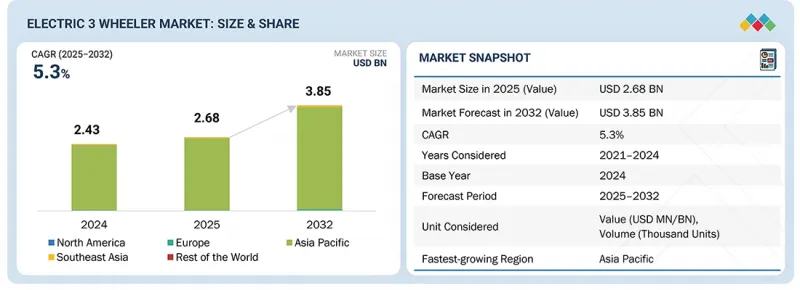
预计电动三轮车市场将从 2025 年的 26.8 亿美元成长到 2032 年的 38.5 亿美元,复合年增长率为 5.3%。
在亚洲各地对低成本最后一公里出行需求不断增长以及强有力的政策支持的推动下,全球市场正迅速走向大规模普及。
| 调查范围 | |
|---|---|
| 调查期 | 2021-2032 |
| 基准年 | 2024 |
| 预测期 | 2025-2032 |
| 目标单元 | 价值(十亿/百万美元)和数量(单位) |
| 部分 | 按马达输出功率、电池容量、电池类型、最终用途、马达类型、负载容量、续航里程和区域划分 |
| 目标区域 | 亚太地区、东南亚、欧洲、北美、世界其他地区 |
由于电池更换技术、连网车队管理以及负载效率的提升,车队营运商正优先考虑能够降低营运成本并提高车辆运转率的车辆。与内燃机 (ICE) 车型相比,电动三轮车的总拥有成本 (TCO) 预计将降低 30-40%,正逐渐成为物流、配送和客运领域的主流资产。政府补贴、融资支援以及老牌汽车製造商和新晋参与企业不断扩大的车款范围,正在加速车队转型。这一转变使电动三轮车成为新兴市场电动出行生态系统中商业化速度最快的细分市场。
对于电动三轮车车主而言,载重能力是一项至关重要的指标,因为它有助于防止车辆因超载而损坏。超过车辆的载重能力会导致维护和维修成本增加,这是应该避免的。因此,载重能力是购买电动三轮车时需要考虑的关键因素。随着电动三轮车在最终交付环节的应用日益广泛,300-500公斤载重等级的车型具有每公里成本更低、停机时间更短、运作更优等优势。 Mahindra & Mahindra Ltd.、Atul Auto Ltd.、Piaggio Group、Lohia Auto Industries 和 Kinetic Green 等公司都提供 300-500 公斤的负载容量三轮车。例如,江苏金鹏集团提供负载容量为 400 公斤的电动三轮车 (X3) 和载重能力为 332 公斤的电动三轮车 (TL)。因此,预计在预测期内,负载容量为 300-500 公斤的电动三轮车市场将保持主导地位。
多家零售、物流和宅配公司已开始小规模部署电动三轮车。随着这些车辆在商业用途中性能的提升,电动三轮车的普及率预计将大幅成长。电动三轮车在货运领域应用广泛,其每公里营运成本显着降低,使其成为高频次「最后一公里」配送的理想选择,成本效益直接转化为盈利。汽车製造商正透过与物流和「最后一公里」配送业者合作,推动电动三轮车在业界的普及。例如,2024年1月,欧米茄精机出行(Omega Seiki Mobility)与起产出行(Kissan Mobility)合作,部署500辆电动三轮车用于「最后一公里」配送。这项价值240万美元的合作涵盖多个产业的多种应用,包括电子商务、消费品和耐用品。
预计亚太地区将在预测期内成为电动三轮车最大的市场。印度末端配送和共享出行服务的快速发展正在推动电动三轮车的普及,以降低营运成本。日本政府也正在采取措施促进电动车的普及,作为其排放计画的一部分,这促进了日本电动三轮车市场的成长。同样,孟加拉製定了一项汽车产业政策,要求到2030年,至少15%的註册车辆必须使用绿色电力。预计这将促进孟加拉电动三轮车市场的发展。此外,菲律宾正在全国推广使用电动三轮车作为公共交通工具。主要城市已开始引进电动三轮车来运送居民和外籍劳工。电动三轮车也正在商业区和都市区应用。这些因素的综合作用预计将使亚太地区成为电动三轮车市场的主导。
本报告研究了全球电动三轮车市场,并按马达功率、电池容量、电池类型、最终用途、马达类型、有效载荷、负载容量里程、区域趋势以及参与市场的公司的概况提供了市场资讯。
目录
第一章 引言
第二章调查方法
第三章执行摘要
第四章重要考察
第五章 市场概览
- 介绍
- 市场动态
- 未满足的需求和差距
第六章:顾客状况与购买行为
- 决策流程
- 主要相关人员和采购标准
- 招募障碍和内部挑战
- 各种最终用途中未满足的需求
- 市场盈利
第七章:科技、专利、数位化和人工智慧应用带来的策略颠覆
- 技术分析
- 技术/产品蓝图
- 专利分析
- 未来应用
第八章永续性和监管环境
- 监管状态
- 对永续性的承诺
第九章 产业趋势
- 总体经济指标
- 生态系分析
- 价值链分析
- 电动三轮车市场的新经营模式
- 电动自行车市场区域准备指数
- 定价分析
- 影响客户业务的趋势与干扰因素
- 投资和资金筹措方案
- 电动三轮车市场总拥有成本
- 材料清单(BOM) 分析
- 海关编码
- 2025-2026 年主要会议和活动
- 案例研究分析
- MNM对电动三轮车市场电动车电池需求的洞察
第十章 电动三轮车市场(以马达输出功率划分)
- 介绍
- 1500瓦或以下
- 1,500~3,500W
- 3500瓦或以上
- 关键见解
第十一章 电动三轮车市场(以电池容量划分)
- 介绍
- 小于5千瓦时
- 5~8KWH
- 8度或以上
- 关键见解
第十二章 电动三轮车市场(依电池类型划分)
- 介绍
- 铅酸电池
- 锂离子
- 其他的
- 关键见解
第十三章 电动三轮车市场(依最终用途划分)
- 介绍
- 客运
- 载货车
- 关键见解
第十四章 电动三轮车市场(依马达类型划分)
- 介绍
- 轮毂式马达
- 中置马达
- 关键见解
第十五章 电动三轮车市场(依负载容量)
- 介绍
- 体重低于300公斤
- 300-500公斤
- 超过500公斤
- 关键见解
第十六章 电动三轮车市场(依续航里程划分)
- 介绍
- 不到50英里
- 超过50英里
- 关键见解
第十七章 电动三轮车市场(依地区划分)
- 介绍
- 亚太地区
- 印度
- 日本
- 孟加拉
- 尼泊尔
- 斯里兰卡
- 中国
- 韩国
- 欧洲
- 德国
- 法国
- 西班牙
- 义大利
- 英国
- 北美洲
- 美国
- 加拿大
- 其他地区
- 南非
- 肯亚
- 东南亚
- 泰国
- 印尼
- 菲律宾
- 越南
第十八章 竞争格局
- 介绍
- 主要参与企业策略概览(2023-2025)
- 市占率分析
- 收入分析
- 估值和财务指标
- 品牌/产品对比
- 公司估值矩阵:主要参与企业,2024 年
- 公司估值矩阵:Start-Ups/中小企业,2024 年
- 竞争场景
第十九章:公司简介
- 主要参与企业
- MAHINDRA&MAHINDRA LTD.
- YATRI ELECTRIC VEHICLE
- BAJAJ AUTO LTD.
- SAERA ELECTRIC AUTO LIMITED
- PIAGGIO & C. SPA
- CITYLIFE ELECTRIC VEHICLES
- KINETIC
- MINI METRO
- ATUL AUTO LIMITED
- TERRA MOTORS
- LOHIA AUTO INDUSTRIES(ZUPERIA AUTO PRIVATE LIMITED)
- OMEGA SEIKI MOBILITY
- 其他公司
- JIANGSU JINPENG GROUP CO., LTD.
- SKYRIDE E RICKSHAW
- SHADO GROUP INTERNATIONAL PTE. LTD.(DATANYZE)
- XIANGHE QIANGSHENG ELECTRIC TRICYCLE FACTORY
- KYBURZ
- PROZZA HIROSE MANUFACTURING INC.
- GAYAM MOTOR WORKS PVT. LTD.
- BEMAC CORPORATION
- JS AUTO(P)LTD.
- SAARTHI E-RICKSHAW
- UNIQUE INTERNATIONAL
- EULER MOTORS
- LECTRIX E-VEHICLE PVT. LTD.
第20章附录
The electric 3 wheeler market is projected to reach USD 3.85 billion by 2032, from USD 2.68 billion in 2025, with a CAGR of 5.3%. The global market is rapidly moving toward large-scale deployment, driven by heightened demand for low-cost last-mile mobility and strong policy support across Asia.
| Scope of the Report | |
|---|---|
| Years Considered for the Study | 2021-2032 |
| Base Year | 2024 |
| Forecast Period | 2025-2032 |
| Units Considered | Value (USD BN/MN) and Volume (Units) |
| Segments | Motor Type, Motor Power, Battery Capacity, Range, Battery Type, Payload Capacity, End Use, and Region |
| Regions covered | Asia Pacific, Southeast Asia, Europe, North America, Rest of the World |
Fleet operators are prioritizing vehicles that deliver lower operating costs and higher uptime, supported by advancements in battery swapping, connected fleet management, and improved payload efficiency. With a total cost of ownership now estimated to be 30-40% lower than that of ICE models, electric 3-wheelers are becoming mainstream assets for logistics, delivery, and passenger transport. The combination of government incentives, supportive financing, and the extended range of vehicle models from both established OEMs and new entrants is accelerating fleet transition. This shift is positioning electric 3-wheelers as the fastest-commercializing segment in the electric mobility ecosystem across emerging markets.
"Fleet economics and delivery growth to drive dominance of 300-500 kg electric 3-wheelers"
Payload capacity is a pivotal metric for proprietors of electric 3-wheelers, as it prevents potential overloading and subsequent damage to the vehicle. Exceeding the vehicle's payload capacity could incur expenses associated with servicing and repairs, which are best avoided. Therefore, the payload capacity emerges as a critical consideration in the procurement of electric 3-wheelers. With the increasing use of electric 3-wheelers for the last-mile delivery of goods, the 300-500 kg segment offers a lower cost per kilometer and reduced downtime, improving the performance of electric 3-wheelers. Companies such as Mahindra & Mahindra Ltd., Atul Auto Ltd., Piaggio Group, Lohia Auto Industries, and Kinetic Green offer electric 3-wheelers with a payload capacity of 30-0500 kg. For instance, Jiangsu Jinpeng Group Co., Ltd. provides the Electric Rickshaw (X3) and Electric Tricycle (TL), with payload capacities of 400 kg and 332 kg, respectively. Hence, the market for electric 3-wheelers with a payload capacity of 300-500 kg is expected to remain dominant during the forecast period.
"Rise of last-mile mobility services to drive load carrier demand"
Various retail, logistics, and courier companies have already started adopting electric 3-wheelers on a small scale. With the improving performance of these vehicles from a commercial usage standpoint, the adoption rate of electric 3-wheeler load carriers is expected to grow exponentially. Electric 3-wheelers are widely used in the cargo segment, as they offer significantly lower operating costs per kilometer, making them ideal for high-frequency last-mile deliveries where cost efficiency directly impacts profitability. OEMs are partnering with logistics and last-mile delivery providers to increase the adoption of electric 3-wheelers in the industry. For instance, in January 2024, Omega Seiki Mobility partnered with Kissan Mobility to deploy 500 electric 3-wheelers for last-mile delivery. This partnership, valued at USD 2.40 million, encompasses various applications across multiple sectors, including e-commerce, fast-moving consumer goods, and durable goods segments.
"Asia Pacific to be leading regional market during forecast period"
Asia Pacific is expected to be the largest market for electric 3-wheelers during the forecast period. India is experiencing a rapid expansion of last-mile delivery and shared mobility services, which are increasingly adopting electric 3-wheelers to reduce operating costs. The Japanese government has also taken steps to increase the adoption of EVs in the country as part of its emission reduction programs, leading to the growth of Japan's electric 3 wheeler market. Similarly, Bangladesh prepared an auto industry policy that called for at least 15% of registered vehicles to be powered by environmentally friendly electricity by 2030. This is expected to drive the electric 3 wheeler market in Bangladesh. Furthermore, the Philippines has been promoting the use of electric 3-wheelers nationwide, including as a form of public transportation. Major cities in the country have started using electric 3-wheelers to transport residents and transient workers. Electric 3-wheelers are also used in the Philippines' business districts and urban areas. Together, these factors are expected to position Asia Pacific as the leading electric 3 wheeler market.
In-depth interviews were conducted with CEOs, marketing directors, other innovation and technology directors, and executives from various key organizations operating in this market.
- By Company Type: OEMs - 24%, Tier I - 67%, Tier II and Tier III - 9%
- By Designation: CXOs - 33%, Managers - 52%, Executives - 15%
- By Country: North America - 10%, Europe - 10%, Asia Pacific - 50%, Southeast Asia - 20% Rest of the World - 10%
The electric 3 wheeler market is dominated by a few globally established players, such as Mahindra & Mahindra Ltd. (India), YC Electric Vehicle (India), Saera Electric Auto Pvt. Ltd. (India), Piaggio Group (Italy), and Bajaj Auto Ltd. (India). These companies manufacture and supply electric 3-wheelers to various countries globally. They have set up R&D infrastructure and offer best-in-class solutions to their customers.
Research Coverage:
This research report categorizes electric 3 wheeler market by end use (passenger carriers, load carriers), range (less than 50 miles, above 50 miles), battery type (lead acid, lithium-ion, other types), battery capacity (below 5 kWh, 5-8 kWh, and above 8 kWh), motor type (hub motor, mid motor, and other motors), motor power (below 1,500 W, 1,500-3,500 W, and above 3,000 W), payload capacity (up to 300 kg, 300-500 kg, and above 500 kg), and region (Asia Pacific, Southeast Asia, Europe, North America, and Rest of the World). It covers the competitive landscape and company profiles of the major players in the electric 3 wheeler market. The study also includes an in-depth competitive analysis of the key players in the market, along with their company profiles, key observations related to product and business offerings, recent developments, and key market strategies.
Key Benefits of Buying this Report:
- This report will help market leaders/new entrants in this market with information on the closest approximations of revenue numbers for the overall electric 3 wheeler ecosystem and its subsegments.
- This report will help stakeholders understand the competitive landscape and gain more insights to better position their businesses and plan suitable go-to-market strategies.
- This report will also help stakeholders understand the market's pulse and provide information on key market drivers, restraints, challenges, and opportunities.
The report provides insight on the following pointers:
- Analysis of key drivers (lower total cost of ownership; government regulations, incentives, and subsidies; advancements in battery technology coupled with reduced battery prices; increasing last-mile delivery), restraints (lack of charging infrastructure; limited power output, range, and speed; battery disposal and recycling concerns), challenges (automobile manufacturer and customer-oriented policies to promote electric 3 wheeler sales; partnership with delivery and logistics fleet operator; battery swapping offerings; fintech firms offering easy loans), and opportunities (limited battery capacity; lack of compatibility, interchangeability, and standardization).
- Product Development/Innovation: Detailed insights on upcoming technologies, research & development activities, and new product launches in the electric 3 wheeler market.
- Market Development: Comprehensive information about lucrative markets - the report analyzes the electric 3 wheeler market across various regions.
- Market Diversification: Exhaustive information about new products, untapped geographies, recent developments, and investments in the electric 3 wheeler market.
- Competitive Assessment: In-depth assessment of market ranking, growth strategies, and service offerings of leading players like Mahindra&Mahindra Ltd. (India), YC Electric Vehicle (India), Saera Electric Auto Pvt. Ltd. (India), Piaggio Group (Italy), and Bajaj Auto Ltd. (India), among others.
TABLE OF CONTENTS
1 INTRODUCTION
- 1.1 STUDY OBJECTIVES
- 1.2 MARKET DEFINITION
- 1.3 STUDY SCOPE
- 1.3.1 MARKET SEGMENTATION AND REGIONAL SCOPE
- 1.4 YEARS CONSIDERED
- 1.5 CURRENCY CONSIDERED
- 1.6 STAKEHOLDERS
- 1.7 SUMMARY OF CHANGES
2 RESEARCH METHODOLOGY
- 2.1 RESEARCH DATA
- 2.1.1 SECONDARY DATA
- 2.1.1.1 List of secondary sources
- 2.1.1.2 Key data from secondary sources
- 2.1.2 PRIMARY DATA
- 2.1.2.1 Primary interviews: Demand and supply sides
- 2.1.2.2 Key industry insights and breakdown of primary interviews
- 2.1.2.3 List of primary participants
- 2.1.1 SECONDARY DATA
- 2.2 MARKET SIZE ESTIMATION
- 2.2.1 BOTTOM-UP APPROACH
- 2.2.2 TOP-DOWN APPROACH
- 2.3 DATA TRIANGULATION
- 2.4 FACTOR ANALYSIS
- 2.5 RESEARCH ASSUMPTIONS
- 2.6 RESEARCH LIMITATIONS
3 EXECUTIVE SUMMARY
- 3.1 KEY INSIGHTS AND MARKET HIGHLIGHTS
- 3.2 KEY MARKET PARTICIPANTS: INSIGHTS AND STRATEGIC DEVELOPMENTS
- 3.3 DISRUPTIVE TRENDS SHAPING ELECTRIC 3 WHEELER MARKET
- 3.4 HIGH-GROWTH SEGMENTS & EMERGING FRONTIERS
- 3.5 POWER-PAYLOAD OPTIMIZATION AND BATTERY-PERFORMANCE ALIGNMENT DEFINING COMPETITIVE POSITIONING IN ELECTRIC 3 WHEELERS
- 3.6 SNAPSHOT: GLOBAL MARKET SIZE, GROWTH RATE, AND FORECAST
4 PREMIUM INSIGHTS
- 4.1 ATTRACTIVE OPPORTUNITIES FOR PLAYERS IN ELECTRIC 3 WHEELER MARKET
- 4.2 ELECTRIC 3 WHEELER MARKET, BY MOTOR POWER
- 4.3 ELECTRIC 3 WHEELER MARKET, BY BATTERY TYPE
- 4.4 ELECTRIC 3 WHEELER MARKET, BY RANGE
- 4.5 ELECTRIC 3 WHEELER MARKET, BY BATTERY CAPACITY
- 4.6 ELECTRIC 3 WHEELER MARKET, BY END USE
- 4.7 ELECTRIC 3 WHEELER MARKET, BY PAYLOAD CAPACITY
- 4.8 ELECTRIC 3 WHEELER MARKET, BY MOTOR TYPE
- 4.9 ELECTRIC 3 WHEELER MARKET, BY REGION
5 MARKET OVERVIEW
- 5.1 INTRODUCTION
- 5.2 MARKET DYNAMICS
- 5.2.1 DRIVERS
- 5.2.1.1 Low operating and maintenance costs
- 5.2.1.2 Government regulations, incentives, and subsidies
- 5.2.1.3 Advancements in battery technology coupled with reducing battery prices
- 5.2.1.4 Established market for electric 3 wheelers in urban transportation
- 5.2.1.5 Automobile manufacturer- and customer-oriented policies to promote electric 3 wheeler sales
- 5.2.2 RESTRAINTS
- 5.2.2.1 Lack of charging infrastructure
- 5.2.2.2 Limited power output, range, and speed of electric 3 wheelers
- 5.2.3 OPPORTUNITIES
- 5.2.3.1 Partnership between delivery and logistics fleet operators
- 5.2.4 CHALLENGES
- 5.2.4.1 Limited battery capacity
- 5.2.4.2 Lack of compatibility, interchangeability, and standardization
- 5.2.1 DRIVERS
- 5.3 UNMET NEEDS AND WHITE SPACES
- 5.3.1 INFRASTRUCTURE GAP IN SMALLER TOWNS AND RURAL AREAS
- 5.3.2 MODULAR PLATFORMS FOR DUAL USE IN ELECTRIC 3 WHEELERS
6 CUSTOMER LANDSCAPE AND BUYER BEHAVIOR
- 6.1 DECISION-MAKING PROCESS
- 6.2 KEY STAKEHOLDERS & BUYING CRITERIA
- 6.2.1 PASSENGER CARRIERS
- 6.2.2 LOAD CARRIERS
- 6.2.3 KEY STAKEHOLDERS IN BUYING PROCESS
- 6.2.4 BUYING CRITERIA
- 6.3 ADOPTION BARRIERS AND INTERNAL CHALLENGES
- 6.4 UNMET NEEDS FROM VARIOUS END USES
- 6.5 MARKET PROFITABILITY
- 6.5.1 REVENUE POTENTIAL
- 6.5.2 COST DYNAMICS
- 6.5.3 MARGIN OPPORTUNITIES, BY PAYLOAD CAPACITY
7 STRATEGIC DISRUPTION THROUGH TECHNOLOGY, PATENTS, DIGITAL, AND AI ADOPTION
- 7.1 TECHNOLOGY ANALYSIS
- 7.1.1 INTRODUCTION
- 7.1.2 KEY EMERGING TECHNOLOGIES
- 7.1.2.1 Intelligent fleet management systems for electric 3 wheelers
- 7.1.2.2 Regenerative braking systems
- 7.1.3 COMPLEMENTARY TECHNOLOGIES
- 7.1.3.1 Solar-powered electric 3 wheelers
- 7.1.3.2 Swappable battery systems
- 7.1.4 ADJACENT TECHNOLOGIES
- 7.1.4.1 Solid-state battery (SSB)
- 7.2 TECHNOLOGY/PRODUCT ROADMAP
- 7.3 PATENT ANALYSIS
- 7.3.1 INTRODUCTION
- 7.3.1.1 Methodology
- 7.3.1.2 Document type
- 7.3.1.3 Insights
- 7.3.1.4 Legal status of patents
- 7.3.1.5 Jurisdiction analysis
- 7.3.1.6 Top applicants
- 7.3.1.7 List of patents
- 7.3.1 INTRODUCTION
- 7.4 FUTURE APPLICATIONS
- 7.4.1 BATTERY AS A SERVICE
- 7.4.2 REGENERATIVE BRAKING IN ELECTRIC 3 WHEELERS
8 SUSTAINABILITY AND REGULATORY LANDSCAPE
- 8.1 REGULATORY LANDSCAPE
- 8.1.1 LIST OF REGULATORY BODIES, GOVERNMENT AGENCIES, AND OTHER ORGANIZATIONS
- 8.1.2 KEY REGULATIONS, BY KEY COUNTRY
- 8.1.2.1 India
- 8.1.2.2 China
- 8.1.2.3 Thailand
- 8.1.2.4 Vietnam
- 8.2 SUSTAINABILITY INITIATIVES
- 8.2.1 INDIA: AIS-183 STANDARD
- 8.2.2 US: FMVSS AND UL STANDARDS
- 8.2.3 EUROPEAN UNION: EEC CERTIFICATION
9 INDUSTRY TRENDS
- 9.1 MACROECONOMIC INDICATORS
- 9.1.1 INTRODUCTION
- 9.1.2 GDP TRENDS AND FORECAST
- 9.1.3 TRENDS IN GLOBAL ELECTRIC 3 WHEELER INDUSTRY
- 9.2 ECOSYSTEM ANALYSIS
- 9.2.1 RAW MATERIAL SUPPLIERS
- 9.2.2 OEMS
- 9.2.3 BATTERY MANUFACTURERS
- 9.2.4 CHARGING INFRASTRUCTURE PROVIDERS
- 9.2.5 POWERTRAIN MANUFACTURERS
- 9.2.6 POWER ELECTRONICS SUPPLIERS
- 9.2.7 MOTOR MANUFACTURERS
- 9.2.8 TELEMATICS AND CONNECTED SOLUTION PROVIDERS
- 9.3 VALUE CHAIN ANALYSIS
- 9.4 EMERGING BUSINESS MODELS IN ELECTRIC 3 WHEELER MARKET
- 9.4.1 FLEET-AS-A-SERVICE (FAAS): ACCELERATING ELECTRIC 3 WHEELER ADOPTION THROUGH MANAGED MOBILITY SOLUTIONS
- 9.5 REGION-LEVEL READINESS INDEX FOR ELECTRIC 3 WHEELER MARKET
- 9.6 PRICING ANALYSIS
- 9.6.1 AVERAGE SELLING PRICE TREND OF ELECTRIC 3 WHEELERS, BY KEY PLAYER
- 9.6.2 AVERAGE SELLING PRICE TREND, BY REGION, 2022-2024
- 9.7 TRENDS AND DISRUPTIONS IMPACTING CUSTOMER BUSINESS
- 9.8 INVESTMENT & FUNDING SCENARIO
- 9.9 TOTAL COST OF OWNERSHIP FOR ELECTRIC 3 WHEELER MARKET
- 9.10 BILL OF MATERIALS (BOM) ANALYSIS
- 9.11 HS CODE
- 9.11.1 IMPORT SCENARIO (HS CODE 870390)
- 9.11.2 EXPORT SCENARIO (HS CODE 870390)
- 9.12 KEY CONFERENCES & EVENTS, 2025-2026
- 9.13 CASE STUDY ANALYSIS
- 9.13.1 DEPLOYMENT OF ELECTRIC TRICYCLES WITH ONBOARD TELEMATICS TO MONITOR BATTERY STATE, DISPATCH SCHEDULE, AND CHARGING USAGE
- 9.13.2 LOCAL GOVERNMENT SUPPORT COVERING CHARGING INFRASTRUCTURE AND SUPPLY SIDE MEASURES TO REDUCE VEHICLE COSTS
- 9.13.3 RACE DESIGNED LIGHTWEIGHT, ENERGY-DENSE BATTERY PACKS THAT CAN BE SWAPPED IN MINUTES
- 9.13.4 SUN MOBILITY INTRODUCED SUBSCRIPTION-BASED SWAPPING MODEL WHERE USERS PAY ONLY FOR ENERGY CONSUMED
- 9.14 MNM INSIGHTS INTO EV BATTERY REQUIREMENTS FOR ELECTRIC 3 WHEELER MARKET
- 9.14.1 ELECTRIC 3 WHEELER CARGO MODELS: PAYLOAD CAPACITY VS. MOTOR POWER BENCHMARKING
- 9.14.2 EVOLVING POWER-BATTERY ALIGNMENT DRIVING PRODUCT SEGMENTATION IN ELECTRIC 3 WHEELER PASSENGER MARKET
10 ELECTRIC 3 WHEELER MARKET, BY MOTOR POWER
- 10.1 INTRODUCTION
- 10.2 BELOW 1,500 W
- 10.2.1 RISING DEMAND FOR LOW-POWERED EVS FOR SHORT-DISTANCE TRAVEL TO BOOST GROWTH
- 10.3 1,500-3,500 W
- 10.3.1 FOCUS ON ENHANCING LOAD CAPACITY AND RANGE TO DRIVE DEMAND
- 10.4 ABOVE 3,500 W
- 10.4.1 EXPANSION IN HIGH-CAPACITY GOODS TRANSPORT AND HEAVY-DUTY URBAN LOGISTICS TO FUEL DEMAND
- 10.5 KEY PRIMARY INSIGHTS
11 ELECTRIC 3 WHEELER MARKET, BY BATTERY CAPACITY
- 11.1 INTRODUCTION
- 11.2 BELOW 5 KWH
- 11.2.1 RISING DEMAND FOR COST-EFFECTIVE AND ZERO-EMISSION TRANSPORT SOLUTIONS TO PROPEL MARKET GROWTH
- 11.3 5-8 KWH
- 11.3.1 GROWING DEMAND FOR LONG-RANGE AND HIGH LOAD CAPACITY TO FUEL MARKET EXPANSION
- 11.4 ABOVE 8 KWH
- 11.4.1 GROWING DEMAND FOR HIGH BATTERY CAPACITY FOR LAST-MILE DELIVERY TO DRIVE MARKET
- 11.5 KEY PRIMARY INSIGHTS
12 ELECTRIC 3 WHEELER MARKET, BY BATTERY TYPE
- 12.1 INTRODUCTION
- 12.2 LEAD ACID
- 12.2.1 DEMAND FOR LOW-COST BATTERIES TO DRIVE MARKET
- 12.3 LITHIUM-ION
- 12.3.1 ONGOING INNOVATIONS AND ADVANCEMENTS IN BATTERY TECHNOLOGY TO DRIVE MARKET
- 12.4 OTHERS
- 12.5 KEY PRIMARY INSIGHTS
13 ELECTRIC 3 WHEELER MARKET, BY END USE
- 13.1 INTRODUCTION
- 13.2 PASSENGER CARRIER
- 13.2.1 GROWING GOVERNMENT SUPPORT AND EASY AVAILABILITY OF FINANCE TO DRIVE GROWTH
- 13.3 LOAD CARRIER
- 13.3.1 GROWING DEMAND FOR LAST-MILE MOBILITY SERVICES TO DRIVE MARKET
- 13.4 KEY PRIMARY INSIGHTS
14 ELECTRIC 3 WHEELER MARKET, BY MOTOR TYPE
- 14.1 INTRODUCTION
- 14.2 HUB MOTOR
- 14.2.1 RISING DEMAND FOR VEHICLES WITH ENHANCED ACCELERATION, CONTROL, AND MAINTENANCE EFFICIENCY TO DRIVE MARKET
- 14.3 MID MOTOR
- 14.3.1 MID MOTORS FAVORED FOR MODULAR ASSEMBLY AND SCALABILITY
- 14.4 KEY PRIMARY INSIGHTS
15 ELECTRIC 3 WHEELER MARKET, BY PAYLOAD CAPACITY
- 15.1 INTRODUCTION
- 15.2 UP TO 300 KG
- 15.2.1 DEMAND FOR AFFORDABLE TRANSPORT OF GOODS OVER SHORT DISTANCES TO DRIVE MARKET
- 15.3 300-500 KG
- 15.3.1 RAPID GROWTH IN E-COMMERCE INDUSTRY TO BOOST MARKET
- 15.4 ABOVE 500 KG
- 15.4.1 GROWING DEMAND FOR BETTER UNIT ECONOMICS IN ELECTRIC LAST-MILE DELIVERY TO DRIVE MARKET
- 15.5 KEY PRIMARY INSIGHTS
16 ELECTRIC 3 WHEELER MARKET, BY RANGE
- 16.1 INTRODUCTION
- 16.2 LESS THAN 50 MILES
- 16.2.1 INCREASING SHORT-DISTANCE URBAN COMMUTING TO DRIVE MARKET
- 16.3 ABOVE 50 MILES
- 16.3.1 SHIFT TOWARD LI-ION BATTERIES AND REDUCTION IN BATTERY COSTS TO DRIVE DEMAND
- 16.4 KEY PRIMARY INSIGHTS
17 ELECTRIC 3 WHEELER MARKET, BY REGION
- 17.1 INTRODUCTION
- 17.2 ASIA PACIFIC
- 17.2.1 INDIA
- 17.2.1.1 Expansion of e-commerce and quick-commerce to drive rapid adoption of electric load carriers
- 17.2.2 JAPAN
- 17.2.2.1 Last-mile logistics to create strategic pathways for electric 3 wheelers
- 17.2.3 BANGLADESH
- 17.2.3.1 Demand for low-cost, locally produced electric rickshaws to drive market
- 17.2.4 NEPAL
- 17.2.4.1 Rising adoption of 3 wheelers and private sector financing to drive market
- 17.2.5 SRI LANKA
- 17.2.5.1 Increased tourism and urban commuting to sustain dominance of electric passenger carriers
- 17.2.6 CHINA
- 17.2.6.1 Rural mobility demand and local transport needs to drive dominance of electric passenger carriers
- 17.2.7 SOUTH KOREA
- 17.2.7.1 Need for compact, low-emission transport for dense urban areas to drive market
- 17.2.1 INDIA
- 17.3 EUROPE
- 17.3.1 GERMANY
- 17.3.1.1 Multimodal transport policies to create strategic space for passenger 3 wheelers
- 17.3.2 FRANCE
- 17.3.2.1 City freight decarbonization policies to create momentum for electric load carriers
- 17.3.3 SPAIN
- 17.3.3.1 Tourism-driven urban mobility policies to strengthen adoption of passenger electric 3 wheelers
- 17.3.4 ITALY
- 17.3.4.1 ZTL expansion and urban density to drive adoption of electric load carriers
- 17.3.5 UK
- 17.3.5.1 Government plans to electrify all on-road vehicles from 2035 to drive market
- 17.3.1 GERMANY
- 17.4 NORTH AMERICA
- 17.4.1 US
- 17.4.1.1 Government plans to slash tailpipe emissions by 49% by 2032 to drive market
- 17.4.2 CANADA
- 17.4.2.1 Urban transport electrification to create strategic space for passenger 3 wheelers
- 17.4.1 US
- 17.5 REST OF THE WORLD
- 17.5.1 SOUTH AFRICA
- 17.5.1.1 Increase in EV imports and improvement in EV charging infrastructure to drive market
- 17.5.2 KENYA
- 17.5.2.1 National electric vehicles' policy to drive market
- 17.5.1 SOUTH AFRICA
- 17.6 SOUTHEAST ASIA
- 17.6.1 THAILAND
- 17.6.1.1 Public-private collaboration to accelerate deployment of electric 3 wheelers in urban centers
- 17.6.2 INDONESIA
- 17.6.2.1 Integration of local manufacturing and national industrial policy to advance passenger EV uptake
- 17.6.3 PHILIPPINES
- 17.6.3.1 Expansion of last-mile logistics to drive rapid electrification of cargo 3 wheelers
- 17.6.4 VIETNAM
- 17.6.4.1 Supportive government policies for EV adoption to drive market
- 17.6.1 THAILAND
18 COMPETITIVE LANDSCAPE
- 18.1 INTRODUCTION
- 18.2 OVERVIEW OF KEY PLAYER STRATEGIES, 2023-2025
- 18.3 MARKET SHARE ANALYSIS
- 18.4 REVENUE ANALYSIS
- 18.5 COMPANY VALUATION AND FINANCIAL METRICS
- 18.6 BRAND/PRODUCT COMPARISON
- 18.7 COMPANY EVALUATION MATRIX: KEY PLAYERS, 2024
- 18.7.1 STARS
- 18.7.2 EMERGING LEADERS
- 18.7.3 PERVASIVE PLAYERS
- 18.7.4 PARTICIPANTS
- 18.7.5 COMPANY FOOTPRINT: KEY PLAYERS, 2024
- 18.8 COMPANY EVALUATION MATRIX: STARTUPS/SMES, 2024
- 18.8.1 PROGRESSIVE COMPANIES
- 18.8.2 RESPONSIVE COMPANIES
- 18.8.3 DYNAMIC COMPANIES
- 18.8.4 STARTING BLOCKS
- 18.8.5 COMPETITIVE BENCHMARKING
- 18.9 COMPETITIVE SCENARIO
- 18.9.1 PRODUCT LAUNCHES
- 18.9.2 DEALS
- 18.9.3 EXPANSION
- 18.9.4 OTHER DEVELOPMENTS
19 COMPANY PROFILES
- 19.1 KEY PLAYERS
- 19.1.1 MAHINDRA&MAHINDRA LTD.
- 19.1.1.1 Business overview
- 19.1.1.2 Products/Services offered
- 19.1.1.3 Recent developments
- 19.1.1.4 MnM view
- 19.1.1.4.1 Key strengths
- 19.1.1.4.2 Strategic choices
- 19.1.1.4.3 Weaknesses and competitive threats
- 19.1.2 YATRI ELECTRIC VEHICLE
- 19.1.2.1 Business overview
- 19.1.2.2 Products/Services offered
- 19.1.2.3 MnM view
- 19.1.2.3.1 Key strengths
- 19.1.2.3.2 Strategic choices
- 19.1.2.3.3 Weaknesses and competitive threats
- 19.1.3 BAJAJ AUTO LTD.
- 19.1.3.1 Business overview
- 19.1.3.2 Products/Services offered
- 19.1.3.3 Recent developments
- 19.1.3.4 MnM view
- 19.1.3.4.1 Key strengths
- 19.1.3.4.2 Strategic choices
- 19.1.3.4.3 Weaknesses and competitive threats
- 19.1.4 SAERA ELECTRIC AUTO LIMITED
- 19.1.4.1 Business overview
- 19.1.4.2 Products/Services offered
- 19.1.4.3 Recent developments
- 19.1.4.4 MnM view
- 19.1.4.4.1 Key strengths
- 19.1.4.4.2 Strategic choices
- 19.1.4.4.3 Weaknesses and competitive threats
- 19.1.5 PIAGGIO & C. SPA
- 19.1.5.1 Business overview
- 19.1.5.2 Products/Services offered
- 19.1.5.3 Recent developments
- 19.1.5.4 MnM view
- 19.1.5.4.1 Key strengths
- 19.1.5.4.2 Strategic choices
- 19.1.5.4.3 Weaknesses and competitive threats
- 19.1.6 CITYLIFE ELECTRIC VEHICLES
- 19.1.6.1 Business overview
- 19.1.6.2 Products/Services offered
- 19.1.7 KINETIC
- 19.1.7.1 Business overview
- 19.1.7.2 Products/Services offered
- 19.1.7.3 Recent developments
- 19.1.8 MINI METRO
- 19.1.8.1 Business overview
- 19.1.8.2 Products/Services offered
- 19.1.9 ATUL AUTO LIMITED
- 19.1.9.1 Business overview
- 19.1.9.2 Products/Services offered
- 19.1.9.3 Recent developments
- 19.1.10 TERRA MOTORS
- 19.1.10.1 Business overview
- 19.1.10.2 Products/Services offered
- 19.1.10.3 Recent developments
- 19.1.11 LOHIA AUTO INDUSTRIES (ZUPERIA AUTO PRIVATE LIMITED)
- 19.1.11.1 Business overview
- 19.1.11.2 Products/Services offered
- 19.1.12 OMEGA SEIKI MOBILITY
- 19.1.12.1 Business overview
- 19.1.12.2 Products/Services offered
- 19.1.12.3 Recent developments
- 19.1.1 MAHINDRA&MAHINDRA LTD.
- 19.2 OTHER PLAYERS
- 19.2.1 JIANGSU JINPENG GROUP CO., LTD.
- 19.2.2 SKYRIDE E RICKSHAW
- 19.2.3 SHADO GROUP INTERNATIONAL PTE. LTD. (DATANYZE)
- 19.2.4 XIANGHE QIANGSHENG ELECTRIC TRICYCLE FACTORY
- 19.2.5 KYBURZ
- 19.2.6 PROZZA HIROSE MANUFACTURING INC.
- 19.2.7 GAYAM MOTOR WORKS PVT. LTD.
- 19.2.8 BEMAC CORPORATION
- 19.2.9 J.S. AUTO (P) LTD.
- 19.2.10 SAARTHI E-RICKSHAW
- 19.2.11 UNIQUE INTERNATIONAL
- 19.2.12 EULER MOTORS
- 19.2.13 LECTRIX E-VEHICLE PVT. LTD.
20 APPENDIX
- 20.1 KEY INSIGHTS FROM INDUSTRY EXPERTS
- 20.2 DISCUSSION GUIDE
- 20.3 KNOWLEDGESTORE: MARKETSANDMARKETS' SUBSCRIPTION PORTAL
- 20.4 CUSTOMIZATION OPTIONS
- 20.4.1 ELECTRIC 3 WHEELER MARKET, BY BATTERY TYPE, AT THE COUNTRY LEVEL (FOR COUNTRIES COVERED IN THE REPORT)
- 20.4.2 ELECTRIC 3 WHEELER MARKET, BY BATTERY CAPACITY, AT THE COUNTRY LEVEL (FOR COUNTRIES COVERED IN THE REPORT)
- 20.4.3 COMPANY INFORMATION
- 20.4.3.1 Profiling of additional market players (up to 5)
- 20.5 RELATED REPORTS
- 20.6 AUTHOR DETAILS
List of Tables
- TABLE 1 ELECTRIC 3 WHEELER MARKET DEFINITION, BY END USE
- TABLE 2 ELECTRIC 3 WHEELER MARKET DEFINITION, BY BATTERY TYPE
- TABLE 3 ELECTRIC 3 WHEELER MARKET DEFINITION, BY MOTOR TYPE
- TABLE 4 ELECTRIC 3 WHEELER MARKET DEFINITION, BY MOTOR POWER
- TABLE 5 ELECTRIC 3 WHEELER MARKET DEFINITION, BY BATTERY CAPACITY
- TABLE 6 ELECTRIC 3 WHEELER MARKET DEFINITION, BY RANGE
- TABLE 7 ELECTRIC 3 WHEELER MARKET DEFINITION, BY PAYLOAD CAPACITY
- TABLE 8 INCLUSIONS & EXCLUSIONS
- TABLE 9 CURRENCY EXCHANGE RATES, 2019-2024
- TABLE 10 MAINTENANCE COST OF ELECTRIC 3 WHEELERS, BY VEHICLE MODEL
- TABLE 11 CONVENTIONAL FUEL 3 WHEELER VS. ELECTRIC 3 WHEELER
- TABLE 12 EMISSION REGULATION SPECIFICATIONS FOR FUEL TYPES, BY KEY COUNTRY, 2016-2025
- TABLE 13 INDIA: GOVERNMENT INCENTIVES, BY MODEL, 2025
- TABLE 14 BUDGETARY ALLOCATION AND EXPENDITURE OF FUNDS UNDER FAME-II
- TABLE 15 COMPARISON BETWEEN BATTERY TECHNOLOGIES USED IN ELECTRIC 3 WHEELERS
- TABLE 16 INDIA: SPECIFICATIONS OF CHARGING INFRASTRUCTURE
- TABLE 17 ELECTRIC 3 WHEELER RANGE, BY MODEL
- TABLE 18 INDIA: E-RICKSHAW VS. ELECTRIC AUTO RICKSHAW
- TABLE 19 ELECTRIC 3 WHEELER MODELS, BY BATTERY CAPACITY
- TABLE 20 ELECTRIC 3 WHEELER MARKET: IMPACT OF MARKET DYNAMICS
- TABLE 21 INFLUENCE OF STAKEHOLDERS ON BUYING PROCESS FOR END USES (%)
- TABLE 22 KEY BUYING CRITERIA, BY END USE
- TABLE 23 UNMET NEEDS IN ELECTRIC 3 WHEELER MARKET, BY END USE
- TABLE 24 ELECTRIC 3 WHEELER MARKET: TOTAL NUMBER OF PATENTS, JANUARY 2014-DECEMBER 2024
- TABLE 25 IMPORTANT PATENT REGISTRATIONS RELATED TO ELECTRIC 3 WHEELER MARKET
- TABLE 26 ASIA PACIFIC: LIST OF REGULATORY BODIES, GOVERNMENT AGENCIES, AND OTHER ORGANIZATIONS
- TABLE 27 NORTH AMERICA: LIST OF REGULATORY BODIES, GOVERNMENT AGENCIES, AND OTHER ORGANIZATIONS
- TABLE 28 EUROPE: LIST OF REGULATORY BODIES, GOVERNMENT AGENCIES, AND OTHER ORGANIZATIONS
- TABLE 29 INDIA: GOVERNMENT INCENTIVES, BY STATE
- TABLE 30 GDP PERCENTAGE CHANGE, BY KEY COUNTRY, 2021-2030
- TABLE 31 ELECTRIC 3 WHEELER MARKET: ROLE OF COMPANIES IN ECOSYSTEM
- TABLE 32 AVERAGE SELLING PRICE TREND OF ELECTRIC 3 WHEELERS, BY KEY PLAYER, 2022-2024 (USD)
- TABLE 33 AVERAGE SELLING PRICE TREND, BY REGION, 2022-2024 (USD)
- TABLE 34 IMPORT DATA FOR HS CODE 870390-COMPLIANT PRODUCTS, BY COUNTRY, 2020-2024 (USD BILLION)
- TABLE 35 EXPORT DATA FOR HS CODE 870390-COMPLIANT PRODUCTS, BY COUNTRY, 2020-2024 (USD BILLION)
- TABLE 36 KEY CONFERENCES & EVENTS, 2025-2026
- TABLE 37 ELECTRIC 3 WHEELER MARKET, BY MOTOR POWER, 2021-2024 (UNITS)
- TABLE 38 ELECTRIC 3 WHEELER MARKET, BY MOTOR POWER, 2025-2032 (UNITS)
- TABLE 39 KEY ELECTRIC 3 WHEELER MODELS, BY MOTOR POWER
- TABLE 40 FACTORS DECIDING USE OF MOTORS IN ELECTRIC 3 WHEELERS
- TABLE 41 BELOW 1,500 W: ELECTRIC 3 WHEELER MARKET, BY REGION, 2021-2024 (UNITS)
- TABLE 42 BELOW 1,500 W: ELECTRIC 3 WHEELER MARKET, BY REGION, 2025-2032 (UNITS)
- TABLE 43 1,500-3,500 W: ELECTRIC 3 WHEELER MARKET, BY REGION, 2021-2024 (UNITS)
- TABLE 44 1,500-3,500 W: ELECTRIC 3 WHEELER MARKET, BY REGION, 2025-2032 (UNITS)
- TABLE 45 ABOVE 3,500 W: ELECTRIC 3 WHEELER MARKET, BY REGION, 2021-2024 (UNITS)
- TABLE 46 ABOVE 3,500 W: ELECTRIC 3 WHEELER MARKET, BY REGION, 2025-2032 (UNITS)
- TABLE 47 TYPES OF BATTERIES USED IN ELECTRIC 3 WHEELERS
- TABLE 48 ELECTRIC 3 WHEELER MARKET, BY BATTERY CAPACITY, 2021-2024 (UNITS)
- TABLE 49 ELECTRIC 3 WHEELER MARKET, BY BATTERY CAPACITY, 2025-2032 (UNITS)
- TABLE 50 BATTERIES WITH CAPACITY BELOW 5 KWH USED IN ELECTRIC 3 WHEELERS
- TABLE 51 BELOW 5 KWH: ELECTRIC 3 WHEELER MARKET, BY REGION, 2021-2024 (UNITS)
- TABLE 52 BELOW 5 KWH: ELECTRIC 3 WHEELER MARKET, BY REGION, 2025-2032 (UNITS)
- TABLE 53 ELECTRIC 3 WHEELER MODELS, BY BATTERY CAPACITY
- TABLE 54 5-8 KWH: ELECTRIC 3 WHEELER MARKET, BY REGION, 2021-2024 (UNITS)
- TABLE 55 5-8 KWH: ELECTRIC 3 WHEELER MARKET, BY REGION, 2025-2032 (UNITS)
- TABLE 56 BATTERIES (ABOVE 8 KWH) USED IN ELECTRIC 3 WHEELERS
- TABLE 57 ABOVE 8 KWH: ELECTRIC 3 WHEELER MARKET, BY REGION, 2021-2024 (UNITS)
- TABLE 58 ABOVE 8 KWH: ELECTRIC 3 WHEELER MARKET, BY REGION, 2025-2032 (UNITS)
- TABLE 59 ELECTRIC 3 WHEELER MARKET, BY BATTERY TYPE, 2021-2024 (UNITS)
- TABLE 60 ELECTRIC 3 WHEELER MARKET, BY BATTERY TYPE, 2025-2032 (UNITS)
- TABLE 61 ELECTRIC 3 WHEELER MODELS AND BATTERY TYPES
- TABLE 62 REPLACEMENT COST OF BATTERY PACKS, BY OEM
- TABLE 63 LEAD ACID: ELECTRIC 3 WHEELER MARKET, BY REGION, 2021-2024 (UNITS)
- TABLE 64 LEAD ACID: ELECTRIC 3 WHEELER MARKET, BY REGION, 2025-2032 (UNITS)
- TABLE 65 PRICE OF POPULAR LITHIUM-ION BATTERIES
- TABLE 66 LITHIUM-ION: ELECTRIC 3 WHEELER MARKET, BY REGION, 2021-2024 (UNITS)
- TABLE 67 LITHIUM-ION: ELECTRIC 3 WHEELER MARKET, BY REGION, 2025-2032 (UNITS)
- TABLE 68 SODIUM-ION BATTERY PROVIDERS
- TABLE 69 OTHERS: ELECTRIC 3 WHEELER MARKET, BY REGION, 2025-2032 (UNITS)
- TABLE 70 ELECTRIC 3 WHEELER MARKET, BY END USE, 2021-2024 (UNITS)
- TABLE 71 ELECTRIC 3 WHEELER MARKET, BY END USE, 2025-2032 (UNITS)
- TABLE 72 ELECTRIC 3 WHEELER MARKET, BY END USE, 2021-2024 (USD)
- TABLE 73 ELECTRIC 3 WHEELER MARKET, BY END USE, 2025-2032 (USD)
- TABLE 74 TOP-SELLING ELECTRIC 3 WHEELER MODELS AND THEIR END USES
- TABLE 75 PASSENGER CARRIER: ELECTRIC 3 WHEELER MARKET, BY REGION, 2021-2024 (UNITS)
- TABLE 76 PASSENGER CARRIER: ELECTRIC 3 WHEELER MARKET, BY REGION, 2025-2032 (UNITS)
- TABLE 77 LOAD CARRIER: ELECTRIC 3 WHEELER MARKET, BY REGION, 2021-2024 (UNITS)
- TABLE 78 LOAD CARRIER: ELECTRIC 3 WHEELER MARKET, BY REGION, 2025-2032 (UNITS)
- TABLE 79 ELECTRIC 3 WHEELER MARKET, BY MOTOR TYPE, 2021-2024 (UNITS)
- TABLE 80 ELECTRIC 3 WHEELER MARKET, BY MOTOR TYPE, 2025-2032 (UNITS)
- TABLE 81 HUB MOTOR: ELECTRIC 3 WHEELER MARKET, BY REGION, 2021-2024 (UNITS)
- TABLE 82 HUB MOTOR: ELECTRIC 3 WHEELER MARKET, BY REGION, 2025-2032 (UNITS)
- TABLE 83 MID MOTOR: ELECTRIC 3 WHEELER MARKET, BY REGION, 2021-2024 (UNITS)
- TABLE 84 MID MOTOR: ELECTRIC 3 WHEELER MARKET, BY REGION, 2025-2032 (UNITS)
- TABLE 85 ELECTRIC 3 WHEELER MARKET, BY PAYLOAD CAPACITY, 2021-2024 (UNITS)
- TABLE 86 ELECTRIC 3 WHEELER MARKET, BY PAYLOAD CAPACITY, 2025-2032 (UNITS)
- TABLE 87 UP TO 300 KG: ELECTRIC 3 WHEELER MARKET, BY REGION, 2021-2024 (UNITS)
- TABLE 88 UP TO 300 KG: ELECTRIC 3 WHEELER MARKET, BY REGION, 2025-2032 (UNITS)
- TABLE 89 300-500 KG: ELECTRIC 3 WHEELER MARKET, BY REGION, 2021-2024 (UNITS)
- TABLE 90 300-500 KG: ELECTRIC 3 WHEELER MARKET, BY REGION, 2025-2032 (UNITS)
- TABLE 91 ABOVE 500 KG: ELECTRIC 3 WHEELER MARKET, BY REGION, 2021-2024 (UNITS)
- TABLE 92 ABOVE 500 KG: ELECTRIC 3 WHEELER MARKET, BY REGION, 2025-2032 (UNITS)
- TABLE 93 ELECTRIC 3 WHEELER MARKET, BY RANGE, 2021-2024 (UNITS)
- TABLE 94 ELECTRIC 3 WHEELER MARKET, BY RANGE, 2025-2032 (UNITS)
- TABLE 95 LESS THAN 50 MILES: ELECTRIC 3 WHEELER MARKET, BY REGION, 2021-2024 (UNITS)
- TABLE 96 LESS THAN 50 MILES: ELECTRIC 3 WHEELER MARKET, BY REGION, 2025-2032 (UNITS)
- TABLE 97 ABOVE 50 MILES: ELECTRIC 3 WHEELER MARKET, BY REGION, 2021-2024 (UNITS)
- TABLE 98 ABOVE 50 MILES: ELECTRIC 3 WHEELER MARKET, BY REGION, 2025-2032 (UNITS)
- TABLE 99 ELECTRIC 3 WHEELER MARKET, BY REGION, 2021-2024 (UNITS)
- TABLE 100 ELECTRIC 3 WHEELER MARKET, BY REGION, 2025-2032 (UNITS)
- TABLE 101 ELECTRIC 3 WHEELER MARKET, BY REGION, 2021-2024 (USD MILLION)
- TABLE 102 ELECTRIC 3 WHEELER MARKET, BY REGION, 2025-2032 (USD MILLION)
- TABLE 103 ASIA PACIFIC: ELECTRIC 3 WHEELER MARKET, BY COUNTRY, 2021-2024 (UNITS)
- TABLE 104 ASIA PACIFIC: ELECTRIC 3 WHEELER MARKET, BY COUNTRY, 2025-2032 (UNITS)
- TABLE 105 INDIA: ELECTRIC 3 WHEELER MARKET, BY END USE, 2021-2024 (UNITS)
- TABLE 106 INDIA: ELECTRIC 3 WHEELER MARKET, BY END USE, 2025-2032 (UNITS)
- TABLE 107 JAPAN: ELECTRIC 3 WHEELER MARKET, BY END USE, 2021-2024 (UNITS)
- TABLE 108 JAPAN: ELECTRIC 3 WHEELER MARKET, BY END USE, 2025-2032 (UNITS)
- TABLE 109 BANGLADESH: ELECTRIC 3 WHEELER MARKET, BY END USE, 2021-2024 (UNITS)
- TABLE 110 BANGLADESH: ELECTRIC 3 WHEELER MARKET, BY END USE, 2025-2032 (UNITS)
- TABLE 111 NEPAL: ELECTRIC 3 WHEELER MARKET, BY END USE, 2021-2024 (UNITS)
- TABLE 112 NEPAL: ELECTRIC 3 WHEELER MARKET, BY END USE, 2025-2032 (UNITS)
- TABLE 113 SRI LANKA: ELECTRIC 3 WHEELER MARKET, BY END USE, 2021-2024 (UNITS)
- TABLE 114 SRI LANKA: ELECTRIC 3 WHEELER MARKET, BY END USE, 2025-2032 (UNITS)
- TABLE 115 CHINA: ELECTRIC 3 WHEELER MARKET, BY END USE, 2021-2024 (UNITS)
- TABLE 116 CHINA: ELECTRIC 3 WHEELER MARKET, BY END USE, 2025-2032 (UNITS)
- TABLE 117 SOUTH KOREA: ELECTRIC 3 WHEELER MARKET, BY END USE, 2021-2024 (UNITS)
- TABLE 118 SOUTH KOREA: ELECTRIC 3 WHEELER MARKET, BY END USE, 2025-2032 (UNITS)
- TABLE 119 EUROPE: ELECTRIC 3 WHEELER MARKET, BY COUNTRY, 2021-2024 (UNITS)
- TABLE 120 EUROPE: ELECTRIC 3 WHEELER MARKET, BY COUNTRY, 2025-2032 (UNITS)
- TABLE 121 GERMANY: ELECTRIC 3 WHEELER MARKET, BY END USE, 2021-2024 (UNITS)
- TABLE 122 GERMANY: ELECTRIC 3 WHEELER MARKET, BY END USE, 2025-2032 (UNITS)
- TABLE 123 FRANCE: ELECTRIC 3 WHEELER MARKET, BY END USE, 2021-2024 (UNITS)
- TABLE 124 FRANCE: ELECTRIC 3 WHEELER MARKET, BY END USE, 2025-2032 (UNITS)
- TABLE 125 SPAIN: ELECTRIC 3 WHEELER MARKET, BY END USE, 2021-2024 (UNITS)
- TABLE 126 SPAIN: ELECTRIC 3 WHEELER MARKET, BY END USE, 2025-2032 (UNITS)
- TABLE 127 ITALY: ELECTRIC 3 WHEELER MARKET, BY END USE, 2021-2024 (UNITS)
- TABLE 128 ITALY: ELECTRIC 3 WHEELER MARKET, BY END USE, 2025-2032 (UNITS)
- TABLE 129 UK: ELECTRIC 3 WHEELER MARKET, BY END USE, 2021-2024 (UNITS)
- TABLE 130 UK: ELECTRIC 3 WHEELER MARKET, BY END USE, 2025-2032 (UNITS)
- TABLE 131 NORTH AMERICA: ELECTRIC 3 WHEELER MARKET, BY COUNTRY, 2021-2024 (UNITS)
- TABLE 132 NORTH AMERICA: ELECTRIC 3 WHEELER MARKET, BY COUNTRY, 2025-2032 (UNITS)
- TABLE 133 US: ELECTRIC 3 WHEELER MARKET, BY END USE, 2021-2024 (UNITS)
- TABLE 134 US: ELECTRIC 3 WHEELER MARKET, BY END USE, 2025-2032 (UNITS)
- TABLE 135 CANADA: ELECTRIC 3 WHEELER MARKET, BY END USE, 2021-2024 (UNITS)
- TABLE 136 CANADA: ELECTRIC 3 WHEELER MARKET, BY END USE, 2025-2032 (UNITS)
- TABLE 137 REST OF THE WORLD: ELECTRIC 3 WHEELER MARKET, BY COUNTRY, 2021-2024 (UNITS)
- TABLE 138 REST OF THE WORLD: ELECTRIC 3 WHEELER MARKET, BY COUNTRY, 2025-2032 (UNITS)
- TABLE 139 SOUTH AFRICA: ELECTRIC 3 WHEELER MARKET, BY END USE, 2021-2024 (UNITS)
- TABLE 140 SOUTH AFRICA: ELECTRIC 3 WHEELER MARKET, BY END USE, 2025-2032 (UNITS)
- TABLE 141 KENYA: ELECTRIC 3 WHEELER MARKET, BY END USE, 2021-2024 (UNITS)
- TABLE 142 KENYA: ELECTRIC 3 WHEELER MARKET, BY END USE, 2025-2032 (UNITS)
- TABLE 143 SOUTHEAST ASIA: ELECTRIC 3 WHEELER MARKET, BY COUNTRY, 2021-2024 (UNITS)
- TABLE 144 SOUTHEAST ASIA: ELECTRIC 3 WHEELER MARKET, BY COUNTRY, 2025-2032 (UNITS)
- TABLE 145 THAILAND: ELECTRIC 3 WHEELER MARKET, BY END USE, 2021-2024 (UNITS)
- TABLE 146 THAILAND: ELECTRIC 3 WHEELER MARKET, BY END USE, 2025-2032 (UNITS)
- TABLE 147 INDONESIA: ELECTRIC 3 WHEELER MARKET, BY END USE, 2021-2024 (UNITS)
- TABLE 148 INDONESIA: ELECTRIC 3 WHEELER MARKET, BY END USE, 2025-2032 (UNITS)
- TABLE 149 PHILIPPINES: ELECTRIC 3 WHEELER MARKET, BY END USE, 2021-2024 (UNITS)
- TABLE 150 PHILIPPINES: ELECTRIC 3 WHEELER MARKET, BY END USE, 2025-2032 (UNITS)
- TABLE 151 VIETNAM: ELECTRIC 3 WHEELER MARKET, BY END USE, 2021-2024 (UNITS)
- TABLE 152 VIETNAM: ELECTRIC 3 WHEELER MARKET, BY END USE, 2025-2032 (UNITS)
- TABLE 153 KEY PLAYER STRATEGIES, JANUARY 2023-MARCH 2025
- TABLE 154 MARKET SHARE ANALYSIS OF TOP FIVE PLAYERS, 2024
- TABLE 155 ELECTRIC 3 WHEELER MARKET: REGION FOOTPRINT, 2024
- TABLE 156 ELECTRIC 3 WHEELER MARKET: MOTOR POWER FOOTPRINT, 2024
- TABLE 157 ELECTRIC 3 WHEELER MARKET: END USE FOOTPRINT, 2024
- TABLE 158 LIST OF KEY STARTUPS/SMES
- TABLE 159 COMPETITIVE BENCHMARKING OF KEY STARTUPS/SMES
- TABLE 160 ELECTRIC 3 WHEELER MARKET: PRODUCT LAUNCHES, JANUARY 2023-OCTOBER 2025
- TABLE 161 ELECTRIC 3 WHEELER MARKET: DEALS, JANUARY 2023-OCTOBER 2025
- TABLE 162 ELECTRIC 3 WHEELER MARKET: EXPANSION, JANUARY 2023-OCTOBER 2025
- TABLE 163 ELECTRIC 3 WHEELER MARKET: OTHER DEVELOPMENTS, JANUARY 2023-OCTOBER 2025
- TABLE 164 MAHINDRA&MAHINDRA LTD.: COMPANY OVERVIEW
- TABLE 165 MAHINDRA&MAHINDRA LTD.: PRODUCTS/SERVICES OFFERED
- TABLE 166 MAHINDRA&MAHINDRA LTD.: PRODUCT LAUNCHES
- TABLE 167 MAHINDRA&MAHINDRA LTD.: DEALS
- TABLE 168 MAHINDRA&MAHINDRA LTD.: EXPANSION
- TABLE 169 MAHINDRA&MAHINDRA LTD.: OTHER DEVELOPMENTS
- TABLE 170 YATRI ELECTRIC VEHICLE: COMPANY OVERVIEW
- TABLE 171 YATRI ELECTRIC VEHICLE: PRODUCTS/SERVICES OFFERED
- TABLE 172 YATRI ELECTRIC VEHICLE: VARIANTS AND THEIR FEATURES
- TABLE 173 BAJAJ AUTO LTD.: COMPANY OVERVIEW
- TABLE 174 BAJAJ AUTO LTD.: PRODUCTS/SERVICES OFFERED
- TABLE 175 BAJAJ AUTO LTD.: PRODUCT LAUNCHES
- TABLE 176 BAJAJ AUTO LTD.: DEALS
- TABLE 177 SAERA ELECTRIC AUTO LIMITED: COMPANY OVERVIEW
- TABLE 178 SAERA ELECTRIC AUTO LIMITED: PRODUCTS/SERVICES OFFERED
- TABLE 179 SAERA ELECTRIC AUTO LIMITED: PRODUCT LAUNCHES
- TABLE 180 SAERA ELECTRIC AUTO LIMITED: DEALS
- TABLE 181 SAERA ELECTRIC AUTO LIMITED: EXPANSION
- TABLE 182 SAERA ELECTRIC AUTO LIMITED: OTHER DEVELOPMENTS
- TABLE 183 PIAGGIO & C. SPA: COMPANY OVERVIEW
- TABLE 184 PIAGGIO & C. SPA: PRODUCTS/SERVICES OFFERED
- TABLE 185 PIAGGIO & C. SPA: PRODUCT LAUNCHES
- TABLE 186 PIAGGIO & C. SPA: DEALS
- TABLE 187 PIAGGIO & C. SPA: EXPANSION
- TABLE 188 CITYLIFE ELECTRIC VEHICLES: COMPANY OVERVIEW
- TABLE 189 CITYLIFE ELECTRIC VEHICLES: PRODUCTS/SERVICES OFFERED
- TABLE 190 KINETIC: COMPANY OVERVIEW
- TABLE 191 KINETIC: PRODUCTS/SERVICES OFFERED
- TABLE 192 KINETIC: PRODUCT LAUNCHES
- TABLE 193 KINETIC: DEALS
- TABLE 194 KINETIC: EXPANSION
- TABLE 195 MINI METRO: COMPANY OVERVIEW
- TABLE 196 MINI METRO: PRODUCTS/SERVICES OFFERED
- TABLE 197 ATUL AUTO LIMITED: COMPANY OVERVIEW
- TABLE 198 ATUL AUTO LIMITED: PRODUCTS/SERVICES OFFERED
- TABLE 199 ATUL AUTO LIMITED: PRODUCT LAUNCHES
- TABLE 200 ATUL AUTO LIMITED: DEALS
- TABLE 201 ATUL AUTO LIMITED: EXPANSION
- TABLE 202 ATUL AUTO LIMITED: OTHER DEVELOPMENTS
- TABLE 203 TERRA MOTORS: COMPANY OVERVIEW
- TABLE 204 TERRA MOTORS: PRODUCTS/SERVICES OFFERED
- TABLE 205 TERRA MOTORS: PRODUCT LAUNCHES
- TABLE 206 TERRA MOTORS: DEALS
- TABLE 207 TERRA MOTORS: EXPANSION
- TABLE 208 LOHIA AUTO INDUSTRIES: COMPANY OVERVIEW
- TABLE 209 LOHIA AUTO INDUSTRIES: PRODUCTS/SERVICES OFFERED
- TABLE 210 LOHIA AUTO INDUSTRIES: PRODUCT LAUNCHES
- TABLE 211 LOHIA AUTO INDUSTRIES: EXPANSION
- TABLE 212 OMEGA SEIKI MOBILITY: COMPANY OVERVIEW
- TABLE 213 OMEGA SEIKI MOBILITY: PRODUCTS/SERVICES OFFERED
- TABLE 214 OMEGA SEIKI MOBILITY: PRODUCT LAUNCHES
- TABLE 215 OMEGA SEIKI MOBILITY: DEALS
- TABLE 216 OMEGA SEIKI MOBILITY: EXPANSION
List of Figures
- FIGURE 1 RESEARCH DESIGN
- FIGURE 2 RESEARCH DESIGN MODEL
- FIGURE 3 KEY INDUSTRY INSIGHTS
- FIGURE 4 BREAKDOWN OF PRIMARY INTERVIEWS
- FIGURE 5 RESEARCH METHODOLOGY: HYPOTHESIS BUILDING
- FIGURE 6 BOTTOM-UP APPROACH
- FIGURE 7 TOP-DOWN APPROACH
- FIGURE 8 MARKET BREAKDOWN AND DATA TRIANGULATION
- FIGURE 9 MARKET GROWTH PROJECTIONS FROM DEMAND-SIDE DRIVERS
- FIGURE 10 ELECTRIC 3 WHEELER MARKET SHOWING STEADY GROWTH ACROSS PASSENGER AND LOAD CARRIER SEGMENTS
- FIGURE 11 ELECTRIC 3 WHEELER MARKET DYNAMICS
- FIGURE 12 MAJOR STRATEGIES ADOPTED BY KEY PLAYERS IN ELECTRIC 3 WHEELER
- FIGURE 13 DISRUPTIVE TRENDS IMPACTING GROWTH OF ELECTRIC 3 WHEELER MARKET
- FIGURE 14 LOAD CARRIER AND ABOVE 500 KG SEGMENTS TO ACHIEVE SIGNIFICANT GROWTH IN 2025
- FIGURE 15 POSITIONING OF CARGO CARRIERS
- FIGURE 16 POSITIONING OF PASSENGER CARRIERS
- FIGURE 17 REST OF THE WORLD TO BE FASTEST-GROWING MARKET DURING FORECAST PERIOD
- FIGURE 18 LOW OPERATING AND MAINTENANCE COST OF ELECTRIC 3 WHEELERS TO DRIVE THEIR POPULARITY
- FIGURE 19 1500-3500 W SEGMENT TO LEAD MARKET DURING FORECAST PERIOD
- FIGURE 20 LITHIUM-ION SEGMENT TO LEAD MARKET DURING FORECAST PERIOD
- FIGURE 21 ABOVE 50 MILES SEGMENT TO LEAD MARKET DURING FORECAST PERIOD
- FIGURE 22 5-8 KWH SEGMENT TO ACCOUNT FOR LARGEST MARKET BY 2032
- FIGURE 23 PASSENGER CARRIER SEGMENT TO LEAD MARKET BY 2032
- FIGURE 24 300-500 KG SEGMENT TO ACCOUNT FOR LARGEST MARKET DURING FORECAST PERIOD
- FIGURE 25 MID MOTOR SEGMENT TO LEAD MARKET DURING FORECAST PERIOD
- FIGURE 26 ASIA PACIFIC TO ACCOUNT FOR LARGEST MARKET SHARE IN 2025
- FIGURE 27 ELECTRIC 3 WHEELER MARKET: DRIVERS, RESTRAINTS, OPPORTUNITIES, AND CHALLENGES
- FIGURE 28 LITHIUM-ION BATTERY PACK AND CELL PRICE, 2014-2024 (USD/KWH)
- FIGURE 29 ASIA PACIFIC: ELECTRIC 3 WHEELER SALES, 2020-2023 (THOUSAND UNITS)
- FIGURE 30 INFLUENCE OF STAKEHOLDERS ON BUYING PROCESS FOR END USES
- FIGURE 31 KEY BUYING CRITERIA, BY END USE
- FIGURE 32 REAL-TIME TRACKER FOR ELECTRIC 3 WHEELERS
- FIGURE 33 REGENERATIVE BRAKING IN ELECTRIC 3 WHEELERS
- FIGURE 34 SOLAR-POWERED ELECTRIC 3 WHEELERS
- FIGURE 35 PHOTOVOLTAIC (PV)-BASED BATTERY SWAPPING STATIONS
- FIGURE 36 ELECTRIC 3 WHEELER TECHNOLOGY ROADMAP
- FIGURE 37 PATENT ANALYSIS, BY DOCUMENT TYPE, JANUARY 2014-DECEMBER 2024
- FIGURE 38 PATENT PUBLICATION TRENDS, 2014-2024
- FIGURE 39 LEGAL STATUS OF PATENTS, JANUARY 2014-DECEMBER 2024
- FIGURE 40 US REGISTERED HIGHEST PERCENTAGE OF PATENTS, 2014-2024
- FIGURE 41 TOP PATENT APPLICANTS, JANUARY 2014-DECEMBER 2024
- FIGURE 42 ECOSYSTEM ANALYSIS
- FIGURE 43 VALUE CHAIN ANALYSIS
- FIGURE 44 AVERAGE SELLING PRICE TREND OF ELECTRIC 3 WHEELERS, BY KEY PLAYER, 2022-2024 (USD)
- FIGURE 45 AVERAGE SELLING PRICE TREND, BY REGION, 2022-2024 (USD)
- FIGURE 46 TRENDS AND DISRUPTIONS IMPACTING CUSTOMER BUSINESS
- FIGURE 47 INVESTMENT & FUNDING SCENARIO, 2022-2024
- FIGURE 48 TCO COMPARISON: ELECTRIC 3 WHEELERS VS. DIESEL 3 WHEELERS, 2024
- FIGURE 49 BILL OF MATERIALS FOR ELECTRIC 3 WHEELERS, BY COMPONENT, 2024
- FIGURE 50 BILL OF MATERIALS FOR ELECTRIC 3 WHEELER BODY & CHASSIS, BY COMPONENT, 2024
- FIGURE 51 BILL OF MATERIALS FOR ELECTRIC 3 WHEELER BATTERY, BY COMPONENT, 2024
- FIGURE 52 BILL OF MATERIALS FOR ELECTRIC 3 WHEELER BMS, BY COMPONENT, 2024
- FIGURE 53 BILL OF MATERIALS FOR ELECTRIC 3 WHEELER SUSPENSION, BY COMPONENT, 2024
- FIGURE 54 BILL OF MATERIALS FOR ELECTRIC 3 WHEELER BRAKING, BY COMPONENT, 2024
- FIGURE 55 BILL OF MATERIALS FOR ELECTRIC 3 WHEELER MOTOR CONTROLLER, BY COMPONENT, 2024
- FIGURE 56 BILL OF MATERIALS FOR ELECTRIC 3 WHEELER TRACTION MOTOR, BY COMPONENT, 2024
- FIGURE 57 BILL OF MATERIALS FOR ELECTRIC 3 WHEELER ON-BOARD CHARGER, BY COMPONENT, 2024
- FIGURE 58 BILL OF MATERIALS FOR ELECTRIC 3 WHEELER LIGHTING, BY COMPONENT, 2024
- FIGURE 59 BILL OF MATERIALS FOR ELECTRIC 3 WHEELER STEERING, BY COMPONENT, 2024
- FIGURE 60 IMPORT DATA FOR HS CODE 870390-COMPLIANT PRODUCTS, BY COUNTRY, 2020-2024 (USD BILLION)
- FIGURE 61 EXPORT DATA FOR HS CODE 870390-COMPLIANT PRODUCTS, BY COUNTRY, 2020-2024 (USD BILLION)
- FIGURE 62 CORRELATION BETWEEN MOTOR POWER AND PAYLOAD CAPACITY IN ELECTRIC 3 WHEELERS
- FIGURE 63 ELECTRIC 3 WHEELER PASSENGER MODELS: BATTERY CAPACITY VS. MOTOR POWER
- FIGURE 64 1,500-3,500 W SEGMENT TO LEAD MARKET DURING FORECAST PERIOD
- FIGURE 65 ELECTRIC 3 WHEELER POWERTRAIN ARCHITECTURE
- FIGURE 66 5-8 KWH SEGMENT TO DOMINATE MARKET DURING FORECAST PERIOD
- FIGURE 67 LITHIUM-ION SEGMENT TO LEAD MARKET BY 2032
- FIGURE 68 LOAD CARRIER SEGMENT TO REGISTER RAPID GROWTH DURING FORECAST PERIOD
- FIGURE 69 MID MOTOR SEGMENT TO DOMINATE MARKET DURING FORECAST PERIOD
- FIGURE 70 300-500 KG SEGMENT TO LEAD MARKET DURING FORECAST PERIOD
- FIGURE 71 LESS THAN 50 MILES SEGMENT TO LEAD MARKET DURING FORECAST PERIOD
- FIGURE 72 ASIA PACIFIC: ELECTRIC 3 WHEELER MARKET, BY COUNTRY, 2025 VS. 2032 (UNITS)
- FIGURE 73 ASIA PACIFIC: ELECTRIC 3 WHEELER MARKET SNAPSHOT
- FIGURE 74 EUROPE: ELECTRIC 3 WHEELER MARKET SNAPSHOT
- FIGURE 75 NORTH AMERICA: ELECTRIC 3 WHEELER MARKET SNAPSHOT
- FIGURE 76 REST OF THE WORLD: ELECTRIC 3 WHEELER MARKET SNAPSHOT
- FIGURE 77 SOUTHEAST ASIA: ELECTRIC 3 WHEELER MARKET, BY COUNTRY, 2025 VS. 2032 (UNITS)
- FIGURE 78 MARKET SHARE ANALYSIS OF KEY PLAYERS, 2024
- FIGURE 79 REVENUE ANALYSIS OF KEY PLAYERS, 2021-2024 (USD BILLION)
- FIGURE 80 COMPANY VALUATION
- FIGURE 81 FINANCIAL METRICS
- FIGURE 82 BRAND/PRODUCT COMPARISON
- FIGURE 83 ELECTRIC 3 WHEELER MARKET: COMPANY EVALUATION MATRIX (KEY PLAYERS), 2024
- FIGURE 84 ELECTRIC 3 WHEELER MARKET: COMPANY FOOTPRINT, 2024
- FIGURE 85 ELECTRIC 3 WHEELER MARKET: COMPANY EVALUATION MATRIX (STARTUPS/SMES), 2024
- FIGURE 86 MAHINDRA&MAHINDRA LTD.: COMPANY SNAPSHOT
- FIGURE 87 MAHINDRA&MAHINDRA LTD.: ELECTRIC 3 WHEELER PRODUCT PORTFOLIO
- FIGURE 88 BAJAJ AUTO LTD.: COMPANY SNAPSHOT
- FIGURE 89 PIAGGIO & C. SPA: COMPANY SNAPSHOT
- FIGURE 90 KINETIC: COMPANY SNAPSHOT
- FIGURE 91 ATUL AUTO LIMITED: COMPANY SNAPSHOT
- FIGURE 92 ATUL AUTO LIMITED: PRODUCT PORTFOLIO
- FIGURE 93 ELECTRIC UTILITY VEHICLES OFFERED BY LOHIA AUTO INDUSTRIES

 2026年全球电动三轮车电池市场报告
 电动三轮车市场-全球产业规模、份额、趋势、机会及预测(按车辆类型、里程、电池类型、地区和竞争格局划分,2021-2031年)
 锂离子电池电动三轮车市场:按车辆类型、动力传动系统配置、电池化学成分、电池容量、应用和最终用户划分-2026年至2032年全球预测
 电动三轮车动力系统市场规模、占有率、成长及全球产业分析:依类型、应用和地区划分的洞察,以及2024-2032年预测全球电动自行车市场按动力来源、电池类型、速度、最终用户、车辆类型和座位容量划分-2025-2032年全球预测电动三轮车市场(按推进类型、电池类型、应用、充电基础设施和销售管道)——2025-2032 年全球预测
 全球电动三轮车(E-Trike)市场全球电动人力车市场全球电动三轮货运自行车市场全球电动三轮车市场