


 |
市场调查报告书
商品编码
1887991
全球网路安全市场(至 2030 年)依解决方案(防火墙/新一代防火墙、安全 Web 闸道、统一威胁管理、网路侦测与回应、网路存取控制)及网路环境(分公司、园区、资料中心)划分Network Security Market By Solution (Firewall/Next Generation Firewall, Secure Web Gateways, Unified Threat Management, Network Detection & Response, Network Access Control), Network Environment (Branch, Campus, Data Center)- Global Forecast to 2030 |
||||||


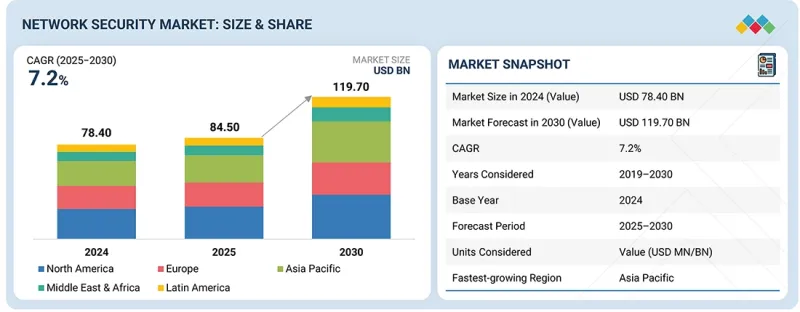
网路安全市场预计将从 2025 年的 845 亿美元成长到 2030 年的 1,197 亿美元,预测期内复合年增长率为 7.2%。
市场成长的驱动力是针对混合网路、云端工作负载和加密流量的网路攻击日益频繁且复杂化,迫使各组织加强其边界和内部防御。
| 调查范围 | |
|---|---|
| 调查期 | 2019-2030 |
| 基准年 | 2024 |
| 预测期 | 2025-2030 |
| 单元 | 价值(美元) |
| 部分 | 解决方案、服务、部署方式、组织规模、网路环境、产业、地区 |
| 目标区域 | 北美洲、欧洲、亚太地区、中东和非洲、拉丁美洲 |
此外,自带装置办公室 (BYOD) 的日益普及扩大了企业的攻击面,因为个人装置会连接到企业环境,这需要严格的存取控制、持续监控和进阶威胁防御措施。这些因素正在加速各产业部署下一代网路安全解决方案。
根据网路环境来看,预计资料中心领域在预测期内将占据最大的市场份额。
这是因为资料中心承载着绝大多数敏感工作负载、大量结构化和非结构化资料、虚拟化环境以及关键任务型应用程式。随着企业整合营运、虚拟化伺服器并采用混合云端策略,资料中心已成为攻击者的高价值目标,包括进阶持续性威胁 (APT)、内部威胁、横向行动攻击、资料窃取、DDoS 攻击和应用层入侵。为了保护这些资产,企业实施了强大的安全措施,例如网路分段、微分段、入侵侦测/防御、新一代防火墙、安全存取控制和持续监控。确保运作、合规性、资料机密性和效能最佳化至关重要,这将确保资料中心安全始终是核心。鑑于风险和价值的集中性,预计资料中心网路安全将继续占据网路安全投资的最大份额。
“按行业划分,预计医疗保健和生命科学领域在预测期内将实现最高的复合年增长率。”
医疗保健和生命科学产业是成长最快的产业之一,其成长动力主要来自日益增长的数位化、资料隐私法等监管压力、远距远端医疗的推广、云端基础的病患资料管理以及医疗设备互通性(IoMT)的兴起。医院、实验室和研究机构处理敏感的病患资料、智慧财产权和关键任务系统。勒索软体攻击、资料外洩和业务中断风险日益频繁,使得部署加密、零信任存取、安全网路分段、云端安全和持续监控等先进的安全措施变得至关重要。随着医疗机构的现代化、迁移到云端基础的记录系统以及全球互联,对扩充性、可靠且合规的网路安全的需求正在迅速增长。这使得医疗保健和生命科学产业成为网路安全市场成长最快的领域之一。
根据部署类型,预计在预测期内,本地部署部分将保持主导地位。
在网路安全领域,本地部署仍然是主流的部署模式。许多组织,尤其是大型企业、政府机构和受监管行业,更倾向于完全掌控其安全基础设施、资料位置、效能和延迟。本地环境允许组织将安全工具与旧有系统、内部网路和现有基础设施紧密整合。它们支援自订配置、实施严格的存取策略,并实现网路分段以符合内部管治法规。在银行、金融和政府等合规性驱动型产业,资料主权和监管要求通常要求将敏感资料储存在本地。此外,本地部署还消除了与云端相关的潜在延迟、可见性和供应商问题。这些因素促使许多组织继续依赖本地安全基础设施,而本地部署仍然是最大的部署模式细分市场。
本报告调查了全球网路安全市场,并提供了市场概览、影响市场成长的各种因素分析、技术和专利趋势、法律制度、案例研究、市场规模趋势和预测、按各个细分市场、地区/主要国家/地区进行的详细分析、竞争格局以及主要企业的概况。
目录
第一章 引言
第二章调查方法
第三章执行摘要
第四章重要考察
第五章 市场概览
- 市场动态
- 司机
- 抑制因素
- 机会
- 任务
- 未满足的需求和閒置频段
- 与相关市场和不同产业相关的跨领域机会
- 一级/二级/三级公司的策略性倡议
第六章 产业趋势
- 波特五力分析
- 总体经济指标
- 价值链分析
- 生态系分析
- 定价分析
- 贸易分析
- 2025-2026 年重要会议与活动
- 影响客户业务的趋势/颠覆性因素
- 投资和资金筹措方案
- 案例研究分析
- 2025年美国关税的影响-网路安全市场
第七章:科技、专利、数位化和人工智慧部署驱动的策略颠覆
- 关键新兴技术
- 防火墙/新一代防火墙
- 入侵侦测系统/入侵防御系统
- 虚拟私人网路
- 人工智慧/机器学习
- 互补技术
- 安全资讯和事件管理 (SIEM)
- 网路分段
- 威胁情报
- 安全存取服务边际
- 零信任网路存取
- 技术/产品蓝图
- 专利分析
- 未来应用
- 人工智慧/生成式人工智慧对网路安全市场的影响
第八章:监理环境
- 地方法规和合规性
第九章 消费者趋势与购买行为
- 决策流程
- 相关利益者和采购标准
- 采用障碍和内部挑战
- 来自各个终端使用者产业的未满足需求
第十章:按解决方案分類的网路安全市场
- 防火墙/新一代防火墙
- 虚拟私人网路
- 网路存取控制
- 预防资料外泄
- 入侵侦测系统/入侵防御系统
- 安全网路网关
- 分散式阻断服务攻击缓解
- 统一威胁管理
- 网路侦测与回应
第十一章 网路安全市场服务
- 专业服务
- 设计、咨询、实施
- 风险和威胁评估
- 培训和教育
- 支援与维护
- 託管服务
第十二章 按网路环境分類的网路安全市场
- 分公司网路安全
- 校园网路安全
- 资料中心网路安全
第十三章:依部署类型分類的网路安全市场
- 本地部署
- 云
- 杂交种
第十四章:依组织规模分類的网路安全市场
- 大公司
- 小型企业
第十五章:依产业垂直领域分類的网路安全市场
- 银行、金融服务和保险(BFSI)
- 政府
- 医疗保健与生命科学
- 航太与国防
- 製造业
- 资讯科技/资讯科技服务
- 零售与电子商务
- 能源与公用事业
- 电讯
- 运输/物流
- 媒体与娱乐
- 其他的
第十六章:各地区的网路安全市场
- 北美洲
- 市场驱动因素
- 美国
- 加拿大
- 欧洲
- 市场驱动因素
- 英国
- 德国
- 法国
- 义大利
- 其他的
- 亚太地区
- 市场驱动因素
- 中国
- 日本
- 印度
- 新加坡
- 其他的
- 中东和非洲
- 市场驱动因素
- 中东
- 其他的
- 非洲
- 拉丁美洲
- 巴西
- 墨西哥
- 其他的
第十七章 竞争格局
- 主要参与企业的策略/优势
- 收入分析
- 市占率分析
- 品牌/产品对比
- 估值和财务指标
- 公司评估矩阵:主要企业
- 公司估值矩阵:Start-Ups/中小企业
- 竞争场景
第十八章:公司简介
- 主要企业
- PALO ALTO NETWORKS
- CISCO
- FORTINET
- CHECK POINT
- TREND MICRO
- VERIZON
- IBM
- BROADCOM
- JUNIPER NETWORKS
- AKAMAI
- NETSKOPE
- MICROSOFT
- CROWDSTRIKE
- HUAWEI
- BARRACUDA NETWORKS
- ZSCALER
- TRELLIX
- CLOUDFLARE
- 其他公司
- AMAZON WEB SERVICES
- OPENTEXT
- SONICWALL
- FORCEPOINT
- SOPHOS
- ZYXEL NETWORKS
- NORDLAYER
- CATO NETWORKS
- HILLSTONE NETWORKS
- VERSA NETWORKS
- WIJUNGLE
- CYNET
- SECNAP
- NOMIOS
- EASI
- GAJSHIELD
- STELLAR CYBER
- STAMUS NETWORKS
- CORELIGHT
- NETSCOUT
- FIDELIS SECURITY
第十九章附录
The network security market is projected to grow from USD 84.50 billion in 2025 to USD 119.70 billion by 2030 at a Compound Annual Growth Rate (CAGR) of 7.2% during the forecast period. The market is driven by the increasing frequency and sophistication of cyberattacks targeting hybrid networks, cloud workloads, and encrypted traffic, prompting organizations to strengthen both perimeter and internal defenses.
| Scope of the Report | |
|---|---|
| Years Considered for the Study | 2019-2030 |
| Base Year | 2024 |
| Forecast Period | 2025-2030 |
| Units Considered | Value (USD Million/ Billion) |
| Segments | Solution, Service, Deployment Mode, Organization Size, Network Environment, Vertical, and Region |
| Regions covered | North America, Europe, Asia Pacific, Middle East & Africa, Latin America |
At the same time, the growing BYOD trend is expanding enterprise attack surfaces as personal devices connect to corporate environments, necessitating the implementation of strict access controls, continuous monitoring, and advanced threat prevention. Together, these factors accelerate the adoption of next-generation network security solutions across industries.
"By network environment, the data center network security segment is expected to hold the largest market size during the forecast period."
Data center network security is expected to be the largest segment in the network environment because data centers house the bulk of sensitive workloads, large volumes of structured/unstructured data, virtualized environments, and mission-critical applications. As enterprises consolidate operations, virtualize servers, and adopt hybrid cloud strategies, data centers become high-value targets for attackers, including advanced persistent threats, insider threats, and lateral movement attacks, as well as data exfiltration, DDoS, and application-layer breaches. To safeguard these assets, organizations deploy robust security measures, including segmentation, micro-segmentation, intrusion detection/prevention, next-generation firewalls, secure access controls, and continuous monitoring. The importance of uptime, regulatory compliance, data confidentiality, and performance optimization ensures that data-center security remains central. Given the concentration of risk and value, data center network security continues to command the largest share of network security investments.
"By vertical, the cloud segment is projected to register the highest CAGR during the forecast period."
The healthcare and life sciences vertical is the fastest-growing sector due to rising digitization, regulatory pressure such as data privacy laws, the adoption of telemedicine, cloud-based patient data management, and the increasing interconnectedness of medical devices (IoMT - Internet of Medical Things). Hospitals, laboratories, and research institutions handle sensitive patient data, intellectual property, and mission-critical systems. The growing frequency of ransomware attacks, data breaches, and disruption risks necessitates the implementation of advanced security measures, including encryption, zero-trust access, secure network segmentation, cloud security, and continuous monitoring. As healthcare organizations modernize, move to cloud-based record systems, and collaborate globally, they require scalable, reliable, and compliant network security, prompting a surging demand and positioning the healthcare & life sciences sector as the fastest-growing vertical in the network security market.
By deployment mode, the on-premises segment is expected to lead in terms of market share during the forecast period.
On-premises deployment remains the dominant deployment mode in network security because many organizations, especially large enterprises, government institutions, and regulated industries, prefer full control over their security infrastructure, data residency, performance, and latency. On-premises setups allow organizations to integrate security tools tightly with legacy systems, internal networks, and existing infrastructure. They can customize configurations, enforce strict access policies, and apply segmentation in ways that suit internal governance rules. For compliance-driven sectors such as banking, finance, and government, data sovereignty and regulatory mandates often require sensitive data to remain on-site. Additionally, on-premises deployments eliminate potential cloud-related latency, visibility, or vendor dependency issues. Because of these factors, many enterprises continue to rely on on-premises security infrastructure, sustaining its position as the largest deployment mode segment.
Breakdown of Primaries
The study draws insights from a range of industry experts, including component suppliers, Tier 1 companies, and OEMs. The break-up of the primaries is as follows:
- By Company Type: Tier 1 - 40%, Tier 2 - 35%, and Tier 3 - 25%
- By Designation: Directors - 45%, Managers - 35%, Others - 20%
- By Region: North America - 35%, Europe - 30%, Asia Pacific - 25%, Middle East & Africa - 5%, Latin America - 5%
Major vendors in the network security market include Cisco (US), Palo Alto Networks (US), Fortinet (US), Check Point (US), Trend Micro (Japan), Verizon (US), IBM (US), Broadcom (US), Juniper Networks (US), Akamai (US), Netskope (US), Microsoft (US), CrowdStrike (US), Zscaler (US), Cloudflare (US), AWS (US), OpenText (Canada), Hillstone Networks (US), Barracuda Networks (US), Huawei (China), Trellix (US), SonicWall (US), Forcepoint (US), Sophos (UK), Ivanti (US), Extreme Networks (US), Zyxel Networks (Taiwan), Cato Networks (Israel), NordLaver (US), Versa Networks (US), WiJungle (India), Cynet (US), SECNAP Network Security (US), Nomios (Netherlands), easi (Belgium), GajShield (India), Stellar Cyber (US), NETSCOUT (US), and Fidelis Security (US).
The study includes an in-depth competitive analysis of the key players in the network security market, their company profiles, recent developments, and key market strategies.
Research Coverage
The report segments the network security market and forecasts its size based on solution (firewall/next-generation firewall, virtual private network, network access control, data loss prevention, intrusion detection/intrusion prevention systems, secure web gateways, distributed denial-of-service mitigation, unified threat management, network detection & response, and other solutions such as URL/content filtering, web/DNS filtering, and vulnerability scanning), service (professional services-including design, consulting & implementation, risk & threat assessment, training & education, support & maintenance-and managed services), network environment (branch, campus, and data center network security), deployment mode (cloud, on-premises, and hybrid), organization size (large enterprises and small & medium-sized enterprises), and vertical (BFSI, government, healthcare & life sciences, manufacturing, IT & ITeS, retail & e-commerce, energy & utilities, telecommunications, transportation & logistics, media & entertainment, aerospace & defense, and other verticals such as education, construction, real estate, and travel & hospitality).
The study also includes an in-depth competitive analysis of the market's key players, their company profiles, key observations related to product and business offerings, recent developments, and key market strategies.
Key Benefits of Buying the Report
The report will help market leaders/new entrants with information on the closest approximations of revenue numbers for the overall network security market and its subsegments. This report will help stakeholders understand the competitive landscape and gain valuable insights to better position their businesses and plan suitable go-to-market strategies. The report also helps stakeholders understand the market pulse and provides information on key market drivers, restraints, challenges, and opportunities.
The report provides insights into the following pointers:
- Analysis of key drivers (Increasing frequency and sophistication of cyberattacks, Growing BYOD trend necessitating network security measures, Rising cloud adoption and remote work trend), restraints (High implementation costs, Shortage of skilled cybersecurity professionals), opportunities (Simplified management and enhanced protection achieved using secure access service edge framework, Implementation of zero-trust approach in network security), and challenges (Lack of awareness and training concerning network security technologies, Integration complexities)
- Product Development/Innovation: Detailed insights on upcoming technologies, research & development activities, and new product & service launches in the network security market
- Market Development: Comprehensive information about lucrative markets - the report analyses the network security market across varied regions
- Market Diversification: Exhaustive information about new products & services, untapped geographies, recent developments, and investments in the network security market
- Competitive Assessment: In-depth assessment of market shares, growth strategies, and service offerings of leading players in the network security market, including Palo Alto Networks (US), Cisco (US), CrowdStrike (US), Check Point (Israel), and Trend Micro (Japan)
TABLE OF CONTENTS
1 INTRODUCTION
- 1.1 STUDY OBJECTIVES
- 1.2 MARKET DEFINITION
- 1.3 STUDY SCOPE AND SEGMENTATION
- 1.3.1 MARKETS COVERED AND REGIONAL SCOPE
- 1.3.2 INCLUSIONS AND EXCLUSIONS
- 1.3.3 YEARS CONSIDERED
- 1.3.4 CURRENCY CONSIDERED
- 1.3.5 STAKEHOLDERS
- 1.3.6 SUMMARY OF CHANGES
2 RESEARCH METHODOLOGY
- 2.1 RESEARCH DATA
- 2.1.1 SECONDARY DATA
- 2.1.2 PRIMARY DATA
- 2.1.2.1 Breakup of primaries
- 2.1.2.2 Key industry insights
- 2.2 MARKET SIZE ESTIMATION
- 2.2.1 TOP-DOWN APPROACH
- 2.2.2 BOTTOM-UP APPROACH
- 2.3 MARKET DATA TRIANGULATION
- 2.4 FACTOR ANALYSIS
- 2.5 RESEARCH ASSUMPTIONS
- 2.6 RESEARCH LIMITATIONS
3 EXECUTIVE SUMMARY
- 3.1 KEY INSIGHTS AND MARKET HIGHLIGHTS
- 3.2 KEY MARKET PARTICIPANTS: SHARE INSIGHTS & STRATEGIC DEVELOPMENTS
- 3.3 DISRUPTIVE TRENDS SHAPING MARKET
- 3.4 HIGH-GROWTH SEGMENTS & EMERGING FRONTIERS
- 3.5 SNAPSHOT: GLOBAL MARKET SIZE, GROWTH RATE, AND FORECAST
4 PREMIUM INSIGHTS
- 4.1 ATTRACTIVE OPPORTUNITIES FOR PLAYERS IN NETWORK SECURITY MARKET
- 4.2 NETWORK SECURITY MARKET, BY SOLUTION
- 4.3 NETWORK SECURITY MARKET, BY SERVICE
- 4.4 NETWORK SECURITY MARKET, BY NETWORK ENVIRONMENT
- 4.5 NETWORK SECURITY MARKET, BY ORGANIZATION SIZE
- 4.6 NETWORK SECURITY MARKET, BY DEPLOYMENT MODE
- 4.7 NETWORK SECURITY MARKET, BY VERTICAL
- 4.8 NETWORK SECURITY MARKET, BY REGION
5 MARKET OVERVIEW
- 5.1 INTRODUCTION
- 5.2 MARKET DYNAMICS
- 5.2.1 DRIVERS
- 5.2.1.1 Increasing frequency and sophistication of cyberattacks
- 5.2.1.2 Growing BYOD trend necessitating network security measures
- 5.2.1.3 Increased cloud adoption and remote work trend
- 5.2.2 RESTRAINTS
- 5.2.2.1 High implementation costs
- 5.2.2.2 Shortage of skilled cybersecurity professionals
- 5.2.3 OPPORTUNITIES
- 5.2.3.1 Simplified management and enhanced protection using SASE framework
- 5.2.3.2 Implementation of zero-trust approach in network security
- 5.2.4 CHALLENGES
- 5.2.4.1 Lack of awareness and training on network security technologies
- 5.2.4.2 Integration complexities
- 5.2.1 DRIVERS
- 5.3 UNMET NEEDS AND WHITE SPACES
- 5.4 INTERCONNECTED MARKETS AND CROSS-SECTOR OPPORTUNITIES
- 5.4.1 BFSI
- 5.4.2 HEALTHCARE & LIFE SCIENCES
- 5.4.3 GOVERNMENT
- 5.4.4 IT & ITES
- 5.4.5 TELECOMMUNICATIONS
- 5.5 STRATEGIC MOVES BY TIER 1/2/3 PLAYERS
- 5.5.1 STRATEGIC TRENDS
- 5.5.1.1 Rise of secure access service edge (SASE)
- 5.5.1.2 Adoption of zero trust network principles
- 5.5.1.3 AI-driven network analytics and automated threat response
- 5.5.1.4 Convergence of networking and security platforms
- 5.5.1.5 Privacy-preserving network inspection and encrypted traffic visibility
- 5.5.1 STRATEGIC TRENDS
6 INDUSTRY TRENDS
- 6.1 PORTER'S FIVE FORCES ANALYSIS
- 6.1.1 THREAT OF NEW ENTRANTS
- 6.1.2 THREAT OF SUBSTITUTES
- 6.1.3 BARGAINING POWER OF SUPPLIERS
- 6.1.4 BARGAINING POWER OF BUYERS
- 6.1.5 INTENSITY OF COMPETITIVE RIVALRY
- 6.2 MACROECONOMIC INDICATORS
- 6.2.1 INTRODUCTION
- 6.2.2 GDP TRENDS AND FORECAST
- 6.2.3 TRENDS IN GLOBAL ICT INDUSTRY
- 6.2.4 TRENDS IN GLOBAL CYBERSECURITY INDUSTRY
- 6.3 VALUE CHAIN ANALYSIS
- 6.3.1 PLANNING AND DESIGNING
- 6.3.2 NETWORK SECURITY SOLUTION AND SERVICE PROVIDERS
- 6.3.3 SYSTEM INTEGRATION
- 6.3.4 DISTRIBUTION/RESELLERS/VALUE-ADDED RESELLERS
- 6.3.5 END USERS
- 6.4 ECOSYSTEM ANALYSIS
- 6.5 PRICING ANALYSIS
- 6.5.1 AVERAGE SELLING PRICE, BY SOLUTION, 2025
- 6.5.2 INDICATIVE PRICING ANALYSIS OF PRODUCTS, BY VENDOR, 2025
- 6.6 TRADE ANALYSIS
- 6.6.1 IMPORT SCENARIO (HS CODE 8517)
- 6.6.2 EXPORT SCENARIO (HS CODE 8517)
- 6.7 KEY CONFERENCES & EVENTS, 2025-2026
- 6.8 TRENDS/DISRUPTIONS IMPACTING CUSTOMERS' BUSINESSES
- 6.9 INVESTMENT AND FUNDING SCENARIO
- 6.10 CASE STUDY ANALYSIS
- 6.10.1 JUNIPER NETWORKS HELPED BEELINE ENHANCE EFFICIENCY AND CYBERSECURITY
- 6.10.2 AMANA BANK BUILT A ROBUST AND EASILY MANAGEABLE CYBERSECURITY INFRASTRUCTURE USING SOPHOS' TECHNOLOGIES
- 6.10.3 FORCEPOINT HELPED BURGER KING SECURE SCALABLE NETWORK TRANSITION
- 6.11 IMPACT OF 2025 US TARIFFS-NETWORK SECURITY MARKET
- 6.11.1 INTRODUCTION
- 6.11.2 KEY TARIFF RATES
- 6.11.3 PRICE IMPACT ANALYSIS
- 6.11.4 IMPACT ON COUNTRIES/REGIONS
- 6.11.4.1 North America
- 6.11.4.2 Europe
- 6.11.4.3 Asia Pacific
- 6.11.5 IMPACT ON END-USE INDUSTRIES
7 STRATEGIC DISRUPTION THROUGH TECHNOLOGY, PATENTS, DIGITAL, AND AI ADOPTION
- 7.1 KEY EMERGING TECHNOLOGIES
- 7.1.1 FIREWALLS/NEXT-GENERATION FIREWALLS
- 7.1.2 INTRUSION DETECTION SYSTEMS/INTRUSION PREVENTION SYSTEMS
- 7.1.3 VIRTUAL PRIVATE NETWORKS
- 7.1.4 AI/ML
- 7.2 COMPLEMENTARY TECHNOLOGIES
- 7.2.1 SECURITY INFORMATION AND EVENT MANAGEMENT (SIEM)
- 7.2.2 NETWORK SEGMENTATION
- 7.2.3 THREAT INTELLIGENCE
- 7.2.4 SECURE ACCESS SERVICE EDGE
- 7.2.5 ZERO TRUST NETWORK ACCESS
- 7.3 TECHNOLOGY/PRODUCT ROADMAP
- 7.3.1 SHORT-TERM (2025-2027) | FOUNDATION & EARLY COMMERCIALIZATION
- 7.3.2 MID-TERM (2027-2030) | EXPANSION & STANDARDIZATION
- 7.3.3 LONG-TERM (2030-2035+) | GLOBAL CONSOLIDATION & INTELLIGENT SECURITY ECOSYSTEMS
- 7.4 PATENT ANALYSIS
- 7.5 FUTURE APPLICATIONS
- 7.5.1 ZERO-TRUST ARCHITECTURES: BEYOND-PERIMETER NETWORK SECURITY
- 7.5.2 AI-POWERED THREAT DETECTION & AUTONOMOUS RESPONSE
- 7.5.3 SECURE ACCESS SERVICE EDGE (SASE) & SECURITY SERVICE EDGE (SSE)
- 7.5.4 OT & ICS CYBERSECURITY FOR CRITICAL INFRASTRUCTURE
- 7.5.5 5G/6G SECURITY & ULTRA-CONNECTED NETWORK DEFENSE
- 7.6 IMPACT OF AI/GEN AI ON NETWORK SECURITY MARKET
- 7.6.1 BEST PRACTICES IN NETWORK SECURITY MARKET
- 7.6.2 CASE STUDIES OF AI IMPLEMENTATION IN THE NETWORK SECURITY MARKET
- 7.6.3 INTERCONNECTED ADJACENT ECOSYSTEM AND IMPACT ON MARKET PLAYERS
- 7.6.4 CLIENTS' READINESS TO ADOPT GENERATIVE AI IN NETWORK SECURITY MARKET
8 REGULATORY LANDSCAPE
- 8.1 REGIONAL REGULATIONS AND COMPLIANCE
- 8.1.1 REGULATORY BODIES, GOVERNMENT AGENCIES, AND OTHER ORGANIZATIONS
- 8.1.2 INDUSTRY STANDARDS
9 CONSUMER LANDSCAPE & BUYER BEHAVIOR
- 9.1 DECISION-MAKING PROCESS
- 9.2 BUYER STAKEHOLDERS AND BUYING EVALUATION CRITERIA
- 9.2.1 KEY STAKEHOLDERS IN BUYING PROCESS
- 9.2.2 BUYING CRITERIA
- 9.3 ADOPTION BARRIERS & INTERNAL CHALLENGES
- 9.4 UNMET NEEDS FROM VARIOUS END-USE INDUSTRIES
10 NETWORK SECURITY MARKET, BY SOLUTION
- 10.1 INTRODUCTION
- 10.1.1 SOLUTIONS: NETWORK SECURITY MARKET DRIVERS
- 10.2 FIREWALL/NEXT-GENERATION FIREWALL
- 10.2.1 NEED FOR SIMPLIFICATION AND AUTOMATION OF ENTERPRISE-GRADE SECURITY WITH CENTRALIZED MANAGEMENT ACROSS DISTRIBUTED NETWORKS TO DRIVE MARKET
- 10.3 VIRTUAL PRIVATE NETWORK
- 10.3.1 INCREASING DEMAND FOR MAINTAINING DATA SECURITY, PRIVACY, AND NETWORK INTEGRITY TO DRIVE MARKET
- 10.4 NETWORK ACCESS CONTROL
- 10.4.1 INCREASING NEED FOR STREAMLINING AUTHENTICATION PROCESS, REDUCING TIME AND COSTS TO FUEL MARKET GROWTH
- 10.5 DATA LOSS PREVENTION
- 10.5.1 DATA LOSS PREVENTION SOLUTIONS TO ENHANCE INTERNAL SECURITY AND MAINTAIN REGULATORY COMPLIANCE
- 10.6 INTRUSION DETECTION SYSTEM/INTRUSION PREVENTION SYSTEM
- 10.6.1 INCREASING DEMAND FOR ROBUST NETWORK SECURITY TO BOOST MARKET
- 10.7 SECURE WEB GATEWAY
- 10.7.1 SURGING DEMAND FOR SAFE INTERNET ACCESS TO DRIVE MARKET
- 10.8 DISTRIBUTED DENIAL-OF-SERVICE MITIGATION
- 10.8.1 RISING NEED TO PROTECT CONFIDENTIALITY, INTEGRITY, AND AVAILABILITY OF RESOURCES TO FUEL MARKET GROWTH
- 10.9 UNIFIED THREAT MANAGEMENT
- 10.9.1 RISING POPULARITY OF UNIFIED THREAT MANAGEMENT SOLUTIONS TO DRIVE MARKET
- 10.10 NETWORK DETECTION AND RESPONSE
- 10.10.1 DELIVERS THREAT DETECTION, INCIDENT RESPONSE, AND FORENSICS FROM A UNIFIED NETWORK-CENTRIC PERSPECTIVE
11 NETWORK SECURITY MARKET, BY SERVICE
- 11.1 INTRODUCTION
- 11.1.1 SERVICES: NETWORK SECURITY MARKET DRIVERS
- 11.2 PROFESSIONAL SERVICES
- 11.2.1 NEED FOR RAPID RESPONSE TO BREACHES AND EXTERNAL SUPPORT TO DRIVE ADOPTION
- 11.2.2 DESIGN, CONSULTING, AND IMPLEMENTATION
- 11.2.3 RISK & THREAT ASSESSMENT
- 11.2.4 TRAINING & EDUCATION
- 11.2.5 SUPPORT & MAINTENANCE
- 11.3 MANAGED SERVICES
- 11.3.1 INCREASING DEMAND FOR SPECIALIZED SECURITY SERVICES TO BOOST MARKET GROWTH
12 NETWORK SECURITY MARKET, BY NETWORK ENVIRONMENT
- 12.1 INTRODUCTION
- 12.1.1 NETWORK ENVIRONMENT: NETWORK SECURITY MARKET DRIVERS
- 12.2 BRANCH NETWORK SECURITY
- 12.2.1 SURGING NEED FOR PROTECTION OF SENSITIVE INFORMATION AND ENFORCING OPERATIONAL CONTINUITY TO DRIVE MARKET
- 12.3 CAMPUS NETWORK SECURITY
- 12.3.1 STRENGTHENED VISIBILITY AND SAFE CONNECTIVITY ACROSS LARGE DISTRIBUTED FACILITIES TO DRIVE MARKET
- 12.4 DATA CENTER NETWORK SECURITY
- 12.4.1 INCREASING NEED FOR ENSURING CRITICAL ASSET AVAILABILITY, RELIABILITY, AND CONFIDENTIALITY TO ACCELERATE MARKET GROWTH
13 NETWORK SECURITY MARKET, BY DEPLOYMENT MODE
- 13.1 INTRODUCTION
- 13.1.1 DEPLOYMENT MODE: NETWORK SECURITY MARKET DRIVERS
- 13.2 ON-PREMISES
- 13.2.1 ON-PREMISES DEPLOYMENT TO HELP MAINTAIN COMPLIANCE, PROTECT DATA, AND CUSTOMIZE SECURITY CONFIGURATIONS
- 13.3 CLOUD
- 13.3.1 COST-EFFECTIVENESS AND EASE OF MAINTENANCE TO BOOST DEMAND FOR CLOUD-BASED SOLUTIONS
- 13.4 HYBRID
- 13.4.1 HYBRID APPROACH TO OFFER DATA SECURITY, FLEXIBILITY, COST-EFFICIENCY, AND THE RAPID DEPLOYMENT CAPABILITIES OF CLOUD SERVICES
14 NETWORK SECURITY MARKET, BY ORGANIZATION SIZE
- 14.1 INTRODUCTION
- 14.1.1 ORGANIZATION SIZE: NETWORK SECURITY MARKET DRIVERS
- 14.2 LARGE ENTERPRISES
- 14.2.1 INCREASING NEED FOR EFFECTIVE SECURITY MANAGEMENT TO BOOST MARKET
- 14.3 SMALL & MEDIUM-SIZED ENTERPRISES
- 14.3.1 INCREASING CYBER THREATS, REGULATORY COMPLIANCE REQUIREMENTS, AND NEED FOR PROTECTION OF SENSITIVE DATA TO DRIVE MARKET
15 NETWORK SECURITY MARKET, BY VERTICAL
- 15.1 INTRODUCTION
- 15.1.1 VERTICAL: NETWORK SECURITY MARKET DRIVERS
- 15.2 BANKING, FINANCIAL SERVICES, AND INSURANCE (BFSI)
- 15.2.1 INCREASING DEMAND FOR MAINTAINING COMPETITIVE EDGE, REDUCING COSTS, AND IMPROVING CUSTOMER EXPERIENCE WITH VALUE-ADDED SERVICES TO DRIVE MARKET
- 15.3 GOVERNMENT
- 15.3.1 NETWORK SECURITY SOLUTIONS TO HELP IMPROVE SECURITY OF CRITICAL INFORMATION AND REDUCE THREAT OF UNAUTHORIZED ACCESS
- 15.4 HEALTHCARE & LIFE SCIENCES
- 15.4.1 RISING USE OF NETWORK SECURITY SOLUTIONS AND INCREASING AWARENESS OF REGULATORY COMPLIANCE TO DRIVE MARKET
- 15.5 AEROSPACE & DEFENSE
- 15.5.1 SURGING DEMAND FOR OPERATIONAL EFFECTIVENESS AND NATIONAL SECURITY TO PROPEL MARKET
- 15.6 MANUFACTURING
- 15.6.1 INCREASING DEMAND FOR EFFICIENT REAL-TIME DATA ACCESS AND SECURE NETWORK CONNECTIVITY TO PROPEL MARKET
- 15.7 IT & ITES
- 15.7.1 INCREASING SHIFT TOWARD HYBRID AND REMOTE WORK MODELS TO HEIGHTEN DEMAND FOR SECURE REMOTE ACCESS SOLUTIONS
- 15.8 RETAIL & ECOMMERCE
- 15.8.1 RISING NETWORK-BASED CYBER-ATTACKS AND DATA THEFT ACTIVITIES TO BOOST ADOPTION OF NETWORK SECURITY SOLUTIONS
- 15.9 ENERGY & UTILITIES
- 15.9.1 NEED TO STRENGTHEN NETWORK SECURITY AND REDUCE COMPLEXITIES TO FUEL ADOPTION
- 15.10 TELECOMMUNICATIONS
- 15.10.1 NEED TO PROTECT VAST AND COMPLEX COMMUNICATION NETWORKS FROM CYBER THREATS TO PROPEL MARKET
- 15.11 TRANSPORTATION & LOGISTICS
- 15.11.1 STRENGTHENING TRANSPORTATION AND LOGISTICS OPERATIONS THROUGH ENHANCED NETWORK SECURITY TO PROPEL MARKET
- 15.12 MEDIA & ENTERTAINMENT
- 15.12.1 NETWORK SECURITY MEASURES TO SAFEGUARD AGAINST UNAUTHORIZED ACCESS, ENSURE THE INTEGRITY OF CONTENT, AND PROTECT CONSUMER PRIVACY
- 15.13 OTHER VERTICALS
16 NETWORK SECURITY MARKET, BY REGION
- 16.1 INTRODUCTION
- 16.2 NORTH AMERICA
- 16.2.1 NORTH AMERICA: NETWORK SECURITY MARKET DRIVERS
- 16.2.2 US
- 16.2.2.1 Increasing network attacks, cyber threats, and evolving regulatory norms to boost market
- 16.2.3 CANADA
- 16.2.3.1 Rapid digitalization and government initiatives to boost market
- 16.3 EUROPE
- 16.3.1 EUROPE: NETWORK SECURITY MARKET DRIVERS
- 16.3.2 UK
- 16.3.2.1 Surging demand for bolstering cybersecurity to drive market
- 16.3.3 GERMANY
- 16.3.3.1 Increasing cybercrimes and sophisticated cyberattacks to boost market
- 16.3.4 FRANCE
- 16.3.4.1 Compliance with stringent EU regulations to drive adoption of comprehensive security frameworks
- 16.3.5 ITALY
- 16.3.5.1 Adoption of modern network security solutions to protect digital infrastructure to drive market
- 16.3.6 REST OF EUROPE
- 16.4 ASIA PACIFIC
- 16.4.1 ASIA PACIFIC: NETWORK SECURITY MARKET DRIVERS
- 16.4.2 CHINA
- 16.4.2.1 Rapid digitalization and growing importance of safeguarding country's expansive digital economy to boost market
- 16.4.3 JAPAN
- 16.4.3.1 Intricate cyberattacks to drive adoption of network security solutions
- 16.4.4 INDIA
- 16.4.4.1 Increased internet penetration, improved telecom services, and government initiatives to drive market
- 16.4.5 SINGAPORE
- 16.4.5.1 Growing emphasis on cybersecurity measures and increasing investments in advanced network security measures to foster market growth
- 16.4.6 REST OF ASIA PACIFIC
- 16.5 MIDDLE EAST & AFRICA
- 16.5.1 MIDDLE EAST & AFRICA: NETWORK SECURITY MARKET DRIVERS
- 16.5.2 MIDDLE EAST
- 16.5.2.1 Rapid expansion of connected systems accelerating the demand for comprehensive network security solutions
- 16.5.2.2 GCC
- 16.5.2.3 UAE
- 16.5.2.3.1 Digital transformation and increasing cyber threats to drive adoption of modern network security solutions
- 16.5.2.4 KSA
- 16.5.2.4.1 Digital transformation and evolving threat landscape to boost market
- 16.5.2.5 Rest of GCC countries
- 16.5.3 REST OF MIDDLE EAST
- 16.5.4 AFRICA
- 16.5.4.1 Rising cyber risks and increasing digital adoption driving the growth of network security market
- 16.6 LATIN AMERICA
- 16.6.1 BRAZIL
- 16.6.1.1 Rising DDoS attacks in Brazil to propel market growth
- 16.6.2 MEXICO
- 16.6.2.1 Increasing demand for protection of sensitive information to bolster market growth
- 16.6.3 REST OF LATIN AMERICA
- 16.6.1 BRAZIL
17 COMPETITIVE LANDSCAPE
- 17.1 KEY PLAYER STRATEGIES/RIGHT TO WIN
- 17.2 REVENUE ANALYSIS
- 17.3 MARKET SHARE ANALYSIS
- 17.4 BRAND/PRODUCT COMPARISON
- 17.5 COMPANY VALUATION AND FINANCIAL METRICS
- 17.5.1 COMPANY VALUATION, 2025
- 17.5.2 FINANCIAL METRICS USING EV/EBITDA, 2025
- 17.6 COMPANY EVALUATION MATRIX: KEY PLAYERS, 2024
- 17.6.1 STARS
- 17.6.2 EMERGING LEADERS
- 17.6.3 PERVASIVE PLAYERS
- 17.6.4 PARTICIPANTS
- 17.6.5 COMPANY FOOTPRINT: KEY PLAYERS, 2024
- 17.6.5.1 Company footprint
- 17.6.5.2 Region footprint
- 17.6.5.3 Solution footprint
- 17.6.5.4 Service footprint
- 17.6.5.5 Vertical footprint
- 17.7 COMPANY EVALUATION MATRIX: STARTUPS/SMES, 2024
- 17.7.1 PROGRESSIVE COMPANIES
- 17.7.2 RESPONSIVE COMPANIES
- 17.7.3 DYNAMIC COMPANIES
- 17.7.4 STARTING BLOCKS
- 17.7.5 COMPETITIVE BENCHMARKING: STARTUPS/SMES, 2024
- 17.7.5.1 Detailed list of key startups/SMEs
- 17.7.5.2 Competitive benchmarking of key startups/SMEs
- 17.8 COMPETITIVE SCENARIO
- 17.8.1 PRODUCT LAUNCHES AND ENHANCEMENTS
- 17.8.2 DEALS
18 COMPANY PROFILES
- 18.1 MAJOR PLAYERS
- 18.1.1 PALO ALTO NETWORKS
- 18.1.1.1 Business overview
- 18.1.1.2 Products/Solutions/Services offered
- 18.1.1.3 Recent developments
- 18.1.1.3.1 Product launches and enhancements
- 18.1.1.3.2 Deals
- 18.1.1.4 MnM view
- 18.1.1.4.1 Key strengths
- 18.1.1.4.2 Strategic choices made
- 18.1.1.4.3 Weaknesses and competitive threats
- 18.1.2 CISCO
- 18.1.2.1 Business overview
- 18.1.2.2 Products/Solutions/Services offered
- 18.1.2.3 Recent developments
- 18.1.2.3.1 Product launches and enhancements
- 18.1.2.3.2 Deals
- 18.1.2.4 MnM view
- 18.1.2.4.1 Key strengths
- 18.1.2.4.2 Strategic choices made
- 18.1.2.4.3 Weaknesses and competitive threats
- 18.1.3 FORTINET
- 18.1.3.1 Business overview
- 18.1.3.2 Products/Solutions/Services offered
- 18.1.3.3 Recent developments
- 18.1.3.3.1 Product launches and enhancements
- 18.1.3.3.2 Deals
- 18.1.3.4 MnM view
- 18.1.3.4.1 Key strengths
- 18.1.3.4.2 Strategic choices made
- 18.1.3.4.3 Weaknesses and competitive threats
- 18.1.4 CHECK POINT
- 18.1.4.1 Business overview
- 18.1.4.2 Products/Solutions/Services offered
- 18.1.4.3 Recent developments
- 18.1.4.3.1 Product launches
- 18.1.4.3.2 Deals
- 18.1.4.4 MnM view
- 18.1.4.4.1 Key strengths
- 18.1.4.4.2 Strategic choices made
- 18.1.4.4.3 Weaknesses and competitive threats
- 18.1.5 TREND MICRO
- 18.1.5.1 Business overview
- 18.1.5.2 Products/Solutions/Services offered
- 18.1.5.3 Recent developments
- 18.1.5.3.1 Product launches
- 18.1.5.3.2 Deals
- 18.1.5.4 MnM view
- 18.1.5.4.1 Key strengths
- 18.1.5.4.2 Strategic choices made
- 18.1.5.4.3 Weaknesses and competitive threats
- 18.1.6 VERIZON
- 18.1.6.1 Business overview
- 18.1.6.2 Products/Solutions/Services offered
- 18.1.6.3 Recent developments
- 18.1.6.3.1 Product launches
- 18.1.6.3.2 Deals
- 18.1.7 IBM
- 18.1.7.1 Business overview
- 18.1.7.2 Products/Solutions/Services offered
- 18.1.7.3 Recent developments
- 18.1.7.3.1 Product enhancements
- 18.1.7.3.2 Deals
- 18.1.8 BROADCOM
- 18.1.8.1 Business overview
- 18.1.8.2 Products/Solutions/Services offered
- 18.1.8.3 Recent developments
- 18.1.8.3.1 Product launches and enhancements
- 18.1.8.3.2 Deals
- 18.1.9 JUNIPER NETWORKS
- 18.1.9.1 Business overview
- 18.1.9.2 Products/Solutions/Services offered
- 18.1.9.3 Recent developments
- 18.1.9.3.1 Product launches and enhancements
- 18.1.9.3.2 Deals
- 18.1.10 AKAMAI
- 18.1.10.1 Business overview
- 18.1.10.2 Products/Solutions/Services offered
- 18.1.10.3 Recent developments
- 18.1.10.3.1 Product launches
- 18.1.10.3.2 Deals
- 18.1.11 NETSKOPE
- 18.1.11.1 Business overview
- 18.1.11.2 Products/Solutions/Services offered
- 18.1.11.3 Recent developments
- 18.1.11.3.1 Product launches
- 18.1.11.3.2 Deals
- 18.1.12 MICROSOFT
- 18.1.12.1 Business overview
- 18.1.12.2 Products/Solutions/Services offered
- 18.1.12.3 Recent developments
- 18.1.12.3.1 Deals
- 18.1.13 CROWDSTRIKE
- 18.1.13.1 Business overview
- 18.1.13.2 Products/Solutions/Services offered
- 18.1.13.3 Recent developments
- 18.1.13.3.1 Deals
- 18.1.14 HUAWEI
- 18.1.14.1 Business overview
- 18.1.14.2 Products/Solutions/Services offered
- 18.1.14.3 Recent developments
- 18.1.14.3.1 Product launches
- 18.1.14.3.2 Deals
- 18.1.15 BARRACUDA NETWORKS
- 18.1.15.1 Business overview
- 18.1.15.2 Products/Solutions/Services offered
- 18.1.15.3 Recent developments
- 18.1.15.3.1 Product launches and enhancements
- 18.1.15.3.2 Deals
- 18.1.16 ZSCALER
- 18.1.16.1 Business overview
- 18.1.16.2 Products/Solutions/Services offered
- 18.1.16.3 Recent developments
- 18.1.16.3.1 Product launches
- 18.1.16.3.2 Deals
- 18.1.17 TRELLIX
- 18.1.17.1 Business overview
- 18.1.17.2 Products/Solutions/Services offered
- 18.1.17.3 Recent developments
- 18.1.17.3.1 Product launches
- 18.1.17.3.2 Deals
- 18.1.18 CLOUDFLARE
- 18.1.18.1 Business overview
- 18.1.18.2 Products/Solutions/Services offered
- 18.1.18.3 Recent developments
- 18.1.18.3.1 Product launches and enhancements
- 18.1.18.3.2 Deals
- 18.1.1 PALO ALTO NETWORKS
- 18.2 OTHER PLAYERS
- 18.2.1 AMAZON WEB SERVICES
- 18.2.2 OPENTEXT
- 18.2.3 SONICWALL
- 18.2.4 FORCEPOINT
- 18.2.5 SOPHOS
- 18.2.6 ZYXEL NETWORKS
- 18.2.7 NORDLAYER
- 18.2.8 CATO NETWORKS
- 18.2.9 HILLSTONE NETWORKS
- 18.2.10 VERSA NETWORKS
- 18.2.11 WIJUNGLE
- 18.2.12 CYNET
- 18.2.13 SECNAP
- 18.2.14 NOMIOS
- 18.2.15 EASI
- 18.2.16 GAJSHIELD
- 18.2.17 STELLAR CYBER
- 18.2.18 STAMUS NETWORKS
- 18.2.19 CORELIGHT
- 18.2.20 NETSCOUT
- 18.2.21 FIDELIS SECURITY
19 APPENDIX
- 19.1 DISCUSSION GUIDE
- 19.2 KNOWLEDGESTORE: MARKETSANDMARKETS' SUBSCRIPTION PORTAL
- 19.3 CUSTOMIZATION OPTIONS
- 19.4 RELATED REPORTS
- 19.5 AUTHOR DETAILS
List of Tables
- TABLE 1 USD EXCHANGE RATES, 2020-2024
- TABLE 2 FACTOR ANALYSIS
- TABLE 3 UNMET NEEDS AND WHITE SPACES IN NETWORK SECURITY SOLUTIONS MARKET
- TABLE 4 STRATEGIC MOVES BY PLAYERS IN NETWORK SECURITY MARKET
- TABLE 5 PORTER'S FIVE FORCES IMPACT ON NETWORK SECURITY MARKET
- TABLE 6 GDP PERCENTAGE CHANGE, BY KEY COUNTRY, 2021-2030
- TABLE 7 NETWORK SECURITY MARKET: ROLE IN ECOSYSTEM
- TABLE 8 AVERAGE SELLING PRICE, BY SOLUTION, 2025 (USD)
- TABLE 9 INDICATIVE PRICING ANALYSIS OF PRODUCTS, BY VENDOR, 2025 (USD)
- TABLE 10 IMPORT DATA FOR HS CODE 8517, BY COUNTRY, 2020-2024 (USD BILLION)
- TABLE 11 EXPORT DATA FOR HS CODE 8517, BY COUNTRY, 2020-2024 (USD BILLION)
- TABLE 12 NETWORK SECURITY MARKET: DETAILED LIST OF CONFERENCES & EVENTS, 2025-2026
- TABLE 13 KEY TARIFF RATES
- TABLE 14 LIST OF MAJOR PATENTS, 2023-2024
- TABLE 15 TOP USE CASES AND MARKET POTENTIAL
- TABLE 16 BEST PRACTICES: COMPANIES IMPLEMENTING USE CASES
- TABLE 17 NETWORK SECURITY MARKET: CASE STUDIES RELATED TO GEN AI IMPLEMENTATION
- TABLE 18 INTERCONNECTED ADJACENT ECOSYSTEM AND IMPACT ON MARKET PLAYERS
- TABLE 19 NORTH AMERICA: LIST OF REGULATORY BODIES, GOVERNMENT AGENCIES, AND OTHER ORGANIZATIONS
- TABLE 20 EUROPE: LIST OF REGULATORY BODIES, GOVERNMENT AGENCIES, AND OTHER ORGANIZATIONS
- TABLE 21 ASIA PACIFIC: LIST OF REGULATORY BODIES, GOVERNMENT AGENCIES, AND OTHER ORGANIZATIONS
- TABLE 22 REST OF THE WORLD: LIST OF REGULATORY BODIES, GOVERNMENT AGENCIES, AND OTHER ORGANIZATIONS
- TABLE 23 GLOBAL INDUSTRY STANDARDS IN NETWORK SECURITY MARKET
- TABLE 24 INFLUENCE OF STAKEHOLDERS ON BUYING PROCESS FOR TOP THREE VERTICALS (%)
- TABLE 25 KEY BUYING CRITERIA FOR TOP THREE VERTICALS
- TABLE 26 NETWORK SECURITY MARKET: UNMET NEEDS, BY END-USE INDUSTRY
- TABLE 27 NETWORK SECURITY MARKET, BY SOLUTION, 2019-2024 (USD MILLION)
- TABLE 28 NETWORK SECURITY MARKET, BY SOLUTION, 2025-2030 (USD MILLION)
- TABLE 29 FIREWALL/NGFW: NETWORK SECURITY MARKET, BY REGION, 2019-2024 (USD MILLION)
- TABLE 30 FIREWALL/NGFW: NETWORK SECURITY MARKET, BY REGION, 2025-2030 (USD MILLION)
- TABLE 31 VIRTUAL PRIVATE NETWORK: NETWORK SECURITY MARKET, BY REGION, 2019-2024 (USD MILLION)
- TABLE 32 VIRTUAL PRIVATE NETWORK: NETWORK SECURITY MARKET, BY REGION, 2025-2030 (USD MILLION)
- TABLE 33 NETWORK ACCESS CONTROL: NETWORK SECURITY MARKET, BY REGION, 2019-2024 (USD MILLION)
- TABLE 34 NETWORK ACCESS CONTROL: NETWORK SECURITY MARKET, BY REGION, 2025-2030 (USD MILLION)
- TABLE 35 DATA LOSS PREVENTION: NETWORK SECURITY MARKET, BY REGION, 2019-2024 (USD MILLION)
- TABLE 36 DATA LOSS PREVENTION: NETWORK SECURITY MARKET, BY REGION, 2025-2030 (USD MILLION)
- TABLE 37 IDS/IPS: NETWORK SECURITY MARKET, BY REGION, 2019-2024 (USD MILLION)
- TABLE 38 IDS/IPS: NETWORK SECURITY MARKET, BY REGION, 2025-2030 (USD MILLION)
- TABLE 39 SECURE WEB GATEWAY: NETWORK SECURITY MARKET, BY REGION, 2019-2024 (USD MILLION)
- TABLE 40 SECURE WEB GATEWAY: NETWORK SECURITY MARKET, BY REGION, 2025-2030 (USD MILLION)
- TABLE 41 DDOS MITIGATION: NETWORK SECURITY MARKET, BY REGION, 2019-2024 (USD MILLION)
- TABLE 42 DDOS MITIGATION: NETWORK SECURITY MARKET, BY REGION, 2025-2030 (USD MILLION)
- TABLE 43 UNIFIED THREAT MANAGEMENT: NETWORK SECURITY MARKET, BY REGION, 2019-2024 (USD MILLION)
- TABLE 44 UNIFIED THREAT MANAGEMENT: NETWORK SECURITY MARKET, BY REGION, 2025-2030 (USD MILLION)
- TABLE 45 NETWORK DETECTION AND RESPONSE: NETWORK SECURITY MARKET, BY REGION, 2019-2024 (USD MILLION)
- TABLE 46 NETWORK DETECTION AND RESPONSE: NETWORK SECURITY MARKET, BY REGION, 2025-2030 (USD MILLION)
- TABLE 47 NETWORK SECURITY MARKET, BY SERVICE, 2019-2024 (USD MILLION)
- TABLE 48 NETWORK SECURITY MARKET, BY SERVICE, 2025-2030 (USD MILLION)
- TABLE 49 PROFESSIONAL NETWORK SECURITY SERVICES MARKET, BY TYPE, 2019-2024 (USD MILLION)
- TABLE 50 PROFESSIONAL NETWORK SECURITY SERVICES MARKET, BY TYPE, 2025-2030 (USD MILLION)
- TABLE 51 PROFESSIONAL NETWORK SECURITY SERVICES MARKET, BY REGION, 2019-2024 (USD MILLION)
- TABLE 52 PROFESSIONAL NETWORK SECURITY SERVICES MARKET, BY REGION, 2025-2030 (USD MILLION)
- TABLE 53 DESIGN, CONSULTING, AND IMPLEMENTATION: NETWORK SECURITY MARKET, BY REGION, 2019-2024 (USD MILLION)
- TABLE 54 DESIGN, CONSULTING, AND IMPLEMENTATION: NETWORK SECURITY MARKET, BY REGION, 2025-2030 (USD MILLION)
- TABLE 55 RISK & THREAT ASSESSMENT: NETWORK SECURITY MARKET, BY REGION, 2019-2024 (USD MILLION)
- TABLE 56 RISK & THREAT ASSESSMENT: NETWORK SECURITY MARKET, BY REGION, 2025-2030 (USD MILLION)
- TABLE 57 TRAINING & EDUCATION: NETWORK SECURITY MARKET, BY REGION, 2019-2024 (USD MILLION)
- TABLE 58 TRAINING & EDUCATION: NETWORK SECURITY MARKET, BY REGION, 2025-2030 (USD MILLION)
- TABLE 59 SUPPORT & MAINTENANCE: NETWORK SECURITY MARKET, BY REGION, 2019-2024 (USD MILLION)
- TABLE 60 SUPPORT & MAINTENANCE: NETWORK SECURITY MARKET, BY REGION, 2025-2030 (USD MILLION)
- TABLE 61 MANAGED SERVICES: NETWORK SECURITY MARKET, BY REGION, 2019-2024 (USD MILLION)
- TABLE 62 MANAGED SERVICES: NETWORK SECURITY MARKET, BY REGION, 2025-2030 (USD MILLION)
- TABLE 63 NETWORK SECURITY MARKET, BY NETWORK ENVIRONMENT, 2019-2024 (USD MILLION)
- TABLE 64 NETWORK SECURITY MARKET, BY NETWORK ENVIRONMENT, 2025-2030 (USD MILLION)
- TABLE 65 BRANCH NETWORK SECURITY: NETWORK SECURITY MARKET, BY REGION, 2019-2024 (USD MILLION)
- TABLE 66 BRANCH NETWORK SECURITY: NETWORK SECURITY MARKET, BY REGION, 2025-2030 (USD MILLION)
- TABLE 67 CAMPUS NETWORK SECURITY: NETWORK SECURITY MARKET, BY REGION, 2019-2024 (USD MILLION)
- TABLE 68 CAMPUS NETWORK SECURITY: NETWORK SECURITY MARKET, BY REGION, 2025-2030 (USD MILLION)
- TABLE 69 DATA CENTER NETWORK SECURITY: NETWORK SECURITY MARKET, BY REGION, 2019-2024 (USD MILLION)
- TABLE 70 DATA CENTER NETWORK SECURITY: NETWORK SECURITY MARKET, BY REGION, 2025-2030 (USD MILLION)
- TABLE 71 NETWORK SECURITY MARKET, BY DEPLOYMENT MODE, 2019-2024 (USD MILLION)
- TABLE 72 NETWORK SECURITY MARKET, BY DEPLOYMENT MODE, 2025-2030 (USD MILLION)
- TABLE 73 ON-PREMISES: NETWORK SECURITY MARKET, BY REGION, 2019-2024 (USD MILLION)
- TABLE 74 ON-PREMISES: NETWORK SECURITY MARKET, BY REGION, 2025-2030 (USD MILLION)
- TABLE 75 CLOUD: NETWORK SECURITY MARKET, BY REGION, 2019-2024 (USD MILLION)
- TABLE 76 CLOUD: NETWORK SECURITY MARKET, BY REGION, 2025-2030 (USD MILLION)
- TABLE 77 HYBRID: NETWORK SECURITY MARKET, BY REGION, 2019-2024 (USD MILLION)
- TABLE 78 HYBRID: NETWORK SECURITY MARKET, BY REGION, 2025-2030 (USD MILLION)
- TABLE 79 NETWORK SECURITY MARKET, BY ORGANIZATION SIZE, 2019-2024 (USD MILLION)
- TABLE 80 NETWORK SECURITY MARKET, BY ORGANIZATION SIZE, 2025-2030 (USD MILLION)
- TABLE 81 LARGE ENTERPRISES: NETWORK SECURITY MARKET, BY REGION, 2019-2024 (USD MILLION)
- TABLE 82 LARGE ENTERPRISES: NETWORK SECURITY MARKET, BY REGION, 2025-2030 (USD MILLION)
- TABLE 83 SMES: NETWORK SECURITY MARKET, BY REGION, 2019-2024 (USD MILLION)
- TABLE 84 SMES: NETWORK SECURITY MARKET, BY REGION, 2025-2030 (USD MILLION)
- TABLE 85 NETWORK SECURITY MARKET, BY VERTICAL, 2019-2024 (USD MILLION)
- TABLE 86 NETWORK SECURITY MARKET, BY VERTICAL, 2025-2030 (USD MILLION)
- TABLE 87 BFSI: NETWORK SECURITY MARKET, BY REGION, 2019-2024 (USD MILLION)
- TABLE 88 BFSI: NETWORK SECURITY MARKET, BY REGION, 2025-2030 (USD MILLION)
- TABLE 89 GOVERNMENT: NETWORK SECURITY MARKET, BY REGION, 2019-2024 (USD MILLION)
- TABLE 90 GOVERNMENT: NETWORK SECURITY MARKET, BY REGION, 2025-2030 (USD MILLION)
- TABLE 91 HEALTHCARE & LIFE SCIENCES: NETWORK SECURITY MARKET, BY REGION, 2019-2024 (USD MILLION)
- TABLE 92 HEALTHCARE & LIFE SCIENCES: NETWORK SECURITY MARKET, BY REGION, 2025-2030 (USD MILLION)
- TABLE 93 AEROSPACE & DEFENSE: NETWORK SECURITY MARKET, BY REGION, 2019-2024 (USD MILLION)
- TABLE 94 AEROSPACE & DEFENSE: NETWORK SECURITY MARKET, BY REGION, 2025-2030 (USD MILLION)
- TABLE 95 MANUFACTURING: NETWORK SECURITY MARKET, BY REGION, 2019-2024 (USD MILLION)
- TABLE 96 MANUFACTURING: NETWORK SECURITY MARKET, BY REGION, 2025-2030 (USD MILLION)
- TABLE 97 IT & ITES: NETWORK SECURITY MARKET, BY REGION, 2019-2024 (USD MILLION)
- TABLE 98 IT & ITES: NETWORK SECURITY MARKET, BY REGION, 2025-2030 (USD MILLION)
- TABLE 99 RETAIL & ECOMMERCE: NETWORK SECURITY MARKET, BY REGION, 2019-2024 (USD MILLION)
- TABLE 100 RETAIL & ECOMMERCE: NETWORK SECURITY MARKET, BY REGION, 2025-2030 (USD MILLION)
- TABLE 101 ENERGY & UTILITIES: NETWORK SECURITY MARKET, BY REGION, 2019-2024 (USD MILLION)
- TABLE 102 ENERGY & UTILITIES: NETWORK SECURITY MARKET, BY REGION, 2025-2030 (USD MILLION)
- TABLE 103 TELECOMMUNICATIONS: NETWORK SECURITY MARKET, BY REGION, 2019-2024 (USD MILLION)
- TABLE 104 TELECOMMUNICATIONS: NETWORK SECURITY MARKET, BY REGION, 2025-2030 (USD MILLION)
- TABLE 105 TRANSPORTATION & LOGISTICS: NETWORK SECURITY MARKET, BY REGION, 2019-2024 (USD MILLION)
- TABLE 106 TRANSPORTATION & LOGISTICS: NETWORK SECURITY MARKET, BY REGION, 2025-2030 (USD MILLION)
- TABLE 107 MEDIA & ENTERTAINMENT: NETWORK SECURITY MARKET, BY REGION, 2019-2024 (USD MILLION)
- TABLE 108 MEDIA & ENTERTAINMENT: NETWORK SECURITY MARKET, BY REGION, 2025-2030 (USD MILLION)
- TABLE 109 OTHER VERTICALS: NETWORK SECURITY MARKET, BY REGION, 2019-2024 (USD MILLION)
- TABLE 110 OTHER VERTICALS: NETWORK SECURITY MARKET, BY REGION, 2025-2030 (USD MILLION)
- TABLE 111 NETWORK SECURITY MARKET, BY REGION, 2019-2024 (USD MILLION)
- TABLE 112 NETWORK SECURITY MARKET, BY REGION, 2025-2030 (USD MILLION)
- TABLE 113 NORTH AMERICA: NETWORK SECURITY MARKET, BY SOLUTION, 2019-2024 (USD MILLION)
- TABLE 114 NORTH AMERICA: NETWORK SECURITY MARKET, BY SOLUTION, 2025-2030 (USD MILLION)
- TABLE 115 NORTH AMERICA: NETWORK SECURITY MARKET, BY SERVICE, 2019-2024 (USD MILLION)
- TABLE 116 NORTH AMERICA: NETWORK SECURITY MARKET, BY SERVICE, 2025-2030 (USD MILLION)
- TABLE 117 NORTH AMERICA: PROFESSIONAL NETWORK SECURITY SERVICES MARKET, BY TYPE, 2019-2024 (USD MILLION)
- TABLE 118 NORTH AMERICA: PROFESSIONAL NETWORK SECURITY SERVICES MARKET, BY TYPE, 2025-2030 (USD MILLION)
- TABLE 119 NORTH AMERICA: NETWORK SECURITY MARKET, BY NETWORK ENVIRONMENT, 2019-2024 (USD MILLION)
- TABLE 120 NORTH AMERICA: NETWORK SECURITY MARKET, BY NETWORK ENVIRONMENT, 2025-2030 (USD MILLION)
- TABLE 121 NORTH AMERICA: NETWORK SECURITY MARKET, BY DEPLOYMENT MODE, 2019-2024 (USD MILLION)
- TABLE 122 NORTH AMERICA: NETWORK SECURITY MARKET, BY DEPLOYMENT MODE, 2025-2030 (USD MILLION)
- TABLE 123 NORTH AMERICA: NETWORK SECURITY MARKET, BY ORGANIZATION SIZE, 2019-2024 (USD MILLION)
- TABLE 124 NORTH AMERICA: NETWORK SECURITY MARKET, BY ORGANIZATION SIZE,
025-2030 (USD MILLION)
- TABLE 125 NORTH AMERICA: NETWORK SECURITY MARKET, BY VERTICAL, 2019-2024 (USD MILLION)
- TABLE 126 NORTH AMERICA: NETWORK SECURITY MARKET, BY VERTICAL, 2025-2030 (USD MILLION)
- TABLE 127 NORTH AMERICA: NETWORK SECURITY MARKET, BY COUNTRY, 2019-2024 (USD MILLION)
- TABLE 128 NORTH AMERICA: NETWORK SECURITY MARKET, BY COUNTRY, 2025-2030 (USD MILLION)
- TABLE 129 US: NETWORK SECURITY MARKET, BY SOLUTION, 2019-2024 (USD MILLION)
- TABLE 130 US: NETWORK SECURITY MARKET, BY SOLUTION, 2025-2030 (USD MILLION)
- TABLE 131 US: NETWORK SECURITY MARKET, BY SERVICE, 2019-2024 (USD MILLION)
- TABLE 132 US: NETWORK SECURITY MARKET, BY SERVICE, 2025-2030 (USD MILLION)
- TABLE 133 US: PROFESSIONAL NETWORK SECURITY SERVICES MARKET, BY TYPE, 2019-2024 (USD MILLION)
- TABLE 134 US: PROFESSIONAL NETWORK SECURITY SERVICES MARKET, BY TYPE, 2025-2030 (USD MILLION)
- TABLE 135 US: NETWORK SECURITY MARKET, BY NETWORK ENVIRONMENT, 2019-2024 (USD MILLION)
- TABLE 136 US: NETWORK SECURITY MARKET, BY NETWORK ENVIRONMENT, 2025-2030 (USD MILLION)
- TABLE 137 US: NETWORK SECURITY MARKET, BY DEPLOYMENT MODE, 2019-2024 (USD MILLION)
- TABLE 138 US: NETWORK SECURITY MARKET, BY DEPLOYMENT MODE, 2025-2030 (USD MILLION)
- TABLE 139 US: NETWORK SECURITY MARKET, BY ORGANIZATION SIZE, 2019-2024 (USD MILLION)
- TABLE 140 US: NETWORK SECURITY MARKET, BY ORGANIZATION SIZE, 2025-2030 (USD MILLION)
- TABLE 141 US: NETWORK SECURITY MARKET, BY VERTICAL, 2019-2024 (USD MILLION)
- TABLE 142 US: NETWORK SECURITY MARKET, BY VERTICAL, 2025-2030 (USD MILLION)
- TABLE 143 CANADA: NETWORK SECURITY MARKET, BY SOLUTION, 2019-2024 (USD MILLION)
- TABLE 144 CANADA: NETWORK SECURITY MARKET, BY SOLUTION, 2025-2030 (USD MILLION)
- TABLE 145 CANADA: NETWORK SECURITY MARKET, BY SERVICE, 2019-2024 (USD MILLION)
- TABLE 146 CANADA: NETWORK SECURITY MARKET, BY SERVICE, 2025-2030 (USD MILLION)
- TABLE 147 CANADA: PROFESSIONAL NETWORK SECURITY SERVICES MARKET, BY TYPE, 2019-2024 (USD MILLION)
- TABLE 148 CANADA: PROFESSIONAL NETWORK SECURITY SERVICES MARKET, BY TYPE, 2025-2030 (USD MILLION)
- TABLE 149 CANADA: NETWORK SECURITY MARKET, BY NETWORK ENVIRONMENT, 2019-2024 (USD MILLION)
- TABLE 150 CANADA: NETWORK SECURITY MARKET, BY NETWORK ENVIRONMENT, 2025-2030 (USD MILLION)
- TABLE 151 CANADA: NETWORK SECURITY MARKET, BY DEPLOYMENT MODE, 2019-2024 (USD MILLION)
- TABLE 152 CANADA: NETWORK SECURITY MARKET, BY DEPLOYMENT MODE, 2025-2030 (USD MILLION)
- TABLE 153 CANADA: NETWORK SECURITY MARKET, BY ORGANIZATION SIZE, 2019-2024 (USD MILLION)
- TABLE 154 CANADA: NETWORK SECURITY MARKET, BY ORGANIZATION SIZE, 2025-2030 (USD MILLION)
- TABLE 155 CANADA: NETWORK SECURITY MARKET, BY VERTICAL, 2019-2024 (USD MILLION)
- TABLE 156 CANADA: NETWORK SECURITY MARKET, BY VERTICAL, 2025-2030 (USD MILLION)
- TABLE 157 EUROPE: NETWORK SECURITY MARKET, BY SOLUTION, 2019-2024 (USD MILLION)
- TABLE 158 EUROPE: NETWORK SECURITY MARKET, BY SOLUTION, 2025-2030 (USD MILLION)
- TABLE 159 EUROPE: NETWORK SECURITY MARKET, BY SERVICE, 2019-2024 (USD MILLION)
- TABLE 160 EUROPE: NETWORK SECURITY MARKET, BY SERVICE, 2025-2030 (USD MILLION)
- TABLE 161 EUROPE: PROFESSIONAL NETWORK SECURITY SERVICES MARKET, BY TYPE, 2019-2024 (USD MILLION)
- TABLE 162 EUROPE: PROFESSIONAL NETWORK SECURITY SERVICES MARKET, BY TYPE, 2025-2030 (USD MILLION)
- TABLE 163 EUROPE: NETWORK SECURITY MARKET, BY NETWORK ENVIRONMENT, 2019-2024 (USD MILLION)
- TABLE 164 EUROPE: NETWORK SECURITY MARKET, BY NETWORK ENVIRONMENT, 2025-2030 (USD MILLION)
- TABLE 165 EUROPE: NETWORK SECURITY MARKET, BY DEPLOYMENT MODE, 2019-2024 (USD MILLION)
- TABLE 166 EUROPE: NETWORK SECURITY MARKET, BY DEPLOYMENT MODE, 2025-2030 (USD MILLION)
- TABLE 167 EUROPE: NETWORK SECURITY MARKET, BY ORGANIZATION SIZE, 2019-2024 (USD MILLION)
- TABLE 168 EUROPE: NETWORK SECURITY MARKET, BY ORGANIZATION SIZE, 2025-2030 (USD MILLION)
- TABLE 169 EUROPE: NETWORK SECURITY MARKET, BY VERTICAL, 2019-2024 (USD MILLION)
- TABLE 170 EUROPE: NETWORK SECURITY MARKET, BY VERTICAL, 2025-2030 (USD MILLION)
- TABLE 171 EUROPE: NETWORK SECURITY MARKET, BY COUNTRY, 2019-2024 (USD MILLION)
- TABLE 172 EUROPE: NETWORK SECURITY MARKET, BY COUNTRY, 2025-2030 (USD MILLION)
- TABLE 173 UK: NETWORK SECURITY MARKET, BY SOLUTION, 2019-2024 (USD MILLION)
- TABLE 174 UK: NETWORK SECURITY MARKET, BY SOLUTION, 2025-2030 (USD MILLION)
- TABLE 175 UK: NETWORK SECURITY MARKET, BY SERVICE, 2019-2024 (USD MILLION)
- TABLE 176 UK: NETWORK SECURITY MARKET, BY SERVICE, 2025-2030 (USD MILLION)
- TABLE 177 UK: PROFESSIONAL NETWORK SECURITY SERVICES MARKET, BY TYPE, 2019-2024 (USD MILLION)
- TABLE 178 UK: PROFESSIONAL NETWORK SECURITY SERVICES MARKET, BY TYPE, 2025-2030 (USD MILLION)
- TABLE 179 UK: NETWORK SECURITY MARKET, BY NETWORK ENVIRONMENT, 2019-2024 (USD MILLION)
- TABLE 180 UK: NETWORK SECURITY MARKET, BY NETWORK ENVIRONMENT, 2025-2030 (USD MILLION)
- TABLE 181 UK: NETWORK SECURITY MARKET, BY DEPLOYMENT MODE, 2019-2024 (USD MILLION)
- TABLE 182 UK: NETWORK SECURITY MARKET, BY DEPLOYMENT MODE, 2025-2030 (USD MILLION)
- TABLE 183 UK: NETWORK SECURITY MARKET, BY ORGANIZATION SIZE, 2019-2024 (USD MILLION)
- TABLE 184 UK: NETWORK SECURITY MARKET, BY ORGANIZATION SIZE, 2025-2030 (USD MILLION)
- TABLE 185 UK: NETWORK SECURITY MARKET, BY VERTICAL, 2019-2024 (USD MILLION)
- TABLE 186 UK: NETWORK SECURITY MARKET, BY VERTICAL, 2025-2030 (USD MILLION)
- TABLE 187 GERMANY: NETWORK SECURITY MARKET, BY SOLUTION, 2019-2024 (USD MILLION)
- TABLE 188 GERMANY: NETWORK SECURITY MARKET, BY SOLUTION, 2025-2030 (USD MILLION)
- TABLE 189 GERMANY: NETWORK SECURITY MARKET, BY SERVICE, 2019-2024 (USD MILLION)
- TABLE 190 GERMANY: NETWORK SECURITY MARKET, BY SERVICE, 2025-2030 (USD MILLION)
- TABLE 191 GERMANY: PROFESSIONAL NETWORK SECURITY SERVICES MARKET, BY TYPE, 2019-2024 (USD MILLION)
- TABLE 192 GERMANY: PROFESSIONAL NETWORK SECURITY SERVICES MARKET, BY TYPE, 2025-2030 (USD MILLION)
- TABLE 193 GERMANY: NETWORK SECURITY MARKET, BY NETWORK ENVIRONMENT, 2019-2024 (USD MILLION)
- TABLE 194 GERMANY: NETWORK SECURITY MARKET, BY NETWORK ENVIRONMENT, 2025-2030 (USD MILLION)
- TABLE 195 GERMANY: NETWORK SECURITY MARKET, BY DEPLOYMENT MODE, 2019-2024 (USD MILLION)
- TABLE 196 GERMANY: NETWORK SECURITY MARKET, BY DEPLOYMENT MODE, 2025-2030 (USD MILLION)
- TABLE 197 GERMANY: NETWORK SECURITY MARKET, BY ORGANIZATION SIZE, 2019-2024 (USD MILLION)
- TABLE 198 GERMANY: NETWORK SECURITY MARKET, BY ORGANIZATION SIZE, 2025-2030 (USD MILLION)
- TABLE 199 GERMANY: NETWORK SECURITY MARKET, BY VERTICAL, 2019-2024 (USD MILLION)
- TABLE 200 GERMANY: NETWORK SECURITY MARKET, BY VERTICAL, 2025-2030 (USD MILLION)
- TABLE 201 FRANCE: NETWORK SECURITY MARKET, BY SOLUTION, 2019-2024 (USD MILLION)
- TABLE 202 FRANCE: NETWORK SECURITY MARKET, BY SOLUTION, 2025-2030 (USD MILLION)
- TABLE 203 FRANCE: NETWORK SECURITY MARKET, BY SERVICE, 2019-2024 (USD MILLION)
- TABLE 204 FRANCE: NETWORK SECURITY MARKET, BY SERVICE, 2025-2030 (USD MILLION)
- TABLE 205 FRANCE: PROFESSIONAL NETWORK SECURITY SERVICES MARKET, BY TYPE, 2019-2024 (USD MILLION)
- TABLE 206 FRANCE: PROFESSIONAL NETWORK SECURITY SERVICES MARKET, BY TYPE, 2025-2030 (USD MILLION)
- TABLE 207 FRANCE: NETWORK SECURITY MARKET, BY NETWORK ENVIRONMENT, 2019-2024 (USD MILLION)
- TABLE 208 FRANCE: NETWORK SECURITY MARKET, BY NETWORK ENVIRONMENT, 2025-2030 (USD MILLION)
- TABLE 209 FRANCE: NETWORK SECURITY MARKET, BY DEPLOYMENT MODE, 2019-2024 (USD MILLION)
- TABLE 210 FRANCE: NETWORK SECURITY MARKET, BY DEPLOYMENT MODE, 2025-2030 (USD MILLION)
- TABLE 211 FRANCE: NETWORK SECURITY MARKET, BY ORGANIZATION SIZE, 2019-2024 (USD MILLION)
- TABLE 212 FRANCE: NETWORK SECURITY MARKET, BY ORGANIZATION SIZE, 2025-2030 (USD MILLION)
- TABLE 213 FRANCE: NETWORK SECURITY MARKET, BY VERTICAL, 2019-2024 (USD MILLION)
- TABLE 214 FRANCE: NETWORK SECURITY MARKET, BY VERTICAL, 2025-2030 (USD MILLION)
- TABLE 215 ITALY: NETWORK SECURITY MARKET, BY SOLUTION, 2019-2024 (USD MILLION)
- TABLE 216 ITALY: NETWORK SECURITY MARKET, BY SOLUTION, 2025-2030 (USD MILLION)
- TABLE 217 ITALY: NETWORK SECURITY MARKET, BY SERVICE, 2019-2024 (USD MILLION)
- TABLE 218 ITALY: NETWORK SECURITY MARKET, BY SERVICE, 2025-2030 (USD MILLION)
- TABLE 219 ITALY: PROFESSIONAL NETWORK SECURITY SERVICES MARKET, BY TYPE, 2019-2024 (USD MILLION)
- TABLE 220 ITALY: PROFESSIONAL NETWORK SECURITY SERVICES MARKET, BY TYPE, 2025-2030 (USD MILLION)
- TABLE 221 ITALY: NETWORK SECURITY MARKET, BY NETWORK ENVIRONMENT, 2019-2024 (USD MILLION)
- TABLE 222 ITALY: NETWORK SECURITY MARKET, BY NETWORK ENVIRONMENT, 2025-2030 (USD MILLION)
- TABLE 223 ITALY: NETWORK SECURITY MARKET, BY DEPLOYMENT MODE, 2019-2024 (USD MILLION)
- TABLE 224 ITALY: NETWORK SECURITY MARKET, BY DEPLOYMENT MODE, 2025-2030 (USD MILLION)
- TABLE 225 ITALY: NETWORK SECURITY MARKET, BY ORGANIZATION SIZE, 2019-2024 (USD MILLION)
- TABLE 226 ITALY: NETWORK SECURITY MARKET, BY ORGANIZATION SIZE, 2025-2030 (USD MILLION)
- TABLE 227 ITALY: NETWORK SECURITY MARKET, BY VERTICAL, 2019-2024 (USD MILLION)
- TABLE 228 ITALY: NETWORK SECURITY MARKET, BY VERTICAL, 2025-2030 (USD MILLION)
- TABLE 229 ASIA PACIFIC: NETWORK SECURITY MARKET, BY SOLUTION, 2019-2024 (USD MILLION)
- TABLE 230 ASIA PACIFIC: NETWORK SECURITY MARKET, BY SOLUTION, 2025-2030 (USD MILLION)
- TABLE 231 ASIA PACIFIC: NETWORK SECURITY MARKET, BY SERVICE, 2019-2024 (USD MILLION)
- TABLE 232 ASIA PACIFIC: NETWORK SECURITY MARKET, BY SERVICE, 2025-2030 (USD MILLION)
- TABLE 233 ASIA PACIFIC: PROFESSIONAL NETWORK SECURITY SERVICES MARKET, BY TYPE, 2019-2024 (USD MILLION)
- TABLE 234 ASIA PACIFIC: PROFESSIONAL NETWORK SECURITY SERVICES MARKET, BY TYPE, 2025-2030 (USD MILLION)
- TABLE 235 ASIA PACIFIC: NETWORK SECURITY MARKET, BY NETWORK ENVIRONMENT, 2019-2024 (USD MILLION)
- TABLE 236 ASIA PACIFIC: NETWORK SECURITY MARKET, BY NETWORK ENVIRONMENT, 2025-2030 (USD MILLION)
- TABLE 237 ASIA PACIFIC: NETWORK SECURITY MARKET, BY DEPLOYMENT MODE, 2019-2024 (USD MILLION)
- TABLE 238 ASIA PACIFIC: NETWORK SECURITY MARKET, BY DEPLOYMENT MODE, 2025-2030 (USD MILLION)
- TABLE 239 ASIA PACIFIC: NETWORK SECURITY MARKET, BY ORGANIZATION SIZE, 2019-2024 (USD MILLION)
- TABLE 240 ASIA PACIFIC: NETWORK SECURITY MARKET, BY ORGANIZATION SIZE, 2025-2030 (USD MILLION)
- TABLE 241 ASIA PACIFIC: NETWORK SECURITY MARKET, BY VERTICAL, 2019-2024 (USD MILLION)
- TABLE 242 ASIA PACIFIC: NETWORK SECURITY MARKET, BY VERTICAL, 2025-2030 (USD MILLION)
- TABLE 243 ASIA PACIFIC: NETWORK SECURITY MARKET, BY COUNTRY, 2019-2024 (USD MILLION)
- TABLE 244 ASIA PACIFIC: NETWORK SECURITY MARKET, BY COUNTRY, 2025-2030 (USD MILLION)
- TABLE 245 CHINA: NETWORK SECURITY MARKET, BY SOLUTION, 2019-2024 (USD MILLION)
- TABLE 246 CHINA: NETWORK SECURITY MARKET, BY SOLUTION, 2025-2030 (USD MILLION)
- TABLE 247 CHINA: NETWORK SECURITY MARKET, BY SERVICE, 2019-2024 (USD MILLION)
- TABLE 248 CHINA: NETWORK SECURITY MARKET, BY SERVICE, 2025-2030 (USD MILLION)
- TABLE 249 CHINA: PROFESSIONAL NETWORK SECURITY SERVICES MARKET, BY TYPE, 2019-2024 (USD MILLION)
- TABLE 250 CHINA: PROFESSIONAL NETWORK SECURITY SERVICES MARKET, BY TYPE, 2025-2030 (USD MILLION)
- TABLE 251 CHINA: NETWORK SECURITY MARKET, BY NETWORK ENVIRONMENT, 2019-2024 (USD MILLION)
- TABLE 252 CHINA: NETWORK SECURITY MARKET, BY NETWORK ENVIRONMENT, 2025-2030 (USD MILLION)
- TABLE 253 CHINA: NETWORK SECURITY MARKET, BY DEPLOYMENT MODE, 2019-2024 (USD MILLION)
- TABLE 254 CHINA: NETWORK SECURITY MARKET, BY DEPLOYMENT MODE, 2025-2030 (USD MILLION)
- TABLE 255 CHINA: NETWORK SECURITY MARKET, BY ORGANIZATION SIZE, 2019-2024 (USD MILLION)
- TABLE 256 CHINA: NETWORK SECURITY MARKET, BY ORGANIZATION SIZE, 2025-2030 (USD MILLION)
- TABLE 257 CHINA: NETWORK SECURITY MARKET, BY VERTICAL, 2019-2024 (USD MILLION)
- TABLE 258 CHINA: NETWORK SECURITY MARKET, BY VERTICAL, 2025-2030 (USD MILLION)
- TABLE 259 JAPAN: NETWORK SECURITY MARKET, BY SOLUTION, 2019-2024 (USD MILLION)
- TABLE 260 JAPAN: NETWORK SECURITY MARKET, BY SOLUTION, 2025-2030 (USD MILLION)
- TABLE 261 JAPAN: NETWORK SECURITY MARKET, BY SERVICE, 2019-2024 (USD MILLION)
- TABLE 262 JAPAN: NETWORK SECURITY MARKET, BY SERVICE, 2025-2030 (USD MILLION)
- TABLE 263 JAPAN: PROFESSIONAL NETWORK SECURITY SERVICES MARKET, BY TYPE, 2019-2024 (USD MILLION)
- TABLE 264 JAPAN: PROFESSIONAL NETWORK SECURITY SERVICES MARKET, BY TYPE, 2025-2030 (USD MILLION)
- TABLE 265 JAPAN: NETWORK SECURITY MARKET, BY NETWORK ENVIRONMENT, 2019-2024 (USD MILLION)
- TABLE 266 JAPAN: NETWORK SECURITY MARKET, BY NETWORK ENVIRONMENT, 2025-2030 (USD MILLION)
- TABLE 267 JAPAN: NETWORK SECURITY MARKET, BY DEPLOYMENT MODE, 2019-2024 (USD MILLION)
- TABLE 268 JAPAN: NETWORK SECURITY MARKET, BY DEPLOYMENT MODE, 2025-2030 (USD MILLION)
- TABLE 269 JAPAN: NETWORK SECURITY MARKET, BY ORGANIZATION SIZE, 2019-2024 (USD MILLION)
- TABLE 270 JAPAN: NETWORK SECURITY MARKET, BY ORGANIZATION SIZE, 2025-2030 (USD MILLION)
- TABLE 271 JAPAN: NETWORK SECURITY MARKET, BY VERTICAL, 2019-2024 (USD MILLION)
- TABLE 272 JAPAN: NETWORK SECURITY MARKET, BY VERTICAL, 2025-2030 (USD MILLION)
- TABLE 273 INDIA: NETWORK SECURITY MARKET, BY SOLUTION, 2019-2024 (USD MILLION)
- TABLE 274 INDIA: NETWORK SECURITY MARKET, BY SOLUTION, 2025-2030 (USD MILLION)
- TABLE 275 INDIA: NETWORK SECURITY MARKET, BY SERVICE, 2019-2024 (USD MILLION)
- TABLE 276 INDIA: NETWORK SECURITY MARKET, BY SERVICE, 2025-2030 (USD MILLION)
- TABLE 277 INDIA: PROFESSIONAL NETWORK SECURITY SERVICES MARKET, BY TYPE, 2019-2024 (USD MILLION)
- TABLE 278 INDIA: PROFESSIONAL NETWORK SECURITY SERVICES MARKET, BY TYPE, 2025-2030 (USD MILLION)
- TABLE 279 INDIA: NETWORK SECURITY MARKET, BY NETWORK ENVIRONMENT, 2019-2024 (USD MILLION)
- TABLE 280 INDIA: NETWORK SECURITY MARKET, BY NETWORK ENVIRONMENT, 2025-2030 (USD MILLION)
- TABLE 281 INDIA: NETWORK SECURITY MARKET, BY DEPLOYMENT MODE, 2019-2024 (USD MILLION)
- TABLE 282 INDIA: NETWORK SECURITY MARKET, BY DEPLOYMENT MODE, 2025-2030 (USD MILLION)
- TABLE 283 INDIA: NETWORK SECURITY MARKET, BY ORGANIZATION SIZE, 2019-2024 (USD MILLION)
- TABLE 284 INDIA: NETWORK SECURITY MARKET, BY ORGANIZATION SIZE, 2025-2030 (USD MILLION)
- TABLE 285 INDIA: NETWORK SECURITY MARKET, BY VERTICAL, 2019-2024 (USD MILLION)
- TABLE 286 INDIA: NETWORK SECURITY MARKET, BY VERTICAL, 2025-2030 (USD MILLION)
- TABLE 287 SINGAPORE: NETWORK SECURITY MARKET, BY SOLUTION, 2019-2024 (USD MILLION)
- TABLE 288 SINGAPORE: NETWORK SECURITY MARKET, BY SOLUTION, 2025-2030 (USD MILLION)
- TABLE 289 SINGAPORE: NETWORK SECURITY MARKET, BY SERVICE, 2019-2024 (USD MILLION)
- TABLE 290 SINGAPORE: NETWORK SECURITY MARKET, BY SERVICE, 2025-2030 (USD MILLION)
- TABLE 291 SINGAPORE: PROFESSIONAL NETWORK SECURITY SERVICES MARKET, BY TYPE, 2019-2024 (USD MILLION)
- TABLE 292 SINGAPORE: PROFESSIONAL NETWORK SECURITY SERVICES MARKET, BY TYPE, 2025-2030 (USD MILLION)
- TABLE 293 SINGAPORE: NETWORK SECURITY MARKET, BY NETWORK ENVIRONMENT, 2019-2024 (USD MILLION)
- TABLE 294 SINGAPORE: NETWORK SECURITY MARKET, BY NETWORK ENVIRONMENT, 2025-2030 (USD MILLION)
- TABLE 295 SINGAPORE: NETWORK SECURITY MARKET, BY DEPLOYMENT MODE, 2019-2024 (USD MILLION)
- TABLE 296 SINGAPORE: NETWORK SECURITY MARKET, BY DEPLOYMENT MODE, 2025-2030 (USD MILLION)
- TABLE 297 SINGAPORE: NETWORK SECURITY MARKET, BY ORGANIZATION SIZE, 2019-2024 (USD MILLION)
- TABLE 298 SINGAPORE: NETWORK SECURITY MARKET, BY ORGANIZATION SIZE, 2025-2030 (USD MILLION)
- TABLE 299 SINGAPORE: NETWORK SECURITY MARKET, BY VERTICAL, 2019-2024 (USD MILLION)
- TABLE 300 SINGAPORE: NETWORK SECURITY MARKET, BY VERTICAL, 2025-2030 (USD MILLION)
- TABLE 301 MIDDLE EAST & AFRICA: NETWORK SECURITY MARKET, BY SOLUTION, 2019-2024 (USD MILLION)
- TABLE 302 MIDDLE EAST & AFRICA: NETWORK SECURITY MARKET, BY SOLUTION, 2025-2030 (USD MILLION)
- TABLE 303 MIDDLE EAST & AFRICA: NETWORK SECURITY MARKET, BY SERVICE, 2019-2024 (USD MILLION)
- TABLE 304 MIDDLE EAST & AFRICA: NETWORK SECURITY MARKET, BY SERVICE, 2025-2030 (USD MILLION)
- TABLE 305 MIDDLE EAST & AFRICA: PROFESSIONAL NETWORK SECURITY SERVICES MARKET, BY TYPE, 2019-2024 (USD MILLION)
- TABLE 306 MIDDLE EAST & AFRICA: PROFESSIONAL NETWORK SECURITY SERVICES MARKET, BY TYPE, 2025-2030 (USD MILLION)
- TABLE 307 MIDDLE EAST & AFRICA: NETWORK SECURITY MARKET, BY NETWORK ENVIRONMENT, 2019-2024 (USD MILLION)
- TABLE 308 MIDDLE EAST & AFRICA: NETWORK SECURITY MARKET, BY NETWORK ENVIRONMENT, 2025-2030 (USD MILLION)
- TABLE 309 MIDDLE EAST & AFRICA: NETWORK SECURITY MARKET, BY DEPLOYMENT MODE, 2019-2024 (USD MILLION)
- TABLE 310 MIDDLE EAST & AFRICA: NETWORK SECURITY MARKET, BY DEPLOYMENT MODE, 2025-2030 (USD MILLION)
- TABLE 311 MIDDLE EAST & AFRICA: NETWORK SECURITY MARKET, BY ORGANIZATION SIZE, 2019-2024 (USD MILLION)
- TABLE 312 MIDDLE EAST & AFRICA: NETWORK SECURITY MARKET, BY ORGANIZATION SIZE, 2025-2030 (USD MILLION)
- TABLE 313 MIDDLE EAST & AFRICA: NETWORK SECURITY MARKET, BY VERTICAL, 2019-2024 (USD MILLION)
- TABLE 314 MIDDLE EAST & AFRICA: NETWORK SECURITY MARKET, BY VERTICAL, 2025-2030 (USD MILLION)
- TABLE 315 MIDDLE EAST & AFRICA: NETWORK SECURITY MARKET, BY REGION, 2019-2024 (USD MILLION)
- TABLE 316 MIDDLE EAST & AFRICA: NETWORK SECURITY MARKET, BY REGION, 2025-2030 (USD MILLION)
- TABLE 317 MIDDLE EAST: NETWORK SECURITY MARKET, BY SOLUTION, 2019-2024 (USD MILLION)
- TABLE 318 MIDDLE EAST: NETWORK SECURITY MARKET, BY SOLUTION, 2025-2030 (USD MILLION)
- TABLE 319 MIDDLE EAST: NETWORK SECURITY MARKET, BY SERVICE, 2019-2024 (USD MILLION)
- TABLE 320 MIDDLE EAST: NETWORK SECURITY MARKET, BY SERVICE, 2025-2030 (USD MILLION)
- TABLE 321 MIDDLE EAST: PROFESSIONAL NETWORK SECURITY SERVICES MARKET, BY TYPE, 2019-2024 (USD MILLION)
- TABLE 322 MIDDLE EAST: PROFESSIONAL NETWORK SECURITY SERVICES MARKET, BY TYPE, 2025-2030 (USD MILLION)
- TABLE 323 MIDDLE EAST: NETWORK SECURITY MARKET, BY NETWORK ENVIRONMENT, 2019-2024 (USD MILLION)
- TABLE 324 MIDDLE EAST: NETWORK SECURITY MARKET, BY NETWORK ENVIRONMENT, 2025-2030 (USD MILLION)
- TABLE 325 MIDDLE EAST: NETWORK SECURITY MARKET, BY DEPLOYMENT MODE, 2019-2024 (USD MILLION)
- TABLE 326 MIDDLE EAST: NETWORK SECURITY MARKET, BY DEPLOYMENT MODE, 2025-2030 (USD MILLION)
- TABLE 327 MIDDLE EAST: NETWORK SECURITY MARKET, BY ORGANIZATION SIZE, 2019-2024 (USD MILLION)
- TABLE 328 MIDDLE EAST: NETWORK SECURITY MARKET, BY ORGANIZATION SIZE, 2025-2030 (USD MILLION)
- TABLE 329 MIDDLE EAST: NETWORK SECURITY MARKET, BY VERTICAL, 2019-2024 (USD MILLION)
- TABLE 330 MIDDLE EAST: NETWORK SECURITY MARKET, BY VERTICAL, 2025-2030 (USD MILLION)
- TABLE 331 MIDDLE EAST: NETWORK SECURITY MARKET, BY REGION, 2019-2024 (USD MILLION)
- TABLE 332 MIDDLE EAST: NETWORK SECURITY MARKET, BY REGION, 2025-2030 (USD MILLION)
- TABLE 333 GCC: NETWORK SECURITY MARKET, BY SOLUTION, 2019-2024 (USD MILLION)
- TABLE 334 GCC: NETWORK SECURITY MARKET, BY SOLUTION, 2025-2030 (USD MILLION)
- TABLE 335 GCC: NETWORK SECURITY MARKET, BY SERVICE, 2019-2024 (USD MILLION)
- TABLE 336 GCC: NETWORK SECURITY MARKET, BY SERVICE, 2025-2030 (USD MILLION)
- TABLE 337 GCC: PROFESSIONAL NETWORK SECURITY SERVICES MARKET, BY TYPE, 2019-2024 (USD MILLION)
- TABLE 338 GCC: PROFESSIONAL NETWORK SECURITY SERVICES MARKET, BY TYPE, 2025-2030 (USD MILLION)
- TABLE 339 GCC: NETWORK SECURITY MARKET, BY NETWORK ENVIRONMENT, 2019-2024 (USD MILLION)
- TABLE 340 GCC: NETWORK SECURITY MARKET, BY NETWORK ENVIRONMENT, 2025-2030 (USD MILLION)
- TABLE 341 GCC: NETWORK SECURITY MARKET, BY DEPLOYMENT MODE, 2019-2024 (USD MILLION)
- TABLE 342 GCC: NETWORK SECURITY MARKET, BY DEPLOYMENT MODE, 2025-2030 (USD MILLION)
- TABLE 343 GCC: NETWORK SECURITY MARKET, BY ORGANIZATION SIZE, 2019-2024 (USD MILLION)
- TABLE 344 GCC: NETWORK SECURITY MARKET, BY ORGANIZATION SIZE, 2025-2030 (USD MILLION)
- TABLE 345 GCC: NETWORK SECURITY MARKET, BY VERTICAL, 2019-2024 (USD MILLION)
- TABLE 346 GCC: NETWORK SECURITY MARKET, BY VERTICAL, 2025-2030 (USD MILLION)
- TABLE 347 GCC: NETWORK SECURITY MARKET, BY COUNTRY, 2019-2024 (USD MILLION)
- TABLE 348 GCC: NETWORK SECURITY MARKET, BY COUNTRY, 2025-2030 (USD MILLION)
- TABLE 349 UAE: NETWORK SECURITY MARKET, BY SOLUTION, 2019-2024 (USD MILLION)
- TABLE 350 UAE: NETWORK SECURITY MARKET, BY SOLUTION, 2025-2030 (USD MILLION)
- TABLE 351 UAE: NETWORK SECURITY MARKET, BY SERVICE, 2019-2024 (USD MILLION)
- TABLE 352 UAE: NETWORK SECURITY MARKET, BY SERVICE, 2025-2030 (USD MILLION)
- TABLE 353 UAE: PROFESSIONAL NETWORK SECURITY SERVICES MARKET, BY TYPE, 2019-2024 (USD MILLION)
- TABLE 354 UAE: PROFESSIONAL NETWORK SECURITY SERVICES MARKET, BY TYPE, 2025-2030 (USD MILLION)
- TABLE 355 UAE: NETWORK SECURITY MARKET, BY NETWORK ENVIRONMENT, 2019-2024 (USD MILLION)
- TABLE 356 UAE: NETWORK SECURITY MARKET, BY NETWORK ENVIRONMENT, 2025-2030 (USD MILLION)
- TABLE 357 UAE: NETWORK SECURITY MARKET, BY DEPLOYMENT MODE, 2019-2024 (USD MILLION)
- TABLE 358 UAE: NETWORK SECURITY MARKET, BY DEPLOYMENT MODE, 2025-2030 (USD MILLION)
- TABLE 359 UAE: NETWORK SECURITY MARKET, BY ORGANIZATION SIZE, 2019-2024 (USD MILLION)
- TABLE 360 UAE: NETWORK SECURITY MARKET, BY ORGANIZATION SIZE, 2025-2030 (USD MILLION)
- TABLE 361 UAE: NETWORK SECURITY MARKET, BY VERTICAL, 2019-2024 (USD MILLION)
- TABLE 362 UAE: NETWORK SECURITY MARKET, BY VERTICAL, 2025-2030 (USD MILLION)
- TABLE 363 KSA: NETWORK SECURITY MARKET, BY SOLUTION, 2019-2024 (USD MILLION)
- TABLE 364 KSA: NETWORK SECURITY MARKET, BY SOLUTION, 2025-2030 (USD MILLION)
- TABLE 365 KSA: NETWORK SECURITY MARKET, BY SERVICE, 2019-2024 (USD MILLION)
- TABLE 366 KSA: NETWORK SECURITY MARKET, BY SERVICE, 2025-2030 (USD MILLION)
- TABLE 367 KSA: PROFESSIONAL NETWORK SECURITY SERVICES MARKET, BY TYPE, 2019-2024 (USD MILLION)
- TABLE 368 KSA: PROFESSIONAL NETWORK SECURITY SERVICES MARKET, BY TYPE, 2025-2030 (USD MILLION)
- TABLE 369 KSA: NETWORK SECURITY MARKET, BY NETWORK ENVIRONMENT, 2019-2024 (USD MILLION)
- TABLE 370 KSA: NETWORK SECURITY MARKET, BY NETWORK ENVIRONMENT, 2025-2030 (USD MILLION)
- TABLE 371 KSA: NETWORK SECURITY MARKET, BY DEPLOYMENT MODE, 2019-2024 (USD MILLION)
- TABLE 372 KSA: NETWORK SECURITY MARKET, BY DEPLOYMENT MODE, 2025-2030 (USD MILLION)
- TABLE 373 KSA: NETWORK SECURITY MARKET, BY ORGANIZATION SIZE, 2019-2024 (USD MILLION)
- TABLE 374 KSA: NETWORK SECURITY MARKET, BY ORGANIZATION SIZE, 2025-2030 (USD MILLION)
- TABLE 375 KSA: NETWORK SECURITY MARKET, BY VERTICAL, 2019-2024 (USD MILLION)
- TABLE 376 KSA: NETWORK SECURITY MARKET, BY VERTICAL, 2025-2030 (USD MILLION)
- TABLE 377 AFRICA: NETWORK SECURITY MARKET, BY SOLUTION, 2019-2024 (USD MILLION)
- TABLE 378 AFRICA: NETWORK SECURITY MARKET, BY SOLUTION, 2025-2030 (USD MILLION)
- TABLE 379 AFRICA: NETWORK SECURITY MARKET, BY SERVICE, 2019-2024 (USD MILLION)
- TABLE 380 AFRICA: NETWORK SECURITY MARKET, BY SERVICE, 2025-2030 (USD MILLION)
- TABLE 381 AFRICA: PROFESSIONAL NETWORK SECURITY SERVICES MARKET, BY TYPE, 2019-2024 (USD MILLION)
- TABLE 382 AFRICA: PROFESSIONAL NETWORK SECURITY SERVICES MARKET, BY TYPE, 2025-2030 (USD MILLION)
- TABLE 383 AFRICA: NETWORK SECURITY MARKET, BY NETWORK ENVIRONMENT, 2019-2024 (USD MILLION)
- TABLE 384 AFRICA: NETWORK SECURITY MARKET, BY NETWORK ENVIRONMENT, 2025-2030 (USD MILLION)
- TABLE 385 AFRICA: NETWORK SECURITY MARKET, BY DEPLOYMENT MODE, 2019-2024 (USD MILLION)
- TABLE 386 AFRICA: NETWORK SECURITY MARKET, BY DEPLOYMENT MODE, 2025-2030 (USD MILLION)
- TABLE 387 AFRICA: NETWORK SECURITY MARKET, BY ORGANIZATION SIZE, 2019-2024 (USD MILLION)
- TABLE 388 AFRICA: NETWORK SECURITY MARKET, BY ORGANIZATION SIZE, 2025-2030 (USD MILLION)
- TABLE 389 AFRICA: NETWORK SECURITY MARKET, BY VERTICAL, 2019-2024 (USD MILLION)
- TABLE 390 AFRICA: NETWORK SECURITY MARKET, BY VERTICAL, 2025-2030 (USD MILLION)
- TABLE 391 LATIN AMERICA: NETWORK SECURITY MARKET, BY SOLUTION, 2019-2024 (USD MILLION)
- TABLE 392 LATIN AMERICA: NETWORK SECURITY MARKET, BY SOLUTION, 2025-2030 (USD MILLION)
- TABLE 393 LATIN AMERICA: NETWORK SECURITY MARKET, BY SERVICE, 2019-2024 (USD MILLION)
- TABLE 394 LATIN AMERICA: NETWORK SECURITY MARKET, BY SERVICE, 2025-2030 (USD MILLION)
- TABLE 395 LATIN AMERICA: PROFESSIONAL NETWORK SECURITY SERVICES MARKET, BY TYPE, 2019-2024 (USD MILLION)
- TABLE 396 LATIN AMERICA: PROFESSIONAL NETWORK SECURITY SERVICES MARKET, BY TYPE, 2025-2030 (USD MILLION)
- TABLE 397 LATIN AMERICA: NETWORK SECURITY MARKET, BY NETWORK ENVIRONMENT, 2019-2024 (USD MILLION)
- TABLE 398 LATIN AMERICA: NETWORK SECURITY MARKET, BY NETWORK ENVIRONMENT, 2025-2030 (USD MILLION)
- TABLE 399 LATIN AMERICA: NETWORK SECURITY MARKET, BY DEPLOYMENT MODE, 2019-2024 (USD MILLION)
- TABLE 400 LATIN AMERICA: NETWORK SECURITY MARKET, BY DEPLOYMENT MODE, 2025-2030 (USD MILLION)
- TABLE 401 LATIN AMERICA: NETWORK SECURITY MARKET, BY ORGANIZATION SIZE, 2019-2024 (USD MILLION)
- TABLE 402 LATIN AMERICA: NETWORK SECURITY MARKET, BY ORGANIZATION SIZE, 2025-2030 (USD MILLION)
- TABLE 403 LATIN AMERICA: NETWORK SECURITY MARKET, BY VERTICAL, 2019-2024 (USD MILLION)
- TABLE 404 LATIN AMERICA: NETWORK SECURITY MARKET, BY VERTICAL, 2025-2030 (USD MILLION)
- TABLE 405 LATIN AMERICA: NETWORK SECURITY MARKET, BY COUNTRY, 2019-2024 (USD MILLION)
- TABLE 406 LATIN AMERICA: NETWORK SECURITY MARKET, BY COUNTRY, 2025-2030 (USD MILLION)
- TABLE 407 BRAZIL: NETWORK SECURITY MARKET, BY SOLUTION, 2019-2024 (USD MILLION)
- TABLE 408 BRAZIL: NETWORK SECURITY MARKET, BY SOLUTION, 2025-2030 (USD MILLION)
- TABLE 409 BRAZIL: NETWORK SECURITY MARKET, BY SERVICE, 2019-2024 (USD MILLION)
- TABLE 410 BRAZIL: NETWORK SECURITY MARKET, BY SERVICE, 2025-2030 (USD MILLION)
- TABLE 411 BRAZIL: PROFESSIONAL NETWORK SECURITY SERVICES MARKET, BY TYPE, 2019-2024 (USD MILLION)
- TABLE 412 BRAZIL: PROFESSIONAL NETWORK SECURITY SERVICES MARKET, BY TYPE, 2025-2030 (USD MILLION)
- TABLE 413 BRAZIL: NETWORK SECURITY MARKET, BY NETWORK ENVIRONMENT, 2019-2024 (USD MILLION)
- TABLE 414 BRAZIL: NETWORK SECURITY MARKET, BY NETWORK ENVIRONMENT, 2025-2030 (USD MILLION)
- TABLE 415 BRAZIL: NETWORK SECURITY MARKET, BY DEPLOYMENT MODE, 2019-2024 (USD MILLION)
- TABLE 416 BRAZIL: NETWORK SECURITY MARKET, BY DEPLOYMENT MODE, 2025-2030 (USD MILLION)
- TABLE 417 BRAZIL: NETWORK SECURITY MARKET, BY ORGANIZATION SIZE, 2019-2024 (USD MILLION)
- TABLE 418 BRAZIL: NETWORK SECURITY MARKET, BY ORGANIZATION SIZE, 2025-2030 (USD MILLION)
- TABLE 419 BRAZIL: NETWORK SECURITY MARKET, BY VERTICAL, 2019-2024 (USD MILLION)
- TABLE 420 BRAZIL: NETWORK SECURITY MARKET, BY VERTICAL, 2025-2030 (USD MILLION)
- TABLE 421 MEXICO: NETWORK SECURITY MARKET, BY SOLUTION, 2019-2024 (USD MILLION)
- TABLE 422 MEXICO: NETWORK SECURITY MARKET, BY SOLUTION, 2025-2030 (USD MILLION)
- TABLE 423 MEXICO: NETWORK SECURITY MARKET, BY SERVICE, 2019-2024 (USD MILLION)
- TABLE 424 MEXICO: NETWORK SECURITY MARKET, BY SERVICE, 2025-2030 (USD MILLION)
- TABLE 425 MEXICO: PROFESSIONAL NETWORK SECURITY SERVICES MARKET, BY TYPE, 2019-2024 (USD MILLION)
- TABLE 426 MEXICO: PROFESSIONAL NETWORK SECURITY SERVICES MARKET, BY TYPE, 2025-2030 (USD MILLION)
- TABLE 427 MEXICO: NETWORK SECURITY MARKET, BY NETWORK ENVIRONMENT, 2019-2024 (USD MILLION)
- TABLE 428 MEXICO: NETWORK SECURITY MARKET, BY NETWORK ENVIRONMENT, 2025-2030 (USD MILLION)
- TABLE 429 MEXICO: NETWORK SECURITY MARKET, BY DEPLOYMENT MODE, 2019-2024 (USD MILLION)
- TABLE 430 MEXICO: NETWORK SECURITY MARKET, BY DEPLOYMENT MODE, 2025-2030 (USD MILLION)
- TABLE 431 MEXICO: NETWORK SECURITY MARKET, BY ORGANIZATION SIZE, 2019-2024 (USD MILLION)
- TABLE 432 MEXICO: NETWORK SECURITY MARKET, BY ORGANIZATION SIZE, 2025-2030 (USD MILLION)
- TABLE 433 MEXICO: NETWORK SECURITY MARKET, BY VERTICAL, 2019-2024 (USD MILLION)
- TABLE 434 MEXICO: NETWORK SECURITY MARKET, BY VERTICAL, 2025-2030 (USD MILLION)
- TABLE 435 OVERVIEW OF STRATEGIES ADOPTED BY NETWORK SECURITY VENDORS
- TABLE 436 NETWORK SECURITY MARKET: DEGREE OF COMPETITION
- TABLE 437 NETWORK SECURITY MARKET: REGION FOOTPRINT
- TABLE 438 NETWORK SECURITY MARKET: SOLUTION FOOTPRINT
- TABLE 439 NETWORK SECURITY MARKET: SERVICE FOOTPRINT
- TABLE 440 NETWORK SECURITY MARKET: VERTICAL FOOTPRINT
- TABLE 441 NETWORK SECURITY MARKET: DETAILED LIST OF KEY STARTUPS/SMES
- TABLE 442 COMPETITIVE BENCHMARKING: SOLUTION FOOTPRINT
- TABLE 443 COMPETITIVE BENCHMARKING: SERVICE FOOTPRINT
- TABLE 444 COMPETITIVE BENCHMARKING: VERTICAL FOOTPRINT
- TABLE 445 COMPETITIVE BENCHMARKING: REGION FOOTPRINT
- TABLE 446 NETWORK SECURITY MARKET: PRODUCT LAUNCHES AND ENHANCEMENTS, JANUARY 2023-NOVEMBER 2025
- TABLE 447 NETWORK SECURITY MARKET: DEALS, JANUARY 2023-NOVEMBER 2025
- TABLE 448 PALO ALTO NETWORKS: COMPANY OVERVIEW
- TABLE 449 PALO ALTO NETWORKS: PRODUCTS/SOLUTIONS/SERVICES OFFERED
- TABLE 450 PALO ALTO NETWORKS: PRODUCT LAUNCHES AND ENHANCEMENTS
- TABLE 451 PALO ALTO NETWORKS: DEALS
- TABLE 452 CISCO: COMPANY OVERVIEW
- TABLE 453 CISCO: PRODUCTS/SOLUTIONS/SERVICES OFFERED
- TABLE 454 CISCO: PRODUCT LAUNCHES AND ENHANCEMENTS
- TABLE 455 CISCO: DEALS
- TABLE 456 FORTINET: COMPANY OVERVIEW
- TABLE 457 FORTINET: PRODUCTS/SOLUTIONS/SERVICES OFFERED
- TABLE 458 FORTINET: PRODUCT LAUNCHES AND ENHANCEMENTS
- TABLE 459 FORTINET: DEALS
- TABLE 460 CHECK POINT: COMPANY OVERVIEW
- TABLE 461 CHECK POINT: PRODUCTS/SOLUTIONS/SERVICES OFFERED
- TABLE 462 CHECK POINT: PRODUCT LAUNCHES
- TABLE 463 CHECK POINT: DEALS
- TABLE 464 TREND MICRO: COMPANY OVERVIEW
- TABLE 465 TREND MICRO: PRODUCTS/SOLUTIONS/SERVICES OFFERED
- TABLE 466 TREND MICRO: PRODUCT LAUNCHES
- TABLE 467 TREND MICRO: DEALS
- TABLE 468 VERIZON: COMPANY OVERVIEW
- TABLE 469 VERIZON: PRODUCTS/SOLUTIONS/SERVICES OFFERED
- TABLE 470 VERIZON: PRODUCT LAUNCHES
- TABLE 471 VERIZON: DEALS
- TABLE 472 IBM: COMPANY OVERVIEW
- TABLE 473 IBM: PRODUCTS/SOLUTIONS/SERVICES OFFERED
- TABLE 474 IBM: PRODUCT ENHANCEMENTS
- TABLE 475 IBM: DEALS
- TABLE 476 BROADCOM: COMPANY OVERVIEW
- TABLE 477 BROADCOM: PRODUCTS/SOLUTIONS/SERVICES OFFERED
- TABLE 478 BROADCOM: PRODUCT LAUNCHES AND ENHANCEMENTS
- TABLE 479 BROADCOM: DEALS
- TABLE 480 JUNIPER NETWORKS: COMPANY OVERVIEW
- TABLE 481 JUNIPER NETWORKS: PRODUCTS/SOLUTIONS/SERVICES OFFERED
- TABLE 482 JUNIPER NETWORKS: PRODUCT LAUNCHES AND ENHANCEMENTS
- TABLE 483 JUNIPER NETWORKS: DEALS
- TABLE 484 AKAMAI: COMPANY OVERVIEW
- TABLE 485 AKAMAI: PRODUCTS/SOLUTIONS/SERVICES OFFERED
- TABLE 486 AKAMAI: PRODUCT LAUNCHES
- TABLE 487 AKAMAI: DEALS
- TABLE 488 NETSKOPE: COMPANY OVERVIEW
- TABLE 489 NETSKOPE: PRODUCTS/SOLUTIONS/SERVICES OFFERED
- TABLE 490 NETSKOPE: PRODUCT LAUNCHES
- TABLE 491 NETSKOPE: DEALS
- TABLE 492 MICROSOFT: COMPANY OVERVIEW
- TABLE 493 MICROSOFT: PRODUCTS/SOLUTIONS/SERVICES OFFERED
- TABLE 494 MICROSOFT: DEALS
- TABLE 495 CROWDSTRIKE: COMPANY OVERVIEW
- TABLE 496 CROWDSTRIKE: PRODUCTS/SOLUTIONS/SERVICES OFFERED
- TABLE 497 CROWDSTRIKE: DEALS
- TABLE 498 HUAWEI: COMPANY OVERVIEW
- TABLE 499 HUAWEI: PRODUCTS/SOLUTIONS/SERVICES OFFERED
- TABLE 500 HUAWEI: PRODUCT LAUNCHES
- TABLE 501 HUAWEI: DEALS
- TABLE 502 BARRACUDA NETWORKS: COMPANY OVERVIEW
- TABLE 503 BARRACUDA NETWORKS: PRODUCTS/SOLUTIONS/SERVICES OFFERED
- TABLE 504 BARRACUDA NETWORKS: PRODUCT LAUNCHES AND ENHANCEMENTS
- TABLE 505 BARRACUDA NETWORKS: DEALS
- TABLE 506 ZSCALER: COMPANY OVERVIEW
- TABLE 507 ZSCALER: PRODUCTS/SOLUTIONS/SERVICES OFFERED
- TABLE 508 ZSCALER: PRODUCT LAUNCHES
- TABLE 509 ZSCALER: DEALS
- TABLE 510 TRELLIX: COMPANY OVERVIEW
- TABLE 511 TRELLIX: PRODUCTS/SOLUTIONS/SERVICES OFFERED
- TABLE 512 TRELLIX: PRODUCT LAUNCHES AND ENHANCEMENTS
- TABLE 513 TRELLIX: DEALS
- TABLE 514 CLOUDFLARE: COMPANY OVERVIEW
- TABLE 515 CLOUDFLARE: PRODUCTS/SOLUTIONS/SERVICES OFFERED
- TABLE 516 CLOUDFLARE: PRODUCT LAUNCHES AND ENHANCEMENTS
- TABLE 517 CLOUDFLARE: DEALS
List of Figures
- FIGURE 1 NETWORK SECURITY MARKET: RESEARCH DESIGN
- FIGURE 2 BREAKDOWN OF PRIMARY INTERVIEWS: BY COMPANY TYPE, DESIGNATION, AND REGION
- FIGURE 3 NETWORK SECURITY MARKET ESTIMATION: RESEARCH FLOW
- FIGURE 4 APPROACH 1 (SUPPLY SIDE): REVENUE FROM SOLUTIONS/SERVICES OF NETWORK SECURITY VENDORS
- FIGURE 5 APPROACH 2 (SUPPLY-SIDE ANALYSIS)
- FIGURE 6 MARKET SIZE ESTIMATION METHODOLOGY (APPROACH 2): BOTTOM-UP (DEMAND SIDE)-PRODUCTS/SOLUTIONS/SERVICES
- FIGURE 7 NETWORK SECURITY MARKET: DATA TRIANGULATION
- FIGURE 8 KEY INSIGHTS & MARKET HIGHLIGHTS
- FIGURE 9 GLOBAL NETWORK SECURITY MARKET, 2025-2030
- FIGURE 10 MAJOR STRATEGIES ADOPTED BY KEY PLAYERS IN NETWORK SECURITY MARKET (2019-2025)
- FIGURE 11 DISRUPTIVE TRENDS IMPACTING GROWTH OF NETWORK SECURITY MARKET
- FIGURE 12 HIGH-GROWTH SEGMENTS & EMERGING FRONTIERS IN NETWORK SECURITY MARKET, 2025
- FIGURE 13 ASIA PACIFIC TO REGISTER HIGHEST GROWTH DURING FORECAST PERIOD
- FIGURE 14 RISING REGULATIONS, ADVANCED CYBER THREATS, REMOTE-WORK EXPANSION, AND CLOUD MODERNIZATION DRIVE MARKET
- FIGURE 15 FIREWALL/NEXT-GENERATION FIREWALL TO ACCOUNT FOR LARGER MARKET SHARE DURING FORECAST PERIOD
- FIGURE 16 MANAGED SERVICES TO ACCOUNT FOR LARGER MARKET SHARE DURING FORECAST PERIOD
- FIGURE 17 DATA CENTER NETWORK SECURITY TO HOLD A SIGNIFICANT SHARE DURING FORECAST PERIOD
- FIGURE 18 LARGE ENTERPRISES TO HOLD SIGNIFICANT SHARE DURING FORECAST PERIOD
- FIGURE 19 ON-PREMISES TO HOLD SIGNIFICANT SHARE DURING FORECAST PERIOD
- FIGURE 20 BFSI TO HOLD SIGNIFICANT SHARE DURING FORECAST PERIOD
- FIGURE 21 NORTH AMERICA TO EMERGE AS MOST SIGNIFICANT MARKET FOR NEXT FIVE YEARS
- FIGURE 22 NETWORK SECURITY MARKET: DRIVERS, RESTRAINTS, OPPORTUNITIES, AND CHALLENGES
- FIGURE 23 NETWORK SECURITY MARKET: PORTER'S FIVE FORCES ANALYSIS
- FIGURE 24 NETWORK SECURITY MARKET: VALUE CHAIN ANALYSIS
- FIGURE 25 NETWORK SECURITY MARKET: ECOSYSTEM
- FIGURE 26 AVERAGE SELLING PRICE, BY SOLUTION, 2025
- FIGURE 27 IMPORT DATA FOR HS CODE 8517, BY KEY COUNTRY, 2020-2024 (USD BILLION)
- FIGURE 28 EXPORT DATA FOR HS CODE 8517, BY KEY COUNTRY, 2020-2024 (USD BILLION)
- FIGURE 29 TRENDS/DISRUPTIONS INFLUENCING CUSTOMER BUSINESS
- FIGURE 30 LEADING GLOBAL NETWORK SECURITY STARTUPS AND SMES BASED ON TOTAL FUNDING VALUE AND NUMBER OF FUNDING ROUNDS
- FIGURE 31 PATENTS GRANTED IN NETWORK SECURITY MARKET, 2015-2025
- FIGURE 32 REGIONAL ANALYSIS OF PATENTS GRANTED IN NETWORK SECURITY MARKET
- FIGURE 33 FUTURE APPLICATIONS OF NETWORK SECURITY
- FIGURE 34 NETWORK SECURITY MARKET: DECISION-MAKING FACTORS
- FIGURE 35 INFLUENCE OF STAKEHOLDERS ON BUYING PROCESS FOR TOP THREE VERTICALS
- FIGURE 36 KEY BUYING CRITERIA FOR TOP THREE VERTICALS
- FIGURE 37 ADOPTION BARRIERS AND INTERNAL CHALLENGES
- FIGURE 38 VPN SEGMENT TO ACCOUNT FOR LARGEST MARKET DURING FORECAST PERIOD
- FIGURE 39 PROFESSIONAL SERVICES TO ACCOUNT FOR LARGER MARKET DURING FORECAST PERIOD
- FIGURE 40 DESIGN, CONSULTING, AND IMPLEMENTATION SEGMENT TO ACCOUNT FOR LARGER MARKET SHARE DURING FORECAST PERIOD
- FIGURE 41 DATA CENTER NETWORK SECURITY SEGMENT TO ACCOUNT FOR LARGER MARKET SHARE DURING FORECAST PERIOD
- FIGURE 42 ON-PREMISES SEGMENT TO ACCOUNT FOR LARGEST MARKET DURING FORECAST PERIOD
- FIGURE 43 LARGE ENTERPRISES SEGMENT TO ACCOUNT FOR LARGER MARKET DURING FORECAST PERIOD
- FIGURE 44 BFSI SEGMENT TO ACCOUNT FOR LARGEST MARKET DURING FORECAST PERIOD
- FIGURE 45 ASIA PACIFIC TO GROW AT HIGHEST CAGR DURING FORECAST PERIOD
- FIGURE 46 NORTH AMERICA: NETWORK SECURITY MARKET SNAPSHOT
- FIGURE 47 ASIA PACIFIC: NETWORK SECURITY MARKET SNAPSHOT
- FIGURE 48 SEGMENTAL REVENUE ANALYSIS OF TOP FIVE MARKET PLAYERS, 2020-2024 (USD MILLION)
- FIGURE 49 SHARE OF LEADING COMPANIES IN NETWORK SECURITY MARKET, 2024
- FIGURE 50 NETWORK SECURITY MARKET: COMPARISON OF VENDOR BRANDS
- FIGURE 51 NETWORK SECURITY MARKET: COMPANY VALUATION OF KEY VENDORS (USD BILLION)
- FIGURE 52 NETWORK SECURITY MARKET: FINANCIAL METRICS OF KEY VENDORS, 2025
- FIGURE 53 NETWORK SECURITY MARKET: COMPANY EVALUATION MATRIX (KEY PLAYERS), 2024
- FIGURE 54 NETWORK SECURITY MARKET: COMPANY FOOTPRINT
- FIGURE 55 NETWORK SECURITY MARKET: COMPANY EVALUATION MATRIX (STARTUPS/SMES), 2024
- FIGURE 56 PALO ALTO NETWORKS: COMPANY SNAPSHOT
- FIGURE 57 CISCO: COMPANY SNAPSHOT
- FIGURE 58 FORTINET: COMPANY SNAPSHOT
- FIGURE 59 CHECK POINT: COMPANY SNAPSHOT
- FIGURE 60 TREND MICRO: COMPANY SNAPSHOT
- FIGURE 61 VERIZON: COMPANY SNAPSHOT
- FIGURE 62 IBM: COMPANY SNAPSHOT
- FIGURE 63 BROADCOM: COMPANY SNAPSHOT
- FIGURE 64 JUNIPER NETWORKS: COMPANY SNAPSHOT
- FIGURE 65 AKAMAI: COMPANY SNAPSHOT
- FIGURE 66 MICROSOFT: COMPANY SNAPSHOT
- FIGURE 67 CROWDSTRIKE: COMPANY SNAPSHOT
- FIGURE 68 HUAWEI: COMPANY SNAPSHOT
- FIGURE 69 ZSCALER: COMPANY SNAPSHOT
- FIGURE 70 CLOUDFLARE: COMPANY SNAPSHOT

 网路安全市场分析及预测(至2035年):按类型、产品类型、服务、技术、组件、应用、部署类型、最终用户和解决方案划分
 网路安全市场规模、份额、成长率及全球产业分析:按类型、应用和地区分類的洞察,2026-2034 年预测
 网路安全市场规模、份额、趋势和预测(按组件、部署类型、组织规模、垂直行业和地区划分),2026-2034 年
 网路安全市场 - 全球产业规模、份额、趋势、竞争格局、机会及预测(按公司规模、部署类型、产业垂直领域、地区和竞争格局划分,2021-2031 年)网路安全市场-2026-2031年预测日本网路安全市场报告:按组件、部署类型、组织规模、产业和地区划分(2026-2034 年)
 网路安全市场规模、份额和成长分析(按组件、部署方式、公司规模、行业垂直领域和地区划分)—产业预测,2026-2033年
 网路安全市场规模、份额、趋势分析报告:按组件、部署、公司规模、行业垂直、地区、细分预测,2025 年至 2033 年
 2024-2028年全球网路安全设备市场
 2030 年网路安全市场预测:按类型、解决方案、部署类型、组织规模、最终用户和区域进行的全球分析