


 |
市场调查报告书
商品编码
1984860
全球混合气体市场(至2030年):按类型(O2、N2、CO2、氩气、H2、特殊气体)、终端用户产业(金属加工、医疗、食品饮料、电子)、储存运输、製造流程和地区划分Gas Mixtures Market by Type (O2, N2, CO2, AR, H2, and Specialty Gas), End-Use Industry (Metal Manufacturing & Fabrication, Healthcare, Food & Beverages, Electronics), Storage & Distribution, Manufacturing Process, and Region - Global Forecast to 2030 |
||||||


预计气体混合物市场将从 2025 年的 287 亿美元成长到 2030 年的 350.4 亿美元,预测期内复合年增长率为 4.1%。
| 调查范围 | |
|---|---|
| 调查期 | 2021-2030 |
| 基准年 | 2024 |
| 预测期 | 2025-2030 |
| 单元 | 金额(美元) 数量(吨) |
| 部分 | 类型、最终用户产业、仓储、分销和运输、製造流程、地区 |
| 目标区域 | 北美洲、亚太地区、欧洲、中东和非洲、南美洲 |
半导体生产的扩张、更严格的排放监测标准以及对高精度工业流程日益增长的需求,正在加速对可靠的、特定应用的混合气体的需求,以作为创建受控气氛和确保分析准确性的解决方案。
“按类型划分,氩气混合物细分市场预计将在预测期内成为第二大细分市场。”
由于氩气在金属加工和高温工业製程的广泛应用,预计在预测期内,氩气混合气体市场将成为第二大细分市场。氩气是一种惰性气体,是焊接和切割应用的理想保护气体。它能防止氧化,并为焊工提供稳定的电弧。氩气-二氧化碳和氩气-氧气等混合气体广泛应用于汽车製造、建筑、造船和重型机械製造等各个工业领域,因为它们有助于提高焊接品质并形成更坚固的结构。除了用于製造过程外,氩气混合气体还用于电子设备的生产以及需要受控、无反应环境的特殊应用。因此,透过与其他气体混合,可以根据熔深、飞溅控制和表面光洁度等需求客製化混合气体,从而获得最佳解决方案。由于基础设施建设和工业扩张的持续成长,氩气混合气体已成为整个混合气体市场中第二大细分市场。
“按终端用户行业划分,预计食品饮料行业将在预测期内成为第二大市场。”
预计食品饮料产业在预测期内将实现显着成长。这主要归功于食品饮料行业对气体混合物的日益广泛应用,该行业利用可控气氛技术来保存和维持食品的品质。该行业使用氮气/二氧化碳混合气体作为食品包装的可控气氛,以延长保质期、抑制微生物生长并保持产品新鲜度。这些气体也常用于防止预包装肉类、乳製品、烘焙点心、零嘴零食和速食食品在储存和运输过程中发生氧化和腐败。在碳酸饮料的生产过程中,饮料生产商需要精确计量和混合气体,以保持口味的一致性并确保整个生产过程的稳定性。随着全球包装食品和简便食品食品消费量的持续增长,对食品级认证气体混合物的需求预计将保持强劲。此外,随着食品安全和品质保证标准的更新和日益严格,製造商将被鼓励使用可追溯其原始成分的认证气体混合物。
“从仓储、配送和运输的角度来看,预计吨位部分将在预测期内成为第二大细分市场。”
以吨位供应模式占据第二大市场份额,主要面向需要从单一来源持续供应大量气体的大规模工业客户。吨位供应通常在现场生产,并透过专用管道系统输送。这些系统通常向钢铁厂、炼油厂、石化厂和大型製造商等终端用户供应多种混合气体。吨位供应模式旨在提供可靠的气体供应,同时最大限度地降低运输风险。由于这些製程中供应中断是不可接受的,因此该模式还旨在最大限度地提高製程效率。此外,对于需要长期连续生产的应用而言,吨位供应至关重要,因为这些应用需要恆定的流量和稳定的气体混合物。透过利用液化气和散装气体输送服务,吨位供应也为向多个客户提供灵活服务创造了机会。吨位供应通常基于长期合约,在较长时间内向大规模终端用户提供固定数量的气体。为吨位供应系统建造基础设施的资本投资规模有助于建立和维护供应商与客户之间的关係,从而根据吨位供应合约获得持续的天然气供应收入。
“从製造流程的各个细分领域来看,预计在预测期内,氢气生产技术细分领域将成为第二大领域。”
由于氢气作为关键成分广泛应用于各种製造製程中,氢气生产技术领域占据了混合气体市场第二大份额。氢气通常与氮气和氩气混合,用于热处理、退火、烧结和半导体製造等应用。由于氢气具有还原性,它有助于防止氧化并改善这些製程中製造零件的表面品质。蒸汽甲烷重整、电解和其他氢气生产方法可提供高纯度氢气,从而能够精确配製混合气体。含氢气混合气体的工业应用持续扩展,特别是在金属加工、电子製造流程和清洁能源相关领域。例如,在半导体製造中,薄膜沉积和蚀刻製程需要超高纯度氢气。氢气作为能源载体的广泛应用正在推动对新型氢气生产基础设施的投资,从而增加混合气体製造商的原材料供应。
“在预测期内,亚太地区有望成为全球第二大市场(以金额为准)。”
在气体混合物领域,亚太地区作为全球第二大市场(按以金额为准),持续受益于其强大的工业基础和不断增长的高科技製造能力。金属加工、化学、食品加工、医疗和电子组装等行业的成长推动了该地区对气体混合物的需求,因为这些气体在製程控制和品质保证方面发挥着重要作用。
亚太地区对混合气体的需求正在显着增长,尤其是中国、日本、韩国、印度和台湾等国家和地区。该地区拥有众多大规模半导体製造商和出口导向製造群,为特种气体和电子级混合气体创造了稳定的需求。此外,更严格的食品安全标准和更严苛的环境监测法规也推动了对经认证的校准和保存混合气体的需求。儘管北美凭藉其完善的基础设施和具有竞争力的价格体系占据了混合气体市场最大的份额,但亚太地区凭藉强劲的需求和快速增长的工业产能,已成为一个不容小觑的竞争对手。因此,就市场规模而言,亚太地区被认为是全球第二大混合气体市场。
本报告考察了全球气体混合物市场,提供了概述、影响市场成长的各种因素分析、技术和专利趋势、法律制度、案例研究、历史和预测市场规模、按各个细分市场和地区/主要国家进行的详细分析、竞争格局以及主要企业的概况。
目录
第一章:引言
第二章执行摘要
第三章重要考察
第四章 市场概览
- 市场动态
- 促进因素
- 抑制因子
- 机会
- 任务
- 未满足的需求和閒置频段
- 与相关市场和不同产业相关的跨领域机会
- 一、二、三级企业的策略性倡议
第五章 产业趋势
- 波特五力分析
- 宏观经济分析
- 价值链分析
- 生态系分析
- 价格分析
- 贸易分析
- 2025-2026 年主要会议和活动
- 影响客户业务的趋势/颠覆性因素
- 投资和资金筹措场景
- 案例研究分析
- 2025年美国关税对混合气体市场的影响
第六章 技术进步
- 主要技术
- 重力式高精度混合系统
- 即时气相层析法(GC)和分析检验系统
- 互补技术
- 智慧气体密度和热导率感测器
- 低温储存和微型散装输送系统
- 邻近技术
- 现场模组化燃气发电系统
- 利用氢气和脱碳技术的气体混合
- 技术/产品蓝图
- 短期(2025-2027年):绩效稳定与数位化品管阶段
- 中期计画(2027-2030 年):可扩展的、以本地为中心的生产和混合混合基础设施。
- 长期(2030-2035 年及以后):自主精确混合和低碳气体生态系的整合。
- 专利分析
- 未来用途
- 人工智慧/生成式人工智慧对气体混合物市场的影响
第七章永续性和监管情势
- 当地法规和合规性
- 对永续性的承诺
- 对永续性和监管政策倡议的影响
- 认证、标籤检视、环境标准
第八章:顾客趋势与购买行为
- 决策流程
- 主要相关利益者和采购评估标准
- 实施障碍和内部挑战
- 各个终端用户产业尚未满足的需求
- 市场盈利
第九章:混合气体市场:按类型划分
- 氧气混合物
- 氮气混合物
- 二氧化碳混合物
- 氩气混合物
- 氢气混合物
- 特殊气体混合物
- 其他的
第十章:气体混合物市场:依终端用户产业划分
- 金属製造/加工
- 食品/饮料
- 医疗保健
- 化学品
- 电子学
- 其他的
第十一章 混合气体市场:依储存、分销和运输划分
- 钢瓶和预包装气体
- 商业液体/散装
- 吨位
第十二章 气体混合物市场:依製造流程划分
- 空气分离技术
- 低温空气分离
- 非低温空气分离
- 氢气生产技术
- 蒸气重整
- 部分氧化法
- 电浆改性
- 其他製造工艺
- 压力波动吸收
第十三章 混合气体市场:依地区划分
- 北美洲
- 我们
- 加拿大
- 墨西哥
- 亚太地区
- 中国
- 印度
- 日本
- 韩国
- 其他的
- 欧洲
- 德国
- 法国
- 英国
- 比利时
- 其他的
- 中东和非洲
- 海湾合作委员会国家
- 南非
- 其他的
- 南美洲
- 巴西
- 阿根廷
- 其他的
第十四章 竞争格局
- 概述
- 主要参与企业的策略/优势
- 收入分析
- 市占率分析
- 品牌/产品对比
- 企业估值矩阵:主要企业
- 公司估值矩阵:Start-Ups/中小企业
- 企业估值和财务指标
- 竞争格局
第十五章:公司简介
- 主要企业
- LINDE PLC
- AIR LIQUIDE
- AIR PRODUCTS AND CHEMICALS, INC.
- MESSER SE & CO. KGAA
- IWATANI CORPORATION
- TAIYO NIPPON SANSO CORPORATION
- WESTFALEN AG
- GULF CRYO
- THE SIAD GROUP
- HOLSTON GASES
- 其他公司
- AXCEL GASES
- BHORUKA SPECIALTY GASES PVT LTD.
- ELLENBARRIE INDUSTRIAL GASES LTD
- GOYAL MG GASES PVT. LTD.
- STEELMAN GASES PVT. LTD.
- CHEMIX SPECIALTY GASES AND EQUIPMENT
- SPECGAS, INC.
- INGAS
- WESCO GAS & WELDING SUPPLY, INC. (WESCO)
- MULTIGAS
- PT SAMATOR INDO GAS TBK
- BRISTOL GASES
- BUZWAIR SPECIALTY GASES (BSG)
- YIGAS INTERNATIONAL LIMITED
- MESA SPECIALTY GASES & EQUIPMENT
第十六章调查方法
第十七章附录
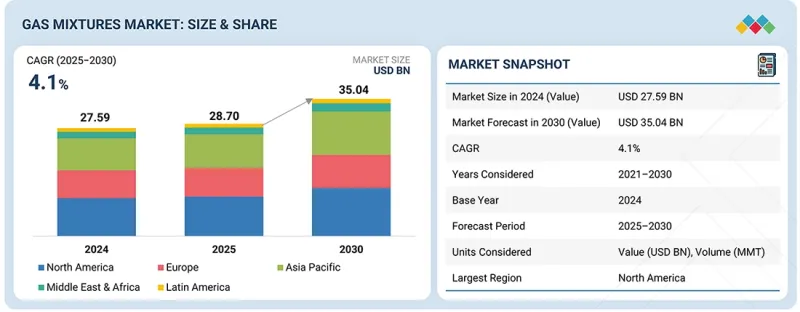
The gas mixtures market is projected to grow from USD 28.70 billion in 2025 to USD 35.04 billion by 2030, at a CAGR of 4.1% during the forecast period.
| Scope of the Report | |
|---|---|
| Years Considered for the Study | 2021-2030 |
| Base Year | 2024 |
| Forecast Period | 2025-2030 |
| Units Considered | Value (USD Billion) Volume (MMT) |
| Segments | Type, End-Use Industry, Storage, Distribution and Transportation, Manufacturing Process, and Region |
| Regions covered | North America, Asia Pacific, Europe, Middle East & Africa, and South America |
Expanding semiconductor production, stricter emission monitoring standards, and growing demand for high-precision industrial processes are accelerating the need for gas mixtures as reliable, application-specific solutions for controlled atmospheres and analytical accuracy.
"By type, the argon mixtures segment is expected to be the second-largest segment during the forecast period."
The argon mixtures segment is expected to be the second-largest market during the forecast period, as they are used extensively in metalworking and high-temperature industrial operations. Argon is an inert gas that makes for the ideal shielding gas for welding and cutting applications. It prevents oxidation and provides a stable arc to the welder. Mixtures such as argon-carbon dioxide and argon-oxygen are also commonly used within various industrial sectors, such as automotive manufacturing, construction, shipbuilding, and heavy equipment manufacturing, as they contribute to improved weld quality and assist in creating stronger structures. In addition to being used in fabrication, argon-based mixtures are also used in the production of electronics and in specialized applications that require a controlled, non-reactive environment. As a result, they can provide an optimum solution when mixed with other gases to provide a customized gas mixture with respect to penetration, spatter control, and surface finish. The continued growth of infrastructure development and industrial expansion supports argon-based mixtures' position as the second-largest segment of the total gas mixtures market.
"By end-use industry, the food & beverages segment is expected to be the second-largest market during the forecast period."
The food & beverages segment is expected to grow significantly during the forecast period. This is due to increased use of gas mixtures in the food & beverage sector, which utilizes controlled atmosphere technologies to preserve and maintain the quality of food produced. The industry uses nitrogen/carbon dioxide mixtures as a modified atmosphere for food packaging to extend shelf life, inhibit microbial growth, and maintain the freshness of products. These gases are also commonly used to prevent oxidation and spoilage of packaged meats, dairy products, baked goods, snack foods, and ready-to-eat meals during storage and shipping. When manufacturing carbonated beverages, beverage manufacturers need to accurately measure and blend gases in order to ensure that beverages have consistent flavors and remain stable during production. As globally packaged and convenience food consumption continues to increase, the demand for food-grade certifiable gas mixtures will remain strong. Further, as food safety and quality assurance standards continue to be updated and made more stringent, manufacturers will be encouraged to use certifiable gas blends that can be traced back to their original composition.
"By storage, distribution, and transportation, the tonnage segment is expected to be the second-largest segment during the forecast period."
The tonnage segment represents the second-largest share in the gas mixtures market, catering primarily to very large industrial customers who have a need for large quantities and single sources of continual gas delivery. Tonnage supplies are generally manufactured on-site and delivered by dedicated piping systems; these systems typically supply multiple blended gases to end-users, such as steel mills, refineries, petrochemical plants, and large manufacturers. The tonnage supply model is designed to provide reliable sources of gaseous supplies with minimal risk of transportation, while maximizing process efficiency since these processes cannot tolerate interruptions. In addition, tonnage supplies are seen as essential in those applications that operate under long production runs, whereby there is a requirement for constant flow rates and stable mixtures. With merchant liquid and bulk distribution services, there are opportunities for flexibility in serving multiple customers. Tonnage supply typically provides a fixed supply over longer periods of time to larger end-users under long-term contracts. The level of capital investment in creating the infrastructure for tonnage systems also helps create and maintain supplier/customer relationships, thereby generating recurring revenue for gases supplied under a tonnage supply agreement.
"By manufacturing process, the hydrogen production technologies segment is expected to be the second-largest segment during the forecast period."
The hydrogen production technologies segment represents the second-largest segment in the gas mixtures market, following hydrogen's common use as a key blending element in many different types of manufacturing processes. Hydrogen is frequently blended with nitrogen and argon in gas mixtures used for applications like heat treatment, annealing, sintering, and semiconductor manufacturing. Because hydrogen has reducing properties, it helps to prevent oxidation and improve the quality of surfaces for parts being manufactured by these processes. Steam methane reforming, electrolysis, and other methods to generate hydrogen provide the high purity level needed to mix hydrogen into precise formulations of gas mixtures. The industrial use of hydrogen-containing gas mixtures continues to expand, particularly in metal processing, electronics manufacturing processes, and clean energy initiatives. Semiconductor manufacturing, for example, demands ultra-high purity levels of hydrogen gas for deposition and etching processes. The overall movement toward using hydrogen as an energy carrier is driving investment in new hydrogen production infrastructure, thereby increasing overall feedstock supply for gas mixture manufacturers.
"Asia Pacific is expected to be the second-largest segment in terms of value during the forecast period."
As the second-largest market, by value, in the gas mixtures realm, Asia Pacific continues to be supported by a strong industrial base and growth in high-tech manufacturing capabilities. The growth of the metal fabrication, chemicals, food processing, healthcare, and electronics assembly sectors is driving the demand for gas mixtures in the region, as these gases help with process control and quality assurance.
The demand for gas mixtures in the region is growing significantly in countries such as China, Japan, South Korea, India, and Taiwan. Many primary manufacturers of semiconductor fabrication, and large volume export-oriented manufacturing clusters in the region, create a steady stream of demand for specialty and electronic-grade gas mixtures. Additionally, the increasing food safety requirements and environmental monitoring regulations are driving a heightened demand for certified calibration and preserved gas blends. While North America has the largest overall market value for gas mixtures because of established infrastructure and top-tier pricing structures, Asia Pacific is a close competitor with strong volume demand and has experienced rapid growth in industrial capabilities; therefore, Asia Pacific is considered the second-largest regional market for gas mixtures by value.
By Company Type: Tier 1 - 25%, Tier 2 - 42%, and Tier 3 - 33%
By Designation: C-level Executives - 20%, Directors - 30%, and Others - 50%
By Region: North America - 20%, Europe - 10%, Asia Pacific - 40%, South America - 10%, and Middle East & Africa - 20%
The gas mixtures market include key players such as Linde PLC (Ireland), Air Liquide (France), Air Products and Chemicals, Inc. (US), Messer SE & Co. KGaA (Germany), Iwatani Corporation (Japan), TAIYO NIPPON SANSO CORPORATION (Japan), Westfalen AG (Germany), Gulf Cryo (UAE), The SIAD Group (Italy), and Holston Gases (US)among others are covered in the report.
The study includes an in-depth competitive analysis of these key players in the gas mixture market. It also studies their company profiles, recent developments, and key market strategies.
Research Coverage
This research report categorizes the gas mixture market based on type (oxygen mixtures, carbon dioxide mixtures, argon mixtures, hydrogen mixtures, speciality gas mixtures, other mixtures), end-use industry (metal manufacturing & fabrication, food & beverages, healthcare, chemicals, electronics, other end-use industries), storage, distribution, and transportation (merchant liquid/bulk, cylinders & packaged gas, tonnage), manufacturing process (air separation technologies, hydrogen production technologies, other manufacturing process), and region (Asia Pacific, North America, Europe, South America, and Middle East & Africa).
The report's scope covers detailed information regarding the drivers, restraints, challenges, and opportunities influencing the growth of the gas mixtures market. A detailed analysis of the key industry players has been done to provide insights into their business overview, products offered, and key strategies, such as partnerships, collaborations, product launches, expansions, and acquisitions, associated with the gas mixtures market. This report covers a competitive analysis of upcoming startups in the gas mixtures market ecosystem.
Reasons to Buy the Report
The report will offer the market leaders/new entrants with information on the closest approximations of the revenue numbers for the overall gas mixtures market and the subsegments. It will help stakeholders understand the competitive landscape, gain more insights into positioning their businesses better, and plan suitable go-to-market strategies. The report will help stakeholders understand the pulse of the market and provide them with information on key market drivers, restraints, challenges, and opportunities.
The report provides insights into the following points:
Analysis of key drivers (increased demand from semiconductor & electronics manufacturing, retail shift toward extended food & beverage shelf-life product, increased demand from stainless and duplex steel manufacturing using nitrogen-bearing n2/ar blends), restraints (raw gas feedstock volatility in rare and specialty component, high cost of gravimetric precision blending infrastructure), opportunities (on-site micro-blending units for high consumption industrial cluster, high-margin low-volume specialty blend portfolio, specialty gas recovery and re-blending programs), and challenges (maintaining composition stability at ppb and ppm levels, scaling customization without sacrificing throughput)
- Product Development/Innovation: Detailed insights into upcoming technologies, research & development activities, and product & service launches in the gas mixtures market
- Market Development: Comprehensive information about profitable markets across varied regions
Market Diversification: Exhaustive information about products & services, untapped geographies, recent developments, and investments in the gas mixtures market
- Competitive Assessment: In-depth assessment of market shares, growth strategies, and service offerings of leading players, such as Linde PLC (Ireland), Air Liquide (France), Air Products and Chemicals, Inc. (US), Messer SE & Co. KGaA (Germany), Iwatani Corporation (Japan), TAIYO NIPPON SANSO CORPORATION (Japan), Westfalen AG (Germany), Gulf Cryo (UAE), The SIAD Group (Italy), Holston Gases (US).
TABLE OF CONTENTS
1 INTRODUCTION
- 1.1 STUDY OBJECTIVES
- 1.2 MARKET DEFINITION
- 1.3 STUDY SCOPE
- 1.3.1 MARKET SEGMENTATION & REGIONAL SCOPE
- 1.3.2 INCLUSIONS & EXCLUSIONS
- 1.4 YEARS CONSIDERED
- 1.4.1 CURRENCY CONSIDERED
- 1.4.2 UNIT CONSIDERED
- 1.5 STAKEHOLDERS
- 1.6 SUMMARY OF CHANGES
2 EXECUTIVE SUMMARY
- 2.1 KEY INSIGHTS & MARKET HIGHLIGHTS
- 2.2 KEY MARKET PARTICIPANTS: INSIGHTS & STRATEGIC DEVELOPMENTS
- 2.3 DISRUPTIVE TRENDS SHAPING MARKET
- 2.4 HIGH-GROWTH SEGMENTS
- 2.5 SNAPSHOT: GLOBAL MARKET SIZE, GROWTH RATE, AND FORECAST
3 PREMIUM INSIGHTS
- 3.1 ATTRACTIVE OPPORTUNITIES FOR PLAYERS IN GAS MIXTURES MARKET
- 3.2 GAS MIXTURES MARKET, BY TYPE AND REGION
- 3.3 GAS MIXTURES MARKET, BY END-USE INDUSTRY
- 3.4 GAS MIXTURES MARKET, BY STORAGE, DISTRIBUTION, AND TRANSPORTATION
- 3.5 GAS MIXTURES MARKET, BY MANUFACTURING PROCESS
- 3.6 GAS MIXTURES MARKET, BY COUNTRY
4 MARKET OVERVIEW
- 4.1 INTRODUCTION
- 4.2 MARKET DYNAMICS
- 4.2.1 DRIVERS
- 4.2.1.1 High demand from manufacturers of semiconductors and electronics
- 4.2.1.2 Retail shift toward extended shelf-life of food and beverage products
- 4.2.1.3 Growing demand from manufacturers of stainless and duplex steel
- 4.2.2 RESTRAINTS
- 4.2.2.1 Volatile availability of raw gas feedstock for rare and specialty components
- 4.2.2.2 High cost of gravimetric precision blending infrastructure
- 4.2.3 OPPORTUNITIES
- 4.2.3.1 On-site micro-blending units for high-consumption industrial clusters
- 4.2.3.2 High-margin, low-volume specialty blend portfolios
- 4.2.3.3 Specialty gas recovery and re-blending programs
- 4.2.4 CHALLENGES
- 4.2.4.1 Maintaining composition stability at ppb and ppm levels
- 4.2.4.2 Scaling customization without compromising throughput
- 4.2.1 DRIVERS
- 4.3 UNMET NEEDS AND WHITE SPACES
- 4.3.1 LONG-TERM STABILITY OF REACTIVE AND TRACE-LEVEL MULTI-COMPONENT MIXTURES
- 4.3.2 SCALABLE SUB-PPB BLENDING WITH TRACEABLE UNCERTAINTY CONTROL
- 4.3.3 ADVANCED CYLINDER MATERIAL AND SURFACE ENGINEERING FOR ULTRA-SENSITIVE BLENDS
- 4.4 INTERCONNECTED MARKETS AND CROSS-SECTOR OPPORTUNITIES
- 4.4.1 INTERCONNECTED MARKETS
- 4.4.2 CROSS-SECTOR OPPORTUNITIES
- 4.5 STRATEGIC MOVES BY TIER 1/2/3 PLAYERS
- 4.5.1 TIER 1 PLAYERS: STRATEGIC INITIATIVES IN GAS MIXTURES MARKET
- 4.5.1.1 Linde plc (Ireland)
- 4.5.1.2 Air Liquide (France)
- 4.5.1.3 Air Products and Chemicals, Inc. (US)
- 4.5.2 TIER 2 PLAYERS: KEY STRATEGIC MOVES AND INNOVATIONS
- 4.5.2.1 Messer SE & Co. KGaA (Germany)
- 4.5.2.2 Taiyo Nippon Sanso Corporation (Japan)
- 4.5.3 TIER 3 PLAYERS: EMERGING STRATEGIES AND REGIONAL POSITIONING
- 4.5.3.1 Yingde Gases Group (China) & Guangdong Huate Gas Co., Ltd. (China)
- 4.5.3.2 Coregas Pty Ltd & Gulf Cryo (Australia & Middle East)
- 4.5.1 TIER 1 PLAYERS: STRATEGIC INITIATIVES IN GAS MIXTURES MARKET
5 INDUSTRY TRENDS
- 5.1 PORTER'S FIVE FORCES' ANALYSIS
- 5.1.1 THREAT FROM NEW ENTRANTS
- 5.1.2 THREAT FROM SUBSTITUTES
- 5.1.3 BARGAINING POWER OF SUPPLIERS
- 5.1.4 BARGAINING POWER OF BUYERS
- 5.1.5 INTENSITY OF COMPETITIVE RIVALRY
- 5.2 MACROECONOMIC ANALYSIS
- 5.2.1 INTRODUCTION
- 5.2.2 GDP TRENDS AND FORECASTS
- 5.2.3 INDUSTRIAL MANUFACTURING OUTPUT CYCLES
- 5.3 VALUE CHAIN ANALYSIS
- 5.4 ECOSYSTEM ANALYSIS
- 5.5 PRICING ANALYSIS
- 5.5.1 AVERAGE SELLING PRICE OF GAS MIXTURE TYPES, BY KEY PLAYER
- 5.5.2 AVERAGE SELLING PRICE TREND, BY REGION
- 5.6 TRADE ANALYSIS
- 5.6.1 IMPORT DATA RELATED TO HS CODE 280440, BY COUNTRY, 2020-2024 (USD THOUSAND)
- 5.6.2 EXPORT DATA RELATED TO HS CODE 280440, BY COUNTRY, 2020-2024 (USD THOUSAND)
- 5.6.3 IMPORT DATA RELATED TO HS CODE 280430, BY COUNTRY, 2020-2024 (USD THOUSAND)
- 5.6.4 EXPORT DATA RELATED TO HS CODE 280430, BY COUNTRY, 2020-2024 (USD THOUSAND)
- 5.6.5 IMPORT DATA RELATED TO HS CODE 281121, BY COUNTRY, 2020-2024 (USD THOUSAND)
- 5.6.6 EXPORT DATA RELATED TO HS CODE 281121, BY COUNTRY, 2020-2024 (USD THOUSAND)
- 5.6.7 IMPORT DATA RELATED TO HS CODE 280421, BY COUNTRY, 2020-2024 (USD THOUSAND)
- 5.6.8 EXPORT DATA RELATED TO HS CODE 280421, BY COUNTRY, 2020-2024 (USD THOUSAND)
- 5.6.9 IMPORT DATA RELATED TO HS CODE 280410, BY COUNTRY, 2020-2024 (USD THOUSAND)
- 5.6.10 EXPORT DATA RELATED TO HS CODE 280410, BY COUNTRY, 2020-2024 (USD THOUSAND)
- 5.7 KEY CONFERENCES & EVENTS, 2025-2026
- 5.8 TRENDS/DISRUPTIONS IMPACTING CUSTOMER BUSINESS
- 5.9 INVESTMENT & FUNDING SCENARIO
- 5.10 CASE STUDY ANALYSIS
- 5.10.1 LINDE PLC: CARBOFLEX(R) ATMOSPHERE CONTROL
- 5.10.2 AIR LIQUIDE: CALIBRATION GAS MIXTURES (EMISSION MONITORING & QUALITY ASSURANCE)
- 5.10.3 AIR PRODUCTS AND CHEMICALS, INC.: NITROGEN-HYDROGEN GAS MIXTURE MONITORING IN SINTERING APPLICATIONS
- 5.11 IMPACT OF 2025 US TARIFFS ON GAS MIXTURES MARKET
- 5.11.1 INTRODUCTION
- 5.11.2 KEY TARIFF RATES
- 5.11.3 PRICE IMPACT ANALYSIS
- 5.11.4 IMPACT OF COUNTRY/REGION
- 5.11.4.1 US
- 5.11.4.2 Europe
- 5.11.4.3 Asia Pacific
- 5.11.5 IMPACT ON END-USE INDUSTRIES
6 TECHNOLOGICAL ADVANCEMENTS
- 6.1 KEY TECHNOLOGIES
- 6.1.1 GRAVIMETRIC HIGH-PRECISION BLENDING SYSTEMS
- 6.1.2 REAL-TIME GAS CHROMATOGRAPHY (GC) & ANALYTICAL VERIFICATION SYSTEMS
- 6.2 COMPLEMENTARY TECHNOLOGIES
- 6.2.1 SMART GAS DENSITY & THERMAL CONDUCTIVITY SENSORS
- 6.2.2 CRYOGENIC STORAGE & MICROBULK DELIVERY SYSTEMS
- 6.3 ADJACENT TECHNOLOGIES
- 6.3.1 ON-SITE MODULAR GAS GENERATION SYSTEMS
- 6.3.2 HYDROGEN & DECARBONIZATION-DRIVEN GAS BLENDING TECHNOLOGIES
- 6.4 TECHNOLOGY/PRODUCT ROADMAP
- 6.4.1 SHORT-TERM (2025-2027): PERFORMANCE STABILIZATION AND DIGITAL QUALITY CONTROL PHASE
- 6.4.2 MID-TERM (2027-2030): SCALABLE LOCALIZED PRODUCTION AND HYBRID BLENDING INFRASTRUCTURE
- 6.4.3 LONG-TERM (2030-2035+): AUTONOMOUS PRECISION BLENDING AND LOW-CARBON GAS ECOSYSTEM INTEGRATION
- 6.5 PATENT ANALYSIS
- 6.5.1 INTRODUCTION
- 6.5.2 APPROACH
- 6.5.3 TOP APPLICANTS
- 6.6 FUTURE APPLICATIONS
- 6.6.1 GREEN HYDROGEN BLENDING FOR INDUSTRIAL PROCESSES
- 6.6.2 SYNTHETIC MICROBIAL GROWTH ATMOSPHERES
- 6.6.3 BIOENGINEERED ORGAN PRESERVATION GASES
- 6.6.4 SMART INDOOR AIR QUALITY MIXTURES
- 6.7 IMPACT OF AI/GENERATIVE AI ON GAS MIXTURES MARKET
- 6.7.1 TOP USE CASES AND MARKET POTENTIAL
- 6.7.2 BEST PRACTICES IN GAS MIXTURES
- 6.7.3 CASE STUDIES OF AI IMPLEMENTATION IN GAS MIXTURES MARKET
- 6.7.4 INTERCONNECTED ADJACENT ECOSYSTEM AND IMPACT ON MARKET PLAYERS
- 6.7.5 CLIENTS' READINESS TO ADOPT GENERATIVE AI IN GAS MIXTURES MARKET
7 SUSTAINABILITY AND REGULATORY LANDSCAPE
- 7.1 REGIONAL REGULATIONS AND COMPLIANCE
- 7.1.1 REGULATORY BODIES, GOVERNMENT AGENCIES, AND OTHER ORGANIZATIONS
- 7.1.2 INDUSTRY STANDARDS
- 7.2 SUSTAINABILITY INITIATIVES
- 7.2.1 CARBON IMPACT AND ECO-APPLICATIONS OF GAS MIXTURES
- 7.2.1.1 Carbon impact reduction
- 7.2.1.2 Eco-applications
- 7.2.1 CARBON IMPACT AND ECO-APPLICATIONS OF GAS MIXTURES
- 7.3 SUSTAINABILITY IMPACT AND REGULATORY POLICY INITIATIVES
- 7.4 CERTIFICATIONS, LABELING, AND ECO-STANDARDS
8 CUSTOMER LANDSCAPE & BUYER BEHAVIOR
- 8.1 DECISION-MAKING PROCESS
- 8.2 KEY STAKEHOLDERS AND BUYING EVALUATION CRITERIA
- 8.2.1 KEY STAKEHOLDERS IN BUYING PROCESS
- 8.2.2 BUYING CRITERIA
- 8.3 ADOPTION BARRIERS & INTERNAL CHALLENGES
- 8.4 UNMET NEEDS FROM VARIOUS END-USE INDUSTRIES
- 8.5 MARKET PROFITABILITY
- 8.5.1 REVENUE POTENTIAL
- 8.5.2 COST DYNAMICS
- 8.5.3 MARGIN OPPORTUNITIES, BY END-USE INDUSTRY
9 GAS MIXTURES MARKET, BY TYPE
- 9.1 INTRODUCTION
- 9.2 OXYGEN MIXTURES
- 9.2.1 OXYGEN MIXTURES ENABLE CONTROLLED OXIDATION PERFORMANCE UNDER STRICT SAFETY PARAMETERS
- 9.3 NITROGEN MIXTURES
- 9.3.1 NITROGEN MIXTURES PROVIDE INERT STABILITY AND ULTRA-HIGH PURITY MATRIX CONTROL
- 9.4 CARBON DIOXIDE MIXTURES
- 9.4.1 CARBON DIOXIDE MIXTURES OFFER DENSITY-DRIVEN PHASE BEHAVIOR AND SOLUBILITY CONTROL
- 9.5 ARGON MIXTURES
- 9.5.1 ARGON MIXTURES PROVIDE INERT ATOMIC STABILITY WITH PRECISE THERMAL MANAGEMENT
- 9.6 HYDROGEN MIXTURES
- 9.6.1 HYDROGEN MIXTURES ENABLE HIGH DIFFUSIVITY REDUCTION ENVIRONMENTS UNDER CONTROLLED COMPOSITION
- 9.7 SPECIALTY GAS MIXTURES
- 9.7.1 SPECIALTY GAS MIXTURES DELIVER MOLECULAR-LEVEL PRECISION WITH VALIDATED COMPOSITIONAL INTEGRITY
- 9.8 OTHER MIXTURES
10 GAS MIXTURES MARKET, BY END-USE INDUSTRY
- 10.1 INTRODUCTION
- 10.2 METAL MANUFACTURING & FABRICATION
- 10.2.1 STEEL OUTPUT EXPANSION AND FABRICATION DEMAND TO DRIVE GAS MIXTURE OPTIMIZATION NEEDS
- 10.3 FOOD & BEVERAGES
- 10.3.1 FOCUS ON STABILIZING BEVERAGE OUTPUT AND POST-HARVEST GAS ADOPTION TO DRIVE DEMAND FOR FOOD GRADE GAS MIXTURES
- 10.4 MEDICAL & HEALTHCARE
- 10.4.1 RISING RESPIRATORY CARE AND SURGICAL VOLUMES TO DRIVE DEMAND FOR MEDICAL GAS MIXTURES
- 10.5 CHEMICALS
- 10.5.1 EXPANDING CLEAN CHEMICAL INVESTMENTS AND SPECIALTY OUTPUT TO DRIVE MARKET
- 10.6 ELECTRONICS
- 10.6.1 RISING SEMICONDUCTOR COMPLEXITY AND WAFER VOLUMES TO DRIVE DEMAND FOR SPECIALTY GAS MIXTURES
- 10.7 OTHER END-USE INDUSTRIES
11 GAS MIXTURES MARKET, BY STORAGE, DISTRIBUTION, AND TRANSPORTATION
- 11.1 INTRODUCTION
- 11.2 CYLINDERS & PACKAGED GAS
- 11.2.1 RISING DEMAND FOR PRECISION AND DECENTRALIZED SUPPLY TO STRENGTHEN CYLINDER-BASED GAS MIXTURE DISTRIBUTION
- 11.3 MERCHANT LIQUID/BULK
- 11.3.1 EXPANDING INDUSTRIAL SCALE OPERATIONS TO INCREASE RELIANCE ON MERCHANT LIQUID AND BULK GAS SUPPLY SYSTEMS
- 11.4 TONNAGE
- 11.4.1 LARGE-SCALE DEMAND FOR INDUSTRIAL GAS MIXTURES TO DRIVE ADOPTION OF ON-SITE TONNAGE GAS PRODUCTION SYSTEMS
12 GAS MIXTURES MARKET, BY MANUFACTURING PROCESS
- 12.1 INTRODUCTION
- 12.2 AIR SEPARATION TECHNOLOGIES
- 12.2.1 AIR SEPARATION TECHNOLOGIES ENABLE SCALABLE PRODUCTION OF HIGH PURITY INDUSTRIAL GAS MIXTURES
- 12.2.2 CRYOGENIC AIR SEPARATION
- 12.2.3 NON-CRYOGENIC AIR SEPARATION
- 12.3 HYDROGEN PRODUCTION TECHNOLOGIES
- 12.3.1 HYDROGEN PRODUCTION TECHNOLOGIES ENABLE CONTROLLED SYNTHESIS OF HIGH PURITY HYDROGEN STREAMS
- 12.3.2 STEAM REFORMING
- 12.3.3 PARTIAL OXIDATION
- 12.3.4 PLASMA REFORMING
- 12.4 OTHER MANUFACTURING PROCESSES
- 12.4.1 PRESSURE SWING ADSORPTION
13 GAS MIXTURES MARKET, BY REGION
- 13.1 INTRODUCTION
- 13.2 NORTH AMERICA
- 13.2.1 US
- 13.2.1.1 Industrial expansion and healthcare trends to drive demand for gas mixtures
- 13.2.2 CANADA
- 13.2.2.1 Canada's expanding industries to drive demand for gas mixtures
- 13.2.3 MEXICO
- 13.2.3.1 Focus on expanding manufacturing to drive demand for gas mixtures
- 13.2.1 US
- 13.3 ASIA PACIFIC
- 13.3.1 CHINA
- 13.3.1.1 Industrial and high-tech expansion to drive demand
- 13.3.2 INDIA
- 13.3.2.1 Industrial expansion to drive demand for gas mixtures
- 13.3.3 JAPAN
- 13.3.3.1 Focus on growth of industrial recovery and technology to drive demand for gas mixtures
- 13.3.4 SOUTH KOREA
- 13.3.4.1 Emphasis on high-tech expansion to accelerate demand for gas mixtures
- 13.3.5 REST OF ASIA PACIFIC
- 13.3.1 CHINA
- 13.4 EUROPE
- 13.4.1 GERMANY
- 13.4.1.1 Germany's industrial rebound to accelerate gas mixture demand
- 13.4.2 FRANCE
- 13.4.2.1 Green transition in country to boost demand for gas mixtures
- 13.4.3 UK
- 13.4.3.1 Rapid growth of manufacturing sector to strengthen demand for gas mixtures
- 13.4.4 BELGIUM
- 13.4.4.1 Belgium's industrial revival to boost demand for specialty gas
- 13.4.5 REST OF EUROPE
- 13.4.1 GERMANY
- 13.5 MIDDLE EAST & AFRICA
- 13.5.1 GCC COUNTRIES
- 13.5.1.1 Saudi Arabia
- 13.5.1.1.1 Focus on industrial expansion to accelerate demand for gas mixtures
- 13.5.1.2 UAE
- 13.5.1.2.1 Need for gas mixtures for industrial surge to drive market
- 13.5.1.3 Rest of GCC countries
- 13.5.1.1 Saudi Arabia
- 13.5.2 SOUTH AFRICA
- 13.5.2.1 South Africa's industrial recovery to lift demand for gas mixtures
- 13.5.3 REST OF MIDDLE EAST & AFRICA
- 13.5.1 GCC COUNTRIES
- 13.6 SOUTH AMERICA
- 13.6.1 BRAZIL
- 13.6.1.1 Emphasis on industrial and healthcare expansion to drive demand for gas mixtures
- 13.6.2 ARGENTINA
- 13.6.2.1 Focus on industrial recovery to drive demand for gas mixtures
- 13.6.3 REST OF SOUTH AMERICA
- 13.6.1 BRAZIL
14 COMPETITIVE LANDSCAPE
- 14.1 OVERVIEW
- 14.2 KEY PLAYER STRATEGIES/RIGHT TO WIN
- 14.3 REVENUE ANALYSIS, 2020-2024
- 14.4 MARKET SHARE ANALYSIS, 2024
- 14.5 BRAND/PRODUCT COMPARISON
- 14.6 COMPANY EVALUATION MATRIX: KEY PLAYERS, 2024
- 14.6.1 STARS
- 14.6.2 EMERGING LEADERS
- 14.6.3 PERVASIVE PLAYERS
- 14.6.4 PARTICIPANTS
- 14.6.5 COMPANY FOOTPRINT: KEY PLAYERS, 2024
- 14.6.5.1 Company footprint
- 14.6.5.2 Region footprint
- 14.6.5.3 Type footprint
- 14.6.5.4 End-use industry footprint
- 14.6.5.5 Storage, distribution, and transportation footprint
- 14.6.5.6 Manufacturing process footprint
- 14.7 COMPANY EVALUATION MATRIX: STARTUPS/SMES, 2024
- 14.7.1 PROGRESSIVE COMPANIES
- 14.7.2 RESPONSIVE COMPANIES
- 14.7.3 DYNAMIC COMPANIES
- 14.7.4 STARTING BLOCKS
- 14.7.5 COMPETITIVE BENCHMARKING: STARTUPS/SMES, 2024
- 14.7.5.1 List of key startups/SMEs
- 14.7.5.2 Competitive benchmarking of key startups/SMEs
- 14.8 COMPANY VALUATION AND FINANCIAL METRICS
- 14.8.1 COMPANY VALUATION
- 14.8.2 FINANCIAL METRICS
- 14.9 COMPETITIVE SCENARIO
- 14.9.1 PRODUCT LAUNCHES
- 14.9.2 DEALS
- 14.9.3 EXPANSIONS
- 14.9.4 OTHER DEVELOPMENTS
15 COMPANY PROFILES
- 15.1 KEY PLAYERS
- 15.1.1 LINDE PLC
- 15.1.1.1 Business overview
- 15.1.1.2 Products offered
- 15.1.1.3 Recent developments
- 15.1.1.3.1 Deals
- 15.1.1.3.2 Expansions
- 15.1.1.4 MnM view
- 15.1.1.4.1 Right to win
- 15.1.1.4.2 Strategic choices
- 15.1.1.4.3 Weaknesses and competitive threats
- 15.1.2 AIR LIQUIDE
- 15.1.2.1 Business overview
- 15.1.2.2 Products offered
- 15.1.2.3 Recent developments
- 15.1.2.3.1 Deals
- 15.1.2.3.2 Expansions
- 15.1.2.3.3 Other developments
- 15.1.2.4 MnM view
- 15.1.2.4.1 Right to win
- 15.1.2.4.2 Strategic choices
- 15.1.2.4.3 Weaknesses and competitive threats
- 15.1.3 AIR PRODUCTS AND CHEMICALS, INC.
- 15.1.3.1 Business overview
- 15.1.3.2 Products offered
- 15.1.3.3 Recent developments
- 15.1.3.3.1 Deals
- 15.1.3.3.2 Expansions
- 15.1.3.4 MnM view
- 15.1.3.4.1 Right to win
- 15.1.3.4.2 Strategic choices
- 15.1.3.4.3 Weaknesses and competitive threats
- 15.1.4 MESSER SE & CO. KGAA
- 15.1.4.1 Business overview
- 15.1.4.2 Products offered
- 15.1.4.3 Recent developments
- 15.1.4.3.1 Deals
- 15.1.4.3.2 Expansions
- 15.1.4.4 MnM view
- 15.1.4.4.1 Right to win
- 15.1.4.4.2 Strategic choices
- 15.1.4.4.3 Weaknesses and competitive threats
- 15.1.5 IWATANI CORPORATION
- 15.1.5.1 Business overview
- 15.1.5.2 Products offered
- 15.1.5.3 Recent developments
- 15.1.5.3.1 Deals
- 15.1.5.3.2 Expansions
- 15.1.5.4 MnM view
- 15.1.5.4.1 Right to win
- 15.1.5.4.2 Strategic choices
- 15.1.5.4.3 Weaknesses and competitive threats
- 15.1.6 TAIYO NIPPON SANSO CORPORATION
- 15.1.6.1 Business overview
- 15.1.6.2 Products offered
- 15.1.6.3 Recent developments
- 15.1.6.3.1 Product launches
- 15.1.6.3.2 Deals
- 15.1.6.4 MnM view
- 15.1.7 WESTFALEN AG
- 15.1.7.1 Business overview
- 15.1.7.2 Products offered
- 15.1.7.3 Recent developments
- 15.1.7.3.1 Deals
- 15.1.7.4 MnM view
- 15.1.8 GULF CRYO
- 15.1.8.1 Business overview
- 15.1.8.2 Products offered
- 15.1.8.3 Recent developments
- 15.1.8.3.1 Deals
- 15.1.8.3.2 Expansions
- 15.1.8.4 MnM view
- 15.1.9 THE SIAD GROUP
- 15.1.9.1 Business overview
- 15.1.9.2 Products offered
- 15.1.9.3 Recent developments
- 15.1.9.3.1 Expansions
- 15.1.9.4 MnM view
- 15.1.10 HOLSTON GASES
- 15.1.10.1 Business overview
- 15.1.10.2 Products offered
- 15.1.10.3 MnM view
- 15.1.1 LINDE PLC
- 15.2 OTHER PLAYERS
- 15.2.1 AXCEL GASES
- 15.2.2 BHORUKA SPECIALTY GASES PVT LTD.
- 15.2.3 ELLENBARRIE INDUSTRIAL GASES LTD
- 15.2.4 GOYAL MG GASES PVT. LTD.
- 15.2.5 STEELMAN GASES PVT. LTD.
- 15.2.6 CHEMIX SPECIALTY GASES AND EQUIPMENT
- 15.2.7 SPECGAS, INC.
- 15.2.8 INGAS
- 15.2.9 WESCO GAS & WELDING SUPPLY, INC. (WESCO)
- 15.2.10 MULTIGAS
- 15.2.11 PT SAMATOR INDO GAS TBK
- 15.2.12 BRISTOL GASES
- 15.2.13 BUZWAIR SPECIALTY GASES (BSG)
- 15.2.14 YIGAS INTERNATIONAL LIMITED
- 15.2.15 MESA SPECIALTY GASES & EQUIPMENT
16 RESEARCH METHODOLOGY
- 16.1 RESEARCH DATA
- 16.1.1 SECONDARY DATA
- 16.1.1.1 Key data from secondary sources
- 16.1.2 PRIMARY DATA
- 16.1.2.1 Key data from primary sources
- 16.1.1 SECONDARY DATA
- 16.2 MARKET SIZE ESTIMATION
- 16.2.1 TOP-DOWN APPROACH
- 16.2.2 BOTTOM-UP APPROACH
- 16.3 BASE NUMBER CALCULATION
- 16.3.1 SUPPLY-SIDE APPROACH
- 16.4 MARKET FORECAST APPROACH
- 16.4.1 SUPPLY SIDE
- 16.4.2 DEMAND SIDE
- 16.5 DATA TRIANGULATION
- 16.6 RESEARCH ASSUMPTIONS
- 16.7 RISK ASSESSMENT
- 16.8 GROWTH RATE ASSUMPTIONS
17 APPENDIX
- 17.1 DISCUSSION GUIDE
- 17.2 KNOWLEDGESTORE: MARKETSANDMARKETS' SUBSCRIPTION PORTAL
- 17.3 CUSTOMIZATION OPTIONS
- 17.4 RELATED REPORTS
- 17.5 AUTHOR DETAILS
List of Tables
- TABLE 1 IMPACT OF PORTER'S FIVE FORCES ON GAS MIXTURES MARKET
- TABLE 2 GLOBAL GDP GROWTH PROJECTION, 2021-2028 (USD TRILLION)
- TABLE 3 ROLES OF COMPANIES IN GAS MIXTURES ECOSYSTEM
- TABLE 4 AVERAGE SELLING PRICE OF GAS MIXTURE TYPES, BY KEY PLAYER, 2024 (USD/TON)
- TABLE 5 AVERAGE SELLING PRICE TREND, BY REGION, 2021-2024 (USD/TON)
- TABLE 6 IMPORT DATA RELATED TO HS CODE 280440, BY COUNTRY, 2020-2024 (USD THOUSAND)
- TABLE 7 EXPORT DATA RELATED TO HS CODE 280440, BY COUNTRY, 2020-2024 (USD THOUSAND)
- TABLE 8 IMPORT DATA RELATED TO HS CODE 280430, BY COUNTRY, 2020-2024 (USD THOUSAND)
- TABLE 9 EXPORT DATA RELATED TO HS CODE 280430, BY COUNTRY, 2020-2024 (USD THOUSAND)
- TABLE 10 IMPORT DATA RELATED TO HS CODE 281121, BY COUNTRY, 2020-2024 (USD THOUSAND)
- TABLE 11 EXPORT DATA RELATED TO HS CODE 281121, BY COUNTRY, 2020-2024 (USD THOUSAND)
- TABLE 12 IMPORT DATA RELATED TO HS CODE 280421, BY COUNTRY, 2020-2024 (USD THOUSAND)
- TABLE 13 EXPORT DATA RELATED TO HS CODE 280421, BY COUNTRY, 2020-2024 (USD THOUSAND)
- TABLE 14 IMPORT DATA RELATED TO HS CODE 280410, BY COUNTRY, 2020-2024 (USD THOUSAND)
- TABLE 15 EXPORT DATA RELATED TO HS CODE 280410, BY COUNTRY, 2020-2024 (USD THOUSAND)
- TABLE 16 KEY CONFERENCES & EVENTS, 2025-2026
- TABLE 17 LIST OF MAJOR PATENTS IN 2025
- TABLE 18 TOP USE CASES AND MARKET POTENTIAL
- TABLE 19 BEST PRACTICES: COMPANIES IMPLEMENTING USE CASES
- TABLE 20 GAS MIXTURES MARKET: CASE STUDIES RELATED TO GENERATIVE AI IMPLEMENTATION
- TABLE 21 NORTH AMERICA: REGULATORY BODIES, GOVERNMENT AGENCIES, AND OTHER ORGANIZATIONS
- TABLE 22 EUROPE: REGULATORY BODIES, GOVERNMENT AGENCIES, AND OTHER ORGANIZATIONS
- TABLE 23 ASIA PACIFIC: REGULATORY BODIES, GOVERNMENT AGENCIES, AND OTHER ORGANIZATIONS
- TABLE 24 SOUTH AMERICA: REGULATORY BODIES, GOVERNMENT AGENCIES, AND OTHER ORGANIZATIONS
- TABLE 25 MIDDLE EAST & AFRICA: REGULATORY BODIES, GOVERNMENT AGENCIES, AND OTHER ORGANIZATIONS
- TABLE 26 GLOBAL INDUSTRY STANDARDS IN GAS MIXTURES MARKET
- TABLE 27 CERTIFICATIONS, LABELING, AND ECO-STANDARDS IN GAS MIXTURES MARKET
- TABLE 28 INFLUENCE OF STAKEHOLDERS ON BUYING PROCESS FOR TOP THREE END-USE INDUSTRIES
- TABLE 29 KEY BUYING CRITERIA FOR TOP THREE END-USE INDUSTRIES
- TABLE 30 UNMET NEEDS IN GAS MIXTURES MARKET, BY END-USE INDUSTRY
- TABLE 31 GAS MIXTURES MARKET, BY TYPE, 2021-2023 (USD MILLION)
- TABLE 32 GAS MIXTURES MARKET, BY TYPE, 2024-2030 (USD MILLION)
- TABLE 33 GAS MIXTURES MARKET, BY TYPE, 2021-2023 (MMT)
- TABLE 34 GAS MIXTURES MARKET, BY TYPE, 2024-2030 (MMT)
- TABLE 35 OXYGEN MIXTURE VARIANTS: COMPOSITION AND APPLICATION
- TABLE 36 NITROGEN MIXTURE VARIANTS: COMPOSITION AND APPLICATION
- TABLE 37 CARBON DIOXIDE MIXTURE VARIANTS: COMPOSITION AND APPLICATION
- TABLE 38 ARGON MIXTURE VARIANTS: COMPOSITION AND APPLICATION
- TABLE 39 HYDROGEN MIXTURE VARIANTS: COMPOSITION AND APPLICATION
- TABLE 40 SPECIALTY GAS MIXTURE VARIANTS: COMPOSITION AND APPLICATION
- TABLE 41 GAS MIXTURES MARKET, BY END-USE INDUSTRY, 2021-2023 (USD MILLION)
- TABLE 42 GAS MIXTURES MARKET, BY END-USE INDUSTRY, 2024-2030 (USD MILLION)
- TABLE 43 GAS MIXTURES MARKET, BY END-USE INDUSTRY, 2021-2023 (MMT)
- TABLE 44 GAS MIXTURES MARKET, BY END-USE INDUSTRY, 2024-2030 (MMT)
- TABLE 45 GAS MIXTURES MARKET, BY STORAGE, DISTRIBUTION, AND TRANSPORTATION, 2021-2023 (USD MILLION)
- TABLE 46 GAS MIXTURES MARKET, BY STORAGE, DISTRIBUTION, AND TRANSPORTATION, 2024-2030 (USD MILLION)
- TABLE 47 GAS MIXTURES MARKET, BY STORAGE, DISTRIBUTION, AND TRANSPORTATION, 2021-2023 (MMT)
- TABLE 48 GAS MIXTURES MARKET, BY STORAGE, DISTRIBUTION, AND TRANSPORTATION, 2024-2030 (MMT)
- TABLE 49 TECHNICAL DIFFERENTIATION IN CYLINDERS AND PACKAGED GAS SYSTEMS
- TABLE 50 TECHNICAL AND OPERATIONAL STRUCTURE OF MERCHANT LIQUID AND BULK GAS SUPPLY (MERCHANT LIQUID/BULK)
- TABLE 51 TECHNICAL AND OPERATIONAL STRUCTURE OF MERCHANT LIQUID AND BULK GAS SUPPLY (TONNAGE)
- TABLE 52 GAS MIXTURES MARKET, BY MANUFACTURING PROCESS, 2021-2023 (USD MILLION)
- TABLE 53 GAS MIXTURES MARKET, BY MANUFACTURING PROCESS, 2024-2030 (USD MILLION)
- TABLE 54 GAS MIXTURES MARKET, BY MANUFACTURING PROCESS, 2021-2023 (MMT)
- TABLE 55 GAS MIXTURES MARKET, BY MANUFACTURING PROCESS, 2024-2030 (MMT)
- TABLE 56 GAS MIXTURES MARKET, BY REGION, 2021-2023 (USD MILLION)
- TABLE 57 GAS MIXTURES MARKET, BY REGION, 2024-2030 (USD MILLION)
- TABLE 58 GAS MIXTURES MARKET, BY REGION, 2021-2023 (MMT)
- TABLE 59 GAS MIXTURES MARKET, BY REGION, 2024-2030 (MMT)
- TABLE 60 NORTH AMERICA: GAS MIXTURES MARKET, BY COUNTRY, 2021-2023 (USD MILLION)
- TABLE 61 NORTH AMERICA: GAS MIXTURES MARKET, BY COUNTRY, 2024-2030 (USD MILLION)
- TABLE 62 NORTH AMERICA: GAS MIXTURES MARKET, BY COUNTRY, 2021-2023 (MMT)
- TABLE 63 NORTH AMERICA: GAS MIXTURES MARKET, BY COUNTRY, 2024-2030 (MMT)
- TABLE 64 NORTH AMERICA: GAS MIXTURES MARKET, BY TYPE, 2021-2023 (USD MILLION)
- TABLE 65 NORTH AMERICA: GAS MIXTURES MARKET, BY TYPE, 2024-2030 (USD MILLION)
- TABLE 66 NORTH AMERICA: GAS MIXTURES MARKET, BY TYPE, 2021-2023 (MMT)
- TABLE 67 NORTH AMERICA: GAS MIXTURES MARKET, BY TYPE, 2024-2030 (MMT)
- TABLE 68 NORTH AMERICA: GAS MIXTURES MARKET, BY END-USE INDUSTRY, 2021-2023 (USD MILLION)
- TABLE 69 NORTH AMERICA: GAS MIXTURES MARKET, BY END-USE INDUSTRY, 2024-2030 (USD MILLION)
- TABLE 70 NORTH AMERICA: GAS MIXTURES MARKET, BY END-USE INDUSTRY, 2021-2023 (MMT)
- TABLE 71 NORTH AMERICA: GAS MIXTURES MARKET, BY END-USE INDUSTRY, 2024-2030 (MMT)
- TABLE 72 NORTH AMERICA: GAS MIXTURES MARKET, BY MANUFACTURING PROCESS, 2021-2023 (USD MILLION)
- TABLE 73 NORTH AMERICA: GAS MIXTURES MARKET, BY MANUFACTURING PROCESS, 2024-2030 (USD MILLION)
- TABLE 74 NORTH AMERICA: GAS MIXTURES MARKET, BY MANUFACTURING PROCESS, 2021-2023 (MMT)
- TABLE 75 NORTH AMERICA: GAS MIXTURES MARKET, BY MANUFACTURING PROCESS, 2024-2030 (MMT)
- TABLE 76 NORTH AMERICA: GAS MIXTURES MARKET, BY STORAGE, DISTRIBUTION, AND TRANSPORTATION, 2021-2023 (USD MILLION)
- TABLE 77 NORTH AMERICA: GAS MIXTURES MARKET, BY STORAGE, DISTRIBUTION, AND TRANSPORTATION, 2024-2030 (USD MILLION)
- TABLE 78 NORTH AMERICA: GAS MIXTURES MARKET, BY STORAGE, DISTRIBUTION, AND TRANSPORTATION, 2021-2023 (MMT)
- TABLE 79 NORTH AMERICA: GAS MIXTURES MARKET, BY STORAGE, DISTRIBUTION, AND TRANSPORTATION, 2024-2030 (MMT)
- TABLE 80 US: GAS MIXTURES MARKET, BY TYPE, 2021-2023 (USD MILLION)
- TABLE 81 US: GAS MIXTURES MARKET, BY TYPE, 2024-2030 (USD MILLION)
- TABLE 82 US: GAS MIXTURES MARKET, BY TYPE, 2021-2023 (MMT)
- TABLE 83 US: GAS MIXTURES MARKET, BY TYPE, 2024-2030 (MMT)
- TABLE 84 US: GAS MIXTURES MARKET, BY END-USE INDUSTRY, 2021-2023 (USD MILLION)
- TABLE 85 US: GAS MIXTURES MARKET, BY END-USE INDUSTRY, 2024-2030 (USD MILLION)
- TABLE 86 US: GAS MIXTURES MARKET, BY END-USE INDUSTRY, 2021-2023 (MMT)
- TABLE 87 US: GAS MIXTURES MARKET, BY END-USE INDUSTRY, 2024-2030 (MMT)
- TABLE 88 CANADA: GAS MIXTURES MARKET, BY TYPE, 2021-2023 (USD MILLION)
- TABLE 89 CANADA: GAS MIXTURES MARKET, BY TYPE, 2024-2030 (USD MILLION)
- TABLE 90 CANADA: GAS MIXTURES MARKET, BY TYPE, 2021-2023 (MMT)
- TABLE 91 CANADA: GAS MIXTURES MARKET, BY TYPE, 2024-2030 (MMT)
- TABLE 92 CANADA: GAS MIXTURES MARKET, BY END-USE INDUSTRY, 2021-2023 (USD MILLION)
- TABLE 93 CANADA: GAS MIXTURES MARKET, BY END-USE INDUSTRY, 2024-2030 (USD MILLION)
- TABLE 94 CANADA: GAS MIXTURES MARKET, BY END-USE INDUSTRY, 2021-2023 (MMT)
- TABLE 95 CANADA: GAS MIXTURES MARKET, BY END-USE INDUSTRY, 2024-2030 (MMT)
- TABLE 96 MEXICO: GAS MIXTURES MARKET, BY TYPE, 2021-2023 (USD MILLION)
- TABLE 97 MEXICO: GAS MIXTURES MARKET, BY TYPE, 2024-2030 (USD MILLION)
- TABLE 98 MEXICO: GAS MIXTURES MARKET, BY TYPE, 2021-2023 (MMT)
- TABLE 99 MEXICO: GAS MIXTURES MARKET, BY TYPE, 2024-2030 (MMT)
- TABLE 100 MEXICO: GAS MIXTURES MARKET, BY END-USE INDUSTRY, 2021-2023 (USD MILLION)
- TABLE 101 MEXICO: GAS MIXTURES MARKET, BY END-USE INDUSTRY, 2024-2030 (USD MILLION)
- TABLE 102 MEXICO: GAS MIXTURES MARKET, BY END-USE INDUSTRY, 2021-2023 (MMT)
- TABLE 103 MEXICO: GAS MIXTURES MARKET, BY END-USE INDUSTRY, 2024-2030 (MMT)
- TABLE 104 ASIA PACIFIC: GAS MIXTURES MARKET, BY COUNTRY, 2021-2023 (USD MILLION)
- TABLE 105 ASIA PACIFIC: GAS MIXTURES MARKET, BY COUNTRY, 2024-2030 (USD MILLION)
- TABLE 106 ASIA PACIFIC: GAS MIXTURES MARKET, BY COUNTRY, 2021-2023 (MMT)
- TABLE 107 ASIA PACIFIC: GAS MIXTURES MARKET, BY COUNTRY, 2024-2030 (MMT)
- TABLE 108 ASIA PACIFIC: GAS MIXTURES MARKET, BY TYPE, 2021-2023 (USD MILLION)
- TABLE 109 ASIA PACIFIC: GAS MIXTURES MARKET, BY TYPE, 2024-2030 (USD MILLION)
- TABLE 110 ASIA PACIFIC: GAS MIXTURES MARKET, BY TYPE, 2021-2023 (MMT)
- TABLE 111 ASIA PACIFIC: GAS MIXTURES MARKET, BY TYPE, 2024-2030 (MMT)
- TABLE 112 ASIA PACIFIC: GAS MIXTURES MARKET, BY END-USE INDUSTRY, 2021-2023 (USD MILLION)
- TABLE 113 ASIA PACIFIC: GAS MIXTURES MARKET, BY END-USE INDUSTRY, 2024-2030 (USD MILLION)
- TABLE 114 ASIA PACIFIC: GAS MIXTURES MARKET, BY END-USE INDUSTRY, 2021-2023 (MMT)
- TABLE 115 ASIA PACIFIC: GAS MIXTURES MARKET, BY END-USE INDUSTRY, 2024-2030 (MMT)
- TABLE 116 ASIA PACIFIC: GAS MIXTURES MARKET, BY MANUFACTURING PROCESS, 2021-2023 (USD MILLION)
- TABLE 117 ASIA PACIFIC: GAS MIXTURES MARKET, BY MANUFACTURING PROCESS, 2024-2030 (USD MILLION)
- TABLE 118 ASIA PACIFIC: GAS MIXTURES MARKET, BY MANUFACTURING PROCESS, 2021-2023 (MMT)
- TABLE 119 ASIA PACIFIC: GAS MIXTURES MARKET, BY MANUFACTURING PROCESS, 2024-2030 (MMT)
- TABLE 120 ASIA PACIFIC: GAS MIXTURES MARKET, BY STORAGE, DISTRIBUTION, AND TRANSPORTATION, 2021-2023 (USD MILLION)
- TABLE 121 ASIA PACIFIC: GAS MIXTURES MARKET, BY STORAGE, DISTRIBUTION, AND TRANSPORTATION, 2024-2030 (USD MILLION)
- TABLE 122 ASIA PACIFIC: GAS MIXTURES MARKET, BY STORAGE, DISTRIBUTION, AND TRANSPORTATION, 2021-2023 (MMT)
- TABLE 123 ASIA PACIFIC: GAS MIXTURES MARKET, BY STORAGE, DISTRIBUTION, AND TRANSPORTATION, 2024-2030 (MMT)
- TABLE 124 CHINA: GAS MIXTURES MARKET, BY TYPE, 2021-2023 (USD MILLION)
- TABLE 125 CHINA: GAS MIXTURES MARKET, BY TYPE, 2024-2030 (USD MILLION)
- TABLE 126 CHINA: GAS MIXTURES MARKET, BY TYPE, 2021-2023 (MMT)
- TABLE 127 CHINA: GAS MIXTURES MARKET, BY TYPE, 2024-2030 (MMT)
- TABLE 128 CHINA: GAS MIXTURES MARKET, BY END-USE INDUSTRY, 2021-2023 (USD MILLION)
- TABLE 129 CHINA: GAS MIXTURES MARKET, BY END-USE INDUSTRY, 2024-2030 (USD MILLION)
- TABLE 130 CHINA: GAS MIXTURES MARKET, BY END-USE INDUSTRY, 2021-2023 (MMT)
- TABLE 131 CHINA: GAS MIXTURES MARKET, BY END-USE INDUSTRY, 2024-2030 (MMT)
- TABLE 132 INDIA: GAS MIXTURES MARKET, BY TYPE, 2021-2023 (USD MILLION)
- TABLE 133 INDIA: GAS MIXTURES MARKET, BY TYPE, 2024-2030 (USD MILLION)
- TABLE 134 INDIA: GAS MIXTURES MARKET, BY TYPE, 2021-2023 (MMT)
- TABLE 135 INDIA: GAS MIXTURES MARKET, BY TYPE, 2024-2030 (MMT)
- TABLE 136 INDIA: GAS MIXTURES MARKET, BY END-USE INDUSTRY, 2021-2023 (USD MILLION)
- TABLE 137 INDIA: GAS MIXTURES MARKET, BY END-USE INDUSTRY, 2024-2030 (USD MILLION)
- TABLE 138 INDIA: GAS MIXTURES MARKET, BY END-USE INDUSTRY, 2021-2023 (MMT)
- TABLE 139 INDIA: GAS MIXTURES MARKET, BY END-USE INDUSTRY, 2024-2030 (MMT)
- TABLE 140 JAPAN: GAS MIXTURES MARKET, BY TYPE, 2021-2023 (USD MILLION)
- TABLE 141 JAPAN: GAS MIXTURES MARKET, BY TYPE, 2024-2030 (USD MILLION)
- TABLE 142 JAPAN: GAS MIXTURES MARKET, BY TYPE, 2021-2023 (MMT)
- TABLE 143 JAPAN: GAS MIXTURES MARKET, BY TYPE, 2024-2030 (MMT)
- TABLE 144 JAPAN: GAS MIXTURES MARKET, BY END-USE INDUSTRY, 2021-2023 (USD MILLION)
- TABLE 145 JAPAN: GAS MIXTURES MARKET, BY END-USE INDUSTRY, 2024-2030 (USD MILLION)
- TABLE 146 JAPAN: GAS MIXTURES MARKET, BY END-USE INDUSTRY, 2021-2023 (MMT)
- TABLE 147 JAPAN: GAS MIXTURES MARKET, BY END-USE INDUSTRY, 2024-2030 (MMT)
- TABLE 148 SOUTH KOREA: GAS MIXTURES MARKET, BY TYPE, 2021-2023 (USD MILLION)
- TABLE 149 SOUTH KOREA: GAS MIXTURES MARKET, BY TYPE, 2024-2030 (USD MILLION)
- TABLE 150 SOUTH KOREA: GAS MIXTURES MARKET, BY TYPE, 2021-2023 (MMT)
- TABLE 151 SOUTH KOREA: GAS MIXTURES MARKET, BY TYPE, 2024-2030 (MMT)
- TABLE 152 SOUTH KOREA: GAS MIXTURES MARKET, BY END-USE INDUSTRY, 2021-2023 (USD MILLION)
- TABLE 153 SOUTH KOREA: GAS MIXTURES MARKET, BY END-USE INDUSTRY, 2024-2030 (USD MILLION)
- TABLE 154 SOUTH KOREA: GAS MIXTURES MARKET, BY END-USE INDUSTRY, 2021-2023 (MMT)
- TABLE 155 SOUTH KOREA: GAS MIXTURES MARKET, BY END-USE INDUSTRY, 2024-2030 (MMT)
- TABLE 156 REST OF ASIA PACIFIC: GAS MIXTURES MARKET, BY TYPE, 2021-2023 (USD MILLION)
- TABLE 157 REST OF ASIA PACIFIC: GAS MIXTURES MARKET, BY TYPE, 2024-2030 (USD MILLION)
- TABLE 158 REST OF ASIA PACIFIC: GAS MIXTURES MARKET, BY TYPE, 2021-2023 (MMT)
- TABLE 159 REST OF ASIA PACIFIC: GAS MIXTURES MARKET, BY TYPE, 2024-2030 (MMT)
- TABLE 160 REST OF ASIA PACIFIC: GAS MIXTURES MARKET, BY END-USE INDUSTRY, 2021-2023 (USD MILLION)
- TABLE 161 REST OF ASIA PACIFIC: GAS MIXTURES MARKET, BY END-USE INDUSTRY, 2024-2030 (USD MILLION)
- TABLE 162 REST OF ASIA PACIFIC: GAS MIXTURES MARKET, BY END-USE INDUSTRY, 2021-2023 (MMT)
- TABLE 163 REST OF ASIA PACIFIC: GAS MIXTURES MARKET, BY END-USE INDUSTRY, 2024-2030 (MMT)
- TABLE 164 EUROPE: GAS MIXTURES MARKET, BY COUNTRY, 2021-2023 (USD MILLION)
- TABLE 165 EUROPE: GAS MIXTURES MARKET, BY COUNTRY, 2024-2030 (USD MILLION)
- TABLE 166 EUROPE: GAS MIXTURES MARKET, BY COUNTRY, 2021-2023 (MMT)
- TABLE 167 EUROPE: GAS MIXTURES MARKET, BY COUNTRY, 2024-2030 (MMT)
- TABLE 168 EUROPE: GAS MIXTURES MARKET, BY TYPE, 2021-2023 (USD MILLION)
- TABLE 169 EUROPE: GAS MIXTURES MARKET, BY TYPE, 2024-2030 (USD MILLION)
- TABLE 170 EUROPE: GAS MIXTURES MARKET, BY TYPE, 2021-2023 (MMT)
- TABLE 171 EUROPE: GAS MIXTURES MARKET, BY TYPE, 2024-2030 (MMT)
- TABLE 172 EUROPE: GAS MIXTURES MARKET, BY END-USE INDUSTRY, 2021-2023 (USD MILLION)
- TABLE 173 EUROPE: GAS MIXTURES MARKET, BY END-USE INDUSTRY, 2024-2030 (USD MILLION)
- TABLE 174 EUROPE: GAS MIXTURES MARKET, BY END-USE INDUSTRY, 2021-2023 (MMT)
- TABLE 175 EUROPE: GAS MIXTURES MARKET, BY END-USE INDUSTRY, 2024-2030 (MMT)
- TABLE 176 EUROPE: GAS MIXTURES MARKET, BY MANUFACTURING PROCESS, 2021-2023 (USD MILLION)
- TABLE 177 EUROPE: GAS MIXTURES MARKET, BY MANUFACTURING PROCESS, 2024-2030 (USD MILLION)
- TABLE 178 EUROPE: GAS MIXTURES MARKET, BY MANUFACTURING PROCESS, 2021-2023 (MMT)
- TABLE 179 EUROPE: GAS MIXTURES MARKET, BY MANUFACTURING PROCESS, 2024-2030 (MMT)
- TABLE 180 EUROPE: GAS MIXTURES MARKET, BY STORAGE, DISTRIBUTION, AND TRANSPORTATION, 2021-2023 (USD MILLION)
- TABLE 181 EUROPE: GAS MIXTURES MARKET, BY STORAGE, DISTRIBUTION, AND TRANSPORTATION, 2024-2030 (USD MILLION)
- TABLE 182 EUROPE: GAS MIXTURES MARKET, BY STORAGE, DISTRIBUTION, AND TRANSPORTATION, 2021-2023 (MMT)
- TABLE 183 EUROPE: GAS MIXTURES MARKET, BY STORAGE, DISTRIBUTION, AND TRANSPORTATION, 2024-2030 (MMT)
- TABLE 184 GERMANY: GAS MIXTURES MARKET, BY TYPE, 2021-2023 (USD MILLION)
- TABLE 185 GERMANY: GAS MIXTURES MARKET, BY TYPE, 2024-2030 (USD MILLION)
- TABLE 186 GERMANY: GAS MIXTURES MARKET, BY TYPE, 2021-2023 (MMT)
- TABLE 187 GERMANY: GAS MIXTURES MARKET, BY TYPE, 2024-2030 (MMT)
- TABLE 188 GERMANY: GAS MIXTURES MARKET, BY END-USE INDUSTRY, 2021-2023 (USD MILLION)
- TABLE 189 GERMANY: GAS MIXTURES MARKET, BY END-USE INDUSTRY, 2024-2030 (USD MILLION)
- TABLE 190 GERMANY: GAS MIXTURES MARKET, BY END-USE INDUSTRY, 2021-2023 (MMT)
- TABLE 191 GERMANY: GAS MIXTURES MARKET, BY END-USE INDUSTRY, 2024-2030 (MMT)
- TABLE 192 FRANCE: GAS MIXTURES MARKET, BY TYPE, 2021-2023 (USD MILLION)
- TABLE 193 FRANCE: GAS MIXTURES MARKET, BY TYPE, 2024-2030 (USD MILLION)
- TABLE 194 FRANCE: GAS MIXTURES MARKET, BY TYPE, 2021-2023 (MMT)
- TABLE 195 FRANCE: GAS MIXTURES MARKET, BY TYPE, 2024-2030 (MMT)
- TABLE 196 FRANCE: GAS MIXTURES MARKET, BY END-USE INDUSTRY, 2021-2023 (USD MILLION)
- TABLE 197 FRANCE: GAS MIXTURES MARKET, BY END-USE INDUSTRY, 2024-2030 (USD MILLION)
- TABLE 198 FRANCE: GAS MIXTURES MARKET, BY END-USE INDUSTRY, 2021-2023 (MMT)
- TABLE 199 FRANCE: GAS MIXTURES MARKET, BY END-USE INDUSTRY, 2024-2030 (MMT)
- TABLE 200 UK: GAS MIXTURES MARKET, BY TYPE, 2021-2023 (USD MILLION)
- TABLE 201 UK: GAS MIXTURES MARKET, BY TYPE, 2024-2030 (USD MILLION)
- TABLE 202 UK: GAS MIXTURES MARKET, BY TYPE, 2021-2023 (MMT)
- TABLE 203 UK: GAS MIXTURES MARKET, BY TYPE, 2024-2030 (MMT)
- TABLE 204 UK: GAS MIXTURES MARKET, BY END-USE INDUSTRY, 2021-2023 (USD MILLION)
- TABLE 205 UK: GAS MIXTURES MARKET, BY END-USE INDUSTRY, 2024-2030 (USD MILLION)
- TABLE 206 UK: GAS MIXTURES MARKET, BY END-USE INDUSTRY, 2021-2023 (MMT)
- TABLE 207 UK: GAS MIXTURES MARKET, BY END-USE INDUSTRY, 2024-2030 (MMT)
- TABLE 208 BELGIUM: GAS MIXTURES MARKET, BY TYPE, 2021-2023 (USD MILLION)
- TABLE 209 BELGIUM: GAS MIXTURES MARKET, BY TYPE, 2024-2030 (USD MILLION)
- TABLE 210 BELGIUM: GAS MIXTURES MARKET, BY TYPE, 2021-2023 (MMT)
- TABLE 211 BELGIUM: GAS MIXTURES MARKET, BY TYPE, 2024-2030 (MMT)
- TABLE 212 BELGIUM: GAS MIXTURES MARKET, BY END-USE INDUSTRY, 2021-2023 (USD MILLION)
- TABLE 213 BELGIUM: GAS MIXTURES MARKET, BY END-USE INDUSTRY, 2024-2030 (USD MILLION)
- TABLE 214 BELGIUM: GAS MIXTURES MARKET, BY END-USE INDUSTRY, 2021-2023 (MMT)
- TABLE 215 BELGIUM: GAS MIXTURES MARKET, BY END-USE INDUSTRY, 2024-2030 (MMT)
- TABLE 216 REST OF EUROPE: GAS MIXTURES MARKET, BY TYPE, 2021-2023 (USD MILLION)
- TABLE 217 REST OF EUROPE: GAS MIXTURES MARKET, BY TYPE, 2024-2030 (USD MILLION)
- TABLE 218 REST OF EUROPE: GAS MIXTURES MARKET, BY TYPE, 2021-2023 (MMT)
- TABLE 219 REST OF EUROPE: GAS MIXTURES MARKET, BY TYPE, 2024-2030 (MMT)
- TABLE 220 REST OF EUROPE: GAS MIXTURES MARKET, BY END-USE INDUSTRY, 2021-2023 (USD MILLION)
- TABLE 221 REST OF EUROPE: GAS MIXTURES MARKET, BY END-USE INDUSTRY, 2024-2030 (USD MILLION)
- TABLE 222 REST OF EUROPE: GAS MIXTURES MARKET, BY END-USE INDUSTRY, 2021-2023 (MMT)
- TABLE 223 REST OF EUROPE: GAS MIXTURES MARKET, BY END-USE INDUSTRY, 2024-2030 (MMT)
- TABLE 224 MIDDLE EAST & AFRICA: GAS MIXTURES MARKET, BY COUNTRY, 2021-2023 (USD MILLION)
- TABLE 225 MIDDLE EAST & AFRICA: GAS MIXTURES MARKET, BY COUNTRY, 2024-2030 (USD MILLION)
- TABLE 226 MIDDLE EAST & AFRICA: GAS MIXTURES MARKET, BY COUNTRY, 2021-2023 (MMT)
- TABLE 227 MIDDLE EAST & AFRICA: GAS MIXTURES MARKET, BY COUNTRY, 2024-2030 (MMT)
- TABLE 228 MIDDLE EAST & AFRICA: GAS MIXTURES MARKET, BY TYPE, 2021-2023 (USD MILLION)
- TABLE 229 MIDDLE EAST & AFRICA: GAS MIXTURES MARKET, BY TYPE, 2024-2030 (USD MILLION)
- TABLE 230 MIDDLE EAST & AFRICA: GAS MIXTURES MARKET, BY TYPE, 2021-2023 (MMT)
- TABLE 231 MIDDLE EAST & AFRICA: GAS MIXTURES MARKET, BY TYPE, 2024-2030 (MMT)
- TABLE 232 MIDDLE EAST & AFRICA: GAS MIXTURES MARKET, BY END-USE INDUSTRY, 2021-2023 (USD MILLION)
- TABLE 233 MIDDLE EAST & AFRICA: GAS MIXTURES MARKET, BY END-USE INDUSTRY, 2024-2030 (USD MILLION)
- TABLE 234 MIDDLE EAST & AFRICA: GAS MIXTURES MARKET, BY END-USE INDUSTRY, 2021-2023 (MMT)
- TABLE 235 MIDDLE EAST & AFRICA: GAS MIXTURES MARKET, BY END-USE INDUSTRY, 2024-2030 (MMT)
- TABLE 236 MIDDLE EAST & AFRICA: GAS MIXTURES MARKET, BY MANUFACTURING PROCESS, 2021-2023 (USD MILLION)
- TABLE 237 MIDDLE EAST & AFRICA: GAS MIXTURES MARKET, BY MANUFACTURING PROCESS, 2024-2030 (USD MILLION)
- TABLE 238 MIDDLE EAST & AFRICA: GAS MIXTURES MARKET, BY MANUFACTURING PROCESS, 2021-2023 (MMT)
- TABLE 239 MIDDLE EAST & AFRICA: GAS MIXTURES MARKET, BY MANUFACTURING PROCESS, 2024-2030 (MMT)
- TABLE 240 MIDDLE EAST & AFRICA: GAS MIXTURES MARKET, BY STORAGE, DISTRIBUTION, AND TRANSPORTATION, 2021-2023 (USD MILLION)
- TABLE 241 MIDDLE EAST & AFRICA: GAS MIXTURES MARKET, BY STORAGE, DISTRIBUTION, AND TRANSPORTATION, 2024-2030 (USD MILLION)
- TABLE 242 MIDDLE EAST & AFRICA: GAS MIXTURES MARKET, BY STORAGE, DISTRIBUTION, AND TRANSPORTATION, 2021-2023 (MMT)
- TABLE 243 MIDDLE EAST & AFRICA: GAS MIXTURES MARKET, BY STORAGE, DISTRIBUTION, AND TRANSPORTATION, 2024-2030 (MMT)
- TABLE 244 GCC COUNTRIES: GAS MIXTURES MARKET, BY TYPE, 2021-2023 (USD MILLION)
- TABLE 245 GCC COUNTRIES: GAS MIXTURES MARKET, BY TYPE, 2024-2030 (USD MILLION)
- TABLE 246 GCC COUNTRIES: GAS MIXTURES MARKET, BY TYPE, 2021-2023 (MMT)
- TABLE 247 GCC COUNTRIES: GAS MIXTURES MARKET, BY TYPE, 2024-2030 (MMT)
- TABLE 248 GCC COUNTRIES: GAS MIXTURES MARKET, BY END-USE INDUSTRY, 2021-2023 (USD MILLION)
- TABLE 249 GCC COUNTRIES: GAS MIXTURES MARKET, BY END-USE INDUSTRY, 2024-2030 (USD MILLION)
- TABLE 250 GCC COUNTRIES: GAS MIXTURES MARKET, BY END-USE INDUSTRY, 2021-2023 (MMT)
- TABLE 251 GCC COUNTRIES: GAS MIXTURES MARKET, BY END-USE INDUSTRY, 2024-2030 (MMT)
- TABLE 252 SAUDI ARABIA: GAS MIXTURES MARKET, BY TYPE, 2021-2023 (USD MILLION)
- TABLE 253 SAUDI ARABIA: GAS MIXTURES MARKET, BY TYPE, 2024-2030 (USD MILLION)
- TABLE 254 SAUDI ARABIA: GAS MIXTURES MARKET, BY TYPE, 2021-2023 (MMT)
- TABLE 255 SAUDI ARABIA: GAS MIXTURES MARKET, BY TYPE, 2024-2030 (MMT)
- TABLE 256 SAUDI ARABIA: GAS MIXTURES MARKET, BY END-USE INDUSTRY, 2021-2023 (USD MILLION)
- TABLE 257 SAUDI ARABIA: GAS MIXTURES MARKET, BY END-USE INDUSTRY, 2024-2030 (USD MILLION)
- TABLE 258 SAUDI ARABIA: GAS MIXTURES MARKET, BY END-USE INDUSTRY, 2021-2023 (MMT)
- TABLE 259 SAUDI ARABIA: GAS MIXTURES MARKET, BY END-USE INDUSTRY, 2024-2030 (MMT)
- TABLE 260 UAE: GAS MIXTURES MARKET, BY TYPE, 2021-2023 (USD MILLION)
- TABLE 261 UAE: GAS MIXTURES MARKET, BY TYPE, 2024-2030 (USD MILLION)
- TABLE 262 UAE: GAS MIXTURES MARKET, BY TYPE, 2021-2023 (MMT)
- TABLE 263 UAE: GAS MIXTURES MARKET, BY TYPE, 2024-2030 (MMT)
- TABLE 264 UAE: GAS MIXTURES MARKET, BY END-USE INDUSTRY, 2021-2023 (USD MILLION)
- TABLE 265 UAE: GAS MIXTURES MARKET, BY END-USE INDUSTRY, 2024-2030 (USD MILLION)
- TABLE 266 UAE: GAS MIXTURES MARKET, BY END-USE INDUSTRY, 2021-2023 (MMT)
- TABLE 267 UAE: GAS MIXTURES MARKET, BY END-USE INDUSTRY, 2024-2030 (MMT)
- TABLE 268 REST OF GCC COUNTRIES: GAS MIXTURES MARKET, BY TYPE, 2021-2023 (USD MILLION)
- TABLE 269 REST OF GCC COUNTRIES: GAS MIXTURES MARKET, BY TYPE, 2024-2030 (USD MILLION)
- TABLE 270 REST OF GCC COUNTRIES: GAS MIXTURES MARKET, BY TYPE, 2021-2023 (MMT)
- TABLE 271 REST OF GCC COUNTRIES: GAS MIXTURES MARKET, BY TYPE, 2024-2030 (MMT)
- TABLE 272 REST OF GCC COUNTRIES: GAS MIXTURES MARKET, BY END-USE INDUSTRY, 2021-2023 (USD MILLION)
- TABLE 273 REST OF GCC COUNTRIES: GAS MIXTURES MARKET, BY END-USE INDUSTRY, 2024-2030 (USD MILLION)
- TABLE 274 REST OF GCC COUNTRIES: GAS MIXTURES MARKET, BY END-USE INDUSTRY, 2021-2023 (MMT)
- TABLE 275 REST OF GCC COUNTRIES: GAS MIXTURES MARKET, BY END-USE INDUSTRY, 2024-2030 (MMT)
- TABLE 276 SOUTH AFRICA: GAS MIXTURES MARKET, BY TYPE, 2021-2023 (USD MILLION)
- TABLE 277 SOUTH AFRICA: GAS MIXTURES MARKET, BY TYPE, 2024-2030 (USD MILLION)
- TABLE 278 SOUTH AFRICA: GAS MIXTURES MARKET, BY TYPE, 2021-2023 (MMT)
- TABLE 279 SOUTH AFRICA: GAS MIXTURES MARKET, BY TYPE, 2024-2030 (MMT)
- TABLE 280 SOUTH AFRICA: GAS MIXTURES MARKET, BY END-USE INDUSTRY, 2021-2023 (USD MILLION)
- TABLE 281 SOUTH AFRICA: GAS MIXTURES MARKET, BY END-USE INDUSTRY, 2024-2030 (USD MILLION)
- TABLE 282 SOUTH AFRICA: GAS MIXTURES MARKET, BY END-USE INDUSTRY, 2021-2023 (MMT)
- TABLE 283 SOUTH AFRICA: GAS MIXTURES MARKET, BY END-USE INDUSTRY, 2024-2030 (MMT)
- TABLE 284 REST OF MIDDLE EAST & AFRICA: GAS MIXTURES MARKET, BY TYPE, 2021-2023 (USD MILLION)
- TABLE 285 REST OF MIDDLE EAST & AFRICA: GAS MIXTURES MARKET, BY TYPE, 2024-2030 (USD MILLION)
- TABLE 286 REST OF MIDDLE EAST & AFRICA: GAS MIXTURES MARKET, BY TYPE, 2021-2023 (MMT)
- TABLE 287 REST OF MIDDLE EAST & AFRICA: GAS MIXTURES MARKET, BY TYPE, 2024-2030 (MMT)
- TABLE 288 REST OF MIDDLE EAST & AFRICA: GAS MIXTURES MARKET, BY END-USE INDUSTRY, 2021-2023 (USD MILLION)
- TABLE 289 REST OF MIDDLE EAST & AFRICA: GAS MIXTURES MARKET, BY END-USE INDUSTRY, 2024-2030 (USD MILLION)
- TABLE 290 REST OF MIDDLE EAST & AFRICA: GAS MIXTURES MARKET, BY END-USE INDUSTRY, 2021-2023 (MMT)
- TABLE 291 REST OF MIDDLE EAST & AFRICA: GAS MIXTURES MARKET, BY END-USE INDUSTRY, 2024-2030 (MMT)
- TABLE 292 SOUTH AMERICA: GAS MIXTURES MARKET, BY COUNTRY, 2021-2023 (USD MILLION)
- TABLE 293 SOUTH AMERICA: GAS MIXTURES MARKET, BY COUNTRY, 2024-2030 (USD MILLION)
- TABLE 294 SOUTH AMERICA: GAS MIXTURES MARKET, BY COUNTRY, 2021-2023 (MMT)
- TABLE 295 SOUTH AMERICA: GAS MIXTURES MARKET, BY COUNTRY, 2024-2030 (MMT)
- TABLE 296 SOUTH AMERICA: GAS MIXTURES MARKET, BY TYPE, 2021-2023 (USD MILLION)
- TABLE 297 SOUTH AMERICA: GAS MIXTURES MARKET, BY TYPE, 2024-2030 (USD MILLION)
- TABLE 298 SOUTH AMERICA: GAS MIXTURES MARKET, BY TYPE, 2021-2023 (MMT)
- TABLE 299 SOUTH AMERICA: GAS MIXTURES MARKET, BY TYPE, 2024-2030 (MMT)
- TABLE 300 SOUTH AMERICA: GAS MIXTURES MARKET, BY END-USE INDUSTRY, 2021-2023 (USD MILLION)
- TABLE 301 SOUTH AMERICA: GAS MIXTURES MARKET, BY END-USE INDUSTRY, 2024-2030 (USD MILLION)
- TABLE 302 SOUTH AMERICA: GAS MIXTURES MARKET, BY END-USE INDUSTRY, 2021-2023 (MMT)
- TABLE 303 SOUTH AMERICA: GAS MIXTURES MARKET, BY END-USE INDUSTRY, 2024-2030 (MMT)
- TABLE 304 SOUTH AMERICA: GAS MIXTURES MARKET, BY MANUFACTURING PROCESS, 2021-2023 (USD MILLION)
- TABLE 305 SOUTH AMERICA: GAS MIXTURES MARKET, BY MANUFACTURING PROCESS, 2024-2030 (USD MILLION)
- TABLE 306 SOUTH AMERICA: GAS MIXTURES MARKET, BY MANUFACTURING PROCESS, 2021-2023 (MMT)
- TABLE 307 SOUTH AMERICA: GAS MIXTURES MARKET, BY MANUFACTURING PROCESS, 2024-2030 (MMT)
- TABLE 308 SOUTH AMERICA: GAS MIXTURES MARKET, BY STORAGE, DISTRIBUTION, AND TRANSPORTATION, 2021-2023 (USD MILLION)
- TABLE 309 SOUTH AMERICA: GAS MIXTURES MARKET, BY STORAGE, DISTRIBUTION, AND TRANSPORTATION, 2024-2030 (USD MILLION)
- TABLE 310 SOUTH AMERICA: GAS MIXTURES MARKET, BY STORAGE, DISTRIBUTION, AND TRANSPORTATION, 2021-2023 (MMT)
- TABLE 311 SOUTH AMERICA: GAS MIXTURES MARKET, BY STORAGE, DISTRIBUTION, AND TRANSPORTATION, 2024-2030 (MMT)
- TABLE 312 BRAZIL: GAS MIXTURES MARKET, BY TYPE, 2021-2023 (USD MILLION)
- TABLE 313 BRAZIL: GAS MIXTURES MARKET, BY TYPE, 2024-2030 (USD MILLION)
- TABLE 314 BRAZIL: GAS MIXTURES MARKET, BY TYPE, 2021-2023 (MMT)
- TABLE 315 BRAZIL: GAS MIXTURES MARKET, BY TYPE, 2024-2030 (MMT)
- TABLE 316 BRAZIL: GAS MIXTURES MARKET, BY END-USE INDUSTRY, 2021-2023 (USD MILLION)
- TABLE 317 BRAZIL: GAS MIXTURES MARKET, BY END-USE INDUSTRY, 2024-2030 (USD MILLION)
- TABLE 318 BRAZIL: GAS MIXTURES MARKET, BY END-USE INDUSTRY, 2021-2023 (MMT)
- TABLE 319 BRAZIL: GAS MIXTURES MARKET, BY END-USE INDUSTRY, 2024-2030 (MMT)
- TABLE 320 ARGENTINA: GAS MIXTURES MARKET, BY TYPE, 2021-2023 (USD MILLION)
- TABLE 321 ARGENTINA: GAS MIXTURES MARKET, BY TYPE, 2024-2030 (USD MILLION)
- TABLE 322 ARGENTINA: GAS MIXTURES MARKET, BY TYPE, 2021-2023 (MMT)
- TABLE 323 ARGENTINA: GAS MIXTURES MARKET, BY TYPE, 2024-2030 (MMT)
- TABLE 324 ARGENTINA: GAS MIXTURES MARKET, BY END-USE INDUSTRY, 2021-2023 (USD MILLION)
- TABLE 325 ARGENTINA: GAS MIXTURES MARKET, BY END-USE INDUSTRY, 2024-2030 (USD MILLION)
- TABLE 326 ARGENTINA: GAS MIXTURES MARKET, BY END-USE INDUSTRY, 2021-2023 (MMT)
- TABLE 327 ARGENTINA: GAS MIXTURES MARKET, BY END-USE INDUSTRY, 2024-2030 (MMT)
- TABLE 328 REST OF SOUTH AMERICA: GAS MIXTURES MARKET, BY TYPE, 2021-2023 (USD MILLION)
- TABLE 329 REST OF SOUTH AMERICA: GAS MIXTURES MARKET, BY TYPE, 2024-2030 (USD MILLION)
- TABLE 330 REST OF SOUTH AMERICA: GAS MIXTURES MARKET, BY TYPE, 2021-2023 (MMT)
- TABLE 331 REST OF SOUTH AMERICA: GAS MIXTURES MARKET, BY TYPE, 2024-2030 (MMT)
- TABLE 332 REST OF SOUTH AMERICA: GAS MIXTURES MARKET, BY END-USE INDUSTRY, 2021-2023 (USD MILLION)
- TABLE 333 REST OF SOUTH AMERICA: GAS MIXTURES MARKET, BY END-USE INDUSTRY, 2024-2030 (USD MILLION)
- TABLE 334 REST OF SOUTH AMERICA: GAS MIXTURES MARKET, BY END-USE INDUSTRY, 2021-2023 (MMT)
- TABLE 335 REST OF SOUTH AMERICA: GAS MIXTURES MARKET, BY END-USE INDUSTRY, 2024-2030 (MMT)
- TABLE 336 GAS MIXTURES MARKET: OVERVIEW OF STRATEGIES ADOPTED BY MARKET PLAYERS BETWEEN JANUARY 2021 AND DECEMBER 2025
- TABLE 337 GAS MIXTURES MARKET: DEGREE OF COMPETITION
- TABLE 338 GAS MIXTURES MARKET: REGION FOOTPRINT
- TABLE 339 GAS MIXTURES MARKET: TYPE FOOTPRINT
- TABLE 340 GAS MIXTURES MARKET: END-USE INDUSTRY FOOTPRINT
- TABLE 341 GAS MIXTURES MARKET: STORAGE, DISTRIBUTION, AND TRANSPORTATION FOOTPRINT
- TABLE 342 GAS MIXTURES MARKET: MANUFACTURING PROCESS FOOTPRINT
- TABLE 343 GAS MIXTURES MARKET: LIST OF KEY STARTUPS/SMES, 2024
- TABLE 344 GAS MIXTURES MARKET: COMPETITIVE BENCHMARKING OF KEY STARTUPS/ SMES, 2024 (1/2)
- TABLE 345 GAS MIXTURES MARKET: COMPETITIVE BENCHMARKING OF KEY STARTUPS/ SMES, 2024 (2/2)
- TABLE 346 GAS MIXTURES MARKET: PRODUCTS LAUNCHES, JANUARY 2021-DECEMBER 2025
- TABLE 347 GAS MIXTURES MARKET: DEALS, JANUARY 2021- DECEMBER 2025
- TABLE 348 GAS MIXTURES MARKET: EXPANSIONS, JANUARY 2021- DECEMBER 2025
- TABLE 349 GAS MIXTURES MARKET: OTHER DEVELOPMENTS, JANUARY 2021-DECEMBER 2025
- TABLE 350 LINDE PLC: COMPANY OVERVIEW
- TABLE 351 LINDE PLC: PRODUCTS OFFERED
- TABLE 352 LINDE PLC: DEALS, JANUARY 2021-DECEMBER 2025
- TABLE 353 LINDE PLC: EXPANSIONS, JANUARY 2021-DECEMBER 2025
- TABLE 354 AIR LIQUIDE: COMPANY OVERVIEW
- TABLE 355 AIR LIQUIDE: PRODUCTS OFFERED
- TABLE 356 AIR LIQUIDE: DEALS, JANUARY 2021-DECEMBER 2025
- TABLE 357 AIR LIQUIDE: EXPANSIONS, JANUARY 2021-DECEMBER 2025
- TABLE 358 AIR LIQUIDE: OTHER DEVELOPMENTS, JANUARY 2021-DECEMBER 2025
- TABLE 359 AIR PRODUCTS AND CHEMICALS, INC.: COMPANY OVERVIEW
- TABLE 360 AIR PRODUCTS AND CHEMICALS, INC.: PRODUCTS OFFERED
- TABLE 361 AIR PRODUCTS AND CHEMICALS, INC.: DEALS, JANUARY 2021-DECEMBER 2025
- TABLE 362 AIR PRODUCTS AND CHEMICALS, INC.: EXPANSIONS, JANUARY 2021-DECEMBER 2025
- TABLE 363 MESSER SE & CO. KGAA: COMPANY OVERVIEW
- TABLE 364 MESSER SE & CO. KGAA: PRODUCTS OFFERED
- TABLE 365 MESSER SE & CO. KGAA: DEALS, JANUARY 2021-DECEMBER 2025
- TABLE 366 MESSER SE & CO. KGAA: EXPANSIONS, JANUARY 2021-DECEMBER 2025
- TABLE 367 IWATANI CORPORATION: COMPANY OVERVIEW
- TABLE 368 IWATANI CORPORATION: PRODUCTS OFFERED
- TABLE 369 IWATANI CORPORATION: DEALS, JANUARY 2021-DECEMBER 2025
- TABLE 370 IWATANI CORPORATION: EXPANSIONS, JANUARY 2021-DECEMBER 2025
- TABLE 371 TAIYO NIPPON SANSO CORPORATION: COMPANY OVERVIEW
- TABLE 372 TAIYO NIPPON SANSO CORPORATION: PRODUCTS OFFERED
- TABLE 373 TAIYO NIPPON SANSO CORPORATION: PRODUCTS LAUNCHES, JANUARY 2021-DECEMBER 2025
- TABLE 374 TAIYO NIPPON SANSO CORPORATION: DEALS, JANUARY 2021-DECEMBER 2025
- TABLE 375 WESTFALEN AG: COMPANY OVERVIEW
- TABLE 376 WESTFALEN AG: PRODUCTS OFFERED
- TABLE 377 WESTFALEN AG: DEALS, JANUARY 2021-DECEMBER 2025
- TABLE 378 GULF CRYO: COMPANY OVERVIEW
- TABLE 379 GULF CRYO: PRODUCTS OFFERED
- TABLE 380 GULF CRYO: DEALS, JANUARY 2021-DECEMBER 2025
- TABLE 381 GULF CRYO: EXPANSIONS, JANUARY 2021-DECEMBER 2025
- TABLE 382 THE SIAD GROUP: COMPANY OVERVIEW
- TABLE 383 THE SIAD GROUP: PRODUCTS OFFERED
- TABLE 384 THE SIAD GROUP: EXPANSIONS, JANUARY 2021-DECEMBER 2025
- TABLE 385 HOLSTON GASES: COMPANY OVERVIEW
- TABLE 386 HOLSTON GASES: PRODUCTS OFFERED
- TABLE 387 AXCEL GASES: COMPANY OVERVIEW
- TABLE 388 BHORUKA SPECIALTY GASES PVT LTD.: COMPANY OVERVIEW
- TABLE 389 ELLENBARRIE INDUSTRIAL GASES LTD: COMPANY OVERVIEW
- TABLE 390 GOYAL MG GASES PVT. LTD.: COMPANY OVERVIEW
- TABLE 391 STEELMAN GASES PVT. LTD.: COMPANY OVERVIEW
- TABLE 392 CHEMIX SPECIALTY GASES AND EQUIPMENT: COMPANY OVERVIEW
- TABLE 393 SPECGAS, INC.: COMPANY OVERVIEW
- TABLE 394 INGAS: COMPANY OVERVIEW
- TABLE 395 WESCO GAS & WELDING SUPPLY, INC. (WESCO): COMPANY OVERVIEW
- TABLE 396 MULTIGAS: COMPANY OVERVIEW
- TABLE 397 PT SAMATOR INDO GAS TBK: COMPANY OVERVIEW
- TABLE 398 BRISTOL GASES: COMPANY OVERVIEW
- TABLE 399 BUZWAIR SPECIALTY GASES (BSG): COMPANY OVERVIEW
- TABLE 400 YIGAS INTERNATIONAL LIMITED: COMPANY OVERVIEW
- TABLE 401 MESA SPECIALTY GASES & EQUIPMENT: COMPANY OVERVIEW
List of Figures
- FIGURE 1 KEY INSIGHTS & MARKET HIGHLIGHTS
- FIGURE 2 GLOBAL GAS MIXTURES MARKET, 2021-2030
- FIGURE 3 MAJOR STRATEGIES ADOPTED BY KEY PLAYERS IN GAS MIXTURES MARKET (2021-2025)
- FIGURE 4 DISRUPTIVE TRENDS IMPACTING GROWTH OF GAS MIXTURES MARKET DURING FORECAST PERIOD
- FIGURE 5 HIGH-GROWTH SEGMENTS IN GAS MIXTURES MARKET, 2024
- FIGURE 6 ASIA PACIFIC TO BE FASTEST-GROWING MARKET DURING FORECAST PERIOD
- FIGURE 7 HIGH DEMAND FOR GAS MIXTURES IN VARIOUS END-USE INDUSTRIES TO CREATE LUCRATIVE OPPORTUNITIES FOR MARKET PLAYERS
- FIGURE 8 NITROGEN MIXTURES SEGMENT AND ASIA PACIFIC ACCOUNTED FOR SIGNIFICANT MARKET SHARE IN 2024
- FIGURE 9 METAL MANUFACTURING & FABRICATION SEGMENT DOMINATED GAS MIXTURES MARKET IN 2024
- FIGURE 10 CYLINDER & PACKAGED GAS SEGMENT DOMINATED GAS MIXTURES MARKET IN 2024
- FIGURE 11 AIR SEPARATION TECHNOLOGIES SEGMENT DOMINATED GAS MIXTURES MARKET IN 2024
- FIGURE 12 INDIA TO REGISTER HIGHEST CAGR DURING FORECAST PERIOD
- FIGURE 13 GAS MIXTURES MARKET: DRIVERS, RESTRAINTS, OPPORTUNITIES, AND CHALLENGES
- FIGURE 14 GLOBAL SEMICONDUCTOR INDUSTRY REVENUE (Q1, 2022-Q2, 2025)
- FIGURE 15 SHARE OF TOTAL FOOD LOST OR WASTED, BY REGION
- FIGURE 16 GAS MIXTURES MARKET: PORTER'S FIVE FORCES ANALYSIS
- FIGURE 17 GLOBAL MANUFACTURING VALUE ADDED (2015-2024)
- FIGURE 18 GAS MIXTURES MARKET: VALUE CHAIN
- FIGURE 19 GAS MIXTURES MARKET: ECOSYSTEM ANALYSIS
- FIGURE 20 AVERAGE SELLING PRICE OF GAS MIXTURE TYPES, BY KEY PLAYER, 2024 (USD/TON)
- FIGURE 21 AVERAGE SELLING PRICE TREND, BY REGION, 2021-2024 (USD/TON)
- FIGURE 22 IMPORT DATA RELATED TO HS CODE 280440, BY COUNTRY, 2020-2024 (USD THOUSAND)
- FIGURE 23 EXPORT DATA RELATED TO HS CODE 280440, BY COUNTRY, 2020-2024 (USD THOUSAND)
- FIGURE 24 IMPORT DATA RELATED TO HS CODE 280430, BY COUNTRY, 2020-2024 (USD THOUSAND)
- FIGURE 25 EXPORT DATA RELATED TO HS CODE 280430, BY COUNTRY, 2020-2024 (USD THOUSAND)
- FIGURE 26 IMPORT DATA RELATED TO HS CODE 281121, BY COUNTRY, 2020-2024 (USD THOUSAND)
- FIGURE 27 EXPORT DATA RELATED TO HS CODE 281121, BY COUNTRY, 2020-2024 (USD THOUSAND)
- FIGURE 28 IMPORT DATA RELATED TO HS CODE 280421, BY COUNTRY, 2020-2024 (USD THOUSAND)
- FIGURE 29 EXPORT DATA RELATED TO HS CODE 280421, BY COUNTRY, 2020-2024 (USD THOUSAND)
- FIGURE 30 IMPORT DATA RELATED TO HS CODE 280410, BY COUNTRY, 2020-2024 (USD THOUSAND)
- FIGURE 31 EXPORT DATA RELATED TO HS CODE 280410, BY COUNTRY, 2020-2024 (USD THOUSAND)
- FIGURE 32 TRENDS/DISRUPTIONS IMPACTING CUSTOMER BUSINESS
- FIGURE 33 INVESTMENT & FUNDING SCENARIO, 2021-2025
- FIGURE 34 LIST OF MAJOR PATENTS RELATED TO GAS MIXTURES, 2016-2025
- FIGURE 35 REGIONAL ANALYSIS OF PATENTS GRANTED FOR GAS MIXTURES, 2016-2025
- FIGURE 36 GAS MIXTURES MARKET: DECISION-MAKING FACTORS
- FIGURE 37 INFLUENCE OF STAKEHOLDERS ON BUYING PROCESS FOR TOP THREE END-USE INDUSTRIES
- FIGURE 38 KEY BUYING CRITERIA FOR TOP THREE END-USE INDUSTRIES
- FIGURE 39 ADOPTION BARRIERS & INTERNAL CHALLENGES
- FIGURE 40 GAS MIXTURES MARKET, BY TYPE, 2025 VS. 2030 (USD MILLION)
- FIGURE 41 GAS MIXTURES MARKET, BY END-USE INDUSTRY, 2025 VS. 2030 (USD MILLION)
- FIGURE 42 GAS MIXTURES MARKET, BY STORAGE, DISTRIBUTION, AND TRANSPORTATION, 2025 VS. 2030 (USD MILLION)
- FIGURE 43 GAS MIXTURES MARKET, BY MANUFACTURING PROCESS, 2025 VS. 2030 (USD MILLION)
- FIGURE 44 NORTH AMERICA TO LEAD MARKET DURING FORECAST PERIOD
- FIGURE 45 NORTH AMERICA: GAS MIXTURES MARKET SNAPSHOT
- FIGURE 46 ASIA PACIFIC: GAS MIXTURES MARKET SNAPSHOT
- FIGURE 47 GAS MIXTURES MARKET: REVENUE ANALYSIS OF KEY PLAYERS, 2020-2024 (USD BILLION)
- FIGURE 48 GAS MIXTURES MARKET SHARE ANALYSIS, 2024
- FIGURE 49 GAS MIXTURES MARKET: BRAND/PRODUCT COMPARISON
- FIGURE 50 GAS MIXTURES MARKET: COMPANY EVALUATION MATRIX (KEY PLAYERS), 2024
- FIGURE 51 GAS MIXTURES MARKET: COMPANY FOOTPRINT, 2024
- FIGURE 52 GAS MIXTURES MARKET: COMPANY EVALUATION MATRIX (STARTUPS/SMES), 2024
- FIGURE 53 COMPANY VALUATION (USD BILLION)
- FIGURE 54 FINANCIAL METRICS: EV/EBITDA RATIO
- FIGURE 55 YEAR-TO-DATE PRICE AND FIVE-YEAR STOCK BETA
- FIGURE 56 LINDE PLC: COMPANY SNAPSHOT
- FIGURE 57 AIR LIQUIDE: COMPANY SNAPSHOT
- FIGURE 58 AIR PRODUCTS AND CHEMICALS, INC.: COMPANY SNAPSHOT
- FIGURE 59 MESSER SE & CO. KGAA: COMPANY SNAPSHOT
- FIGURE 60 IWATANI CORPORATION: COMPANY SNAPSHOT
- FIGURE 61 GAS MIXTURES MARKET: RESEARCH DESIGN
- FIGURE 62 BREAKDOWN OF PRIMARY INTERVIEWS
- FIGURE 63 MARKET SIZE ESTIMATION: TOP-DOWN APPROACH
- FIGURE 64 MARKET SIZE ESTIMATION: BOTTOM-UP APPROACH
- FIGURE 65 GAS MIXTURES MARKET APPROACH
- FIGURE 66 GAS MIXTURES MARKET: DATA TRIANGULATION

