


 |
市场调查报告书
商品编码
1996976
全球医疗家具市场:按产品/服务、应用、最终用户和地区划分-预测至2031年Medical Furniture Market By Product [Medical Beds (Electric, Manual), Chairs (Gynecology, Bariatric), Tables, Cabinets, Trolleys], By Application [Long-term, Patient Care & Accommodation], End User [Hospitals, ASCs], By Region - Global Forecast to 2031 |
||||||


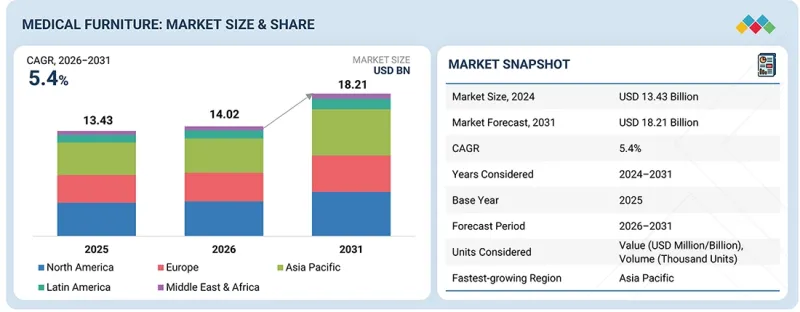
全球医疗家具市场预计将从 2026 年的 140.2 亿美元成长到 2031 年的 182.1 亿美元,预测期内复合年增长率为 5.4%。
| 调查范围 | |
|---|---|
| 调查期 | 2024-2031 |
| 基准年 | 2025 |
| 预测期 | 2025-2031 |
| 目标单元 | 金额(10亿美元) |
| 部分 | 按产品/服务、按应用、按最终用户、按地区 |
| 目标区域 | 北美、欧洲、亚太地区、拉丁美洲、中东和非洲 |
医疗家具市场的发展动力主要来自医疗基础设施的扩张、住院率的上升、慢性病负担的加重,以及医院、门诊手术中心和长期护理机构对先进、符合人体工学、以患者为中心的护理环境日益增长的需求。政府对现代化建设的投资以及向智慧化、数位整合家具的转型进一步加速了其普及。然而,高昂的资本成本、公立医院和新兴市场医院的预算限制、较长的更换週期、老旧设施的基础设施不相容以及低成本本地替代方案的存在,都制约着医疗家具市场的扩张,导致采购和升级决策的延迟。
依产品及服务细分,市场可分为医用床、椅、手术台、担架、推车、柜子、置物柜、服务及其他。其中,受手术量增加、诊断程序扩展以及手术室现代化改造投资增加的推动,椅类细分市场预计在预测期内将以最高的复合年增长率增长。手术台细分市场进一步分为一般外科手术台、整形外科手术台、妇产科手术台、影像诊断手术台、检查台及其他手术台。慢性病盛行率的上升、微创手术需求的成长以及专科医疗服务的扩展,都支撑了这些细分市场的成长。电动定位、渗透性表面、与影像诊断设备的兼容性以及模组化设计等技术进步,提高了产品的附加价值,并推动了更换需求。此外,门诊手术中心和诊断机构的增加也加速了先进手术台的普及应用。随着医院升级基础设施以提高手术效率和病人安全,对专用和多功能手术台的需求预计将大幅增加。
从终端使用者角度来看,医疗家具市场可细分为医院、诊所、门诊手术中心、长期照护机构和其他终端使用者。其中,预计到2025年,门诊手术中心(ASC)将占据第二大市场。这主要得益于手术成本降低、住院时间缩短以及报销奖励的改善。门诊手术中心在已开发市场和新兴市场均快速扩张,需要对手术台、手术椅、担架、柜子和恢復床等专用医疗家具进行大量投资。微创手术和择期手术的日益普及进一步推动了对高性能、紧凑型和工作流程优化家具的需求。此外,私募股权对门诊手术中心网路的投资以及医疗服务分散化的趋势,也促进了门诊手术中心容量的持续扩张,使其成为成长最快的终端用户群体。
医疗家具市场分为五个区域:北美、欧洲、亚太、拉丁美洲以及中东和非洲。
由于主要经济体医疗保健行业的显着扩张、人口快速老化以及医疗保健支出不断增长,亚太地区预计将以最高的复合年增长率增长。在医院、诊断和专科医疗投资不断增加的推动下,印度的医疗保健产业正以惊人的速度成长,预计2025年将达到6,380亿美元。这将加速对医用床、担架、治疗台和患者照护家具的需求。日本是世界上老化程度最高的国家之一,人均医疗保健支出为5,251美元,占其GDP的11.5%,这推动了急诊、老年照护和长期照护设施的持续维修。在中国,65岁以上人口达2.1676亿,对復健中心、养老院和医院的容量需求日益增长。此外,亚太国家的医疗保健基础设施正在快速现代化,从而提高了保险覆盖率并促进了医疗旅游的发展。这些趋势结合起来,将使亚太地区在预测期内成为医疗家具市场成长最快的地区。
医疗家具市场的主要企业包括:Arjo(瑞典)、Getinge AB(瑞典)、Baxter(美国)、Stryker(美国)、PARAMOUNT BED(日本)、GPC Medical Ltd(印度)、MillerKnoll, Inc.(美国)、KOVONAX spol. s ro(捷克共和国)、DriveKnoll, Inc.(美国)、KOVONAX spol。 & Co. KG(德国)、Steris Corporation(美国)、Savaria(加拿大)、PROMOTAL(法国)、Skytron, LLC(美国)、GF Health Products, Inc.(美国)、Midmark Corporation(美国)、Opera Beds(英国)、medifa(德国)、Malvesio Medical(义大利)、Mercoat Corp of(MakAman)、M.A.) 和加拿大印度) Inc.(加拿大)。
调查范围
本报告分析了医疗家具市场,旨在基于产品和服务、应用、最终用户和地区等多个细分市场,估算其市场规模和未来成长潜力。报告还包括对市场主要主要企业的竞争分析,以及公司简介、提供的服务、近期发展和主要参与企业策略。
购买本报告的理由
本报告透过提供最准确的医疗家具市场整体销售数据估算,帮助市场领导和新参与企业更了解市场。它有助于相关人员了解竞争格局,更好地定位自身业务,并深入了解市场动态,从而製定合适的打入市场策略。此外,本报告还帮助相关人员了解市场趋势,并提供关键市场驱动因素、限制因素、挑战和机会的资讯。
本报告深入分析了以下几点:
- 对关键市场驱动因素(慢性病负担加重和住院率上升、人口老龄化导致对长期护理和老年护理的需求增加,以及政府为实现医疗保健现代化而采取的倡议)、阻碍因素(先进医疗家具高成本且产品生命週期长,导致更换率低)、机会(肥胖患者对家具的需求不断增长)和挑战有限的高级产品
- 市场渗透率:本报告详细介绍了全球医疗家具市场主要企业提供的产品。报告结构分为多个部分,包括产品和服务、应用程式、最终用户和地区。
- 产品提升与创新:全面介绍全球医疗家具市场的新产品发表与预期趋势。
- 市场发展:按产品/服务、应用、最终用户和地区对盈利成长市场进行详细洞察和分析。
- 市场多元化:提供全球医疗家具市场新产品发布、市场扩张、当前发展和投资的全面资讯。
- 竞争分析:对全球医疗家具市场主要竞争对手的市场份额、成长计画、产品线和生产能力进行全面评估。
目录
第一章:引言
第二章:创投家的执行摘要
第三章重要考察
第四章 市场概览
- 市场动态
- 促进因素
- 抑制因子
- 机会
- 任务
- 未满足的需求和未开发的领域
- 相互关联的市场与跨产业机会
- 一级/二级/三级公司的策略性倡议
第五章 产业趋势
- 波特五力分析
- 宏观经济展望
- 报销分析
- 供应链分析
- 价值链分析
- 生态系分析
- 价格分析(2023-2025)
- 贸易分析
- 2026-2027 年主要会议和活动
- 影响客户业务的趋势/颠覆性因素
- 投资和资金筹措场景
- 2025年美国关税的影响-医疗家具市场
第六章:技术进步、人工智慧的影响、专利、创新与未来应用
- 主要新兴技术
- 互补技术
- 技术/产品蓝图
- 专利分析
- 未来应用
- 人工智慧/通用人工智慧对医疗家具市场的影响
第七章永续性和监管情势
- 当地法规和合规性
- 认证、标籤检视和环境标准
- 美国医疗家具的HCPCS编码状态
- 购买型号
第八章:顾客趋势与购买行为
- 决策流程
- 相关人员和采购标准
- 实施障碍和内部挑战
- 各个终端用户产业尚未满足的需求
- 市场盈利
第九章:医疗家具市场(按产品和服务划分)
- 医用床
- 椅子和座椅
- 桌子
- 担架
- 橱柜、置物柜、收纳单元
- 手推车和货车
- 服务
- 其他的
第十章:医疗家具市场(依应用领域划分)
- 患者照护和住宿设施
- 重症监护设施
- 长期医疗和肥胖治疗
- 妇产科和小儿科
- 其他的
第十一章:医疗家具市场(依最终用户划分)
- 医院
- 门诊手术中心
- 长期照护机构及护理院
- 诊所
- 其他的
第十二章:医疗家具市场(按地区划分)
- 北美洲
- 北美宏观经济展望
- 我们
- 加拿大
- 欧洲
- 欧洲宏观经济展望
- 德国
- 英国
- 法国
- 义大利
- 西班牙
- 其他的
- 亚太地区
- 亚太地区宏观经济展望
- 中国
- 日本
- 印度
- 澳洲
- 韩国
- 其他的
- 拉丁美洲
- 拉丁美洲宏观经济展望
- 巴西
- 墨西哥
- 其他的
- 中东和非洲
- 中东和非洲宏观经济展望
- 海湾合作委员会国家
- 其他的
第十三章 竞争格局
- 主要参与企业的策略/优势
- 2021-2025年收入分析
- 2025年市占率分析
- 企业估值矩阵:主要企业,2025 年
- 公司估值矩阵:Start-Ups/中小企业,2025 年
- 企业估值和财务指标
- 品牌/产品对比
- 竞争格局
第十四章:公司简介
- 主要参与企业
- ARJO
- GETINGE AB
- BAXTER
- STRYKER CORPORATION
- PARAMOUNT BED HOLDINGS CO., LTD.
- STERIS
- MILLERKNOLL, INC.
- SAVARIA
- LINET
- DRIVE DEVILBISS HEALTHCARE
- JOERNS HEALTHCARE
- STIEGELMEYER GMBH & CO. KG
- MALVESTIO SPA
- 其他公司
- NARANG MEDICAL LIMITED
- GF HEALTH PRODUCTS, INC.
- PROMOTAL
- GPC MEDICAL LTD
- KOVONAX SPOL. S RO
- SKYTRON LLC
- MIDMARK CORPORATION
- MEDIFA
- MERIVAARA CORP.
- AMICO GROUP OF COMPANIES.
- UMANO MEDICAL INC
- OPERA BEDS
第十五章:调查方法
第十六章附录
The global medical furniture market is projected to reach USD 18.21 billion by 2031 from USD 14.02 billion in 2026, at a CAGR of 5.4% during the forecast period.
| Scope of the Report | |
|---|---|
| Years Considered for the Study | 2024-2031 |
| Base Year | 2025 |
| Forecast Period | 2025-2031 |
| Units Considered | Value (USD billion) |
| Segments | Products & Services, Application, End User, and Region |
| Regions covered | North America, Europe, APAC, LATAM, MEA |
The medical furniture market is driven by expanding healthcare infrastructure, rising hospitalization rates, increasing chronic disease burden, and growing demand for advanced, ergonomic, and patient-centric care environments across hospitals, ASCs, and long-term care facilities. Government investments in modernization and the shift toward smart, digitally integrated furniture further accelerate adoption. However, market expansion is restrained by high capital costs, budget constraints in public and emerging-market hospitals, long replacement cycles, infrastructural incompatibilities in older facilities, and the availability of low-cost local alternatives, which collectively slow procurement and upgrade decisions.
"By products & services segment, the chairs & seating segment is projected to grow at the fastest CAGR in the medical furniture market during the forecast period."
By products & services segment, the market is divided into medical beds, chairs & seatings, tables, stretchers, trolleys & carts, cabinets, storage units, lockers, services, and others. Among these, the chairs & segment sub-segment is projected to grow at the fastest CAGR during the forecast period, owing to rising surgical volumes, expanding diagnostic procedures, and increasing investments in operating room modernization. The tables segment is further bifurcated into general surgery operating tables, orthopedic tables, gynecology/obstetric tables, imaging tables, examination tables, and other tables. Growth across these sub-segments is supported by the increasing prevalence of chronic diseases, higher demand for minimally invasive surgeries, and expansion of specialty care services. Technological advancements such as motorized positioning, radiolucent surfaces, imaging compatibility, and modular designs are enhancing product value and driving replacement demand. Additionally, growing ambulatory surgery centers and diagnostic facilities are accelerating procurement of advanced tables. As hospitals upgrade infrastructure to improve procedural efficiency and patient safety, demand for specialized and multi-functional tables is expected to expand significantly.
"By end user, the ambulatory surgery centers segment accounted for the second largest share in the medical furniture market in 2025."
By end users, the medical furniture market is divided into hospitals, clinics, ambulatory surgery centers, long-term & nursing facilities, and other end users. Among these, in 2025, the ambulatory surgery centers (ASCs) segment held the second largest share in the market. This is driven by lower procedure costs, reduced hospital stays, and improved reimbursement incentives. ASCs are rapidly expanding across developed and emerging markets, requiring substantial investments in specialized medical furniture, including operating tables, procedure chairs, stretchers, cabinets, and recovery beds. Increasing adoption of minimally invasive and elective procedures further boosts demand for high-performance, compact, and workflow-optimized furniture. Additionally, private equity investment in ASC networks and the preference for decentralized care support continuous capacity expansion, positioning ASCs as the fastest-growing end-user segment.
"The Asia Pacific region segment is projected to grow at the fastest CAGR in the medical furniture market during the forecast period."
The medical furniture market is segmented into five major regions, namely, North America, Europe, Asia Pacific, Latin America, the Middle East, and Africa.
The Asia Pacific region is estimated to grow at the fastest CAGR due to substantial healthcare expansion, rapid demographic aging, and rising healthcare spending across major economies. India's healthcare sector is growing at an exceptional pace, projected to reach USD 638 billion by 2025, supported by increasing investments in hospitals, diagnostics, and specialty care, which accelerates demand for medical beds, stretchers, tables, and patient-care furniture. Japan, one of the world's oldest nations, spends USD 5,251 per capita on health, 11.5% of its GDP, driving continuous upgrades in acute, geriatric, and long-term care facilities. China's aging population of 216.76 million people aged 65+ is intensifying the need for rehabilitation centers, nursing care, and hospital capacity expansion. Additionally, Asia Pacific countries are rapidly modernizing their healthcare infrastructure and witnessing rising insurance penetration and medical tourism. Together, these developments make Asia Pacific the fastest-growing region for medical furniture during the forecast period.
A breakdown of the primary participants (supply-side) for the medical furniture market referred to in this report is provided below:
- By Company Type: Tier 1 - 40%, Tier 2 - 30%, and Tier 3 - 30%
- By Designation: C-level - 50%, Director Level - 30%, and Others - 20%
- By Region: North America - 30%, Europe - 25%, Asia Pacific - 20%, Latin America - 15%, Middle East & Africa - 10%
Prominent players in the medical furniture market: Arjo (Sweden), Getinge AB (Sweden), Baxter (US), Stryker (US), PARAMOUNT BED CO., LTD. (Japan), GPC Medical Ltd (India), MillerKnoll, Inc. (US), KOVONAX spol. s r.o. (Czech Republic), Drive DeVilbiss Healthcare (US), LINET Group SE (Netherlands), Joerns Healthcare (US), Stiegelmeyer GmbH & Co. KG (Germany), Steris Corporation (US), Savaria (Canada), PROMOTAL (France), Skytron, LLC (US), GF Health Products, Inc. (US), Midmark Corporation (US), Opera Beds (UK), medifa (Germany), Malvestio Spa (Italy), Merivaara Corp (Finland), Amico Group of Companies (Canada), Narang Medical Limited (India), and Umano Medical Inc. (Canada).
Research Coverage
The report analyzes the medical furniture market and aims to estimate the market size and future growth potential of this market based on various segments such as products & services, application, end user, and region. The report also includes a competitive analysis of the key players in this market along with their company profiles, service offerings, recent developments, and key market strategies.
Reasons to Buy the Report
The report will help the market leaders/new entrants in this market with information on the closest approximations of the revenue numbers for the overall medical furniture market. This report will help stakeholders understand the competitive landscape and gain more insights to position their businesses better and plan suitable go-to-market strategies. The report also helps stakeholders understand the pulse of the market and provides them with information on key market drivers, restraints, challenges, and opportunities.
This report provides insights into the following pointers:
- Analysis of key drivers (rising burden of chronic diseases & increasing hospitalization rates, aging population driving long-term and geriatric care needs, and government initiatives for healthcare modernization), restraints (high cost of advanced medical furniture & long product life cycle leading to slow replacement rate), opportunities (rising need for bariatric care furniture), and challenges (limited customization and low premium product adoption is challenging the medical furniture market growth)
- Market Penetration: It includes extensive information on products offered by the major players in the global medical furniture market. The report consists of various segments in products & services, applications, end users, and regions.
- Product Enhancement/Innovation: Comprehensive details about new product launches and anticipated trends in the global medical furniture market
- Market Development: Thorough knowledge and analysis of the profitable rising markets by products & services, application, end user, and region
- Market Diversification: Comprehensive information about newly launched products, expanding markets, current advancements, and investments in the global medical furniture market
- Competitive Assessment: Thorough evaluation of the market shares, growth plans, offerings of products, and capacities of the major competitors in the global medical furniture market
TABLE OF CONTENTS
1 INTRODUCTION
- 1.1 STUDY OBJECTIVES
- 1.2 MARKET DEFINITION
- 1.3 STUDY SCOPE
- 1.3.1 MARKETS COVERED & REGIONAL SEGMENTATION
- 1.3.2 INCLUSIONS & EXCLUSIONS
- 1.3.3 YEARS CONSIDERED
- 1.3.4 CURRENCY CONSIDERED
- 1.4 STAKEHOLDERS
2 VENTURE CAPITALISTS EXECUTIVE SUMMARY
- 2.1 KEY INSIGHTS AND MARKET HIGHLIGHTS
- 2.2 KEY MARKET PARTICIPANTS: INSIGHTS AND DEVELOPMENTS
- 2.3 DISRUPTIVE TRENDS SHAPING MARKET
- 2.4 HIGH-GROWTH SEGMENTS & EMERGING FRONTIERS
- 2.5 SNAPSHOT: GLOBAL MARKET SIZE, GROWTH RATE, AND FORECAST
3 PREMIUM INSIGHTS
- 3.1 MEDICAL FURNITURE MARKET OVERVIEW
- 3.2 NORTH AMERICA: MEDICAL FURNITURE MARKET, BY END USER
- 3.3 GEOGRAPHIC SNAPSHOT OF MEDICAL FURNITURE MARKET (2025)
- 3.4 GEOGRAPHIC MIX: MEDICAL FURNITURE MARKET, 2026-2031 (USD MILLION)
- 3.5 MEDICAL FURNITURE MARKET: DEVELOPING VS. DEVELOPED MARKETS, 2026 VS. 2031 (USD MILLION)
4 MARKET OVERVIEW
- 4.1 INTRODUCTION
- 4.2 MARKET DYNAMICS
- 4.2.1 DRIVERS
- 4.2.1.1 Rising chronic disease burden and hospital admissions
- 4.2.1.2 Aging population drives demand for long-term care medical furniture
- 4.2.1.3 Rising government healthcare investments
- 4.2.2 RESTRAINTS
- 4.2.2.1 High capital costs and long replacement cycles
- 4.2.3 OPPORTUNITIES
- 4.2.3.1 Rising obesity prevalence to drive demand for specialized bariatric medical furniture
- 4.2.4 CHALLENGES
- 4.2.4.1 Limited customization and low-premium product adoption
- 4.2.1 DRIVERS
- 4.3 UNMET NEEDS AND WHITE SPACES
- 4.3.1 UNMET NEEDS IN MEDICAL FURNITURE MARKET
- 4.3.2 WHITE SPACE OPPORTUNITIES
- 4.4 INTERCONNECTED MARKETS AND CROSS-SECTOR OPPORTUNITIES
- 4.4.1 INTERCONNECTED MARKETS
- 4.4.2 CROSS-SECTOR OPPORTUNITIES
- 4.5 STRATEGIC MOVES BY TIER-1/2/3 PLAYERS
5 INDUSTRY TRENDS
- 5.1 PORTER'S FIVE FORCES ANALYSIS
- 5.1.1 THREAT OF NEW ENTRANTS
- 5.1.2 THREAT OF SUBSTITUTES
- 5.1.3 BARGAINING POWER OF BUYERS
- 5.1.4 BARGAINING POWER OF SUPPLIERS
- 5.1.5 INTENSITY OF COMPETITIVE RIVALRY
- 5.2 MACROECONOMIC OUTLOOK
- 5.2.1 INTRODUCTION
- 5.2.2 GDP TRENDS AND FORECAST
- 5.2.3 TRENDS IN GLOBAL DURABLE MEDICAL EQUIPMENT INDUSTRY
- 5.2.4 TRENDS IN MEDICAL FACILITY PRODUCTS INDUSTRY
- 5.3 REIMBURSEMENT ANALYSIS
- 5.4 SUPPLY CHAIN ANALYSIS
- 5.5 VALUE CHAIN ANALYSIS
- 5.6 ECOSYSTEM ANALYSIS
- 5.7 PRICING ANALYSIS (2023-2025)
- 5.7.1 AVERAGE SELLING PRICE TREND, BY PRODUCT (2023-2025)
- 5.7.2 AVERAGE SELLING PRICE TREND, BY REGION (2023-2025)
- 5.8 TRADE ANALYSIS
- 5.8.1 IMPORT SCENARIO (HS CODE 9402)
- 5.8.2 EXPORT DATA (HS CODE 9402)
- 5.9 KEY CONFERENCES AND EVENTS, 2026-2027
- 5.10 TRENDS/DISRUPTIONS IMPACTING CUSTOMER BUSINESS
- 5.11 INVESTMENT AND FUNDING SCENARIO
- 5.12 IMPACT OF 2025 US TARIFF - MEDICAL FURNITURE MARKET
- 5.12.1 INTRODUCTION
- 5.12.2 KEY TARIFF RATES
- 5.12.3 PRICE IMPACT ANALYSIS
- 5.12.4 IMPACT ON COUNTRIES/REGIONS
- 5.12.4.1 North America
- 5.12.4.2 Europe
- 5.12.4.3 Asia Pacific
- 5.12.5 END-USE INDUSTRY IMPACT
6 TECHNOLOGICAL ADVANCEMENTS, AI-DRIVEN IMPACT, PATENTS, INNOVATIONS, AND FUTURE APPLICATIONS
- 6.1 KEY EMERGING TECHNOLOGIES
- 6.1.1 ELECTROMECHANICAL ACTUATION SYSTEMS
- 6.2 COMPLEMENTARY TECHNOLOGIES
- 6.2.1 IOT AND REMOTE MONITORING INTEGRATION
- 6.3 TECHNOLOGY/PRODUCT ROADMAP
- 6.3.1 SHORT-TERM (2025-2027) | FOUNDATION & EARLY COMMERCIALIZATION
- 6.3.2 MID-TERM (2027-2031) | EXPANSION & STANDARDIZATION
- 6.3.3 LONG-TERM (2030-2035+) | MASS COMMERCIALIZATION & DISRUPTION
- 6.4 PATENT ANALYSIS
- 6.4.1 INSIGHTS: JURISDICTION AND TOP APPLICANT ANALYSIS
- 6.5 FUTURE APPLICATIONS
- 6.5.1 AI-ENABLED SMART ICU BEDS
- 6.5.2 CONNECTED & INTEROPERABLE HOSPITAL FURNITURE
- 6.6 IMPACT OF AI/GEN AI ON MEDICAL FURNITURE MARKET
- 6.6.1 TOP USE CASES AND MARKET POTENTIAL
- 6.6.2 BEST OPERATIONAL PRACTICES IN MEDICAL FURNITURE MARKET
- 6.6.3 CASE STUDIES OF AI IMPLEMENTATION IN MEDICAL FURNITURE MARKET
- 6.6.4 INTERCONNECTED ADJACENT ECOSYSTEM AND IMPACT ON MARKET PLAYERS
- 6.6.5 CLIENTS' READINESS TO ADOPT GENERATIVE AI IN POWERED MEDICAL FURNITURE MARKET
7 SUSTAINABILITY AND REGULATORY LANDSCAPE
- 7.1 REGIONAL REGULATIONS AND COMPLIANCE
- 7.1.1 REGULATORY BODIES, GOVERNMENT AGENCIES, AND OTHER ORGANIZATIONS
- 7.1.2 INDUSTRY STANDARDS
- 7.2 CERTIFICATIONS, LABELING, AND ECO-STANDARDS
- 7.3 US MEDICAL FURNITURE HCPCS CODING LANDSCAPE
- 7.3.1 HCPCS CODE ARCHITECTURE AND SEGMENT CONCENTRATION
- 7.3.2 CLAIMS-BASED DEMAND ANALYSIS AND VOLUME STABILITY
- 7.3.3 COMPETITIVE BIDDING AND PRICING PRESSURE ANALYSIS
- 7.3.4 STRATEGIC INSIGHTS AND CONCLUSION
- 7.4 PURCHASING MODEL
- 7.4.1 PROVIDERS PURCHASING MEDICAL FURNITURE
- 7.4.2 PURCHASING BEHAVIOR
8 CUSTOMER LANDSCAPE & BUYER BEHAVIOR
- 8.1 DECISION-MAKING PROCESS
- 8.2 STAKEHOLDERS AND BUYING CRITERIA
- 8.2.1 KEY STAKEHOLDERS IN BUYING PROCESS
- 8.2.2 KEY BUYING CRITERIA
- 8.3 ADOPTION BARRIERS & INTERNAL CHALLENGES
- 8.4 UNMET NEEDS FROM VARIOUS END-USE INDUSTRIES
- 8.5 MARKET PROFITABILITY
- 8.5.1 REVENUE POTENTIAL
- 8.5.2 COST DYNAMICS
- 8.5.3 MARGIN OPPORTUNITIES IN KEY APPLICATIONS
9 MEDICAL FURNITURE MARKET, BY PRODUCT & SERVICE
- 9.1 INTRODUCTION
- 9.2 MEDICAL BEDS
- 9.2.1 BY PRODUCT
- 9.2.1.1 Electric beds
- 9.2.1.1.1 Electric beds to dominate medical beds segment
- 9.2.1.2 Semi-electric beds
- 9.2.1.2.1 Cost-performance advantage accelerates adoption
- 9.2.1.3 Manual beds
- 9.2.1.3.1 Cost-effective infrastructure expansion to drive demand
- 9.2.1.1 Electric beds
- 9.2.2 BY TYPE
- 9.2.2.1 Critical care beds
- 9.2.2.1.1 Increasing prevalence of chronic diseases to drive segmental growth
- 9.2.2.2 Long-term & home care beds
- 9.2.2.2.1 Rising long-term diseases to drive growth
- 9.2.2.3 Maternity & pediatric beds
- 9.2.2.3.1 Expanding maternal and neonatal care infrastructure to drive segment
- 9.2.2.4 General ward beds
- 9.2.2.4.1 High inpatient volumes driving sustained demand for general ward beds
- 9.2.2.5 Other beds
- 9.2.2.1 Critical care beds
- 9.2.1 BY PRODUCT
- 9.3 CHAIRS & SEATING
- 9.3.1 GYNECOLOGY/OB-GYN CHAIRS
- 9.3.1.1 Rising women's preventive healthcare drives demand
- 9.3.2 DIALYSIS CHAIRS
- 9.3.2.1 Rising incidence of chronic kidney disease drives demand
- 9.3.3 BARIATRIC CHAIRS
- 9.3.3.1 Rising global obesity rates drive demand
- 9.3.4 OTHER CHAIRS
- 9.3.1 GYNECOLOGY/OB-GYN CHAIRS
- 9.4 TABLES
- 9.4.1 GENERAL SURGERY OPERATING TABLES
- 9.4.1.1 High surgical volumes drive demand
- 9.4.2 GYNECOLOGY/OBSTETRIC TABLES
- 9.4.2.1 Continuous childbirth volumes and reproductive care to drive demand
- 9.4.3 ORTHOPEDIC TABLES
- 9.4.3.1 Rising musculoskeletal disorders and joint replacements to drive demand
- 9.4.4 EXAMINATION TABLES
- 9.4.4.1 High outpatient volumes sustain demand
- 9.4.5 IMAGING TABLES
- 9.4.5.1 Rising diagnostic imaging volumes to drive demand
- 9.4.6 OTHER TABLES
- 9.4.1 GENERAL SURGERY OPERATING TABLES
- 9.5 STRETCHERS
- 9.5.1 EMERGENCY STRETCHERS
- 9.5.1.1 Rising emergency admissions and trauma cases to drive demand
- 9.5.2 SPECIALTY STRETCHERS
- 9.5.2.1 Procedure-specific clinical needs to drive demand
- 9.5.3 TRANSFER & PROCEDURE TROLLEYS
- 9.5.3.1 Expanding ambulatory surgeries to accelerate demand
- 9.5.1 EMERGENCY STRETCHERS
- 9.6 CABINETS, LOCKERS, AND STORAGE UNITS
- 9.6.1 BEDSIDE & WARD STORAGE
- 9.6.1.1 Universal inpatient deployment to drive segment
- 9.6.2 CLINICAL STORAGE
- 9.6.2.1 Regulatory compliance and infection control to drive demand
- 9.6.3 PERSONAL & STAFF STORAGE
- 9.6.3.1 Expanding healthcare workforce and hygiene protocols to drive segment
- 9.6.4 OTHER CABINETS, LOCKERS, AND STORAGE UNITS
- 9.6.1 BEDSIDE & WARD STORAGE
- 9.7 TROLLEYS & CARTS
- 9.7.1 INSTRUMENT TROLLEYS
- 9.7.1.1 Essential surgical workflow requirements to drive segmental growth
- 9.7.2 LOGISTIC & UTILITY CARTS
- 9.7.2.1 Increasing hospital throughput to drive demand
- 9.7.3 ANESTHESIA CARTS
- 9.7.3.1 Rising surgical procedures and medication safety to drive segment growth
- 9.7.4 OTHER TROLLEYS & CARTS
- 9.7.1 INSTRUMENT TROLLEYS
- 9.8 SERVICES
- 9.8.1 MAINTENANCE & ANNUAL MAINTENANCE CONTRACTS
- 9.8.1.1 Growing installed base of powered furniture drives segment dominance
- 9.8.2 INSTALLATION & COMMISSIONING
- 9.8.2.1 Expanding healthcare infrastructure to drive demand
- 9.8.3 OTHER SERVICES
- 9.8.1 MAINTENANCE & ANNUAL MAINTENANCE CONTRACTS
- 9.9 OTHER PRODUCTS
10 MEDICAL FURNITURE MARKET, BY APPLICATION
- 10.1 INTRODUCTION
- 10.2 PATIENT CARE & ACCOMMODATION
- 10.2.1 LARGE BASE OF INSTALLED BEDS TO DRIVE SEGMENT
- 10.3 CRITICAL CARE FACILITIES
- 10.3.1 RISING CHRONIC DISEASE PREVALENCE TO DRIVE SEGMENT GROWTH
- 10.4 LONG-TERM & BARIATRIC CARE
- 10.4.1 RISING LONG-TERM DISEASES TO DRIVE DEMAND
- 10.5 MATERNITY & PEDIATRICS
- 10.5.1 SUSTAINED CHILDBIRTH RATES DRIVE DEMAND
- 10.6 OTHER APPLICATIONS
11 MEDICAL FURNITURE MARKET, BY END USER
- 11.1 INTRODUCTION
- 11.2 HOSPITALS
- 11.2.1 PRIVATE HOSPITALS
- 11.2.1.1 Higher capital spending drives private hospital segment
- 11.2.2 PUBLIC HOSPITALS
- 11.2.2.1 Extensive patient coverage sustains demand in public hospitals
- 11.2.1 PRIVATE HOSPITALS
- 11.3 AMBULATORY SURGERY CENTERS
- 11.3.1 SHIFT TOWARD OUTPATIENT SURGERIES DRIVES SEGMENT GROWTH
- 11.4 LONG-TERM & NURSING FACILITIES
- 11.4.1 RISING PREVALENCE OF LONG-TERM DISEASES & AGING POPULATION BURDEN TO DRIVE SEGMENTAL GROWTH
- 11.5 CLINICS
- 11.5.1 EXPANDING OUTPATIENT SERVICES TO DRIVE GROWTH
- 11.6 OTHER END USERS
12 MEDICAL FURNITURE MARKET, BY REGION
- 12.1 INTRODUCTION
- 12.2 NORTH AMERICA
- 12.2.1 MACROECONOMIC OUTLOOK FOR NORTH AMERICA
- 12.2.2 US
- 12.2.2.1 US to dominate North American market during forecast period
- 12.2.3 CANADA
- 12.2.3.1 Growth in disabled population to fuel medical furniture market
- 12.3 EUROPE
- 12.3.1 MACROECONOMIC OUTLOOK FOR EUROPE
- 12.3.2 GERMANY
- 12.3.2.1 Dominant European medical furniture market
- 12.3.3 UK
- 12.3.3.1 Rising government investment in hospital infrastructure to drive market
- 12.3.4 FRANCE
- 12.3.4.1 High healthcare expenditure and government investment foster rapid market growth
- 12.3.5 ITALY
- 12.3.5.1 Rapidly aging population and rising injury rates to drive market
- 12.3.6 SPAIN
- 12.3.6.1 Growing disability prevalence and mobility challenges increases demand for patient handling equipment
- 12.3.7 REST OF EUROPE
- 12.4 ASIA PACIFIC
- 12.4.1 MACROECONOMIC OUTLOOK FOR ASIA PACIFIC
- 12.4.2 CHINA
- 12.4.2.1 China to dominate regional market during forecast period
- 12.4.3 JAPAN
- 12.4.3.1 Rapidly aging population and expanding healthcare infrastructure drives market expansion
- 12.4.4 INDIA
- 12.4.4.1 Sustained, broad-based growth driven by growing hospital infrastructure and demand for long-term care
- 12.4.5 AUSTRALIA
- 12.4.5.1 Intensive hospital utilization set to drive demand across care settings
- 12.4.6 SOUTH KOREA
- 12.4.6.1 Increasing investment in hospital equipment to drive market growth
- 12.4.7 REST OF ASIA PACIFIC
- 12.5 LATIN AMERICA
- 12.5.1 MACROECONOMIC OUTLOOK FOR LATIN AMERICA
- 12.5.2 BRAZIL
- 12.5.2.1 Expanding hospital network, dual public-private coverage, and rising chronic disease burden to drive market
- 12.5.3 MEXICO
- 12.5.3.1 Rising obesity rates and associated hospitalization needs to propel market growth
- 12.5.4 REST OF LATIN AMERICA
- 12.6 MIDDLE EAST & AFRICA
- 12.6.1 MACROECONOMIC OUTLOOK FOR MIDDLE EAST & AFRICA
- 12.6.2 GCC COUNTRIES
- 12.6.2.1 Expanding hospital capacity and smart hospital investments to accelerate medical furniture demand
- 12.6.3 REST OF MIDDLE EAST & AFRICA
13 COMPETITIVE LANDSCAPE
- 13.1 INTRODUCTION
- 13.2 KEY PLAYER STRATEGIES/RIGHT TO WIN
- 13.2.1 OVERVIEW OF STRATEGIES ADOPTED BY KEY PLAYERS IN MEDICAL FURNITURE MARKET
- 13.3 REVENUE ANALYSIS, 2021-2025
- 13.4 MARKET SHARE ANALYSIS, 2025
- 13.5 COMPANY EVALUATION MATRIX: KEY PLAYERS, 2025
- 13.5.1 STARS
- 13.5.2 EMERGING LEADERS
- 13.5.3 PERVASIVE PLAYERS
- 13.5.4 PARTICIPANTS
- 13.5.5 COMPANY FOOTPRINT: KEY PLAYERS, 2025
- 13.5.5.1 Company footprint
- 13.5.5.2 Region footprint
- 13.5.5.3 Product & service footprint
- 13.5.5.4 Application footprint
- 13.5.5.5 End user footprint
- 13.6 COMPANY EVALUATION MATRIX: STARTUPS/SMES, 2025
- 13.6.1 PROGRESSIVE COMPANIES
- 13.6.2 RESPONSIVE COMPANIES
- 13.6.3 DYNAMIC COMPANIES
- 13.6.4 STARTING BLOCKS
- 13.6.5 COMPETITIVE BENCHMARKING: STARTUPS/SMES, 2025
- 13.6.5.1 Detailed list of key startups/SMEs
- 13.6.5.2 Competitive benchmarking of key startups/SMEs
- 13.7 COMPANY VALUATION & FINANCIAL METRICS
- 13.7.1 FINANCIAL METRICS
- 13.7.2 COMPANY VALUATION
- 13.8 BRAND/PRODUCT COMPARISON
- 13.9 COMPETITIVE SCENARIO
- 13.9.1 PRODUCT LAUNCHES & APPROVALS
- 13.9.2 DEALS
- 13.9.3 EXPANSIONS
- 13.9.4 OTHER DEVELOPMENTS
14 COMPANY PROFILES
- 14.1 KEY PLAYERS
- 14.1.1 ARJO
- 14.1.1.1 Business overview
- 14.1.1.2 Products offered
- 14.1.1.3 Recent developments
- 14.1.1.3.1 Product launches & approvals
- 14.1.1.3.2 Other developments
- 14.1.1.4 MnM view
- 14.1.1.4.1 Right to win
- 14.1.1.4.2 Strategic choices
- 14.1.1.4.3 Weaknesses & competitive threats
- 14.1.2 GETINGE AB
- 14.1.2.1 Business overview
- 14.1.2.2 Products offered
- 14.1.2.3 Recent developments
- 14.1.2.3.1 Product launches & approvals
- 14.1.2.3.2 Deals
- 14.1.2.3.3 Expansions
- 14.1.2.4 MnM view
- 14.1.2.4.1 Right to win
- 14.1.2.4.2 Strategic choices
- 14.1.2.4.3 Weaknesses & competitive threats
- 14.1.3 BAXTER
- 14.1.3.1 Business overview
- 14.1.3.2 Products offered
- 14.1.3.3 Recent developments
- 14.1.3.3.1 Product launches & approvals
- 14.1.3.4 MnM view
- 14.1.3.4.1 Right to win
- 14.1.3.4.2 Strategic choices
- 14.1.3.4.3 Weaknesses & competitive threats
- 14.1.4 STRYKER CORPORATION
- 14.1.4.1 Business overview
- 14.1.4.2 Products offered
- 14.1.4.3 Recent developments
- 14.1.4.3.1 Product launches & approvals
- 14.1.4.4 MnM view
- 14.1.4.4.1 Right to win
- 14.1.4.4.2 Strategic choices
- 14.1.4.4.3 Weaknesses & competitive threats
- 14.1.5 PARAMOUNT BED HOLDINGS CO., LTD.
- 14.1.5.1 Business overview
- 14.1.5.2 Products offered
- 14.1.5.3 Recent developments
- 14.1.5.3.1 Product launches & approvals
- 14.1.5.4 MnM view
- 14.1.5.4.1 Right to win
- 14.1.5.4.2 Strategic choices
- 14.1.5.4.3 Weaknesses & competitive threats
- 14.1.6 STERIS
- 14.1.6.1 Business overview
- 14.1.6.2 Products offered
- 14.1.7 MILLERKNOLL, INC.
- 14.1.7.1 Business overview
- 14.1.7.2 Products offered
- 14.1.7.3 Recent developments
- 14.1.7.3.1 Product launches & approvals
- 14.1.8 SAVARIA
- 14.1.8.1 Business overview
- 14.1.8.2 Products offered
- 14.1.9 LINET
- 14.1.9.1 Business overview
- 14.1.9.2 Products offered
- 14.1.9.3 Recent developments
- 14.1.9.3.1 Product launches & approvals
- 14.1.9.3.2 Deals
- 14.1.9.3.3 Expansions
- 14.1.10 DRIVE DEVILBISS HEALTHCARE
- 14.1.10.1 Business overview
- 14.1.10.2 Products offered
- 14.1.10.3 Recent developments
- 14.1.10.3.1 Other developments
- 14.1.11 JOERNS HEALTHCARE
- 14.1.11.1 Business overview
- 14.1.11.2 Products offered
- 14.1.11.3 Recent developments
- 14.1.11.3.1 Product launches & approvals
- 14.1.12 STIEGELMEYER GMBH & CO. KG
- 14.1.12.1 Business overview
- 14.1.12.2 Products offered
- 14.1.13 MALVESTIO SPA
- 14.1.13.1 Business overview
- 14.1.13.2 Products offered
- 14.1.1 ARJO
- 14.2 OTHER PLAYERS
- 14.2.1 NARANG MEDICAL LIMITED
- 14.2.2 GF HEALTH PRODUCTS, INC.
- 14.2.3 PROMOTAL
- 14.2.4 GPC MEDICAL LTD
- 14.2.5 KOVONAX SPOL. S R.O.
- 14.2.6 SKYTRON LLC
- 14.2.7 MIDMARK CORPORATION
- 14.2.8 MEDIFA
- 14.2.9 MERIVAARA CORP.
- 14.2.10 AMICO GROUP OF COMPANIES.
- 14.2.11 UMANO MEDICAL INC
- 14.2.12 OPERA BEDS
15 RESEARCH METHODOLOGY
- 15.1 RESEARCH DATA
- 15.1.1 SECONDARY DATA
- 15.1.1.1 Key data from secondary sources
- 15.1.2 PRIMARY DATA
- 15.1.2.1 Key data from primary sources
- 15.1.2.2 Key industry insights
- 15.1.1 SECONDARY DATA
- 15.2 MARKET SIZE ESTIMATION
- 15.3 MARKET BREAKDOWN & DATA TRIANGULATION
- 15.4 MARKET RANKING ANALYSIS
- 15.5 STUDY ASSUMPTIONS
- 15.6 RESEARCH LIMITATIONS
- 15.6.1 METHODOLOGY-RELATED LIMITATIONS
- 15.6.2 SCOPE-RELATED LIMITATIONS
- 15.7 RISK ASSESSMENT
16 APPENDIX
- 16.1 DISCUSSION GUIDE
- 16.2 KNOWLEDGESTORE: MARKETSANDMARKETS' SUBSCRIPTION PORTAL
- 16.3 CUSTOMIZATION OPTIONS
- 16.4 RELATED REPORTS
- 16.5 AUTHOR DETAILS
List of Tables
- TABLE 1 MEDICAL FURNITURE MARKET: INCLUSIONS & EXCLUSIONS
- TABLE 2 STANDARD CURRENCY CONVERSION RATES
- TABLE 3 MEDICAL FURNITURE MARKET: PORTER'S FIVE FORCES ANALYSIS
- TABLE 4 GDP PERCENTAGE CHANGE, BY KEY COUNTRY, 2021-2030
- TABLE 5 AVERAGE SELLING PRICE TREND, BY TYPE, 2023-2025 (USD)
- TABLE 6 AVERAGE PRICING TREND OF MEDICAL FURNITURE PRODUCTS, BY REGION, 2023-2025 (USD)
- TABLE 7 IMPORT DATA FOR MEDICAL FURNITURE PRODUCTS UNDER HS CODE 9402, BY COUNTRY, 2019-2025 (USD THOUSAND)
- TABLE 8 EXPORT DATA FOR MEDICAL FURNITURE UNDER HS CODE 9402, BY COUNTRY, 2020-2025 (USD THOUSAND)
- TABLE 9 MEDICAL FURNITURE MARKET: KEY CONFERENCES AND EVENTS (2026-2027)
- TABLE 10 US-ADJUSTED RECIPROCAL TARIFF RATES
- TABLE 11 KEY PRODUCT-RELATED TARIFF EFFECTIVE FOR MEDICAL FURNITURE PRODUCTS
- TABLE 12 TOP USE CASES AND MARKET POTENTIAL
- TABLE 13 MEDICAL FURNITURE MARKET: CASE STUDIES RELATED TO AI IMPLEMENTATION
- TABLE 14 INTERCONNECTED ADJACENT ECOSYSTEM AND IMPACT ON MARKET PLAYERS
- TABLE 15 NORTH AMERICA: REGULATORY BODIES, GOVERNMENT AGENCIES, AND OTHER ORGANIZATIONS
- TABLE 16 EUROPE: REGULATORY BODIES, GOVERNMENT AGENCIES, AND OTHER ORGANIZATIONS
- TABLE 17 ASIA PACIFIC: REGULATORY BODIES, GOVERNMENT AGENCIES, AND OTHER ORGANIZATIONS
- TABLE 18 LATIN AMERICA: REGULATORY BODIES, GOVERNMENT AGENCIES, AND OTHER ORGANIZATIONS
- TABLE 19 MIDDLE EAST & AFRICA AND GCC COUNTRIES: REGULATORY BODIES, GOVERNMENT AGENCIES, AND OTHER ORGANIZATIONS
- TABLE 20 GLOBAL STANDARDS IN MEDICAL FURNITURE MARKET
- TABLE 21 CERTIFICATIONS, LABELING, AND ECO-STANDARDS IN MEDICAL FURNITURE MARKET
- TABLE 22 INFLUENCE OF STAKEHOLDERS ON BUYING PROCESS FOR MEDICAL FURNITURE PRODUCTS
- TABLE 23 KEY BUYING CRITERIA FOR TOP THREE MEDICAL FURNITURE PRODUCTS
- TABLE 24 MEDICAL FURNITURE MARKET: UNMET NEEDS/END USER EXPECTATIONS
- TABLE 25 MEDICAL FURNITURE MARKET, BY PRODUCT & SERVICE, 2024-2031 (USD MILLION)
- TABLE 26 MEDICAL BEDS: MEDICAL FURNITURE MARKET, BY COUNTRY, 2024-2031 (USD MILLION)
- TABLE 27 MEDICAL BEDS: MEDICAL FURNITURE MARKET, BY PRODUCT, 2024-2031 (USD MILLION)
- TABLE 28 ELECTRIC BEDS: MEDICAL FURNITURE MARKET, BY COUNTRY, 2024-2031 (USD MILLION)
- TABLE 29 SEMI-ELECTRIC BEDS: MEDICAL FURNITURE MARKET, BY COUNTRY, 2024-2031 (USD MILLION)
- TABLE 30 MANUAL BEDS: MEDICAL FURNITURE MARKET, BY COUNTRY, 2024-2031 (USD MILLION)
- TABLE 31 CRITICAL CARE BEDS: MEDICAL FURNITURE MARKET, BY COUNTRY, 2024-2031 (USD MILLION)
- TABLE 32 LONG-TERM & HOME CARE BEDS: MEDICAL FURNITURE MARKET, BY COUNTRY, 2024-2031 (USD MILLION)
- TABLE 33 MATERNITY & PEDIATRIC BEDS: MEDICAL FURNITURE MARKET, BY COUNTRY, 2024-2031 (USD MILLION)
- TABLE 34 GENERAL WARD BEDS: MEDICAL FURNITURE MARKET, BY COUNTRY, 2024-2031 (USD MILLION)
- TABLE 35 OTHER BEDS: MEDICAL FURNITURE MARKET, BY COUNTRY, 2024-2031 (USD MILLION)
- TABLE 36 GYNECOLOGY/OB-GYN CHAIRS: MEDICAL FURNITURE MARKET, BY TYPE, 2024-2031 (USD MILLION)
- TABLE 37 CHAIRS & SEATING: MEDICAL FURNITURE MARKET, BY COUNTRY, 2024-2031 (USD MILLION)
- TABLE 38 GYNECOLOGY/OB-GYN CHAIRS: MEDICAL FURNITURE MARKET, BY COUNTRY, 2024-2031 (USD MILLION)
- TABLE 39 DIALYSIS CHAIRS: MEDICAL FURNITURE MARKET, BY COUNTRY, 2024-2031 (USD MILLION)
- TABLE 40 BARIATRIC CHAIRS: MEDICAL FURNITURE MARKET, BY COUNTRY, 2024-2031 (USD MILLION)
- TABLE 41 OTHER CHAIRS: MEDICAL FURNITURE MARKET, BY COUNTRY, 2024-2031 (USD MILLION)
- TABLE 42 TABLES: MEDICAL FURNITURE MARKET, BY TYPE, 2024-2031 (USD MILLION)
- TABLE 43 TABLES: MEDICAL FURNITURE MARKET, BY COUNTRY, 2024-2031 (USD MILLION)
- TABLE 44 GENERAL-SURGERY OPERATING TABLES: MEDICAL FURNITURE MARKET, BY COUNTRY, 2024-2031 (USD MILLION)
- TABLE 45 GYNECOLOGY/OBSTETRIC TABLES: MEDICAL FURNITURE MARKET, BY COUNTRY, 2024-2031 (USD MILLION)
- TABLE 46 ORTHOPEDIC TABLES: MEDICAL FURNITURE MARKET, BY COUNTRY, 2024-2031 (USD MILLION)
- TABLE 47 EXAMINATION TABLES: MEDICAL FURNITURE MARKET, BY COUNTRY, 2024-2031 (USD MILLION)
- TABLE 48 IMAGING TABLES: MEDICAL FURNITURE MARKET, BY COUNTRY, 2024-2031 (USD MILLION)
- TABLE 49 OTHER TABLES: MEDICAL FURNITURE MARKET, BY COUNTRY, 2024-2031 (USD MILLION)
- TABLE 50 STRETCHERS: MEDICAL FURNITURE MARKET, BY TYPE, 2024-2031 (USD MILLION)
- TABLE 51 STRETCHERS: MEDICAL FURNITURE MARKET, BY COUNTRY, 2024-2031 (USD MILLION)
- TABLE 52 EMERGENCY STRETCHERS: MEDICAL FURNITURE MARKET, BY COUNTRY, 2024-2031 (USD MILLION)
- TABLE 53 SPECIALTY STRETCHERS: MEDICAL FURNITURE MARKET, BY COUNTRY, 2024-2031 (USD MILLION)
- TABLE 54 TRANSFER & PROCEDURE TROLLEYS: MEDICAL FURNITURE MARKET, BY COUNTRY, 2024-2031 (USD MILLION)
- TABLE 55 CABINETS, LOCKERS, AND STORAGE UNITS: MEDICAL FURNITURE MARKET, BY TYPE, 2024-2031 (USD MILLION)
- TABLE 56 CABINETS, LOCKERS, AND STORAGE UNITS: MEDICAL FURNITURE MARKET, BY COUNTRY, 2024-2031 (USD MILLION)
- TABLE 57 BEDSIDE & WARD STORAGE: MEDICAL FURNITURE MARKET, BY COUNTRY, 2024-2031 (USD MILLION)
- TABLE 58 CLINICAL STORAGE: MEDICAL FURNITURE MARKET, BY COUNTRY, 2024-2031 (USD MILLION)
- TABLE 59 PERSONAL & STAFF STORAGE: MEDICAL FURNITURE MARKET, BY COUNTRY, 2024-2031 (USD MILLION)
- TABLE 60 OTHER CABINETS, LOCKERS & STORAGE UNITS: MEDICAL FURNITURE MARKET, BY COUNTRY, 2024-2031 (USD MILLION)
- TABLE 61 TROLLEYS & CARTS: MEDICAL FURNITURE MARKET, BY TYPE, 2024-2031 (USD MILLION)
- TABLE 62 TROLLEYS & CARTS: MEDICAL FURNITURE MARKET, BY COUNTRY, 2024-2031 (USD MILLION)
- TABLE 63 INSTRUMENT TROLLEYS: MEDICAL FURNITURE MARKET, BY COUNTRY, 2024-2031 (USD MILLION)
- TABLE 64 LOGISTIC & UTILITY CARTS: MEDICAL FURNITURE MARKET, BY COUNTRY, 2024-2031 (USD MILLION)
- TABLE 65 ANESTHESIA CARTS: MEDICAL FURNITURE MARKET, BY COUNTRY, 2024-2031 (USD MILLION)
- TABLE 66 OTHER TROLLEYS & CARTS: MEDICAL FURNITURE MARKET, BY COUNTRY, 2024-2031 (USD MILLION)
- TABLE 67 MEDICAL FURNITURE MARKET, BY SERVICE, 2024-2031 (USD MILLION)
- TABLE 68 SERVICES: MEDICAL FURNITURE MARKET, BY COUNTRY, 2024-2031 (USD MILLION)
- TABLE 69 MAINTENANCE & ANNUAL MAINTENANCE CONTRACTS: MEDICAL FURNITURE MARKET, BY COUNTRY, 2024-2031 (USD MILLION)
- TABLE 70 INSTALLATION & COMMISSIONING: MEDICAL FURNITURE MARKET, BY COUNTRY, 2024-2031 (USD MILLION)
- TABLE 71 OTHER SERVICES: MEDICAL FURNITURE MARKET, BY COUNTRY, 2024-2031 (USD MILLION)
- TABLE 72 OTHER PRODUCTS: MEDICAL FURNITURE MARKET, BY COUNTRY, 2024-2031 (USD MILLION)
- TABLE 73 MEDICAL FURNITURE MARKET, BY APPLICATION, 2024-2031 (USD MILLION)
- TABLE 74 PATIENT CARE & ACCOMMODATION: MEDICAL FURNITURE MARKET, BY COUNTRY, 2024-2031 (USD MILLION)
- TABLE 75 CRITICAL CARE FACILITIES: MEDICAL FURNITURE MARKET, BY COUNTRY, 2024-2031 (USD MILLION)
- TABLE 76 LONG-TERM & BARIATRIC CARE: MEDICAL FURNITURE MARKET, BY COUNTRY, 2024-2031 (USD MILLION)
- TABLE 77 MATERNITY & PEDIATRICS: MEDICAL FURNITURE MARKET, BY COUNTRY, 2024-2031 (USD MILLION)
- TABLE 78 OTHER APPLICATIONS: MEDICAL FURNITURE MARKET, BY COUNTRY, 2024-2031 (USD MILLION)
- TABLE 79 MEDICAL FURNITURE MARKET, BY END USER, 2024-2031 (USD MILLION)
- TABLE 80 HOSPITALS: MEDICAL FURNITURE MARKET, BY TYPE, 2024-2031 (USD MILLION)
- TABLE 81 HOSPITALS: MEDICAL FURNITURE MARKET, BY COUNTRY, 2024-2031 (USD MILLION)
- TABLE 82 PRIVATE HOSPITALS: MEDICAL FURNITURE MARKET, BY COUNTRY, 2024-2031 (USD MILLION)
- TABLE 83 PUBLIC HOSPITALS: MEDICAL FURNITURE MARKET, BY COUNTRY, 2024-2031 (USD MILLION)
- TABLE 84 AMBULATORY SURGERY CENTERS: MEDICAL FURNITURE MARKET, BY COUNTRY, 2024-2031 (USD MILLION)
- TABLE 85 LONG-TERM & NURSING FACILITIES: MEDICAL FURNITURE MARKET, BY COUNTRY, 2024-2031 (USD MILLION)
- TABLE 86 CLINICS: MEDICAL FURNITURE MARKET, BY COUNTRY, 2024-2031 (USD MILLION)
- TABLE 87 OTHER END USERS: MEDICAL FURNITURE MARKET, BY COUNTRY, 2024-2031 (USD MILLION)
- TABLE 88 MEDICAL FURNITURE MARKET, BY REGION, 2024-2031 (USD MILLION)
- TABLE 89 NORTH AMERICA: MEDICAL FURNITURE MARKET, VOLUME DATA, 2024-2031 (THOUSAND UNITS)
- TABLE 90 NORTH AMERICA: MEDICAL FURNITURE MARKET, BY COUNTRY, 2024-2031 (USD MILLION)
- TABLE 91 NORTH AMERICA: MEDICAL FURNITURE MARKET, BY PRODUCT, 2024-2031 (USD MILLION)
- TABLE 92 NORTH AMERICA: MEDICAL FURNITURE MARKET FOR MEDICAL BEDS, BY PRODUCT, 2024-2031 (USD MILLION)
- TABLE 93 NORTH AMERICA: MEDICAL FURNITURE MARKET FOR MEDICAL BEDS, BY TYPE, 2024-2031 (USD MILLION)
- TABLE 94 NORTH AMERICA: MEDICAL FURNITURE MARKET FOR CHAIRS & SEATING, BY TYPE, 2024-2031 (USD MILLION)
- TABLE 95 NORTH AMERICA: MEDICAL FURNITURE MARKET FOR TABLES, BY TYPE, 2024-2031 (USD MILLION)
- TABLE 96 NORTH AMERICA: MEDICAL FURNITURE MARKET FOR STRETCHERS, BY TYPE, 2024-2031 (USD MILLION)
- TABLE 97 NORTH AMERICA: MEDICAL FURNITURE MARKET FOR CABINETS, LOCKERS, & STORAGE UNITS, BY TYPE, 2024-2031 (USD MILLION)
- TABLE 98 NORTH AMERICA: MEDICAL FURNITURE MARKET FOR TROLLEYS & CARTS, BY TYPE, 2024-2031 (USD MILLION)
- TABLE 99 NORTH AMERICA: MEDICAL FURNITURE MARKET FOR SERVICES, BY TYPE, 2024-2031 (USD MILLION)
- TABLE 100 NORTH AMERICA: MEDICAL FURNITURE MARKET, BY APPLICATION, 2024-2031 (USD MILLION)
- TABLE 101 NORTH AMERICA: MEDICAL FURNITURE MARKET, BY END USER, 2024-2031 (USD MILLION)
- TABLE 102 NORTH AMERICA: MEDICAL FURNITURE MARKET FOR HOSPITALS, BY TYPE, 2024-2031 (USD MILLION)
- TABLE 103 US: KEY MACROINDICATORS
- TABLE 104 US: MEDICAL FURNITURE MARKET, BY PRODUCT, 2024-2031 (USD MILLION)
- TABLE 105 US: MEDICAL FURNITURE MARKET FOR MEDICAL BEDS, BY PRODUCT, 2024-2031 (USD MILLION)
- TABLE 106 US: MEDICAL FURNITURE MARKET FOR MEDICAL BEDS, BY TYPE, 2024-2031 (USD MILLION)
- TABLE 107 US: MEDICAL FURNITURE MARKET FOR CHAIRS & SEATING, BY TYPE, 2024-2031 (USD MILLION)
- TABLE 108 US: MEDICAL FURNITURE MARKET FOR TABLES, BY TYPE, 2024-2031 (USD MILLION)
- TABLE 109 US: MEDICAL FURNITURE MARKET FOR STRETCHERS, BY TYPE, 2024-2031 (USD MILLION)
- TABLE 110 US: MEDICAL FURNITURE MARKET FOR CABINETS, LOCKERS, & STORAGE UNITS, BY TYPE, 2024-2031 (USD MILLION)
- TABLE 111 US: MEDICAL FURNITURE MARKET FOR TROLLEYS & CARTS, BY TYPE, 2024-2031 (USD MILLION)
- TABLE 112 US: MEDICAL FURNITURE MARKET FOR SERVICES, BY TYPE, 2024-2031 (USD MILLION)
- TABLE 113 US: MEDICAL FURNITURE MARKET, BY APPLICATION, 2024-2031 (USD MILLION)
- TABLE 114 US: MEDICAL FURNITURE MARKET, BY END USER, 2024-2031 (USD MILLION)
- TABLE 115 US: MEDICAL FURNITURE MARKET FOR HOSPITALS, BY TYPE, 2024-2031 (USD MILLION)
- TABLE 116 CANADA: KEY MACROINDICATORS
- TABLE 117 CANADA: MEDICAL FURNITURE MARKET, BY PRODUCT, 2024-2031 (USD MILLION)
- TABLE 118 CANADA: MEDICAL FURNITURE MARKET FOR MEDICAL BEDS, BY PRODUCT, 2024-2031 (USD MILLION)
- TABLE 119 CANADA: MEDICAL FURNITURE MARKET FOR MEDICAL BEDS, BY TYPE, 2024-2031 (USD MILLION)
- TABLE 120 CANADA: MEDICAL FURNITURE MARKET FOR CHAIRS & SEATING, BY TYPE, 2024-2031 (USD MILLION)
- TABLE 121 CANADA: MEDICAL FURNITURE MARKET FOR TABLES, BY TYPE, 2024-2031 (USD MILLION)
- TABLE 122 CANADA: MEDICAL FURNITURE MARKET FOR STRETCHERS, BY TYPE, 2024-2031 (USD MILLION)
- TABLE 123 CANADA: MEDICAL FURNITURE MARKET FOR CABINETS, LOCKERS, & STORAGE UNITS, BY TYPE, 2024-2031 (USD MILLION)
- TABLE 124 CANADA: MEDICAL FURNITURE MARKET FOR TROLLEYS & CARTS, BY TYPE, 2024-2031 (USD MILLION)
- TABLE 125 CANADA: MEDICAL FURNITURE MARKET FOR SERVICES, BY TYPE, 2024-2031 (USD MILLION)
- TABLE 126 CANADA: MEDICAL FURNITURE MARKET, BY APPLICATION, 2024-2031 (USD MILLION)
- TABLE 127 CANADA: MEDICAL FURNITURE MARKET, BY END USER, 2024-2031 (USD MILLION)
- TABLE 128 CANADA: MEDICAL FURNITURE MARKET FOR HOSPITALS, BY TYPE, 2024-2031 (USD MILLION)
- TABLE 129 EUROPE: MEDICAL FURNITURE MARKET, VOLUME DATA, 2024-2031 (THOUSAND UNITS)
- TABLE 130 EUROPE: MEDICAL FURNITURE MARKET, BY COUNTRY, 2024-2031 (USD MILLION)
- TABLE 131 EUROPE: MEDICAL FURNITURE MARKET, BY PRODUCT, 2024-2031 (USD MILLION)
- TABLE 132 EUROPE: MEDICAL FURNITURE MARKET FOR MEDICAL BEDS, BY PRODUCT, 2024-2031 (USD MILLION)
- TABLE 133 EUROPE: MEDICAL FURNITURE MARKET FOR MEDICAL BEDS, BY TYPE, 2024-2031 (USD MILLION)
- TABLE 134 EUROPE: MEDICAL FURNITURE MARKET FOR CHAIRS & SEATING, BY TYPE, 2024-2031 (USD MILLION)
- TABLE 135 EUROPE: MEDICAL FURNITURE MARKET FOR TABLES, BY TYPE, 2024-2031 (USD MILLION)
- TABLE 136 EUROPE: MEDICAL FURNITURE MARKET FOR STRETCHERS, BY TYPE, 2024-2031 (USD MILLION)
- TABLE 137 EUROPE: MEDICAL FURNITURE MARKET FOR CABINETS, LOCKERS, AND STORAGE UNITS, BY TYPE, 2024-2031 (USD MILLION)
- TABLE 138 EUROPE: MEDICAL FURNITURE MARKET FOR TROLLEYS & CARTS, BY TYPE, 2024-2031 (USD MILLION)
- TABLE 139 EUROPE: MEDICAL FURNITURE MARKET FOR SERVICES, BY TYPE, 2024-2031 (USD MILLION)
- TABLE 140 EUROPE: MEDICAL FURNITURE MARKET, BY APPLICATION, 2024-2031 (USD MILLION)
- TABLE 141 EUROPE: MEDICAL FURNITURE MARKET, BY END USER, 2024-2031 (USD MILLION)
- TABLE 142 EUROPE: MEDICAL FURNITURE MARKET FOR HOSPITALS, BY TYPE, 2024-2031 (USD MILLION)
- TABLE 143 GERMANY: KEY MACROINDICATORS
- TABLE 144 GERMANY: MEDICAL FURNITURE MARKET, BY PRODUCT, 2024-2031 (USD MILLION)
- TABLE 145 GERMANY: MEDICAL FURNITURE MARKET FOR MEDICAL BEDS, BY PRODUCT, 2024-2031 (USD MILLION)
- TABLE 146 GERMANY: MEDICAL FURNITURE MARKET FOR MEDICAL BEDS, BY TYPE, 2024-2031 (USD MILLION)
- TABLE 147 GERMANY: MEDICAL FURNITURE MARKET FOR CHAIRS & SEATING, BY TYPE, 2024-2031 (USD MILLION)
- TABLE 148 GERMANY: MEDICAL FURNITURE MARKET FOR TABLES, BY TYPE, 2024-2031 (USD MILLION)
- TABLE 149 GERMANY: MEDICAL FURNITURE MARKET FOR STRETCHERS, BY TYPE, 2024-2031 (USD MILLION)
- TABLE 150 GERMANY: MEDICAL FURNITURE MARKET FOR CABINETS, LOCKERS, AND STORAGE UNITS, BY TYPE, 2024-2031 (USD MILLION)
- TABLE 151 GERMANY: MEDICAL FURNITURE MARKET FOR TROLLEYS & CARTS, BY TYPE, 2024-2031 (USD MILLION)
- TABLE 152 GERMANY: MEDICAL FURNITURE MARKET FOR SERVICES, BY TYPE, 2024-2031 (USD MILLION)
- TABLE 153 GERMANY: MEDICAL FURNITURE MARKET, BY APPLICATION, 2024-2031 (USD MILLION)
- TABLE 154 GERMANY: MEDICAL FURNITURE MARKET, BY END USER, 2024-2031 (USD MILLION)
- TABLE 155 GERMANY: MEDICAL FURNITURE MARKET FOR HOSPITALS, BY TYPE, 2024-2031 (USD MILLION)
- TABLE 156 UK: KEY MACROINDICATORS
- TABLE 157 UK: MEDICAL FURNITURE MARKET, BY PRODUCT, 2024-2031 (USD MILLION)
- TABLE 158 UK: MEDICAL FURNITURE MARKET FOR MEDICAL BEDS, BY PRODUCT, 2024-2031 (USD MILLION)
- TABLE 159 UK: MEDICAL FURNITURE MARKET FOR MEDICAL BEDS, BY TYPE, 2024-2031 (USD MILLION)
- TABLE 160 UK: MEDICAL FURNITURE MARKET FOR CHAIRS & SEATING, BY TYPE, 2024-2031 (USD MILLION)
- TABLE 161 UK: MEDICAL FURNITURE MARKET FOR TABLES, BY TYPE, 2024-2031 (USD MILLION)
- TABLE 162 UK: MEDICAL FURNITURE MARKET FOR STRETCHERS, BY TYPE, 2024-2031 (USD MILLION)
- TABLE 163 UK: MEDICAL FURNITURE MARKET FOR CABINETS, LOCKERS, AND STORAGE UNITS, BY TYPE, 2024-2031 (USD MILLION)
- TABLE 164 UK: MEDICAL FURNITURE MARKET FOR TROLLEYS & CARTS, BY TYPE, 2024-2031 (USD MILLION)
- TABLE 165 UK: MEDICAL FURNITURE MARKET FOR SERVICES, BY TYPE, 2024-2031 (USD MILLION)
- TABLE 166 UK: MEDICAL FURNITURE MARKET, BY APPLICATION, 2024-2031 (USD MILLION)
- TABLE 167 UK: MEDICAL FURNITURE MARKET, BY END USER, 2024-2031 (USD MILLION)
- TABLE 168 UK: MEDICAL FURNITURE MARKET FOR HOSPITALS, BY TYPE, 2024-2031 (USD MILLION)
- TABLE 169 FRANCE: KEY MACROINDICATORS
- TABLE 170 FRANCE: MEDICAL FURNITURE MARKET, BY PRODUCT, 2024-2031 (USD MILLION)
- TABLE 171 FRANCE: MEDICAL FURNITURE MARKET FOR MEDICAL BEDS, BY PRODUCT, 2024-2031 (USD MILLION)
- TABLE 172 FRANCE: MEDICAL FURNITURE MARKET FOR MEDICAL BEDS, BY TYPE, 2024-2031 (USD MILLION)
- TABLE 173 FRANCE: MEDICAL FURNITURE MARKET FOR CHAIRS & SEATING, BY TYPE, 2024-2031 (USD MILLION)
- TABLE 174 FRANCE: MEDICAL FURNITURE MARKET FOR TABLES, BY TYPE, 2024-2031 (USD MILLION)
- TABLE 175 FRANCE: MEDICAL FURNITURE MARKET FOR STRETCHERS, BY TYPE, 2024-2031 (USD MILLION)
- TABLE 176 FRANCE: MEDICAL FURNITURE MARKET FOR CABINETS, LOCKERS, AND STORAGE UNITS, BY TYPE, 2024-2031 (USD MILLION)
- TABLE 177 FRANCE: MEDICAL FURNITURE MARKET FOR TROLLEYS & CARTS, BY TYPE, 2024-2031 (USD MILLION)
- TABLE 178 FRANCE: MEDICAL FURNITURE MARKET FOR SERVICES, BY TYPE, 2024-2031 (USD MILLION)
- TABLE 179 FRANCE: MEDICAL FURNITURE MARKET, BY APPLICATION, 2024-2031 (USD MILLION)
- TABLE 180 FRANCE: MEDICAL FURNITURE MARKET, BY END USER, 2024-2031 (USD MILLION)
- TABLE 181 FRANCE: MEDICAL FURNITURE MARKET FOR HOSPITALS, BY TYPE, 2024-2031 (USD MILLION)
- TABLE 182 ITALY: KEY MACROINDICATORS
- TABLE 183 ITALY: MEDICAL FURNITURE MARKET, BY PRODUCT, 2024-2031 (USD MILLION)
- TABLE 184 ITALY: MEDICAL FURNITURE MARKET FOR MEDICAL BEDS, BY PRODUCT, 2024-2031 (USD MILLION)
- TABLE 185 ITALY: MEDICAL FURNITURE MARKET FOR MEDICAL BEDS, BY TYPE, 2024-2031 (USD MILLION)
- TABLE 186 ITALY: MEDICAL FURNITURE MARKET FOR CHAIRS & SEATING, BY TYPE, 2024-2031 (USD MILLION)
- TABLE 187 ITALY: MEDICAL FURNITURE MARKET FOR TABLES, BY TYPE, 2024-2031 (USD MILLION)
- TABLE 188 ITALY: MEDICAL FURNITURE MARKET FOR STRETCHERS, BY TYPE, 2024-2031 (USD MILLION)
- TABLE 189 ITALY: MEDICAL FURNITURE MARKET FOR CABINETS, LOCKERS, AND STORAGE UNITS, BY TYPE, 2024-2031 (USD MILLION)
- TABLE 190 ITALY: MEDICAL FURNITURE MARKET FOR TROLLEYS & CARTS, BY TYPE, 2024-2031 (USD MILLION)
- TABLE 191 ITALY: MEDICAL FURNITURE MARKET FOR SERVICES, BY TYPE, 2024-2031 (USD MILLION)
- TABLE 192 ITALY: MEDICAL FURNITURE MARKET, BY APPLICATION, 2024-2031 (USD MILLION)
- TABLE 193 ITALY: MEDICAL FURNITURE MARKET, BY END USER, 2024-2031 (USD MILLION)
- TABLE 194 ITALY: MEDICAL FURNITURE MARKET FOR HOSPITALS, BY TYPE, 2024-2031 (USD MILLION)
- TABLE 195 SPAIN: KEY MACROINDICATORS
- TABLE 196 SPAIN: MEDICAL FURNITURE MARKET, BY PRODUCT, 2024-2031 (USD MILLION)
- TABLE 197 SPAIN: MEDICAL FURNITURE MARKET FOR MEDICAL BEDS, BY PRODUCT, 2024-2031 (USD MILLION)
- TABLE 198 SPAIN: MEDICAL FURNITURE MARKET FOR MEDICAL BEDS, BY TYPE, 2024-2031 (USD MILLION)
- TABLE 199 SPAIN: MEDICAL FURNITURE MARKET FOR CHAIRS & SEATING, BY TYPE, 2024-2031 (USD MILLION)
- TABLE 200 SPAIN: MEDICAL FURNITURE MARKET FOR TABLES, BY TYPE, 2024-2031 (USD MILLION)
- TABLE 201 SPAIN: MEDICAL FURNITURE MARKET FOR STRETCHERS, BY TYPE, 2024-2031 (USD MILLION)
- TABLE 202 SPAIN: MEDICAL FURNITURE MARKET FOR CABINETS, LOCKERS, AND STORAGE UNITS, BY TYPE, 2024-2031 (USD MILLION)
- TABLE 203 SPAIN: MEDICAL FURNITURE MARKET FOR TROLLEYS & CARTS, BY TYPE, 2024-2031 (USD MILLION)
- TABLE 204 SPAIN: MEDICAL FURNITURE MARKET FOR SERVICES, BY TYPE, 2024-2031 (USD MILLION)
- TABLE 205 SPAIN: MEDICAL FURNITURE MARKET, BY APPLICATION, 2024-2031 (USD MILLION)
- TABLE 206 SPAIN: MEDICAL FURNITURE MARKET, BY END USER, 2024-2031 (USD MILLION)
- TABLE 207 SPAIN: MEDICAL FURNITURE MARKET FOR HOSPITALS, BY TYPE, 2024-2031 (USD MILLION)
- TABLE 208 REST OF EUROPE: MEDICAL FURNITURE MARKET, BY PRODUCT, 2024-2031 (USD MILLION)
- TABLE 209 REST OF EUROPE: MEDICAL FURNITURE MARKET FOR MEDICAL BEDS, BY PRODUCT, 2024-2031 (USD MILLION)
- TABLE 210 REST OF EUROPE: MEDICAL FURNITURE MARKET FOR MEDICAL BEDS, BY TYPE, 2024-2031 (USD MILLION)
- TABLE 211 REST OF EUROPE: MEDICAL FURNITURE MARKET FOR CHAIRS & SEATING, BY TYPE, 2024-2031 (USD MILLION)
- TABLE 212 REST OF EUROPE: MEDICAL FURNITURE MARKET FOR TABLES, BY TYPE, 2024-2031 (USD MILLION)
- TABLE 213 REST OF EUROPE: MEDICAL FURNITURE MARKET FOR STRETCHERS, BY TYPE, 2024-2031 (USD MILLION)
- TABLE 214 REST OF EUROPE: MEDICAL FURNITURE MARKET FOR CABINETS, LOCKERS, AND STORAGE UNITS, BY TYPE, 2024-2031 (USD MILLION)
- TABLE 215 REST OF EUROPE: MEDICAL FURNITURE MARKET FOR TROLLEYS & CARTS, BY TYPE, 2024-2031 (USD MILLION)
- TABLE 216 REST OF EUROPE: MEDICAL FURNITURE MARKET FOR SERVICES, BY TYPE, 2024-2031 (USD MILLION)
- TABLE 217 REST OF EUROPE: MEDICAL FURNITURE MARKET, BY APPLICATION, 2024-2031 (USD MILLION)
- TABLE 218 REST OF EUROPE: MEDICAL FURNITURE MARKET, BY END USER, 2024-2031 (USD MILLION)
- TABLE 219 REST OF EUROPE: MEDICAL FURNITURE MARKET FOR HOSPITALS, BY TYPE, 2024-2031 (USD MILLION)
- TABLE 220 ASIA PACIFIC: MEDICAL FURNITURE MARKET, VOLUME DATA, 2024-2031 (THOUSAND UNITS)
- TABLE 221 ASIA PACIFIC: MEDICAL FURNITURE MARKET, BY COUNTRY, 2024-2031 (USD MILLION)
- TABLE 222 ASIA PACIFIC: MEDICAL FURNITURE MARKET, BY PRODUCT, 2024-2031 (USD MILLION)
- TABLE 223 ASIA PACIFIC: MEDICAL FURNITURE MARKET FOR MEDICAL BEDS, BY PRODUCT, 2024-2031 (USD MILLION)
- TABLE 224 ASIA PACIFIC: MEDICAL FURNITURE MARKET FOR MEDICAL BEDS, BY TYPE, 2024-2031 (USD MILLION)
- TABLE 225 ASIA PACIFIC: MEDICAL FURNITURE MARKET FOR CHAIRS & SEATING, BY TYPE, 2024-2031 (USD MILLION)
- TABLE 226 ASIA PACIFIC: MEDICAL FURNITURE MARKET FOR TABLES, BY TYPE, 2024-2031 (USD MILLION)
- TABLE 227 ASIA PACIFIC: MEDICAL FURNITURE MARKET FOR STRETCHERS, BY TYPE, 2024-2031 (USD MILLION)
- TABLE 228 ASIA PACIFIC: MEDICAL FURNITURE MARKET FOR CABINETS, LOCKERS, AND STORAGE UNITS, BY TYPE, 2024-2031 (USD MILLION)
- TABLE 229 ASIA PACIFIC: MEDICAL FURNITURE MARKET FOR TROLLEYS & CARTS, BY TYPE, 2024-2031 (USD MILLION)
- TABLE 230 ASIA PACIFIC: MEDICAL FURNITURE MARKET FOR SERVICES, BY TYPE, 2024-2031 (USD MILLION)
- TABLE 231 ASIA PACIFIC: MEDICAL FURNITURE MARKET, BY APPLICATION, 2024-2031 (USD MILLION)
- TABLE 232 ASIA PACIFIC: MEDICAL FURNITURE MARKET, BY END USER, 2024-2031 (USD MILLION)
- TABLE 233 ASIA PACIFIC: MEDICAL FURNITURE MARKET FOR HOSPITALS, BY TYPE, 2024-2031 (USD MILLION)
- TABLE 234 CHINA: KEY MACROINDICATORS
- TABLE 235 CHINA: MEDICAL FURNITURE MARKET, BY PRODUCT, 2024-2031 (USD MILLION)
- TABLE 236 CHINA: MEDICAL FURNITURE MARKET FOR MEDICAL BEDS, BY PRODUCT, 2024-2031 (USD MILLION)
- TABLE 237 CHINA: MEDICAL FURNITURE MARKET FOR MEDICAL BEDS, BY TYPE, 2024-2031 (USD MILLION)
- TABLE 238 CHINA: MEDICAL FURNITURE MARKET FOR CHAIRS & SEATINGS, BY TYPE, 2024-2031 (USD MILLION)
- TABLE 239 CHINA: MEDICAL FURNITURE MARKET FOR TABLES, BY TYPE, 2024-2031 (USD MILLION)
- TABLE 240 CHINA: MEDICAL FURNITURE MARKET FOR STRETCHERS, BY TYPE, 2024-2031 (USD MILLION)
- TABLE 241 CHINA: MEDICAL FURNITURE MARKET FOR CABINETS, LOCKERS, AND STORAGE UNITS, BY TYPE, 2024-2031 (USD MILLION)
- TABLE 242 CHINA: MEDICAL FURNITURE MARKET FOR TROLLEYS & CARTS, BY TYPE, 2024-2031 (USD MILLION)
- TABLE 243 CHINA: MEDICAL FURNITURE MARKET FOR SERVICES, BY TYPE, 2024-2031 (USD MILLION)
- TABLE 244 CHINA: MEDICAL FURNITURE MARKET, BY APPLICATION, 2024-2031 (USD MILLION)
- TABLE 245 CHINA: MEDICAL FURNITURE MARKET, BY END USER, 2024-2031 (USD MILLION)
- TABLE 246 CHINA: MEDICAL FURNITURE MARKET FOR HOSPITALS, BY TYPE, 2024-2031 (USD MILLION)
- TABLE 247 JAPAN: KEY MACROINDICATORS
- TABLE 248 JAPAN: MEDICAL FURNITURE MARKET, BY PRODUCT, 2024-2031 (USD MILLION)
- TABLE 249 JAPAN: MEDICAL FURNITURE MARKET FOR MEDICAL BEDS, BY PRODUCT, 2024-2031 (USD MILLION)
- TABLE 250 JAPAN: MEDICAL FURNITURE MARKET FOR MEDICAL BEDS, BY TYPE, 2024-2031 (USD MILLION)
- TABLE 251 JAPAN: MEDICAL FURNITURE MARKET FOR CHAIRS & SEATINGS, BY TYPE, 2024-2031 (USD MILLION)
- TABLE 252 JAPAN: MEDICAL FURNITURE MARKET FOR TABLES, BY TYPE, 2024-2031 (USD MILLION)
- TABLE 253 JAPAN: MEDICAL FURNITURE MARKET FOR STRETCHERS, BY TYPE, 2024-2031 (USD MILLION)
- TABLE 254 JAPAN: MEDICAL FURNITURE MARKET FOR CABINETS, LOCKERS, AND STORAGE UNITS, BY TYPE, 2024-2031 (USD MILLION)
- TABLE 255 JAPAN: MEDICAL FURNITURE MARKET FOR TROLLEYS & CARTS, BY TYPE, 2024-2031 (USD MILLION)
- TABLE 256 JAPAN: MEDICAL FURNITURE MARKET FOR SERVICES, BY TYPE, 2024-2031 (USD MILLION)
- TABLE 257 JAPAN: MEDICAL FURNITURE MARKET, BY APPLICATION, 2024-2031 (USD MILLION)
- TABLE 258 JAPAN: MEDICAL FURNITURE MARKET, BY END USER, 2024-2031 (USD MILLION)
- TABLE 259 JAPAN: MEDICAL FURNITURE MARKET FOR HOSPITALS, BY TYPE, 2024-2031 (USD MILLION)
- TABLE 260 INDIA: KEY MACROINDICATORS
- TABLE 261 INDIA: MEDICAL FURNITURE MARKET, BY PRODUCT, 2024-2031 (USD MILLION)
- TABLE 262 INDIA: MEDICAL FURNITURE MARKET FOR MEDICAL BEDS, BY PRODUCT, 2024-2031 (USD MILLION)
- TABLE 263 INDIA: MEDICAL FURNITURE MARKET FOR MEDICAL BEDS, BY TYPE, 2024-2031 (USD MILLION)
- TABLE 264 INDIA: MEDICAL FURNITURE MARKET FOR CHAIRS & SEATINGS, BY TYPE, 2024-2031 (USD MILLION)
- TABLE 265 INDIA: MEDICAL FURNITURE MARKET FOR TABLES, BY TYPE, 2024-2031 (USD MILLION)
- TABLE 266 INDIA: MEDICAL FURNITURE MARKET FOR STRETCHERS, BY TYPE, 2024-2031 (USD MILLION)
- TABLE 267 INDIA: MEDICAL FURNITURE MARKET FOR CABINETS, LOCKERS, AND STORAGE UNITS, BY TYPE, 2024-2031 (USD MILLION)
- TABLE 268 INDIA: MEDICAL FURNITURE MARKET FOR TROLLEYS & CARTS, BY TYPE, 2024-2031 (USD MILLION)
- TABLE 269 INDIA: MEDICAL FURNITURE MARKET FOR SERVICES, BY TYPE, 2024-2031 (USD MILLION)
- TABLE 270 INDIA: MEDICAL FURNITURE MARKET, BY APPLICATION, 2024-2031 (USD MILLION)
- TABLE 271 INDIA: MEDICAL FURNITURE MARKET, BY END USER, 2024-2031 (USD MILLION)
- TABLE 272 INDIA: MEDICAL FURNITURE MARKET FOR HOSPITALS, BY TYPE, 2024-2031 (USD MILLION)
- TABLE 273 AUSTRALIA: KEY MACROINDICATORS
- TABLE 274 AUSTRALIA: MEDICAL FURNITURE MARKET, BY PRODUCT, 2024-2031 (USD MILLION)
- TABLE 275 AUSTRALIA: MEDICAL FURNITURE MARKET FOR MEDICAL BEDS, BY PRODUCT, 2024-2031 (USD MILLION)
- TABLE 276 AUSTRALIA: MEDICAL FURNITURE MARKET FOR MEDICAL BEDS, BY TYPE, 2024-2031 (USD MILLION)
- TABLE 277 AUSTRALIA: MEDICAL FURNITURE MARKET FOR CHAIRS & SEATINGS, BY TYPE, 2024-2031 (USD MILLION)
- TABLE 278 AUSTRALIA: MEDICAL FURNITURE MARKET FOR TABLES, BY TYPE, 2024-2031 (USD MILLION)
- TABLE 279 AUSTRALIA: MEDICAL FURNITURE MARKET FOR STRETCHERS, BY TYPE, 2024-2031 (USD MILLION)
- TABLE 280 AUSTRALIA: MEDICAL FURNITURE MARKET FOR CABINETS, LOCKERS, AND STORAGE UNITS, BY TYPE, 2024-2031 (USD MILLION)
- TABLE 281 AUSTRALIA: MEDICAL FURNITURE MARKET FOR TROLLEYS & CARTS, BY TYPE, 2024-2031 (USD MILLION)
- TABLE 282 AUSTRALIA: MEDICAL FURNITURE MARKET FOR SERVICES, BY TYPE, 2024-2031 (USD MILLION)
- TABLE 283 AUSTRALIA: MEDICAL FURNITURE MARKET, BY APPLICATION, 2024-2031 (USD MILLION)
- TABLE 284 AUSTRALIA: MEDICAL FURNITURE MARKET, BY END USER, 2024-2031 (USD MILLION)
- TABLE 285 AUSTRALIA: MEDICAL FURNITURE MARKET FOR HOSPITALS, BY TYPE, 2024-2031 (USD MILLION)
- TABLE 286 SOUTH KOREA: KEY MACROINDICATORS
- TABLE 287 SOUTH KOREA: MEDICAL FURNITURE MARKET, BY PRODUCT, 2024-2031 (USD MILLION)
- TABLE 288 SOUTH KOREA: MEDICAL FURNITURE MARKET FOR MEDICAL BEDS, BY PRODUCT, 2024-2031 (USD MILLION)
- TABLE 289 SOUTH KOREA: MEDICAL FURNITURE MARKET FOR MEDICAL BEDS, BY TYPE, 2024-2031 (USD MILLION)
- TABLE 290 SOUTH KOREA: MEDICAL FURNITURE MARKET FOR CHAIRS & SEATINGS, BY TYPE, 2024-2031 (USD MILLION)
- TABLE 291 SOUTH KOREA: MEDICAL FURNITURE MARKET FOR TABLES, BY TYPE, 2024-2031 (USD MILLION)
- TABLE 292 SOUTH KOREA: MEDICAL FURNITURE MARKET FOR STRETCHERS, BY TYPE, 2024-2031 (USD MILLION)
- TABLE 293 SOUTH KOREA: MEDICAL FURNITURE MARKET FOR CABINETS, LOCKERS, AND STORAGE UNITS, BY TYPE, 2024-2031 (USD MILLION)
- TABLE 294 SOUTH KOREA: MEDICAL FURNITURE MARKET FOR TROLLEYS & CARTS, BY TYPE, 2024-2031 (USD MILLION)
- TABLE 295 SOUTH KOREA: MEDICAL FURNITURE MARKET FOR SERVICES, BY TYPE, 2024-2031 (USD MILLION)
- TABLE 296 SOUTH KOREA: MEDICAL FURNITURE MARKET, BY APPLICATION, 2024-2031 (USD MILLION)
- TABLE 297 SOUTH KOREA: MEDICAL FURNITURE MARKET, BY END USER, 2024-2031 (USD MILLION)
- TABLE 298 SOUTH KOREA: MEDICAL FURNITURE MARKET FOR HOSPITALS, BY TYPE, 2024-2031 (USD MILLION)
- TABLE 299 REST OF ASIA PACIFIC: MEDICAL FURNITURE MARKET, BY PRODUCT, 2024-2031 (USD MILLION)
- TABLE 300 REST OF ASIA PACIFIC: MEDICAL FURNITURE MARKET FOR MEDICAL BEDS, BY PRODUCT, 2024-2031 (USD MILLION)
- TABLE 301 REST OF ASIA PACIFIC: MEDICAL FURNITURE MARKET FOR MEDICAL BEDS, BY TYPE, 2024-2031 (USD MILLION)
- TABLE 302 REST OF ASIA PACIFIC: MEDICAL FURNITURE MARKET FOR CHAIRS & SEATINGS, BY TYPE, 2024-2031 (USD MILLION)
- TABLE 303 REST OF ASIA PACIFIC: MEDICAL FURNITURE MARKET FOR TABLES, BY TYPE, 2024-2031 (USD MILLION)
- TABLE 304 REST OF ASIA PACIFIC: MEDICAL FURNITURE MARKET FOR STRETCHERS, BY TYPE, 2024-2031 (USD MILLION)
- TABLE 305 REST OF ASIA PACIFIC: MEDICAL FURNITURE MARKET FOR CABINETS, LOCKERS, AND STORAGE UNITS, BY TYPE, 2024-2031 (USD MILLION)
- TABLE 306 REST OF ASIA PACIFIC: MEDICAL FURNITURE MARKET FOR TROLLEYS & CARTS, BY TYPE, 2024-2031 (USD MILLION)
- TABLE 307 REST OF ASIA PACIFIC: MEDICAL FURNITURE MARKET FOR SERVICES, BY TYPE, 2024-2031 (USD MILLION)
- TABLE 308 REST OF ASIA PACIFIC: MEDICAL FURNITURE MARKET, BY APPLICATION, 2024-2031 (USD MILLION)
- TABLE 309 REST OF ASIA PACIFIC: MEDICAL FURNITURE MARKET, BY END USER, 2024-2031 (USD MILLION)
- TABLE 310 REST OF ASIA PACIFIC: MEDICAL FURNITURE MARKET FOR HOSPITALS, BY TYPE, 2024-2031 (USD MILLION)
- TABLE 311 LATIN AMERICA: MEDICAL FURNITURE MARKET, VOLUME DATA, 2024-2031 (THOUSAND UNITS)
- TABLE 312 LATIN AMERICA: MEDICAL FURNITURE MARKET, BY COUNTRY, 2024-2031 (USD MILLION)
- TABLE 313 LATIN AMERICA: MEDICAL FURNITURE MARKET, BY PRODUCT, 2024-2031 (USD MILLION)
- TABLE 314 LATIN AMERICA: MEDICAL FURNITURE MARKET FOR MEDICAL BEDS, BY PRODUCT, 2024-2031 (USD MILLION)
- TABLE 315 LATIN AMERICA: MEDICAL FURNITURE MARKET FOR MEDICAL BEDS, BY TYPE, 2024-2031 (USD MILLION)
- TABLE 316 LATIN AMERICA: MEDICAL FURNITURE MARKET FOR CHAIRS & SEATING, BY TYPE, 2024-2031 (USD MILLION)
- TABLE 317 LATIN AMERICA: MEDICAL FURNITURE MARKET FOR TABLES, BY TYPE, 2024-2031 (USD MILLION)
- TABLE 318 LATIN AMERICA: MEDICAL FURNITURE MARKET FOR STRETCHERS, BY TYPE, 2024-2031 (USD MILLION)
- TABLE 319 LATIN AMERICA: MEDICAL FURNITURE MARKET FOR CABINETS, LOCKERS, AND STORAGE UNITS, BY TYPE, 2024-2031 (USD MILLION)
- TABLE 320 LATIN AMERICA: MEDICAL FURNITURE MARKET FOR TROLLEYS & CARTS, BY TYPE, 2024-2031 (USD MILLION)
- TABLE 321 LATIN AMERICA: MEDICAL FURNITURE MARKET FOR SERVICES, BY TYPE, 2024-2031 (USD MILLION)
- TABLE 322 LATIN AMERICA: MEDICAL FURNITURE MARKET, BY APPLICATION, 2024-2031 (USD MILLION)
- TABLE 323 LATIN AMERICA: MEDICAL FURNITURE MARKET, BY END USER, 2024-2031 (USD MILLION)
- TABLE 324 LATIN AMERICA: MEDICAL FURNITURE MARKET FOR HOSPITALS, BY TYPE, 2024-2031 (USD MILLION)
- TABLE 325 BRAZIL: KEY MACROINDICATORS
- TABLE 326 BRAZIL: MEDICAL FURNITURE MARKET, BY PRODUCT, 2024-2031 (USD MILLION)
- TABLE 327 BRAZIL: MEDICAL FURNITURE MARKET FOR MEDICAL BEDS, BY PRODUCT, 2024-2031 (USD MILLION)
- TABLE 328 BRAZIL: MEDICAL FURNITURE MARKET FOR MEDICAL BEDS, BY TYPE, 2024-2031 (USD MILLION)
- TABLE 329 BRAZIL: MEDICAL FURNITURE MARKET FOR CHAIRS & SEATING, BY TYPE, 2024-2031 (USD MILLION)
- TABLE 330 BRAZIL: MEDICAL FURNITURE MARKET FOR TABLES, BY TYPE, 2024-2031 (USD MILLION)
- TABLE 331 BRAZIL: MEDICAL FURNITURE MARKET FOR STRETCHERS, BY TYPE, 2024-2031 (USD MILLION)
- TABLE 332 BRAZIL: MEDICAL FURNITURE MARKET FOR CABINETS, LOCKERS, AND STORAGE UNITS, BY TYPE, 2024-2031 (USD MILLION)
- TABLE 333 BRAZIL: MEDICAL FURNITURE MARKET FOR TROLLEYS & CARTS, BY TYPE, 2024-2031 (USD MILLION)
- TABLE 334 BRAZIL: MEDICAL FURNITURE MARKET FOR SERVICES, BY TYPE, 2024-2031 (USD MILLION)
- TABLE 335 BRAZIL: MEDICAL FURNITURE MARKET, BY APPLICATION, 2024-2031 (USD MILLION)
- TABLE 336 BRAZIL: MEDICAL FURNITURE MARKET, BY END USER, 2024-2031 (USD MILLION)
- TABLE 337 BRAZIL: MEDICAL FURNITURE MARKET FOR HOSPITALS, BY TYPE, 2024-2031 (USD MILLION)
- TABLE 338 MEXICO: KEY MACROINDICATORS
- TABLE 339 MEXICO: MEDICAL FURNITURE MARKET, BY PRODUCT, 2024-2031 (USD MILLION)
- TABLE 340 MEXICO: MEDICAL FURNITURE MARKET FOR MEDICAL BEDS, BY PRODUCT, 2024-2031 (USD MILLION)
- TABLE 341 MEXICO: MEDICAL FURNITURE MARKET FOR MEDICAL BEDS, BY TYPE, 2024-2031 (USD MILLION)
- TABLE 342 MEXICO: MEDICAL FURNITURE MARKET FOR CHAIRS & SEATING, BY TYPE, 2024-2031 (USD MILLION)
- TABLE 343 MEXICO: MEDICAL FURNITURE MARKET FOR TABLES, BY TYPE, 2024-2031 (USD MILLION)
- TABLE 344 MEXICO: MEDICAL FURNITURE MARKET FOR STRETCHERS, BY TYPE, 2024-2031 (USD MILLION)
- TABLE 345 MEXICO: MEDICAL FURNITURE MARKET FOR CABINETS, LOCKERS, AND STORAGE UNITS, BY TYPE, 2024-2031 (USD MILLION)
- TABLE 346 MEXICO: MEDICAL FURNITURE MARKET FOR TROLLEYS & CARTS, BY TYPE, 2024-2031 (USD MILLION)
- TABLE 347 MEXICO: MEDICAL FURNITURE MARKET FOR SERVICES, BY TYPE, 2024-2031 (USD MILLION)
- TABLE 348 MEXICO: MEDICAL FURNITURE MARKET, BY APPLICATION, 2024-2031 (USD MILLION)
- TABLE 349 MEXICO: MEDICAL FURNITURE MARKET, BY END USER, 2024-2031 (USD MILLION)
- TABLE 350 MEXICO: MEDICAL FURNITURE MARKET FOR HOSPITALS, BY TYPE, 2024-2031 (USD MILLION)
- TABLE 351 REST OF LATIN AMERICA: MEDICAL FURNITURE MARKET, BY PRODUCT, 2024-2031 (USD MILLION)
- TABLE 352 REST OF LATIN AMERICA: MEDICAL FURNITURE MARKET FOR MEDICAL BEDS, BY PRODUCT, 2024-2031 (USD MILLION)
- TABLE 353 REST OF LATIN AMERICA: MEDICAL FURNITURE MARKET FOR MEDICAL BEDS, BY TYPE, 2024-2031 (USD MILLION)
- TABLE 354 REST OF LATIN AMERICA: MEDICAL FURNITURE MARKET FOR CHAIRS & SEATING, BY TYPE, 2024-2031 (USD MILLION)
- TABLE 355 REST OF LATIN AMERICA: MEDICAL FURNITURE MARKET FOR TABLES, BY TYPE, 2024-2031 (USD MILLION)
- TABLE 356 REST OF LATIN AMERICA: MEDICAL FURNITURE MARKET FOR STRETCHERS, BY TYPE, 2024-2031 (USD MILLION)
- TABLE 357 REST OF LATIN AMERICA: MEDICAL FURNITURE MARKET FOR CABINETS, LOCKERS, AND STORAGE UNITS, BY TYPE, 2024-2031 (USD MILLION)
- TABLE 358 REST OF LATIN AMERICA: MEDICAL FURNITURE MARKET FOR TROLLEYS & CARTS, BY TYPE, 2024-2031 (USD MILLION)
- TABLE 359 REST OF LATIN AMERICA: MEDICAL FURNITURE MARKET FOR SERVICES, BY TYPE, 2024-2031 (USD MILLION)
- TABLE 360 REST OF LATIN AMERICA: MEDICAL FURNITURE MARKET, BY APPLICATION, 2024-2031 (USD MILLION)
- TABLE 361 REST OF LATIN AMERICA: MEDICAL FURNITURE MARKET, BY END USER, 2024-2031 (USD MILLION)
- TABLE 362 REST OF LATIN AMERICA: MEDICAL FURNITURE MARKET FOR HOSPITALS, BY TYPE, 2024-2031 (USD MILLION)
- TABLE 363 MIDDLE EAST & AFRICA: MEDICAL FURNITURE MARKET, VOLUME DATA, 2024-2031 (THOUSAND UNITS)
- TABLE 364 MIDDLE EAST & AFRICA: MEDICAL FURNITURE MARKET, BY COUNTRY, 2024-2031 (USD MILLION)
- TABLE 365 MIDDLE EAST & AFRICA: MEDICAL FURNITURE MARKET, BY PRODUCT, 2024-2031 (USD MILLION)
- TABLE 366 MIDDLE EAST & AFRICA: MEDICAL FURNITURE MARKET FOR MEDICAL BEDS, BY PRODUCT, 2024-2031 (USD MILLION)
- TABLE 367 MIDDLE EAST & AFRICA: MEDICAL FURNITURE MARKET FOR MEDICAL BEDS, BY TYPE, 2024-2031 (USD MILLION)
- TABLE 368 MIDDLE EAST & AFRICA: MEDICAL FURNITURE MARKET FOR CHAIRS & SEATING, BY TYPE, 2024-2031 (USD MILLION)
- TABLE 369 MIDDLE EAST & AFRICA: MEDICAL FURNITURE MARKET FOR TABLES, BY TYPE, 2024-2031 (USD MILLION)
- TABLE 370 MIDDLE EAST & AFRICA: MEDICAL FURNITURE MARKET FOR STRETCHERS, BY TYPE, 2024-2031 (USD MILLION)
- TABLE 371 MIDDLE EAST & AFRICA: MEDICAL FURNITURE MARKET FOR CABINETS, LOCKERS, AND STORAGE UNITS, BY TYPE, 2024-2031 (USD MILLION)
- TABLE 372 MIDDLE EAST & AFRICA: MEDICAL FURNITURE MARKET FOR TROLLEYS & CARTS, BY TYPE, 2024-2031 (USD MILLION)
- TABLE 373 MIDDLE EAST & AFRICA: MEDICAL FURNITURE MARKET FOR SERVICES, BY TYPE, 2024-2031 (USD MILLION)
- TABLE 374 MIDDLE EAST & AFRICA: MEDICAL FURNITURE MARKET, BY APPLICATION, 2024-2031 (USD MILLION)
- TABLE 375 MIDDLE EAST & AFRICA: MEDICAL FURNITURE MARKET, BY END USER, 2024-2031 (USD MILLION)
- TABLE 376 MIDDLE EAST & AFRICA: MEDICAL FURNITURE MARKET FOR HOSPITALS, BY TYPE, 2024-2031 (USD MILLION)
- TABLE 377 GCC COUNTRIES: MEDICAL FURNITURE MARKET, BY PRODUCT, 2024-2031 (USD MILLION)
- TABLE 378 GCC COUNTRIES: MEDICAL FURNITURE MARKET FOR MEDICAL BEDS, BY PRODUCT, 2024-2031 (USD MILLION)
- TABLE 379 GCC COUNTRIES: MEDICAL FURNITURE MARKET FOR MEDICAL BEDS, BY TYPE, 2024-2031 (USD MILLION)
- TABLE 380 GCC COUNTRIES: MEDICAL FURNITURE MARKET FOR CHAIRS & SEATING, BY TYPE, 2024-2031 (USD MILLION)
- TABLE 381 GCC COUNTRIES: MEDICAL FURNITURE MARKET FOR TABLES, BY TYPE, 2024-2031 (USD MILLION)
- TABLE 382 GCC COUNTRIES: MEDICAL FURNITURE MARKET FOR STRETCHERS, BY TYPE, 2024-2031 (USD MILLION)
- TABLE 383 GCC COUNTRIES: MEDICAL FURNITURE MARKET FOR CABINETS, LOCKERS, AND STORAGE UNITS, BY TYPE, 2024-2031 (USD MILLION)
- TABLE 384 GCC COUNTRIES: MEDICAL FURNITURE MARKET FOR TROLLEYS & CARTS, BY TYPE, 2024-2031 (USD MILLION)
- TABLE 385 GCC COUNTRIES: MEDICAL FURNITURE MARKET FOR SERVICES, BY TYPE, 2024-2031 (USD MILLION)
- TABLE 386 GCC COUNTRIES: MEDICAL FURNITURE MARKET, BY APPLICATION, 2024-2031 (USD MILLION)
- TABLE 387 GCC COUNTRIES: MEDICAL FURNITURE MARKET, BY END USER, 2024-2031 (USD MILLION)
- TABLE 388 GCC COUNTRIES: MEDICAL FURNITURE MARKET FOR HOSPITALS, BY TYPE, 2024-2031 (USD MILLION)
- TABLE 389 REST OF MIDDLE EAST & AFRICA: MEDICAL FURNITURE MARKET, BY PRODUCT, 2024-2031 (USD MILLION)
- TABLE 390 REST OF MIDDLE EAST & AFRICA: MEDICAL FURNITURE MARKET FOR MEDICAL BEDS, BY PRODUCT, 2024-2031 (USD MILLION)
- TABLE 391 REST OF MIDDLE EAST & AFRICA: MEDICAL FURNITURE MARKET FOR MEDICAL BEDS, BY TYPE, 2024-2031 (USD MILLION)
- TABLE 392 REST OF MIDDLE EAST & AFRICA: MEDICAL FURNITURE MARKET FOR CHAIRS & SEATING, BY TYPE, 2024-2031 (USD MILLION)
- TABLE 393 REST OF MIDDLE EAST & AFRICA: MEDICAL FURNITURE MARKET FOR TABLES, BY TYPE, 2024-2031 (USD MILLION)
- TABLE 394 REST OF MIDDLE EAST & AFRICA: MEDICAL FURNITURE MARKET FOR STRETCHERS, BY TYPE, 2024-2031 (USD MILLION)
- TABLE 395 REST OF MIDDLE EAST & AFRICA: MEDICAL FURNITURE MARKET FOR CABINETS, LOCKERS, AND STORAGE UNITS, BY TYPE, 2024-2031 (USD MILLION)
- TABLE 396 REST OF MIDDLE EAST & AFRICA: MEDICAL FURNITURE MARKET FOR TROLLEYS & CARTS, BY TYPE, 2024-2031 (USD MILLION)
- TABLE 397 REST OF MIDDLE EAST & AFRICA: MEDICAL FURNITURE MARKET FOR SERVICES, BY TYPE, 2024-2031 (USD MILLION)
- TABLE 398 REST OF MIDDLE EAST & AFRICA: MEDICAL FURNITURE MARKET, BY APPLICATION, 2024-2031 (USD MILLION)
- TABLE 399 REST OF MIDDLE EAST & AFRICA: MEDICAL FURNITURE MARKET, BY END USER, 2024-2031 (USD MILLION)
- TABLE 400 REST OF MIDDLE EAST & AFRICA: MEDICAL FURNITURE MARKET FOR HOSPITALS, BY TYPE, 2024-2031 (USD MILLION)
- TABLE 401 OVERVIEW OF STRATEGIES DEPLOYED BY KEY PLAYERS IN MEDICAL FURNITURE MARKET
- TABLE 402 MEDICAL FURNITURE MARKET: DEGREE OF COMPETITION
- TABLE 403 MEDICAL FURNITURE MARKET: REGION FOOTPRINT
- TABLE 404 MEDICAL FURNITURE MARKET: PRODUCT & SERVICE FOOTPRINT
- TABLE 405 MEDICAL FURNITURE MARKET: APPLICATION FOOTPRINT
- TABLE 406 MEDICAL FURNITURE MARKET: END USER FOOTPRINT
- TABLE 407 MEDICAL FURNITURE MARKET: DETAILED LIST OF KEY STARTUPS/SMES
- TABLE 408 MEDICAL FURNITURE MARKET: COMPETITIVE BENCHMARKING OF KEY STARTUPS/SMES
- TABLE 409 MEDICAL FURNITURE MARKET: PRODUCT LAUNCHES & APPROVALS, JANUARY 2022-JANUARY 2026
- TABLE 410 MEDICAL FURNITURE MARKET: DEALS, JANUARY 2022-JANUARY 2026
- TABLE 411 MEDICAL FURNITURE MARKET: EXPANSIONS, JANUARY 2022-JANUARY 2026
- TABLE 412 MEDICAL FURNITURE MARKET: OTHER DEVELOPMENTS, JANUARY 2022-JANUARY 2026
- TABLE 413 ARJO: COMPANY OVERVIEW
- TABLE 414 ARJO: PRODUCTS OFFERED
- TABLE 415 ARJO: PRODUCT LAUNCHES & APPROVALS, JANUARY 2022-JANUARY 2026
- TABLE 416 ARJO: OTHER DEVELOPMENTS, JANUARY 2022-JANUARY 2026
- TABLE 417 GETINGE AB: COMPANY OVERVIEW
- TABLE 418 GETINGE AB: PRODUCTS OFFERED
- TABLE 419 GETINGE AB: PRODUCT LAUNCHES & APPROVALS, JANUARY 2022-JANUARY 2026
- TABLE 420 GETINGE AB: DEALS, JANUARY 2022- JANUARY 2026
- TABLE 421 GETINGE AB: EXPANSIONS, JANUARY 2022- JANUARY 2026
- TABLE 422 BAXTER: COMPANY OVERVIEW
- TABLE 423 BAXTER: PRODUCTS OFFERED
- TABLE 424 BAXTER: PRODUCT LAUNCHES & APPROVALS, JANUARY 2022-JANUARY 2026
- TABLE 425 STRYKER: COMPANY OVERVIEW
- TABLE 426 STRYKER: PRODUCTS OFFERED
- TABLE 427 STRYKER: PRODUCT LAUNCHES & APPROVALS, JANUARY 2022-JANUARY 2026
- TABLE 428 PARAMOUNT BED HOLDINGS CO., LTD.: COMPANY OVERVIEW
- TABLE 429 PARAMOUNT BED HOLDINGS CO., LTD.: PRODUCTS OFFERED
- TABLE 430 PARAMOUNT BED HOLDINGS CO., LTD.: PRODUCT LAUNCHES & APPROVALS, JANUARY 2022-JANUARY 2026
- TABLE 431 STERIS: COMPANY OVERVIEW
- TABLE 432 STERIS: PRODUCTS OFFERED
- TABLE 433 MILLERKNOLL, INC.: COMPANY OVERVIEW
- TABLE 434 MILLERKNOLL, INC.: PRODUCTS OFFERED
- TABLE 435 MILLERKNOLL, INC: PRODUCT LAUNCHES & APPROVALS, JANUARY 2022-JANUARY 2026
- TABLE 436 SAVARIA: COMPANY OVERVIEW
- TABLE 437 SAVARIA: PRODUCTS OFFERED
- TABLE 438 LINET: COMPANY OVERVIEW
- TABLE 439 LINET: PRODUCTS OFFERED
- TABLE 440 LINET: PRODUCT LAUNCHES & APPROVALS, JANUARY 2022-JANUARY 2026
- TABLE 441 LINET: DEALS, JANUARY 2022- JANUARY 2026
- TABLE 442 LINET: EXPANSIONS, JANUARY 2022-JANUARY 2026
- TABLE 443 DRIVE DEVILBISS HEALTHCARE: COMPANY OVERVIEW
- TABLE 444 DRIVE DEVILBISS HEALTHCARE: PRODUCTS OFFERED
- TABLE 445 DRIVE DEVILBISS HEALTHCARE: OTHER DEVELOPMENTS, JANUARY 2022-JANUARY 2026
- TABLE 446 JOERNS HEALTHCARE: COMPANY OVERVIEW
- TABLE 447 JOERNS HEALTHCARE: PRODUCTS OFFERED
- TABLE 448 JOERNS HEALTHCARE: PRODUCT LAUNCHES & APPROVALS, JANUARY 2022-JANUARY 2026
- TABLE 449 STIEGELMEYER GMBH & CO. KG: COMPANY OVERVIEW
- TABLE 450 STIEGELMEYER GMBH & CO. KG: PRODUCTS OFFERED
- TABLE 451 MALVESTIO SPA: COMPANY OVERVIEW
- TABLE 452 MALVESTIO SPA: PRODUCTS OFFERED
- TABLE 453 NARANG MEDICAL LIMITED: COMPANY OVERVIEW
- TABLE 454 GF HEALTH PRODUCTS, INC.: COMPANY OVERVIEW
- TABLE 455 PROMOTAL: COMPANY OVERVIEW
- TABLE 456 GPC MEDICAL LTD.: COMPANY OVERVIEW
- TABLE 457 KOVONAX SPOL. S R.O.: COMPANY OVERVIEW
- TABLE 458 SKYTRON LLC: COMPANY OVERVIEW
- TABLE 459 MIDMARK CORPORATION: COMPANY OVERVIEW
- TABLE 460 MEDIFA: COMPANY OVERVIEW
- TABLE 461 MERIVAARA CORP.: COMPANY OVERVIEW
- TABLE 462 AMICO GROUP OF COMPANIES.: COMPANY OVERVIEW
- TABLE 463 UMANO MEDICAL INC.: COMPANY OVERVIEW
- TABLE 464 OPERA BEDS: COMPANY OVERVIEW
- TABLE 465 MEDICAL FURNITURE MARKET: STUDY ASSUMPTIONS
- TABLE 466 MEDICAL FURNITURE MARKET: RISK ASSESSMENT ANALYSIS
List of Figures
- FIGURE 1 MEDICAL FURNITURE MARKET: SEGMENTS CONSIDERED
- FIGURE 2 KEY INSIGHTS AND MARKET HIGHLIGHTS
- FIGURE 3 MEDICAL FURNITURE MARKET, 2024-2031
- FIGURE 4 MAJOR STRATEGIES ADOPTED BY KEY PLAYERS IN MEDICAL FURNITURE MARKET
- FIGURE 5 DISRUPTIVE TRENDS IMPACTING GROWTH OF MEDICAL FURNITURE MARKET
- FIGURE 6 HIGH-GROWTH SEGMENTS AND EMERGING FRONTIERS IN MEDICAL FURNITURE MARKET, 2025
- FIGURE 7 NORTH AMERICA TO REGISTER HIGHEST GROWTH DURING FORECAST PERIOD
- FIGURE 8 NORTH AMERICA HELD MAJOR SHARE IN MEDICAL FURNITURE MARKET
- FIGURE 9 HOSPITALS SEGMENT ACCOUNTED FOR LARGEST SHARE OF NORTH AMERICAN MEDICAL FURNITURE MARKET IN 2025
- FIGURE 10 ASIA PACIFIC TO BE FASTEST-GROWING REGION DURING FORECAST PERIOD
- FIGURE 11 ASIA PACIFIC TO GROW AT HIGHEST CAGR DURING FORECAST PERIOD
- FIGURE 12 DEVELOPING MARKETS TO REGISTER HIGHER GROWTH DURING FORECAST PERIOD
- FIGURE 13 MEDICAL FURNITURE MARKET: DRIVERS, RESTRAINTS, OPPORTUNITIES, AND CHALLENGES
- FIGURE 14 MEDICAL FURNITURE MARKET: PORTER'S FIVE FORCES ANALYSIS
- FIGURE 15 MEDICAL FURNITURE MARKET: SUPPLY CHAIN ANALYSIS
- FIGURE 16 MEDICAL FURNITURE MARKET: VALUE CHAIN ANALYSIS
- FIGURE 17 MEDICAL FURNITURE MARKET: ECOSYSTEM ANALYSIS
- FIGURE 18 MEDICAL FURNITURE MARKET: TRENDS/DISRUPTIONS IMPACTING CUSTOMER BUSINESS
- FIGURE 19 MEDICAL FURNITURE MARKET: INVESTMENT & FUNDING SCENARIO
- FIGURE 20 NUMBER OF PATENTS PUBLISHED (JANUARY 2015-FEBRUARY 2026)
- FIGURE 21 TOP APPLICANT COUNTRIES/REGIONS FOR MEDICAL FURNITURE (JANUARY 2015-FEBRUARY 2026)
- FIGURE 22 INFLUENCE OF STAKEHOLDERS ON BUYING PROCESS FOR MEDICAL FURNITURE PRODUCTS
- FIGURE 23 KEY BUYING CRITERIA FOR TOP THREE MEDICAL FURNITURE PRODUCTS
- FIGURE 24 MEDICAL FURNITURE MARKET: REGIONAL SNAPSHOT
- FIGURE 25 NORTH AMERICA: MEDICAL FURNITURE MARKET SNAPSHOT
- FIGURE 26 ASIA PACIFIC: MEDICAL FURNITURE MARKET SNAPSHOT
- FIGURE 27 REVENUE ANALYSIS OF KEY PLAYERS IN MEDICAL FURNITURE MARKET (2021-2025)
- FIGURE 28 MEDICAL FURNITURE MARKET SHARE ANALYSIS OF KEY PLAYERS (2025)
- FIGURE 29 MEDICAL FURNITURE MARKET: COMPANY EVALUATION MATRIX (KEY PLAYERS), 2025
- FIGURE 30 MEDICAL FURNITURE MARKET: COMPANY FOOTPRINT
- FIGURE 31 MEDICAL FURNITURE MARKET: COMPANY EVALUATION MATRIX (STARTUPS/SMES), 2025
- FIGURE 32 EV/EBITDA OF KEY VENDORS
- FIGURE 33 YEAR-TO-DATE (YTD) PRICE TOTAL RETURN AND 5-YEAR STOCK BETA OF KEY VENDORS
- FIGURE 34 MEDICAL FURNITURE MARKET: BRAND/PRODUCT COMPARATIVE ANALYSIS
- FIGURE 35 ARJO: COMPANY SNAPSHOT (2025)
- FIGURE 36 GETINGE AB: COMPANY SNAPSHOT (2025)
- FIGURE 37 BAXTER: COMPANY SNAPSHOT (2024)
- FIGURE 38 STRYKER: COMPANY SNAPSHOT (2024)
- FIGURE 39 PARAMOUNT BED HOLDINGS CO., LTD.: COMPANY SNAPSHOT (2024)
- FIGURE 40 STERIS: COMPANY SNAPSHOT (2024)
- FIGURE 41 MILLERKNOLL, INC: COMPANY SNAPSHOT (2024)
- FIGURE 42 SAVARIA: COMPANY SNAPSHOT (2024)
- FIGURE 43 RESEARCH DESIGN
- FIGURE 44 PRIMARY SOURCES
- FIGURE 45 PRIMARY BREAKDOWN OF PRIMARY INTERVIEWS: BY COMPANY TYPE, DESIGNATION, AND REGION
- FIGURE 46 MARKET SIZE APPROACH: REVENUE SHARE ANALYSIS
- FIGURE 47 TOP-DOWN APPROACH
- FIGURE 48 BOTTOM-UP APPROACH
- FIGURE 49 IMPACT ANALYSIS OF DRIVERS, RESTRAINTS, OPPORTUNITIES, AND CHALLENGES (2026-2031)
- FIGURE 50 MEDICAL FURNITURE MARKET: CAGR PROJECTIONS
- FIGURE 51 DATA TRIANGULATION METHODOLOGY


