


 |
市场调查报告书
商品编码
1844500
聚氯乙烯(PVC):市场份额分析、产业趋势、统计数据和成长预测(2025-2030)Polyvinyl Chloride (PVC) - Market Share Analysis, Industry Trends & Statistics, Growth Forecasts (2025 - 2030) |
||||||

※ 本网页内容可能与最新版本有所差异。详细情况请与我们联繫。
聚氯乙烯(PVC) 市场规模预计在 2025 年为 5,382 万吨,预计到 2030 年将达到 6,548 万吨,预测期内(2025-2030 年)的复合年增长率为 4%。
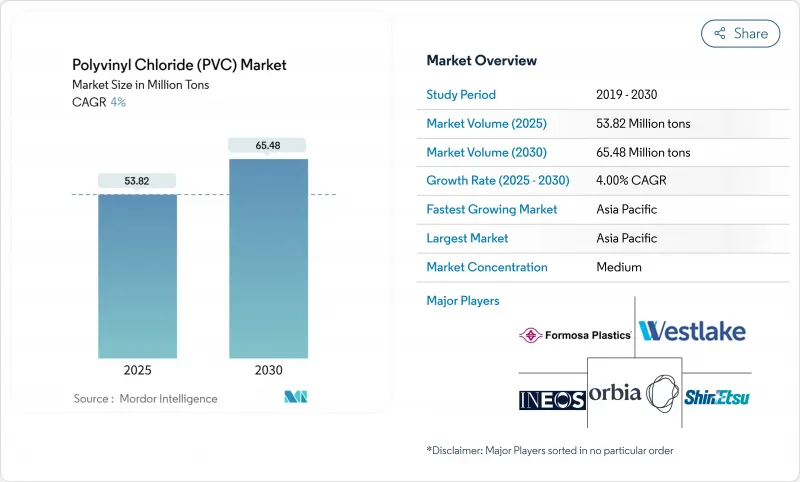
这一扩张反映了PVC在水利基础设施、医疗耗材和新一代电动车领域中的重要地位,即使在传统添加剂的监管愈发严格的情况下。良好的性价比支撑着PVC的需求,尤其是在快速都市化的地区,这些地区的替代品尚无法与PVC的耐用性、耐化学性和易加工性相媲美。用于雨水和饮用水的大口径管道、不含邻苯二甲酸酯的医用导管以及轻量化汽车内部装潢建材都推动了聚氯乙烯正在帮助大型企业抵消原材料和合规成本。
全球聚氯乙烯(PVC)市场趋势与洞察
SPAC支持的特大城市基础建设
亚洲特大城市持续投资防洪和饮用水供应网络,推动了对直径超过2公尺的PVC管道的需求,这与传统的住宅规格有所不同。印度和印尼的计划展示如何将声学洩漏检测技术整合到PVC管道中,帮助公共产业解决非收益性水损失,同时延长其资产的使用寿命。各国政府也将气候变迁资金与使用寿命较长的材料挂钩,更青睐PVC,而非球墨铸铁和混凝土。因此,能够承受更高压力和恶劣土壤条件的优质管道比标准管道拥有更高的利润率。波湾合作理事会)国家类似的基础设施建设可能会在未来十年推动中东地区的需求。
一次性医疗设备需求激增,无DEHP的PVC化合物备受青睐
随着加州即将于2030年实施DEHP禁令,北美加工业者已将DOTP增塑PVC作为血袋、静脉输液器和腹膜透析管的预设选择。例如,Teknor Apex已将低萃取APEX医用化合物商业化,这些化合物符合柔韧性目标,且无生殖毒性问题。同时,欧盟将DEHP禁令延后至2030年中期,为已重新认证其无邻苯二甲酸酯配方的供应商提供了先发优势。高昂的合规成本很容易被医院采购预算吸收,从而完善了一个高端利基市场,保护特种PVC等级免受商品週期的影响。
欧盟 REACH 和印度 BIS 加速禁止含铅稳定剂
欧盟法规 923/2023 规定,自 2026 年 1 月起,PVC 製品的铅含量将限制在 0.1 wt%。印度标准局也正在印度实施同样的阈值。重新使用钙锌稳定剂虽然对环境有利,但对于电线电缆等级而言尤其成问题,因为它会缩小加工窗口并降低介电强度。拥有协同添加剂专利的公司可以获得价格溢价,但研发规模有限的小型挤出机製造商在获得认证方面面临延迟。在价格敏感的市场中,成本转嫁仍然很困难,这挤压了利润率并促使企业整合。
細項分析
到 2024 年,在建筑型材、窗框和基础设施管道的推动下,硬质 PVC 将占据聚氯乙烯(PVC) 市场份额的 62%。这个市场主导地位归功于标准化模具、原材料的广泛供应以及具有成本效益的大规模生产。然而,儘管 CPVC 的市占率仍保持在个位数,但由于其在饭店、医院和资料中心的聚氯乙烯水供应系统中具有出色的耐高温性,预计到 2030 年其复合年增长率将达到 4.80%。 CPVC 的性能优势使其具有两位数的价格差异,保护生产商免受 PVC 市场商品波动的影响。聚氯乙烯继续用于医疗袋、汽车内装和消费软管等应用。 DOTP 和柠檬酸酯塑化剂的进步消除了监管审查,从而维持了这些应用。低烟、零卤素 PVC 将进一步推动地铁和公共事业布线的成长,这些领域的消防安全法规正在收紧。
CPVC 共混物还能在管中管安装中提供更高的耐热性,且无需支付 CPVC 的全部成本。製造商正在利用这些混合材料来扩展产品系列,并赢得超过标准温度阈值的计划。同时,硬质聚氯乙烯製造商正在透过提供发泡管道来应对 CPVC 的崛起,这些管道采用泡沫芯材和抗衝击处理表皮,以减轻重量并减少树脂消费量。这些创新支持了整个聚氯乙烯市场的竞争,即使特定细分市场导致溢价。
悬浮聚合法体现了无与伦比的规模经济效益以及与添加剂的广泛兼容性,到2024年将占到销售量的75%。大多数建筑树脂均由年产能超过30万吨的悬浮聚合生产线生产,从而在聚氯乙烯(PVC)市场中占据成本领先地位。然而,儘管乳液PVC基数不大,但由于其细颗粒形态,支持高解析度压延薄膜和医用导管的生产,预计其复合年增长率将达到4.61%。乳液工厂本身规模小且灵活性高,因此可以快速转换产品等级,进入高利润的利基市场,例如透明采血膜和电动车内装合成皮革。
供应商正在将製程多样化作为差异化因素。一体化製造商同时运作悬浮法和乳液法资产,并提供捆绑供应协议和技术服务,以锁定在通用和特种应用之间转换的转化商。本体聚合在超高纯度应用(例如半导体洁净室面板)的受众有限,因为这些应用必须最大程度地减少可萃取物。在监管和最终用户需求日益严格的背景下,製程多样化可以保护收益并缓衝聚氯乙烯(PVC) 市场的价格波动。
区域分析
到2024年,亚太地区将占据聚氯乙烯(PVC) 市场60%的主导份额,预计到2030年复合年增长率将达到4.38%。中国决定将聚氯乙烯(PVC) 进口关税提高至5.5%,凸显了其致力于利用其每年3000万吨的国内铭牌生产能力,同时鼓励悬浮法和糊化生产线的技术升级。印度的水利工程计画 (Jal Jeevan Mission) 正在向农村饮用水网络注入创纪录的资金,以支持对大口径 PVC 管道以及洩漏检测基础设施的需求。泰国将从2029年起进口美国乙烷,这将使其原料多样化,确保东南亚加工商的成本竞争力。同时,该地区的生产商正在投资乙烯基回收工厂,生产经过认证的消费后树脂,用于生产符合出口要求的建筑产品。
在北美,基础设施更新投资与电动车组装投资的增加相平衡。信越公司斥资12.5亿美元在路易斯安那州实施的去瓶颈计划,以及台塑公司在巴吞鲁日的扩建项目,将在2025年至2027年期间每年新增800多吨悬浮液排放能。环保授权依然严格,迫使业者整合盐水开采和氯乙烯单体减量技术。随着各州法规逐步淘汰邻苯二甲酸酯(DEHP),美国复合材料生产商正在迅速推出不含邻苯二甲酸酯的产品,从而提高每吨产品的价值,并缓解週期性建筑市场的压力。
在欧洲,在全球最严格的添加剂法规背景下,该地区正在加速可回收单一材料型材的研发,同时将资金投入钙锌稳定剂的生产。 VinylPlus 提前五年实现了2025年自愿回收目标,该地区PVC型材的回收率已超过20%。同时,当电价上涨时,该地区的生产商会运转率,并从美国墨西哥湾沿岸的工厂出口PVC,以补充欧洲的合约量。巴西的甘蔗乙烯计划代表了一条差异化、低碳的PVC生产路线,而奈及利亚正在考虑投资氯碱,以减少对进口的依赖。巴西的甘蔗乙烯计划代表了一条差异化、低碳的PVC生产路线,而奈及利亚正在考虑投资氯碱,以减少对进口的依赖。
其他福利:
- Excel 格式的市场预测 (ME) 表
- 3个月的分析师支持
目录
第一章 引言
- 研究假设和市场定义
- 调查范围
第二章调查方法
第三章执行摘要
第四章 市场状况
- 市场概况
- 市场驱动因素
- SPAC主导的亚洲特大城市城市基础设施快速扩张
- 北美和欧洲一次性医疗设备需求激增,对不含 DEHP 的 PVC 化合物青睐有加
- 对清洁水基础设施的需求不断增长
- 原始设备製造商转向电动车的轻质柔性 PVC 内装
- 美国和欧盟生产商整合氯碱产能,降低 PVC 製造成本
- 市场限制
- 欧盟 REACH 和印度 BIS 标准加速禁止含铅稳定剂
- 品牌所有者推动不含邻苯二甲酸酯的包装正在减少对传统柔性 PVC 的需求
- 乙烯价格随原油价格波动,对利润造成压力
- 价值链分析
- 监理展望
- 五力分析
- 供应商的议价能力
- 买方的议价能力
- 新进入者的威胁
- 替代品的威胁
- 竞争对手之间的竞争
第五章市场规模及成长预测(数量)
- 依产品类型
- 硬质聚氯乙烯
- 透明硬质PVC
- 不透明硬质PVC
- 软质聚氯乙烯
- 透明软质PVC
- 不透明软质PVC
- 低烟聚氯乙烯
- 氯化聚氯乙烯(CPVC)
- 硬质聚氯乙烯
- 按製造工艺
- 悬浮聚氯乙烯
- 乳液PVC
- 本体/本体聚合PVC
- 依稳定器类型
- 钙系稳定剂(Ca-Zn系稳定剂)
- 铅基稳定剂(Pb稳定剂)
- 锡和有机锡(Sn稳定剂)
- 钡基和其他稳定剂类型(液态混合金属)
- 按用途
- 管道和配件
- 薄膜和片材
- 电线电缆
- 瓶子
- 型材、软管、管材
- 其他用途
- 按最终用户产业
- 建筑/施工
- 汽车和运输
- 电气和电子
- 包装
- 鞋类
- 卫生保健
- 其他最终用户产业
- 按地区
- 亚太地区
- 中国
- 印度
- 日本
- 韩国
- 其他亚太地区
- 北美洲
- 美国
- 加拿大
- 墨西哥
- 欧洲
- 德国
- 英国
- 义大利
- 法国
- 西班牙
- 其他欧洲国家
- 南美洲
- 巴西
- 阿根廷
- 南美洲其他地区
- 中东和非洲
- 沙乌地阿拉伯
- 南非
- 奈及利亚
- 其他中东和非洲地区
- 亚太地区
第六章 竞争态势
- 市场集中度
- 策略倡议
- 市占率分析
- 公司简介
- Aditya Birla Chemicals
- China National Bluestar(Group)Co,Ltd.
- Ercros, SA
- Formosa Plastics Corporation
- Hanwha Solutions
- INEOS
- Inner Mongolia Junzheng Energy & Chemical Group Co., Ltd.
- Kem One SAS
- LG Chem
- Occidental Petroleum Corporation
- Orbia
- Reliance Industries Limited
- SABIC
- Shaanxi Coal & Chemical Industry Group Co., Ltd.
- Shin-Etsu Chemical Co., Ltd.
- Tianye Group
- Westlake Corporation
- Xinjiang Zhongtai Chemical Co., Ltd.
第七章 市场机会与未来展望
The Polyvinyl Chloride Market size is estimated at 53.82 Million tons in 2025, and is expected to reach 65.48 Million tons by 2030, at a CAGR of 4% during the forecast period (2025-2030).
This expansion reflects PVC's entrenched role in water infrastructure, healthcare disposables, and new-generation electric vehicles, even as regulations tighten around traditional additives. Sustained demand arises from a favorable performance-to-price ratio, especially in fast-urbanizing regions where substitutes cannot yet match PVC's durability, chemical resistance, or ease of processing. Large-diameter pipes for stormwater and potable-water grids, phthalate-free medical tubing, and lightweight automotive interiors all reinforce the growth trajectory of the polyvinyl chloride market. Meanwhile, producer margins face mixed pressures: Chinese overcapacity weighs on global prices, but vertical integration into chlor-alkali and recycling operations helps offset feedstock and compliance costs for leading firms.
Global Polyvinyl Chloride (PVC) Market Trends and Insights
Rapid Urban Infrastructure Expansion in SPAC-Financed Megacities
Continued spending on flood management and potable-water grids in Asia's megacities drives specification of large-diameter PVC pipes exceeding 2m, a departure from legacy residential bore sizes. Projects in India and Indonesia illustrate how acoustic leak-detection technology embedded in PVC piping allows utilities to address non-revenue water losses while extending asset life. Governments also link climate-resilience funding to materials with long service lives, which favors PVC over ductile iron or concrete. As a result, premium grades capable of handling higher pressures and aggressive soil conditions obtain stronger margins than commodity pipe. Similar infrastructure commitments across Gulf Cooperation Council states suggest spill-over demand into the Middle East over the next decade.
Surge in Single-Use Medical Devices Favoring DEHP-Free PVC Compounds
California's impending DEHP ban in 2030 prompted North American converters to adopt DOTP-plasticized PVC as the default choice for blood bags, IV sets, and peritoneal-dialysis tubing. Teknor Apex, for instance, commercialized low-extractable APEX medical compounds that match flexibility targets without reproductive-toxicity concerns. Simultaneously, EU postponement of its own DEHP prohibition until mid-2030 offers first-mover advantage to suppliers that have already re-qualified with phthalate-free formulations. Higher compliance costs are readily absorbed by hospital procurement budgets, rounding out a premium niche that shields specialty PVC grades from commodity cycles.
Accelerating Bans on Lead-Based Stabilizers under EU REACH and Indian BIS
EU Regulation 923/2023 limits total lead content in PVC articles to 0.1 wt% starting January 2026. The same threshold is being replicated by India's Bureau of Indian Standards. Re-formulation to calcium-zinc stabilizers, while environmentally favorable, reduces processing windows and can lower dielectric strength-posing particular issues for wire and cable grades. Companies with patented synergistic additive packages secure a pricing premium, yet smaller extruders lacking R&D scale face qualification delays. Cost pass-through remains challenging in price-sensitive markets, compressing margins and encouraging consolidation.
Other drivers and restraints analyzed in the detailed report include:
- Rising Demand for Clean-Water Infrastructure
- OEM Shift Toward Lightweight Flexible PVC Interiors in Electric Vehicles
- Brand-Owner Push for Phthalate-Free Packaging Diminishing Conventional Flexible PVC Demand
For complete list of drivers and restraints, kindly check the Table Of Contents.
Segment Analysis
Rigid PVC accounted for 62% of polyvinyl chloride market share in 2024, anchored by construction profiles, window frames, and infrastructure pipe. Volume leadership rests on standardized tooling, wide raw-material availability, and cost-efficient mass production. However, CPVC-while representing a single-digit share-shows the strongest 4.80% CAGR to 2030 thanks to superior temperature tolerance for hot-and-cold potable systems in hotels, hospitals, and data centers. CPVC's performance premium permits double-digit price differentials that cushion producers from commodity swings in the polyvinyl chloride market. Flexible PVC continues to serve medical bags, vehicle interiors, and consumer hoses; advances in DOTP and citrate plasticizers resolve regulatory scrutiny, retaining these applications. Low-smoke zero-halogen PVC variants further unlock growth in metro-rail and public-venue cabling where fire-safety codes tighten.
A notable spill-over effect involves CPVC blends that deliver incremental heat resistance in pipe-in-pipe installations without the full cost of neat CPVC. Producers exploit these hybrids to extend product portfolios and capture projects beyond standard temperature thresholds. Meanwhile, rigid PVC suppliers counter CPVC's rise by marketing co-extruded pipes with foam cores or impact-modified skins that reduce weight and resin consumption. These innovations collectively sustain competition across the polyvinyl chloride market even as specialized niches attract premium pricing.
Suspension polymerization delivered 75% of 2024 volume, reflecting unmatched economies of scale and broad compatibility with additives. Most construction-grade resins stem from suspension lines exceeding 300 kt/yr, enabling cost leadership across the polyvinyl chloride market. Yet emulsion PVC, while holding a modest base, is forecast for a 4.61% CAGR driven by its fine-particle morphology which supports high-definition calendared films and medical-grade tubing. Emulsion plants are inherently smaller and more flexible, allowing rapid grade switches toward higher-margin niches such as transparent blood-collection film or synthetic leather for EV interiors.
Suppliers use process versatility as a differentiation lever. Integrated producers operate both suspension and emulsion assets, bundling supply contracts and technical services to lock in converters shifting between commodity and specialty applications. Bulk polymerization, although limited, serves ultra-high-purity segments like semiconductor clean-room paneling where extractables must be minimized. As regulatory and end-user demands become more exacting, process diversification protects revenue streams and tempers price volatility in the polyvinyl chloride market.
The Polyvinyl Chloride Market Report Segments the Industry by Product Type (Rigid PVC, Flexible PVC, and More), Manufacturing Process (Suspension PVC, Emulsion PVC, and More), Stabilizer Type (Calcium-Based Stabilizers, Lead-Based Stabilizers, and More), Application (Pipes and Fittings, Bottles, and More), End-User Industry (Building and Construction, Packaging, and More), and Geography (Asia-Pacific, North America, and More).
Geography Analysis
Asia-Pacific preserved a commanding 60% share of the polyvinyl chloride market in 2024 and is forecasting a 4.38% CAGR to 2030. China's decision to raise PVC import tariffs to 5.5% underscores a policy focus on utilizing its 30 million t/yr domestic nameplate capacity while encouraging technological upgrades in suspension and paste lines. India's Jal Jeevan Mission funnels record capital into rural drinking-water networks, supporting large-bore PVC pipe demand alongside leak-detection infrastructure. Thailand's feedstock diversification, enabled by US ethane imports from 2029, secures cost competitiveness for Southeast Asian converters. In parallel, regional producers invest in vinyl recycling plants that create certified post-consumer resin for export-compliant building products.
North America balances infrastructure-renewal spending with rising EV assembly investments. Shin-Etsu's USD 1.25 billion Louisiana debottlenecking project and Formosa's Baton Rouge expansion add over 800 kt/yr of new suspension capacity between 2025 and 2027. Environmental permitting remains strict, compelling operators to integrate brine mining and vinyl chloride monomer emissions-reduction technology. As state regulations phase out DEHP, US compounders expedite phthalate-free offerings, thereby raising value per tonne and cushioning the cyclical construction market.
Europe endures the world's most stringent additive rules, driving capital toward calcium-zinc stabilizer production while accelerating R&D on recyclable mono-material profiles. VinylPlus exceeded its 2025 voluntary recycling target five years early, lifting the region's recycled-content rate in PVC profiles above 20%. Meanwhile, regional producers operate at reduced run-rates when power prices spike, exporting PVC from US Gulf Coast plants to backfill European contract commitments. Beyond OECD markets, South America and Africa seek polymer self-sufficiency; Brazil's sugar-cane-based ethylene project signifies a differentiated low-carbon route to PVC, while Nigeria evaluates chlor-alkali investments to reduce import reliance. Political and currency volatility remains a hurdle, yet infrastructure deficits present an undeniable addressable need for the polyvinyl chloride market.
- Aditya Birla Chemicals
- China National Bluestar (Group) Co,Ltd.
- Ercros, S.A.
- Formosa Plastics Corporation
- Hanwha Solutions
- INEOS
- Inner Mongolia Junzheng Energy & Chemical Group Co., Ltd.
- Kem One SAS
- LG Chem
- Occidental Petroleum Corporation
- Orbia
- Reliance Industries Limited
- SABIC
- Shaanxi Coal & Chemical Industry Group Co., Ltd.
- Shin-Etsu Chemical Co., Ltd.
- Tianye Group
- Westlake Corporation
- Xinjiang Zhongtai Chemical Co., Ltd.
Additional Benefits:
- The market estimate (ME) sheet in Excel format
- 3 months of analyst support
TABLE OF CONTENTS
1 Introduction
- 1.1 Study Assumptions and Market Definition
- 1.2 Scope of the Study
2 Research Methodology
3 Executive Summary
4 Market Landscape
- 4.1 Market Overview
- 4.2 Market Drivers
- 4.2.1 Rapid Urban Infrastructure Expansion in SPAC-Driven Megacities across Asia
- 4.2.2 Surge in Single-Use Medical Devices Favoring DEHP-Free PVC Compounds in North America and Europe
- 4.2.3 Rising Demand for Clean Water Infrastructure:
- 4.2.4 OEM Shift Toward Lightweight Flexible PVC Interiors in Electric Vehicles Produced
- 4.2.5 Chlor-Alkali Capacity Integration by Producers in the US and EU Lowering PVC Production Costs
- 4.3 Market Restraints
- 4.3.1 Accelerating Bans on Lead-Based Stabilizers under EU REACH and Indian BIS Standards
- 4.3.2 Brand-Owner Push for Phthalate-Free Packaging Diminishing Conventional Flexible PVC Demand
- 4.3.3 Ethylene Price Volatility Linked to Crude-Oil Fluctuations Compressing Margins
- 4.4 Value Chain Analysis
- 4.5 Regulatory Outlook
- 4.6 Porter's Five Forces
- 4.6.1 Bargaining Power of Suppliers
- 4.6.2 Bargaining Power of Buyers
- 4.6.3 Threat of New Entrants
- 4.6.4 Threat of Substitutes
- 4.6.5 Competitive Rivalry
5 Market Size and Growth Forecasts (Volume)
- 5.1 By Product Type
- 5.1.1 Rigid PVC
- 5.1.1.1 Clear Rigid PVC
- 5.1.1.2 Non-clear Rigid PVC
- 5.1.2 Flexible PVC
- 5.1.2.1 Clear Flexible PVC
- 5.1.2.2 Non-clear Flexible PVC
- 5.1.3 Low-Smoke PVC
- 5.1.4 Chlorinated PVC (CPVC)
- 5.1.1 Rigid PVC
- 5.2 By Manufacturing Process
- 5.2.1 Suspension PVC
- 5.2.2 Emulsion PVC
- 5.2.3 Bulk/Mass Polymerized PVC
- 5.3 By Stabilizer Type
- 5.3.1 Calcium-based Stabilizers (Ca-Zn Stabilizers)
- 5.3.2 Lead-based Stabilizers (Pb Stabilizers)
- 5.3.3 Tin and Organotin-based (Sn Stabilizers)
- 5.3.4 Barium-based and Other Stabilizer Types (Liquid Mixed Metals)
- 5.4 By Application
- 5.4.1 Pipes and Fittings
- 5.4.2 Films and Sheets
- 5.4.3 Wires and Cables
- 5.4.4 Bottles
- 5.4.5 Profiles, Hoses and Tubings
- 5.4.6 Other Applications
- 5.5 By End-User Industry
- 5.5.1 Building and Construction
- 5.5.2 Automotive and Transportation
- 5.5.3 Electrical and Electronics
- 5.5.4 Packaging
- 5.5.5 Footwear
- 5.5.6 Healthcare
- 5.5.7 Other End-User Industries
- 5.6 By Geography
- 5.6.1 Asia-Pacific
- 5.6.1.1 China
- 5.6.1.2 India
- 5.6.1.3 Japan
- 5.6.1.4 South Korea
- 5.6.1.5 Rest of Asia-Pacific
- 5.6.2 North America
- 5.6.2.1 United States
- 5.6.2.2 Canada
- 5.6.2.3 Mexico
- 5.6.3 Europe
- 5.6.3.1 Germany
- 5.6.3.2 United Kingdom
- 5.6.3.3 Italy
- 5.6.3.4 France
- 5.6.3.5 Spain
- 5.6.3.6 Rest of Europe
- 5.6.4 South America
- 5.6.4.1 Brazil
- 5.6.4.2 Argentina
- 5.6.4.3 Rest of South America
- 5.6.5 Middle East and Africa
- 5.6.5.1 Saudi Arabia
- 5.6.5.2 South Africa
- 5.6.5.3 Nigeria
- 5.6.5.4 Rest of Middle East and Africa
- 5.6.1 Asia-Pacific
6 Competitive Landscape
- 6.1 Market Concentration
- 6.2 Strategic Moves
- 6.3 Market Share Analysis
- 6.4 Company Profiles (includes Global level Overview, Market level overview, Core Segments, Financials as available, Strategic Information, Market Rank/Share for key companies, Products and Services, and Recent Developments)
- 6.4.1 Aditya Birla Chemicals
- 6.4.2 China National Bluestar (Group) Co,Ltd.
- 6.4.3 Ercros, S.A.
- 6.4.4 Formosa Plastics Corporation
- 6.4.5 Hanwha Solutions
- 6.4.6 INEOS
- 6.4.7 Inner Mongolia Junzheng Energy & Chemical Group Co., Ltd.
- 6.4.8 Kem One SAS
- 6.4.9 LG Chem
- 6.4.10 Occidental Petroleum Corporation
- 6.4.11 Orbia
- 6.4.12 Reliance Industries Limited
- 6.4.13 SABIC
- 6.4.14 Shaanxi Coal & Chemical Industry Group Co., Ltd.
- 6.4.15 Shin-Etsu Chemical Co., Ltd.
- 6.4.16 Tianye Group
- 6.4.17 Westlake Corporation
- 6.4.18 Xinjiang Zhongtai Chemical Co., Ltd.
7 Market Opportunities and Future Outlook
- 7.1 White-space and Unmet-Need Assessment
- 7.2 Recycled PVC and Circular Economy Integration
- 7.3 Green Hydrogen-Driven Chlor-Alkali for Carbon-Neutral PVC

 欧洲聚氯乙烯(PVC):市场占有率分析、产业趋势与统计、成长预测(2026-2031)
 全球压延聚氯乙烯柔性薄膜市场规模、份额、趋势及成长分析报告(2026-2034)
 日本聚氯乙烯(PVC)市场规模、份额、趋势及预测(依产品类型、应用、最终用途产业及地区划分),2026-2034年
 2026年全球聚氯乙烯(PVC)捲帘百叶窗市场报告2026年全球PVC乳液市场报告2026年全球聚氯乙烯(PVC)市场报告
 PVC添加剂市场-全球产业规模、份额、趋势、机会及预测(按类型、製造流程、应用、地区及竞争格局划分,2021-2031年)聚氯乙烯市场-全球产业规模、份额、趋势、机会及预测(依产品类型、稳定剂类型、应用、终端用户产业、区域及竞争格局划分),2021-2031年
 按类型、形状、厚度、颜色、销售管道、应用程式和最终用户分類的硬质PVC板材市场,全球预测,2026-2032年特种PVC树脂市场:按类型、形态、技术、应用和终端用户产业划分,全球预测,2026-2032年