


 |
市场调查报告书
商品编码
1939111
汽车玻璃:市场占有率分析、产业趋势与统计、成长预测(2026-2031)Automotive Glass - Market Share Analysis, Industry Trends & Statistics, Growth Forecasts (2026 - 2031) |
||||||

※ 本网页内容可能与最新版本有所差异。详细情况请与我们联繫。
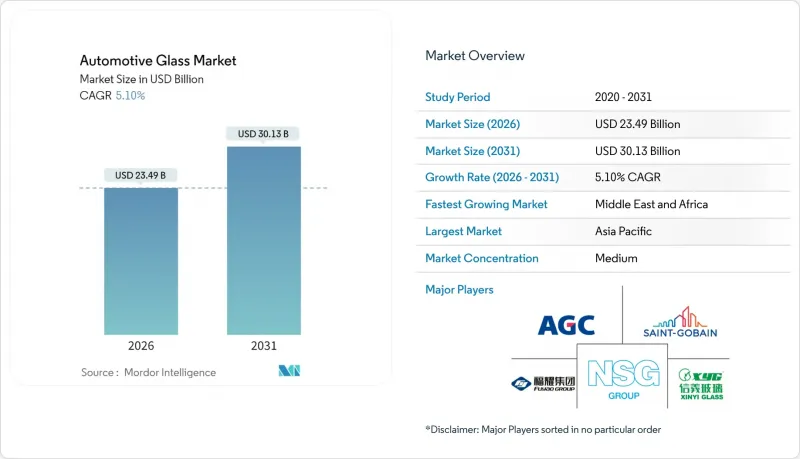
预计汽车玻璃市场将从 2025 年的 223.5 亿美元成长到 2026 年的 234.9 亿美元,到 2031 年将达到 301.3 亿美元,2026 年至 2031 年的复合年增长率为 5.1%。
儘管原材料价格和物流成本有所波动,但汽车产量的成长、更严格的安全标准以及向电动出行的转型正在推动市场成长。全景天窗、轻质夹层挡风玻璃和电致变色玻璃的需求不断增长,促使製造商拓展专业产品线并加强与整车製造商的合作。 SUV车型对更大玻璃面积的需求以及降低二氧化碳排放的监管压力,正在加速镀膜玻璃和多功能玻璃产品的普及。预计未来十年,这些因素将共同推动汽车玻璃市场实现强劲的技术主导成长。
全球汽车玻璃市场趋势及展望
电动车平台向全景玻璃过渡
电动车製造商正采用更大的车顶面板来提升车内氛围和品牌形象。例如,特斯拉 Cybertruck 和Mercedes-Benz Vision V 概念车整合了电致变色车顶,可调节色调,将车内温度降低多达 18 华氏度(约摄氏 10 度),并减少空调系统的负载。预计每辆车的玻璃面积将快速成长,促使供应商投资于大幅面弯曲成型、低辐射 (Low-E) 涂层和红外线吸收夹层等技术。随着生产成本的下降,这种高端产品有望扩展到中等价位的电动车,从而支撑汽车玻璃市场的持续成长。
为满足二氧化碳排放目标,原始设备製造商 (OEM) 对轻质夹层玻璃的需求日益增长
欧洲法规设定了2030年将车队平均二氧化碳排放降至100克/公里的目标,汽车製造商正竭尽所能减轻车身重量。美国环保署(EPA)对2017年福特GT的研究表明,夹层玻璃显着减轻了车身重量,减重幅度高达30%。目前,采用离子塑胶夹层的超薄夹层玻璃可在不影响抗衝击性的前提下,可达到高达30%的减重。 AGC和圣戈班已将一种1.6毫米厚的挡风玻璃结构商业化,该结构兼具轻量化和隔音性能,增强了汽车玻璃市场的长期发展前景。
特殊层间薄膜(PVB、离子聚合物)的紧密供应网络
KURARAY CO. LTD.的PVB产能扩张未能满足隔音和抬头显示器日益增长的需求,迫使其延长交货时间并实施配额制。欧洲的贴合机报告称,部分产品出现短缺,迫使他们优先满足OEM订单,而非售后市场订单。实验性的生物基中间层材料已展现出令人鼓舞的53.1%的机械性能提升,但大规模生产仍需数年时间。在新工厂运作之前,短期供应限制可能会限制汽车玻璃市场的成长。
细分市场分析
到2025年,传统玻璃将占据汽车玻璃市场82.05%的份额,这主要得益于成本效益和成熟的生产设施。夹层玻璃因其在受到衝击时不易破碎的特性,符合全球安全标准,其市场份额正在超越钢化玻璃。这种转变导致特种夹层材料的供应趋紧,但随着贴合机製造商对更薄、更轻结构的需求,夹层玻璃製造商也迎来了增值机会。智慧玻璃目前仍处于小众市场,预计将以12.1%的复合年增长率成长,并在豪华车和高端电动车领域占有一席之地。
电致变色车顶主导智慧玻璃的早期应用。梅赛德斯-宾士Vision V原型车上采用的悬浮颗粒装置(SPD)具有更快的切换速度和更高的耐用性。聚合物分散液晶(PDLC)车窗正瞄准隐私隔间市场,而热致变色薄膜仍处于商业化前的阶段。随着规模经济效益的提升,智慧玻璃的应用范围将超越旗舰车型,并进一步巩固汽车玻璃市场。
到2025年,挡风玻璃将占汽车玻璃市场的44.15%,这主要得益于强制安装和ADAS感测器数量的增加。日益复杂的结构推高了单位成本,并加强了供应商和OEM厂商之间的共同开发週期。同时,天窗是成长最快的应用领域,年复合成长率达9.6%,这主要得益于SUV车型为了提供全景视野而采用的更大开口尺寸的标准化。
受声学夹层玻璃的推动,后窗玻璃市场呈现温和成长,但保固问题减缓了其普及速度。由于排放法规的要求,尤其是在欧洲和日本,侧窗玻璃正逐步采用夹层结构。后视镜和三角窗玻璃则将电致变色防眩光涂层作为一项功能性附加组件进行集成,而对大面积应用的需求并不高。这种多元化的应用组合支撑着汽车玻璃市场的稳定成长。
区域分析
亚太地区将引领汽车玻璃市场,预计2025年将占全球总销量的48.75%。这主要得益于中国庞大的产能和快速成长的国内需求。政府优惠政策维持了工厂使用率,而印度产能的提升则催生了新的需求。智慧玻璃、雷射雷达渗透性技术和AR-HUD整合技术在上海汽车玻璃产业大会上备受关注,展现了持续的技术创新。日本和韩国为高端汽车製造商提供先进的夹层玻璃和镀膜产品,在整体汽车玻璃市场中占据着有利可图的细分领域。
为了应对来自中国进口产品带来的利润压力,製造商正转向智慧玻璃和永续性项目。由AGC和圣戈班共同开发的Volta熔炉,正是降低二氧化碳排放强度的策略性倡议。同时,由于对SUV的需求旺盛,北美市场仍具有重要影响力。美国的售后市场蓬勃发展,像Auto Glass Now这样的品牌正在全国扩张,试图抢占替换市场。
预计中东和非洲地区将以6.8%的复合年增长率(CAGR)实现最快成长,直至2031年。沙乌地阿拉伯丰富的二氧化硅矿床正吸引着旨在实现在地化供应的浮法玻璃投资。与产业多元化政策相配合的补贴计画正在鼓励汽车零件生产,帮助该地区扩大其在汽车玻璃市场的份额。南美洲的前景主要取决于巴西的组装量,而非洲的成长则由南非相对成熟的产业所驱动。就近生产策略使全球供应商能够在这些不同的地区平衡运输成本和准时交货的需求。
其他福利:
- Excel格式的市场预测(ME)表
- 3个月的分析师支持
目录
第一章 引言
- 研究假设和市场定义
- 调查范围
第二章调查方法
第三章执行摘要
第四章 市场情势
- 市场概览
- 市场驱动因素
- 电动车平台采用全景嵌装玻璃的趋势
- 为满足二氧化碳排放目标,原始设备製造商 (OEM) 对轻质夹层玻璃的需求日益增长
- SUV天窗的快速普及
- 监理机关主导要求侧窗使用安全玻璃
- 高端OEM製造商对售后市场兼容HUD的挡风玻璃的需求不断增长
- 用于ADAS功能的嵌入式感测器集成
- 市场限制
- 特殊层间薄膜(PVB、离子聚合物)供应链紧张
- 中国浮法玻璃产能过剩进入欧盟市场,降低了利润率。
- SUV声学堆迭式后灯的高保固成本
- 成熟售后市场通路的更换週期延长
- 价值链分析
- 波特五力模型
- 供应商的议价能力
- 买方的议价能力
- 新进入者的威胁
- 替代品的威胁
- 竞争对手之间的竞争
- OEM 与售后市场趋势分析
第五章 市场规模及成长预测(金额)
- 按玻璃类型
- 普通玻璃
- 夹层玻璃
- 强化玻璃
- 智慧眼镜
- 电致变色
- 悬浮颗粒装置(SPD)
- 聚合物分散液晶(PDLC)
- 感温变色
- 普通玻璃
- 透过使用
- 挡风玻璃
- 后窗背光
- 侧窗(侧灯)
- 天窗
- 后视镜和侧视镜
- 其他玻璃製品(四分之一圆玻璃和弯曲玻璃)
- 按车辆类型
- 搭乘用车
- 掀背车
- 轿车
- SUV 与跨界车
- 豪华与运动
- 轻型商用车
- 中型和重型商用车辆
- 搭乘用车
- 透过推广
- 内燃机(ICE)
- 电池式电动车(BEV)
- 混合动力电动车(HEV/PHEV)
- 燃料电池电动车(FCEV)
- 按销售管道
- OEM
- 售后市场
- 按地区
- 北美洲
- 我们
- 加拿大
- 北美其他地区
- 南美洲
- 巴西
- 阿根廷
- 其他南美洲
- 欧洲
- 德国
- 英国
- 法国
- 西班牙
- 义大利
- 俄罗斯
- 其他欧洲地区
- 亚太地区
- 中国
- 印度
- 日本
- 韩国
- 澳洲
- 纽西兰
- 亚太其他地区
- 中东和非洲
- 沙乌地阿拉伯
- 阿拉伯聯合大公国
- 南非
- 其他中东和非洲地区
- 北美洲
第六章 竞争情势
- 市场集中度
- 策略趋势
- 市占率分析
- 公司简介
- AGC Inc.(Asahi Glass)
- Saint-Gobain SA
- Nippon Sheet Glass Co. Ltd.
- Fuyao Glass Industry Group Co. Ltd.
- Xinyi Glass Holdings Ltd.
- Guardian Automotive(Koch Industries)
- Webasto SE
- Carlex Glass America LLC
- Magna International Inc.
- Vitro Automotive
- Corning Incorporated
- Sisecam Automotive
- Shanghai Yaohua Pilkington Glass
- Gentex Corporation
- AGP Group
第七章 市场机会与未来展望
The automotive glass market is expected to grow from USD 22.35 billion in 2025 to USD 23.49 billion in 2026 and is forecast to reach USD 30.13 billion by 2031 at 5.1% CAGR over 2026-2031.
Rising vehicle production, stricter safety mandates, and the shift toward electric mobility are sustaining momentum even as raw-material prices and logistics costs fluctuate. Growing demand for panoramic roofs, lightweight laminated windshields, and electrochromic glazing is encouraging manufacturers to scale specialized lines and deepen partnerships with OEMs. The emphasis on larger glass surfaces in SUVs, coupled with regulatory pressure to cut CO2 emissions, is accelerating the adoption of coated and multi-functional products. Together, these forces position the automotive glass market for resilient, technology-led growth through the decade.
Global Automotive Glass Market Trends and Insights
Shift Toward Panoramic Glazing In EV Platforms
Electric-vehicle makers are installing larger roof panes to enhance cabin ambience and brand identity. Tesla's Cybertruck and Mercedes-Benz's Vision V concept integrate electrochromic roofs that modulate tint levels, cutting cabin temperatures by up to 18°F and lowering HVAC loads. Glass area per vehicle is forecast to surge, prompting suppliers to invest in wide-format bending, low-E coatings, and infrared-absorbing interlayers. This premium specification is expected to permeate mid-priced EVs as production costs fall, supporting sustained growth in the automotive glass market.
OEM Demand For Lightweight Laminated Glass To Meet CO2 Targets
European regulations set a 100 g/km fleet-average CO2 goal for 2030, pushing automakers to shave every kilogram. EPA studies of the 2017 Ford GT show laminated glazing contributed materially to a 30% mass drop. Thin-gauge laminates using ionoplast interlayers now trim weight by up to 30% without compromising impact performance. AGC and Saint-Gobain are commercializing 1.6-mm windshield constructions that pair weight savings with acoustic damping, reinforcing long-term prospects for the automotive glass market.
Supply-Chain Crunch Of Specialty Interlayers (PVB, Ionoplast)
Kuraray's PVB capacity expansions have not kept pace with rising demand for acoustic and HUD-grade films, extending lead times and forcing allocation programs. European laminators report spot shortages, compelling them to prioritize OEM production over aftermarket orders. Experimental bio-based interlayers deliver promising mechanical gains of 53.1% but remain years from scale. Short-term supply stress may temper automotive glass market growth until new plants start up.
Other drivers and restraints analyzed in the detailed report include:
- Rapid Sunroof Penetration In SUVs
- Regulation-Led Mandatory Safety Glazing For Side Windows
- Margin Erosion From Chinese Float-Glass Overcapacity Flooding EU Market
For complete list of drivers and restraints, kindly check the Table Of Contents.
Segment Analysis
Regular glass commanded 82.05% of the automotive glass market share in 2025, thanks to cost efficiency and entrenched production assets. Laminated variants are gaining against tempered formats because they keep shards intact on impact, satisfying global safety norms. The shift tightens the supply of specialty interlayers, yet it positions laminators for higher value capture as OEMs demand thinner, lighter constructions. Smart glass, though only a minority today, is projected to post a 12.1% CAGR, carving out niches in luxury vehicles and high-end EVs.
Electrochromic roofs dominate early adoption; suspended particle devices (SPD) deliver faster switching and durability, as shown in Mercedes-Benz's Vision V prototype. Polymer-dispersed liquid crystal (PDLC) windows target privacy partitions, while thermochromic films remain pre-commercial. As economies of scale improve, smart glass will expand beyond flagships, bolstering the automotive glass market.
Windshields held 44.15% of the automotive glass market size in 2025, underpinned by mandatory fitment and rising ADAS sensor content. Complexity drives up unit value, reinforcing supplier-OEM co-development cycles. Sunroofs, however, are the fastest-growing application at 9.6% CAGR as SUVs standardize large openings for panoramic vistas.
Backlites see modest traction from acoustic laminates, though warranty issues temper speed. Sidelites transition to laminated construction to meet ejection-prevention laws, especially in Europe and Japan. Rear-view mirrors and quarter windows integrate electrochromic anti-glare coatings, adding feature content without large area demand. Collectively, the application mix underpins steady expansion in the automotive glass market.
The Automotive Glass Market Report is Segmented by Glass Type (Regular Glass and Smart Glass), Application (Windshield, Sunroof and More), Vehicle Type (Passenger Cars, and More), Propulsion (Internal Combustion Engine, Battery Electric Vehicle (BEV), and More), Sales Channel (OEM, and Aftermarket), and Geography. The Market Sizes and Forecasts are Provided in Terms of Value (USD).
Geography Analysis
Asia-Pacific dominated the automotive glass market, with 48.75% of the revenue in 2025, anchored by China's vast output and rapid domestic uptake. Government incentives have kept plants near capacity, while India's production climb adds a fresh demand axis. Conferences in Shanghai spotlight intelligent glazing, LiDAR transparency, and AR-HUD integration, showcasing continual innovation. Japan and South Korea supply advanced laminated and coated products for premium OEMs, preserving high-margin niches as part of the broader automotive glass market.
Producers combat margin squeeze from Chinese imports by pivoting into smart glass and sustainability programs. AGC and Saint-Gobain's joint Volta furnace evidences a strategic move to slash CO2 intensity. Meanwhile, North America remains influential due to the demand for SUVs. The United States features vibrant aftermarket activity; brands such as Auto Glass Now scale national footprints to capture replacement revenue.
The Middle East and Africa are expected to be the fastest climbers at 6.8% CAGR through 2031. Saudi Arabia's silica-rich deposits attract float-glass investments intended to localize supply. Subsidies aligned with broader industrial-diversification agendas incentivize auto-component production, broadening the region's stake in the automotive glass market. South America's outlook is tied chiefly to Brazilian assembly volumes, while Africa's growth centers on South Africa's relatively mature sector. Proximity production strategies help global suppliers balance freight costs and just-in-time expectations across these varied geographies.
- AGC Inc. (Asahi Glass)
- Saint-Gobain S.A.
- Nippon Sheet Glass Co. Ltd.
- Fuyao Glass Industry Group Co. Ltd.
- Xinyi Glass Holdings Ltd.
- Guardian Automotive (Koch Industries)
- Webasto SE
- Carlex Glass America LLC
- Magna International Inc.
- Vitro Automotive
- Corning Incorporated
- Sisecam Automotive
- Shanghai Yaohua Pilkington Glass
- Gentex Corporation
- AGP Group
Additional Benefits:
- The market estimate (ME) sheet in Excel format
- 3 months of analyst support
TABLE OF CONTENTS
1 Introduction
- 1.1 Study Assumptions & Market Definition
- 1.2 Scope of the Study
2 Research Methodology
3 Executive Summary
4 Market Landscape
- 4.1 Market Overview
- 4.2 Market Drivers
- 4.2.1 Shift Toward Panoramic Glazing In EV Platforms
- 4.2.2 OEM Demand For Lightweight Laminated Glass To Meet CO2 Targets
- 4.2.3 Rapid Sunroof Penetration In SUVs
- 4.2.4 Regulation-Led Mandatory Safety Glazing For Side Windows
- 4.2.5 Growing Retrofit Of HUD-Compatible Windshields By Premium OEMs
- 4.2.6 Integration Of Embedded Sensors For ADAS Functionality
- 4.3 Market Restraints
- 4.3.1 Supply-Chain Crunch Of Specialty Interlayers (PVB, Ionoplast)
- 4.3.2 Margin Erosion From Chinese Float-Glass Overcapacity Flooding EU Market
- 4.3.3 High Warranty Costs Linked To Acoustic Laminated Backlights In SUVs
- 4.3.4 Slow Replacement Cycles In Mature Aftermarket Channels
- 4.4 Value-Chain Analysis
- 4.5 Porter's Five Forces
- 4.5.1 Bargaining Power of Suppliers
- 4.5.2 Bargaining Power of Buyers
- 4.5.3 Threat of New Entrants
- 4.5.4 Threat of Substitutes
- 4.5.5 Intensity of Competitive Rivalry
- 4.6 OEM vs. Aftermarket Trend Analysis
5 Market Size & Growth Forecasts (Value (USD))
- 5.1 By Glass Type
- 5.1.1 Regular Glass
- 5.1.1.1 Laminated Glass
- 5.1.1.2 Tempered Glass
- 5.1.2 Smart Glass
- 5.1.2.1 Electrochromic
- 5.1.2.2 Suspended Particle Device (SPD)
- 5.1.2.3 Polymer Dispersed Liquid Crystal (PDLC)
- 5.1.2.4 Thermochromic
- 5.1.1 Regular Glass
- 5.2 By Application
- 5.2.1 Windshield
- 5.2.2 Backlite (Rear Window)
- 5.2.3 Sidelite (Side Windows)
- 5.2.4 Sunroof
- 5.2.5 Rear-view & Side-view Mirrors
- 5.2.6 Other Glazing (Quarter & Vent)
- 5.3 By Vehicle Type
- 5.3.1 Passenger Cars
- 5.3.1.1 Hatchback
- 5.3.1.2 Sedan
- 5.3.1.3 SUV & Crossover
- 5.3.1.4 Luxury & Sports
- 5.3.2 Light Commercial Vehicles
- 5.3.3 Medium and Heavy Commercial Vehicles
- 5.3.1 Passenger Cars
- 5.4 By Propulsion
- 5.4.1 Internal Combustion Engine (ICE)
- 5.4.2 Battery Electric Vehicle (BEV)
- 5.4.3 Hybrid Electric Vehicle (HEV/PHEV)
- 5.4.4 Fuel Cell Electric Vehicles (FCEV)
- 5.5 By Sales Channel
- 5.5.1 OEM
- 5.5.2 Aftermarket
- 5.6 By Geography
- 5.6.1 North America
- 5.6.1.1 United States
- 5.6.1.2 Canada
- 5.6.1.3 Rest of North America
- 5.6.2 South America
- 5.6.2.1 Brazil
- 5.6.2.2 Argentina
- 5.6.2.3 Rest of South America
- 5.6.3 Europe
- 5.6.3.1 Germany
- 5.6.3.2 United Kingdom
- 5.6.3.3 France
- 5.6.3.4 Spain
- 5.6.3.5 Italy
- 5.6.3.6 Russia
- 5.6.3.7 Rest of Europe
- 5.6.4 Asia-Pacific
- 5.6.4.1 China
- 5.6.4.2 India
- 5.6.4.3 Japan
- 5.6.4.4 South Korea
- 5.6.4.5 Australia
- 5.6.4.6 New Zealand
- 5.6.4.7 Rest of Asia-Pacific
- 5.6.5 Middle East and Africa
- 5.6.5.1 Saudi Arabia
- 5.6.5.2 United Arab Emirates
- 5.6.5.3 South Africa
- 5.6.5.4 Rest of Middle East and Africa
- 5.6.1 North America
6 Competitive Landscape
- 6.1 Market Concentration
- 6.2 Strategic Moves
- 6.3 Market Share Analysis
- 6.4 Company Profiles (includes Global level Overview, Market level overview, Core Segments, Financials as available, Strategic Information, Products & Services, and Recent Developments)
- 6.4.1 AGC Inc. (Asahi Glass)
- 6.4.2 Saint-Gobain S.A.
- 6.4.3 Nippon Sheet Glass Co. Ltd.
- 6.4.4 Fuyao Glass Industry Group Co. Ltd.
- 6.4.5 Xinyi Glass Holdings Ltd.
- 6.4.6 Guardian Automotive (Koch Industries)
- 6.4.7 Webasto SE
- 6.4.8 Carlex Glass America LLC
- 6.4.9 Magna International Inc.
- 6.4.10 Vitro Automotive
- 6.4.11 Corning Incorporated
- 6.4.12 Sisecam Automotive
- 6.4.13 Shanghai Yaohua Pilkington Glass
- 6.4.14 Gentex Corporation
- 6.4.15 AGP Group
7 Market Opportunities & Future Outlook
- 7.1 White-space & Unmet-need Assessment

 日本汽车挡风玻璃市场规模、份额、趋势及预测(按玻璃类型、车辆类型、通路、产品类型、技术和地区划分,2026-2034年)
 2026年全球汽车玻璃市场报告
 汽车玻璃市场-全球产业规模、份额、趋势、机会及预测(按类型、应用、车辆类型、地区和竞争格局划分,2021-2031年)
 汽车低辐射玻璃市场(按产品类型、车辆类型、最终用途、涂层技术和应用划分)—2026-2032年全球预测汽车盖板玻璃市场按材料类型、车辆类型、最终用途、应用和技术划分-2026-2032年全球预测日本汽车玻璃市场报告(按玻璃类型、材料类型、车辆类型、技术、应用、最终用户和地区划分,2026-2034)
 汽车玻璃/智慧玻璃(2025)
 汽车玻璃盖板 - 全球市场份额和排名、总销售量和需求预测(2025-2031 年)汽车全景挡风玻璃市场按分销管道、车辆类型、产品类型和技术划分-全球预测,2025-2032年汽车玻璃市场依产品类型、玻璃类型、中阶材料、车辆类型和安装方式划分-2025-2032年全球预测