


 |
市场调查报告书
商品编码
1844652
自密实混凝土(SCC):市场份额分析、行业趋势、统计数据和成长预测(2025-2030)Self-Consolidating Concrete (SCC) - Market Share Analysis, Industry Trends & Statistics, Growth Forecasts (2025 - 2030) |
||||||

※ 本网页内容可能与最新版本有所差异。详细情况请与我们联繫。
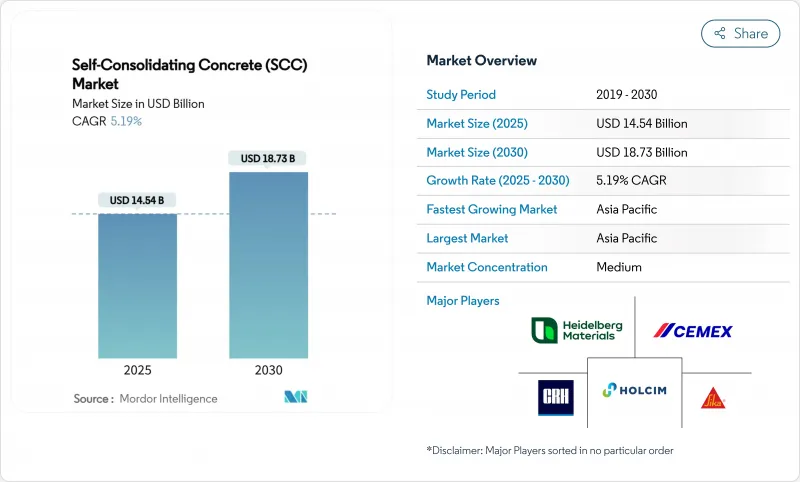
自密实混凝土 (SCC) 市场规模预计在 2025 年为 145.4 亿美元,预计到 2030 年将达到 187.3 亿美元,预测期内(2025-2030 年)的复合年增长率为 5.19%。
强劲的需求源自于承包商需要在浇筑复杂的钢筋笼时避免产生机械振动,这项要求与日益严格的劳动法规和自动化目标相符。尤其是在北美和欧洲,限制混凝土碳排放的监管压力正在加速向添加更多胶凝材料的混合物的转变。现有的外加剂製造商正在利用聚羧酸盐的化学特性来提高较低水胶比下的流动性,而数位监控平台则提供即时强度数据,有助于降低水泥用量。这些因素共同作用,形成了性能提升、劳动强度降低和永续性要求的良性循环,有利于自密实混凝土 (SCC) 市场的发展。
全球自密实混凝土(SCC)市场趋势与洞察
预製和现浇施工节省劳力
长期的劳动力短缺促使建筑公司采用无振动浇注方法,这种方法可将週期缩短高达73%,并减少工人数量。预製工厂透过整合纤维增强自密实混合料,生产率提高了28%,目前在北美和日本均有体现。更快的周转速度使其成本与传统混凝土持平,儘管材料成本高出15-25%。在钢筋密集、无法进行振动或物理上无法进行振动的应用中,其优势更为显着,这使得自密实混凝土 (SCC) 市场成为高层建筑和桥樑建设的核心。
对低碳供应链管理丰富组合的需求
纽约州的「购买清洁能源」法规对公共计划混凝土的碳排放总量设定了上限,这促使生产商增加矿渣和飞灰的用量,这些材料能够与高流动性混合料自然结合。加州的「加州绿建筑」法规和法国的「再生能源2020」框架也对二氧化碳排放量比「I类」混合料减少30-50%的混合料征收溢价。现代聚羧酸塑化剂在降低熟料係数的同时保持了所需的流动性,正在加强自凝混凝土市场,使其成为永续性的槓桿,而不仅仅是劳动力的解决方案。
高混合设计和材料成本溢价
在薪资低廉且计划业主抵制溢价的情况下,与传统混凝土相比15-25%的成本差异仍然是一个不利因素。东南亚和拉丁美洲部分地区对混合骨材和进口外加剂的需求推高了成本,儘管表面上节省了劳动力,但这可能会抑制自凝混凝土市场的成长。承包商需要平衡前期成本和下游效率,这限制了自凝混凝土在小型专案中的应用。
細項分析
2024年,水泥将占自密实混凝土 (SCC) 市场的37.18%,其驱动力来自产量而非成长动能。外加剂的复合年增长率将达到7.18%,这得益于第四代聚羧酸醚的快速普及。这种材料能够在不牺牲流动性的情况下,将水胶比提升至接近0.30。这些化学品与黏度调节剂相结合,可实现更高的SCM替代水平,帮助生产者遵守日益严格的二氧化碳排放法规。骨材的价值排名第二,这得益于对低结垢间隙级配石材的需求不断增长,以减少在最小上举力下发生堵塞的情况。由于生产商更重视性能而非水泥吨位,外加剂正朝着化学优化的方向发展,这也凸显了全球主要企业为何优先考虑在外加剂领域建立研发合作伙伴关係并进行收购。
向供应链管理 (SCM) 整合的转变正在重塑供应商层级结构。在西方市场,燃煤发电量的下降导致飞灰供应不确定,从而引发了人们对煅烧粘土和磨碎玻璃火山灰的兴趣。纤维在预製应用的添加量不断增加,其裂缝控制功能与无振动浇注相辅相成。 SikaGrind-400 展示了针对性助磨剂如何提高早期强度,并在熟料模量降低的情况下拓展可寻址自硬混凝土市场。水泥製造商正努力将自己的外加剂产品线与低碳黏合剂捆绑销售,以保持市场份额,这表明未来的竞争优势将更多地取决于全面的化学解决方案,而非原材料吨位。
区域分析
预计到2024年,亚太地区将占全球总收入的49.55%,复合年增长率为7.45%。在中国的高铁高架桥和印度的智慧城市计画中,采用密实钢筋笼的防振混凝土正逐渐成为常规做法。日本的加班规定限制了现场工时,这增强了预製场和现浇应用中自动化浇筑的商业可行性。两党在基础设施方面的支出为桥面和高速公路的修復带来了机会,这与纽约州的隐含碳排放上限规定相一致。
欧洲是一个成熟又富有创新的产业。法国再生能源2020计画和爱尔兰的水泥熟料减量指令下的二氧化碳排放法规将加速SCM的采用,并刺激外加剂的需求。中东/非洲和南美洲的规模较小,但随着技术服务网路的扩展和大型计划的增加,人们对其的兴趣日益浓厚。
其他福利:
- Excel 格式的市场预测 (ME) 表
- 3个月的分析师支持
目录
第一章 引言
- 研究假设和市场定义
- 调查范围
第二章调查方法
第三章执行摘要
第四章 市场状况
- 市场概况
- 市场驱动因素
- 预製和现场施工中节省劳力的放置
- 对低碳、富含供应链管理的能源组合的需求不断增加
- 自动化/机器人混凝土浇筑线快速增加
- 在复杂、高层和大型基础设施的应用
- 政府绿建筑指令
- 市场限制
- 高混合设计和材料成本溢价
- 新兴地区的现场专业知识有限
- 混合物敏感性导致质量变化
- 价值链分析
- 五力分析
- 供应商的议价能力
- 买方的议价能力
- 新进入者的威胁
- 替代品的威胁
- 竞争程度
第五章市场规模及成长预测
- 按成分
- 水泥
- 总计的
- 外加剂和添加剂
- 其他成分
- 按用途
- 预製混凝土产品
- 建筑材料
- 住宅结构
- 基础建设(桥樑、隧道等)
- 其他用途
- 按地区
- 亚太地区
- 中国
- 日本
- 印度
- 韩国
- 东南亚国协
- 其他亚太地区
- 北美洲
- 美国
- 加拿大
- 墨西哥
- 欧洲
- 德国
- 英国
- 法国
- 义大利
- 西班牙
- 俄罗斯
- 北欧国家
- 其他欧洲国家
- 南美洲
- 巴西
- 阿根廷
- 其他南美
- 中东和非洲
- 沙乌地阿拉伯
- 南非
- 其他中东和非洲地区
- 亚太地区
第六章 竞争态势
- 市场集中度
- 策略倡议
- 市占率(%)/排名分析
- 公司简介
- BASF
- Breedon Group plc
- Cemex SAB de CV
- CRH
- GCP Applied Technologies
- Heidelberg Materials
- Holcim
- Saint-Gobain
- Sika AG
- Tarmac Ltd.
- UltraTech Cement Ltd.
- Unibeton Ready Mix
- Vicat Group
第七章 市场机会与未来展望
The Self-Consolidating Concrete Market size is estimated at USD 14.54 billion in 2025, and is expected to reach USD 18.73 billion by 2030, at a CAGR of 5.19% during the forecast period (2025-2030).
Robust demand arises from contractors' need to pour intricate reinforcement cages without mechanical vibration, a requirement that lines up with tightening labor regulations and automation goals. Regulatory pressure to curb embodied carbon, especially in North America and Europe, accelerates the shift toward supplementary-cementitious-material-rich mixes. Established admixture producers leverage polycarboxylate chemistry to enhance flow at lower water-binder ratios, while digital monitoring platforms provide real-time strength data that helps reduce cement content. Collectively, these factors reinforce a virtuous cycle in which better performance, lower labor intensity and sustainability mandates all favor the self-consolidating concrete market.
Global Self-Consolidating Concrete (SCC) Market Trends and Insights
Labor-saving placement in precast and in-situ works
Chronic craft-worker shortages prompt builders to adopt vibration-free placement methods that cut cycle times by up to 73% and permit leaner crew sizes. Precast plants record 28% productivity gains when integrating fiber-reinforced self-consolidating mixes, a figure now observable across North America and Japan. Faster turnarounds yield cost parity against conventional concrete despite a 15-25% materials premium. The benefit multiplies on congested rebars where vibration is either impractical or physically impossible, placing the self-consolidating concrete market at the center of high-rise and bridge work.
Demand for low-carbon SCM-rich mixes
State-level "Buy Clean" rules in New York enforce embodied-carbon ceilings for concrete supplied to public projects, pushing producers toward high slag and fly-ash dosages that pair naturally with flowable mixes. Similar thresholds under California's CALGreen code and France's RE2020 framework create a price premium for formulations that deliver 30-50% CO2 cuts relative to Type I blends. Modern polycarboxylate superplasticizers sustain required flow at reduced clinker factors, reinforcing the self-consolidating concrete market as a sustainability lever rather than just a labor solution.
High mix-design & material cost premium
A 15-25% cost delta over conventional concrete remains a headwind wherever wages are low and project owners resist premium pricing. The need for well-graded aggregates and imported admixtures can inflate costs in Southeast Asia and parts of Latin America, dampening self-consolidating concrete market growth despite clear labor savings. Contractors must balance up-front expense against downstream efficiencies, limiting uptake in small-scale jobs.
Other drivers and restraints analyzed in the detailed report include:
- Surge in automated robotic casting lines
- Adoption in complex high-rise and mega-infrastructure
- Limited field know-how in emerging regions
For complete list of drivers and restraints, kindly check the Table Of Contents.
Segment Analysis
Cement accounted for 37.18% of the self-consolidating concrete market in 2024, a lead attributable to structural volume rather than growth momentum. Admixtures now post a 7.18% CAGR, underpinned by the rapid uptake of fourth-generation polycarboxylate ethers that enable water-binder ratios near 0.30 without sacrificing flow. Paired with viscosity modifiers, these chemistries unlock higher SCM replacement levels that help producers comply with tightening CO2 caps. Aggregates rank second by value; demand intensifies for gap-graded stone with low flakiness to mitigate blocking under minimal head pressure. The constituent mix tilts toward chemical optimization as producers emphasize performance over cement tonnage, underscoring why global majors prioritize R&D alliances and acquisitions in the admixture space.
The pivot toward SCM integration reshapes supplier hierarchies. Fly-ash availability remains volatile in Western markets due to declining coal power, spurring interest in calcined clay and ground-glass pozzolans. Fiber additions grow in precast applications, offering crack control that complements vibration-free casting. SikaGrind-400 illustrates how targeted grinding aids elevate early strength when clinker factors drop, widening the addressable self-consolidating concrete market. Cement producers counter by bundling low-carbon binders with in-house admixture lines to retain share, signaling that future competitive advantage depends less on raw tonnage and more on integrated chemical solutions.
The Self-Consolidating Concrete Market Report is Segmented by Constituent (Cement, Aggregates, Admixtures & Additives, Other Constituents), Application (Precast Concrete Products, Architectural Elements, Residential Structures, Infrastructure, Other Applications), and Geography (Asia-Pacific, North America, Europe, South America, Middle East and Africa). The Market Forecasts are Provided in Terms of Value (USD).
Geography Analysis
Asia-Pacific controlled 49.55% of global revenue in 2024 and is projected to expand at a 7.45% CAGR, reflecting massive infrastructure outlays coupled with acute labor shortages. China's high-speed-rail viaducts and India's smart-cities program routinely specify vibration-free concrete for dense reinforcement cages. Japan's overtime legislation caps site hours, strengthening the business case for automated placement in both precast yards and cast-in-place work. North America ranks second by value; bipartisan infrastructure spending unlocks bridge-deck and highway rehabilitation opportunities that align with New York's embodied-carbon caps.
Europe remains a mature yet innovative arena. Embodied-carbon ceilings under RE2020 in France and Ireland's clinker-reduction mandate accelerate SCM adoption, thereby boosting admixture demand. Middle East & Africa and South America start from smaller bases but display rising interest as technical service networks expand and megaprojects proliferate.
- BASF
- Breedon Group plc
- Cemex SAB de CV
- CRH
- GCP Applied Technologies
- Heidelberg Materials
- Holcim
- Saint-Gobain
- Sika AG
- Tarmac Ltd.
- UltraTech Cement Ltd.
- Unibeton Ready Mix
- Vicat Group
Additional Benefits:
- The market estimate (ME) sheet in Excel format
- 3 months of analyst support
TABLE OF CONTENTS
1 Introduction
- 1.1 Study Assumptions & Market Definition
- 1.2 Scope of the Study
2 Research Methodology
3 Executive Summary
4 Market Landscape
- 4.1 Market Overview
- 4.2 Market Drivers
- 4.2.1 Labor-saving placement in precast and in-situ works
- 4.2.2 Accelerating demand for low-carbon, SCM-rich mixes
- 4.2.3 Surge in automated/robotic casting lines
- 4.2.4 Adoption in complex, high-rise & mega-infrastructure
- 4.2.5 Government green-building mandates
- 4.3 Market Restraints
- 4.3.1 High mix-design & material cost premium
- 4.3.2 Limited field know-how in emerging regions
- 4.3.3 Admixture-sensitivity causing quality variability
- 4.4 Value Chain Analysis
- 4.5 Porter's Five Forces
- 4.5.1 Bargaining Power of Suppliers
- 4.5.2 Bargaining Power of Buyers
- 4.5.3 Threat of New Entrants
- 4.5.4 Threat of Substitutes
- 4.5.5 Degree of Competition
5 Market Size & Growth Forecasts (Value)
- 5.1 By Constituent
- 5.1.1 Cement
- 5.1.2 Aggregates
- 5.1.3 Admixtures and Additives
- 5.1.4 Other Constituents
- 5.2 By Application
- 5.2.1 Precast Concrete Products
- 5.2.2 Architectural Elements
- 5.2.3 Residential Structures
- 5.2.4 Infrastructure (Bridges, Tunnels, etc.)
- 5.2.5 Other Applications
- 5.3 By Geography
- 5.3.1 Asia-Pacific
- 5.3.1.1 China
- 5.3.1.2 Japan
- 5.3.1.3 India
- 5.3.1.4 South Korea
- 5.3.1.5 ASEAN Countries
- 5.3.1.6 Rest of Asia-Pacific
- 5.3.2 North America
- 5.3.2.1 United States
- 5.3.2.2 Canada
- 5.3.2.3 Mexico
- 5.3.3 Europe
- 5.3.3.1 Germany
- 5.3.3.2 United Kingdom
- 5.3.3.3 France
- 5.3.3.4 Italy
- 5.3.3.5 Spain
- 5.3.3.6 Russia
- 5.3.3.7 NORDIC Countries
- 5.3.3.8 Rest of Europe
- 5.3.4 South America
- 5.3.4.1 Brazil
- 5.3.4.2 Argentina
- 5.3.4.3 Rest of South America
- 5.3.5 Middle East and Africa
- 5.3.5.1 Saudi Arabia
- 5.3.5.2 South Africa
- 5.3.5.3 Rest of Middle East and Africa
- 5.3.1 Asia-Pacific
6 Competitive Landscape
- 6.1 Market Concentration
- 6.2 Strategic Moves
- 6.3 Market Share(%)/Ranking Analysis
- 6.4 Company Profiles (includes Global level Overview, Market level overview, Core Segments, Financials as available, Strategic Information, Market Rank/Share for key companies, Products & Services, and Recent Developments)
- 6.4.1 BASF
- 6.4.2 Breedon Group plc
- 6.4.3 Cemex SAB de CV
- 6.4.4 CRH
- 6.4.5 GCP Applied Technologies
- 6.4.6 Heidelberg Materials
- 6.4.7 Holcim
- 6.4.8 Saint-Gobain
- 6.4.9 Sika AG
- 6.4.10 Tarmac Ltd.
- 6.4.11 UltraTech Cement Ltd.
- 6.4.12 Unibeton Ready Mix
- 6.4.13 Vicat Group
7 Market Opportunities & Future Outlook
- 7.1 White-space & Unmet-Need Assessment
