


 |
市场调查报告书
商品编码
1850166
碳纤维:市场份额分析、行业趋势、统计数据和成长预测(2025-2030 年)Carbon Fiber - Market Share Analysis, Industry Trends & Statistics, Growth Forecasts (2025 - 2030) |
||||||

※ 本网页内容可能与最新版本有所差异。详细情况请与我们联繫。
预计到 2025 年碳纤维市场规模将达到 207.64 千吨,到 2030 年将达到 402.93 千吨,2025 年至 2030 年的复合年增长率为 18.10%。
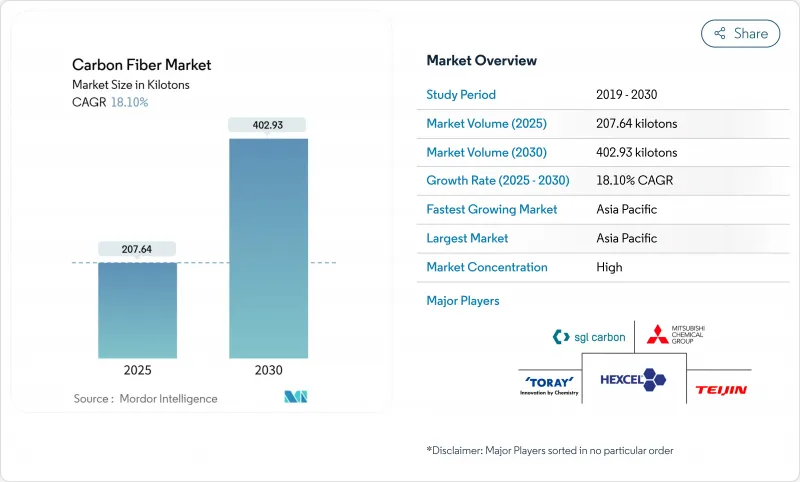
随着多个行业以轻质复合材料取代金属以减少燃料消耗、降低排放并提高设计灵活性,市场需求正在迅速增长。关键的成长催化剂包括快速发展的航太项目、加速推进的风力发电机安装、高压氢气容器的日益普及以及电动汽车轻量化倡议的广泛推进。诸如微波辅助碳化等技术创新(可将生产能耗降低高达70%)正在改善成本动态,并有望扩大碳纤维市场的整体规模。
全球碳纤维市场趋势与洞察
航太与国防领域的最新进展
波音787、空中巴士A350以及新型太空平台都大量依赖碳纤维复合材料,主要供应商正加紧提升产能。随着轻量化零件取代铝製蒙皮,Hexcel公司2024年的商业航太收入成长了17.2%。麻省理工学院的研究人员推出了一种名为「奈米缝合」的技术,作为现有预浸料的补充,将奈米碳管嵌入层压板之间,可将韧性提高62%并减少分层。能够在高达1500°C温度下运作的陶瓷基质复合材料、可减少航空二氧化碳排放的生物基纤维以及快速固化的热固性材料,都在不断突破性能极限,凸显了航太设计的升级如何推动碳纤维市场的发展。
风力发电领域的应用不断扩展
更长的叶片可以容纳更大的涡轮机翼冠。碳纤维翼梁翼冠为百米转子提供了必要的刚度,同时又能减轻重量。 2024年9月,Kineco Excel Composites India与维斯塔斯公司签署了一份供应拉挤钢板的合同,这凸显了叶片製造商为支持海上业务增长而注重区域供应的趋势。欧洲的建筑热潮、中国的竞标以及美国的税额扣抵都有利于碳纤维结构件的发展,从而巩固了碳纤维在碳纤维市场中的地位。
高耗能的氧化和碳化
传统生产线在1000°C以上的高温下运行,停留时间长,耗电量庞大,超过40%的营业成本被锁定。能源价格波动挤压净利率,抑制产能扩张。微波辅助炉和替代前驱体最终或许能够解决瓶颈问题,但大规模维修仍需大量资金投入。
细分市场分析
2024年,聚丙烯腈(PAN)基碳纤维将占据碳纤维市场95%的份额,这得益于完善的供应链和已知的机械性能。预计到2030年,PAN基碳纤维仍将维持18.3%的复合年增长率,即便生产商正在尝试沥青和木质素等其他材料。添加0.075 wt%石墨烯的实验表明,PAN基碳纤维的拉伸强度提高了225%,杨氏模数提高了184%,预计性能还将进一步提升。沥青纤维将占据剩余的市场份额,凭藉其优异的模量,在卫星和高刚度轴领域占有一席之地。
对前驱体研发的持续投入表明,多种原料并存的趋势正在逐步显现。然而,PAN 完善的基础设施、成熟的品管和广泛的认证基础应有助于其在未来十年内保持市场地位。节能氧化製程带来的成本节约将使生产商能够把节省的成本让利给消费者,并抵御其他高性能塑胶的竞争。
到2024年,原生材料将占碳纤维市场份额的63%。在安全关键零件领域,原生材料因其性能稳定性、航太合格和供应充足等优势而备受青睐。然而,先进的溶剂分解技术如今能够在较低的能量负荷下恢復高达90%的纤维强度,推动再生碳纤维的复合年增长率达到19.5%。汽车、家电和体育用品行业正在测试再生纤维,以减少隐性排放和成本,其中东丽公司与联想的合作项目显示,再生纤维占据主导地位。
随着原始设备製造商 (OEM) 将永续性目标纳入采购流程,原生纤维的市占优势将逐渐减弱。扩大基础设施、协调废弃物处理法规以及确保稳定的供应品质仍然是更广泛应用的前提条件。具有奈米孔、金属级导热性和其他功能特性的特殊纤维目前仍处于边缘地位,但一旦产量达到足以支撑专用生产线的规模,它们可能会成为利润丰厚的来源。
区域分析
亚太地区预计到2024年将占全球碳纤维市场份额的44.3%,并预计在2030年之前维持20.6%的年复合成长率,成为成长最快的地区。日本老牌企业东丽和三菱化学凭藉着成熟的聚丙烯腈(PAN)生产线和持续的技术创新,继续保持其全球领先地位。中国製造商正积极扩大规模,并受益于国家能源转型计画。
北美拥有强大的航空枢纽,并正在扩大氢燃料卡车试验。 Hexcel公司在航太领域的积压订单以及美国能源部对清洁材料的最新支持,巩固了该地区的地位。欧洲则受惠于一系列监管政策的出台,这些政策鼓励离岸风力发电、豪华汽车和低碳生产。
南美洲和中东/非洲地区具有更大的成长潜力,儘管交易量可能较为温和,因为巴西正在利用其风能资源和基础设施发展。
其他福利:
- Excel格式的市场预测(ME)表
- 包含 3 个月的分析师支持
目录
第一章 引言
- 研究假设和市场定义
- 调查范围
第二章调查方法
第三章执行摘要
第四章 市场情势
- 市场概览
- 市场驱动因素
- 航太和国防领域的最新进展
- 风力发电领域的应用日益增多
- 商用车辆内的氢气和压缩天然气高压容器
- 电动车平台中的电池组外壳和车身重量减轻
- 亚洲地震区建筑中钢筋使用量的增加
- 市场限制
- 密集型能耗的氧化和碳化过程会增加营运成本(超过成本的40%)。
- 再生碳纤维的供应链安全
- 在运动用品领域与高性能热塑性塑胶竞争
- 价值链分析
- 技术展望
- 波特五力模型
- 供应商的议价能力
- 买方的议价能力
- 新进入者的威胁
- 替代产品和服务的威胁
- 竞争程度
- 定价分析
- 生产分析
第五章 市场规模与成长预测
- 按原料
- 聚丙烯腈(PAN)
- 石油沥青和人造丝
- 依纤维类型
- 原生碳纤维(VCF)
- 再生碳纤维(RCF)
- 其他的
- 透过使用
- 复合材料
- 纺织品
- 微电极
- 催化剂
- 按最终用户行业划分
- 航太与国防
- 替代能源
- 车
- 建筑和基础设施
- 体育用品
- 其他终端用户产业
- 按地区
- 亚太地区
- 中国
- 日本
- 印度
- 韩国
- 亚太其他地区
- 北美洲
- 美国
- 加拿大
- 墨西哥
- 欧洲
- 德国
- 英国
- 法国
- 义大利
- 其他欧洲地区
- 南美洲
- 巴西
- 阿根廷
- 其他南美洲
- 中东和非洲
- 沙乌地阿拉伯
- 阿拉伯聯合大公国
- 南非
- 埃及
- 其他中东和非洲地区
- 亚太地区
第六章 竞争情势
- 市场集中度
- 策略趋势
- 市占率分析
- 公司简介
- A&P Technology, Inc.
- Anshan Senoda Carbon Fiber Co., Ltd.
- DowAksa
- Formosa Plastics Group
- Hexcel Corporation
- HS HYOSUNG ADVANCED MATERIALS
- Jiangsu Hengshen Co.,Ltd
- KUREHA CORPORATION
- Mitsubishi Chemical Group Corporation
- Nippon Graphite Fiber Co., Ltd.
- Rock West Composites, Inc.
- SGL Carbon
- Sigmatex(UK)Limited
- Solvay
- Teijin Limited
- TORAY INDUSTRIES, INC.
- UMATEX
- Zhongfu Shenying Carbon Fiber Co., Ltd.
第七章 市场机会与未来展望
The carbon fiber market stands at 207.64 kilotons in 2025 and is forecast to reach 402.93 kilotons by 2030, expanding at an 18.10% CAGR for 2025-2030.
Demand is scaling rapidly as multiple industries replace metals with lightweight composites to cut fuel use, shrink emissions, and unlock design flexibility. Major growth catalysts include fast-evolving aerospace programs, accelerating wind-turbine installations, rising adoption of high-pressure hydrogen vessels, and the spread of electric-vehicle (EV) lightweighting initiatives. Innovations such as microwave-assisted carbonization that trim manufacturing energy by as much as 70% are beginning to improve cost dynamics and could widen the total addressable carbon fiber market.
Global Carbon Fiber Market Trends and Insights
Recent Advancements in Aerospace and Defense
Boeing 787, Airbus A350, and new space platforms depend heavily on carbon composites, which have pushed major suppliers to ramp up capacity. Hexcel posted 17.2% growth in its commercial-aerospace revenue in 2024 as lightweight parts replaced aluminum skins. Complementing established prepregs, Massachusetts Institute of Technology researchers introduced "nanostitching," embedding carbon nanotubes between laminate layers to boost toughness by 62% and curb delamination, which can lengthen service life while lowering lifecycle cost. Ceramic-matrix composites capable of 1,500 °C, bio-derived fibers that cut aviation CO2, and rapid-cure thermosets are widening performance envelopes, underscoring how aerospace design upgrades raise the carbon fiber market ceiling.
Increasing Applications in Wind Energy
Longer blades enable higher-capacity turbines. Carbon spar caps deliver the stiffness needed for 100-meter rotors while holding weight down. In September 2024, Kineco Exel Composites India landed a contract to supply pultruded planks to Vestas, underscoring how blade makers lean on regional supply to support offshore growth. Europe's build-out, China's auctions, and United States tax credits favor carbon fiber structural parts, reinforcing the material's role in the carbon fiber market.
Energy-Intensive Oxidation and Carbonization
Conventional lines run above 1,000 °C for long dwell times, consuming vast power and locking in more than 40% of operating cost. Energy price swings squeeze margins and deter capacity adds. Microwave-assisted furnaces and alternative precursors could eventually resolve the bottleneck, yet large-scale retrofits remain capital-heavy.
Other drivers and restraints analyzed in the detailed report include:
- Hydrogen and CNG High-Pressure Vessels in Commercial Vehicles
- EV Battery-Pack Enclosures and BIW Lightweighting
- Supply-Chain Security for Recycled Carbon Fiber
For complete list of drivers and restraints, kindly check the Table Of Contents.
Segment Analysis
PAN-based grades held 95% of the carbon fiber market volume in 2024, backed by refined supply chains and known mechanical properties. They are projected to keep an 18.3% CAGR to 2030, even as producers test pitch and lignin options. Adding 0.075 wt% graphene lifted PAN tensile strength 225% and Young's modulus 184% in lab trials, pointing to scope for incremental gains. Pitch fibers claim the remaining share and are securing niches in satellites and high-rigidity shafts thanks to modulus advantages, which could widen automotive reach.
Sustained investment in precursor research and development points to a gradual shift where multiple feedstocks coexist. Yet PAN's entrenched infrastructure, proven quality control, and broad certification base will safeguard its position through the decade. Cost relief from energy-efficient oxidation could allow producers to pass savings and defend their share against alternative high-performance plastics.
Virgin material commanded 63% of the carbon fiber market volume in 2024. Performance consistency, aerospace qualification, and availability favor virgin output in safety-critical parts. However, advanced solvolysis now recovers up to 90% fiber strength at lower energy load, handing recycled grades a 19.5% CAGR, runway. Automotive, consumer electronics, and sporting goods are testing recycled fiber to lower embedded emissions and cut costs, and Toray's Lenovo program illustrates mainstream appeal.
The carbon fiber market share advantage of virgin fibers will erode incrementally as OEMs integrate sustainability targets into sourcing. Scaling infrastructure, harmonizing waste regulations, and ensuring stable supply quality remain prerequisites for broader adoption. Specialized fibers with nano-pores, metal-like thermal conductivities, or other functional properties sit on the sidelines for now, yet can emerge as profit pools once volumes justify dedicated lines.
The Carbon Fiber Market Report Segments the Industry by Raw Material (Polyacrylonitrile (PAN) and Petroleum Pitch and Rayon), Fiber Type (Virgin Fiber (VCF), Recycled Carbon Fiber (RCF), and Others), Application (Composite Materials, Textiles, and More), End-User Industry (Aerospace and Defense, Alternative Energy, Automotive, and More), and Geography (Asia-Pacific, North America, Europe, South America, and Middle-East and Africa).
Geography Analysis
Asia-Pacific controlled 44.3% of the carbon fiber market in 2024 and should keep the fastest trajectory with a 20.6% CAGR to 2030. Japanese incumbents Toray and Mitsubishi Chemical sustain global leadership through captive PAN lines and steady innovation. Chinese producers are scaling aggressively and benefit from national energy transition programs.
North America retains a strong aviation hub and is expanding hydrogen-truck trials. Hexcel's aerospace backlog and emerging Department of Energy support for clean materials consolidate the region's position. Europe benefits from offshore wind, luxury autos, and regulatory pushes that reward low-carbon production; Brussels' debate over composite waste could, however, add compliance hurdles for imported parts.
South America and the Middle East, and Africa account for modest volumes yet offer upside. Brazil leverages wind resources and infrastructure buildouts.
- A&P Technology, Inc.
- Anshan Senoda Carbon Fiber Co., Ltd.
- DowAksa
- Formosa Plastics Group
- Hexcel Corporation
- HS HYOSUNG ADVANCED MATERIALS
- Jiangsu Hengshen Co.,Ltd
- KUREHA CORPORATION
- Mitsubishi Chemical Group Corporation
- Nippon Graphite Fiber Co., Ltd.
- Rock West Composites, Inc.
- SGL Carbon
- Sigmatex (UK) Limited
- Solvay
- Teijin Limited
- TORAY INDUSTRIES, INC.
- UMATEX
- Zhongfu Shenying Carbon Fiber Co., Ltd.
Additional Benefits:
- The market estimate (ME) sheet in Excel format
- 3 months of analyst support
TABLE OF CONTENTS
1 Introduction
- 1.1 Study Assumptions and Market Definition
- 1.2 Scope of the Study
2 Research Methodology
3 Executive Summary
4 Market Landscape
- 4.1 Market Overview
- 4.2 Market Drivers
- 4.2.1 Recent Advancements in Aerospace and Defense Sector
- 4.2.2 Increasing Applications in Wind Energy Sector
- 4.2.3 Hydrogen and CNG High-Pressure Vessels in Commercial Vehicles
- 4.2.4 Battery-Pack Enclosures and BIW Lightweighting in EV Platforms
- 4.2.5 Rising Adoption of Carbon Fiber Rebars in Seismic-Zone Construction (Asia)
- 4.3 Market Restraints
- 4.3.1 Energy-Intensive Oxidation and Carbonization Inflating Opex (more than 40% of Cost)
- 4.3.2 Supply Chain Security for Recycled Carbon Fiber
- 4.3.3 Competition from High-Performance Thermoplastics in Sporting Goods
- 4.4 Value Chain Analysis
- 4.5 Technological Outlook
- 4.6 Porter's Five Forces
- 4.6.1 Bargaining Power of Suppliers
- 4.6.2 Bargaining Power of Buyers
- 4.6.3 Threat of New Entrants
- 4.6.4 Threat of Substitute Products and Services
- 4.6.5 Degree of Competition
- 4.7 Pricing Analysis
- 4.8 Production Analysis
5 Market Size and Growth Forecasts (Value and Volume)
- 5.1 By Raw Material
- 5.1.1 Polyacrylonitrile (PAN)
- 5.1.2 Petroleum Pitch and Rayon
- 5.2 By Fiber Type
- 5.2.1 Virgin Carbon Fiber (VCF)
- 5.2.2 Recycled Carbon Fiber (RCF)
- 5.2.3 Others
- 5.3 By Application
- 5.3.1 Composite Materials
- 5.3.2 Textiles
- 5.3.3 Micro-Electrodes
- 5.3.4 Catalysis
- 5.4 By End-User Industry
- 5.4.1 Aerospace and Defense
- 5.4.2 Alternative Energy
- 5.4.3 Automotive
- 5.4.4 Construction and Infrastructure
- 5.4.5 Sporting Goods
- 5.4.6 Other End-user Industries
- 5.5 By Geography
- 5.5.1 Asia-Pacific
- 5.5.1.1 China
- 5.5.1.2 Japan
- 5.5.1.3 India
- 5.5.1.4 South Korea
- 5.5.1.5 Rest of Asia-Pacific
- 5.5.2 North America
- 5.5.2.1 United States
- 5.5.2.2 Canada
- 5.5.2.3 Mexico
- 5.5.3 Europe
- 5.5.3.1 Germany
- 5.5.3.2 United Kingdom
- 5.5.3.3 France
- 5.5.3.4 Italy
- 5.5.3.5 Rest of Europe
- 5.5.4 South America
- 5.5.4.1 Brazil
- 5.5.4.2 Argentina
- 5.5.4.3 Rest of South America
- 5.5.5 Middle-East and Africa
- 5.5.5.1 Saudi Arabia
- 5.5.5.2 United Arab Emirates
- 5.5.5.3 South Africa
- 5.5.5.4 Egypt
- 5.5.5.5 Rest of Middle-East and Africa
- 5.5.1 Asia-Pacific
6 Competitive Landscape
- 6.1 Market Concentration
- 6.2 Strategic Moves
- 6.3 Market Share Analysis
- 6.4 Company Profiles (includes Global level Overview, Market level overview, Core Segments, Financials as available, Strategic Information, Market Rank/Share, Products and Services, Recent Developments)
- 6.4.1 A&P Technology, Inc.
- 6.4.2 Anshan Senoda Carbon Fiber Co., Ltd.
- 6.4.3 DowAksa
- 6.4.4 Formosa Plastics Group
- 6.4.5 Hexcel Corporation
- 6.4.6 HS HYOSUNG ADVANCED MATERIALS
- 6.4.7 Jiangsu Hengshen Co.,Ltd
- 6.4.8 KUREHA CORPORATION
- 6.4.9 Mitsubishi Chemical Group Corporation
- 6.4.10 Nippon Graphite Fiber Co., Ltd.
- 6.4.11 Rock West Composites, Inc.
- 6.4.12 SGL Carbon
- 6.4.13 Sigmatex (UK) Limited
- 6.4.14 Solvay
- 6.4.15 Teijin Limited
- 6.4.16 TORAY INDUSTRIES, INC.
- 6.4.17 UMATEX
- 6.4.18 Zhongfu Shenying Carbon Fiber Co., Ltd.
7 Market Opportunities and Future Outlook
- 7.1 White-Space and Unmet-Need Assessment
- 7.2 Emphasis on Usage of Lignin as Raw Material for Carbon Fiber

 碳纤维织物市场:依纤维类型、编织方式、织物形式和最终用途产业划分-2026-2032年全球预测高纯度碳纤维市场:按类型、形态、等级、应用和最终用途产业划分-2026年至2032年全球预测碳纤维梁市场按纤维类型、製造形式、製造流程和应用划分-全球预测,2026-2032年
 全球碳纤维市场(2026-2036)彩色碳纤维布市场按形态、树脂类型、纤维类型、等级、应用和製造流程划分,全球预测(2026-2032年)碳纤维可膨胀管市场按阶段、最终用户、材料类型、销售管道和应用划分-全球预测,2026-2032年碳纤维方管市场:依製造流程、材料等级、树脂类型和应用划分-全球预测,2026-2032年
 碳纤维 (CF) 和碳纤维增强塑胶 (CFRP) 市场分析及预测(至 2035 年):类型、产品、应用、技术、材料类型、组件、製程、最终用户、功能、安装类型碳纤维全球市场规模、份额、趋势和成长分析报告(2026-2034)
 2026年全球碳纤维市场报告