


 |
市场调查报告书
商品编码
1850980
持续测试:市场份额分析、行业趋势、统计数据和成长预测(2025-2030 年)Continuous Testing - Market Share Analysis, Industry Trends & Statistics, Growth Forecasts (2025 - 2030) |
||||||

※ 本网页内容可能与最新版本有所差异。详细情况请与我们联繫。
预计到 2025 年,连续测试市场规模将达到 24.4 亿美元,到 2030 年将达到 30 亿美元,年复合成长率为 4.2%。
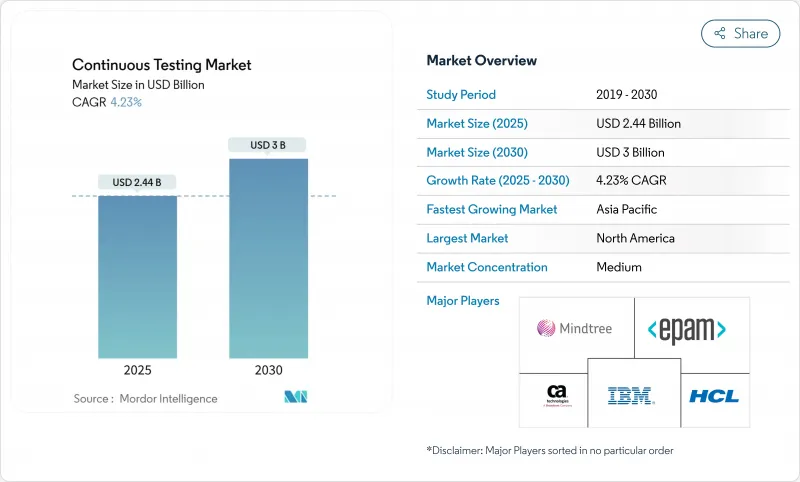
这是由于持续测试市场正从传统的品质保证工作流程转向以人工智慧支援、以合规性为中心的生态系统。超过68%的公司已将生成式人工智慧融入其品质工程流程。这一成长势头得益于DevOps以20.1%的复合年增长率持续增长,儘管只有大约一半的DevOps采用者完全整合了测试自动化。随着技能短缺推动测试环境编配的外部化,託管服务伙伴关係关係蓬勃发展,同时,为了响应欧洲新《网路弹性法案》的里程碑,功能测试和安全测试的组合也在重新平衡。虽然北美在地理上占据领先地位,但随着製造业、银行业和零售业的快速数位化,亚太地区正以5.0%的复合年增长率缩小差距。
全球连续测试市场趋势与洞察
采用敏捷和DevOps方法
儘管DevOps实践如今已成为主流,但测试方面的差距仍然巨大,因为持续测试所需的技能仍然短缺。在受监管的银行环境中,结合DevOps和持续测试的公司报告称,生产力提高了20%,因为人工智慧产生的测试案例缩短了发布週期,同时保留了审核追踪。随着向品质工程模式的转变,传统QA职能的角色正在缩小,测试覆盖率的责任转移到了整个开发团队。分析师预测,到2027年,90%的测试工作流程将自动化,这将增加对人工智慧保障工程师和模型训练人员的需求。像Nationwide Building Society这样的机构指出,在敏捷迭代早期阶段引入测试的好处在于,可以加快变更交付速度并提高客户满意度。
新冠疫情后加速数位转型势在必行
快速向数位化管道转型迫使企业以前所未有的速度发布软体,这往往突破了品质保障的底线。由于程式码未经完整的回归测试週期就被推送,拉丁美洲企业正面临缺陷发布数量增加的问题。一家全球连锁企业在维持「五个九」运转率的同时,每天处理 1 万个订单,但转换率却提高了 4.5 个百分点。製造业领导者表示,智慧工厂的竞争优势取决于软体质量,但当人工智慧试点计画无法扩展时,其雄心壮志往往停滞不前,这凸显了平台级测试框架的必要性,该框架能够弥合概念验证和企业部署之间的差距。
缺乏端到端测试环境编配技能
美国劳动市场数据显示,到2032年,品质保证(QA)职缺将成长17%,如果这些职缺持续空缺,每年可能造成1,620亿美元的产出损失。目前,能够整合持续整合/持续交付(CI/CD)管线、云端基础设施和人工智慧主导的测试自动化的专家严重短缺。为了填补人手不足,企业正在采购託管服务和无程式码测试平台,从而降低了技术水平较低的人员的准入门槛。虽然自动化消除了重复性工作,但对能够建立人工智慧模型、进行偏见审核以及保护管线免受资料外洩的架构师的需求却在不断增长。
细分市场分析
到2024年,託管服务将占持续测试市场的67.8%,到2030年将以5.8%的复合年增长率成长。企业对外部合作伙伴的依赖日益增强,主要原因是其内部运作复杂、人工智慧驱动的测试环境的能力有限,而这些环境必须满足日益严格的监管标准。服务供应商正在重新定位自身,聘用人工智慧保障工程师和模型治理人员,而不是传统的手动负责人。咨询和专业服务业务是外包业务的补充,并引导客户完成向品质工程和云端运维方向的文化转变。
如今,託管服务模式已不再局限于基础测试执行,而是涵盖了全面的品质智慧分析,服务提供者致力于确保快速发布、风险分析和高效的测试调度。在澳洲和纽西兰,一些公司将云端迁移和资料现代化工作流程打包在一起,并重新聘请专家来处理混合工作负载。这种服务范围的扩大使现有企业能够在成长加速的同时保持市场份额,从而使託管服务成为持续测试市场的重要组成部分。
到2024年,Web应用程式仍将以58.2%的市占率成为最大的介面类别,但行动测试预计在2030年前实现5.5%的最高复合年增长率。预计到2027年,智慧型手机主导的商务将占据全球零售额的大部分,这对分散式设备环境提出了更高的效能和可用性要求。为了在数千种行动装置组合上保持品牌的一致性,企业正在采用云端託管设备集群、网路状况模拟和基于人工智慧的视觉检验。
浏览器标准正朝着融合区块链和边缘服务的分散式 Web 4.0 架构演进,这需要新的状态持久化和 API 层容错方法。桌面测试对于传统业务流程平台仍然至关重要,但相关资金投入仍然不足。总体而言,介面的多样化强化了对统一编配的需求,该编排能够透过单一介面管理跨通道的测试资料、交付物和分析结果。
持续测试市场报告按服务类型(託管服务和专业服务)、介面(Web、桌面、行动)、部署类型(本地和云端)、测试类型(功能测试、效能和负载测试、其他)、组织规模(大型企业和中小企业)、垂直行业(银行、金融服务和保险、IT 和电信、其他)以及地区进行细分。
区域分析
北美地区预计占2024年营收的26.5%,这得益于DevOps的早期应用、强大的云端基础设施以及对高品质工程平台的大力创业投资资金。生成式人工智慧的应用十分广泛,96%的公司正在测试产生和优化工作流程中试点或扩展人工智慧的应用。儘管该地区在技术上处于领先地位,但仍面临严重的人才短缺问题,导致对託管服务协议和自动化工具链的依赖性增强。美国银行报告称,透过引入能够推荐基于风险的回归测试包的人工智慧代理,其生产力实现了两位数的成长。
亚太地区是成长最快的区域,预计到2030年将以5.0%的复合年增长率成长。中国、印度和东南亚国家正在为其智慧製造和金融科技生态系统注入资金,为持续品质自动化创造了新的待开发区机会。随着企业寻求SAP S/4HANA升级、API现代化和部门特定合规性报告的专业知识,澳洲和纽西兰的外包测试业务正在復苏。预计到2033年,该地区将需要新增380万製造业员工,将推动可扩展、低成本测试框架的需求。
欧洲依然是产业巨头,这得益于其法规环境,该环境有效地强制推行持续测试。 《网路韧性法案》(Cyber Resilience Act,简称CRA)将于2024年通过,《数位营运韧性法案》(Digital Operational Resilience Act,简称DORA)将于2025年生效,这两项法案分别要求製造商和金融机构证明其持续的安全检验。德国、法国和英国在企业人工智慧驱动的合规自动化方面的支出处于领先地位,这些自动化系统既能满足CRA和DORA的指标要求,又能最大限度地减少人工干预。诸如欧盟产品责任指令修正案等配套立法,加强了对软体缺陷的问责,并促进了持续测试的市场渗透,将品质视为董事会层面的责任,而非工程上的事后考虑。
其他福利:
- Excel格式的市场预测(ME)表
- 3个月的分析师支持
目录
第一章 引言
- 研究假设和市场定义
- 调查范围
第二章调查方法
第三章执行摘要
第四章 市场情势
- 市场概览
- 市场驱动因素
- 采用敏捷和DevOps方法
- 新冠疫情后加速数位转型势在必行
- 人工智慧驱动的测试平台日益普及
- 向云端原生架构与微服务转型
- 合规压力促使产品更快、更安全地上市
- 与永续性相关的IT采购优先考虑高效测试
- 市场限制
- 缺乏端到端测试环境编配技能
- 传统单体架构会降低测试自动化速度。
- 工具链碎片化和供应商锁定问题
- 测试资料隐私法规限制了接近生产环境的资料。
- 价值链分析
- 监管环境
- 技术展望
- 波特五力分析
- 供应商的议价能力
- 买方的议价能力
- 新进入者的威胁
- 替代品的威胁
- 竞争对手之间的竞争
- 评估宏观经济趋势对市场的影响
第五章 市场规模与成长预测
- 按服务类型
- 託管服务
- 专业服务
- 透过介面
- Web
- 桌面
- 移动的
- 透过部署模式
- 本地部署
- 云
- 按测试类型
- 功能测试
- 效能和负载测试
- 安全测试
- API 测试
- UI/UX 测试
- 按组织规模
- 大公司
- 小型企业
- 按行业
- BFSI
- 资讯科技和通讯
- 零售与电子商务
- 医疗保健和生命科学
- 製造业
- 媒体与娱乐
- 其他的
- 按地区
- 北美洲
- 美国
- 加拿大
- 墨西哥
- 南美洲
- 巴西
- 阿根廷
- 其他南美洲
- 欧洲
- 德国
- 英国
- 法国
- 义大利
- 西班牙
- 俄罗斯
- 其他欧洲地区
- 亚太地区
- 中国
- 印度
- 日本
- 韩国
- 澳洲
- 亚太其他地区
- 中东和非洲
- 中东
- 沙乌地阿拉伯
- 阿拉伯聯合大公国
- 土耳其
- 其他中东地区
- 非洲
- 南非
- 奈及利亚
- 其他非洲地区
- 北美洲
第六章 竞争情势
- 市场集中度
- 策略倡议与发展
- 市占率分析
- 公司简介
- IBM Corporation
- Broadcom Inc.(CA Technologies)
- Tricentis GmbH
- Micro Focus International plc
- Sauce Labs Inc.
- Mindtree Ltd(LTIMindtree)
- EPAM Systems Inc.
- HCL Technologies Ltd
- Cigniti Technologies Ltd
- Cognizant Technology Solutions Corp.
- Tech Mahindra Ltd
- Hexaware Technologies Ltd
- Larsen and Toubro Infotech Ltd
- Accenture plc
- Infosys Ltd
- Capgemini SE
- Atos SE
- Keysight Technologies Inc.
- SmartBear Software
- Perfecto(Perforce Software)
- Applitools Ltd
- Parasoft Corporation
- Katalon Inc.
- mabl Inc.
第七章 市场机会与未来展望
The continuous testing market size is valued at USD 2.44 billion in 2025 and is forecast to reach USD 3 billion by 2030, expanding at a 4.2% CAGR.
Behind the measured headline rate, the continuous testing market is shifting from traditional quality-assurance workflows to AI-supported, compliance-centric ecosystems. More than 68% of enterprises have already embedded generative AI into quality-engineering processes. Momentum is reinforced by a wider DevOps backdrop growing at a 20.1% CAGR, although only about half of DevOps adopters have achieved full test-automation integration, signalling untapped headroom inside existing pipelines. Managed service partnerships are thriving as skill shortages drive externalisation of test-environment orchestration, while the functional-to-security testing mix is recalibrating in response to new European Cyber Resilience Act milestones. Geographic leadership remains with North America, yet Asia-Pacific's 5.0% CAGR trajectory suggests a narrowing gap as manufacturers, banks, and retailers digitise at speed.
Global Continuous Testing Market Trends and Insights
Adoption of Agile and DevOps methodologies
DevOps practices are now mainstream, yet sizeable testing gaps persist because continuous testing requires skills that remain scarce. Enterprises that combine DevOps with continuous testing report productivity gains of 20% in regulated banking environments where AI-generated test cases compress release cycles while maintaining audit trails. The role of the traditional QA function is shrinking as companies transition toward quality-engineering models in which responsibility for test coverage shifts to the entire development squad. Analysts expect 90% of all testing workflows to become automated by 2027, elevating demand for AI-assurance engineers and model trainers. Organisations such as Nationwide Building Society illustrate the payoff, citing faster change delivery and higher customer-satisfaction scores after embedding testing earlier in agile increments.
Need for accelerated digital transformation post-COVID
A rapid pivot to digital channels has forced enterprises to release software at unprecedented speed, often stretching quality guardrails. Latin American firms have experienced heightened defect leakage when code is pushed without complete regression cycles. Retailers are scaling AI-guided user-acceptance testing to safeguard 24/7 e-commerce uptime, with one global chain improving conversion by 4.5 percentage points while supporting 10,000 daily orders at "five-nine" availability. Manufacturing leaders say smart-factory competitiveness hinges on software quality, yet ambitions frequently stall when AI pilots cannot be scaled, underscoring the need for platform-level testing frameworks capable of bridging proof-of-concept and enterprise rollout.
Scarcity of end-to-end test-environment orchestration skills
U.S. labour-market data show QA vacancies on course to grow 17% through 2032, potentially placing USD 162 billion of annual output at risk if roles remain unfilled. The gap is acute for specialists who can weave CI/CD pipelines, cloud infrastructure and AI-driven test automation into a cohesive fabric. To offset shortages, enterprises are procuring managed services and codeless test platforms that lower entry barriers for less technical staff. Automation eliminates repetitive tasks but raises demand for architects able to curate AI models, audit bias and safeguard pipelines against data exposure.
Other drivers and restraints analyzed in the detailed report include:
- Rising adoption of AI-augmented testing platforms
- Shift to cloud-native architectures and micro-services
- Legacy monolithic architectures slowing test automation
For complete list of drivers and restraints, kindly check the Table Of Contents.
Segment Analysis
Managed services captured 67.8% of the continuous testing market in 2024 and are forecast to grow at a 5.8% CAGR through 2030. Heightened reliance on external partners stems from limited in-house capacity to run complex, AI-enabled test estates that must meet tightening regulatory standards. Providers are repositioning, hiring AI-assurance engineers and model governors rather than traditional manual testers. Advisory and professional-services lines complement outsourcing deals, guiding clients through cultural shifts toward quality engineering and CloudOps alignment.
The managed-services model now extends beyond basic test execution to holistic quality intelligence, with providers guaranteeing release velocity, risk analytics, and energy-efficient test scheduling. Renewed demand is visible in Australia and New Zealand, where enterprises bundling cloud migration and data-modernisation workstreams are re-engaging specialists to maintain coverage across hybrid workloads. Such breadth enables incumbents to defend their share even as growth accelerates, making managed services the structural anchor of the continuous testing market.
Web applications remained the largest interface class with a 58.2% share in 2024, but mobile testing is on track for the highest 5.5% CAGR to 2030. Smartphone-led commerce, forecast to comprise a dominant slice of global retail sales by 2027, places rigorous performance and usability demands on distributed device landscapes. Enterprises are adopting cloud-hosted device farms, network-condition emulation, and AI-based visual validation to uphold brand consistency across thousands of handset permutations.
Web testing is hardly static; browser standards are evolving toward decentralized Web 4.0 constructs that blend blockchain and edge services, which in turn mandate new approaches to state persistence and API-layer fault tolerance. Desktop testing remains relevant for legacy business-process platforms, yet receives lower capital allocation. Overall, interface diversification is reinforcing the need for unified orchestration that can manage cross-channel test data, artefacts, and analytics inside a single pane of glass.
The Continuous Testing Market Report is Segmented by Service Type (Managed Services and Professional Services), Interface (Web, Desktop, and Mobile), Deployment Type (On-Premise and Cloud), Testing Type (Functional Testing, Performance and Load Testing, and More), Organization Size (Large Enterprises and Small and Medium Enterprises), Industry Vertical (BFSI, IT and Telecom, and More) and Geography.
Geography Analysis
North America accounted for 26.5% revenue in 2024, benefiting from early DevOps uptake, robust cloud infrastructure, and strong venture funding into quality-engineering platforms. Generative AI adoption is widespread, with 96% of enterprises piloting or scaling AI in test generation and optimisation workflows. Despite technology leadership, the region contends with acute talent shortages, prompting higher reliance on managed-service engagements and automated toolchains. U.S. banks report double-digit productivity gains after embedding AI agents that recommend risk-based regression packs, balancing rapid feature delivery against strict regulatory demands.
Asia-Pacific is the fastest-expanding theatre, registering a projected 5.0% CAGR to 2030. China, India, and Southeast Asian nations are channelling capital into smart manufacturing and fintech ecosystems, creating greenfield opportunities for continuous quality automation. Australia and New Zealand showcase a resurgence in outsourced testing as enterprises hunt for expertise that spans SAP S/4HANA upgrades, API modernisation, and sector-specific compliance reporting. An expected 3.8 million additional manufacturing employees will be required across the region by 2033, magnifying demand for scalable, low-overhead testing frameworks.
Europe remains a heavyweight, shaped by a regulatory environment that effectively mandates continuous testing. The Cyber Resilience Act, adopted in 2024, and the Digital Operational Resilience Act, effective in 2025, oblige manufacturers and financial institutions, respectively, to demonstrate ongoing security validation. Germany, France, and the United Kingdom spearhead enterprise spending on AI-enabled compliance automation that can satisfy both CRA and DORA metrics while minimizing manual effort. Complementary legislation such as the revised EU Product Liability Directive heightens liability for software defects, encouraging continuous testing and market penetration that treats quality as a board-level responsibility rather than an engineering afterthought.
- IBM Corporation
- Broadcom Inc. (CA Technologies)
- Tricentis GmbH
- Micro Focus International plc
- Sauce Labs Inc.
- Mindtree Ltd (LTIMindtree)
- EPAM Systems Inc.
- HCL Technologies Ltd
- Cigniti Technologies Ltd
- Cognizant Technology Solutions Corp.
- Tech Mahindra Ltd
- Hexaware Technologies Ltd
- Larsen and Toubro Infotech Ltd
- Accenture plc
- Infosys Ltd
- Capgemini SE
- Atos SE
- Keysight Technologies Inc.
- SmartBear Software
- Perfecto (Perforce Software)
- Applitools Ltd
- Parasoft Corporation
- Katalon Inc.
- mabl Inc.
Additional Benefits:
- The market estimate (ME) sheet in Excel format
- 3 months of analyst support
TABLE OF CONTENTS
1 INTRODUCTION
- 1.1 Study Assumptions and Market Definition
- 1.2 Scope of the Study
2 RESEARCH METHODOLOGY
3 EXECUTIVE SUMMARY
4 MARKET LANDSCAPE
- 4.1 Market Overview
- 4.2 Market Drivers
- 4.2.1 Adoption of Agile and DevOps methodologies
- 4.2.2 Need for accelerated digital transformation post-COVID
- 4.2.3 Rising adoption of AI-augmented testing platforms
- 4.2.4 Shift to cloud-native architectures and micro-services
- 4.2.5 Compliance pressure for faster yet secure releases
- 4.2.6 Sustainability-linked IT procurement favouring efficient testing
- 4.3 Market Restraints
- 4.3.1 Scarcity of end-to-end test-environment orchestration skills
- 4.3.2 Legacy monolithic architectures slowing test automation
- 4.3.3 Tool-chain fragmentation and vendor lock-in concerns
- 4.3.4 Test-data-privacy regulation limiting production-like data
- 4.4 Value Chain Analysis
- 4.5 Regulatory Landscape
- 4.6 Technological Outlook
- 4.7 Porter's Five Forces Analysis
- 4.7.1 Bargaining Power of Suppliers
- 4.7.2 Bargaining Power of Buyers
- 4.7.3 Threat of New Entrants
- 4.7.4 Threat of Substitutes
- 4.7.5 Intensity of Competitive Rivalry
- 4.8 Assessment of the Impact of Macroeconomic Trends on the Market
5 MARKET SIZE AND GROWTH FORECASTS (VALUE)
- 5.1 By Service Type
- 5.1.1 Managed Services
- 5.1.2 Professional Services
- 5.2 By Interface
- 5.2.1 Web
- 5.2.2 Desktop
- 5.2.3 Mobile
- 5.3 By Deployment Mode
- 5.3.1 On-premise
- 5.3.2 Cloud
- 5.4 By Testing Type
- 5.4.1 Functional Testing
- 5.4.2 Performance and Load Testing
- 5.4.3 Security Testing
- 5.4.4 API Testing
- 5.4.5 UI/UX Testing
- 5.5 By Organization Size
- 5.5.1 Large Enterprises
- 5.5.2 Small and Medium Enterprises
- 5.6 By Industry Vertical
- 5.6.1 BFSI
- 5.6.2 IT and Telecom
- 5.6.3 Retail and eCommerce
- 5.6.4 Healthcare and Life Sciences
- 5.6.5 Manufacturing
- 5.6.6 Media and Entertainment
- 5.6.7 Others
- 5.7 By Geography
- 5.7.1 North America
- 5.7.1.1 United States
- 5.7.1.2 Canada
- 5.7.1.3 Mexico
- 5.7.2 South America
- 5.7.2.1 Brazil
- 5.7.2.2 Argentina
- 5.7.2.3 Rest of South America
- 5.7.3 Europe
- 5.7.3.1 Germany
- 5.7.3.2 United Kingdom
- 5.7.3.3 France
- 5.7.3.4 Italy
- 5.7.3.5 Spain
- 5.7.3.6 Russia
- 5.7.3.7 Rest of Europe
- 5.7.4 Asia-Pacific
- 5.7.4.1 China
- 5.7.4.2 India
- 5.7.4.3 Japan
- 5.7.4.4 South Korea
- 5.7.4.5 Australia
- 5.7.4.6 Rest of Asia-Pacific
- 5.7.5 Middle East and Africa
- 5.7.5.1 Middle East
- 5.7.5.1.1 Saudi Arabia
- 5.7.5.1.2 United Arab Emirates
- 5.7.5.1.3 Turkey
- 5.7.5.1.4 Rest of Middle East
- 5.7.5.2 Africa
- 5.7.5.2.1 South Africa
- 5.7.5.2.2 Nigeria
- 5.7.5.2.3 Rest of Africa
- 5.7.1 North America
6 COMPETITIVE LANDSCAPE
- 6.1 Market Concentration
- 6.2 Strategic Moves and Developments
- 6.3 Market Share Analysis
- 6.4 Company Profiles (includes Global level Overview, Market level overview, Core Segments, Financials as available, Strategic Information, Market Rank/Share for key companies, Products and Services, and Recent Developments)
- 6.4.1 IBM Corporation
- 6.4.2 Broadcom Inc. (CA Technologies)
- 6.4.3 Tricentis GmbH
- 6.4.4 Micro Focus International plc
- 6.4.5 Sauce Labs Inc.
- 6.4.6 Mindtree Ltd (LTIMindtree)
- 6.4.7 EPAM Systems Inc.
- 6.4.8 HCL Technologies Ltd
- 6.4.9 Cigniti Technologies Ltd
- 6.4.10 Cognizant Technology Solutions Corp.
- 6.4.11 Tech Mahindra Ltd
- 6.4.12 Hexaware Technologies Ltd
- 6.4.13 Larsen and Toubro Infotech Ltd
- 6.4.14 Accenture plc
- 6.4.15 Infosys Ltd
- 6.4.16 Capgemini SE
- 6.4.17 Atos SE
- 6.4.18 Keysight Technologies Inc.
- 6.4.19 SmartBear Software
- 6.4.20 Perfecto (Perforce Software)
- 6.4.21 Applitools Ltd
- 6.4.22 Parasoft Corporation
- 6.4.23 Katalon Inc.
- 6.4.24 mabl Inc.
7 MARKET OPPORTUNITIES AND FUTURE OUTLOOK
- 7.1 White-space and Unmet-Need Assessment

 持续测试市场:按测试类型、自动化等级、部署模型、组织规模、应用类型和产业划分 - 全球预测(2026-2032 年)
 2026年全球连续测试市场报告持续穿透测试市场按部署方式、类型、服务模式、订阅模式、组织规模和产业划分,全球预测(2026-2032 年)
 持续测试市场规模、份额和成长分析(按组件、部署类型、组织规模、应用、最终用户产业和地区划分)-2026-2033年产业预测
 全球持续测试市场规模研究与预测,按测试类型、部署、工具类型、垂直产业(银行、金融服务和保险)和区域预测 2025-2035
 2024 年至 2031 年按服务、部署类型、组织规模、介面、垂直和地区划分的持续测试市场