


 |
市场调查报告书
商品编码
1851766
六氟化硫:市场占有率分析、产业趋势、统计数据、成长预测(2025-2030 年)Sulfur Hexafluoride - Market Share Analysis, Industry Trends & Statistics, Growth Forecasts (2025 - 2030) |
||||||

※ 本网页内容可能与最新版本有所差异。详细情况请与我们联繫。
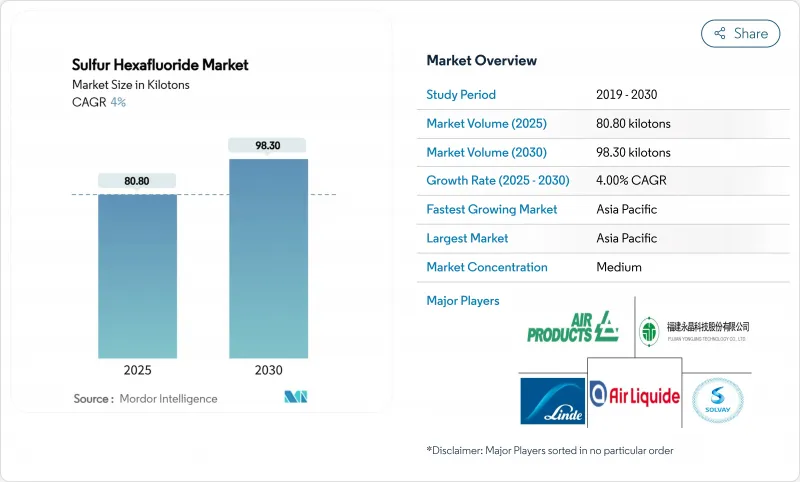
预计到 2025 年,六氟化硫市场规模将达到 80.80 千吨,到 2030 年将达到 98.30 千吨,预测期(2025-2030 年)复合年增长率为 4%。
新兴国家积极的电网发展计画、半导体製造能力的快速扩张以及离岸风电输电计划,在日益严格的环境法规下,支撑着市场需求。由于SF6具有无与伦比的介电强度、紧凑的尺寸和快速通电等优点,电力公司继续指定将其用于气体绝缘开关设备,而现有替代品则缺乏类似的优势。半导体製造商需要超高纯度的SF6来进行快速、洁净的等离子蚀刻,随着特征尺寸的缩小,这项需求只会更加迫切。同时,医疗和镁压铸应用正在推动市场进一步成长,创造了多元化的终端市场,有助于缓解监管衝击。
全球六氟化硫市场趋势及洞察
新兴国家的併网需求
随着输电业者安装紧凑型气体绝缘变电站以适应创纪录的电网扩张,中国的六氟化硫(SF6)排放将从2011年的2.6吉克(Gg)增加到2021年的5.1吉克(Gg)。印度已累计200亿卢比用于电网现代化改造,并指定使用SF6开关设备,以确保在快速都市化中保持电压稳定。典型的变电站使用寿命为25至50年,因此每一次安装决策都锁定了未来对六氟化硫的市场需求。气体绝缘变电站的通电速度比空气绝缘变电站快45%,为急于缓解电网拥塞的电力公司节省了时间。因此,儘管环境政策的争论日益激烈,但亚太地区的六氟化硫市场仍在持续成长。
半导体和液晶显示器等离子体蚀刻技术的发展
韩国价值4,710亿美元的半导体产业丛集计画到2047年新增16家工厂,显示资本流动将推动超高纯度六氟化硫(SF6)的消耗。在深沟槽硅蚀刻中,SF6产生的氟自由基去除材料的速度比其他气体快100倍,从而确保3奈米及以下节点的产能目标。虽然减排系统可以减少直接排放,但仍有部分原料进入大气,因此随着产能的扩张,监管力道必须加强。儘管如此,在可直接替代的气体能够达到其蚀刻精度之前,製程工程师仍将继续指定使用SF6,这使得六氟化硫市场牢牢地嵌入到先进製造价值链中。
严格的全球暖化法规
欧盟将从2026年起禁止在中压开关设备中使用六氟化硫(SF6),并从2032年起禁止在高压开关设备中使用SF6,这将迫使电力公司加快维修计画。加州强制要求在2033年前全面淘汰SF6,并将年洩漏率限制在1%。纽约州和麻州的类似政策将缩短依赖SF6设备的投资寿命,并减少已开发地区的采购量。这些重迭的政策将使六氟化硫市场的成长前景下降1.8个百分点。
细分市场分析
预计到2024年,电子/技术级六氟化硫市场份额将达到61.18%,因为电力公司优先考虑开关设备、断路器和气体绝缘线路中经过验证的绝缘性能。技术级六氟化硫的价格波动与商品价格密切相关,并受益于成熟的全球通路,这些管道能够透过油罐车向变电站批量运输。随着维修计划在预测期内持续进行,此细分市场将维持较大的基本负载需求,以支撑整个六氟化硫市场。
超高纯度六氟化硫(SF6)虽然绝对吨位较小,但预计将以4.90%的复合年增长率成为所有产品类型中增长最快的,这主要得益于先进半导体和液晶显示器(LCD)製造行业的推动。将污染物阈值控制在十亿分之一以下需要多道纯化工序、专用钢瓶和专属供应链。精通这些生产通讯协定的供应商能够获得更高的利润,抵消产量下降的影响,并在环保政策降低传统公用事业需求的情况下提供策略性对冲。将这两种等级的产品结合起来,有助于六氟化硫市场维持大宗商品和特殊产品之间的平衡组合。
六氟化硫市场报告按产品类型(电子及技术级、超高纯度级)、应用领域(电力能源、电子、金属製造、医疗及其他应用)和地区(亚太、北美、欧洲、南美、中东和非洲)进行细分。市场预测以吨为单位。
区域分析
预计到2024年,亚太地区将占六氟化硫(SF6)市场47.65%的份额,到2030年将以4.75%的复合年增长率成长。中国电网营运商正在超高压走廊安装紧凑型550kV气体绝缘变电站,以适应创纪录的可再生能源装置容量,这一战略巩固了数十年来对SF6的需求。印度的跨邦输电强化计画采用SF6环路开关来提高快速都市化负载中心的可靠性。在韩国,半导体产业的扩张正在推动区域超高纯度SF6的需求,而日本则将自身定位为无SF6解决方案的技术示范者,从而形成了成熟技术和新兴技术并存的双轨格局。
在北美,公用事业公司在更换老旧设备与遵守监管规定之间寻求平衡,因此其消费量成长为个位数中段。在加州,2033 年的逐步淘汰计画和洩漏量上限迫使电力公司提前部署监测和捕集系统,而其他州的电网营运商仍在高压等级中使用六氟化硫(SF6),因为现场可用的替代技术十分稀缺。联邦基础设施资金的投入提高了电网的韧性,并稳定了整体需求,而不断提高的回收率也限制了对新供应的需求。加拿大与加州的总量管制与交易计画开展合作,促进了跨境政策协调,使加拿大公用事业公司能够在保留大量旧设备备用库存的同时,探索无六氟化硫试点计画。
欧洲面临最严峻的政策环境。氟化气体法规的修订将禁止从2026年起安装新的中压SF6开关设备设备,并自2032年起禁止安装新的高压开关设备。输电系统营运商,主要集中在德国和斯堪的纳维亚半岛,正在试验真空断路器和清洁空气技术,但在棕地扩建项目中仍依赖SF6。英国的维修计画预计将增加1亿至2.8亿英镑的合规成本,以应对欧盟的限制。南欧和东欧的公用事业公司由于设备更换週期较慢,面临成本压力,这可能导致SF6的有限采购持续到本世纪中期以后。拉丁美洲以及中东和非洲地区虽然规模较小,但成长强劲,正在扩大其干线电气化和工业产能,为六氟化硫市场带来了未来的成长空间。
其他福利:
- Excel格式的市场预测(ME)表
- 3个月的分析师支持
目录
第一章 引言
- 研究假设和市场定义
- 调查范围
第二章调查方法
第三章执行摘要
第四章 市场情势
- 市场概览
- 市场驱动因素
- 新兴国家的併网需求
- 半导体和液晶电浆蚀刻的发展
- 可再生能源併网高压直流输电及海上变电站
- 防止镁合金压铸件氧化
- 医疗领域需求不断成长
- 市场限制
- 严格的全球暖化法规
- 价格波动和出口配额
- 半导体製程可能被禁止
- 价值链分析
- 波特五力模型
- 供应商的议价能力
- 买方的议价能力
- 新进入者的威胁
- 替代品的威胁
- 竞争程度
第五章 市场规模与成长预测
- 依产品类型
- 电子/技术级
- 超高纯度
- 透过使用
- 电力和能源
- 电子学
- 金属製造
- 医疗保健
- 其他用途(例如窗户隔热材料等)
- 按地区
- 亚太地区
- 中国
- 日本
- 印度
- 韩国
- 东南亚国协
- 亚太其他地区
- 北美洲
- 美国
- 加拿大
- 墨西哥
- 欧洲
- 德国
- 英国
- 法国
- 义大利
- 西班牙
- 俄罗斯
- 北欧国家
- 其他欧洲地区
- 南美洲
- 巴西
- 阿根廷
- 其他南美洲
- 中东和非洲
- 沙乌地阿拉伯
- 南非
- 其他中东和非洲地区
- 亚太地区
第六章 竞争情势
- 市场集中度
- 策略趋势
- 市占率(%)/排名分析
- 公司简介
- Advanced Specialty Gases
- Air Liquide
- Air Products and Chemicals, Inc.
- AIR WATER INC
- Airgas, Inc.
- Concorde Specialty Gases, Inc.,
- Fujian Yongjing Technology Co., Ltd
- Guangdong Huate Gas Co., Ltd.
- Honeywell International Inc.
- Kanto Denka Kogyo Co., Ltd.
- Linde plc
- Matheson Tri-Gas, Inc.
- Messer SE & Co. KGaA
- Resonac Holdings Corporation
- Solvay SA
第七章 市场机会与未来展望
The Sulfur Hexafluoride Market size is estimated at 80.80 kilotons in 2025, and is expected to reach 98.30 kilotons by 2030, at a CAGR of 4% during the forecast period (2025-2030).
Robust grid-upgrade programs in emerging economies, surging semiconductor fabrication capacity, and offshore wind transmission projects are sustaining demand even as environmental regulations tighten. Electrical utilities continue to specify SF6 for gas-insulated switchgear because it delivers unrivalled dielectric strength, compact footprints, and rapid energization, advantages that existing alternatives still struggle to match. Semiconductor manufacturers require ultra-high-purity SF6 to achieve fast, clean plasma etching, and this requirement deepens as feature sizes shrink. Meanwhile, medical and magnesium die-casting uses provide incremental growth, creating diversified end-markets that help buffer regulatory shocks.
Global Sulfur Hexafluoride Market Trends and Insights
Grid-upgrade demand in emerging economies
China's SF6 emissions climbed from 2.6 Gg in 2011 to 5.1 Gg in 2021 as transmission developers installed compact gas-insulated substations to keep pace with record-setting grid expansions. India has earmarked INR 2,000 crore for network modernization that specifies SF6 switchgear to secure voltage stability during rapid urbanization. Because typical substation assets remain in service for 25 to 50 years, every installation decision effectively locks in future sulfur hexafluoride market demand. Gas-insulated stations can be energized 45% faster than air-insulated yards, a time saving valued by utilities racing to alleviate congestion. As a result, the sulfur hexafluoride market continues to deepen its presence across Asia-Pacific despite intensifying environmental policy debates.
Semiconductor and LCD plasma-etching growth
Korea's USD 471 billion semiconductor cluster, slated to add 16 fabs by 2047, exemplifies capital flows that elevate consumption of ultra-high-purity SF6. In deep-trench silicon etching, SF6 generates fluorine radicals that remove material up to 100 times faster than rival gases, ensuring throughput targets for 3 nm and below nodes. Although abatement systems curb direct emissions, a portion of feedstock still reaches the atmosphere, prompting regulatory scrutiny as fabrication capacity scales. Even so, process engineers continue to specify SF6 until drop-in alternatives can replicate its etching precision, keeping the sulfur hexafluoride market firmly embedded in advanced manufacturing value chains.
Stringent global-warming regulations
The European Union has banned SF6 in medium-voltage switchgear from 2026 and in high-voltage gear from 2032, forcing utilities to accelerate retrofit plans. California mandates complete phase-out by 2033 and restricts annual leak rates to 1%, compelling asset owners to fund costly monitoring systems. Similar trajectories in New York and Massachusetts compress investment horizons for SF6-dependent assets, dampening procurement volumes in developed regions. These overlapping policies subtract 1.8 percentage points from the sulfur hexafluoride market growth outlook.
Other drivers and restraints analyzed in the detailed report include:
- Renewable-integrated HVDC and offshore substations
- Magnesium die-casting oxidation prevention
- Price volatility and export quotas
For complete list of drivers and restraints, kindly check the Table Of Contents.
Segment Analysis
The electronic/technical-grade segment accounted for 61.18% of sulfur hexafluoride market share in 2024 as utilities prioritize proven insulation performance for switchgear, breakers, and gas-insulated lines. Technical-grade SF6 follows commodity price dynamics and benefits from established global distribution channels that permit bulk tanker deliveries to substation sites. Because retrofit projects continue through the forecast period, the segment maintains a sizable base-load volume that anchors the overall sulfur hexafluoride market.
Ultra-high-purity SF6, while representing a smaller absolute tonnage, is forecast to expand at 4.90% CAGR, the fastest among product types, propelled by advanced semiconductor and LCD fabrication. Maintaining contaminant thresholds below parts-per-billion requires multiple purification stages, specialised cylinders, and dedicated supply chains. Suppliers that master these production protocols secure higher margins, offsetting lower volumes and providing a strategic hedge as environmental policy squeezes traditional utility demand. Collectively, the two grade tiers ensure that the sulfur hexafluoride market retains a balanced portfolio across commodity and specialty niches.
The Sulfur Hexafluoride Market Report is Segmented by Product Type (Electronic/Technical Grade, Ultra-High Purity Grade), Application (Power and Energy, Electronics, Metal Manufacturing, Medical, Other Applications), and Geography (Asia-Pacific, North America, Europe, South America, Middle-East and Africa). The Market Forecasts are Provided in Terms of Volume (tons).
Geography Analysis
Asia-Pacific dominated the sulfur hexafluoride market with 47.65% share in 2024 and is projected to log a 4.75% CAGR through 2030. China's grid operators are installing compact 550 kV gas-insulated substations across ultrahigh-voltage corridors to accommodate record renewable capacity, a strategy that cements multi-decade SF6 demand. India's program to reinforce inter-state transmission uses SF6 ring-main units to improve reliability in rapidly urbanizing load centers. South Korea's semiconductor expansion amplifies regional ultra-high-purity volumes, while Japan positions itself as a technology demonstrator for SF6-free solutions, creating a dual-track landscape that blends incumbent and emerging technologies.
North America shows mid-single-digit consumption growth as utilities balance ageing-asset replacements with regulatory compliance. California's 2033 phase-out and leak caps compel early adoption of monitoring and capture systems, but grid operators in other states continue to specify SF6 in high-voltage classes where field-ready alternatives remain scarce. Federal infrastructure funding for resilience upgrades keeps overall demand stable, although rising recycling rates help temper fresh supply needs. Canada's linkages to California's cap-and-trade system drive cross-border policy alignment, nudging Canadian utilities to explore SF6-free pilots while maintaining critical spares for legacy equipment.
Europe faces the most stringent policy environment: the revised F-gas regulation bans new medium-voltage SF6 switchgear from 2026 and high-voltage installations from 2032. Transmission system operators, led by entities in Germany and the Nordics, are piloting vacuum-interrupter and clean-air technologies but still rely on SF6 for brownfield extensions. The United Kingdom mirrors EU limits, adding compliance costs estimated at GBP 100-280 million for retrofit programs. Southern and Eastern European utilities with slower replacement cycles face cost pressures, potentially extending limited SF6 procurement beyond mid-decade. Latin America, the Middle East, and Africa collectively remain smaller yet high-growth territories as they expand base-line electrification and industrial capacity, offering future upside for the sulfur hexafluoride market.
- Advanced Specialty Gases
- Air Liquide
- Air Products and Chemicals, Inc.
- AIR WATER INC
- Airgas, Inc.
- Concorde Specialty Gases, Inc.,
- Fujian Yongjing Technology Co., Ltd
- Guangdong Huate Gas Co., Ltd.
- Honeywell International Inc.
- Kanto Denka Kogyo Co., Ltd.
- Linde plc
- Matheson Tri-Gas, Inc.
- Messer SE & Co. KGaA
- Resonac Holdings Corporation
- Solvay S.A.
Additional Benefits:
- The market estimate (ME) sheet in Excel format
- 3 months of analyst support
TABLE OF CONTENTS
1 Introduction
- 1.1 Study Assumptions and Market Definition
- 1.2 Scope of the Study
2 Research Methodology
3 Executive Summary
4 Market Landscape
- 4.1 Market Overview
- 4.2 Market Drivers
- 4.2.1 Grid-Upgrade Demand in Emerging Economies
- 4.2.2 Semiconductor and LCD Plasma-Etching Growth
- 4.2.3 Renewable-Integrated HVDC and Offshore Substations
- 4.2.4 Magnesium Die-Casting Oxidation Prevention
- 4.2.5 Increasing Demand in the Medical Sector
- 4.3 Market Restraints
- 4.3.1 Stringent Global-Warming Regulations
- 4.3.2 Price Volatility and Export Quotas
- 4.3.3 Potential Semiconductor-Process Bans
- 4.4 Value Chain Analysis
- 4.5 Porter's Five Forces
- 4.5.1 Bargaining Power of Suppliers
- 4.5.2 Bargaining Power of Buyers
- 4.5.3 Threat of New Entrants
- 4.5.4 Threat of Substitutes
- 4.5.5 Degree of Competition
5 Market Size and Growth Forecasts (Volume)
- 5.1 By Product Type
- 5.1.1 Electronic / Technical Grade
- 5.1.2 Ultra-High Purity Grade
- 5.2 By Application
- 5.2.1 Power and Energy
- 5.2.2 Electronics
- 5.2.3 Metal Manufacturing
- 5.2.4 Medical
- 5.2.5 Other Applications (Window Insulation, etc.)
- 5.3 By Geography
- 5.3.1 Asia-Pacific
- 5.3.1.1 China
- 5.3.1.2 Japan
- 5.3.1.3 India
- 5.3.1.4 South Korea
- 5.3.1.5 ASEAN Countries
- 5.3.1.6 Rest of Asia-Pacific
- 5.3.2 North America
- 5.3.2.1 United States
- 5.3.2.2 Canada
- 5.3.2.3 Mexico
- 5.3.3 Europe
- 5.3.3.1 Germany
- 5.3.3.2 United Kingdom
- 5.3.3.3 France
- 5.3.3.4 Italy
- 5.3.3.5 Spain
- 5.3.3.6 Russia
- 5.3.3.7 NORDIC Countries
- 5.3.3.8 Rest of Europe
- 5.3.4 South America
- 5.3.4.1 Brazil
- 5.3.4.2 Argentina
- 5.3.4.3 Rest of South America
- 5.3.5 Middle-East and Africa
- 5.3.5.1 Saudi Arabia
- 5.3.5.2 South Africa
- 5.3.5.3 Rest of Middle-East and Africa
- 5.3.1 Asia-Pacific
6 Competitive Landscape
- 6.1 Market Concentration
- 6.2 Strategic Moves
- 6.3 Market Share(%)/Ranking Analysis
- 6.4 Company Profiles {(includes Global level Overview, Market level overview, Core Segments, Financials as available, Strategic Information, Market Rank/Share for key companies, Products and Services, and Recent Developments)}
- 6.4.1 Advanced Specialty Gases
- 6.4.2 Air Liquide
- 6.4.3 Air Products and Chemicals, Inc.
- 6.4.4 AIR WATER INC
- 6.4.5 Airgas, Inc.
- 6.4.6 Concorde Specialty Gases, Inc.,
- 6.4.7 Fujian Yongjing Technology Co., Ltd
- 6.4.8 Guangdong Huate Gas Co., Ltd.
- 6.4.9 Honeywell International Inc.
- 6.4.10 Kanto Denka Kogyo Co., Ltd.
- 6.4.11 Linde plc
- 6.4.12 Matheson Tri-Gas, Inc.
- 6.4.13 Messer SE & Co. KGaA
- 6.4.14 Resonac Holdings Corporation
- 6.4.15 Solvay S.A.
7 Market Opportunities and Future Outlook
- 7.1 White-space and Unmet-need Assessment


