


 |
市场调查报告书
商品编码
1851898
基于模型的企业:市场份额分析、行业趋势、统计数据和成长预测(2025-2030 年)Model-based Enterprise - Market Share Analysis, Industry Trends & Statistics, Growth Forecasts (2025 - 2030) |
||||||

※ 本网页内容可能与最新版本有所差异。详细情况请与我们联繫。
基于模型的企业市场预计到 2025 年将达到 260.2 亿美元,到 2030 年将达到 530.8 亿美元,复合年增长率为 15.33%。
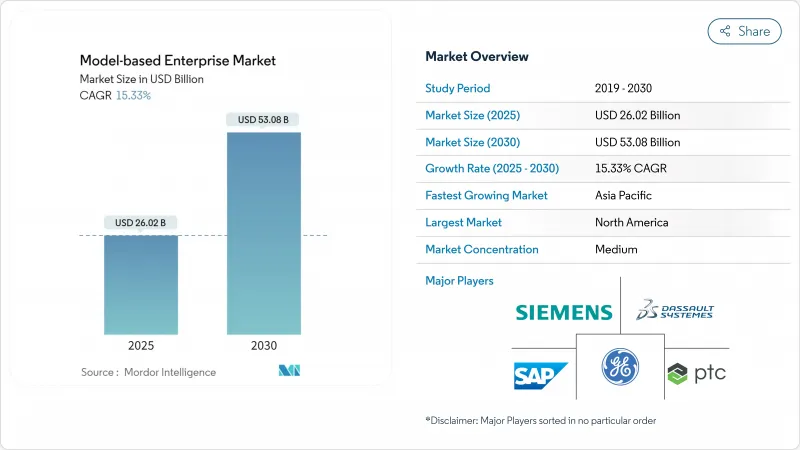
这一发展势头源于工作流程从以文件为中心的模式转变为连接设计、工程、製造和服务功能的连贯数位主线的转变。美国国防部已强制要求将数位模型作为单一权威资料来源,这促使航太和国防相关企业迅速采用该技术。汽车製造商正在采用类似技术来加快电动车的开发速度,而云端原生产品生命週期管理套件正在降低亚太地区中小型製造商的进入门槛。供应商正在投资人工智慧驱动的模拟、积层製造品质控制环和整合数位双胞胎,以实现更快的投资回报,但许多用户仍在努力应对员工技能再培训成本和数据互通性方面的挑战。
全球基于模型的企业市场趋势与洞察
美国国防部数位工程指令加速在北美地区的应用
美国国防部承包商现在必须将3D模型视为设计、分析、采购和维护决策的唯一权威资讯来源。近30万家供应商已开始更新其流程、软体堆迭和网路安全防护措施,以确保继续取得未来的合约。随着共用分包商采用合规的工作流程,这一趋势正在向商业航太蔓延。工具供应商也积极回应,提供包装好的合规模板和自动化的基于模型的定义(MBD)检查器,从而缩短文件编制时间并增强可追溯性。
汽车OEM厂商转向电动车平台的全3D数位线程
纯电动车专案依赖机械、电气和热力系统的同步设计。一家大型汽车製造商透过实施统一的3D数位线程,将平台週期从72个月缩短至36个月,同时提高了可追溯性。透过将数位双胞胎与基于模型的系统工程相结合,团队可以及早期模拟能量流动、碰撞行为和电池劣化,从而减少设计返工和保固风险。这些优势正在推动该技术在欧洲、北美和中国的广泛应用。
数据互通性挑战阻碍了无缝集成
大约 65% 的工程计划在将传统 CAD 檔案转换为功能丰富的、可用于模型驱动设计 (MBD) 的模型时会遇到延误。仅进行几何转换是不够的;必须保留数十年来累积的特征、约束和关联图纸。虽然专用转换工具正在不断改进,但企业级迁移仍然需要资源,并且存在资料遗失的风险,这可能会阻碍数位转型计画的实施。
细分市场分析
到2024年,解决方案业务将占总收入的71%,凸显其作为大多数部署方案支柱的地位。然而,随着企业面临大规模部署基于模型的实践的复杂性,服务合约的复合年增长率将达到17.8%。服务供应商正在引入人工智慧技术来实现资料迁移和检验的自动化,从而加快价值实现速度并提高模型准确性。市场对专注于数位线程技能的培训和认证的需求不断增长,表明人才缺口仍然存在。专业服务公司的出现为寻求指导但又不想承担大型咨询团队高昂费用的中型製造商提供了更多选择。
订阅模式的兴起正将收入模式从永久软体转向与绩效指标和结果导向合约挂钩的持续服务关係。将预测分析应用于维护和支援合同,可以在整合故障中断生产之前发出预警。这些功能增强了客户对可信赖合作伙伴的信任,并维持了基于模型的企业服务市场份额的持续成长动能。
儘管产品生命週期管理平台仍然是许多实施方案的基础,但随着企业寻求在设计和营运之间建立闭合迴路回馈,数位双胞胎和模拟领域正日益受到重视。即时感测器数据被输入到高保真模型中,以创建可自我更新的数位双胞胎模型,从而指导指南、优化性能并延长资产寿命。模拟和系统工程的融合透过更早检验需求来减少返工。
视觉化和协作工具正在添加AR/VR迭加层,以促进身临其境型设计评审。工程师、供应商甚至现场技术人员都可以即时查看相同模型,从而缩短决策时间。 CAD/CAM/CAE套件现在将产品製造资讯直接嵌入3D几何模型中。这使得下游软体(例如检测规划和现场计量平台)能够使用单一资料集,从而减少转换步骤并最大限度地减少校正误差。
区域分析
北美地区在国防开支、成熟的航太供应链以及汽车製造商加速推出电动车的推动下,占2024年全球销量的38%。联邦政府强制将数位化模型作为官方技术基准的政策,正促使即使是较保守的承包商也进行现代化改造。加拿大和墨西哥透过整合供应链参与其中,这些供应链必须证明其合规性,从而推动了整个北美大陆的广泛应用。
亚太地区是成长最快的地区,2025年至2030年的复合年增长率将达到18.7%。云端託管PLM降低了日本精密製造商、韩国电子巨头和印度工程服务供应商的进入门槛。中国对数位化工厂的投资推动了庞大生产网路中对可扩展数位线程解决方案的需求。地方政府正在推行智慧製造补贴,以加速中小企业的参与。
在德国工业4.0倡议和法国先进航太计划的推动下,欧洲持续强劲地采用数位孪生技术。英国位于贝尔法斯特的数位双胞胎中心体现了英国致力于在下一代飞机研发领域保持竞争力的国家决心。永续性法规进一步鼓励以模型为中心的设计,以追踪碳足迹并优化资源利用。区域标准机构正在合作制定互通性框架,以促进跨境合作。
其他福利:
- Excel格式的市场预测(ME)表
- 3个月的分析师支持
目录
第一章 引言
- 研究假设和市场定义
- 调查范围
第二章调查方法
第三章执行摘要
第四章 市场情势
- 市场概览
- 市场驱动因素
- 美国国防部数位工程指令加速北美地区的采用
- 汽车OEM厂商转向电动车平台的全3D数位胎面设计
- 云端原生PLM套件的普及使亚太地区的中小企业能够获得这些套件
- 缩短航太MRO週转时间带来的投资报酬率
- 将基于模型的定义与积层製造品质工作流程结合
- 市场限制
- 传统CAD标准与下一代MBD标准之间的资料互通性差距
- 员工再培训的前期成本很高。
- 云端部署中IP的网路安全隐患
- 监理展望
- 技术展望
- 波特五力分析
- 新进入者的威胁
- 买方/消费者的议价能力
- 供应商的议价能力
- 替代品的威胁
- 竞争对手之间的竞争
- 宏观经济影响分析
第五章 市场规模与成长预测
- 报价
- 解决方案
- 服务
- 按解决方案类型
- PLM软体
- CAD/CAM/CAE
- 数位双胞胎与仿真
- 视觉化与协作
- 按服务类型
- 整合与实施
- 咨询与培训
- 支援与维护
- 透过部署模式
- 本地部署
- 云
- 公共云端
- 私有云端
- 混合云端
- 按最终用户行业划分
- 航太/国防
- 车
- 建筑和基础设施
- 电力和能源
- 零售及消费品
- 电子与高科技
- 海洋/近海
- 其他行业
- 按地区
- 北美洲
- 美国
- 加拿大
- 墨西哥
- 南美洲
- 巴西
- 阿根廷
- 智利
- 秘鲁
- 其他南美洲国家
- 欧洲
- 德国
- 英国
- 法国
- 义大利
- 西班牙
- 其他欧洲地区
- 亚太地区
- 中国
- 日本
- 韩国
- 印度
- 澳洲
- 纽西兰
- 亚太其他地区
- 中东
- 阿拉伯聯合大公国
- 沙乌地阿拉伯
- 土耳其
- 其他中东地区
- 非洲
- 南非
- 其他非洲地区
- 北美洲
第六章 竞争情势
- Strategic Developments
- Vendor Positioning Analysis
- 公司简介
- Siemens AG
- Dassault Systemes SE
- PTC Inc.
- SAP SE
- Ansys, Inc.
- Autodesk Inc.
- IBM Corporation
- Oracle Corporation
- HCL Technologies Limited
- Aras Corporation
- Anark Corporation
- Hexagon AB
- Altair Engineering Inc.
- Ansys Inc.
- Rockwell Automation Inc.
- IFS AB
- Bentley Systems Inc.
- Capgemini SE
第七章 市场机会与未来展望
The model-based enterprise market is valued at USD 26.02 billion in 2025 and is forecast to reach USD 53.08 billion by 2030, reflecting a CAGR of 15.33%.
This momentum is anchored in the shift from document-centric workflows to coherent digital threads that connect design, engineering, manufacturing, and service functions. The United States Department of Defense requirement that digital models act as the single authoritative data source is spurring swift uptake among aerospace and defense contractors. Automotive manufacturers are adopting similar practices to compress electric-vehicle development timelines, while cloud-native product-lifecycle-management suites are lowering barriers for small and medium manufacturers in Asia-Pacific. Vendors are investing in AI-driven simulation, additive-manufacturing quality loops, and integrated digital twins to deliver faster ROI, yet many users still grapple with workforce reskilling costs and data-interoperability gaps.
Global Model-based Enterprise Market Trends and Insights
DoD Digital Engineering Mandates Accelerating Adoption in North America
Defense contractors must now treat 3D models as the single source of truth for design, analysis, sourcing, and sustainment decisions. Close to 300,000 suppliers have started updating processes, software stacks, and cybersecurity safeguards to stay eligible for future contracts. Uptake is spilling over to commercial aerospace as shared subcontractors align with mandate-compliant workflows. Tool vendors are responding with packaged compliance templates and automated model-based definition (MBD) checkers that cut documentation time and enhance traceability.
Automotive OEM Shift to Full-3D Digital Thread for EV Platforms
Battery-electric programs rely on concurrent design of mechanical, electrical, and thermal systems. Deploying a unified 3D digital thread has allowed leading automakers to shrink platform cycles from 72 months to 36 months while improving traceability. The integration of digital twins with model-based systems engineering lets teams simulate energy flow, crash behavior, and battery degradation early, curbing late redesigns and warranty risk. These gains drive widespread rollouts across Europe, North America, and China.
Data-Interoperability Challenges Hinder Seamless Integration
Roughly 65% of engineering projects still encounter delays when transforming historical CAD files into feature-rich, MBD-ready models. Geometry translation alone is not enough; teams must also preserve features, constraints, and linked drawings built over decades. Specialized conversion tools are improving, yet enterprise-wide migrations remain resource intensive and carry risk of data loss that can stall digital-thread initiatives.
Other drivers and restraints analyzed in the detailed report include:
- Surge in Cloud-Native PLM Suites Enabling SMB Access in Asia-Pacific
- ROI From Aerospace MRO Turn-Around-Time Reduction
- Workforce Reskilling Creates Implementation Hurdle
For complete list of drivers and restraints, kindly check the Table Of Contents.
Segment Analysis
The Solutions segment generated 71% of 2024 revenue, underscoring its role as the backbone of most deployments. Service engagements, however, are registering a 17.8% CAGR as enterprises confront the complexity of rolling out model-based practices at scale. Service providers are embedding AI to automate data migration and validation, shortening time-to-value and boosting confidence in model accuracy. Training and certification packages focused on digital-thread skills are rising in demand, highlighting the persistent talent gap. The influx of specialized service firms is broadening options for mid-market manufacturers seeking guidance without the expense of large consulting teams.
Rising subscription models are shifting revenue from perpetual software toward continuous service relationships tied to performance metrics and outcome-based contracts. Predictive analytics applied within maintenance and support agreements can flag integration glitches before they disrupt production. These capabilities reinforce client reliance on trusted partners, sustaining the upward trajectory of the Services share within the model-based enterprise market.
Product-lifecycle-management platforms remain the foundation of most implementations, but the Digital-Twin & Simulation segment is gaining prominence as organizations seek closed-loop feedback between design and operation. Real-time sensor data feeding high-fidelity models creates self-updating digital twins that guide maintenance, optimize performance, and extend asset life. The convergence of simulation and systems engineering reduces rework by validating requirements early, a benefit that is especially acute in regulated domains such as aerospace and medical devices.
Visualization and collaboration tools are adding AR/VR overlays to facilitate immersive design reviews. Engineers, suppliers, and even field technicians can inspect the same model in real time, shrinking the decision window. CAD/CAM/CAE suites now embed product-manufacturing information directly in 3D geometry. This allows downstream software, including inspection planning and shop-floor metrology platforms, to consume a single data set, trimming translation steps and minimizing revision errors.
The Model-Based Enterprise Market Report is Segmented by Offering (Solutions, and Services), Solution Type (PLM Software, CAD/CAM/CAE, and More), Service Type (Integration and Implementation, Consulting and Training, and More), Deployment Mode (On-Premise, and Cloud), End User Industry (Aerospace and Defense, Construction and Infrastructure, and More), and Geography. The Market Forecasts are Provided in Terms of Value (USD).
Geography Analysis
North America contributed 38% of 2024 revenue, supported by defense spending, a mature aerospace supply chain, and automakers seeking to accelerate electric-vehicle launches. Federal policies that enforce digital models as the official technical baseline are nudging even conservative contractors to modernize. Canada and Mexico participate through integrated supply chains that must also prove compliance, driving widespread adoption across the continent.
Asia-Pacific is the fastest-growing region with an 18.7% CAGR over 2025-2030. Cloud-hosted PLM lowers entry barriers for Japan's precision manufacturers, South Korea's electronics champions, and India's engineering-services providers. China's investment in digital factories fuels demand for digital-thread solutions that can scale across vast production networks. Local governments promote smart-manufacturing grants, accelerating SMB participation.
Europe maintains robust adoption driven by Germany's Industrie 4.0 initiatives and France's advanced aerospace programs. A United Kingdom digital-twin center in Belfast demonstrates national commitment to remain competitive in next-generation aircraft development. Sustainability regulations further encourage model-centric design to track carbon footprints and optimize resource use. Regional standards bodies collaborate on interoperability frameworks, smoothing cross-border collaboration.
- Siemens AG
- Dassault Systemes SE
- PTC Inc.
- SAP SE
- Ansys, Inc.
- Autodesk Inc.
- IBM Corporation
- Oracle Corporation
- HCL Technologies Limited
- Aras Corporation
- Anark Corporation
- Hexagon AB
- Altair Engineering Inc.
- Ansys Inc.
- Rockwell Automation Inc.
- IFS AB
- Bentley Systems Inc.
- Capgemini SE
Additional Benefits:
- The market estimate (ME) sheet in Excel format
- 3 months of analyst support
TABLE OF CONTENTS
1 Introduction
- 1.1 Study Assumptions and Market Definition
- 1.2 Scope of the Study
2 Research Methodology
3 Executive Summary
4 Market Landscape
- 4.1 Market Overview
- 4.2 Market Drivers
- 4.2.1 DoD Digital Engineering Mandates Accelerating Adoption in North America
- 4.2.2 Automotive OEM Shift to Full-3D Digital Thread for EV Platforms
- 4.2.3 Surge in Cloud-Native PLM Suites Enabling SMB Access in Asia-Pacific
- 4.2.4 ROI From Aerospace MRO Turn-Around Time Reduction
- 4.2.5 Integrating Model-Based Definition with Additive-Manufacturing Quality Workflows
- 4.3 Market Restraints
- 4.3.1 Data-Interoperability Gaps Between Legacy CAD and Next-Gen MBD Standards
- 4.3.2 High Up-Front Workforce Reskilling Costs
- 4.3.3 Cyber-security Concerns Over IP in Cloud Deployments
- 4.4 Regulatory Outlook
- 4.5 Technological Outlook
- 4.6 Porter's Five Forces Analysis
- 4.6.1 Threat of New Entrants
- 4.6.2 Bargaining Power of Buyers/Consumers
- 4.6.3 Bargaining Power of Suppliers
- 4.6.4 Threat of Substitute Products
- 4.6.5 Intensity of Competitive Rivalry
- 4.7 Macroeconomic Impact Analysis
5 Market Size and Growth Forecasts (Value)
- 5.1 By Offering
- 5.1.1 Solutions
- 5.1.2 Services
- 5.2 By Solution Type
- 5.2.1 PLM Software
- 5.2.2 CAD/CAM/CAE
- 5.2.3 Digital-Twin and Simulation
- 5.2.4 Visualization and Collaboration
- 5.3 By Service Type
- 5.3.1 Integration and Implementation
- 5.3.2 Consulting and Training
- 5.3.3 Support and Maintenance
- 5.4 By Deployment Mode
- 5.4.1 On-premise
- 5.4.2 Cloud
- 5.4.2.1 Public Cloud
- 5.4.2.2 Private Cloud
- 5.4.2.3 Hybrid Cloud
- 5.5 By End User Industry
- 5.5.1 Aerospace and Defense
- 5.5.2 Automotive
- 5.5.3 Construction and Infrastructure
- 5.5.4 Power and Energy
- 5.5.5 Retail and CPG
- 5.5.6 Electronics and Hi-Tech
- 5.5.7 Marine and Offshore
- 5.5.8 Other Industries
- 5.6 By Geography
- 5.6.1 North America
- 5.6.1.1 United States
- 5.6.1.2 Canada
- 5.6.1.3 Mexico
- 5.6.2 South America
- 5.6.2.1 Brazil
- 5.6.2.2 Argentina
- 5.6.2.3 Chile
- 5.6.2.4 Peru
- 5.6.2.5 Rest of South America
- 5.6.3 Europe
- 5.6.3.1 Germany
- 5.6.3.2 United Kingdom
- 5.6.3.3 France
- 5.6.3.4 Italy
- 5.6.3.5 Spain
- 5.6.3.6 Rest of Europe
- 5.6.4 Asia-Pacific
- 5.6.4.1 China
- 5.6.4.2 Japan
- 5.6.4.3 South Korea
- 5.6.4.4 India
- 5.6.4.5 Australia
- 5.6.4.6 New Zealand
- 5.6.4.7 Rest of Asia-Pacific
- 5.6.5 Middle East
- 5.6.5.1 United Arab Emirates
- 5.6.5.2 Saudi Arabia
- 5.6.5.3 Turkey
- 5.6.5.4 Rest of Middle East
- 5.6.6 Africa
- 5.6.6.1 South Africa
- 5.6.6.2 Rest of Africa
- 5.6.1 North America
6 Competitive Landscape
- 6.1 Strategic Developments
- 6.2 Vendor Positioning Analysis
- 6.3 Company Profiles (includes Global level Overview, Market level overview, Core Segments, Financials as available, Strategic Information, Products and Services, and Recent Developments)
- 6.3.1 Siemens AG
- 6.3.2 Dassault Systemes SE
- 6.3.3 PTC Inc.
- 6.3.4 SAP SE
- 6.3.5 Ansys, Inc.
- 6.3.6 Autodesk Inc.
- 6.3.7 IBM Corporation
- 6.3.8 Oracle Corporation
- 6.3.9 HCL Technologies Limited
- 6.3.10 Aras Corporation
- 6.3.11 Anark Corporation
- 6.3.12 Hexagon AB
- 6.3.13 Altair Engineering Inc.
- 6.3.14 Ansys Inc.
- 6.3.15 Rockwell Automation Inc.
- 6.3.16 IFS AB
- 6.3.17 Bentley Systems Inc.
- 6.3.18 Capgemini SE
7 Market Opportunities and Future Outlook
- 7.1 White-space and Unmet-Need Assessment

 基于模型的企业市场规模、份额和成长分析(按产品类型、部署类型、垂直产业和地区划分)-2026-2033年产业预测
 基于模型的企业市场:2025-2032 年全球预测(按部署类型、组织规模、组件、最终用户、技术、应用和产业划分)
 基于模型的企业市场规模、份额、成长分析(按产品、按部署类型、按垂直行业和按地区)- 行业预测,2025 年至 2032 年
 基于模型的企业 (MBE) 全球市场预测(截至 2030 年):按产品、部署类型、最终用户和区域进行分析
 基于模型的企业市场、占有率、规模、趋势、行业分析报告:依产品、依部署模式、依最终用户、依地区、依细分市场、预测,2024-2032 年
 全球基于模型的企业市场规模、份额、趋势分析报告,按产品、按部署模式、按行业、按地区、展望和预测,2024-2031 年
 全球基于模型的企业市场:按产品、部署类型、产业、地区划分 - 到 2029 年的预测