


 |
市场调查报告书
商品编码
1852139
光学显微镜:市场份额分析、行业趋势、统计数据和成长预测(2025-2030 年)Optical Microscopes - Market Share Analysis, Industry Trends & Statistics, Growth Forecasts (2025 - 2030) |
||||||

※ 本网页内容可能与最新版本有所差异。详细情况请与我们联繫。
预计到 2025 年,光学显微镜市场规模将达到 29.2 亿美元,到 2030 年将达到 38.8 亿美元,在预测期(2025-2030 年)内,复合年增长率将达到 5.83%。
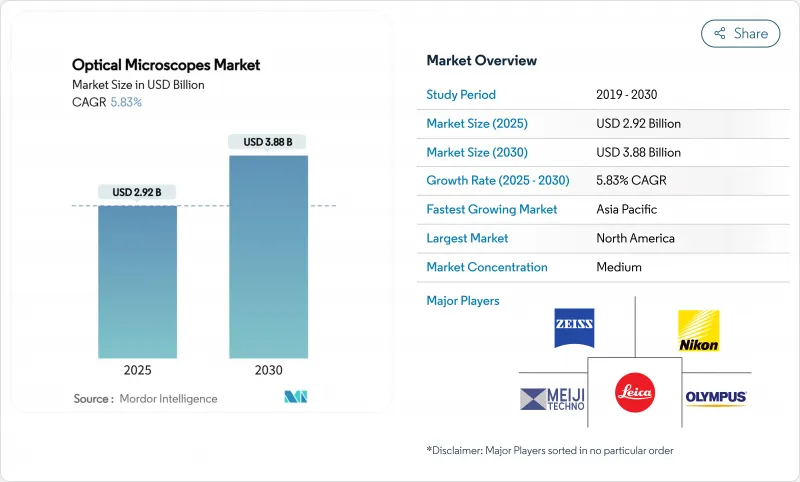
机器学习演算法如今已实现影像撷取和解读的自动化,将分析时间从数小时缩短至数分钟,并使实验室能够处理更大样本量。量子感测器的整合将空间分辨率提升至10奈米,为分子生物学和奈米材料研究开闢了新的探索窗口。大量资金的涌入,特别是来自美国卫生研究院共用设备津贴,正在支持学术和临床机构进行强劲的设备升级。同时,诸如售价低于50美元的全3D列印光学组件等普及化製造技术,正开始降低资源匮乏地区采用这些技术的门槛。
全球光学显微镜市场趋势与洞察
增加对生命科学研发的投入
联邦政府和慈善机构对下一代成像设施的资助,例如美国国立卫生研究院 (NIH) 斥资 1.3 亿美元扩建冷冻电镜以及普林斯顿大学由捐赠基金支持的光学核心升级项目,正推动资金流向共享模式,提高设备利用率,并促使采购转向多功能模组化平台。津贴的增加尤其有利于萤光和超高解析度显微镜的发展,因为它们的高价位与先进的生物医学应用场景相符。因此,光学显微镜市场在学术联盟和区域研究网络中拥有多年的发展前景。
数位化和基于人工智慧的图像分析
如今,深度学习流程在肿瘤分级任务中已能与病理专家比肩甚至超越他们,使显微镜能够近乎即时地提供可操作的见解。诸如 ATOMIC 的框架已展示了零样本材料表征,突破了预训练模型的瓶颈,并为工业应用开闢了新的可能性。直接整合到相机感测器中的边缘运算降低了延迟,而人工智慧引导的自适应照明则将光毒性暴露降低了两位数百分比。因此,光学显微镜市场对整合软硬体套件的需求日益增长,而非独立的光学元件。
电子显微镜解析度差距及比较
儘管光学系统受衍射限制,可见光解析度通常仅200奈米左右,但电子显微镜已能轻鬆突破亚埃尺度。 MINFLUX及相关技术已将生物成像解析度缩小至1-3奈米,但材料科学领域仍倾向使用电子平台进行晶格级成像。利用标准透射电镜(TEM)进行电子光刻技术的进步,无需昂贵的像差校正即可实现0.44埃的分辨率,进一步强化了这种对比。因此,一些企业的预算倾向于建造多技术实验室,而非单纯的光学升级,这限制了高精度冶金和半导体製造厂光学显微镜市场的成长潜力。
细分市场分析
到2024年,数位显微镜将占光学显微镜市场的36.92%,这反映出市场正发生显着转变,转向以相机为中心的架构,将光学元件和图形处理单元整合在一起,实现即时渲染和註释。研究人员和临床医生青睐整合式电动载物台、频谱解混和支援人工智慧的檔案格式,这些功能可以缩短端到端的分析时间。同时,萤光和超高解析度系统正在推动市场成长,预计到2030年将以7.56%的复合年增长率成长。这主要得益于确定性奈米显微镜等突破性技术的出现,这些技术具有λ/33的轴向分辨率,能够对细胞内机制进行体积成像。立体显微镜在电子设备检测和生命科学领域的解剖中发挥着至关重要的作用。能够将磁共振转换为10奈米光学讯号的量子感测器的出现,正在模糊传统的产品界限。
开放原始码生态系统加速了迭代周期。如今,大学发布了售价低于50美元的3D列印钻机,用于可视化细胞内部结构,这极大地促进了现场媒介传播感染疾病监测的应用。市场领导者正积极回应,将人工智慧引导的自动对焦和云端遥测技术融入产品,进一步增强了其软体差异化优势。支持长期观察的活细胞培养室正推动倒置式显微镜在生物加工设施中广泛应用。因此,即使入门级市场面临价格压缩的挑战,数位和萤光光学显微镜市场预计在未来半个世纪仍将占据收入成长的很大一部分。
区域分析
2024年,北美将引领光学显微镜市场,收入贡献率将达到34.13%,主要得益于美国国立卫生研究院(NIH)资助的冷冻电镜中心和成熟的临床病理工作流程。然而,临床实验室技术人员长期短缺(预计2024年空缺率高达46%)将限制检测效率,并促使医院优先考虑自动化和整合人工智慧平台。随着远距会诊成为常态,以及市场参与企业将扫描器、分析和云端储存打包成订阅模式,确保支出可预测,数位病理学的应用将会加速成长。
亚太地区是成长最快的区域,预计到2030年将以11.09%的复合年增长率成长。中国地方政府正在拨出多年预算,用于升级三级医院,使其配备多光子和量子感测器设备;印度的诊断产业也为分散式成像技术的发展创造了有利条件。供应商正在加速在地化进程:蔡司在苏州开设了一个占地13,000平方公尺的研发和製造地,旨在提供符合当地通讯协定的光学元件和软体。然而,部分市场监管的不确定性和报销延迟导致收入确认延迟,促使供应商采用伙伴关係主导的市场拓展模式。
在「地平线欧洲」研究津贴和简化跨境销售的统一CE认证框架的推动下,欧洲维持了均衡成长。中东和非洲以及南美洲的整体光学显微镜市场也呈现温和成长,这得益于各国政府优先发展医疗保健自主能力,以及与七国集团机构的学术合作促进了技术转移。
其他福利:
- Excel格式的市场预测(ME)表
- 3个月的分析师支持
目录
第一章 引言
- 研究假设和市场定义
- 调查范围
第二章调查方法
第三章执行摘要
第四章 市场情势
- 市场概览
- 市场驱动因素
- 增加对生命科学研发的投入
- 数位化和基于人工智慧的图像分析
- 奈米科技推动显微镜需求激增
- 临床照护现场技术的发展
- 开放原始码硬体和3D列印光学元件
- 实验室晶片/微流体控集成
- 市场限制
- 电子显微镜解析度的差异及比较
- 低价品牌造成的价格侵蚀
- 高级显微镜技术人员短缺
- 低成本替代品的可用性
- 技术展望
- 波特五力分析
- 新进入者的威胁
- 买方的议价能力
- 供应商的议价能力
- 替代品的威胁
- 竞争对手之间的竞争
第五章 市场规模及成长预测(单位:美元)
- 副产品
- 复式显微镜
- 立体显微镜
- 数位显微镜
- 倒置显微镜
- 萤光和超高解析度显微镜
- 其他的
- 最终用户
- 医院和诊所
- 学术和研究机构
- 诊断实验室
- 製药和生物技术公司
- 按地区
- 北美洲
- 美国
- 加拿大
- 墨西哥
- 欧洲
- 德国
- 英国
- 法国
- 义大利
- 西班牙
- 其他欧洲地区
- 亚太地区
- 中国
- 日本
- 印度
- 澳洲
- 韩国
- 亚太其他地区
- 中东和非洲
- GCC
- 南非
- 其他中东和非洲地区
- 南美洲
- 巴西
- 阿根廷
- 其他南美洲国家
- 北美洲
第六章 竞争情势
- 市场集中度
- 市占率分析
- 公司简介
- Carl Zeiss AG
- Nikon Instruments Inc.
- Leica Microsystems(Danaher)
- Olympus Corporation
- Bruker Corporation
- Hitachi High-Tech Corp.
- Agilent Technologies
- Keyence Corp.
- Thermo Fisher Scientific
- Meiji Techno
- Labomed Inc.
- AmScope
- Celestron
- Accu-Scope Inc.
- Motic Microscope
- Andor Technology(Oxford Instr.)
- Jenoptik AG
- Prior Scientific Instruments
- Dino-Lite(AnMo Electronics)
- OPTO-Tech
第七章 市场机会与未来展望
The Optical Microscopes Market size is estimated at USD 2.92 billion in 2025, and is expected to reach USD 3.88 billion by 2030, at a CAGR of 5.83% during the forecast period (2025-2030).
Machine-learning algorithms now automate image acquisition and interpretation, cutting analysis times from hours to minutes and allowing laboratories to cope with mounting sample volumes. Quantum-sensor integrations are pushing spatial resolution to 10 nanometers, opening new investigative windows in molecular biology and nanomaterials research. Funding inflows particularly the National Institutes of Health's shared instrumentation grants underpin robust upgrade cycles in academic and clinical facilities. Meanwhile, democratized fabrication such as fully 3D-printed optical assemblies priced below USD 50 has begun to lower adoption barriers in resource-limited settings.
Global Optical Microscopes Market Trends and Insights
Rising Funding for Life-Science R&D
Federal and philanthropic programs are underwriting next-generation imaging facilities, such as NIH's USD 130 million cryo-EM expansion and Princeton University's endowment-backed optical core upgrades. Grant mechanisms favor shared-use models, elevating utilization rates and steering procurement toward versatile, modular platforms. Higher capital availability particularly benefits fluorescence and super-resolution instruments whose premium pricing aligns with advanced biomedical use cases. The optical microscopes market therefore locks in multi-year order visibility across academic consortia and regional research networks.
Digitization & AI-Enabled Image Analytics
Deep-learning pipelines now equal or exceed expert pathologists in tumor grading tasks, enabling microscopes to deliver actionable insights in near real time. Frameworks such as ATOMIC demonstrate zero-shot material characterization, removing pre-trained model bottlenecks and widening industrial applicability. Edge computing embedded directly into camera sensors slashes latency, and adaptive illumination guided by AI reduces phototoxic exposure by double-digit percentages. As a result, the optical microscopes market sees escalating demand for integrated hardware-software bundles rather than standalone optics.
Resolution Gap vs. Electron Microscopes
Optical systems remain bounded by diffraction, capping visible-light resolution near 200 nanometers, whereas electron setups routinely push into the sub-angstrom realm. Although MINFLUX and related modalities shrink biological imaging to the 1-3 nanometer domain, materials science still gravitates toward electron platforms for lattice-level insights. Advances in electron ptychography using standard TEMs intensify the comparison by delivering 0.44-angstrom resolution without costly aberration correction. Consequently, some capital budgets tilt toward multi-technique labs rather than pure-play optical upgrades, trimming optical microscopes market growth potential in high-precision metallurgy and semiconductor fabs.
Other drivers and restraints analyzed in the detailed report include:
- Surge in Nanotechnology-Driven Microscopy Demand
- Growth of Clinical Point-of-Care Microscopy
- Price Erosion from Low-Cost Brands
For complete list of drivers and restraints, kindly check the Table Of Contents.
Segment Analysis
The digital sub-category accounted for 36.92% of the optical microscopes market in 2024, reflecting a decisive shift toward camera-centric architectures that merge optics with graphics-processing units for instantaneous rendering and annotation. Researchers and clinicians value integrated motorized stages, spectral unmixing, and AI-ready file formats that shrink end-to-end analysis times. Meanwhile, fluorescence and super-resolution systems lead growth, projected at a 7.56% CAGR through 2030, driven by breakthroughs such as λ/33 axial resolution deterministic nanoscopy that unlocks volumetric imaging of intracellular machinery. Compound microscopes remain staples in hematology and classroom instruction, while stereo variants serve electronics inspection and life-science dissection. Emerging quantum-sensor configurations capable of converting magnetic resonance into optical signals at 10 nanometers start to blur traditional product lines, promising a new echelon of versatility within the optical microscopes market.
Open-source ecosystems accelerate iteration cycles: universities now release 3D-printable rigs that hit sub-cellular clarity for under USD 50, catalyzing adoption in field surveillance of vector-borne diseases. Market leaders respond by embedding AI-guided autofocus and cloud telemetry, reinforcing differentiation through software. Inverted formats gain traction inside bioprocessing facilities thanks to live-cell chambers supporting long-term observation. Consequently, the optical microscopes market size for digital and fluorescence lines is projected to command the bulk of incremental revenue over the next half-decade, even as entry-level segments wrestle with price compression.
The Optical Microscopes Market Report is Segmented by Product (Compound Microscopes, Stereo Microscopes, Digital Microscopes, Inverted Microscopes, and More), End User (Hospitals & Clinics, Academic & Research Institutes, Diagnostic Laboratories, Pharmaceutical & Biotech Companies), and Geography (North America, Europe, Asia Pacific, Middle East & Africa, South America). The Market Forecasts are Provided in Terms of Value (USD).
Geography Analysis
North America leads the optical microscopes market with a 34.13% revenue contribution in 2024, supported by NIH-funded cryo-EM hubs and well-established clinical pathology workflows. Yet chronic laboratory technologist shortages 46% vacancy reported in 2024 limit throughput, prompting hospitals to prioritize automation and integrated AI platforms. Digital pathology penetration rises as teleconsultation becomes standard, and market players package scanners, analytics, and cloud storage in subscription models that ensure predictable spending.
Asia Pacific is the fastest mover, expanding at an 11.09% CAGR through 2030. China's provincial governments allocate multi-year budgets for tertiary-hospital upgrades that include multi-photon and quantum-sensor units, while India's diagnostics sector, creating fertile ground for decentralized imaging. Suppliers accelerate localization ZEISS inaugurated a 13,000 square-meter R&D and manufacturing site in Suzhou to tailor optics and software for local protocols. Still, regulatory uncertainty and reimbursement lag in some markets introduce revenue recognition delays, encouraging vendors to adopt partnership-led go-to-market models.
Europe maintains balanced growth, buoyed by Horizon Europe research grants and a cohesive CE-mark framework that simplifies cross-border sales. Middle East & Africa and South America collectively account for a modest but accelerating slice of the optical microscopes market as governments emphasize healthcare self-sufficiency and academic collaborations with G7 institutions drive technology transfers.
- Carl Zeiss
- Nikon Instruments
- Danaher
- Olympus
- Bruker
- Hitachi High-Tech Corp.
- Agilent Technologies
- Keyence Corp.
- Thermo Fisher Scientific
- Meiji Techno
- Labomed Inc.
- AmScope
- Celestron
- Accu-Scope Inc.
- Motic Microscope
- Andor Technology (Oxford Instr.)
- Jenoptik AG
- Prior Scientific Instruments
- Dino-Lite (AnMo Electronics)
- OPTO-Tech
Additional Benefits:
- The market estimate (ME) sheet in Excel format
- 3 months of analyst support
TABLE OF CONTENTS
1 Introduction
- 1.1 Study Assumptions & Market Definition
- 1.2 Scope of the Study
2 Research Methodology
3 Executive Summary
4 Market Landscape
- 4.1 Market Overview
- 4.2 Market Drivers
- 4.2.1 Rising Funding for Life-Science R&D
- 4.2.2 Digitization & AI-Enabled Image Analytics
- 4.2.3 Surge in Nanotechnology-Driven Microscopy Demand
- 4.2.4 Growth Of Clinical Point-Of-Care Microscopy
- 4.2.5 Open-Source Hardware & 3-D-Printed Optical Components
- 4.2.6 Lab-On-Chip / Micro-Fluidic Integration
- 4.3 Market Restraints
- 4.3.1 Resolution Gap Vs. Electron Microscopes
- 4.3.2 Price Erosion from Low-Cost Brands
- 4.3.3 Shortage of Advanced Microscopy Technicians
- 4.3.4 Availability of Low-Cost Alternatives
- 4.4 Technological Outlook
- 4.5 Porter's Five Forces Analysis
- 4.5.1 Threat of New Entrants
- 4.5.2 Bargaining Power of Buyers
- 4.5.3 Bargaining Power of Suppliers
- 4.5.4 Threat of Substitutes
- 4.5.5 Competitive Rivalry
5 Market Size & Growth Forecasts (Value in USD)
- 5.1 By Product
- 5.1.1 Compound Microscopes
- 5.1.2 Stereo Microscopes
- 5.1.3 Digital Microscopes
- 5.1.4 Inverted Microscopes
- 5.1.5 Fluorescence & Super-Resolution Microscopes
- 5.1.6 Other Optical Microscopes
- 5.2 By End User
- 5.2.1 Hospitals & Clinics
- 5.2.2 Academic & Research Institutes
- 5.2.3 Diagnostic Laboratories
- 5.2.4 Pharmaceutical & Biotech Companies
- 5.3 By Geography
- 5.3.1 North America
- 5.3.1.1 United States
- 5.3.1.2 Canada
- 5.3.1.3 Mexico
- 5.3.2 Europe
- 5.3.2.1 Germany
- 5.3.2.2 United Kingdom
- 5.3.2.3 France
- 5.3.2.4 Italy
- 5.3.2.5 Spain
- 5.3.2.6 Rest of Europe
- 5.3.3 Asia Pacific
- 5.3.3.1 China
- 5.3.3.2 Japan
- 5.3.3.3 India
- 5.3.3.4 Australia
- 5.3.3.5 South Korea
- 5.3.3.6 Rest of Asia-Pacific
- 5.3.4 Middle East & Africa
- 5.3.4.1 GCC
- 5.3.4.2 South Africa
- 5.3.4.3 Rest of Middle East & Africa
- 5.3.5 South America
- 5.3.5.1 Brazil
- 5.3.5.2 Argentina
- 5.3.5.3 Rest of South America
- 5.3.1 North America
6 Competitive Landscape
- 6.1 Market Concentration
- 6.2 Market Share Analysis
- 6.3 Company Profiles (includes Global level Overview, Market level overview, Core Segments, Financials as available, Strategic Information, Market Rank/Share for key companies, Products & Services, and Recent Developments)
- 6.3.1 Carl Zeiss AG
- 6.3.2 Nikon Instruments Inc.
- 6.3.3 Leica Microsystems (Danaher)
- 6.3.4 Olympus Corporation
- 6.3.5 Bruker Corporation
- 6.3.6 Hitachi High-Tech Corp.
- 6.3.7 Agilent Technologies
- 6.3.8 Keyence Corp.
- 6.3.9 Thermo Fisher Scientific
- 6.3.10 Meiji Techno
- 6.3.11 Labomed Inc.
- 6.3.12 AmScope
- 6.3.13 Celestron
- 6.3.14 Accu-Scope Inc.
- 6.3.15 Motic Microscope
- 6.3.16 Andor Technology (Oxford Instr.)
- 6.3.17 Jenoptik AG
- 6.3.18 Prior Scientific Instruments
- 6.3.19 Dino-Lite (AnMo Electronics)
- 6.3.20 OPTO-Tech
7 Market Opportunities & Future Outlook
- 7.1 White-Space & Unmet-Need Assessment

 光学显微镜:全球市场份额和排名、总收入和需求预测(2025-2031年)金相光学显微镜:全球市占率及排名、总收入及需求预测(2025-2031年)
 2025年全球光学显微镜市场报告
 光学显微镜市场(2025-2029)
 光学显微镜市场规模、份额、成长分析(按产品、最终用途和地区)- 产业预测(2025-2032)2025年全球立体显微镜市场报告
 光学显微镜市场(按产品、最终用户和地区)
 3D光学显微镜的全球市场2024-2028
 光学显微镜市场(产品:数位显微镜、体视显微镜、倒置显微镜、配件、软体等)- 2023-2031 年全球产业分析、规模、份额、成长、趋势和预测