


 |
市场调查报告书
商品编码
1852176
离子交换树脂:市场份额分析、行业趋势、统计数据和成长预测(2025-2030 年)Ion Exchange Resin - Market Share Analysis, Industry Trends & Statistics, Growth Forecasts (2025 - 2030) |
||||||

※ 本网页内容可能与最新版本有所差异。详细情况请与我们联繫。
预计到 2025 年,离子交换树脂市场规模将达到 24.7 亿美元,到 2030 年将达到 31 亿美元,预测期(2025-2030 年)的复合年增长率为 4.62%。
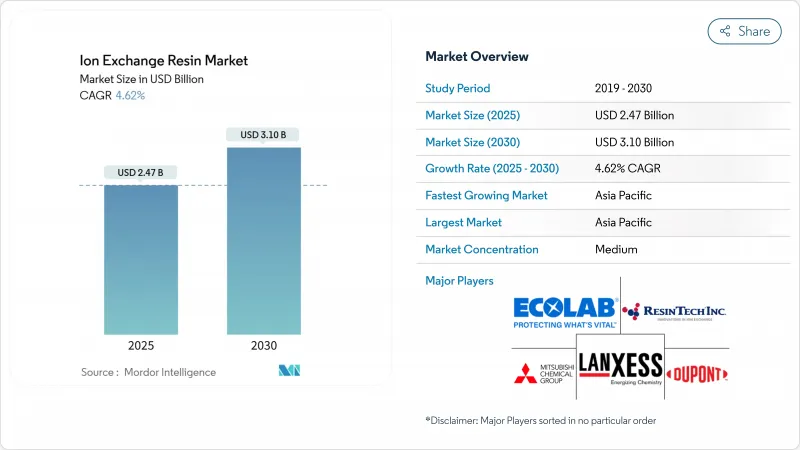
全球水质法规日益严格、半导体产能快速扩张以及製药生产对超高纯度製程的需求不断增长,推动了市场需求的成长。监管的复杂性提高了终端用户对产品性能的要求,促使供应商提供离子选择性窗口更窄、运行週期更长、再生化学品需求量更低的树脂。海水淡化、工业污水处理和资源回收计划中零液体排放(ZLD) 系统的资本投资,也催生了对混合床级和螯合级树脂的二次需求。同时,原料成本(尤其是苯乙烯和丙烯酸单体)的波动,促使企业转向垂直整合的采购模式,并寻求生物基替代品,从而重塑长期筹资策略。这些因素共同作用,加剧了市场竞争,并促使大型化学企业、设备整合商和区域专家伙伴关係,以符合区域规范。
全球离子交换树脂市场趋势及洞察
亚太地区对半导体级超纯水的需求
台湾、韩国和中国当地的晶片製造厂已通过认证,其离子交换树脂床能够去除低至万亿分之一浓度的硼和微量金属。采用诸如2025 Sievers Boron Ultra之类的分析仪,可以连续检测如此低浓度的硼,从而优化了树脂更换时机并减少了化学废料。 Organo公司已在2024年至2026年间为超纯水资本累计1,750亿日圆,其中包括提升树脂产能以满足市场需求。由于半导体产量比率损失会直接转化为数百万美元的机会成本,因此采购决策优先考虑性能而非树脂价格波动。因此,即使在整体製造业放缓的情况下,离子交换树脂市场也受益于半导体供应的稳定性,从而使供应商免受其他地区景气衰退。
PFAS和重金属排放法规推动北美螯合树脂的发展
美国环保署 (EPA) 2024 年发布的临时指南将大多数 PFAS 列为持久性有害物质,并要求饮用水取水口的去除目标低于 4 ng/L。市政和工业污水厂正在试验使用与短链和长链 PFAS 相容的树脂进行离子交换处理,现场研究报告显示,单一途径处理去除率超过 90%。朗盛的 Lewatit MDS TP 108 树脂的穿透循环次数是传统大孔阴离子交换树脂的两倍,在降低总处理成本的同时,也符合废介质处置限制。日益严厉的 PFAS 超标监管处罚正在推动公用事业采购,并促使离子交换树脂市场转向利润更高的螯合型树脂,这些树脂具有更高的选择性和更长的使用寿命。
挥发性苯乙烯和丙烯酸单体价格
由于原物料价格波动,尤其是苯乙烯和丙烯酸单体价格波动,离子交换树脂生产商面临巨大的利润压力,这直接影响了价值链。 2024年5月,美国环保署修订了有机合成化学品生产的排放标准,增加了单体生产商的合规成本,进一步加剧了价格波动。中国常青新材料科技有限公司正投资14亿美元用于精细化学品生产,包括原料,并计划透过垂直整合来降低供应链风险。大型树脂生产商正利用规模经济和长期供应合约来应对价格波动,而小型生产商则面临利润压缩和价格上涨的双重压力,这不仅可能导致客户流失,还会加速市场整合。
细分市场分析
到2024年,商品级树脂将占全球销量的74%,这充分证明了市政水软化和锅炉海水淡化对树脂的强劲需求,这些领域优先考虑的是单价和成熟的再生通讯协定。印度和东南亚地区持续推动的水利基础建设是离子交换树脂市场的主要驱动力。供应商透过整合抗氧化交联剂和LewaPlus等云端基础设计工具来延长树脂的使用寿命,从而帮助公用事业公司合理配置树脂柱库存并减少盐的使用量。儘管商品级树脂市场规模庞大,但随着苯乙烯价格的上涨,其利润空间受到挤压,迫使生产商寻求ISCC PLUS等绿色认证。
用于对选择性、萃取物含量和生物製药要求较高的应用领域的特种树脂,预计到2030年将以5.3%的复合年增长率增长,儘管基数较小,但仍将超过整个离子交换树脂市场的增长速度。杜邦公司将于2025年推出的AmberChrom TQ1,透过在连续处理过程中将寡核苷酸结合能力提高一倍,同时将柱压降降低一半,进一步推动了这一趋势。由于该树脂的稳定性能够减少停机时间、确保符合法规要求并保证批次产量,高端生物製药和微电子用户愿意接受比普通树脂高出三到五倍的价格分布。随着监管审查范围扩大到每公升纳克级污染物,对分子印迹和大孔螯合级树脂的需求将加速成长,从而使更广泛的离子交换树脂市场的收入结构更加多元化。
区域分析
预计到2024年,亚太地区将占全球营收的36%,复合年增长率(CAGR)为5.4%。中国长荣新材料集团正投资14亿美元建造苯乙烯联合企业,以确保区域树脂生产商的原材料供应,这标誌着供应链本地化过程的推进,有助于保护离子交换树脂市场免受跨太平洋物流中断的影响。台湾和韩国的晶片代工厂持续试运行新的超纯水系统,迫使Organo和Purolite等製造地,以缩短前置作业时间并遵守原产地采购法规。印度新建的Roha工厂预计到2027年将使国内产能翻倍,凸显了在地采购要求如何重塑全球供应链格局。
北美市场环境成熟且创新主导,环境合规和製药生产对树脂规格有重要影响。马萨诸塞州、北卡罗来纳州和魁北克省的生物製药产业集中度推动了层析法基质的持续需求,杜邦公司计划于2025年在北美推出AmberChrom TQ1,这将进一步强化这一趋势。儘管通用树脂的销售量可能趋于平稳,但由于北美消费者愿意为经过检验的性能买单,该地区在全球离子交换树脂市场中的重要性日益凸显。
欧洲仍以监管为中心,在化学品限制和绿色氢能奖励之间寻求平衡,从而推动了对膜级全氟磺酸(PFSA)的需求。欧盟对废弃旧树脂的掩埋限制促进了先进再生通讯协定的研发,这些技术可将树脂使用寿命延长20-30%,从而提升了综合解决方案供应商的服务合约收入。加之都市废水处理指令的持续实施,儘管欧洲在离子交换树脂市场的份额相对较小,但其价值加权影响力仍保持稳定。
其他福利:
- Excel格式的市场预测(ME)表
- 3个月的分析师支持
目录
第一章 引言
- 研究假设和市场定义
- 调查范围
第二章调查方法
第三章执行摘要
第四章 市场情势
- 市场概览
- 市场驱动因素
- 亚太地区对半导体级超纯水的需求
- 北美PFAS和重金属排放法规推动螯合树脂的发展
- 中东海水淡化和零排放计划推动混合床树脂的应用
- 欧洲氢电解厂采用PFSA离子交换膜的奖励
- 拉丁美洲糖脱色产业的蓬勃发展带动了对食品级树脂的需求。
- 市场限制
- 挥发性苯乙烯和丙烯酸单体价格
- 生物基吸附剂威胁树脂经济
- 欧盟关于废弃树脂掩埋的法规
- 价值链分析
- 波特五力模型
- 供应商的议价能力
- 买方的议价能力
- 新进入者的威胁
- 替代品的威胁
- 产业间竞争
第五章 市场规模与成长预测
- 按类型
- 通用树脂
- 特种树脂
- 按最终用途行业划分
- 水处理
- 电力
- 食品和饮料
- 製药
- 化学处理
- 采矿和冶金
- 其他终端用户产业
- 透过使用功能
- 软化和脱钙
- 超纯水生产
- 重金属去除和 PFAS 减排
- 催化与分离(非水相)
- 糖漂白和食品饮料精炼
- 贵金属回收与湿式冶金
- 按地区
- 亚太地区
- 中国
- 印度
- 日本
- 韩国
- 东南亚国协
- 亚太其他地区
- 北美洲
- 美国
- 加拿大
- 墨西哥
- 欧洲
- 德国
- 英国
- 义大利
- 法国
- 其他欧洲地区
- 南美洲
- 巴西
- 阿根廷
- 其他南美洲国家
- 中东和非洲
- 沙乌地阿拉伯
- 南非
- 其他中东和非洲地区
- 亚太地区
第六章 竞争情势
- 市场集中度
- 策略趋势
- 市占率分析
- 公司简介
- Anhui Sanxing Resin Co., Ltd.
- Bio-Rad Laboratories, Inc.
- DOSHION POLYSCIENCE PVT. LTD.
- DuPont
- Ecolab
- Eichrom Technologies, LLC
- IEI
- JACOBI CARBONS GROUP
- LANXESS
- Mitsubishi Chemical Group Corporation
- Polymex
- Pure Resin Co., Ltd.
- ResinTech, Inc.
- Samyang Corporation
- Sunresin New Materials Co.Ltd.
- Suqing Group
- Suzhou bojie resin technology Co.,Ltd
- Thermax Limited
- Xylem
第七章 市场机会与未来展望
The Ion Exchange Resin Market size is estimated at USD 2.47 billion in 2025, and is expected to reach USD 3.10 billion by 2030, at a CAGR of 4.62% during the forecast period (2025-2030).
Demand growth is anchored in tightening global water-quality rules, rapid semiconductor capacity additions, and expanding pharmaceutical production that all require ultrapure process streams. Regulatory complexity is expanding the performance envelope that end users expect, pushing suppliers to deliver resins with narrower ionic selectivity windows, longer operating cycles, and lower regeneration chemical demand. Capital spending on zero-liquid-discharge (ZLD) systems in desalination, industrial wastewater, and resource-recovery projects is creating secondary pull for mixed-bed and chelating grades. Meanwhile, raw-material cost swings-especially for styrene and acrylic monomers-are catalyzing a shift toward vertically integrated sourcing and the exploration of bio-based alternatives that could reshape long-term procurement strategies. Collectively, these drivers are keeping competitive intensity high and encouraging partnerships between chemical majors, equipment integrators, and regional specialists to keep pace with localized specifications.
Global Ion Exchange Resin Market Trends and Insights
Semiconductor-grade Ultrapure Water Demand in Asia Pacific
Chip-fabs in Taiwan, South Korea, and Mainland China are qualifying ion-exchange beds that remove boron and trace metals to single-digit parts-per-trillion, a specification codified by foundries chasing sub-3 nm node geometries. The adoption of analyzers such as the 2025 Sievers Boron Ultra, which allows continuous boron detection at those levels, has improved resin change-out timing and reduced chemical waste. Organo Corporation has earmarked JPY 175 billion in ultrapure-water capital outlays for 2024-2026, including resin capacity debottlenecking to capture this captive demand. Because semiconductor yield losses translate directly into multi-million-dollar opportunity costs, purchasing decisions emphasize proven performance over resin price volatility. Consequently, the ion exchange resin market benefits from resilient semiconductor procurement even during broader manufacturing slowdowns, insulating suppliers from cyclical downturns elsewhere.
PFAS and Heavy-Metal Discharge Limits Boosting Chelating Resins in North America
The 2024 U.S. EPA interim guidance classifies most PFAS as persistent hazardous constituents, requiring removal targets below 4 ng/L for drinking-water intakes. Municipalities and industrial dischargers have responded by piloting ion-exchange trains featuring resins tailored for short- and long-chain PFAS, with field studies reporting more than 90% removal efficiencies in single-pass operation. LANXESS's Lewatit MDS TP 108 extends breakthrough cycles two-fold compared with conventional macroporous anion resins, lowering total cost of treatment while complying with disposal restrictions on spent media. Because regulatory penalties escalate rapidly for PFAS exceedances, utilities are accelerating procurement, pushing the ion exchange resin market toward higher-margin chelating grades engineered for selectivity and longer operational life.
Volatile Styrene and Acrylic Monomer Prices
Ion exchange resin manufacturers face significant margin pressures due to raw material price volatility, particularly styrene and acrylic monomers, impacting the value chain. In May 2024, the Environmental Protection Agency's amended emission standards for the Synthetic Organic Chemical Manufacturing Industry added compliance costs for monomer producers, further destabilizing prices. China's Evergreen New Material Technology's USD 1.4 billion investment in fine chemicals production, including ion exchange resin raw materials, aims to mitigate supply chain risks through vertical integration. Larger resin manufacturers leverage economies of scale and long-term supply agreements to manage volatility, while smaller players face margin compression or price hikes, risking customer loss and accelerating market consolidation.
Other drivers and restraints analyzed in the detailed report include:
- Desalination and ZLD Projects in the Middle East Elevating Mixed-Bed Resin Uptake
- Europe Hydrogen Electrolyzer Incentives Lifting PFSA Ion-Exchange Membranes
- Bio-based Adsorbents Undercutting Resin Economics
For complete list of drivers and restraints, kindly check the Table Of Contents.
Segment Analysis
Commodity grades anchored 74% of global revenue in 2024, a testament to entrenched municipal water-softening and boiler-demineralization demand that prioritize unit cost and proven regeneration protocols. The ion exchange resin market is driven by ongoing water-infrastructure buildouts across India and Southeast Asia. Suppliers are stretching lifetimes by integrating oxidative-stable cross-linkers and cloud-based design tools such as LewaPlus, which let utilities right-size column inventories and cut salt usage. Despite their scale, commodity resins face margin compression when styrene prices spike, compelling producers to seek green certifications, such as ISCC PLUS, that justify modest price premiums with verified carbon-emission reductions.
Specialty resins, though accounting for a smaller base, will outpace overall ion exchange resin market growth at 5.3% CAGR through 2030 as applications demand higher selectivity, lower extractables, and compatibility with biologics. The 2025 release of AmberChrom TQ1 by DuPont underscores this trend, doubling oligonucleotide binding capacity while halving column pressure losses during continuous processing. Premium bio-pharma and microelectronics users accept price points 3-5 times those of commodity beads when resin stability reduces downtime, ensures regulatory compliance, and shields batch yields. As regulatory scrutiny widens to nanogram-per-liter contaminants, demand for molecularly imprinted and macroporous chelating grades will accelerate, diversifying the revenue mix within the broader ion exchange resin market.
The Ion Exchange Resins Market Report Segments the Industry by Type (Commodity Resins and Specialty Resins), End-Use Industry (Water Treatment, Power, Pharmaceutical, and More), Application Function (Softening and Demineralization, Ultrapure Water Production, and More), and Geography (Asia-Pacific, North America, Europe, South America, and Middle East and Africa). The Market Forecasts are Provided in Terms of Value (USD).
Geography Analysis
Asia Pacific dominates with 36% 2024 revenue and the highest forecast 5.4% CAGR, reflecting rapid industrialization alongside national mandates for advanced wastewater treatment. China's Evergreen New Material is channeling USD 1.4 billion into a styrenics complex designed to lock in feedstock security for regional resin producers, demonstrating supply-chain localization that shields the ion exchange resin market from trans-Pacific logistic disruptions. Taiwanese and South Korean chip foundries continue to commission new ultrapure-water systems, compelling Organo and Purolite to expand manufacturing footprints in the region to shorten lead times and comply with country-of-origin procurement rules. India's upcoming Roha greenfield plant will double domestic capacity by 2027, underscoring how local content requirements are reshaping global flow patterns.
North America presents a mature yet innovation-led environment where environmental compliance and pharmaceutical production shape resin specifications. Biopharma clustering in Massachusetts, North Carolina, and Quebec is driving sustained demand for chromatography matrices, a trend reinforced by DuPont's 2025 North America launch of AmberChrom TQ1. While commodity resin volumes may plateau, the region's willingness to pay for validated performance cements its relevance within the global ion exchange resin market.
Europe remains regulation-centric, balancing chemical-restriction measures with green-hydrogen incentives that elevate membrane-grade PFSA demand. EU landfill constraints on spent resins are fueling research and development on advanced regeneration protocols capable of extending service life by 20-30%, thereby lifting service-contract revenue for integrated solution providers. Coupled with ongoing enforcement of the Urban Wastewater Treatment Directive, Europe maintains steady, value-weighted influence over the ion exchange resin market despite its comparatively modest volume share.
- Anhui Sanxing Resin Co., Ltd.
- Bio-Rad Laboratories, Inc.
- DOSHION POLYSCIENCE PVT. LTD.
- DuPont
- Ecolab
- Eichrom Technologies, LLC
- IEI
- JACOBI CARBONS GROUP
- LANXESS
- Mitsubishi Chemical Group Corporation
- Polymex
- Pure Resin Co., Ltd.
- ResinTech, Inc.
- Samyang Corporation
- Sunresin New Materials Co.Ltd.
- Suqing Group
- Suzhou bojie resin technology Co.,Ltd
- Thermax Limited
- Xylem
Additional Benefits:
- The market estimate (ME) sheet in Excel format
- 3 months of analyst support
TABLE OF CONTENTS
1 Introduction
- 1.1 Study Assumptions and Market Definition
- 1.2 Scope of the Study
2 Research Methodology
3 Executive Summary
4 Market Landscape
- 4.1 Market Overview
- 4.2 Market Drivers
- 4.2.1 Semiconductor-grade Ultrapure Water Demand in Asia Pacific
- 4.2.2 PFAS and Heavy-Metal Discharge Limits Boosting Chelating Resins in North America
- 4.2.3 Desalination and ZLD Projects in Middle East Elevating Mixed-Bed Resin Uptake
- 4.2.4 Europe Hydrogen Electrolyzer Incentives Lifting PFSA Ion-Exchange Membranes
- 4.2.5 LATAM Sugar-Decolorization Boom Raising Food-Grade Resins Demand
- 4.3 Market Restraints
- 4.3.1 Volatile Styrene and Acrylic Monomer Prices
- 4.3.2 Bio-based Adsorbents Undercutting Resin Economics
- 4.3.3 EU Land-fill Restrictions on Spent Resins
- 4.4 Value Chain Analysis
- 4.5 Porter's Five Forces
- 4.5.1 Bargaining Power of Suppliers
- 4.5.2 Bargaining Power of Buyers
- 4.5.3 Threat of New Entrants
- 4.5.4 Threat of Substitutes
- 4.5.5 Industry Rivalry
5 Market Size and Growth Forecasts (Value)
- 5.1 By Type
- 5.1.1 Commodity Resins
- 5.1.2 Specialty Resins
- 5.2 By End-Use Industry
- 5.2.1 Water Treatment
- 5.2.2 Power
- 5.2.3 Food and Beverage
- 5.2.4 Pharmaceutical
- 5.2.5 Chemical Processing
- 5.2.6 Mining and Metallurgy
- 5.2.7 Other End-user Industries
- 5.3 By Application Function
- 5.3.1 Softening and Demineralization
- 5.3.2 Ultrapure Water Production
- 5.3.3 Heavy-Metal Removal and PFAS Mitigation
- 5.3.4 Catalysis and Separation (Non-Water)
- 5.3.5 Sugar Decolorization and Food and Beverage Purification
- 5.3.6 Precious-Metal Recovery and Hydrometallurgy
- 5.4 By Geography
- 5.4.1 Asia-Pacific
- 5.4.1.1 China
- 5.4.1.2 India
- 5.4.1.3 Japan
- 5.4.1.4 South Korea
- 5.4.1.5 ASEAN Countries
- 5.4.1.6 Rest of Asia-Pacific
- 5.4.2 North America
- 5.4.2.1 United States
- 5.4.2.2 Canada
- 5.4.2.3 Mexico
- 5.4.3 Europe
- 5.4.3.1 Germany
- 5.4.3.2 United Kingdom
- 5.4.3.3 Italy
- 5.4.3.4 France
- 5.4.3.5 Rest of Europe
- 5.4.4 South America
- 5.4.4.1 Brazil
- 5.4.4.2 Argentina
- 5.4.4.3 Rest of South America
- 5.4.5 Middle East and Africa
- 5.4.5.1 Saudi Arabia
- 5.4.5.2 South Africa
- 5.4.5.3 Rest of Middle East and Africa
- 5.4.1 Asia-Pacific
6 Competitive Landscape
- 6.1 Market Concentration
- 6.2 Strategic Moves
- 6.3 Market Share Analysis
- 6.4 Company Profiles (includes Global level Overview, Market level overview, Core Segments, Financials as available, Strategic Information, Market Rank/Share, Products and Services, Recent Developments)
- 6.4.1 Anhui Sanxing Resin Co., Ltd.
- 6.4.2 Bio-Rad Laboratories, Inc.
- 6.4.3 DOSHION POLYSCIENCE PVT. LTD.
- 6.4.4 DuPont
- 6.4.5 Ecolab
- 6.4.6 Eichrom Technologies, LLC
- 6.4.7 IEI
- 6.4.8 JACOBI CARBONS GROUP
- 6.4.9 LANXESS
- 6.4.10 Mitsubishi Chemical Group Corporation
- 6.4.11 Polymex
- 6.4.12 Pure Resin Co., Ltd.
- 6.4.13 ResinTech, Inc.
- 6.4.14 Samyang Corporation
- 6.4.15 Sunresin New Materials Co.Ltd.
- 6.4.16 Suqing Group
- 6.4.17 Suzhou bojie resin technology Co.,Ltd
- 6.4.18 Thermax Limited
- 6.4.19 Xylem
7 Market Opportunities and Future Outlook
- 7.1 White-space and Unmet-Need Assessment
- 7.2 Growing Demand For Fuel Cells

 阴离子树脂市场:按类型、形态、功能、应用和最终用途产业划分-2026-2032年全球市场预测离子交换树脂市场:按产品类型、原料、功能和应用分類的全球市场预测,2026-2032年
 离子交换材料:技术与全球市场
 离子交换树脂市场规模、份额和趋势分析报告:按产品、应用、地区和细分市场预测(2026-2033 年)碳电池和石墨电池用软毛毡市场:按电池类型、产品类型、製造流程、应用和最终用途产业划分-全球预测,2026-2032年
 离子交换树脂市场规模、份额和成长分析(按产品类型、应用、最终用途和地区划分)-2026-2033年产业预测
 离子交换树脂市场-2025-2030年预测
 离子交换树脂:全球市场份额和排名、总收入和需求预测(2025-2031年)
 全球离子交换树脂市场:产能、需求、平均价格及产业展望(至2034年)
 阳离子和阴离子交换树脂市场报告:趋势、预测和竞争分析(至 2031 年)