


 |
市场调查报告书
商品编码
1906021
滑线测井服务:市场份额分析、产业趋势与统计、成长预测(2026-2031 年)Slickline Logging Services - Market Share Analysis, Industry Trends & Statistics, Growth Forecasts (2026 - 2031) |
||||||

※ 本网页内容可能与最新版本有所差异。详细情况请与我们联繫。
2025年,滑线测井服务市场价值为16.1亿美元,预计2031年将达到23.6亿美元,高于2026年的17.2亿美元。
预计在预测期(2026-2031 年)内,复合年增长率将达到 6.55%。
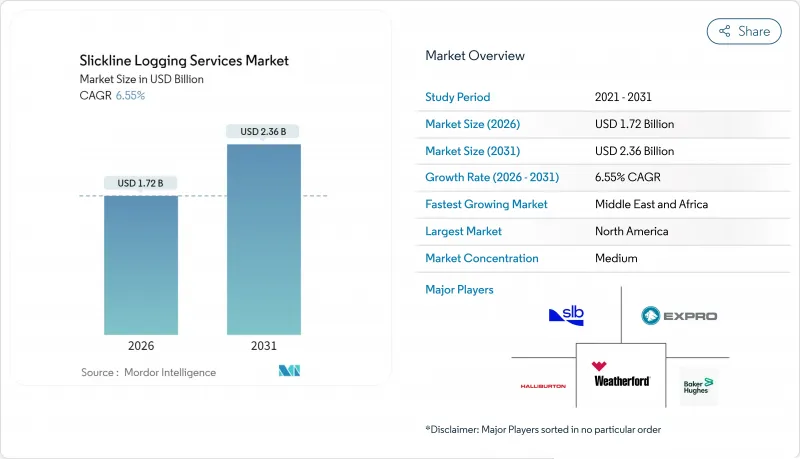
需求成长主要受以下因素驱动:营运商倾向于生产最佳化;深水和超深水计划持续增加;以及数位化滑线平台快速普及,这些平台无需停产即可进行即时井下诊断。其他支援因素包括:老旧油井积压日益增多;国家石油公司竞标综合服务;以及新兴的碳捕获试验计画,这些项目需要微创测井。人工智慧和自主作业技术的不断进步,正在将传统的机械维修作业转变为数据驱动型干预措施,从而延长资产寿命并降低开采成本。
全球滑线测井服务市场趋势与洞察
深海和超深海钻探的可持续升级再造
预计到2025年,深水钻井钻机运转率将维持在82%,这支撑了强劲的日租金,并满足了在极端压力和温度条件下对可靠的滑线作业的需求。伍德赛德公司的Trion开发计划(水深2500米,共18口井)等项目表明,地层评估和井完整性监测的持续需求源自于其复杂性。各国石油公司正将滑线服务纳入多年期综合钻井合同,以实现营运协同效应并减少钻机移动。即时滑线诊断技术与人工智慧钻探平臺集成,以维持井控并优化储存接触。在偏远水域进行的长期宣传活动提升了多功能滑线管柱的价值,这些管柱无需额外调动即可完成机械作业、测井作业和清理作业。
老旧油井的干预成本不断增加
2030年,全球26万口在运作中油井中约有三分之二的井龄将超过10年,预计全球井下作业支出将达到580亿美元,业者的目标是使每口井的平均产量提高10%。滑线已从简单的机械维修发展到配备高清摄影机和电子仪表的平台,为钻井平台作业提供了一种成本更低的替代方案。北海业者正在试验利用滑线进行跨接气举作业,预计将深水维修成本降低一半。其他应用包括机器人筛管回收和化学药剂注入,这两项技术都增强了针对性干预而非新钻井的经济合理性。
原油价格波动正在抑制上游产业的资本投资。
儘管服务成本有所下降,但美国独立石油公司已将2024年的资本支出计画缩减至617亿美元至654亿美元,凸显了油价波动可能导致非必要干预措施推迟的风险。大型石油公司继续将支出控制在230亿美元至250亿美元的狭窄范围内,进一步强化了其谨慎的资本配置策略。由于滑线作业通常具有选择性,当西德州中质原油(WTI)价格跌至损益平衡点以下时,业者会延后优先顺序较低的作业。工程和安装服务的通膨进一步加剧了干预预算的压力。服务提供者正透过基于绩效的定价和多井套餐来应对这项挑战,这些方案将付款与新增采油量挂钩,而不是与现场作业时间挂钩。
细分市场分析
2025年,井下套管作业占滑线测井服务市场份额的59.12%,预计2026年至2031年将以6.88%的复合年增长率快速成长。这表明营运商优先考虑从现有油井中获取价值,而非钻探新井。这种主导地位的驱动因素是老井数量的不断增加。到2030年,超过三分之二的油井井龄将超过10运作,这将持续推动对机械维修、产量剖面分析和水泥黏结评估的需求,而这些服务无需出井即可完成。数位化滑线平台可将压力、温度和流量资料即时传输到地面,将测井和机械作业整合到一次作业中,从而实现即时诊断并减少非生产时间。因此,与井下套管作业相关的滑线测井服务市场规模受益于作业频率和工具复杂性的双重成长。人工智慧可即时提案最佳工具串配置,以最大限度地提高增量采收率。
裸井作业虽然规模较小,但在初始井筒建造阶段以及需要精确评估储存接触面时,对于地层评估至关重要。这些作业需要直接接触岩体,但由于钻井预算限制和套管后返工频率降低,盈利有限。自主式滑线牵引机的进步使作业者能够执行多管完井作业,并透过狭窄井眼部署桥塞和跨接封隔器,从而扩大了套管后服务的范围。页岩气藏的再压裂计画进一步推动了需求,因为滑线牵引的隔离工具能够对成熟井进行目标增产,预计将最终采收率提高50%以上。这些因素共同作用,使套管作业成为收入成长的关键驱动力,而裸井服务则继续提供高价值的细分应用,与更广泛的滑线作业产品组合形成互补。
区域分析
北美地区在2025年之前将保持38.55%的收入份额,这得益于其庞大的老井存量和积极的压裂再作业项目。在鹰滩页岩油气区和巴肯页岩油气区,采用滑线压裂技术使最终可采储量(EUR)提高了50%以上,证实了该技术的经济可行性。在二迭纪盆地,人工智慧增强型数位化滑线装置正被越来越多地部署,以减少停机时间和甲烷排放。预计加拿大近海大西洋油田和墨西哥的Trion深水计划将拓展该地区页岩油气以外的收入来源。
预计到2031年,中东和非洲地区的复合年增长率将达到7.05%,这主要得益于上游7300亿美元的投资以及旨在以天然气替代发电领域液态燃料的「天然气优先」策略。阿布达比国家石油公司(ADNOC)和沙特阿美公司正在竞标一份综合性的多年期合同,该合同将涵盖滑线服务、钻井、完井和碳捕获监测等环节。尼日利亚超深水区和纳米比亚边远地区的油气发现需要高压高温的滑线设备,这为专业服务船队创造了机会。
亚太和欧洲正经历均衡成长。中国和印度正在南海和孟加拉湾进行更深的钻探,这些地区的高压高温储存需要使用光纤滑线进行即时遥测。欧洲北海的作业量持续稳定,营运商的目标是利用无钻机滑线作业系统将营运成本降低50%。南美洲受益于巴西的盐盐层下开发和阿根廷的瓦卡穆尔塔页岩油田开发,这两个项目均采用综合服务模式,确保在三到五年内提供多次服务。
其他福利:
- Excel格式的市场预测(ME)表
- 分析师支持(3个月)
目录
第一章 引言
- 研究假设和市场定义
- 调查范围
第二章调查方法
第三章执行摘要
第四章 市场情势
- 市场概览
- 即将进行的主要上游计划
- 市场驱动因素
- 深海和超深海钻探的持续繁荣週期
- 老旧油井的井下作业成本不断增加
- 快速采用数位化滑线平台
- 页岩/緻密油压裂计画增加了干预频率
- 国家石油公司(NOC)将滑线纳入综合服务竞标
- CCS试点井需要微创测井解决方案
- 市场限制
- 原油价格波动抑制了上游产业的资本投资。
- 加强对中间流体的健康、安全、环境和排放法规
- 全球合格的滑线人员短缺
- 2030年起,自主地下机器人将出现
- 供应链分析
- 监管环境
- 科技展望(数位滑线、生活数据、人工智慧)
- 波特五力模型
- 供应商的议价能力
- 买方的议价能力
- 新进入者的威胁
- 替代品的威胁
- 竞争对手之间的竞争
第五章 市场规模与成长预测
- 按孔类型
- 裸井
- 下套管井
- 按位置
- 陆上
- 离岸
- 按地区
- 北美洲
- 美国
- 加拿大
- 墨西哥
- 欧洲
- 德国
- 英国
- 挪威
- 北欧国家
- 俄罗斯
- 其他欧洲地区
- 亚太地区
- 中国
- 印度
- 韩国
- 东南亚国协
- 澳洲
- 亚太其他地区
- 南美洲
- 巴西
- 阿根廷
- 哥伦比亚
- 南美洲其他地区
- 中东和非洲
- 沙乌地阿拉伯
- 阿拉伯聯合大公国
- 南非
- 奈及利亚
- 埃及
- 其他中东和非洲地区
- 北美洲
第六章 竞争情势
- 市场集中度
- 策略趋势(併购、联盟、购电协议)
- 市场占有率分析(主要企业的市场排名和份额)
- 公司简介
- SLB
- Halliburton
- Baker Hughes
- Weatherford
- Expro Group
- Vallourec
- National Oilwell Varco
- Scientific Drilling
- Archer Ltd
- Superior Energy Services
- Nine Energy Service
- Altus Intervention
- TETRA Technologies
- Welltec
- TechnipFMC
- Nabors Industries
- NESR
- Axis Energy Services
- Patterson-UTI
第七章 市场机会与未来展望
The Slickline Logging Services Market was valued at USD 1.61 billion in 2025 and estimated to grow from USD 1.72 billion in 2026 to reach USD 2.36 billion by 2031, at a CAGR of 6.55% during the forecast period (2026-2031).
Demand is being propelled by operators' preference for production optimisation on existing wells, the steady rise in deep- and ultra-deepwater projects, and the rapid deployment of digital slickline platforms that enable real-time downhole diagnostics without halting production. Other supportive factors include the growing backlog of ageing wells, national oil companies' integrated service tenders, and emerging carbon-capture pilot programmes that require low-invasion logging. Continued advancements in artificial intelligence and autonomous operations are transforming conventional mechanical workovers into data-rich interventions that extend asset life and reduce lifting costs.
Global Slickline Logging Services Market Trends and Insights
Sustained Offshore Deep- & Ultra-Deepwater Drilling Upcycle
Deepwater rig utilisation stood at 82% in 2025, keeping day-rates firm and sustaining demand for robust slickline intervention under extreme pressure and temperature conditions. Projects such as Woodside's Trion development-18 wells in 2,500 m water-illustrate the complexity that fuels a continual need for formation evaluation and well-integrity surveillance. National oil companies are locking slickline services into multi-year integrated drilling contracts to capture operational synergies and reduce rig moves. Real-time slickline diagnostics now integrate with AI-enabled drilling platforms to maintain well control and optimize reservoir contact. Longer campaign durations in remote waters heighten the value of multi-function slickline strings that complete mechanical, logging, and clean-out tasks without additional mobilisation.
Rising Well-Intervention Spend on Ageing Wells
Roughly two-thirds of the world's 260,000 active wells will be more than 10 years old by 2030, pushing global intervention spend toward USD 58 billion as operators chase a 10% average output uplift per well. Slickline has evolved from simple mechanical retrieval into a platform for high-definition cameras and electronic gauges, offering a low-cost alternative to rig-based workovers. North Sea operators are piloting slickline-mediated straddle gas-lift activation that cuts deepwater workover costs by half. Additional applications include robotic screen retrieval and chemical deployment, all of which strengthen the economic case for targeted intervention over fresh drilling.
Crude-Price Volatility Curbing Upstream CAPEX
US independents trimmed their 2024 capital plans to USD 61.7-65.4 billion, despite lower service costs, highlighting how price swings can postpone discretionary interventions. Major companies continue to spend within a tight USD 23-25 billion band, reinforcing cautious cash allocation. Because slickline work is often elective, operators defer lower-priority jobs when WTI falls below breakeven thresholds. Inflation in engineering and installation services adds further pressure to intervention budgets. Providers respond with outcome-based pricing and multi-well packages that tie payment to incremental barrels recovered rather than time on-site.
Other drivers and restraints analyzed in the detailed report include:
- Rapid Adoption of Digital Slickline Platforms
- Shale/Tight-Oil Re-Frac Programmes Driving Frequent Interventions
- Tightening HSE & Emissions Regulations on Intervention Fluids
For complete list of drivers and restraints, kindly check the Table Of Contents.
Segment Analysis
Cased hole interventions commanded 59.12% of slickline logging services market share in 2025 and are forecast to register the fastest 6.88% CAGR from 2026-2031, underscoring operators' preference to extract additional value from existing wellbores rather than drill new ones. This dominance is rooted in the growing inventory of ageing wells-more than two-thirds will surpass 10 years of service by 2030-which keeps demand high for mechanical repairs, production profiling, and cement-bond evaluation that can be executed without pulling tubing. Digital slickline platforms stream live pressure, temperature, and flow data to the surface, enabling real-time diagnostics and reducing non-productive time by combining logging and mechanical tasks in a single run. The slickline logging services market size associated with these cased operations, therefore, benefits from both higher job frequency and expanding tool complexity, as artificial intelligence recommends optimal tool-string configurations on the fly to maximize incremental barrels recovered.
Open hole work represents the smaller share of activity, yet remains essential for formation evaluation during initial well construction or when precise reservoir contact is critical. While these jobs require direct rock exposure, their revenue potential is limited by drilling budgets and fewer repeat visits once a well is cased. Advancements in autonomous slickline tractors now enable operators to navigate multi-string completions and deploy bridge plugs or straddle packers through restrictive profiles, thereby widening the scope of cased services. Re-fracturing programs in shale plays further amplify demand, as slickline-conveyed isolation tools enable targeted stimulation that can increase estimated ultimate recovery by 50% or more in a mature well. Together, these factors position cased hole operations as the primary engine of revenue expansion, while open hole services continue to deliver high-value niche applications that complement the broader slickline portfolio.
The Slickline Logging Services Market Report is Segmented by Hole Type (Open Hole and Cased Hole), Location of Deployment (Onshore and Offshore), and Geography (North America, Europe, Asia-Pacific, South America, and Middle East and Africa). The Market Sizes and Forecasts are Provided in Terms of Value (USD).
Geography Analysis
North America retained a 38.55% revenue share in 2025, driven by a vast ageing well stock and prolific re-fracturing programs. The Eagle Ford and Bakken plays recorded EUR gains exceeding 50% when slickline-enabled re-fracs were executed, confirming the technique's economic relevance. AI-augmented digital slickline units are increasingly deployed in the Permian Basin to cut downtime and lower methane intensity. Canada's Atlantic offshore and Mexico's Trion deepwater project are set to widen regional revenue streams beyond shale.
The Middle East & Africa is forecast to grow at a 7.05% CAGR to 2031, supported by USD 730 billion of upstream spending and gas-directed strategies aimed at substituting liquid fuels in power generation. ADNOC and Saudi Aramco are issuing multi-year, integrated tenders that bundle slickline services with drilling, completion, and carbon capture monitoring. Nigeria's ultra-deepwater discoveries and Namibia's frontier finds require high-pressure, high-temperature slickline tool strings, creating opportunities for specialized service fleets.
Asia-Pacific and Europe provide balanced growth. China and India are drilling deeper in the South China Sea and Bay of Bengal, where HPHT reservoirs need fibre-optic slickline for live telemetry. Europe's North Sea continues to generate steady intervention volumes as operators target 50% work-over cost cuts through rigless slickline packages. South America remains buoyed by Brazil's pre-salt developments and Argentina's Vaca Muerta shale, both adopting integrated service models that secure multi-service lineups for three-to-five-year windows.
- SLB
- Halliburton
- Baker Hughes
- Weatherford
- Expro Group
- Vallourec
- National Oilwell Varco
- Scientific Drilling
- Archer Ltd
- Superior Energy Services
- Nine Energy Service
- Altus Intervention
- TETRA Technologies
- Welltec
- TechnipFMC
- Nabors Industries
- NESR
- Axis Energy Services
- Patterson-UTI
Additional Benefits:
- The market estimate (ME) sheet in Excel format
- 3 months of analyst support
TABLE OF CONTENTS
1 Introduction
- 1.1 Study Assumptions & Market Definition
- 1.2 Scope of the Study
2 Research Methodology
3 Executive Summary
4 Market Landscape
- 4.1 Market Overview
- 4.2 Major Upcoming Upstream Projects
- 4.3 Market Drivers
- 4.3.1 Sustained offshore deep- & ultra-deepwater drilling upcycle
- 4.3.2 Rising well-intervention spend on aging wells
- 4.3.3 Rapid adoption of digital slickline platforms
- 4.3.4 Shale/tight-oil re-frac programs driving frequent interventions
- 4.3.5 NOCs bundling slickline into integrated service tenders
- 4.3.6 CCS pilot wells needing low-invasion logging solutions
- 4.4 Market Restraints
- 4.4.1 Crude-price volatility curbing upstream CAPEX
- 4.4.2 Tightening HSE & emissions regulations on intervention fluids
- 4.4.3 Global shortage of certified slickline crews
- 4.4.4 Emergence of autonomous down-hole robots post-2030
- 4.5 Supply-Chain Analysis
- 4.6 Regulatory Landscape
- 4.7 Technological Outlook (Digital Slickline, Live-well data, AI)
- 4.8 Porter's Five Forces
- 4.8.1 Bargaining Power of Suppliers
- 4.8.2 Bargaining Power of Buyers
- 4.8.3 Threat of New Entrants
- 4.8.4 Threat of Substitutes
- 4.8.5 Competitive Rivalry
5 Market Size & Growth Forecasts
- 5.1 By Hole Type
- 5.1.1 Open Hole
- 5.1.2 Cased Hole
- 5.2 By Location of Deployment
- 5.2.1 Onshore
- 5.2.2 Offshore
- 5.3 By Geography
- 5.3.1 North America
- 5.3.1.1 United States
- 5.3.1.2 Canada
- 5.3.1.3 Mexico
- 5.3.2 Europe
- 5.3.2.1 Germany
- 5.3.2.2 United Kingdom
- 5.3.2.3 Norway
- 5.3.2.4 NORDIC Countries
- 5.3.2.5 Russia
- 5.3.2.6 Rest of Europe
- 5.3.3 Asia-Pacific
- 5.3.3.1 China
- 5.3.3.2 India
- 5.3.3.3 South Korea
- 5.3.3.4 ASEAN Countries
- 5.3.3.5 Australia
- 5.3.3.6 Rest of Asia-Pacific
- 5.3.4 South America
- 5.3.4.1 Brazil
- 5.3.4.2 Argentina
- 5.3.4.3 Colombia
- 5.3.4.4 Rest of South America
- 5.3.5 Middle East and Africa
- 5.3.5.1 Saudi Arabia
- 5.3.5.2 United Arab Emirates
- 5.3.5.3 South Africa
- 5.3.5.4 Nigeria
- 5.3.5.5 Egypt
- 5.3.5.6 Rest of Middle East and Africa
- 5.3.1 North America
6 Competitive Landscape
- 6.1 Market Concentration
- 6.2 Strategic Moves (M&A, Partnerships, PPAs)
- 6.3 Market Share Analysis (Market Rank/Share for key companies)
- 6.4 Company Profiles (includes Global level Overview, Market level overview, Core Segments, Financials as available, Strategic Information, Products & Services, and Recent Developments)
- 6.4.1 SLB
- 6.4.2 Halliburton
- 6.4.3 Baker Hughes
- 6.4.4 Weatherford
- 6.4.5 Expro Group
- 6.4.6 Vallourec
- 6.4.7 National Oilwell Varco
- 6.4.8 Scientific Drilling
- 6.4.9 Archer Ltd
- 6.4.10 Superior Energy Services
- 6.4.11 Nine Energy Service
- 6.4.12 Altus Intervention
- 6.4.13 TETRA Technologies
- 6.4.14 Welltec
- 6.4.15 TechnipFMC
- 6.4.16 Nabors Industries
- 6.4.17 NESR
- 6.4.18 Axis Energy Services
- 6.4.19 Patterson-UTI
7 Market Opportunities & Future Outlook
- 7.1 White-space & Unmet-Need Assessment

 2026年全球有线服务市场报告
 全球电缆测井服务市场:市场规模、占有率、成长率、产业分析、类型、应用和区域分析,未来预测(2026-2034)
 电缆作业服务市场规模、份额和成长分析(按电缆类型、服务、井类型和地区划分)-2026-2033年产业预测
 滑线服务市场规模、份额和成长分析(按滑线工具、部署方法、作业方式和地区划分)-2026-2033年产业预测
 按技术、服务类型、最终用户、速度、应用和分销管道分類的缆线服务市场 - 全球预测 2025-2032
 有线服务市场规模及预测 2025-2031、全球及地区份额、趋势及成长机会分析报告涵盖范围:按类型、孔类型、服务类型、应用和地理
 有线服务市场-全球产业规模、份额、趋势、机会和预测,按服务类型、应用、技术、地区和竞争细分,2020-2030 年预测钢丝绳服务市场-全球产业规模、份额、趋势、机会及预测(按钢丝绳工具、应用、地区及竞争细分,2020-2030 年预测)
 2032 年有线服务市场预测:按有线类型、井类型、服务、位置、技术、应用、最终用户和地区进行的全球分析
 2025 年至 2033 年有线服务市场报告,按有线类型(电力线、钢丝)、服务类型(完井、干预、测井)、孔类型(裸眼、套管井)、应用(陆上、海上)和地区划分