


 |
市场调查报告书
商品编码
1906034
计划管理软体系统:市场占有率分析、产业趋势与统计、成长预测(2026-2031)Project Management Software Systems - Market Share Analysis, Industry Trends & Statistics, Growth Forecasts (2026 - 2031) |
||||||

※ 本网页内容可能与最新版本有所差异。详细情况请与我们联繫。
2025年计划管理软体系统市值为97.6亿美元,预计2031年将达到230.9亿美元,高于2026年的112.7亿美元。
预测期(2026-2031 年)的复合年增长率预计为 15.42%。
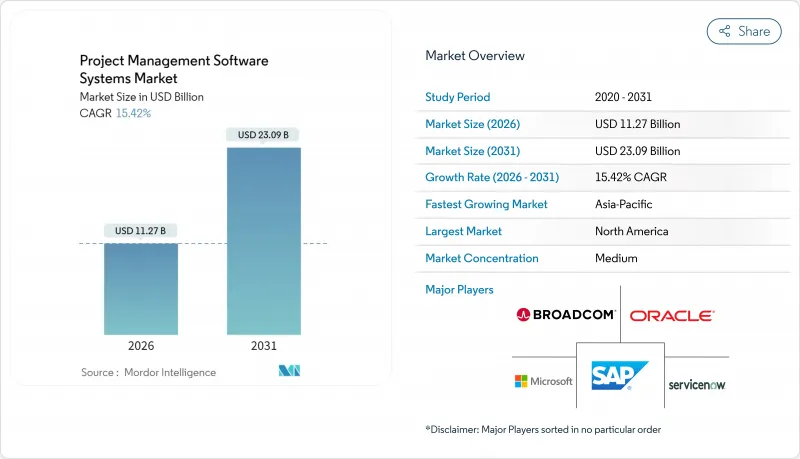
此次扩展基于云端优先部署、低程式码可配置性和预测分析,这些特性共同将计划监控从任务追踪提升到策略协调。随着分散式团队需要即时协作,以及企业寻求将专案资料与财务、人力资源和客户系统整合以实现统一的可见性,市场需求正在不断增长。混合部署的成长速度最快,因为受监管行业仍然需要本地资料管理。中小企业 (SME) 透过绕过传统的实施障碍来加速采用,而人工智慧原生功能则增强了风险管理和成本预测。随着供应商整合特定产业的工作流程和开放的 API 生态系统,竞争也日益激烈。
全球计划管理软体系统市场趋势与洞察
远端和混合企划团队的云端优先部署
组织机构报告称,从桌面工具迁移到云端原生平台后,任务完成速度提高了 54%。计划管理软体系统市场正蓬勃发展,即时同步功能使分散式团队能够跨时区保持工作进度。 IT 部门更青睐云端的可扩展性,因为它减轻了容量规划的负担。混合模式市场预计将以 18.4% 的复合年增长率成长,因为受监管行业要求在可访问性和数据控制之间取得平衡。供应商正在积极回应,提供资料居住选项,在满足资料主权要求的同时,保持顺畅的协作。
将您的专案管理平台与企业级 SaaS 堆迭集成
企业平均运行 976 个应用程序,但只有 28% 的应用程式实现了深度集成,导致专案资料流缓慢。现代平台将自身定位为整合中心,连接财务、客户关係管理 (CRM) 和人力资源 (HR) 系统,使得计划管理软体系统在企业架构中的重要性日益凸显。预计到 2025 年,SaaS 整合市场规模将超过 150 亿美元,而拥有全面整合策略的公司生产力提高了 30%。云端原生供应商凭藉开放的 API 和预先建置的连接器获得优势,从而减少了对昂贵的客製化编码的需求。
遗留资产的迁移和定製成本很高
由于资料映射、检验和使用者培训需要耗费大量人力,企业面临的实施成本可能高达许可费的三倍。迁移成本平均可能比许可费高出 30%,每Terabyte存檔资料的成本可达 15,000 美元。这项障碍会减缓更新週期,并降低计划管理软体系统在拥有高度客製化工作流程的现有企业中的市场渗透率。
细分市场分析
到2025年,云端采用将占总营收的74.20%,而混合配置将在计划管理软体系统市场中展现出最强劲的成长势头,年复合成长率将达到18.12%。混合解决方案将本机储存库与云端工作空间同步,这种双重特性正吸引受资料居住法规约束的企业。本地部署解决方案在政府和国防领域依然存在,但随着云端区域安全认证日益严格,其市场份额正在萎缩。
混合模式的兴起反映了用于管理无缝离线同步、加密隧道和选择性储存的工具的进步。建设公司将图纸储存在本地伺服器上,同时透过云端控制面板共用现场更新资讯。供应商透过提供精细化的租户控制和围绕合规性来提升销售路径来脱颖而出。
到2025年,大型企业将占专案管理软体支出的60.35%,而中小企业的复合年增长率将达到16.89%,这将彻底改变计划管理软体市场的规模。成长主要集中在亚太地区,当地政府正在资助数位技能发展津贴。日本的中小企业正在采用人工智慧辅助的日程安排来应对劳动力短缺问题。价格层级中最低用户数量的取消降低了市场进入门槛。
随着大型企业在市场饱和地区的成长趋于平缓,供应商开始推出中小企业的精简版产品和社群活动。然而,跨国公司仍然是重要的收入来源,这主要得益于其复杂的整合和高端分析软体包。这种双重需求为产品团队带来了挑战:如何在保持扩充性的同时,避免增加实施流程的复杂性。
区域分析
预计到2025年,北美将占据计划管理软体系统市场36.12%的份额。该地区的企业凭藉强大的基础设施和大规模的IT预算,部署端到端的计划生态系统。微软在2024年实现了16%的营收成长,达到2,450亿美元,主要得益于Microsoft 365中整合的计划管理功能。创新中心仍在持续开发人工智慧模组,但随着市场应用接近饱和,区域成长速度正在放缓。
预计到2031年,亚太地区的复合年增长率将达到16.06%,是全球成长最快的地区。中国的SaaS市场正以每年约30%的速度成长,跨国公司纷纷采用整合的Salesforce和Azure技术堆迭来管理跨国专案。在云端运算普及和Start-Ups企业蓬勃发展的推动下,印度的SaaS收入预计将从2023年的71.8亿美元成长到2032年的629.3亿美元。东南亚各地的中小企业正在采用符合当地合规标准的在地化专案管理套件。
在欧洲,随着GDPR强制要求在地化能力,提供欧盟资料中心和进阶加密技术的供应商正经历稳定成长。在南美和中东/非洲,宽频和支付基础设施的改善推动了云端订阅用户的成长,此前由于基础设施不足而受到阻碍。随着连接成本的持续下降,供应商预计将实现两位数的成长。
其他福利:
- Excel格式的市场预测(ME)表
- 分析师支持(3个月)
目录
第一章 引言
- 研究假设和市场定义
- 调查范围
第二章调查方法
第三章执行摘要
第四章 市场情势
- 市场概览
- 市场驱动因素
- 远端和混合企划团队的云端优先采用
- 将您的专案管理平台与企业级 SaaS 堆迭集成
- 低程式码/无程式码可配置性推动了中小企业的采用。
- 人工智慧驱动的进度和成本偏差预测分析
- 行业专用计划管理套件(例如,建设业、医疗产业)
- 将ESG合规报告嵌入计划工作流程
- 市场限制
- 遗留资产的迁移和定製成本很高
- 多租户云端中的资料主权和隐私问题
- 功能商品化导致供应商锁定风险增加
- 变革管理疲劳会阻碍大规模采用
- 关键法规结构评估
- 产业价值链分析
- 技术展望
- 波特五力分析
- 供应商的议价能力
- 买方的议价能力
- 新进入者的威胁
- 替代品的威胁
- 竞争对手之间的竞争
- 关键相关人员影响评估
- 主要用例和案例研究
- 宏观经济因素对市场的影响
- 投资分析
第五章 市场区隔
- 透过部署
- 云
- 本地部署
- 按组织规模
- 大公司
- 小型企业
- 按最终用户行业划分
- 资讯科技和电信
- 卫生保健
- 建筑和基础设施
- BFSI
- 政府和公共部门
- 製造业
- 其他的
- 按合约类型
- 月度订阅
- 年度订阅
- 一次许可证
- 按地区
- 北美洲
- 美国
- 加拿大
- 墨西哥
- 南美洲
- 巴西
- 阿根廷
- 南美洲其他地区
- 欧洲
- 英国
- 德国
- 法国
- 义大利
- 西班牙
- 北欧国家
- 其他欧洲地区
- 中东和非洲
- 中东
- 沙乌地阿拉伯
- 阿拉伯聯合大公国
- 土耳其
- 其他中东地区
- 非洲
- 南非
- 埃及
- 奈及利亚
- 其他非洲地区
- 中东
- 亚太地区
- 中国
- 印度
- 日本
- 韩国
- ASEAN
- 澳洲
- 纽西兰
- 亚太其他地区
- 北美洲
第六章 竞争情势
- 市场集中度
- 策略趋势
- 市占率分析
- 公司简介
- Adobe Inc.(Workfront)
- AEC Software Inc.
- Asana Inc.
- Atlassian Corporation PLC
- Basecamp LLC
- Broadcom Inc.(Clarity PPM)
- ClickUp(Mango Technologies, Inc.)
- Microsoft Corporation
- Monday.com Ltd.
- Oracle Corporation
- Planview Inc.
- Procore Technologies Inc.
- SAP SE
- ServiceNow Inc.
- Smartsheet Inc.
- Teamwork.com Ltd.
- Trello Enterprise(Atlassian)
- Unit4 NV
- Wrike Inc.(Citrix Systems)
- Zoho Corporation Pvt Ltd.
第七章 市场机会与未来展望
The project management software systems market was valued at USD 9.76 billion in 2025 and estimated to grow from USD 11.27 billion in 2026 to reach USD 23.09 billion by 2031, at a CAGR of 15.42% during the forecast period (2026-2031).
Expansion remains anchored in cloud-first deployment, low-code configurability, and predictive analytics that collectively upgrade project oversight from task tracking to strategic orchestration. Demand intensifies as distributed teams require real-time collaboration, and enterprises integrate project data with finance, HR, and customer systems for unified visibility. Hybrid deployment registers the fastest growth because regulated industries still need local data control. Small and medium enterprises (SMEs) accelerate adoption by bypassing traditional implementation hurdles, while AI-native features strengthen risk management and cost forecasting. Competitive intensity increases as vendors embed industry-specific workflows and open API ecosystems.
Global Project Management Software Systems Market Trends and Insights
Cloud-First Adoption for Remote and Hybrid Project Teams
Organizations report 54% faster task completion when shifting from desktop tools to cloud-native platforms. The project management software systems market gains traction because real-time synchronization enables distributed teams to sustain momentum across time zones. IT departments prefer cloud scalability that removes capacity planning burdens. Hybrid models are projected to grow at an 18.4% CAGR because regulated sectors balance accessibility with data control. Vendors respond by offering data-residency options that satisfy sovereignty mandates while maintaining friction-free collaboration.
Integration of PM Platforms with Enterprise SaaS Stacks
Enterprises run an average of 976 applications, yet only 28% are meaningfully integrated, stalling project data flow. Modern platforms position themselves as integration hubs tied to finance, CRM, and HR systems, thereby increasing the relevance of project management software systems in enterprise architecture. The SaaS integration segment is projected to exceed USD 15 billion by 2025, and firms that deploy comprehensive integration strategies report 30% productivity lifts. Cloud-native vendors gain an advantage through open APIs and pre-built connectors, which reduce the need for expensive custom coding.
High Migration and Customization Costs for Legacy Estates
Enterprises face implementation bills that triple license fees because data mapping, validation, and user training are labor-intensive. Migration overruns average 30% and can reach USD 15,000 per terabyte of archives. The hurdle delays refresh cycles and slows the project management software systems market uptake among incumbents with heavily customized workflows.
Other drivers and restraints analyzed in the detailed report include:
- SME Uptake Boosted by Low-Code / No-Code Configurability
- AI-Driven Predictive Analytics for Schedule and Cost Variance
- Data-Sovereignty and Privacy Concerns in Multi-Tenant Clouds
For complete list of drivers and restraints, kindly check the Table Of Contents.
Segment Analysis
Cloud deployment accounted for 74.20% of revenue in 2025, but hybrid configurations grew at an 18.12% CAGR, signaling the strongest momentum within the project management software systems market. Hybrid solutions synchronize local repositories with cloud workspaces; this duality attracts firms bound by data residency statutes. On-premise solutions persist in government and defense, yet their share is shrinking as security certifications for cloud zones become tighter.
The hybrid rise reflects tools that now manage seamless offline sync, encrypted tunnels, and selective storage. Construction companies store drawings on local servers while sharing field updates through cloud dashboards. Vendors differentiate by offering granular tenancy controls, creating upsell paths around compliance.
Large enterprises controlled 60.35% of the 2025 spend, but SMEs chart a 16.89% CAGR, reshaping the project management software systems market size trajectory. Growth centers on the Asia-Pacific region, where local governments are funding digital upskilling grants. Japanese SMEs adopt AI-assisted scheduling to offset labor shortages. Pricing tiers remove user minimums, reducing the barrier to entry.
Enterprise growth plateaus in saturated regions, so vendors launch light editions and community events geared to smaller firms. Yet, multi-national corporations still anchor revenue with complex integrations and premium analytics bundles. Dual focus forces product teams to maintain scalability without complicating the onboarding process.
The Project Management Software Systems Market Report is Segmented by Deployment (Cloud and On-Premise), Organization Size (Large Enterprises, and Small and Medium Enterprises), End-User Industry (IT and Telecom, Healthcare, and More), Subscription Type (Monthly Subscription, Annual Subscription, and One-Time License), and Geography (North America, Europe, and More). The Market Forecasts are Provided in Terms of Value (USD).
Geography Analysis
North America held 36.12% of the project management software systems market in 2025. Enterprises there leverage robust infrastructure and sizable IT budgets to roll out end-to-end project ecosystems. Microsoft recorded 16% revenue growth to USD 245 billion in 2024, supported by integrated project functions within Microsoft 365. Innovation hubs continue to pioneer AI modules, yet regional growth moderates as penetration nears saturation.
Asia-Pacific grows at a 16.06% CAGR through 2031, the fastest across regions. China's SaaS segment is expanding at nearly 30% annually, with multinationals installing integrated Salesforce and Azure stacks to manage cross-border initiatives. India's SaaS revenue is forecast to increase from USD 7.18 billion in 2023 to USD 62.93 billion by 2032, driven by cloud adoption and startup momentum. SMEs across Southeast Asia adopt local-language PM suites that embed regional compliance norms.
Europe posts steady gains as GDPR compels localization features, rewarding vendors offering EU data centers and advanced encryption. South America, and Middle East, and Africa are now improving broadband and payment rails, nurturing cloud subscriptions previously held back by infrastructure gaps. Vendors anticipate double-digit uptake once connectivity costs fall further.
- Adobe Inc. (Workfront)
- AEC Software Inc.
- Asana Inc.
- Atlassian Corporation PLC
- Basecamp LLC
- Broadcom Inc. (Clarity PPM)
- ClickUp (Mango Technologies, Inc.)
- Microsoft Corporation
- Monday.com Ltd.
- Oracle Corporation
- Planview Inc.
- Procore Technologies Inc.
- SAP SE
- ServiceNow Inc.
- Smartsheet Inc.
- Teamwork.com Ltd.
- Trello Enterprise (Atlassian)
- Unit4 N.V.
- Wrike Inc. (Citrix Systems)
- Zoho Corporation Pvt Ltd.
Additional Benefits:
- The market estimate (ME) sheet in Excel format
- 3 months of analyst support
TABLE OF CONTENTS
1 INTRODUCTION
- 1.1 Study Assumptions and Market Definition
- 1.2 Scope of the Study
2 RESEARCH METHODOLOGY
3 EXECUTIVE SUMMARY
4 MARKET LANDSCAPE
- 4.1 Market Overview
- 4.2 Market Drivers
- 4.2.1 Cloud-First Adoption for Remote and Hybrid Project Teams
- 4.2.2 Integration of PM Platforms with Enterprise SaaS Stacks
- 4.2.3 SME Uptake Boosted by Low-Code / No-Code Configurability
- 4.2.4 AI-Driven Predictive Analytics for Schedule and Cost Variance
- 4.2.5 Vertical-Specific PM Suites (e.g., Construction, Healthcare)
- 4.2.6 ESG Compliance Reporting Embedded in Project Workflows
- 4.3 Market Restraints
- 4.3.1 High Migration and Customization Costs for Legacy Estates
- 4.3.2 Data-Sovereignty and Privacy Concerns in Multi-Tenant Clouds
- 4.3.3 Feature Commoditization Heightening Vendor-Lock-in Risk
- 4.3.4 Change-Management Fatigue Curbing Large-Scale Roll-Outs
- 4.4 Evaluation of Critical Regulatory Framework
- 4.5 Industry Value Chain Analysis
- 4.6 Technological Outlook
- 4.7 Porter's Five Forces Analysis
- 4.7.1 Bargaining Power of Suppliers
- 4.7.2 Bargaining Power of Buyers
- 4.7.3 Threat of New Entrants
- 4.7.4 Threat of Substitutes
- 4.7.5 Competitive Rivalry
- 4.8 Impact Assessment of Key Stakeholders
- 4.9 Key Use Cases and Case Studies
- 4.10 Impact on Macroeconomic Factors of the Market
- 4.11 Investment Analysis
5 MARKET SEGMENTATION
- 5.1 By Deployment
- 5.1.1 Cloud
- 5.1.2 On-premise
- 5.2 By Organization Size
- 5.2.1 Large Enterprises
- 5.2.2 Small and Medium Enterprises
- 5.3 By End-user Industry
- 5.3.1 IT and Telecom
- 5.3.2 Healthcare
- 5.3.3 Construction and Infrastructure
- 5.3.4 BFSI
- 5.3.5 Government and Public Sector
- 5.3.6 Manufacturing
- 5.3.7 Others
- 5.4 By Subscription Type
- 5.4.1 Monthly Subscription
- 5.4.2 Annual Subscription
- 5.4.3 One-time License
- 5.5 By Geography
- 5.5.1 North America
- 5.5.1.1 United States
- 5.5.1.2 Canada
- 5.5.1.3 Mexico
- 5.5.2 South America
- 5.5.2.1 Brazil
- 5.5.2.2 Argentina
- 5.5.2.3 Rest of South America
- 5.5.3 Europe
- 5.5.3.1 United Kingdom
- 5.5.3.2 Germany
- 5.5.3.3 France
- 5.5.3.4 Italy
- 5.5.3.5 Spain
- 5.5.3.6 Nordics
- 5.5.3.7 Rest of Europe
- 5.5.4 Middle East and Africa
- 5.5.4.1 Middle East
- 5.5.4.1.1 Saudi Arabia
- 5.5.4.1.2 United Arab Emirates
- 5.5.4.1.3 Turkey
- 5.5.4.1.4 Rest of Middle East
- 5.5.4.2 Africa
- 5.5.4.2.1 South Africa
- 5.5.4.2.2 Egypt
- 5.5.4.2.3 Nigeria
- 5.5.4.2.4 Rest of Africa
- 5.5.4.1 Middle East
- 5.5.5 Asia-Pacific
- 5.5.5.1 China
- 5.5.5.2 India
- 5.5.5.3 Japan
- 5.5.5.4 South Korea
- 5.5.5.5 ASEAN
- 5.5.5.6 Australia
- 5.5.5.7 New Zealand
- 5.5.5.8 Rest of Asia-Pacific
- 5.5.1 North America
6 COMPETITIVE LANDSCAPE
- 6.1 Market Concentration
- 6.2 Strategic Moves
- 6.3 Market Share Analysis
- 6.4 Company Profiles (includes Global level Overview, Market level overview, Core Segments, Financials as available, Strategic Information, Market Rank/Share for key companies, Products and Services, and Recent Developments)
- 6.4.1 Adobe Inc. (Workfront)
- 6.4.2 AEC Software Inc.
- 6.4.3 Asana Inc.
- 6.4.4 Atlassian Corporation PLC
- 6.4.5 Basecamp LLC
- 6.4.6 Broadcom Inc. (Clarity PPM)
- 6.4.7 ClickUp (Mango Technologies, Inc.)
- 6.4.8 Microsoft Corporation
- 6.4.9 Monday.com Ltd.
- 6.4.10 Oracle Corporation
- 6.4.11 Planview Inc.
- 6.4.12 Procore Technologies Inc.
- 6.4.13 SAP SE
- 6.4.14 ServiceNow Inc.
- 6.4.15 Smartsheet Inc.
- 6.4.16 Teamwork.com Ltd.
- 6.4.17 Trello Enterprise (Atlassian)
- 6.4.18 Unit4 N.V.
- 6.4.19 Wrike Inc. (Citrix Systems)
- 6.4.20 Zoho Corporation Pvt Ltd.
7 MARKET OPPORTUNITIES AND FUTURE OUTLOOK
- 7.1 White-space and Unmet-need Assessment

 2026年全球计划合管理市场报告
 计划合管理 (PPM) 市场分析及至 2035 年预测:按类型、产品类型、服务、技术、组件、应用、部署类型、最终用户、模组和功能划分
 全球计划合管理市场规模、份额、趋势和成长分析报告(2026-2034)
 计划合管理市场 - 全球产业规模、份额、趋势、机会及预测(按组件、部署类型、企业规模、应用、垂直产业、地区和竞争格局划分),2021-2031年
 日本计划与组合管理市场报告:按组件、解决方案类型、部署类型、组织规模、产业和地区划分,2026-2034 年
 计划合管理市场规模、份额和成长分析(按产品类型、部署类型、组织规模和地区划分)-2026-2033年产业预测
 计划合管理市场:按组件、所有者、部署方式、公司规模、应用和行业划分 - 2025-2032 年全球预测
 全球计划合管理 (PPM) 软体市场,2025-2029
 计划合管理市场规模、份额、趋势分析报告:按解决方案、平台、公司规模、部署、最终用途、地区、细分市场预测,2025 年至 2030 年
 计划合管理:市场占有率分析、产业趋势与统计、成长预测(2025-2030 年)