


 |
市场调查报告书
商品编码
1906124
乘用车配件:市场占有率分析、产业趋势与统计、成长预测(2026-2031)Passenger Car Accessories - Market Share Analysis, Industry Trends & Statistics, Growth Forecasts (2026 - 2031) |
||||||

※ 本网页内容可能与最新版本有所差异。详细情况请与我们联繫。
2025年乘用车配件市场价值为2,652.7亿美元,预计到2031年将达到3,654.8亿美元,而2026年为2,798.2亿美元。
预计在预测期(2026-2031 年)内,复合年增长率将达到 5.49%。
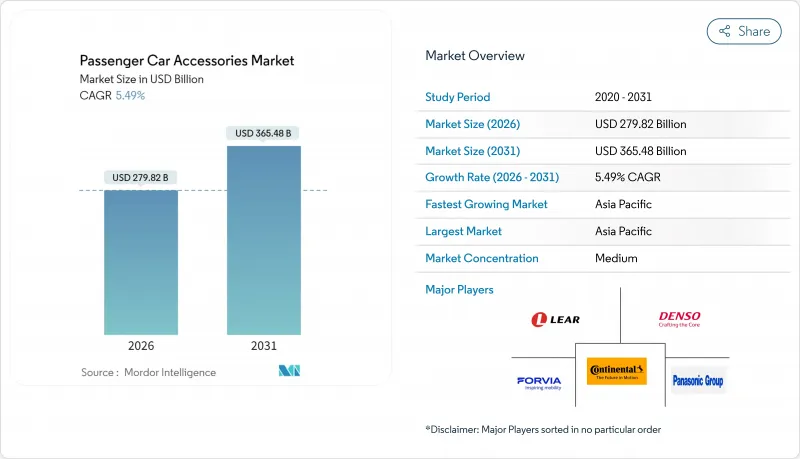
SUV和跨界车销售成长、电商主导的售后市场扩张以及汽车製造商向订阅式联网汽车功能转型,共同推动了汽车配件市场的稳定成长。亚太地区保持了其需求主导,这反映了中国庞大的零件製造规模以及印度对电动车的快速普及。内装升级,尤其是资讯娱乐系统和智慧表面解决方案,持续推动收入成长,而外观配件则因生活方式的改变和轻量化电动车设计而呈现成长动能。平台整合、ADAS功能配件以及永续材料创新正在重塑汽车配件市场的价值结构,因此市场竞争强度仍然适中。
全球乘用车配件市场趋势与洞察
SUV和CUV配件需求快速成长
运动型多用途车 (SUV) 和跨界车 (CUV) 平台正日益主导汽车配件需求,进而带动了车顶架、踏脚板和防护覆层等在轿车上鲜少需要的配件的开发。紧凑型 SUV 在都市区的普及刺激了个人化需求,而中国消费者如今也越来越倾向于追随西方的配件潮流。这种转变推动了外观配件市场的收入成长,同时也促使需要对支援高级驾驶辅助系统 (ADAS) 的配件进行重新设计,以避免遮挡感测器的视线。那些通过认证确保产品感测器完整性的配件供应商,在整个汽车配件市场中占据高端地位。
电子商务主导的售后市场成长
线上汽车配件入口网站的成长速度超过了实体店,人工智慧驱动的适配工具有助于提高转换率并降低退货率。光是NAPA Online在2025年5月就处理了217,385笔交易,充分展现了纯线上网站的规模经济效益。全球扩张使中小品牌无需经销商即可满足长尾需求。然而,数位市场也助长了仿冒品的流通,因此需要投资于认证技术,以维护信任并保护不断增长的线上汽车零件市场。
假冒伪劣和灰色市场零件的普遍存在
仿冒零件会削弱消费者信心,并引发安全召回。由业界主导的「抵制假冒产品」宣传活动旨在强调劣质煞车零件在负荷下失效的风险。电子商务的匿名性加剧了这种风险,尤其是在价格敏感地区。基于区块链的原产地控制系统和包装上的QR码认证旨在遏制这一问题,但实施成本给小规模供应商带来了沉重负担。
细分市场分析
预计到2025年,内装配件将占汽车配件市场57.68%的份额,因为消费者优先考虑资讯娱乐系统升级、豪华座椅套和电子安全系统。这个细分市场受益于汽车製造商向软体定义车辆的转型,软体定义车辆可以透过空中下载(OTA)更新无缝整合新功能。地垫、隔热座椅套和人工智慧增强型环境灯等产品将在车辆的整个生命週期中保持持续的销售。
外饰配件依然是成长最快的细分市场,复合年增长率高达 8.18%。 LED 照明套件、空气动力学车身加强件和多功能车顶行李架系统深受追求个性与实用性的 SUV 车主欢迎。在越野旅游和积极生活方式交会的地区,市场需求特别强劲。随着电动车的日益普及,为避免续航里程损失而转向轻量化复合材料,正推动汽车外饰配件市场以高于平均水平的速度成长。
2025年,OEM通路凭藉原厂认证零件和保固服务,将维持75.63%的市占率。汽车製造商正利用联网汽车遥测技术,直接透过车载资讯娱乐系统萤幕销售服务计画和订阅式配件功能。这种整合式模式将消费者牢牢锁定在品牌生态系统中,有助于稳定整个汽车配件市场的利润率。
受电子商务便利性、产品选择范围扩大和价格竞争的推动,汽车后市场正以9.71%的复合年增长率高速成长。人工智慧驱动的库存管理工具使独立经销商能够实现与原厂配件媲美的组装品质。因此,汽车配件产业正在经历渐进式的重新平衡:原厂配件製造商(OEM)试图透过软体锁定和专有数据通讯协定来保护其市场份额,而数位平台则降低了小众品牌的准入门槛,并促进了跨境销售。
区域分析
预计到2025年,亚太地区将占全球营收的63.78%,并在2031年之前以7.63%的复合年增长率持续成长。中国的零件製造能力正呈指数级增长,为整车厂配套(OEM)和售后市场供应链提供强力支撑。印度大力发展电动车,推动了对适合当地路况的轻量化模组化附加零件的需求。日本在设计和人机介面(HMI)领域处于主导地位,而韩国则在显示器和电池整合方面为供应链深度提供了支援。在东协市场,可支配收入的成长和线上零售的蓬勃发展正在推动汽车配件市场的扩张。
北美仍然是重要的收入来源。车辆老化和浓厚的DIY文化推动了地垫、照明设备和拖车设备的销售。安全法规的差异影响了配件认证,加拿大和墨西哥仍然是重要的生产和分销地点。
欧洲正凭藉其工程技术传统,在应对复杂的监管环境的同时,不断提升自身竞争力。欧盟第二版通用安全法规(EU General Safety Regulation II)限制了某些外部配件的使用,同时也推动了对能够保持感测器完整性的ADAS(高级驾驶辅助系统)解决方案的需求。大陆集团2024年的售后市场扩张计画新增700个SKU,使其欧洲市场覆盖率提升50%。德国和英国对高端内装技术的需求强劲,而法国、义大利和西班牙则专注于更具成本效益的替代方案。由于强而有力的贸易协定,越来越多的供应商寻求接近性欧盟市场,东欧作为製造地的地位也日益凸显。
其他福利:
- Excel格式的市场预测(ME)表
- 3个月的分析师支持
目录
第一章 引言
- 研究假设和市场定义
- 调查范围
第二章调查方法
第三章执行摘要
第四章 市场情势
- 市场概览
- 市场驱动因素
- SUV和CUV配件需求激增
- 电子商务主导的售后市场成长
- 汽车製造商关注联网汽车的升级週期
- 主要市场车辆平均车龄不断增加
- 用于延长电动车续航里程的轻量化模组化配件
- 采用智慧内装表面(人机互动/手势控制)
- 市场限制
- 假冒伪劣和灰色市场零件的普遍存在
- 减少纯电动车的零件数量将抑制需求。
- 安全关键型ADAS感测器限制了外部改装
- 原物料价格(塑胶和合金)波动
- 价值/供应链分析
- 监管环境
- 技术展望
- 波特五力模型
- 新进入者的威胁
- 买方的议价能力
- 供应商的议价能力
- 替代品的威胁
- 竞争对手之间的竞争
第五章 市场规模与成长预测
- 透过使用
- 室内装饰品
- 资讯娱乐系统
- 地毯和垫子
- 座椅套
- 电气和电子系统
- 安全系统
- 其他的
- 外部配件
- LED和辅助照明
- 合金轮圈
- 车身套件和空气动力学零件
- 车顶行李架及载物架
- 窗膜和窗膜
- 车罩(车身罩、车轮罩、备胎罩)
- 防撞桿和防撞桿
- 其他的
- 室内装饰品
- 按销售管道
- 相容原厂设备
- 售后市场
- 按车辆类型
- 掀背车
- 轿车
- 跑车和豪华车
- 紧凑型SUV和CUV
- 中型和大型SUV
- 皮卡和轻型卡车
- 依材料类型
- 塑胶
- 金属
- 皮革製品
- 其他的
- 按地区
- 北美洲
- 美国
- 加拿大
- 北美其他地区
- 南美洲
- 巴西
- 阿根廷
- 南美洲其他地区
- 欧洲
- 德国
- 英国
- 法国
- 义大利
- 西班牙
- 俄罗斯
- 其他欧洲地区
- 亚太地区
- 中国
- 印度
- 日本
- 韩国
- 亚太其他地区
- 中东和非洲
- 沙乌地阿拉伯
- 阿拉伯聯合大公国
- 土耳其
- 埃及
- 南非
- 其他中东和非洲地区
- 北美洲
第六章 竞争情势
- 市场集中度
- 策略趋势
- 市占率分析
- 公司简介
- Adient PLC
- Grupo Antolin
- Panasonic Holdings Corp.
- Faurecia SE
- Lear Corporation
- Continental AG
- Denso Corporation
- Harman International
- Robert Bosch GmbH
- JVCKenwood Corp.
- Alps Alpine Co.
- Magna International
- Pioneer Corporation
- Garmin Ltd.
- Covercraft Industries
- Webasto SE
- Thule Group AB
- 3M Company
- Katzkin Leather
- Valeo SA
- Gentex Corporation
- Momo Srl
- Visteon Corporation
- Yokohama Wheels
- Clarion Co.
第七章 市场机会与未来展望
The passenger car accessories market was valued at USD 265.27 billion in 2025 and estimated to grow from USD 279.82 billion in 2026 to reach USD 365.48 billion by 2031, at a CAGR of 5.49% during the forecast period (2026-2031).
Steady growth stems from rising SUV and crossover sales, e-commerce-led aftermarket expansion, and OEM moves toward subscription-based connected-car features. Asia-Pacific retains demand leadership, reflecting China's component manufacturing scale and India's rapid electric-mobility adoption. Interior upgrades, especially infotainment and smart-surface solutions, drive recurring revenue, while exterior categories gain momentum from lifestyle modifications and lightweight EV-compatible designs. Competitive intensity remains moderate as platform consolidations, ADAS-ready accessories, and sustainable material innovations reshape value pools within the wider car accessories market.
Global Passenger Car Accessories Market Trends and Insights
Surge in SUV and CUV Accessorizing
Sport-utility and crossover platforms increasingly dictate accessory demand, spurring the development of roof carriers, running boards, and protective cladding that sedans rarely require. Compact SUVs in urban areas accelerate personalization needs, while Chinese consumers now mirror Western accessory trends. The shift lifts exterior-category revenue yet forces ADAS-compatible redesigns so sensors remain unobstructed. Accessory suppliers certifying sensor integrity products secure premium positioning across the broader car accessories market.
Growth of E-Commerce-Led Aftermarket
Online parts portals outpace brick-and-mortar growth as AI-powered fitment tools boost conversion and reduce returns. NAPA Online alone processed 217,385 transactions in May 2025, evidencing scale economics for pure-play sites. Global reach helps smaller brands bypass distributors and tap long-tail demand. Yet digital marketplaces also facilitate counterfeit flow, prompting authentication tech investments that preserve trust and protect the expanding online slice of the car accessories market.
Counterfeit and Grey-Market Parts Penetration
Illicit parts erode consumer confidence and trigger safety recalls. The industry-led "Brakes on Fakes" campaign highlights risks from sub-standard brake components that can fail under load. E-commerce anonymity worsens exposure, particularly in price-sensitive regions. Blockchain-based provenance systems and QR-code authentication on packaging aim to curb the issue, but implementation costs strain small suppliers.
Other drivers and restraints analyzed in the detailed report include:
- OEM Focus on Connected-Car Upgrade Cycles
- Rising Average Vehicle Age
- Safety-Critical ADAS Sensors Limiting Exterior Mods
For complete list of drivers and restraints, kindly check the Table Of Contents.
Segment Analysis
Interior accessories controlled 57.68% of the car accessories market in 2025 as consumers prioritized infotainment upgrades, premium seat coverings, and electronic security systems. The segment benefits from OEM moves toward software-defined vehicles that allow seamless integration of new features via over-the-air updates. Flooring products, thermal-comfort seat covers, and AI-enhanced ambient lighting sustain recurring sales throughout extended vehicle lifecycles.
Exterior accessories remain the fastest-growing slice at an 8.18% CAGR. LED lighting kits, aerodynamic body enhancements, and multi-sport roof rack systems appeal to SUV owners seeking personalization and utility. Demand is especially strong where off-road tourism and active lifestyle demographics intersect. Increasing EV adoption steers design toward lightweight composites that avoid range penalties, ensuring the car accessories market size for exterior products expands faster than the average.
The OEM channel retained 75.63% market share in 2025 by bundling factory-approved parts with warranty protection. Automakers leverage connected-car telemetry to market service plans and subscription-based accessory features directly through infotainment screens. This integrated approach locks consumers into branded ecosystems and helps stabilize margins across the car accessories market.
The aftermarket grows at a brisk 9.71% CAGR, propelled by e-commerce convenience, broader assortment, and competitive pricing. AI-driven inventory tools allow independents to mirror OEM-quality fitment confidence. The car accessories industry, therefore, sees a slow rebalancing as digital platforms lower entry barriers for niche brands and encourage cross-border sales, even while OEMs defend their share through software locks and proprietary data protocols.
The Passenger Car Accessories Market Report is Segmented by Application (Interior Accessories and Exterior Accessories), Sales Channel (OEM Fitted and Aftermarket), Vehicle Type (Hatchback, Sedan and More), Material Type (Plastic, Metal, and More), and Geography (North America, South America, Europe, Asia-Pacific, Middle East and Africa). The Market Forecasts are Provided in Terms of Value (USD).
Geography Analysis
Asia-Pacific held 63.78% revenue in 2025 and is projected to grow 7.63% CAGR through 2031. China's component manufacturing output expands exponentially and feeds OEM and aftermarket pipelines. India's electric-mobility push widens demand for lightweight modular add-ons suited to local road conditions. Japan contributes design and HMI leadership, while South Korea supports supply-chain depth for display and battery integration. ASEAN markets ride rising disposable incomes and online retail proliferation, which enlarges the car accessories market.
North America remains a vital profit center. Aging fleets and a strong DIY culture spur floor mats, lighting, and towing equipment sales. Although differing safety regulations fragment accessory homologation, Canada and Mexico anchor manufacturing and distribution corridors.
Europe confronts regulatory complexity but leverages engineering heritage. The EU's General Safety Regulation II curbs certain exterior add-ons but fosters a premium for ADAS-compatible solutions that preserve sensor integrity. Continental's 2024 aftermarket expansion added 700 SKUs, raising European market coverage by 50%. Germany and the United Kingdom dominate demand for premium interior tech, while France, Italy, and Spain emphasize cost-effective replacements. Eastern Europe's role as a manufacturing hub grows as suppliers seek proximity to EU markets under resilient trade agreements.
- Adient PLC
- Grupo Antolin
- Panasonic Holdings Corp.
- Faurecia SE
- Lear Corporation
- Continental AG
- Denso Corporation
- Harman International
- Robert Bosch GmbH
- JVCKenwood Corp.
- Alps Alpine Co.
- Magna International
- Pioneer Corporation
- Garmin Ltd.
- Covercraft Industries
- Webasto SE
- Thule Group AB
- 3M Company
- Katzkin Leather
- Valeo SA
- Gentex Corporation
- Momo Srl
- Visteon Corporation
- Yokohama Wheels
- Clarion Co.
Additional Benefits:
- The market estimate (ME) sheet in Excel format
- 3 months of analyst support
TABLE OF CONTENTS
1 Introduction
- 1.1 Study Assumptions and Market Definition
- 1.2 Scope of the Study
2 Research Methodology
3 Executive Summary
4 Market Landscape
- 4.1 Market Overview
- 4.2 Market Drivers
- 4.2.1 Surge In SUV and CUV Accessorizing
- 4.2.2 Growth Of E-Commerce-Led Aftermarket
- 4.2.3 OEM Focus On Connected-Car Upgrade Cycles
- 4.2.4 Rising Average Vehicle Age In Core Markets
- 4.2.5 Lightweight Modular Accessories For EV Range-Boost
- 4.2.6 Smart Interior Surfaces (HMI/Gesture) Adoption
- 4.3 Market Restraints
- 4.3.1 Counterfeit and Grey-Market Parts Penetration
- 4.3.2 Reduced Parts Count In BEVs Curbing Demand
- 4.3.3 Safety-Critical ADAS Sensors Limiting Exterior Mods
- 4.3.4 Raw-Material Price Volatility (Plastics and Alloys)
- 4.4 Value/Supply-Chain Analysis
- 4.5 Regulatory Landscape
- 4.6 Technological Outlook
- 4.7 Porter's Five Forces
- 4.7.1 Threat of New Entrants
- 4.7.2 Bargaining Power of Buyers
- 4.7.3 Bargaining Power of Suppliers
- 4.7.4 Threat of Substitute Products
- 4.7.5 Intensity of Competitive Rivalry
5 Market Size and Growth Forecasts
- 5.1 By Application
- 5.1.1 Interior Accessories
- 5.1.1.1 Infotainment Systems
- 5.1.1.2 Floor Carpets and Mats
- 5.1.1.3 Seat Covers
- 5.1.1.4 Electrical and Electronic Systems
- 5.1.1.5 Security Systems
- 5.1.1.6 Others
- 5.1.2 Exterior Accessories
- 5.1.2.1 LED and Auxiliary Lighting
- 5.1.2.2 Alloy Wheels
- 5.1.2.3 Body Kits and Aero Parts
- 5.1.2.4 Roof Racks and Carriers
- 5.1.2.5 Window Films and Tinting
- 5.1.2.6 Covers (Car, Wheel, Spare-tire)
- 5.1.2.7 Crash Guards and Bull Bars
- 5.1.2.8 Others
- 5.1.1 Interior Accessories
- 5.2 By Sales Channel
- 5.2.1 OEM Fitted
- 5.2.2 Aftermarket
- 5.3 By Vehicle Type
- 5.3.1 Hatchback
- 5.3.2 Sedan
- 5.3.3 Sports and Luxury Cars
- 5.3.4 Compact SUV and CUV
- 5.3.5 Mid and Full-size SUV
- 5.3.6 Pick-up Trucks and Light Trucks
- 5.4 By Material Type
- 5.4.1 Plastic
- 5.4.2 Metal
- 5.4.3 Leather
- 5.4.4 Others
- 5.5 By Geography
- 5.5.1 North America
- 5.5.1.1 United States
- 5.5.1.2 Canada
- 5.5.1.3 Rest of North America
- 5.5.2 South America
- 5.5.2.1 Brazil
- 5.5.2.2 Argentina
- 5.5.2.3 Rest of South America
- 5.5.3 Europe
- 5.5.3.1 Germany
- 5.5.3.2 United Kingdom
- 5.5.3.3 France
- 5.5.3.4 Italy
- 5.5.3.5 Spain
- 5.5.3.6 Russia
- 5.5.3.7 Rest of Europe
- 5.5.4 Asia-Pacific
- 5.5.4.1 China
- 5.5.4.2 India
- 5.5.4.3 Japan
- 5.5.4.4 South Korea
- 5.5.4.5 Rest of Asia-Pacific
- 5.5.5 Middle East and Africa
- 5.5.5.1 Saudi Arabia
- 5.5.5.2 United Arab Emirates
- 5.5.5.3 Turkey
- 5.5.5.4 Egypt
- 5.5.5.5 South Africa
- 5.5.5.6 Rest of Middle East and Africa
- 5.5.1 North America
6 Competitive Landscape
- 6.1 Market Concentration
- 6.2 Strategic Moves
- 6.3 Market Share Analysis
- 6.4 Company Profiles (Includes Global Level Overview, Market Level Overview, Core Segments, Financials as Available, Strategic Information, Market Rank/Share for Key Companies, Products and Services, and Recent Developments)
- 6.4.1 Adient PLC
- 6.4.2 Grupo Antolin
- 6.4.3 Panasonic Holdings Corp.
- 6.4.4 Faurecia SE
- 6.4.5 Lear Corporation
- 6.4.6 Continental AG
- 6.4.7 Denso Corporation
- 6.4.8 Harman International
- 6.4.9 Robert Bosch GmbH
- 6.4.10 JVCKenwood Corp.
- 6.4.11 Alps Alpine Co.
- 6.4.12 Magna International
- 6.4.13 Pioneer Corporation
- 6.4.14 Garmin Ltd.
- 6.4.15 Covercraft Industries
- 6.4.16 Webasto SE
- 6.4.17 Thule Group AB
- 6.4.18 3M Company
- 6.4.19 Katzkin Leather
- 6.4.20 Valeo SA
- 6.4.21 Gentex Corporation
- 6.4.22 Momo Srl
- 6.4.23 Visteon Corporation
- 6.4.24 Yokohama Wheels
- 6.4.25 Clarion Co.
7 Market Opportunities & Future Outlook

 汽车帘市场:依产品类型、材料、安装类型、操作方式、车辆类型和通路划分-全球预测,2026-2032年宠物车用配件市场按配件类型、价格范围、宠物类型、材质类型、分销管道、安装类型和车辆类型划分,全球预测(2026-2032年)
 全球商用车配件市场规模、份额、趋势及成长分析报告(2026-2034年)全球汽车配件市场规模、份额、趋势和成长分析报告(2026-2034)
 2026年全球乘用车内外饰零件市场报告
 商用车配件市场 - 全球产业规模、份额、趋势、机会及预测(按产品类型、车辆类型、应用、地区和竞争格局划分,2021-2031年)
 乘用车配件市场规模、份额及成长分析(按应用、销售管道、车辆类型、材质及地区划分)-2026-2033年产业预测
 汽车主动降噪麦克风和扬声器:全球市场份额和排名、总收入和需求预测(2025-2031年)货物垫和后备箱衬垫市场按产品类型、材料类型、产品形式、车辆类型、最终用户和销售管道划分 - 2025-2030 年全球预测
 全球商用车配件市场