


 |
市场调查报告书
商品编码
1906130
导电涂层:市场占有率分析、产业趋势与统计、成长预测(2026-2031)Electrically Conductive Coating - Market Share Analysis, Industry Trends & Statistics, Growth Forecasts (2026 - 2031) |
||||||

※ 本网页内容可能与最新版本有所差异。详细情况请与我们联繫。
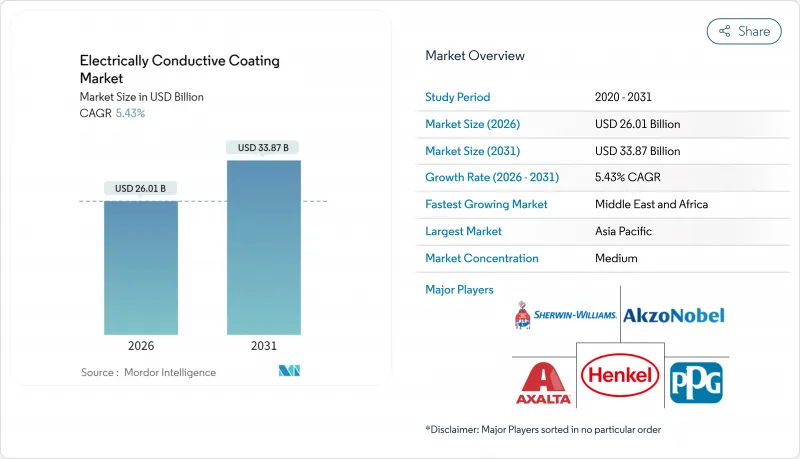
预计导电涂料市场将从 2025 年的 246.7 亿美元成长到 2026 年的 260.1 亿美元,到 2031 年将达到 338.7 亿美元,2026 年至 2031 年的复合年增长率为 5.43%。
导电涂层市场正从传统的防静电应用转向高附加价值的电磁干扰 (EMI) 屏蔽应用,以支援 5G 基础设施的部署和设备小型化。虽然银填充丙烯酸酯仍然是主流选择,但导电涂层市场目前更青睐铜基和聚氨酯基体系,因为它们在导电性、柔软性和成本方面实现了更好的平衡。亚太地区密集的电子产品供应链正在缩短采购週期,而北美和欧洲的原始设备製造商 (OEM) 则愿意为具有毫米波屏蔽、热稳定性和符合 REACH 法规的涂层支付更高的价格。随着特种材料製造商将奈米填料分散技术应用于从电池机壳到医疗植入等各种领域,竞争对手之间的竞争日益激烈,进一步扩大了导电涂层市场的机会。
全球导电涂布市场趋势与洞察
扩展抗静电应用
在半导体製造厂、无尘室和先进汽车组装线上,静电放电控制已成为一项关键任务要求,这推动了对既能保持表面电阻率又不增加体积的薄型防静电层的持续需求。与传统的炭黑填充系统相比,奈米碳管增强丙烯酸树脂具有更优异的耐磨性,从而延长了高流量生产区域的维护週期。汽车供应商正在透过对燃油模组和HVAC外壳(这些区域先前缺乏屏蔽要求)进行涂层处理,以响应2024年修订版IEC 61340测试通讯协定更为严格的合格标准。航太和医疗设备製造商正在指定使用低挥发性防静电薄膜来保护高价值电子产品在洲际运输过程中的安全,这使得静电控製成为设计要求,而非事后考虑。
来自电气和电子行业的需求不断增长
原始设备製造商 (OEM) 在 CAD 设计阶段将涂层融入产品设计,这使得导电涂层市场从主导转向工程主导型。柔性聚酰亚胺基板和陶瓷复合材料依靠喷涂涂层来贴合不规则形状的机壳。整合天线的物联网节点倾向于使用薄聚合物薄膜而非金属外壳,这要求供应商确保可预测的表面电阻,以防止阻抗不匹配。共同开发契约规定在原型製作阶段製程工程师必须协同办公,从而将材料专业知识融入消费性电子产品蓝图。
重金属填料的毒性和环境问题。
2024 年 REACH 法规附件 XVIII 的咨询将把三氧化二锑和氧化镉列为高度关注物质,这将迫使配方师转向石墨烯和奈米碳管体系,儘管它们的每公斤价格更高。一级汽车供应商正在利用生命週期评估来评估材料,尤其优先考虑那些报废后可回收的涂料。医疗和航太的买家现在要求供应商声明保证铅和汞不会进入混配过程,这增加了依赖金属薄片填充的传统生产线的审核负担。
细分市场分析
截至2025年,丙烯酸涂料在导电涂料市场中占比33.58%,这得益于强大的亚洲供应链以及符合区域空气品质法规的水性产品。聚氨酯涂料是成长引擎,其复合年增长率高达5.95%,这主要得益于电动车和穿戴式装置对弹性的依赖,以承受振动和弯曲。航太领域持续选用耐热温度高达200°C的高温环氧树脂,这一细分市场虽然稳定,但规模化发展较为罕见。
聚酯树脂可用于製造低成本的消费品外壳。硅胶树脂用于保护暴露于原子氧环境中的卫星,而氟聚合物则用于覆盖需要血液相容性的植入式导线。 ISO 9001通讯协定强调製程的可重复性,从而推动了在线连续电阻率扫描器的研发,该扫描器可对涂层的每一公尺检验。终端市场的多元化降低了丙烯酸树脂的易损性,而向柔性元件的转变则使聚氨酯成为导电涂层市场未来大规模生产的领导者。
区域分析
到2025年,亚太地区将占据导电涂层市场47.85%的份额,主要得益于中国消费性电子产品的出口和台湾晶圆代工厂产业的蓬勃发展。各地区政府正在补贴本地供应链,将前置作业时间时间缩短至数天。韩国的记忆体工厂正在采用与在线连续溅镀製程相容的涂层,而日本则在为高端混合动力汽车改进零VOC配方技术。北美也将占据相当大的市场份额,因为主要企业需要能够屏蔽雷达航电的涂层。欧洲正在推广无添加剂化学技术,以符合未来REACH法规的修订要求,并正努力将自身打造成为绿色配方中心。
中东和非洲地区预计将以5.75%的复合年增长率成长。这主要得益于阿联酋自由贸易区的优惠政策,这些政策吸引了专业电子代工。沙乌地阿拉伯正将导电涂层工厂集中到其「2030愿景」工业园区,旨在降低对进口的依赖。在南美洲,主要汽车製造商正将其生产基地从亚洲转移至其他地区,以分散风险,从而形成区域性汽车电子产品生产线,并创造在局部需求。
其他福利:
- Excel格式的市场预测(ME)表
- 3个月的分析师支持
目录
第一章 引言
- 研究假设和市场定义
- 调查范围
第二章调查方法
第三章执行摘要
第四章 市场情势
- 市场概览
- 市场驱动因素
- 扩大防静电保护应用
- 来自电气和电子行业的需求不断增长
- 5G基础设施中EMI/RFI屏蔽技术的快速应用
- 穿戴式电子设备的快速小型化
- 用于植入的导电生物相容性涂层的出现
- 市场限制
- 重金属填料的毒性与环境问题
- 白银和铜价格波动
- 奈米填料分散问题引起的缺陷
- 价值链分析
- 波特五力模型
- 新进入者的威胁
- 买方的议价能力
- 供应商的议价能力
- 替代品的威胁
- 竞争程度
第五章 市场规模与成长预测
- 按类型
- 丙烯酸树脂
- 环氧树脂
- 聚酯纤维
- 聚氨酯
- 其他类型
- 透过导电填料
- 铜
- 铝
- 银
- 其他材料类型
- 透过使用
- 电子电器设备
- 车
- 航太/国防
- 其他用途
- 按地区
- 亚太地区
- 中国
- 印度
- 日本
- 韩国
- 马来西亚
- 泰国
- 印尼
- 越南
- 亚太其他地区
- 北美洲
- 美国
- 加拿大
- 墨西哥
- 欧洲
- 德国
- 英国
- 法国
- 义大利
- 西班牙
- 俄罗斯
- 北欧国家
- 其他欧洲地区
- 南美洲
- 巴西
- 阿根廷
- 南美洲其他地区
- 中东和非洲
- 沙乌地阿拉伯
- 阿拉伯聯合大公国
- 埃及
- 南非
- 其他中东和非洲地区
- 亚太地区
第六章 竞争情势
- 市场集中度
- 策略趋势
- 市占率(%)/排名分析
- 公司简介
- A & A Coatings
- Akzo Nobel NV
- Ameetuff Technical Paints Industries
- Axalta Coating Systems
- BeDimensional
- CAIG
- Creative Materials Inc.
- Cromas Paints
- Gelest Inc.
- Henkel AG & Co. KGaA
- Holland Shielding Systems BV
- MG Chemicals
- Parker-Hannifin Corporation
- PPG Industries Inc.
- RS Coatings
- Specialty Coating Systems Inc.
- The Sherwin-Williams Company
第七章 市场机会与未来展望
The Electrically Conductive Coating market is expected to grow from USD 24.67 billion in 2025 to USD 26.01 billion in 2026 and is forecast to reach USD 33.87 billion by 2031 at 5.43% CAGR over 2026-2031.
The electrically conductive coating market is shifting from legacy anti-static roles to value-added electromagnetic interference (EMI) shielding, supporting 5G infrastructure rollouts and device miniaturization. Silver-filled acrylics remain the mainstream choice; however, the electrically conductive coating market now favors copper-based and polyurethane systems that strike a balance between conductivity, flexibility, and cost. Asia-Pacific's dense electronics supply chains keep procurement cycles short, while North American and European original equipment manufacturers (OEMs) pay premiums for coatings that deliver millimeter-wave shielding, thermal stability, and REACH compliance. Competitive rivalry intensifies as specialty materials firms bring nano-filler dispersion know-how to applications ranging from battery enclosures to medical implants, further widening the electrically conductive coating market opportunity.
Global Electrically Conductive Coating Market Trends and Insights
Rising Applications for Anti-Static Protection
Electrostatic discharge control has become mission-critical in semiconductor fabs, cleanrooms, and advanced vehicle assembly lines, driving sustained demand for thin anti-static layers that maintain surface resistivity without adding bulk. Carbon-nanotube-reinforced acrylics exhibit greater abrasion resistance than traditional carbon-black-filled systems, thereby extending maintenance intervals in high-traffic production zones. Automotive suppliers are now coating fuel modules and HVAC housings that previously had no shielding requirements, in response to a 2024 update of IEC 61340 test protocols that tightened pass-fail margins. Aerospace and medical device OEMs specify low-outgassing anti-static films to protect high-value electronics during transcontinental shipment, effectively making static control a default design parameter rather than a last-minute fix.
Growing Demand from Electrical and Electronics Industry
OEMs embed coatings into product architecture at the CAD stage, turning the electrically conductive coating market into an engineering-driven rather than procurement-driven purchase. Flexible polyimide boards and ceramic composites rely on spray-applied coatings that stretch with odd-shaped enclosures. IoT nodes with integrated antennas opt for thin polymeric films over metal cans to prevent detuning, prompting suppliers to ensure predictable surface impedance. Joint-development agreements now stipulate co-location of process engineers during pre-production, embedding material expertise inside consumer-electronics roadmaps.
Toxicity and Environmental Concerns of Heavy-Metal Fillers
REACH Annex XVIII consultations in 2024 flagged antimony trioxide and cadmium oxide as substances of very high concern, compelling formulators to pivot to graphene and carbon nanotube systems, despite higher per-kilogram prices. Automotive tier-1 suppliers utilize life-cycle assessments to evaluate materials, prioritizing coatings based on their recyclability at the end of life. Medical and aerospace buyers now request supplier declarations that no lead or mercury enters the formulation pipeline, adding audit overhead for legacy lines that still rely on metal-flake loading.
Other drivers and restraints analyzed in the detailed report include:
- Surge in Adoption of EMI/RFI Shielding in 5G Infrastructure
- Rapid Miniaturization in Wearable Electronics
- Volatility in Silver and Copper Prices
For complete list of drivers and restraints, kindly check the Table Of Contents.
Segment Analysis
Acrylics held a 33.58% share of the electrically conductive coating market in 2025, underpinned by robust Asian supply chains and waterborne grades that meet regional air-quality mandates. Polyurethanes are the growth engine, expanding at a 5.95% CAGR as electric vehicles and wearables rely on their elasticity to survive vibration and flexing. Aerospace continues to specify high-temperature epoxies rated to 200 °C, a niche that holds steady but rarely scales.
Polyester chemistries provide low-cost consumer cases. Silicones protect satellites exposed to atomic oxygen, while fluoropolymers cover implantable leads that require hemocompatibility. ISO 9001 protocols have emphasized process repeatability, resulting in inline resistivity scanners that validate every meter of coated film. End-market diversification insulates acrylics, yet the shift to flexible devices positions polyurethanes as the future volume leader within the electrically conductive coating market.
The Electrically Conductive Coating Market Report is Segmented by Type (Acrylics, Epoxy, Polyesters, Polyurethanes, and Other Types), Conductive Filler Material (Copper, Aluminum, Silver, and Other Material Types), Application (Electronics and Electrical, Automotive, Aerospace and Defense, and Other Applications), and Geography (Asia-Pacific, North America, and More). The Market Forecasts are Provided in Terms of Value (USD).
Geography Analysis
Asia-Pacific commanded 47.85% of the electrically conductive coating market in 2025, anchored by China's consumer-electronics exports and Taiwan's foundry complexes. Regional governments subsidize local supply chains, cutting logistics lead times to days. South Korea's memory fabs embrace in-line sputterable coatings, while Japan refines zero-VOC recipes for high-end hybrid vehicles. North America holds a significant share, where defense primes insist on coatings that shield radar avionics. Europe advances additive-free chemistries to comply with future REACH amendments, positioning itself as the hub for green formulations.
The Middle-East and Africa are projected to grow at a 5.75% CAGR, driven by the United Arab Emirates' free-zone incentives that attract contract electronics manufacturers. Saudi Arabia bundles conductive-coating plants into Vision 2030 industrial parks, thereby reducing its dependence on imports. South America sees localized automotive electronics lines as auto majors diversify beyond Asia for risk mitigation, creating pockets of regional demand.
- A & A Coatings
- Akzo Nobel NV
- Ameetuff Technical Paints Industries
- Axalta Coating Systems
- BeDimensional
- CAIG
- Creative Materials Inc.
- Cromas Paints
- Gelest Inc.
- Henkel AG & Co. KGaA
- Holland Shielding Systems BV
- MG Chemicals
- Parker-Hannifin Corporation
- PPG Industries Inc.
- RS Coatings
- Specialty Coating Systems Inc.
- The Sherwin-Williams Company
Additional Benefits:
- The market estimate (ME) sheet in Excel format
- 3 months of analyst support
TABLE OF CONTENTS
1 Introduction
- 1.1 Study Assumptions and Market Definition
- 1.2 Scope of the Study
2 Research Methodology
3 Executive Summary
4 Market Landscape
- 4.1 Market Overview
- 4.2 Market Drivers
- 4.2.1 Rising applications for anti-static protection
- 4.2.2 Growing demand from electrical and electronics industry
- 4.2.3 Surge in adoption of EMI/RFI shielding in 5G infrastructure
- 4.2.4 Rapid miniaturization in wearable electronics
- 4.2.5 Emergence of conductive bio-compatible coatings for implants
- 4.3 Market Restraints
- 4.3.1 Toxicity and environmental concerns of heavy-metal fillers
- 4.3.2 Volatility in silver and copper prices
- 4.3.3 Dispersion challenges of nano-fillers causing defects
- 4.4 Value Chain Analysis
- 4.5 Porter's Five Forces
- 4.5.1 Threat of New Entrants
- 4.5.2 Bargaining Power of Buyers
- 4.5.3 Bargaining Power of Suppliers
- 4.5.4 Threat of Substitute Products
- 4.5.5 Degree of Competition
5 Market Size and Growth Forecasts (Value)
- 5.1 By Type
- 5.1.1 Acrylics
- 5.1.2 Epoxy
- 5.1.3 Polyesters
- 5.1.4 Polyurethanes
- 5.1.5 Other Types
- 5.2 By Conductive Filler Material
- 5.2.1 Copper
- 5.2.2 Aluminum
- 5.2.3 Silver
- 5.2.4 Other Material Types
- 5.3 By Application
- 5.3.1 Electronics and Electrical
- 5.3.2 Automotive
- 5.3.3 Aerospace and Defense
- 5.3.4 Other Applications
- 5.4 By Geography
- 5.4.1 Asia-Pacific
- 5.4.1.1 China
- 5.4.1.2 India
- 5.4.1.3 Japan
- 5.4.1.4 South Korea
- 5.4.1.5 Malaysia
- 5.4.1.6 Thailand
- 5.4.1.7 Indonesia
- 5.4.1.8 Vietnam
- 5.4.1.9 Rest of Asia-Pacific
- 5.4.2 North America
- 5.4.2.1 United States
- 5.4.2.2 Canada
- 5.4.2.3 Mexico
- 5.4.3 Europe
- 5.4.3.1 Germany
- 5.4.3.2 United Kingdom
- 5.4.3.3 France
- 5.4.3.4 Italy
- 5.4.3.5 Spain
- 5.4.3.6 Russia
- 5.4.3.7 NORDIC Countries
- 5.4.3.8 Rest of Europe
- 5.4.4 South America
- 5.4.4.1 Brazil
- 5.4.4.2 Argentina
- 5.4.4.3 Rest of South America
- 5.4.5 Middle-East and Africa
- 5.4.5.1 Saudi Arabia
- 5.4.5.2 United Arab Emirates
- 5.4.5.3 Egypt
- 5.4.5.4 South Africa
- 5.4.5.5 Rest of Middle-East and Africa
- 5.4.1 Asia-Pacific
6 Competitive Landscape
- 6.1 Market Concentration
- 6.2 Strategic Moves
- 6.3 Market Share(%)/Ranking Analysis
- 6.4 Company Profiles (includes Global level Overview, Market level overview, Core Segments, Financials as available, Strategic Information, Market Rank/Share for key companies, Products and Services, and Recent Developments)
- 6.4.1 A & A Coatings
- 6.4.2 Akzo Nobel NV
- 6.4.3 Ameetuff Technical Paints Industries
- 6.4.4 Axalta Coating Systems
- 6.4.5 BeDimensional
- 6.4.6 CAIG
- 6.4.7 Creative Materials Inc.
- 6.4.8 Cromas Paints
- 6.4.9 Gelest Inc.
- 6.4.10 Henkel AG & Co. KGaA
- 6.4.11 Holland Shielding Systems BV
- 6.4.12 MG Chemicals
- 6.4.13 Parker-Hannifin Corporation
- 6.4.14 PPG Industries Inc.
- 6.4.15 RS Coatings
- 6.4.16 Specialty Coating Systems Inc.
- 6.4.17 The Sherwin-Williams Company
7 Market Opportunities and Future Outlook
- 7.1 White-space and Unmet-Need Assessment


