


 |
市场调查报告书
商品编码
1906190
氧气:市场占有率分析、产业趋势与统计、成长预测(2026-2031)Oxygen - Market Share Analysis, Industry Trends & Statistics, Growth Forecasts (2026 - 2031) |
||||||

※ 本网页内容可能与最新版本有所差异。详细情况请与我们联繫。
预计氧气市场将从 2025 年的 8,793 万吨增长到 2026 年的 9,192 万吨,到 2031 年将达到 1.1468 亿吨,2026 年至 2031 年的复合年增长率为 4.53%。
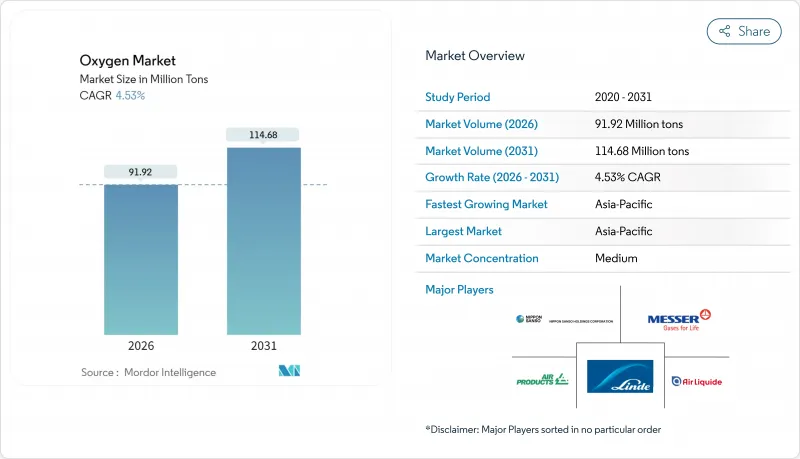
亚太地区钢铁产量的成长、医院基础设施的现代化以及半导体级气体产能的扩张正在推动市场扩张。先进晶片製造对超高纯度氢气的需求以及清洁氢能计划的拓展,正在开闢新的收入来源;同时,低温空气分离装置能源效率的提升,也使生产商能够维持利润率。寡占的供应结构有利于合理的定价和长期合约的签订,从而为现有企业提供可预测的现金流。
全球氧气市场趋势与洞察
急性和慢性呼吸系统疾病呈上升趋势
随着人口老化,慢性阻塞性肺病(COPD)、气喘和老龄化相关肺部疾病的发生率不断上升,医疗保健系统面临越来越大的压力。医用氧气是首选治疗方法,随着医院转向更早出院和居家呼吸护理,其需求量也不断增加。携带式製氧机和液体氧气输送系统能够维持患者的活动能力,从而支持护理的连续性并减少再入院率。旨在稳定中低收入国家氧气供应的投资正在释放巨大的市场潜力,并鼓励设备供应商实现生产和培训计画的在地化。政府和慈善机构的资金正在填补采购缺口,并加速变压吸附(PSA)制氧机和製氧机的普及应用。
亚洲钢铁和非铁金属产量成长
亚太地区钢铁产能的扩张支撑了对散装氧气的需求,即便中国正在关闭低效率的钢铁厂。电弧炉和氢基直接还原製程每吨钢铁消费量的氧气量高于传统高炉工艺,从而提高了氧气的使用强度。向越南和印度地域多角化降低了单一国家的风险,并鼓励投资建造新的空气分离产能。西澳大利亚新发现的铁矿石拓宽了矿石供应前景,而印尼和智利铝铜产量的增加扩大了非铁金属的需求丛集。随着生产商采用富氧燃烧来提高炉子效率并减少碳排放,氧气市场保持着强劲的成长势头。
低温分离器能耗高
电力是空气分离装置最大的营运成本,欧洲和亚洲部分地区的电价飙升正给利润率带来压力。生产商透过多年期购电协议进行部分对冲,但对现货市场的依赖加剧了价格波动。製程控制维修和余热回收可以逐步提高效率,但需要大量资本投入才能节省少量成本。一些营运商正在考虑建造可再生能源发电发电厂以缓解石化燃料价格波动,但间歇性仍然是一项挑战。如果客户抵制频繁的价格变动,能源成本转嫁条款的缓解作用有限。
细分市场分析
儘管液态氧的市占率相对小规模,但预计其成长速度将最快,2026年至2031年的复合年增长率将达到4.62%。大批量用户优先考虑能够将低温运输转化为现场不间断气体供应的膨胀比,从而显着减少卡车运输和缓衝罐的面积。对隔热ISO容器和配备遥测功能的车队管理系统的投资,可以减少蒸发损失并提高配送效率。医院和区域供应中心正在部署微型液化装置,以缩短最终配送路线,并在供应中断的情况下增强业务永续营运。不断发展的法规结构,例如美国食品药物管理局(FDA)的标籤规则,正在优先考虑压力容器的安全性和可追溯性。
然而,在大型空分装置附近钢铁、玻璃和化工产业丛集的管道网路的支持下,天然气供应在2025年仍将维持87.62%的市场份额。连续流用户重视管路连接的便捷性,这消除了现场储存的风险。这使得签订长期合约成为可能,资金筹措,并巩固了现有企业的地位。由于处理过程复杂,固体氧目前仍仅限于航太测试和低温研究领域。在预测期内,整合液态氧生产、高压管束拖车和现场真空变压吸附装置的多产品枢纽有望扩大氧气市场,因为供应商可以根据客户的规模和纯度需求量身定制供应。
氧气市场报告按形态(气体、液体、固体)、用途(医疗和工业)、应用领域(金属和采矿、化学、石油和天然气、医药、其他)以及地区(亚太、北美、欧洲、南美、中东和非洲)进行细分。市场预测以吨为单位。
区域分析
预计到2025年,亚太地区将占据全球氧气市场41.45%的份额,并在2031年之前以5.41%的复合年增长率成长。印度、越南和印尼钢铁及非铁金属产能的扩张,以及韩国和台湾半导体超大型晶圆厂的建设,构成了该地区的主要需求丛集。政府主导的医院改造将推动液态医用氧的消耗,而对绿色氢能试点计画的补贴将支持未来氧气需求的成长。新加坡即将于2025年生效的《化学品储存条例》修订案等地方监管倡议,正促使供应商对其物流资产进行现代化改造,从而提高安全性并实现市场专业化。
欧洲对工业脱碳的重视正在推动氧燃料技术和氢能直接还原生产线的发展。欧盟修订后的臭氧消耗物质(ODS)法规正在加强向更环保的製程气体的转型,间接推动了对高纯度氧气的需求。医疗保健系统正在转向居家慢性病照护模式,携带式製氧机的使用范围也不断扩大。北美仍然是主要的消费市场,充分利用了现有的管道网络和墨西哥湾沿岸不断发展的蓝氢枢纽。空气产品公司在密苏里州扩大膜分离解决方案的规模,显示该公司对氮气和沼气领域的互补机会充满信心,这两个领域与氧气共用基础设施。
在拉丁美洲和非洲,对医院和采矿业的投资正在加速成长。巴西对汽车用钢的需求以及智利铜冶炼厂的需求支撑着南美洲稳定的氧气需求,而尼日利亚、肯亚和埃及不断扩大的医疗保健资金则推动了变压吸附(PSA)装置的建设。在中东,国有能源公司正在推广碳捕获和提高石油采收率(EOR)技术,该技术需要注入氧气,这改变了该地区传统的炼油模式。这些趋势正在巩固氧气市场地域分布的多元化基础。
其他福利:
- Excel格式的市场预测(ME)表
- 3个月的分析师支持
目录
第一章 引言
- 研究假设和市场定义
- 调查范围
第二章调查方法
第三章执行摘要
第四章 市场情势
- 市场概览
- 市场驱动因素
- 急性和慢性呼吸系统疾病发生率上升
- 亚洲钢铁和非铁金属产量成长
- 专用氢气生产及氧气燃料计划扩建
- 新兴市场医院向PSA微型工厂转型
- 先进节点半导体对超高纯度氧气的需求
- 市场限制
- 低温分离器的高耗能
- 替代切割/燃料气体(液化石油气、乙炔)的可用性
- 全球大型低温油轮短缺
- 价值链分析
- 波特五力模型
- 供应商的议价能力
- 买方的议价能力
- 新进入者的威胁
- 替代品的威胁
- 竞争程度
第五章 市场规模与成长预测
- 按形式
- 气体
- 液体
- 固体的
- 按类型
- 医疗保健
- 产业
- 透过使用
- 金属和采矿
- 化工
- 石油和天然气
- 卫生保健
- 製药
- 其他用途
- 按地区
- 亚太地区
- 中国
- 印度
- 日本
- 韩国
- ASEAN
- 亚太其他地区
- 北美洲
- 美国
- 加拿大
- 墨西哥
- 欧洲
- 德国
- 英国
- 法国
- 义大利
- 西班牙
- 其他欧洲地区
- 南美洲
- 巴西
- 阿根廷
- 其他南美洲
- 中东和非洲
- 沙乌地阿拉伯
- 南非
- 其他中东和非洲地区
- 亚太地区
第六章 竞争情势
- 市场集中度
- 策略性倡议(併购、合资、合约)
- 市占率(%)/排名分析
- 公司简介
- Air Liquide
- Air Products and Chemicals, Inc.
- AIR WATER INC
- Axcel Gases
- Gruppo SIAD
- Guangdong Huate Gas Co., Ltd.
- Gulfcryo
- Hangzhou Oxygen Group Co., Ltd.
- INOX-Air Products Inc.
- International Industrial Gases Ltd
- Iwatani Corporation
- Linde PLC
- Messer SE & Co. KGaA
- NIPPON SANSO HOLDINGS CORPORATION
- Sauerstoffwerk Friedrichshafen GmbH
- SOL Spa
- Steelman Gases Pvt. Ltd.
- Yingde Gas Shanghai
第七章 市场机会与未来展望
The Oxygen Market is expected to grow from 87.93 million tons in 2025 to 91.92 million tons in 2026 and is forecast to reach 114.68 million tons by 2031 at 4.53% CAGR over 2026-2031.
Growing steel output in the Asia-Pacific, modernization of hospital infrastructure, and capacity additions for semiconductor-grade gases collectively underpin expansion. Ultra-high-purity demand in advanced-node chip fabrication and the build-out of clean-hydrogen projects are opening new revenue streams, while energy-efficiency upgrades in cryogenic air-separation units help producers defend margins. The oligopolistic supply structure supports rational pricing and long-term contracts, giving incumbents predictable cash flows.
Global Oxygen Market Trends and Insights
Rising incidence of acute and chronic respiratory disorders
Healthcare systems face mounting pressure as COPD, asthma, and age-related lung diseases grow alongside aging populations. Medical oxygen is a frontline therapy, and demand intensifies when hospitals pivot toward early discharge and home-based respiratory care. Portable concentrators and liquid portable systems help patients remain mobile, supporting adherence to therapy and reducing readmissions. Investments targeting uninterrupted oxygen supply in low- and middle-income nations unlock a sizeable addressable market, prompting equipment suppliers to localize production and training programs. Government and philanthropic financing bridge procurement gaps, accelerating the diffusion of PSA plants and concentrators.
Steel and non-ferrous metal production growth in Asia
Asia-Pacific's broadening steel capacity sustains bulk oxygen off-take, even as China retires inefficient mills. Electric-arc and hydrogen-based direct-reduction routes consume more oxygen per ton than the legacy blast-furnace process, raising intensity of use. Regional diversification toward Vietnam and India reduces single-country risk and stimulates greenfield air-separation investments. New iron-ore discoveries in Western Australia lengthen ore supply horizons, while rising aluminum and copper output in Indonesia and Chile expands non-ferrous demand clusters. Producers deploy oxy-fuel combustion to lift furnace efficiency and cut carbon emissions, keeping the oxygen market on a positive growth curve.
High electricity cost of cryogenic separation units
Power is the single largest operating expense in air-separation plants, and price surges in Europe and parts of Asia squeeze profit margins. Producers hedge partially via multi-year power purchase agreements, but spot-market exposure amplifies volatility. Process-control retrofits and waste-heat recovery deliver incremental efficiency gains yet require capital for modest savings. Some operators explore renewable-powered plants to shield against fossil-fuel price swings, although intermittency challenges persist. Energy-cost pass-through clauses provide limited relief when customers resist frequent price revisions.
Other drivers and restraints analyzed in the detailed report include:
- Expansion of on-purpose hydrogen and oxy-fuel projects
- Hospital shift to PSA micro-plants in emerging markets
- Availability of alternate cutting/fuel gases (LPG, acetylene)
For complete list of drivers and restraints, kindly check the Table Of Contents.
Segment Analysis
Liquid oxygen held a comparatively smaller share but recorded the swiftest trajectory, advancing at a 4.62% CAGR between 2026 and 2031. Bulk consumers value the expansion ratio that turns cryogenic deliveries into an uninterrupted gaseous supply on site, slashing truck movements and buffer-tank footprints. Investments in insulated ISO containers and telemetry-enabled fleet management shrink boil-off losses, raising distribution efficiency. Hospitals and regional supply depots deploy micro-liquefiers to shorten last-mile routes, enhancing business resilience during supply disruption events. Advancing regulatory frameworks, such as the United States Food and Drug Administration's labeling rule, prioritize safety and traceability for pressurized vessels.
Gaseous supply nonetheless retained an 87.62% foothold in 2025, backed by pipeline networks serving steel, glass, and chemical clusters adjacent to large air-separation complexes. Continuous-flow users prize the simplicity of pipeline ties that remove onsite storage risks. The resulting long-term contracts underpin financing for new plants, cementing the incumbents' presence. Solid oxygen remains confined to aerospace tests and cryogenic research owing to handling complexities. Over the forecast horizon, multiproduct hubs incorporating liquid production, high-pressure tube trailers, and onsite vacuum swing adsorbers will help vendors tailor supply modes to customer scale and purity needs, expanding the oxygen market.
The Oxygen Market Report is Segmented by Form (Gas, Liquid, and Solid), Type (Medical and Industrial), Application (Metals and Mining, Chemical Industry, Oil and Gas, Healthcare, Pharmaceutical, and Other Applications), and Geography (Asia-Pacific, North America, Europe, South America, and Middle-East and Africa). The Market Forecasts are Provided in Terms of Volume (Tons).
Geography Analysis
Asia-Pacific commanded 41.45% oxygen market share in 2025 and is positioned to grow at a 5.41% CAGR to 2031. Expanding steel and non-ferrous capacities in India, Vietnam, Indonesia, and semiconductor mega-fabs in South Korea and Taiwan, anchor regional demand clusters. Government-mandated hospital upgrades drive liquid-medical-oxygen consumption, while subsidies for green-hydrogen pilots boost future oxygen off-take. Local regulators, such as Singapore's revised chemical-storage rules effective 2025, compel suppliers to modernize logistics assets, enhancing safety and market professionalism.
Europe focuses on industrial decarbonization, fostering oxy-fuel initiatives and hydrogen-ready direct-reduction lines. The European Union's updated ozone-depleting-substances regulation reinforces the switch to environment-friendly processing gases, indirectly favoring high-purity oxygen. Healthcare systems shift toward home-based chronic-care models, broadening use of portable concentrators. North America remains a sizeable consumer, leveraging embedded pipeline grids and ramp-ups in blue-hydrogen hubs along the Gulf Coast. Air Products' Missouri membrane-solutions expansion illustrates supplier confidence in complementary nitrogen and biogas opportunities that share infrastructure with oxygen.
Latin America and Africa register accelerating hospital and mining investments. Brazil's automotive steel demand and Chile's copper smelters channel steady oxygen flows in South America, while healthcare-funding expansions in Nigeria, Kenya, and Egypt incentivize PSA plant deployments. In the Middle East, state-owned energy companies pursue carbon-capture and enhanced-oil-recovery schemes requiring oxygen injection, offsetting the region's historical concentration on conventional refining. Collectively, these dynamics keep the oxygen market firmly on a diversified regional footing.
- Air Liquide
- Air Products and Chemicals, Inc.
- AIR WATER INC
- Axcel Gases
- Gruppo SIAD
- Guangdong Huate Gas Co., Ltd.
- Gulfcryo
- Hangzhou Oxygen Group Co., Ltd.
- INOX-Air Products Inc.
- International Industrial Gases Ltd
- Iwatani Corporation
- Linde PLC
- Messer SE & Co. KGaA
- NIPPON SANSO HOLDINGS CORPORATION
- Sauerstoffwerk Friedrichshafen GmbH
- SOL Spa
- Steelman Gases Pvt. Ltd.
- Yingde Gas Shanghai
Additional Benefits:
- The market estimate (ME) sheet in Excel format
- 3 months of analyst support
TABLE OF CONTENTS
1 Introduction
- 1.1 Study Assumptions and Market Definition
- 1.2 Scope of the Study
2 Research Methodology
3 Executive Summary
4 Market Landscape
- 4.1 Market Overview
- 4.2 Market Drivers
- 4.2.1 Rising incidence of acute and chronic respiratory disorders
- 4.2.2 Steel and non-ferrous metal production growth in Asia
- 4.2.3 Expansion of on-purpose hydrogen and oxy-fuel projects
- 4.2.4 Hospital shift to PSA micro-plants in emerging markets
- 4.2.5 Ultra-high-purity O2 demand from advanced-node semiconductors
- 4.3 Market Restraints
- 4.3.1 High electricity cost of cryogenic separation units
- 4.3.2 Availability of alternate cutting/fuel gases (LPG, acetylene)
- 4.3.3 Global shortage of large-bore cryogenic tankers
- 4.4 Value Chain Analysis
- 4.5 Porter's Five Forces
- 4.5.1 Bargaining Power of Suppliers
- 4.5.2 Bargaining Power of Buyers
- 4.5.3 Threat of New Entrants
- 4.5.4 Threat of Substitutes
- 4.5.5 Degree of Competition
5 Market Size and Growth Forecasts (Volume)
- 5.1 By Form
- 5.1.1 Gas
- 5.1.2 Liquid
- 5.1.3 Solid
- 5.2 By Type
- 5.2.1 Medical
- 5.2.2 Industrial
- 5.3 By Application
- 5.3.1 Metals and Mining
- 5.3.2 Chemical Industry
- 5.3.3 Oil and Gas
- 5.3.4 Healthcare
- 5.3.5 Pharmaceutical
- 5.3.6 Other Applications
- 5.4 By Geography
- 5.4.1 Asia-Pacific
- 5.4.1.1 China
- 5.4.1.2 India
- 5.4.1.3 Japan
- 5.4.1.4 South Korea
- 5.4.1.5 ASEAN
- 5.4.1.6 Rest of Asia-Pacific
- 5.4.2 North America
- 5.4.2.1 United States
- 5.4.2.2 Canada
- 5.4.2.3 Mexico
- 5.4.3 Europe
- 5.4.3.1 Germany
- 5.4.3.2 United Kingdom
- 5.4.3.3 France
- 5.4.3.4 Italy
- 5.4.3.5 Spain
- 5.4.3.6 Rest of Europe
- 5.4.4 South America
- 5.4.4.1 Brazil
- 5.4.4.2 Argentina
- 5.4.4.3 Rest of South America
- 5.4.5 Middle-East and Africa
- 5.4.5.1 Saudi Arabia
- 5.4.5.2 South Africa
- 5.4.5.3 Rest of Middle-East and Africa
- 5.4.1 Asia-Pacific
6 Competitive Landscape
- 6.1 Market Concentration
- 6.2 Strategic Moves (Mergers and Acquisitions, JVs, Agreements)
- 6.3 Market Share (%)/Ranking Analysis
- 6.4 Company Profiles (includes Global level Overview, Market level overview, Core Segments, Financials as available, Strategic Information, Market Rank/Share, Products and Services, Recent Developments)
- 6.4.1 Air Liquide
- 6.4.2 Air Products and Chemicals, Inc.
- 6.4.3 AIR WATER INC
- 6.4.4 Axcel Gases
- 6.4.5 Gruppo SIAD
- 6.4.6 Guangdong Huate Gas Co., Ltd.
- 6.4.7 Gulfcryo
- 6.4.8 Hangzhou Oxygen Group Co., Ltd.
- 6.4.9 INOX-Air Products Inc.
- 6.4.10 International Industrial Gases Ltd
- 6.4.11 Iwatani Corporation
- 6.4.12 Linde PLC
- 6.4.13 Messer SE & Co. KGaA
- 6.4.14 NIPPON SANSO HOLDINGS CORPORATION
- 6.4.15 Sauerstoffwerk Friedrichshafen GmbH
- 6.4.16 SOL Spa
- 6.4.17 Steelman Gases Pvt. Ltd.
- 6.4.18 Yingde Gas Shanghai
7 Market Opportunities and Future Outlook
- 7.1 White-space and Unmet-need Assessment

 工业氧气市场分析及预测(至2035年):类型、产品类型、应用、技术、最终用户、组件、部署形式、製程、安装类型
 2026年全球氧气市场报告
 氧气市场-全球产业规模、份额、趋势、机会、预测:按形态、应用、地区和竞争格局划分,2021-2031年
 工业氧气市场按类型、纯度等级、生产方法、应用和通路划分-2026-2032年全球预测高速氧燃料喷射服务市场按服务类型、设备类型、涂层材料、应用和最终用途产业划分-2026-2032年全球预测
 日本鳕鱼市场报告(按品种(大西洋鳕鱼、太平洋鳕鱼、格陵兰鳕鱼及其他)、来源(养殖、野生捕捞)、产品类型(鲜、罐装、冷冻及其他)、配销通路(机构、零售)和地区划分,2026-2034年)
 工业氧气市场规模、份额和成长分析(按产品类型、氧气纯度、形态、用途、应用、最终用户和地区划分)-2026-2033年产业预测
 全球包装氧气市场:预测(2025-2030)
 高速氧燃料(HVOF)炭化钨(WC)涂料市场:全球产业分析,规模,占有率,成长,趋势,预测,2024年~2033年
 化学需氧量分析仪市场报告:2030 年趋势、预测与竞争分析